


Ulster Volunteer Force

Encyclopedia
The Ulster Volunteer Force (UVF) is a loyalist
paramilitary
group in Northern Ireland
. It was formed in late 1965 or early 1966 and named after the Ulster Volunteer Force of 1913. The group's volunteers
undertook an armed campaign
of almost thirty years during The Troubles
. It declared a ceasefire
in 1994, although sporadic attacks continued until it officially ended its armed campaign in May 2007.
The UVF's declared goal was to combat Irish republicanism
, particularly republican paramilitaries
. The vast majority (more than two-thirds) of its 481 known victims were Catholic
civilians. During the conflict, its deadliest attack in Northern Ireland was the McGurk's Bar bombing
, which killed fifteen civilians. The group also carried out some attacks in the Republic of Ireland
, the most deadly of which were the Dublin and Monaghan bombings
which killed 33 civilians, the highest number of deaths in a single day during the conflict. The no-warning car bombings had been carried out by units from the Belfast and Mid-Ulster Brigades
.
The group is a designated terrorist organisation in the United Kingdom and United States and a proscribed organisation
in the Republic of Ireland.
and known as the Brigade Staff. It comprises high-ranking officers under a Chief of Staff or Brigadier-General. With a few exceptions, such as Mid-Ulster brigadier Billy Hanna
(a native of Lurgan
), the Brigade Staff members have been from the Shankill Road or the neighbouring Woodvale area to the west. The Brigade Staff's former headquarters were situated in rooms above "The Eagle" chip shop located on the Shankill Road at its junction with Spier's Place. The chip shop has since been closed down.
In 1972, the UVF's imprisoned leader Gusty Spence
was at liberty for four months following a staged kidnapping by UVF volunteers. During this time he restructured the organisation into brigades, battalions, companies, platoons and sections. These were all subordinate to the Brigade Staff. The incumbent Chief of Staff, referred to by Martin Dillon as "Mr. F", has held the position since he assumed office in 1976.
The UVF's nickname is "Blacknecks", derived from their uniform of black polo neck jumper, black trousers, black leather jacket, black forage cap, along with the UVF badge and belt. This uniform, based on those of the original UVF, was introduced in the early 1970s.
Its motto is "For God and Ulster".
– particularly the Provisional Irish Republican Army
(IRA) – and maintain Northern Ireland's status as part of the United Kingdom. Most of its victims were Irish Catholic
civilian
s, who were often chosen at random. Whenever it claimed responsibility for its attacks, the UVF usually claimed that those targeted were IRA members or IRA sympathisers. Other times, attacks on Catholic civilians were claimed as "retaliation" for IRA actions, since the IRA drew most of its support from the Catholic community. Such retaliation was seen as both collective punishment
and an attempt to weaken the IRA's support; it was thought that 'fear of retaliation' would make the Catholic community rein in the IRA. Many retaliatory attacks on Catholics were claimed using the covername "Protestant Action Force" (PAF).
Like the Ulster Defence Association
(UDA), the UVF's modus operandi
involved assassinations, mass shootings, bombings and kidnappings. It used sub machine-guns
, assault rifles, pistol
s, grenade
s (including homemade grenades), incendiary bombs, booby trap
bombs and car bomb
s. Bomb attacks were usually made without warning. They always signed their statements with the fictitious name "Captain William Johnston, UVF Chief of Staff". Like other loyalist paramilitaries, most UVF operations were gun attacks rather than bombings.
— when Irish republicans
seized key buildings in Dublin and declared an independent Irish Republic
. On 8 March 1966, a group of ex-Irish Republican Army
(IRA) volunteers planted a bomb that destroyed Nelson's Pillar
in Dublin. On 17 April, large republican parades took place in Belfast
to mark the anniversary. Some unionists
and loyalists
feared there would be a "revival" of the IRA. Since 1964 there had also been a growing campaign for equality reforms in Northern Ireland. This was led by groups like Campaign for Social Justice
(CSJ), which became the Northern Ireland Civil Rights Association
(NICRA). They sought to end the discrimination suffered by Catholics in housing, employment and through gerrymandering
. Prime Minister
Terence O'Neill was willing to accept some of the demands. The unionists, who were overwhelmingly Protestant
, feared losing their grip on power.
On 7 May, a group of loyalists led by Gusty Spence petrol bombed a Catholic-owned pub on the loyalist Shankill Road, Belfast. The ensuing fire swept to the house next door, killing the elderly Protestant widow who lived there. Spence, a former British soldier, was from the Shankill Road. On 21 May, the group (calling itself the "Ulster Volunteer Force") issued a statement:
On 27 May, four UVF men were sent to kill an IRA volunteer
, Leo Martin, who lived on Falls Road. Unable to find their target, the men drove around in search of a Catholic. They shot dead John Scullion, a civilian, as he walked home. Spence later wrote "At the time, the attitude was that if you couldn't get an IRA man you should shoot a Taig
, he's your last resort".
On 26 June, the group shot dead a Catholic civilian and wounded two others as they left a pub on Malvern Street, Belfast. Two days later, the government of Northern Ireland
declared the UVF illegal. The shootings led to Spence being arrested and sentenced to life imprisonment with a recommended minimum sentence of twenty years. Spence appointed Samuel McClelland
as UVF Chief of Staff in his stead.
In 1969, the UVF took part in a string of bomb attacks on electricity and water installations in Northern Ireland. It was hoped that this would be blamed on the IRA and halt the equality reforms promised by Terence O'Neill. These reforms would have ended discrimination against Catholics. The attacks were carried out with help from the short-lived Ulster Protestant Volunteers
(UPV), another loyalist paramilitary group. The UPV was the paramilitary wing of the Ulster Constitution Defence Committee
, founded by Ian Paisley
. Many of those involved were members of both groups. There were bombings on 30 March, 4 April, 20 April, 24 and 26 April.
On 12 August 1969, the "Battle of the Bogside
" began in Derry
. The rioting spread throughout Northern Ireland
. This is generally seen as the beginning of "the Troubles
". As violence between loyalists and republicans grew, the UVF began a campaign of attacks on both republicans and (more often) Catholic civilians.
in the New Lodge
area of Belfast on 4 December 1971, which killed fifteen Catholic civilians. The attack was initially blamed on republican paramilitaries by the authorities and media but the UVF later admitted responsibility. On 23 October 1972, the UVF carried out an armed raid against King's Park camp, a UDR/Territorial Army
depot in Lurgan. They managed to procure a large cache of weapons and ammunition including self-loading rifles, Browning pistols, and Sterling submachine guns. Twenty tons of ammonium nitrate was also stolen from the Belfast docks.
Two UVF units from the Belfast and the Mid-Ulster brigades
were responsible, allegedly with help from former and serving members of the Ulster Defence Regiment
(UDR) and British Intelligence, for the bombs
in Dublin and Monaghan
of 17 May 1974 when thirty-three people were killed and close to 300 injured. The 2003 Barron Report, however, concluded that the Monaghan bombing was perpetrated solely by the Mid-Ulster Brigade.
, who then passed the leadership to Billy Wright
. Hanna and Jackson have both been implicated by journalist Joe Tiernan, and RUC Special Patrol Group
(SPG) officer John Weir
as having led one of the units that bombed Dublin. Jackson was allegedly the hitman who shot Hanna dead outside his home in Lurgan, and subsequently took over his command.
The brigade formed part of the Glenanne gang
, a loose alliance of loyalist assassins which the Pat Finucane Centre
has linked to 87 killings in the 1970s. The gang comprised, in addition to the UVF, rogue elements of the UDR, RUC, SPG, and the regular Army, all acting allegedly under the direction of British Military Intelligence and/or RUC Special Branch
.
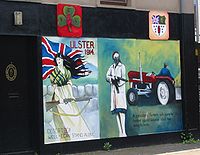 In 1974, hardliners staged a coup and took over the Brigade Staff. This resulted in a lethal upsweep of sectarian killings and internecine feuding with both the UDA and within the UVF itself. Some of the new Brigade Staff members bore nicknames such as "Big Dog" and "Smudger".
The UVF's Mid-Ulster Brigade carried out further attacks during this same period. These included the Miami Showband killings
of 31 July 1975 — when three members of the popular showband
from the Republic of Ireland were killed having been stopped at a fake British Army checkpoint outside of Newry
in County Down
. Two members of the group survived the attack and later testified against those responsible. Two UVF members, Harris Boyle
and Wesley Somerville
, were accidentally killed by their own bomb while carrying out this attack. Two of those later convicted (James McDowell and Thomas Crozier) were also serving members of the Ulster Defence Regiment (UDR), a part-time, locally recruited regiment of the British Army
.
From late 1975 to mid-1977, a unit of the UVF dubbed the Shankill Butchers
(a group of UVF men based on Belfast's Shankill Road) carried out a series of sectarian murders of Catholic civilians. Six of the victims were abducted at random, then beaten and tortured before having their throats slashed. This gang was led by Lenny Murphy
. He was shot dead by the IRA in November 1982, four months after his release from the Maze Prison.
The group had been proscribed in July 1966, but this ban was lifted on 4 April 1974 by Merlyn Rees, Secretary of State for Northern Ireland
, in an effort to bring the UVF into the democratic process. A political wing was formed in June 1974, the Volunteer Political Party
led by UVF Chief of Staff Ken Gibson, which contested West Belfast
in the October 1974 General Election
, polling 2,690 votes (6%). The UVF spurned the government efforts however and continued killing. Colin Wallace
, part of the intelligence apparatus of the British Army, asserted in an internal memo in 1975 that MI6 and RUC Special Branch formed a pseudo-gang within the UVF, designed to engage in violence and to subvert moves of the UVF towards the political process. Captain Robert Nairac
of 14 Intelligence Company
was alleged to have been involved in many acts of UVF violence. The UVF was banned again on 3 October 1975 and two days later twenty-six suspected UVF members were arrested in a series of raids. The men were tried and in March 1977 were sentenced to an average of twenty-five years each.
In October 1975, after staging a counter-coup, the Brigade Staff acquired a new leadership of moderates with Tommy West serving as the Chief of Staff. These men had overthrown the "hawkish" officers, who had called for a "big push", which meant an increase in violent attacks, earlier in the same month. In fact, the UVF was behind the deaths of seven civilians in a series of attacks on 2 October. The hawks had been ousted by those in the UVF who were unhappy with their political and military strategy. The new Brigade Staff's aim was to carry out attacks against known republicans rather than Catholic civilians. This had been thoroughly endorsed by Gusty Spence who issued a statement asking all UVF volunteers to support the new regime.The UVF's activities in the last years of the decade were increasingly being curtailed by the number of UVF members who were sent to prison. Indeed, the number of killings in Northern Ireland had decreased from 300 per year during the period between 1973 and 1976 to just under 100 in the years 1977-1981. In 1976, Tommy West was replaced with "Mr. F", who is the incumbent Chief of Staff as of 2011. West died in 1980.
s. The damage from security service informers started in 1983 with "supergrass"
Joseph Bennett's information which led to the arrest of fourteen senior figures. In 1984, they attempted to kill the northern editor of the Sunday World
, Jim Campbell after he had exposed the paramiltary activities of Mid-Ulster brigadier Robin Jackson. By the mid 1980s, a Loyalist paramilitary-style organisation called Ulster Resistance
was formed on 10 November 1986 by Ian Paisley
, then leader of the Democratic Unionist Party
(DUP), Peter Robinson
of the DUP, and Ivan Foster. The initial aim of Ulster Resistance was to bring an end to the Anglo-Irish Agreement. Loyalists were successful in importing arms into Northern Ireland. The weapons were Palestine Liberation Organisation arms captured by the Israelis, sold to Armscor, the South African state-owned company which, in defiance of the 1977 United Nations arms embargo, set about making South Africa self-sufficient in military hardware. The arms were divided between the UVF, the UDA
(the largest loyalist group) and Ulster Resistance.
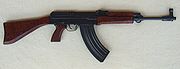 The arms are thought to have consisted of:
The UVF used this new infusion of arms to escalate their campaign of sectarian assassinations. This era also saw a more widespread targeting on the UVF's part of IRA and Sinn Féin members, such as the killing of civilian Michael Fay by UVF volunteer Billy Giles
in 1982.
The UVF also attacked republican paramilitaries and their political activists. These attacks were stepped up in the late 1980s and early 1990s. The largest death toll was on 3 March 1991 when the UVF killed IRA members John Quinn, Dwayne O'Donnell and Malcolm Nugent, and civilian Thomas Armstrong in the car park next to Boyle's Bar, Cappagh. Republicans had responded to the attacks by assassinating UVF leaders, including John Bingham
, William "Frenchie" Marchant
, Trevor King and, allegedly, Leslie Dallas. The UVF also killed republicans James Burns, Liam Ryan and Larry Marley. According to Conflict Archive on the Internet
(CAIN), the UVF killed 17 active and four former republican paramilitaries. CAIN also states that Republicans killed 13 UVF members.
According to journalist and author Ed Moloney
the UVF campaign in Mid Ulster in this period "indisputably shattered Republican morale", and put the leadership of the republican movement under intense pressure to "do something".
(CLMC) and indicated its acceptance of moves towards peace. However, the year leading up to the loyalist ceasefire, which took place shortly after the Provisional IRA ceasefire, saw some of the worst sectarian killings carried out by loyalists during the Troubles
. On 18 June 1994, UVF members machine-gunned a pub in Loughinisland, County Down
on the basis that its customers were watching the Republic of Ireland national football team
playing in the World Cup
on television and were therefore assumed to be Catholics. The gunmen shot dead six people and injured five.
The UVF agreed to a ceasefire in October 1994.
(LVF). This development came soon after the UVF's Brigade Staff in Belfast had stood down Wright and the Portadown unit of the Mid-Ulster Brigade, on 2 August 1996, for the killing of a Catholic taxi driver near Lurgan during Drumcree disturbances.
There followed years of violence between the two organisations. In January 2000 UVF Mid-Ulster brigadier Richard Jameson
was shot dead by a LVF gunman which led to an escalation of the UVF/LVF feud. The UVF was also clashing with the UDA in the summer of 2000. The feud with the UDA ended in December following seven deaths. Veteran anti-UVF campaigner Raymond McCord, whose son, a Protestant, was beaten to death by UVF men in 1997, estimates the UVF has killed more than thirty people since its 1994 ceasefire, most of them Protestants. The feud between the UVF and the LVF erupted again in the summer of 2005. The UVF killed four men in Belfast and trouble ended only when the LVF announced that it was disbanding in October of that year.
On 14 September 2005, following serious loyalist rioting during which dozens of shots were fired at riot police, the Northern Ireland Secretary Peter Hain
announced that the British government no longer recognised the UVF ceasefire.
On 12 February 2006, The Observer
reported that the UVF was to disband by the end of 2006. The newspaper also reported that the group refused to decommission its weapons.
On 2 September 2006, BBC News
reported the UVF may be intending to re-enter dialogue with the Independent International Commission on Decommissioning, with a view to decommissioning of their weapons. This move comes as the organisation holds high level discussions about their future.
On 3 May 2007, following recent negotiations between the Progressive Unionist Party
(PUP) and Irish Taoiseach
Bertie Ahern
and with Police Service of Northern Ireland
(PSNI) Chief Constable Sir Hugh Orde, the UVF made a statement that they would transform to a "non-military, civilianised" organisation. This was to take effect from midnight. They also stated that they would retain their weaponry but put them beyond reach of normal volunteers. Their weapons stock-piles are to be retained under the watch of the UVF leadership.
In January 2008, the UVF was accused of involvement in vigilante
action against alleged criminals in Belfast.
In the twentieth IMC report, the group was said to be continuing to put its weapons "beyond reach", (in the group's own words) to downsize, and reduce the criminality of the group. The report added that individuals, some current and some former members, in the group have, without the orders from above, continued to "localised recruitment", and although some continued to try and acquire weapons, including a senior member, most forms of crime had fallen, including shootings and assaults. The group concluded a general acceptance of the need to decommission, though there was no conclusive proof of moves towards this end.
In June 2009 the UVF formally decommissioned their weapons in front of independent witnesses as a formal statement of decommissioning was read by Dawn Purvis
and Billy Hutchinson
. The IICD confirmed that "substantial quantities of firearms, ammunition, explosives and explosive devices" had been decommissioned and that for the UVF and RHC, decommissioning had been completed. On 30 May 2010, however, the UVF was believed to have carried out the murder of a member of the RHC, Bobby Moffett, on the Shankill Road in broad daylight. The shooting raised questions over the future of the PUP.
On 25–26 October 2010, the UVF were involved in rioting and disturbances in the Rathcoole area of Newtownabbey. UVF gunmen were seen on the streets at the time.
On 28 May 2010, the UVF was severely criticised over the murder of Moffett. The Independent Monitoring Commission
was highly critical of the leadership for having condoned and even sanctioned the attack, in contrast to praise bestowed on the Brigade Staff for a moderating influence during the marching season. The Progressive Unionist Party
's condemnation, and Dawn Purvis
and other leaders' resignations as a response to the Moffett shooting, were also noted. 11 months later, a 40-year old man was arrested and charged with the attempted murder of a "Senior Loyalist Figure". The 50-year old was stabbed more than 15 times in a supermarket in the Greater Shankill area, the attack was believed to have been linked to the Moffett Murder. However, public opinion suggests that the stabbing was a personal vendetta and any connection being made to the Moffett case was simply a romantic tale of revenge.
On the night of 20 June 2011, riots involving 500 people erupted in the Short Strand
area of East Belfast
. They were blamed by the PSNI on members of the UVF, who also said UVF guns had been used to try to kill police officers. The UVF leader in East Belfast ordered the attack on Catholic homes and a church in the Catholic enclave of the Short Strand
in retaliation for attacks on Loyalist homes the previous weekend and after a young girl was hit in the face with a brick by Republicans. A dissident Republican was arrested for "the attempted murder of police officers in east Belfast" after shots were fired upon the police.
In July 2011 a UVF flag flying in Limavady
was deemed legal by the PSNI after the police had received complaints about the flag from nationalist politicians.
The UVF have been implicated in drug dealing in areas from where they draw their support. Recently it has emerged from the Police Ombudsman that senior North Belfast UVF member and Royal Ulster Constabulary
(RUC) Special Branch informant Mark Haddock
has been involved in drug dealing. According to the Belfast Telegraph, "...70 separate police intelligence reports implicating the north Belfast UVF man in dealing cannabis, Ecstasy, amphetamines and cocaine."
report in April 2004 estimated the UVF/RHC had "a few hundred" active members "based mainly in the Belfast and immediately adjacent areas" The UVF weaponry was limited to small arms
, with its sporadic bombing efforts being made using stolen quarrying explosives.
's Sutton database, the UVF and RHC was responsible for 481 killings during "the Troubles", between 1969 and 2001. A notable victim was golfer Rory McIlroy
's great uncle.
Note that these figures include killings that were claimed by the "Protestant Action Force" and "Protestant Action Group".
Ulster loyalism
Ulster loyalism is an ideology that is opposed to a united Ireland. It can mean either support for upholding Northern Ireland's status as a constituent part of the United Kingdom , support for Northern Ireland independence, or support for loyalist paramilitaries...
paramilitary
Paramilitary
A paramilitary is a force whose function and organization are similar to those of a professional military, but which is not considered part of a state's formal armed forces....
group in Northern Ireland
Northern Ireland
Northern Ireland is one of the four countries of the United Kingdom. Situated in the north-east of the island of Ireland, it shares a border with the Republic of Ireland to the south and west...
. It was formed in late 1965 or early 1966 and named after the Ulster Volunteer Force of 1913. The group's volunteers
Volunteer (Ulster loyalist)
Volunteer, abbreviated Vol., is a title used by a number of Ulster loyalist paramilitary organisations to describe their members.-History of the term volunteer in Ireland:...
undertook an armed campaign
Timeline of Ulster Volunteer Force actions
This is a timeline of actions by the Ulster Volunteer Force , a loyalist paramilitary group formed in 1966. It includes actions carried out by the Red Hand Commando , a group integrated into the UVF shortly after their formation in 1972. It also includes attacks claimed by the Protestant Action...
of almost thirty years during The Troubles
The Troubles
The Troubles was a period of ethno-political conflict in Northern Ireland which spilled over at various times into England, the Republic of Ireland, and mainland Europe. The duration of the Troubles is conventionally dated from the late 1960s and considered by many to have ended with the Belfast...
. It declared a ceasefire
Ceasefire
A ceasefire is a temporary stoppage of a war in which each side agrees with the other to suspend aggressive actions. Ceasefires may be declared as part of a formal treaty, but they have also been called as part of an informal understanding between opposing forces...
in 1994, although sporadic attacks continued until it officially ended its armed campaign in May 2007.
The UVF's declared goal was to combat Irish republicanism
Irish Republicanism
Irish republicanism is an ideology based on the belief that all of Ireland should be an independent republic.In 1801, under the Act of Union, the Kingdom of Great Britain and the Kingdom of Ireland merged to form the United Kingdom of Great Britain and Ireland...
, particularly republican paramilitaries
Paramilitary
A paramilitary is a force whose function and organization are similar to those of a professional military, but which is not considered part of a state's formal armed forces....
. The vast majority (more than two-thirds) of its 481 known victims were Catholic
Irish Catholic
Irish Catholic is a term used to describe people who are both Roman Catholic and Irish .Note: the term is not used to describe a variant of Catholicism. More particularly, it is not a separate creed or sect in the sense that "Anglo-Catholic", "Old Catholic", "Eastern Orthodox Catholic" might be...
civilians. During the conflict, its deadliest attack in Northern Ireland was the McGurk's Bar bombing
McGurk's Bar bombing
On 4 December 1971, the Ulster Volunteer Force , a loyalist paramilitary group, exploded a bomb at McGurk's Bar in Belfast, Northern Ireland. The pub was in a mainly Catholic and nationalist area. The explosion caused the building to collapse, killing fifteen Catholic civilians and wounding...
, which killed fifteen civilians. The group also carried out some attacks in the Republic of Ireland
Republic of Ireland
Ireland , described as the Republic of Ireland , is a sovereign state in Europe occupying approximately five-sixths of the island of the same name. Its capital is Dublin. Ireland, which had a population of 4.58 million in 2011, is a constitutional republic governed as a parliamentary democracy,...
, the most deadly of which were the Dublin and Monaghan bombings
Dublin and Monaghan Bombings
The Dublin and Monaghan bombings of 17 May 1974 were a series of car bombings in Dublin and Monaghan in the Republic of Ireland. The attacks killed 33 civilians and wounded almost 300 – the highest number of casualties in any single day during the conflict known as The Troubles.A loyalist...
which killed 33 civilians, the highest number of deaths in a single day during the conflict. The no-warning car bombings had been carried out by units from the Belfast and Mid-Ulster Brigades
UVF Mid-Ulster Brigade
UVF Mid-Ulster Brigade formed part of the loyalist paramilitary Ulster Volunteer Force in Northern Ireland. The brigade was established in Lurgan, County Armagh in 1972 by its first commander Billy Hanna. The unit operated mainly around the Lurgan and Portadown areas. Subsequent leaders of the...
.
The group is a designated terrorist organisation in the United Kingdom and United States and a proscribed organisation
Proscription
Proscription is a term used for the public identification and official condemnation of enemies of the state. It is defined by the Oxford English Dictionary as a "decree of condemnation to death or banishment" and is a heavily politically charged word, frequently used to refer to state-approved...
in the Republic of Ireland.
Brigade Staff
The UVF's leadership is based in BelfastBelfast
Belfast is the capital of and largest city in Northern Ireland. By population, it is the 14th biggest city in the United Kingdom and second biggest on the island of Ireland . It is the seat of the devolved government and legislative Northern Ireland Assembly...
and known as the Brigade Staff. It comprises high-ranking officers under a Chief of Staff or Brigadier-General. With a few exceptions, such as Mid-Ulster brigadier Billy Hanna
Billy Hanna
William Henry Wilson "Billy" Hanna MM was a high-ranking Northern Irish loyalist who founded and led the Mid-Ulster Brigade of the Ulster Volunteer Force until he was killed, allegedly by Robin Jackson, who took over command of the brigade.According to RUC Special Patrol Group officer John Weir,...
(a native of Lurgan
Lurgan
Lurgan is a town in County Armagh, Northern Ireland. The town is near the southern shore of Lough Neagh and in the north-eastern corner of the county. Part of the Craigavon Borough Council area, Lurgan is about 18 miles south-west of Belfast and is linked to the city by both the M1 motorway...
), the Brigade Staff members have been from the Shankill Road or the neighbouring Woodvale area to the west. The Brigade Staff's former headquarters were situated in rooms above "The Eagle" chip shop located on the Shankill Road at its junction with Spier's Place. The chip shop has since been closed down.
In 1972, the UVF's imprisoned leader Gusty Spence
Gusty Spence
Augustus Andrew "Gusty" Spence was a leader of the Ulster Volunteer Force and a leading loyalist politician. One of the first UVF members to be convicted of murder, Spence was a senior figure in the organisation for over a decade but later renounced violence and joined the Progressive Unionist...
was at liberty for four months following a staged kidnapping by UVF volunteers. During this time he restructured the organisation into brigades, battalions, companies, platoons and sections. These were all subordinate to the Brigade Staff. The incumbent Chief of Staff, referred to by Martin Dillon as "Mr. F", has held the position since he assumed office in 1976.
The UVF's nickname is "Blacknecks", derived from their uniform of black polo neck jumper, black trousers, black leather jacket, black forage cap, along with the UVF badge and belt. This uniform, based on those of the original UVF, was introduced in the early 1970s.
Its motto is "For God and Ulster".
Chiefs of Staff
- Gusty SpenceGusty SpenceAugustus Andrew "Gusty" Spence was a leader of the Ulster Volunteer Force and a leading loyalist politician. One of the first UVF members to be convicted of murder, Spence was a senior figure in the organisation for over a decade but later renounced violence and joined the Progressive Unionist...
(1966-1966). Whilst remaining de jure UVF leader after he was jailed for murder, he no longer acted as the Chief of Staff - Sam "Bo" McClellandSamuel McClellandSamuel "Bo" McClelland was a Northern Irish loyalist paramilitary who served as the Chief of Staff on the Ulster Volunteer Force's Brigade Staff from 1966 until his internment in late 1973.-UVF leadership:...
(1966-1973) Described as a "tough disciplinarian", he was personally appointed by Spence to succeed him as Chief of Staff, due to his having served in the Korean WarKorean WarThe Korean War was a conventional war between South Korea, supported by the United Nations, and North Korea, supported by the People's Republic of China , with military material aid from the Soviet Union...
with Spence's former regiment, the Royal Ulster RiflesRoyal Ulster RiflesThe Royal Ulster Rifles was a British Army infantry regiment. It saw service in the Second Boer War, Great War, the Second World War and the Korean War, before being amalgamated into the Royal Irish Rangers in 1968.-History:...
. He was interned in late 1973, although by that stage the de facto Chief of Staff was his successor, Jim Hanna. - Jim HannaJim Hanna (loyalist)James Andrew "Jim" Hanna, also known as Red Setter, was a senior member of the Northern Irish loyalist paramilitary organisation, the Ulster Volunteer Force until he was shot dead by fellow members, for being an alleged informer. Journalists Joe Tiernan and Kevin Myers described him as having...
(1973-April 1974) Hanna was allegedly shot dead by the UVF as a suspected informer. - Ken GibsonKen Gibson (loyalist)Kenneth "Ken" Gibson was a Northern Irish politician, who acted as the Chairman of the Volunteer Political Party which he had helped to form in 1974...
(1974) Gibson was the Chief of Staff during the Ulster Workers' Council StrikeUlster Workers' Council StrikeThe Ulster Workers' Council strike was a general strike that took place in Northern Ireland between 15 May and 28 May 1974, during "The Troubles". The strike was called by loyalists and unionists who were against the Sunningdale Agreement, which had been signed in December 1973...
in May 1974. - "Mr. Smith" (1974-October 1975). Leader of the Young Citizen VolunteersYoung Citizen VolunteersThe Young Citizen Volunteers of Northern Ireland had its first meeting just prior to the signing of the Solemn League and Covenant , opposing Home Rule, in Belfast City Hall on September 10, 1912...
(YCV), the youth wing of the UVF. Assumed command after a coup by hardliners in 1974. He, along with the other hawkish Brigade Staff members were overthrown by Tommy West and a new Brigade Staff of "moderates" in a counter-coup supported by Gusty Spence. - Tommy West (October 1975-1976) A former British Army soldier, West was already the Chief of Staff at the time UVF volunteer Noel "Nogi" Shaw was killed by Lenny MurphyLenny MurphyHugh Leonard Thompson Murphy, who commonly went by the name Lenny , was an Ulster loyalist from Belfast, Northern Ireland. Murphy was a member of the Ulster Volunteer Force and leader of the infamous Shankill Butchers a gang which became notorious for its torture and murder of Catholic men...
in November 1975 as part of an internal feud. It's possible West served as Chief of Staff more than once. - "Mr. F" (1976-present day)
Aim and strategy
The UVF's goal was to combat Irish republicanismIrish Republicanism
Irish republicanism is an ideology based on the belief that all of Ireland should be an independent republic.In 1801, under the Act of Union, the Kingdom of Great Britain and the Kingdom of Ireland merged to form the United Kingdom of Great Britain and Ireland...
– particularly the Provisional Irish Republican Army
Provisional Irish Republican Army
The Provisional Irish Republican Army is an Irish republican paramilitary organisation whose aim was to remove Northern Ireland from the United Kingdom and bring about a socialist republic within a united Ireland by force of arms and political persuasion...
(IRA) – and maintain Northern Ireland's status as part of the United Kingdom. Most of its victims were Irish Catholic
Irish Catholic
Irish Catholic is a term used to describe people who are both Roman Catholic and Irish .Note: the term is not used to describe a variant of Catholicism. More particularly, it is not a separate creed or sect in the sense that "Anglo-Catholic", "Old Catholic", "Eastern Orthodox Catholic" might be...
civilian
Civilian
A civilian under international humanitarian law is a person who is not a member of his or her country's armed forces or other militia. Civilians are distinct from combatants. They are afforded a degree of legal protection from the effects of war and military occupation...
s, who were often chosen at random. Whenever it claimed responsibility for its attacks, the UVF usually claimed that those targeted were IRA members or IRA sympathisers. Other times, attacks on Catholic civilians were claimed as "retaliation" for IRA actions, since the IRA drew most of its support from the Catholic community. Such retaliation was seen as both collective punishment
Collective punishment
Collective punishment is the punishment of a group of people as a result of the behavior of one or more other individuals or groups. The punished group may often have no direct association with the other individuals or groups, or direct control over their actions...
and an attempt to weaken the IRA's support; it was thought that 'fear of retaliation' would make the Catholic community rein in the IRA. Many retaliatory attacks on Catholics were claimed using the covername "Protestant Action Force" (PAF).
Like the Ulster Defence Association
Ulster Defence Association
The Ulster Defence Association is the largest although not the deadliest loyalist paramilitary and vigilante group in Northern Ireland. It was formed in September 1971 and undertook a campaign of almost twenty-four years during "The Troubles"...
(UDA), the UVF's modus operandi
Modus operandi
Modus operandi is a Latin phrase, approximately translated as "mode of operation". The term is used to describe someone's habits or manner of working, their method of operating or functioning...
involved assassinations, mass shootings, bombings and kidnappings. It used sub machine-guns
Submachine gun
A submachine gun is an automatic carbine, designed to fire pistol cartridges. It combines the automatic fire of a machine gun with the cartridge of a pistol. The submachine gun was invented during World War I , but the apex of its use was during World War II when millions of the weapon type were...
, assault rifles, pistol
Pistol
When distinguished as a subset of handguns, a pistol is a handgun with a chamber that is integral with the barrel, as opposed to a revolver, wherein the chamber is separate from the barrel as a revolving cylinder. Typically, pistols have an effective range of about 100 feet.-History:The pistol...
s, grenade
Grenade
A grenade is a small explosive device that is projected a safe distance away by its user. Soldiers called grenadiers specialize in the use of grenades. The term hand grenade refers any grenade designed to be hand thrown. Grenade Launchers are firearms designed to fire explosive projectile grenades...
s (including homemade grenades), incendiary bombs, booby trap
Booby trap
A booby trap is a device designed to harm or surprise a person, unknowingly triggered by the presence or actions of the victim. As the word trap implies, they often have some form of bait designed to lure the victim towards it. However, in other cases the device is placed on busy roads or is...
bombs and car bomb
Car bomb
A car bomb, or truck bomb also known as a Vehicle Borne Improvised Explosive Device , is an improvised explosive device placed in a car or other vehicle and then detonated. It is commonly used as a weapon of assassination, terrorism, or guerrilla warfare, to kill the occupants of the vehicle,...
s. Bomb attacks were usually made without warning. They always signed their statements with the fictitious name "Captain William Johnston, UVF Chief of Staff". Like other loyalist paramilitaries, most UVF operations were gun attacks rather than bombings.
The 1960s
The year 1966 marked the 50th anniversary of the 1916 Easter RisingEaster Rising
The Easter Rising was an insurrection staged in Ireland during Easter Week, 1916. The Rising was mounted by Irish republicans with the aims of ending British rule in Ireland and establishing the Irish Republic at a time when the British Empire was heavily engaged in the First World War...
— when Irish republicans
Irish Republicanism
Irish republicanism is an ideology based on the belief that all of Ireland should be an independent republic.In 1801, under the Act of Union, the Kingdom of Great Britain and the Kingdom of Ireland merged to form the United Kingdom of Great Britain and Ireland...
seized key buildings in Dublin and declared an independent Irish Republic
Irish Republic
The Irish Republic was a revolutionary state that declared its independence from Great Britain in January 1919. It established a legislature , a government , a court system and a police force...
. On 8 March 1966, a group of ex-Irish Republican Army
Irish Republican Army (1922–1969)
The original Irish Republican Army fought a guerrilla war against British rule in Ireland in the Irish War of Independence 1919–1921. Following the signing of the Anglo-Irish Treaty on 6 December 1921, the IRA in the 26 counties that were to become the Irish Free State split between supporters and...
(IRA) volunteers planted a bomb that destroyed Nelson's Pillar
Nelson's Pillar
The Nelson Pillar , known locally as Nelson's Pillar or simply The Pillar, was a large granite pillar topped by a statue of Horatio Nelson in the middle of O'Connell Street, Dublin...
in Dublin. On 17 April, large republican parades took place in Belfast
Belfast
Belfast is the capital of and largest city in Northern Ireland. By population, it is the 14th biggest city in the United Kingdom and second biggest on the island of Ireland . It is the seat of the devolved government and legislative Northern Ireland Assembly...
to mark the anniversary. Some unionists
Unionism in Ireland
Unionism in Ireland is an ideology that favours the continuation of some form of political union between the islands of Ireland and Great Britain...
and loyalists
Ulster loyalism
Ulster loyalism is an ideology that is opposed to a united Ireland. It can mean either support for upholding Northern Ireland's status as a constituent part of the United Kingdom , support for Northern Ireland independence, or support for loyalist paramilitaries...
feared there would be a "revival" of the IRA. Since 1964 there had also been a growing campaign for equality reforms in Northern Ireland. This was led by groups like Campaign for Social Justice
Campaign for Social Justice
Campaign for Social Justice was an organisation based in Northern Ireland which campaigned for civil rights in the country.The Campaign for Social Justice in Northern Ireland was inaugurated on 17 January, 1964...
(CSJ), which became the Northern Ireland Civil Rights Association
Northern Ireland Civil Rights Association
The Northern Ireland Civil Rights Association was an organisation which campaigned for equal civil rights for the all the people in Northern Ireland during the late 1960s and early 1970s...
(NICRA). They sought to end the discrimination suffered by Catholics in housing, employment and through gerrymandering
Gerrymandering
In the process of setting electoral districts, gerrymandering is a practice that attempts to establish a political advantage for a particular party or group by manipulating geographic boundaries to create partisan, incumbent-protected districts...
. Prime Minister
Prime Minister of Northern Ireland
The Prime Minister of Northern Ireland was the de facto head of the Government of Northern Ireland. No such office was provided for in the Government of Ireland Act 1920. However the Lord Lieutenant, as with Governors-General in other Westminster Systems such as in Canada, chose to appoint someone...
Terence O'Neill was willing to accept some of the demands. The unionists, who were overwhelmingly Protestant
Protestantism
Protestantism is one of the three major groupings within Christianity. It is a movement that began in Germany in the early 16th century as a reaction against medieval Roman Catholic doctrines and practices, especially in regards to salvation, justification, and ecclesiology.The doctrines of the...
, feared losing their grip on power.
On 7 May, a group of loyalists led by Gusty Spence petrol bombed a Catholic-owned pub on the loyalist Shankill Road, Belfast. The ensuing fire swept to the house next door, killing the elderly Protestant widow who lived there. Spence, a former British soldier, was from the Shankill Road. On 21 May, the group (calling itself the "Ulster Volunteer Force") issued a statement:
From this day, we declare war against the Irish Republican Army and its splinter groups. Known IRA men will be executed mercilessly and without hesitation. Less extreme measures will be taken against anyone sheltering or helping them, but if they persist in giving them aid, then more extreme methods will be adopted... we solemnly warn the authorities to make no more speeches of appeasement. We are heavily armed Protestants dedicated to this cause.
On 27 May, four UVF men were sent to kill an IRA volunteer
Volunteer (Irish republican)
Volunteer, often abbreviated Vol., is a term used by a number of Irish republican paramilitary organisations to describe their members. Among these have been the various forms of the Irish Republican Army and the Irish National Liberation Army...
, Leo Martin, who lived on Falls Road. Unable to find their target, the men drove around in search of a Catholic. They shot dead John Scullion, a civilian, as he walked home. Spence later wrote "At the time, the attitude was that if you couldn't get an IRA man you should shoot a Taig
Taig
Taig is a derogatory term for an Irish Catholic. It is mainly used by sectarian loyalists in Northern Ireland and Scotland. It has been used in sectarian slogans such as "Kill All Taigs" , "All Taigs Are Targets" and "Any Taig Will Do"...
, he's your last resort".
On 26 June, the group shot dead a Catholic civilian and wounded two others as they left a pub on Malvern Street, Belfast. Two days later, the government of Northern Ireland
Executive Committee of the Privy Council of Northern Ireland
The Executive Committee or the Executive Committee of the Privy Council of Northern Ireland was the government of Northern Ireland created under the Government of Ireland Act 1920. Generally known as either the Cabinet or the Government, the Executive Committee existed from 1922 to 1972...
declared the UVF illegal. The shootings led to Spence being arrested and sentenced to life imprisonment with a recommended minimum sentence of twenty years. Spence appointed Samuel McClelland
Samuel McClelland
Samuel "Bo" McClelland was a Northern Irish loyalist paramilitary who served as the Chief of Staff on the Ulster Volunteer Force's Brigade Staff from 1966 until his internment in late 1973.-UVF leadership:...
as UVF Chief of Staff in his stead.
In 1969, the UVF took part in a string of bomb attacks on electricity and water installations in Northern Ireland. It was hoped that this would be blamed on the IRA and halt the equality reforms promised by Terence O'Neill. These reforms would have ended discrimination against Catholics. The attacks were carried out with help from the short-lived Ulster Protestant Volunteers
Ulster Protestant Volunteers
The Ulster Protestant Volunteers were a loyalist and fundamentalist Christian paramilitary group in Northern Ireland. They were active between 1966 and 1969 and closely linked to the Ulster Constitution Defence Committee , established by Ian Paisley in 1966.The UPV launched a bombing campaign to...
(UPV), another loyalist paramilitary group. The UPV was the paramilitary wing of the Ulster Constitution Defence Committee
Ulster Constitution Defence Committee
The Ulster Constitution Defence Committee was established in Northern Ireland in April 1966. The UCDC was the governing body of the loyalist Ulster Protestant Volunteers...
, founded by Ian Paisley
Ian Paisley
Ian Richard Kyle Paisley, Baron Bannside, PC is a politician and church minister in Northern Ireland. As the leader of the Democratic Unionist Party , he and Sinn Féin's Martin McGuinness were elected First Minister and deputy First Minister respectively on 8 May 2007.In addition to co-founding...
. Many of those involved were members of both groups. There were bombings on 30 March, 4 April, 20 April, 24 and 26 April.
On 12 August 1969, the "Battle of the Bogside
Battle of the Bogside
The Battle of the Bogside was a very large communal riot that took place during 12–14 August 1969 in Derry, Northern Ireland. The fighting was between residents of the Bogside area and the Royal Ulster Constabulary .The rioting erupted after the RUC attempted to disperse Irish nationalists who...
" began in Derry
Derry
Derry or Londonderry is the second-biggest city in Northern Ireland and the fourth-biggest city on the island of Ireland. The name Derry is an anglicisation of the Irish name Doire or Doire Cholmcille meaning "oak-wood of Colmcille"...
. The rioting spread throughout Northern Ireland
1969 Northern Ireland Riots
During 12–17 August 1969, Northern Ireland was rocked by intense political and sectarian rioting. There had been sporadic violence throughout the year arising from the civil rights campaign, which was demanding an end to government discrimination against Irish Catholics and nationalists...
. This is generally seen as the beginning of "the Troubles
The Troubles
The Troubles was a period of ethno-political conflict in Northern Ireland which spilled over at various times into England, the Republic of Ireland, and mainland Europe. The duration of the Troubles is conventionally dated from the late 1960s and considered by many to have ended with the Belfast...
". As violence between loyalists and republicans grew, the UVF began a campaign of attacks on both republicans and (more often) Catholic civilians.
The early to mid-1970s
The UVF's attacks were aimed at Catholics, in what it called retaliation for attacks on Protestants by the Irish republican groups. As the violence in Northern Ireland began to escalate in the early 1970s the UVF's attacks became more random and lethal. One example of this is the McGurk's Bar bombingMcGurk's Bar bombing
On 4 December 1971, the Ulster Volunteer Force , a loyalist paramilitary group, exploded a bomb at McGurk's Bar in Belfast, Northern Ireland. The pub was in a mainly Catholic and nationalist area. The explosion caused the building to collapse, killing fifteen Catholic civilians and wounding...
in the New Lodge
New Lodge, Belfast
The New Lodge is an urban, working-class Catholic community in Belfast, Northern Ireland, immediately to the north of city centre. The landscape is dominated by several large tower blocks. The area has a number of murals, mostly sited along the New Lodge Road...
area of Belfast on 4 December 1971, which killed fifteen Catholic civilians. The attack was initially blamed on republican paramilitaries by the authorities and media but the UVF later admitted responsibility. On 23 October 1972, the UVF carried out an armed raid against King's Park camp, a UDR/Territorial Army
Territorial Army
The Territorial Army is the part time volunteer force of the British Army. With around 35,500 members, the TA forms about a quarter of the overall manpower strength of the British Army. TA members regularly volunteer to serve overseas on operations, either with TA units, or as individuals...
depot in Lurgan. They managed to procure a large cache of weapons and ammunition including self-loading rifles, Browning pistols, and Sterling submachine guns. Twenty tons of ammonium nitrate was also stolen from the Belfast docks.
Two UVF units from the Belfast and the Mid-Ulster brigades
UVF Mid-Ulster Brigade
UVF Mid-Ulster Brigade formed part of the loyalist paramilitary Ulster Volunteer Force in Northern Ireland. The brigade was established in Lurgan, County Armagh in 1972 by its first commander Billy Hanna. The unit operated mainly around the Lurgan and Portadown areas. Subsequent leaders of the...
were responsible, allegedly with help from former and serving members of the Ulster Defence Regiment
Ulster Defence Regiment
The Ulster Defence Regiment was an infantry regiment of the British Army which became operational in 1970, formed on similar lines to other British reserve forces but with the operational role of defence of life or property in Northern Ireland against armed attack or sabotage...
(UDR) and British Intelligence, for the bombs
Dublin and Monaghan Bombings
The Dublin and Monaghan bombings of 17 May 1974 were a series of car bombings in Dublin and Monaghan in the Republic of Ireland. The attacks killed 33 civilians and wounded almost 300 – the highest number of casualties in any single day during the conflict known as The Troubles.A loyalist...
in Dublin and Monaghan
Monaghan
Monaghan is the county town of County Monaghan in Ireland. Its population at the 2006 census stood at 7,811 . The town is located on the main road, the N2 road, from Dublin north to both Derry and Letterkenny.-Toponym:...
of 17 May 1974 when thirty-three people were killed and close to 300 injured. The 2003 Barron Report, however, concluded that the Monaghan bombing was perpetrated solely by the Mid-Ulster Brigade.
The Mid-Ulster Brigade
The UVF's Mid-Ulster Brigade was founded in 1972 in Lurgan by Billy Hanna, a captain in the UDR and a member of the Brigade Staff, who served as the brigade's commander until his shooting death in July 1975. From that time until the early 1990s, the Mid-Ulster Brigade was led by Robin "the Jackal" JacksonRobin Jackson
Robert John "Robin" Jackson, known as the Jackal was a Northern Irish loyalist who held the rank of brigadier in the Ulster Volunteer Force during the period of violent religious and political conflict in Northern Ireland known as the Troubles.From his home in the small village of Donaghcloney,...
, who then passed the leadership to Billy Wright
Billy Wright (loyalist)
William Stephen "Billy" Wright was a prominent Ulster loyalist during the period of violent religious/political conflict known as "The Troubles". He joined the Ulster Volunteer Force in 1975 and became commander of its Mid-Ulster Brigade in the early 1990s...
. Hanna and Jackson have both been implicated by journalist Joe Tiernan, and RUC Special Patrol Group
Special Patrol Group
The Special Patrol Group was a unit of Greater London's Metropolitan Police Service, responsible for providing a centrally-based mobile capability for combating serious public disorder and crime that could not be dealt with by local divisions....
(SPG) officer John Weir
John Weir (loyalist)
John Oliver Weir , is an Ulster loyalist born in the Republic of Ireland. He served as an officer in Northern Ireland's Royal Ulster Constabulary's Special Patrol Group , and was a volunteer in the illegal Ulster Volunteer Force...
as having led one of the units that bombed Dublin. Jackson was allegedly the hitman who shot Hanna dead outside his home in Lurgan, and subsequently took over his command.
The brigade formed part of the Glenanne gang
Glenanne gang
The Glenanne gang was a name given, since 2003, to a loose alliance of Northern Irish loyalist extremists who carried out sectarian killings and bomb attacks in the 1970s against the Irish Catholic and Irish nationalist community. Most of its attacks took place in the area of County Armagh and mid...
, a loose alliance of loyalist assassins which the Pat Finucane Centre
Pat Finucane Centre
The Pat Finucane Centre is a human rights advocacy and lobbying entity in Northern Ireland. Named in honour of murdered solicitor Pat Finucane, it operates advice centres in Derry and Newry, dealing mainly with complaints from nationalists and republicans...
has linked to 87 killings in the 1970s. The gang comprised, in addition to the UVF, rogue elements of the UDR, RUC, SPG, and the regular Army, all acting allegedly under the direction of British Military Intelligence and/or RUC Special Branch
Special Branch
Special Branch is a label customarily used to identify units responsible for matters of national security in British and Commonwealth police forces, as well as in the Royal Thai Police...
.
Mid to late-1970s
The UVF's Mid-Ulster Brigade carried out further attacks during this same period. These included the Miami Showband killings
Miami Showband killings
The Miami Showband killings was a paramilitary attack at Buskhill, County Down, Northern Ireland, in the early morning of 31 July 1975. It left five people dead at the hands of Ulster Volunteer Force gunmen, including three members of The Miami Showband...
of 31 July 1975 — when three members of the popular showband
The Miami Showband
The Miami Showband were one of the most successful and popular showbands in Ireland in the 1960s and 1970s. Led at first by singer Dickie Rock, and later by Fran O'Toole, they had seven number one records on the Irish singles chart...
from the Republic of Ireland were killed having been stopped at a fake British Army checkpoint outside of Newry
Newry
Newry is a city in Northern Ireland. The River Clanrye, which runs through the city, formed the historic border between County Armagh and County Down. It is from Belfast and from Dublin. Newry had a population of 27,433 at the 2001 Census, while Newry and Mourne Council Area had a population...
in County Down
County Down
-Cities:*Belfast *Newry -Large towns:*Dundonald*Newtownards*Bangor-Medium towns:...
. Two members of the group survived the attack and later testified against those responsible. Two UVF members, Harris Boyle
Harris Boyle
Harris Boyle was a Ulster Defence Regiment soldier and a high-ranking member of the Ulster Volunteer Force , a Northern Irish loyalist paramilitary organisation. Boyle was implicated in the 1974 Dublin and Monaghan bombings which left a total of 33 people dead...
and Wesley Somerville
Wesley Somerville
Wesley Somerville was a Northern Irish loyalist, who held the rank of lieutenant in the Ulster Volunteer Force's Mid-Ulster Brigade during the period of religious-political conflict known as "The Troubles". He also served as a member of the Ulster Defence Regiment...
, were accidentally killed by their own bomb while carrying out this attack. Two of those later convicted (James McDowell and Thomas Crozier) were also serving members of the Ulster Defence Regiment (UDR), a part-time, locally recruited regiment of the British Army
British Army
The British Army is the land warfare branch of Her Majesty's Armed Forces in the United Kingdom. It came into being with the unification of the Kingdom of England and Scotland into the Kingdom of Great Britain in 1707. The new British Army incorporated Regiments that had already existed in England...
.
From late 1975 to mid-1977, a unit of the UVF dubbed the Shankill Butchers
Shankill Butchers
The Shankill Butchers is the name given to an Ulster loyalist gang, many of whom were members of the Ulster Volunteer Force . The gang conducted paramilitary activities during the 1970s in Belfast, Northern Ireland. It was most notorious for its late-night kidnapping, torture and murder of random...
(a group of UVF men based on Belfast's Shankill Road) carried out a series of sectarian murders of Catholic civilians. Six of the victims were abducted at random, then beaten and tortured before having their throats slashed. This gang was led by Lenny Murphy
Lenny Murphy
Hugh Leonard Thompson Murphy, who commonly went by the name Lenny , was an Ulster loyalist from Belfast, Northern Ireland. Murphy was a member of the Ulster Volunteer Force and leader of the infamous Shankill Butchers a gang which became notorious for its torture and murder of Catholic men...
. He was shot dead by the IRA in November 1982, four months after his release from the Maze Prison.
The group had been proscribed in July 1966, but this ban was lifted on 4 April 1974 by Merlyn Rees, Secretary of State for Northern Ireland
Secretary of State for Northern Ireland
The Secretary of State for Northern Ireland, informally the Northern Ireland Secretary, is the principal secretary of state in the government of the United Kingdom with responsibilities for Northern Ireland. The Secretary of State is a Minister of the Crown who is accountable to the Parliament of...
, in an effort to bring the UVF into the democratic process. A political wing was formed in June 1974, the Volunteer Political Party
Volunteer Political Party
The Volunteer Political Party was a loyalist political party launched in Northern Ireland on 22 June 1974 by members of the then recently legalised Ulster Volunteer Force . The Chairman was Ken Gibson from East Belfast, an ex-internee and UVF chief of staff at the time...
led by UVF Chief of Staff Ken Gibson, which contested West Belfast
Belfast West (UK Parliament constituency)
Belfast West is a parliamentary constituency in the House of Commons of the United Kingdom.-Boundaries:The seat was restored in 1922 when as part of the establishment of the devolved Stormont Parliament for Northern Ireland, the number of MPs in the Westminster Parliament was drastically cut...
in the October 1974 General Election
United Kingdom general election, October 1974
The United Kingdom general election of October 1974 took place on 10 October 1974 to elect 635 members to the British House of Commons. It was the second general election of that year and resulted in the Labour Party led by Harold Wilson, winning by a tiny majority of 3 seats.The election of...
, polling 2,690 votes (6%). The UVF spurned the government efforts however and continued killing. Colin Wallace
Colin Wallace
John Colin Wallace is a former British soldier and psychological warfare operative who was one of the members of the 'Clockwork Orange' project, which is alleged to have been an attempt to smear a number of British politicians in the early 1970s.-Early life:...
, part of the intelligence apparatus of the British Army, asserted in an internal memo in 1975 that MI6 and RUC Special Branch formed a pseudo-gang within the UVF, designed to engage in violence and to subvert moves of the UVF towards the political process. Captain Robert Nairac
Robert Nairac
Captain Robert Laurence Nairac GC was a British Army officer who was abducted from a pub in south County Armagh during an undercover operation and killed by the Provisional Irish Republican Army on his fourth tour of duty in Northern Ireland as a Military Intelligence Liaison Officer...
of 14 Intelligence Company
14 Intelligence Company
14 Field Security and Intelligence Company is alleged to have been an element of the British Army Intelligence Corps which operated in Northern Ireland from the 1970s onwards. The unit conducted undercover surveillance operations against suspected members of Irish republican and loyalist...
was alleged to have been involved in many acts of UVF violence. The UVF was banned again on 3 October 1975 and two days later twenty-six suspected UVF members were arrested in a series of raids. The men were tried and in March 1977 were sentenced to an average of twenty-five years each.
In October 1975, after staging a counter-coup, the Brigade Staff acquired a new leadership of moderates with Tommy West serving as the Chief of Staff. These men had overthrown the "hawkish" officers, who had called for a "big push", which meant an increase in violent attacks, earlier in the same month. In fact, the UVF was behind the deaths of seven civilians in a series of attacks on 2 October. The hawks had been ousted by those in the UVF who were unhappy with their political and military strategy. The new Brigade Staff's aim was to carry out attacks against known republicans rather than Catholic civilians. This had been thoroughly endorsed by Gusty Spence who issued a statement asking all UVF volunteers to support the new regime.The UVF's activities in the last years of the decade were increasingly being curtailed by the number of UVF members who were sent to prison. Indeed, the number of killings in Northern Ireland had decreased from 300 per year during the period between 1973 and 1976 to just under 100 in the years 1977-1981. In 1976, Tommy West was replaced with "Mr. F", who is the incumbent Chief of Staff as of 2011. West died in 1980.
The early to mid-1980s
In the 1980s, the UVF was greatly reduced by a series of police informerInformant
An informant is a person who provides privileged information about a person or organization to an agency. The term is usually used within the law enforcement world, where they are officially known as confidential or criminal informants , and can often refer pejoratively to the supply of information...
s. The damage from security service informers started in 1983 with "supergrass"
Supergrass (informer)
Supergrass is a slang term for an informer, which originated in London. Informers had been referred to as "grasses" since the late-1930s, and the "super" prefix was coined by journalists in the early 1970s to describe those informers from the city's underworld who testified against former...
Joseph Bennett's information which led to the arrest of fourteen senior figures. In 1984, they attempted to kill the northern editor of the Sunday World
Sunday World
The Sunday World is an Irish newspaper published by Sunday Newspapers Limited, a division of Independent News and Media. It is the largest selling "popular" newspaper in the Republic of Ireland and is also sold in Northern Ireland .-Origins:The Sunday World was Ireland's first tabloid newspaper...
, Jim Campbell after he had exposed the paramiltary activities of Mid-Ulster brigadier Robin Jackson. By the mid 1980s, a Loyalist paramilitary-style organisation called Ulster Resistance
Ulster Resistance
Ulster Resistance was a paramilitary movement established by unionists in Northern Ireland on 10 November 1986 in opposition to the Anglo-Irish Agreement.-Origins:The group was launched at a three thousand-strong invitation-only meeting at the Ulster Hall...
was formed on 10 November 1986 by Ian Paisley
Ian Paisley
Ian Richard Kyle Paisley, Baron Bannside, PC is a politician and church minister in Northern Ireland. As the leader of the Democratic Unionist Party , he and Sinn Féin's Martin McGuinness were elected First Minister and deputy First Minister respectively on 8 May 2007.In addition to co-founding...
, then leader of the Democratic Unionist Party
Democratic Unionist Party
The Democratic Unionist Party is the larger of the two main unionist political parties in Northern Ireland. Founded by Ian Paisley and currently led by Peter Robinson, it is currently the largest party in the Northern Ireland Assembly and the fourth-largest party in the House of Commons of the...
(DUP), Peter Robinson
Peter Robinson (politician)
Peter David Robinson is the current First Minister of Northern Ireland and leader of the Democratic Unionist Party...
of the DUP, and Ivan Foster. The initial aim of Ulster Resistance was to bring an end to the Anglo-Irish Agreement. Loyalists were successful in importing arms into Northern Ireland. The weapons were Palestine Liberation Organisation arms captured by the Israelis, sold to Armscor, the South African state-owned company which, in defiance of the 1977 United Nations arms embargo, set about making South Africa self-sufficient in military hardware. The arms were divided between the UVF, the UDA
Ulster Defence Association
The Ulster Defence Association is the largest although not the deadliest loyalist paramilitary and vigilante group in Northern Ireland. It was formed in September 1971 and undertook a campaign of almost twenty-four years during "The Troubles"...
(the largest loyalist group) and Ulster Resistance.
- 200 Czech Sa vz. 58 assault rifles,
- 90 BrowningBrowning Arms CompanyBrowning Arms Company is a maker of firearms, bows and fishing gear. Founded in Utah in 1927, it offers a wide variety of firearms, including shotguns, rifles, pistols, and rimfire firearms and sport bows, as well as fishing rods and reels....
pistols, - 500 RGD-5RGD-5The RGD-5 English "Hand Grenade of the Degtyareva design", is a post World War II Soviet anti-personnel fragmentation grenade, designed in the early 1950s...
fragmentation grenades, - 30,000 rounds of ammunition and
- 12 RPG-7RPG-7The RPG-7 is a widely-produced, portable, unguided, shoulder-launched, anti-tank rocket-propelled grenade launcher. Originally the RPG-7 and its predecessor, the RPG-2, were designed by the Soviet Union, and now manufactured by the Bazalt company...
rocket launchers and 150 warheads.
The UVF used this new infusion of arms to escalate their campaign of sectarian assassinations. This era also saw a more widespread targeting on the UVF's part of IRA and Sinn Féin members, such as the killing of civilian Michael Fay by UVF volunteer Billy Giles
Billy Giles
Billy Giles was a Ulster Volunteer Force volunteer who later became active in politics following his release from the Maze Prison in 1997 after serving 14 years of a life sentence for murder....
in 1982.
The late 1980s and early 1990s
(See also IRA and loyalist paramilitaries)The UVF also attacked republican paramilitaries and their political activists. These attacks were stepped up in the late 1980s and early 1990s. The largest death toll was on 3 March 1991 when the UVF killed IRA members John Quinn, Dwayne O'Donnell and Malcolm Nugent, and civilian Thomas Armstrong in the car park next to Boyle's Bar, Cappagh. Republicans had responded to the attacks by assassinating UVF leaders, including John Bingham
John Bingham (loyalist)
John Dowey Bingham was a prominent Northern Irish loyalist who led "D Company" , 1st Battalion, Ulster Volunteer Force . He was shot dead by the Provisional IRA after they had broken into his home...
, William "Frenchie" Marchant
William Marchant (loyalist)
William "Frenchie" Marchant was a Northern Irish loyalist and a middle-ranking volunteer in the Ulster Volunteer Force . He was on a Garda list of suspects in the 1974 Dublin car bombings which left a total of 26 people dead, and close to 300 injured...
, Trevor King and, allegedly, Leslie Dallas. The UVF also killed republicans James Burns, Liam Ryan and Larry Marley. According to Conflict Archive on the Internet
Conflict Archive on the Internet
CAIN is a database containing information about Conflict and Politics in Northern Ireland from 1968 to the Present. The project began in 1996, with the website launching in 1997. The project is based within the University of Ulster at its Magee campus...
(CAIN), the UVF killed 17 active and four former republican paramilitaries. CAIN also states that Republicans killed 13 UVF members.
According to journalist and author Ed Moloney
Ed Moloney
Ed Moloney is an Irish journalist and author best known for his coverage of the Troubles in Northern Ireland and particularly the activities of the Provisional IRA. Ed worked for the Hibernia magazine and Magill before going on to serve as Northern Ireland editor for The Irish Times and...
the UVF campaign in Mid Ulster in this period "indisputably shattered Republican morale", and put the leadership of the republican movement under intense pressure to "do something".
1994 ceasefire
In 1990 the UVF joined the Combined Loyalist Military CommandCombined Loyalist Military Command
The Combined Loyalist Military Command was an umbrella body for loyalist paramilitary groups in Northern Ireland set up in the early 1990s, recalling the earlier Ulster Army Council and Ulster Loyalist Central Co-ordinating Committee....
(CLMC) and indicated its acceptance of moves towards peace. However, the year leading up to the loyalist ceasefire, which took place shortly after the Provisional IRA ceasefire, saw some of the worst sectarian killings carried out by loyalists during the Troubles
The Troubles
The Troubles was a period of ethno-political conflict in Northern Ireland which spilled over at various times into England, the Republic of Ireland, and mainland Europe. The duration of the Troubles is conventionally dated from the late 1960s and considered by many to have ended with the Belfast...
. On 18 June 1994, UVF members machine-gunned a pub in Loughinisland, County Down
County Down
-Cities:*Belfast *Newry -Large towns:*Dundonald*Newtownards*Bangor-Medium towns:...
on the basis that its customers were watching the Republic of Ireland national football team
Republic of Ireland national football team
The Republic of Ireland national football team represents Ireland in association football. It is run by the Football Association of Ireland and currently plays home fixtures at Aviva Stadium in Dublin, which opened in May 2010....
playing in the World Cup
FIFA World Cup
The FIFA World Cup, often simply the World Cup, is an international association football competition contested by the senior men's national teams of the members of Fédération Internationale de Football Association , the sport's global governing body...
on television and were therefore assumed to be Catholics. The gunmen shot dead six people and injured five.
The UVF agreed to a ceasefire in October 1994.
Post-ceasefire activities
More militant members of the UVF, led by Billy Wright who disagreed with the ceasefire, broke away to form the Loyalist Volunteer ForceLoyalist Volunteer Force
The Loyalist Volunteer Force is a loyalist paramilitary group in Northern Ireland. It was formed by Billy Wright in 1996 when he and the Portadown unit of the Ulster Volunteer Force's Mid-Ulster Brigade was stood down by the UVF leadership. He had been the commander of the Mid-Ulster Brigade. The...
(LVF). This development came soon after the UVF's Brigade Staff in Belfast had stood down Wright and the Portadown unit of the Mid-Ulster Brigade, on 2 August 1996, for the killing of a Catholic taxi driver near Lurgan during Drumcree disturbances.
There followed years of violence between the two organisations. In January 2000 UVF Mid-Ulster brigadier Richard Jameson
Richard Jameson (loyalist)
Richard Jameson , was a Northern Irish businessman and loyalist, who served as the leader of the paramilitary Ulster Volunteer Force's Mid-Ulster Brigade...
was shot dead by a LVF gunman which led to an escalation of the UVF/LVF feud. The UVF was also clashing with the UDA in the summer of 2000. The feud with the UDA ended in December following seven deaths. Veteran anti-UVF campaigner Raymond McCord, whose son, a Protestant, was beaten to death by UVF men in 1997, estimates the UVF has killed more than thirty people since its 1994 ceasefire, most of them Protestants. The feud between the UVF and the LVF erupted again in the summer of 2005. The UVF killed four men in Belfast and trouble ended only when the LVF announced that it was disbanding in October of that year.
On 14 September 2005, following serious loyalist rioting during which dozens of shots were fired at riot police, the Northern Ireland Secretary Peter Hain
Peter Hain
Peter Gerald Hain is a British Labour Party politician, who has been the Member of Parliament for the Welsh constituency of Neath since 1991, and has served in the Cabinets of both Tony Blair and Gordon Brown, firstly as Leader of the House of Commons under Blair and both Secretary of State for...
announced that the British government no longer recognised the UVF ceasefire.
On 12 February 2006, The Observer
The Observer
The Observer is a British newspaper, published on Sundays. In the same place on the political spectrum as its daily sister paper The Guardian, which acquired it in 1993, it takes a liberal or social democratic line on most issues. It is the world's oldest Sunday newspaper.-Origins:The first issue,...
reported that the UVF was to disband by the end of 2006. The newspaper also reported that the group refused to decommission its weapons.
On 2 September 2006, BBC News
BBC News
BBC News is the department of the British Broadcasting Corporation responsible for the gathering and broadcasting of news and current affairs. The department is the world's largest broadcast news organisation and generates about 120 hours of radio and television output each day, as well as online...
reported the UVF may be intending to re-enter dialogue with the Independent International Commission on Decommissioning, with a view to decommissioning of their weapons. This move comes as the organisation holds high level discussions about their future.
On 3 May 2007, following recent negotiations between the Progressive Unionist Party
Progressive Unionist Party
The Progressive Unionist Party is a small unionist political party in Northern Ireland. It was formed from the Independent Unionist Group operating in the Shankill area of Belfast, becoming the PUP in 1979...
(PUP) and Irish Taoiseach
Taoiseach
The Taoiseach is the head of government or prime minister of Ireland. The Taoiseach is appointed by the President upon the nomination of Dáil Éireann, the lower house of the Oireachtas , and must, in order to remain in office, retain the support of a majority in the Dáil.The current Taoiseach is...
Bertie Ahern
Bertie Ahern
Patrick Bartholomew "Bertie" Ahern is a former Irish politician who served as Taoiseach of Ireland from 26 June 1997 to 7 May 2008....
and with Police Service of Northern Ireland
Police Service of Northern Ireland
The Police Service of Northern Ireland is the police force that serves Northern Ireland. It is the successor to the Royal Ulster Constabulary which, in turn, was the successor to the Royal Irish Constabulary in Northern Ireland....
(PSNI) Chief Constable Sir Hugh Orde, the UVF made a statement that they would transform to a "non-military, civilianised" organisation. This was to take effect from midnight. They also stated that they would retain their weaponry but put them beyond reach of normal volunteers. Their weapons stock-piles are to be retained under the watch of the UVF leadership.
In January 2008, the UVF was accused of involvement in vigilante
Vigilante
A vigilante is a private individual who legally or illegally punishes an alleged lawbreaker, or participates in a group which metes out extralegal punishment to an alleged lawbreaker....
action against alleged criminals in Belfast.
In the twentieth IMC report, the group was said to be continuing to put its weapons "beyond reach", (in the group's own words) to downsize, and reduce the criminality of the group. The report added that individuals, some current and some former members, in the group have, without the orders from above, continued to "localised recruitment", and although some continued to try and acquire weapons, including a senior member, most forms of crime had fallen, including shootings and assaults. The group concluded a general acceptance of the need to decommission, though there was no conclusive proof of moves towards this end.
In June 2009 the UVF formally decommissioned their weapons in front of independent witnesses as a formal statement of decommissioning was read by Dawn Purvis
Dawn Purvis
Dawn Purvis was an Independent Unionist member of the Northern Ireland Assembly. She was previously the leader of the Progressive Unionist Party until she resigned in 2010. She lost her seat in the Assembly in the 2011 election.-Biography:...
and Billy Hutchinson
Billy Hutchinson
Billy Hutchinson is the leader of the Progressive Unionist Party in Northern Ireland. He was elected to Belfast City Council in 1997 and to the Northern Ireland Assembly in 1998. He lost his assembly seat in 2003 and his council seat in 2005...
. The IICD confirmed that "substantial quantities of firearms, ammunition, explosives and explosive devices" had been decommissioned and that for the UVF and RHC, decommissioning had been completed. On 30 May 2010, however, the UVF was believed to have carried out the murder of a member of the RHC, Bobby Moffett, on the Shankill Road in broad daylight. The shooting raised questions over the future of the PUP.
On 25–26 October 2010, the UVF were involved in rioting and disturbances in the Rathcoole area of Newtownabbey. UVF gunmen were seen on the streets at the time.
On 28 May 2010, the UVF was severely criticised over the murder of Moffett. The Independent Monitoring Commission
Independent Monitoring Commission
The Independent Monitoring Commission was an organization founded on 7 January 2004, by an agreement between the British and Irish governments, signed in Dublin on 25 November 2003...
was highly critical of the leadership for having condoned and even sanctioned the attack, in contrast to praise bestowed on the Brigade Staff for a moderating influence during the marching season. The Progressive Unionist Party
Progressive Unionist Party
The Progressive Unionist Party is a small unionist political party in Northern Ireland. It was formed from the Independent Unionist Group operating in the Shankill area of Belfast, becoming the PUP in 1979...
's condemnation, and Dawn Purvis
Dawn Purvis
Dawn Purvis was an Independent Unionist member of the Northern Ireland Assembly. She was previously the leader of the Progressive Unionist Party until she resigned in 2010. She lost her seat in the Assembly in the 2011 election.-Biography:...
and other leaders' resignations as a response to the Moffett shooting, were also noted. 11 months later, a 40-year old man was arrested and charged with the attempted murder of a "Senior Loyalist Figure". The 50-year old was stabbed more than 15 times in a supermarket in the Greater Shankill area, the attack was believed to have been linked to the Moffett Murder. However, public opinion suggests that the stabbing was a personal vendetta and any connection being made to the Moffett case was simply a romantic tale of revenge.
On the night of 20 June 2011, riots involving 500 people erupted in the Short Strand
Short Strand
The Short Strand is a mainly-nationalist area in east Belfast, surrounded by a mainly-unionist area. It is within the townland of Ballymacarret and sits on the east bank of the River Lagan in County Down.-Security issues:...
area of East Belfast
Belfast
Belfast is the capital of and largest city in Northern Ireland. By population, it is the 14th biggest city in the United Kingdom and second biggest on the island of Ireland . It is the seat of the devolved government and legislative Northern Ireland Assembly...
. They were blamed by the PSNI on members of the UVF, who also said UVF guns had been used to try to kill police officers. The UVF leader in East Belfast ordered the attack on Catholic homes and a church in the Catholic enclave of the Short Strand
Short Strand
The Short Strand is a mainly-nationalist area in east Belfast, surrounded by a mainly-unionist area. It is within the townland of Ballymacarret and sits on the east bank of the River Lagan in County Down.-Security issues:...
in retaliation for attacks on Loyalist homes the previous weekend and after a young girl was hit in the face with a brick by Republicans. A dissident Republican was arrested for "the attempted murder of police officers in east Belfast" after shots were fired upon the police.
In July 2011 a UVF flag flying in Limavady
Limavady
Limavady is a market town in County Londonderry, Northern Ireland, with Binevenagh as a backdrop. It lies east of Derry and south west of Coleraine. It had a population of 12,135 people in the 2001 Census, an increase of some 17% compared to 1991...
was deemed legal by the PSNI after the police had received complaints about the flag from nationalist politicians.
Drug dealing
The UVF state they are against drug dealing, and will 'deal justice' to drug dealers. The UVF has put up a series of anti-drugs posters on the estates they run to warn dealers that they are not welcome.The UVF have been implicated in drug dealing in areas from where they draw their support. Recently it has emerged from the Police Ombudsman that senior North Belfast UVF member and Royal Ulster Constabulary
Royal Ulster Constabulary
The Royal Ulster Constabulary was the name of the police force in Northern Ireland from 1922 to 2000. Following the awarding of the George Cross in 2000, it was subsequently known as the Royal Ulster Constabulary GC. It was founded on 1 June 1922 out of the Royal Irish Constabulary...
(RUC) Special Branch informant Mark Haddock
Mark Haddock
Mark Haddock is a loyalist paramilitary leader in Northern Ireland, and British Special Branch informer, who has been named by various sources in connection with more than twenty-one murders...
has been involved in drug dealing. According to the Belfast Telegraph, "...70 separate police intelligence reports implicating the north Belfast UVF man in dealing cannabis, Ecstasy, amphetamines and cocaine."
Strength and support
The strength of the UVF is uncertain. The first Independent Monitoring CommissionIndependent Monitoring Commission
The Independent Monitoring Commission was an organization founded on 7 January 2004, by an agreement between the British and Irish governments, signed in Dublin on 25 November 2003...
report in April 2004 estimated the UVF/RHC had "a few hundred" active members "based mainly in the Belfast and immediately adjacent areas" The UVF weaponry was limited to small arms
Small arms
Small arms is a term of art used by armed forces to denote infantry weapons an individual soldier may carry. The description is usually limited to revolvers, pistols, submachine guns, carbines, assault rifles, battle rifles, multiple barrel firearms, sniper rifles, squad automatic weapons, light...
, with its sporadic bombing efforts being made using stolen quarrying explosives.
Affiliated groups
- The Red Hand Commando (RHC) is an organisation that was established in 1972 and is closely linked with the UVF.
- The Young Citizen VolunteersYoung Citizen VolunteersThe Young Citizen Volunteers of Northern Ireland had its first meeting just prior to the signing of the Solemn League and Covenant , opposing Home Rule, in Belfast City Hall on September 10, 1912...
(YCV) is the youth section of the UVF. It was initially a youth group akin to the ScoutsScouting IrelandScouting Ireland is the World Organization of the Scout Movement-recognised Scouting association in the Republic of Ireland, although it also has Scout Groups in Northern Ireland. Scouting Ireland is a voluntary, non-formal educational movement for young people...
, but became the youth wing of the UVF during the Home Rule crisis.
- The Progressive Unionist PartyProgressive Unionist PartyThe Progressive Unionist Party is a small unionist political party in Northern Ireland. It was formed from the Independent Unionist Group operating in the Shankill area of Belfast, becoming the PUP in 1979...
(PUP) is the political wing of the UVF. In June 2010 their sole member in the Northern Ireland AssemblyNorthern Ireland AssemblyThe Northern Ireland Assembly is the devolved legislature of Northern Ireland. It has power to legislate in a wide range of areas that are not explicitly reserved to the Parliament of the United Kingdom, and to appoint the Northern Ireland Executive...
, their party leader Dawn PurvisDawn PurvisDawn Purvis was an Independent Unionist member of the Northern Ireland Assembly. She was previously the leader of the Progressive Unionist Party until she resigned in 2010. She lost her seat in the Assembly in the 2011 election.-Biography:...
, resigned from the PUP over the UVF being accused of involvement in the Moffett murder.
- The Protestant Action Force and, much less commonly, the Protestant Action GroupProtestant Action GroupThe names Protestant Action Force and, less commonly, Protestant Action Group were used by the Ulster Volunteer Force to avoid taking blame for attacks during "The Troubles" in Northern Ireland...
were cover names used by the UVF to avoid directly claiming responsibility for killings and other acts of violence. The names were first used during the early 1970s.
Deaths as a result of activity
The UVF has killed more people than any other loyalist paramilitary group. According to the University of UlsterUniversity of Ulster
The University of Ulster is a multi-campus, co-educational university located in Northern Ireland. It is the largest single university in Ireland, discounting the federal National University of Ireland...
's Sutton database, the UVF and RHC was responsible for 481 killings during "the Troubles", between 1969 and 2001. A notable victim was golfer Rory McIlroy
Rory McIlroy
Rory McIlroy is a Northern Irish professional golfer from Holywood in County Down. He has represented Europe, Great Britain & Ireland, and Ireland as both an amateur and a professional. He had a successful amateur career, topping the World Amateur Golf Ranking for one week as a 17-year-old in 2007...
's great uncle.
Note that these figures include killings that were claimed by the "Protestant Action Force" and "Protestant Action Group".
| Status | Deaths | Percentage |
|---|---|---|
| Civilian | 412 | 85% |
| Republican paramilitary | 21 | 4% |
| Loyalist paramilitary | 42 | 9% |
| Security forces | 6 | 1% |
See also
- Glenanne gangGlenanne gangThe Glenanne gang was a name given, since 2003, to a loose alliance of Northern Irish loyalist extremists who carried out sectarian killings and bomb attacks in the 1970s against the Irish Catholic and Irish nationalist community. Most of its attacks took place in the area of County Armagh and mid...
- Billy HannaBilly HannaWilliam Henry Wilson "Billy" Hanna MM was a high-ranking Northern Irish loyalist who founded and led the Mid-Ulster Brigade of the Ulster Volunteer Force until he was killed, allegedly by Robin Jackson, who took over command of the brigade.According to RUC Special Patrol Group officer John Weir,...
- Independent International Commission on DecommissioningIndependent International Commission on DecommissioningThe Independent International Commission on Decommissioning was established to oversee the decommissioning of paramilitary weapons in Northern Ireland, as part of the peace process.-Legislation and organisation:...
(IICD) – Organisation overseeing Decommissioning, - Independent Monitoring CommissionIndependent Monitoring CommissionThe Independent Monitoring Commission was an organization founded on 7 January 2004, by an agreement between the British and Irish governments, signed in Dublin on 25 November 2003...
(IMC) – Organisation monitoring activity by paramilitary groups. - Robin JacksonRobin JacksonRobert John "Robin" Jackson, known as the Jackal was a Northern Irish loyalist who held the rank of brigadier in the Ulster Volunteer Force during the period of violent religious and political conflict in Northern Ireland known as the Troubles.From his home in the small village of Donaghcloney,...
- Larne Gun RunningLarne Gun RunningThe Larne gun-running was a major gun smuggling operation organised in Ireland by Major Frederick H. Crawford and Captain Wilfrid Spender for the Ulster Unionist Council to equip the Ulster Volunteer Force...
- Loyalist Volunteer ForceLoyalist Volunteer ForceThe Loyalist Volunteer Force is a loyalist paramilitary group in Northern Ireland. It was formed by Billy Wright in 1996 when he and the Portadown unit of the Ulster Volunteer Force's Mid-Ulster Brigade was stood down by the UVF leadership. He had been the commander of the Mid-Ulster Brigade. The...
- Red Hand CommandoRed Hand CommandosThe Red Hand Commando is a small loyalist paramilitary group in Northern Ireland, which is closely linked to the Ulster Volunteer Force...
- Gusty SpenceGusty SpenceAugustus Andrew "Gusty" Spence was a leader of the Ulster Volunteer Force and a leading loyalist politician. One of the first UVF members to be convicted of murder, Spence was a senior figure in the organisation for over a decade but later renounced violence and joined the Progressive Unionist...
- Ulster Defence AssociationUlster Defence AssociationThe Ulster Defence Association is the largest although not the deadliest loyalist paramilitary and vigilante group in Northern Ireland. It was formed in September 1971 and undertook a campaign of almost twenty-four years during "The Troubles"...
- UVF Mid-Ulster BrigadeUVF Mid-Ulster BrigadeUVF Mid-Ulster Brigade formed part of the loyalist paramilitary Ulster Volunteer Force in Northern Ireland. The brigade was established in Lurgan, County Armagh in 1972 by its first commander Billy Hanna. The unit operated mainly around the Lurgan and Portadown areas. Subsequent leaders of the...
- Billy WrightBilly Wright (loyalist)William Stephen "Billy" Wright was a prominent Ulster loyalist during the period of violent religious/political conflict known as "The Troubles". He joined the Ulster Volunteer Force in 1975 and became commander of its Mid-Ulster Brigade in the early 1990s...
- Young Citizens Volunteers