

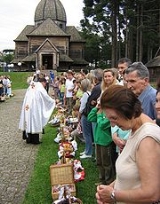
Ukrainians of Brazil

Encyclopedia
Ukrainians of Brazil are Brazilian citizens born in Ukraine
, or Brazilians of Ukrainian descent who remain connected, in some degree, to Ukrainian culture. As of 1994, 400,000 people of Ukrainian descent lived in Brazil, 80% (or approximately 350,000) of whom lived in a compact region approximately 1930 square miles (4,998.7 km²) in size (an area slightly larger than the US state of Rhode Island
), in the hilly south central part of State of Paraná
in southern Brazil. They refer to this region as "Brazilian Ukraine." Smaller numbers of Ukrainians have settled in São Paulo, Santa Catarina
, and Rio Grande do Sul
. The cities with the largest number of Ukrainians are Prudentópolis
(approximately 38,000 Ukrainians, or 75% of the city's population), Curitiba
(33,000 Ukrainians), and União da Vitória
(approximately 26,400 Ukrainians or 50% of the city's population). In 2009 the Ukrainian population in Brazil was estimated to be 500,000 people.
Brazil has the third largest Ukrainian community in the Americas, and the third largest Ukrainian population outside of the former Soviet Union; only Canada and the United States have larger Ukrainian populations. In comparison to Ukrainians in North America, the Ukrainian community in Brazil (as well as in neighboring Argentina
) tends to be more descended from earlier waves of immigration, is poorer, more rural, has less organizational strength, and is more focused on the Church as the center of cultural identity. Seventy percent of Brazil's Ukrainians live in agricultural communities known as "colonies" where they tend crops such as wheat, rye, buckwheat, rice, black beans, and erva mate
, a local type of tea. These colonies are isolated from modern areas of Brazil's economy and from non-Ukrainians, and in many respects closely resemble Galician (Western Ukrainian) villages of the 19th century.
s occupying small plots of land. As the population increased, the peasant families had less land to support themselves; by 1890 a peasant farm averaged only 6 acres (2.4 ha) in size. This situation created tremendous incentive to emigrate. The Ukrainians of Galicia belonged to the Ukrainian Greek Catholic Church
. The married priests
, who had formal higher education (studying in seminaries in Vienna
and Lviv
), formed the Ukrainian community's educated social elite and dominated Ukrainian Galician social, political and cultural life. The aristorcacy in Galicia were largely ethnically Polish, and in the course of struggling against them the ethnic Ukrainian priests and peasants developed a very strong sense of Ukrainian patriotism and tendency to resist assimilation.
arrived in 1872, large waves of settlers from Austro-Hungarian
controlled Galicia began coming to Brazil in 1895, mostly arriving through the port city of Paranaguá
. During a period of time known as the "Brazilian fever", between 1895–1897 more than 20,000 small farmers and landless peasants from Galicia, a region now in western Ukraine, came to Brazil after having been lured by promises of cheap land with good black soil. Some Ukrainian peasants were also encouraged by rumors that Rudolf, Crown Prince of Austria, had not died but had moved to Brazil and that he would welcome Ukrainian immigrants to that country (Ukrainians were traditionally loyal to the Austrian monarchy). The Brazilian government was interested in increasing European settlement, often paid for travel (thus enabling the poorest members of society to emigrate), and even promised to provide clothing and food to the settlers. Soon after arriving, however, the settlers found that the promises were not kept. They were given plots of uncleared land far away from civilization and weren't given any assistance. The settlers were unfamiliar with the strange climate and how to cultivate it, succumbed to diseases without any medical help, and experienced many deaths. Their suffering became known in Ukraine and even became the subject of a series of poems, "To Brazil", by the well-known Ukrainian poet Ivan Franko
. After news of their misfortune spread throughout western Ukraine, the flow of Ukrainian emigrants to Brazil decreased considerably, and Canada replaced Brazil as the main destination for Ukrainians leaving for the New World. Until 1907, only several hundred to one thousand Ukrainians came to Brazil from western Ukraine every year. From that year until 1914, approximately 15,000 to 20,000 Ukrainians were brought to Brazil by the Brazilian government in order to help build a railroad from the State of São Paulo to Rio Grande do Sul
through Paraná
.
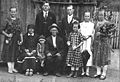
, Polesia
, as well as in smaller numbers from Transcarpathia
, Bukovina
and from Ukrainian settlements in Yugoslavia
. Among its members were some with a higher level of education and greater level of political activity. In 1922, under the initiative of a representative of the West Ukrainian National Republic
, the "Ukrainian Union of Brazil" was formed. It took a leadership role in the Ukrainian community's political, economic and cultural-educational life. At this time, Ukrainian cooperatives
made their appearance in Brazil.
The last group of Ukrainians came to Brazil between 1947–1951. These were mostly seeking asylum from Soviet persecution having played an active part in Ukraine's national liberation struggle. This group, numbering approximately 7,000 was for the most part more educated and highly skilled compared to previous immigrants, and included many intellectuals. Many of them later emigrated to other countries, especially the United States and Canada, in pursuit of better economic opportunities. The new arrivals helped create the Brazilian chapter of the Ukrainian scouting organization Plast
which continues to function in Brazil today.
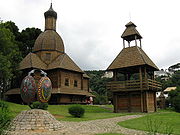 The Ukrainian Greek Catholic Church
has a strong hold on Ukrainian society in Brazil, where it is wealthy and has massive landholdings including 230 churches and five monasteries run by the Order of Saint Basil the Great
. Approximately 85% of Brazil's Ukrainians belong to this Church. Lavish onion-domed churches proliferate throughout the villages in the Ukrainian part of Brazil, despite the modest economic means of the farmers. The Church has been accused of blocking measures to improve the plight of the rural population, for fear that modernization will lessen the population's dependence on it. In some respects rural Brazilian-Ukrainian society resembles that of Galicia in the 19th century, where the influence of the Church and its priests
was so great that it has been referred to as theocratic
. In Prudentópolis
, the regional center in Parana whose population is 75% Ukrainian, the Ukrainian Catholic Cathedral of São Josafat overlooks the city center. There is also a seminary, and Ukrainian printing press run by the Church and a Ukrainian cultural museum.
It should be also noticed that some Ukrainians were also Protestant, belonging to the Baptist
and Pentecostals branch of Christianity. Originally coming from from Volyn Region
, they brought their Ukrainian traditions of worshipping God. The biggest church was the Russian Assembly of God (90% were Ukrainians and the rest Russians, Poles, Bielo Russians and few Lithuanians) based in São Paulo. It was founded around 1930 and led by Pr. Szymon Misiuk with branches in Arapongas -PR, Apucarana - PR, Curitiba - PR, Erexin and Santa Rosa - RS. São Caetano do Sul, in São Paulo State had a big concentration of Ukrainians as well and the First Ukrainian Baptist Church was established there by Rev. Dmitro Bucky. Many other churches were also based in São Paulo. The Ukrainian Protestants were not able to maintain their ethnic identity and with the oldtimers passing away, the new generation did not keep the tradition of services in Ukrainian language, churches disappeared or were turned in to Brazilian churches, and Slavic connections disappeared.
 Although most Brazilian Ukrainians have lived in Brazil for 4-5 generations and few have ever seen Ukraine, they have preserved their language
and culture to a large degree in rural Paraná state. This has largely been due to the colossal efforts of the Ukrainian Churches. In contrast, among the Ukrainians in Argentina where the Church was not as strong as in Brazil, the Ukrainian language has largely disappeared. Among those who live in the colonies, or agricultural settlements, Ukrainian is widely spoken at home, in church, and in the community, and today it is not uncommon for Ukrainian children to be unable to speak the Portuguese language until they begin school. Despite the Ukrainian language's widespread use in everyday speech, the ability to read and write is more limited, with over 50% of the Ukrainian population being unable to write in the Ukrainian language. Due to isolation from Ukraine, the Ukrainians of Brazil speak a 100 year-old form of the language's Galician or "Upper Dniestrian" dialect
. Ninety percent of Church services are conducted in the Ukrainian language (in contrast, among the 700,000 ethnic Poles in Brazil
only two churches use the Polish language). The Portuguese language has only come into wide use in the youngest generation - those who are younger than fifteen years old. Paraná boasts five Ukrainian-language radio stations, including "Zabava" which broadcasts news, Ukrainian folk and pop music, and the Divine Liturgy
. In addition, Brazil has 23 Ukrainian dance troupes. In the rural areas, Ukrainians rarely marry non-Ukrainians, and mixed marriages generally adopt the Ukrainian culture. The Ukrainians' neighbors - Caboclo
s, Poles, Germans, Italians, and some Dutch - at times accuse the Ukrainians and their priests of maintaining an exclusiveness that sometimes borders on racism, although non-Brazilians who visit the local Ukrainians are treated with the utmost civility. Ukrainians in Brazil commonly refer to themselves and to Ukrainians from other countries as "our people" (Nashi Liudy) and to non-Ukrainians of any nationality as "blacks" (Chorni).
The situation in urban areas is quite different. In the cities, Ukrainians tend to become assimilated into Brazilian culture and to adopt the Portuguese language.

As a result of an amendment to the constitution of the state of Paraná initiated by Ukrainian-Brazilian Deputy Vira Vichymyshyn Azhibert, the Ukrainian language is now taught in state schools as well. In March 1991, it was taught in 4 state schools with 600 students; the number of public schools adopting the Ukrainian language was expected to grow. The Federal University of Paraná
in Curitiba
has organized a pedagogical course for Ukrainian-language instructors. Ukrainian Saturday schools operate in Curitiba
.
Ukraine
Ukraine is a country in Eastern Europe. It has an area of 603,628 km², making it the second largest contiguous country on the European continent, after Russia...
, or Brazilians of Ukrainian descent who remain connected, in some degree, to Ukrainian culture. As of 1994, 400,000 people of Ukrainian descent lived in Brazil, 80% (or approximately 350,000) of whom lived in a compact region approximately 1930 square miles (4,998.7 km²) in size (an area slightly larger than the US state of Rhode Island
Rhode Island
The state of Rhode Island and Providence Plantations, more commonly referred to as Rhode Island , is a state in the New England region of the United States. It is the smallest U.S. state by area...
), in the hilly south central part of State of Paraná
Paraná (state)
Paraná is one of the states of Brazil, located in the South of the country, bordered on the north by São Paulo state, on the east by the Atlantic Ocean, on the south by Santa Catarina state and the Misiones Province of Argentina, and on the west by Mato Grosso do Sul and the republic of Paraguay,...
in southern Brazil. They refer to this region as "Brazilian Ukraine." Smaller numbers of Ukrainians have settled in São Paulo, Santa Catarina
Santa Catarina (state)
Santa Catarina is a state in southern Brazil with one of the highest standards of living in Latin America. Its capital is Florianópolis, which mostly lies on the Santa Catarina Island. Neighbouring states are Rio Grande do Sul to the south and Paraná to the north. It is bounded on the east by...
, and Rio Grande do Sul
Rio Grande do Sul
Rio Grande do Sul is the southernmost state in Brazil, and the state with the fifth highest Human Development Index in the country. In this state is located the southernmost city in the country, Chuí, on the border with Uruguay. In the region of Bento Gonçalves and Caxias do Sul, the largest wine...
. The cities with the largest number of Ukrainians are Prudentópolis
Prudentópolis
Prudentópolis is a Brazilian city in the state of Paraná, in Southern Brazil. As of 2008, it had a population of 50,614 people. It is the center of the Ukrainian community in Brazil.-History:...
(approximately 38,000 Ukrainians, or 75% of the city's population), Curitiba
Curitiba
Curitiba is the capital of the Brazilian state of Paraná. It is the largest city with the biggest economy of both Paraná and southern Brazil. The population of Curitiba numbers approximately 1.75 million people and the latest GDP figures for the city surpass US$61 billion according to...
(33,000 Ukrainians), and União da Vitória
União da Vitória
União da Vitória is a city located in the south of the State of Paraná, Brazil. Its population was about 51.858 people in 2006. In the economic area, União da Vitória's GDP is of US$ 115,364,648.65.- History :...
(approximately 26,400 Ukrainians or 50% of the city's population). In 2009 the Ukrainian population in Brazil was estimated to be 500,000 people.
Brazil has the third largest Ukrainian community in the Americas, and the third largest Ukrainian population outside of the former Soviet Union; only Canada and the United States have larger Ukrainian populations. In comparison to Ukrainians in North America, the Ukrainian community in Brazil (as well as in neighboring Argentina
Ukrainians of Argentina
The Ukrainian Argentine are an ethnic minority in Argentina; although the Argentine census does not provide data on ethnic origins, estimates of the Ukrainian population range from 305,000 to 500,000 people...
) tends to be more descended from earlier waves of immigration, is poorer, more rural, has less organizational strength, and is more focused on the Church as the center of cultural identity. Seventy percent of Brazil's Ukrainians live in agricultural communities known as "colonies" where they tend crops such as wheat, rye, buckwheat, rice, black beans, and erva mate
Yerba mate
Maté, yerba maté or erva maté , Ilex paraguariensis, is a species of holly native to subtropical South America in northeastern Argentina, Bolivia, southern Brazil, Uruguay and Paraguay...
, a local type of tea. These colonies are isolated from modern areas of Brazil's economy and from non-Ukrainians, and in many respects closely resemble Galician (Western Ukrainian) villages of the 19th century.
Background
Most Ukrainians in Brazil have roots in the Ukrainian region of eastern Galicia. In the 19th century Galicia was an impoverished, economically underdeveloped agrarian region of the Austro-Hungarian Empire. Most ethnic Ukrainians were peasantPeasant
A peasant is an agricultural worker who generally tend to be poor and homeless-Etymology:The word is derived from 15th century French païsant meaning one from the pays, or countryside, ultimately from the Latin pagus, or outlying administrative district.- Position in society :Peasants typically...
s occupying small plots of land. As the population increased, the peasant families had less land to support themselves; by 1890 a peasant farm averaged only 6 acres (2.4 ha) in size. This situation created tremendous incentive to emigrate. The Ukrainians of Galicia belonged to the Ukrainian Greek Catholic Church
Ukrainian Greek Catholic Church
The Ukrainian Greek Catholic Church , Ukrainska Hreko-Katolytska Tserkva), is the largest Eastern Rite Catholic sui juris particular church in full communion with the Holy See, and is directly subject to the Pope...
. The married priests
Western Ukrainian Clergy
The Western Ukrainian clergy of the Ukrainian Greek Catholic Church were a hereditary tight-knit social caste that dominated western Ukrainian society from the late eighteenth until the mid twentieth centuries, following the reforms instituted by Joseph II, Emperor of Austria...
, who had formal higher education (studying in seminaries in Vienna
Vienna
Vienna is the capital and largest city of the Republic of Austria and one of the nine states of Austria. Vienna is Austria's primary city, with a population of about 1.723 million , and is by far the largest city in Austria, as well as its cultural, economic, and political centre...
and Lviv
Lviv
Lviv is a city in western Ukraine. The city is regarded as one of the main cultural centres of today's Ukraine and historically has also been a major Polish and Jewish cultural center, as Poles and Jews were the two main ethnicities of the city until the outbreak of World War II and the following...
), formed the Ukrainian community's educated social elite and dominated Ukrainian Galician social, political and cultural life. The aristorcacy in Galicia were largely ethnically Polish, and in the course of struggling against them the ethnic Ukrainian priests and peasants developed a very strong sense of Ukrainian patriotism and tendency to resist assimilation.
Ukrainian Immigration Prior to 1914: the First Wave
The majority of Ukrainians in Brazil are descended from immigrants who arrived in the country prior to World War I. Although the first settler from UkraineUkraine
Ukraine is a country in Eastern Europe. It has an area of 603,628 km², making it the second largest contiguous country on the European continent, after Russia...
arrived in 1872, large waves of settlers from Austro-Hungarian
Austria-Hungary
Austria-Hungary , more formally known as the Kingdoms and Lands Represented in the Imperial Council and the Lands of the Holy Hungarian Crown of Saint Stephen, was a constitutional monarchic union between the crowns of the Austrian Empire and the Kingdom of Hungary in...
controlled Galicia began coming to Brazil in 1895, mostly arriving through the port city of Paranaguá
Paranaguá
Paranaguá is a city in the state of Paraná in Brazil. Founded in 1648, it is Paraná's oldest city.It is known for its excellent port facilities, being the sea port for Curitiba, the capital of Paraná....
. During a period of time known as the "Brazilian fever", between 1895–1897 more than 20,000 small farmers and landless peasants from Galicia, a region now in western Ukraine, came to Brazil after having been lured by promises of cheap land with good black soil. Some Ukrainian peasants were also encouraged by rumors that Rudolf, Crown Prince of Austria, had not died but had moved to Brazil and that he would welcome Ukrainian immigrants to that country (Ukrainians were traditionally loyal to the Austrian monarchy). The Brazilian government was interested in increasing European settlement, often paid for travel (thus enabling the poorest members of society to emigrate), and even promised to provide clothing and food to the settlers. Soon after arriving, however, the settlers found that the promises were not kept. They were given plots of uncleared land far away from civilization and weren't given any assistance. The settlers were unfamiliar with the strange climate and how to cultivate it, succumbed to diseases without any medical help, and experienced many deaths. Their suffering became known in Ukraine and even became the subject of a series of poems, "To Brazil", by the well-known Ukrainian poet Ivan Franko
Ivan Franko
Ivan Yakovych Franko was a Ukrainian poet, writer, social and literary critic, journalist, interpreter, economist, political activist, doctor of philosophy, the author of the first detective novels and modern poetry in the Ukrainian language....
. After news of their misfortune spread throughout western Ukraine, the flow of Ukrainian emigrants to Brazil decreased considerably, and Canada replaced Brazil as the main destination for Ukrainians leaving for the New World. Until 1907, only several hundred to one thousand Ukrainians came to Brazil from western Ukraine every year. From that year until 1914, approximately 15,000 to 20,000 Ukrainians were brought to Brazil by the Brazilian government in order to help build a railroad from the State of São Paulo to Rio Grande do Sul
Rio Grande do Sul
Rio Grande do Sul is the southernmost state in Brazil, and the state with the fifth highest Human Development Index in the country. In this state is located the southernmost city in the country, Chuí, on the border with Uruguay. In the region of Bento Gonçalves and Caxias do Sul, the largest wine...
through Paraná
Paraná (state)
Paraná is one of the states of Brazil, located in the South of the country, bordered on the north by São Paulo state, on the east by the Atlantic Ocean, on the south by Santa Catarina state and the Misiones Province of Argentina, and on the west by Mato Grosso do Sul and the republic of Paraguay,...
.
The second and third waves of Ukrainian immigration
Between the two world wars, approximately 9,000 more Ukrainians immigrated to Brazil. This group was more diverse, coming not only from the Galicia region in Ukraine but also from VolhyniaVolhynia
Volhynia, Volynia, or Volyn is a historic region in western Ukraine located between the rivers Prypiat and Southern Bug River, to the north of Galicia and Podolia; the region is named for the former city of Volyn or Velyn, said to have been located on the Southern Bug River, whose name may come...
, Polesia
Polesia
Polesia is one of the largest European swampy areas, located in the south-western part of the Eastern-European Lowland, mainly within Belarus and Ukraine but also partly within Poland and Russia...
, as well as in smaller numbers from Transcarpathia
Carpathian Ruthenia
Carpathian Ruthenia is a region in Eastern Europe, mostly located in western Ukraine's Zakarpattia Oblast , with smaller parts in easternmost Slovakia , Poland's Lemkovyna and Romanian Maramureş.It is...
, Bukovina
Bukovina
Bukovina is a historical region on the northern slopes of the northeastern Carpathian Mountains and the adjoining plains.-Name:The name Bukovina came into official use in 1775 with the region's annexation from the Principality of Moldavia to the possessions of the Habsburg Monarchy, which became...
and from Ukrainian settlements in Yugoslavia
Yugoslavia
Yugoslavia refers to three political entities that existed successively on the western part of the Balkans during most of the 20th century....
. Among its members were some with a higher level of education and greater level of political activity. In 1922, under the initiative of a representative of the West Ukrainian National Republic
West Ukrainian National Republic
The West Ukrainian People's Republic was a short-lived republic that existed in late 1918 and early 1919 in eastern Galicia, that claimed parts of Bukovina and Carpathian Ruthenia and included the cities of Lviv , Przemyśl , Kolomyia , and Stanislaviv...
, the "Ukrainian Union of Brazil" was formed. It took a leadership role in the Ukrainian community's political, economic and cultural-educational life. At this time, Ukrainian cooperatives
Ukrainian cooperative movement
The Ukrainian Cooperative Movement was a movement based primarily in Western Ukraine that addressed the economic plight of the western Ukrainian people through the creation of financial, agricultural and trade cooperatives that enabled western Ukrainians to pool their resources, to obtain less...
made their appearance in Brazil.
The last group of Ukrainians came to Brazil between 1947–1951. These were mostly seeking asylum from Soviet persecution having played an active part in Ukraine's national liberation struggle. This group, numbering approximately 7,000 was for the most part more educated and highly skilled compared to previous immigrants, and included many intellectuals. Many of them later emigrated to other countries, especially the United States and Canada, in pursuit of better economic opportunities. The new arrivals helped create the Brazilian chapter of the Ukrainian scouting organization Plast
Plast
The Plast National Scout Organization of Ukraine commonly called Ukrainian Plast or simply Plast is the largest Scouting organization in Ukraine.-First Phase: 1911-1920:...
which continues to function in Brazil today.
Religion
Ukrainian Greek Catholic Church
The Ukrainian Greek Catholic Church , Ukrainska Hreko-Katolytska Tserkva), is the largest Eastern Rite Catholic sui juris particular church in full communion with the Holy See, and is directly subject to the Pope...
has a strong hold on Ukrainian society in Brazil, where it is wealthy and has massive landholdings including 230 churches and five monasteries run by the Order of Saint Basil the Great
Order of Saint Basil the Great
The Order of St. Basil the Great also known as the Basilian Order of Saint Josaphat is an monastic religious order of the Greek Catholic Churches that is present in many countries and that has its Mother House in Rome. The order received approbation on August 20, 1631...
. Approximately 85% of Brazil's Ukrainians belong to this Church. Lavish onion-domed churches proliferate throughout the villages in the Ukrainian part of Brazil, despite the modest economic means of the farmers. The Church has been accused of blocking measures to improve the plight of the rural population, for fear that modernization will lessen the population's dependence on it. In some respects rural Brazilian-Ukrainian society resembles that of Galicia in the 19th century, where the influence of the Church and its priests
Western Ukrainian Clergy
The Western Ukrainian clergy of the Ukrainian Greek Catholic Church were a hereditary tight-knit social caste that dominated western Ukrainian society from the late eighteenth until the mid twentieth centuries, following the reforms instituted by Joseph II, Emperor of Austria...
was so great that it has been referred to as theocratic
Theocracy
Theocracy is a form of organization in which the official policy is to be governed by immediate divine guidance or by officials who are regarded as divinely guided, or simply pursuant to the doctrine of a particular religious sect or religion....
. In Prudentópolis
Prudentópolis
Prudentópolis is a Brazilian city in the state of Paraná, in Southern Brazil. As of 2008, it had a population of 50,614 people. It is the center of the Ukrainian community in Brazil.-History:...
, the regional center in Parana whose population is 75% Ukrainian, the Ukrainian Catholic Cathedral of São Josafat overlooks the city center. There is also a seminary, and Ukrainian printing press run by the Church and a Ukrainian cultural museum.
It should be also noticed that some Ukrainians were also Protestant, belonging to the Baptist
Baptists in Ukraine
The Baptist Church in Ukraine is one of the oldest and most widespread Protestant Christian denominations in the country. Before the fall of the Soviet Union, over half the 1.5 million acknowledged Baptists and Pentecostals in the USSR lived in Soviet Ukraine...
and Pentecostals branch of Christianity. Originally coming from from Volyn Region
Volhynia
Volhynia, Volynia, or Volyn is a historic region in western Ukraine located between the rivers Prypiat and Southern Bug River, to the north of Galicia and Podolia; the region is named for the former city of Volyn or Velyn, said to have been located on the Southern Bug River, whose name may come...
, they brought their Ukrainian traditions of worshipping God. The biggest church was the Russian Assembly of God (90% were Ukrainians and the rest Russians, Poles, Bielo Russians and few Lithuanians) based in São Paulo. It was founded around 1930 and led by Pr. Szymon Misiuk with branches in Arapongas -PR, Apucarana - PR, Curitiba - PR, Erexin and Santa Rosa - RS. São Caetano do Sul, in São Paulo State had a big concentration of Ukrainians as well and the First Ukrainian Baptist Church was established there by Rev. Dmitro Bucky. Many other churches were also based in São Paulo. The Ukrainian Protestants were not able to maintain their ethnic identity and with the oldtimers passing away, the new generation did not keep the tradition of services in Ukrainian language, churches disappeared or were turned in to Brazilian churches, and Slavic connections disappeared.
Language and culture
Ukrainian language
Ukrainian is a language of the East Slavic subgroup of the Slavic languages. It is the official state language of Ukraine. Written Ukrainian uses a variant of the Cyrillic alphabet....
and culture to a large degree in rural Paraná state. This has largely been due to the colossal efforts of the Ukrainian Churches. In contrast, among the Ukrainians in Argentina where the Church was not as strong as in Brazil, the Ukrainian language has largely disappeared. Among those who live in the colonies, or agricultural settlements, Ukrainian is widely spoken at home, in church, and in the community, and today it is not uncommon for Ukrainian children to be unable to speak the Portuguese language until they begin school. Despite the Ukrainian language's widespread use in everyday speech, the ability to read and write is more limited, with over 50% of the Ukrainian population being unable to write in the Ukrainian language. Due to isolation from Ukraine, the Ukrainians of Brazil speak a 100 year-old form of the language's Galician or "Upper Dniestrian" dialect
Ukrainian dialects
A dialect is a territorial, professional or social variant of a standard literary language.In the Ukrainian language there are 3 major dialectical groups according to territory: the south-western group, the south-eastern group and the northern group of dialects....
. Ninety percent of Church services are conducted in the Ukrainian language (in contrast, among the 700,000 ethnic Poles in Brazil
Polish Brazilian
A Polish Brazilian is a Brazilian person of full or partial Polish ancestry, who is aware of such ancestry and remains connected, in some degree, to Polish culture, or a Polish-born person permanently residing in Brazil. The number of Polish descendants in Brazil is estimated at 1.8 million...
only two churches use the Polish language). The Portuguese language has only come into wide use in the youngest generation - those who are younger than fifteen years old. Paraná boasts five Ukrainian-language radio stations, including "Zabava" which broadcasts news, Ukrainian folk and pop music, and the Divine Liturgy
Divine Liturgy
Divine Liturgy is the common term for the Eucharistic service of the Byzantine tradition of Christian liturgy. As such, it is used in the Eastern Orthodox and Eastern Catholic Churches. Armenian Christians, both of the Armenian Apostolic Church and of the Armenian Catholic Church, use the same term...
. In addition, Brazil has 23 Ukrainian dance troupes. In the rural areas, Ukrainians rarely marry non-Ukrainians, and mixed marriages generally adopt the Ukrainian culture. The Ukrainians' neighbors - Caboclo
Caboclo
A caboclo or caboco is a person of a mixed Brazilian Indian and European ancestry. In Brazil, a caboclo is a specific type of mestiço as is the mulato, a person of a mixed Afro-Brazilian and European ancestry....
s, Poles, Germans, Italians, and some Dutch - at times accuse the Ukrainians and their priests of maintaining an exclusiveness that sometimes borders on racism, although non-Brazilians who visit the local Ukrainians are treated with the utmost civility. Ukrainians in Brazil commonly refer to themselves and to Ukrainians from other countries as "our people" (Nashi Liudy) and to non-Ukrainians of any nationality as "blacks" (Chorni).
The situation in urban areas is quite different. In the cities, Ukrainians tend to become assimilated into Brazilian culture and to adopt the Portuguese language.
Education
The Sister Servants of Mary Immaculate operate 30 Ukrainian elementary schools, 17 kindergartens, and two secondary schools. They also operate a boarding school in Prudentopolis, as well as teach instructions in the Ukrainian language on Saturdays. Only Ukrainian is spoken in the boarding school.As a result of an amendment to the constitution of the state of Paraná initiated by Ukrainian-Brazilian Deputy Vira Vichymyshyn Azhibert, the Ukrainian language is now taught in state schools as well. In March 1991, it was taught in 4 state schools with 600 students; the number of public schools adopting the Ukrainian language was expected to grow. The Federal University of Paraná
Universidade Federal do Paraná
Federal University of Paraná is a university headquartered in Curitiba, Paraná, Brazil.Established on December 19, 1912 and initially named as Universidade do Paraná , the Universidade Federal do Paraná – UFPR is regarded as the oldest Brazilian university.In 1920, the federal government split...
in Curitiba
Curitiba
Curitiba is the capital of the Brazilian state of Paraná. It is the largest city with the biggest economy of both Paraná and southern Brazil. The population of Curitiba numbers approximately 1.75 million people and the latest GDP figures for the city surpass US$61 billion according to...
has organized a pedagogical course for Ukrainian-language instructors. Ukrainian Saturday schools operate in Curitiba
Curitiba
Curitiba is the capital of the Brazilian state of Paraná. It is the largest city with the biggest economy of both Paraná and southern Brazil. The population of Curitiba numbers approximately 1.75 million people and the latest GDP figures for the city surpass US$61 billion according to...
.
Notable Brazilian nationals of Ukrainian ethnicity
- Maria BerushkoMaria BerushkoMaria Aparecida Berushko was a school teacher who died saving her students in a school fire in Brazil. She may become the first Orthodox saint in Latin America.Maria, being of Ukrainian descent, was born in 1959, in Joaquim Távora, Paraná, Brazil....
- teacher, may become the first OrthodoxOrthodox ChristianityThe term Orthodox Christianity may refer to:* the Eastern Orthodox Church and its various geographical subdivisions...
saint in South America (of Orthodox Ukrainian descent). - Héctor BabencoHector BabencoHéctor Eduardo Babenco is an Argentine-born Brazilian film director, screenwriter, producer and actor.He has worked in several countries including Argentina, Brazil and the United States....
- film director, screenwriter, producer, actor (Naturalized Brazilian, born in Argentina to Ukrainian father and Polish-Jewish mother). - Oxana NarozniakOxana NarozniakOxana Narozniak is a Ukrainian artist born in Germany and currently residing in Curitiba, Brazil. She participated in the international art exhibition "Progress of the World's Women," shown at the United Nations lobby as part of the U.N. "Women 2000" conference. Narozniak's work has also been...
- sculptor (born in Germany of Ukrainian descent, living in CuritibaCuritibaCuritiba is the capital of the Brazilian state of Paraná. It is the largest city with the biggest economy of both Paraná and southern Brazil. The population of Curitiba numbers approximately 1.75 million people and the latest GDP figures for the city surpass US$61 billion according to...
) - Vira VovkVira VovkVira Ostapivna Selianska , pen name Vira Vovk , — Ukrainian writer, critic and translator living in Brazil. She writes in Ukrainian, German and Portuguese.-Biography:...
- poetess (born in Ukraine and emigrated to Brazil after World War II) - Rafael SóbisRafael SóbisRafael Augusto Sóbis do Nascimento , commonly known as Rafael Sóbis, is a Brazilian footballer of Ukrainian descent, who plays for Fluminense.-Internacional:...
- soccer striker - Roberto Minczuk - conductor, born in Brazil of Ukrainian origin (New York Philharmonic) is probably the most notable today's Ukrainian Brazilian in the music field. Pan Minczuk has won many prestigious awards and prizes. At the recommendation of Kurt Masur, he received the 2000 Martin E. Segal Award as one of Lincoln Center's most promising young artists. Other awards include the 1997 Revelation of the Year Award, given to the most outstanding young artist by the Performing Arts Critics Association in São Paulo, and the 1991 Moinho Santista Youth Prize (the most important prize in Brazil), awarded in various disciplines for extraordinary achievement in a chosen field. Is the music director of the OSB, the Brazilian Symphony Orchestra and the Calgary Philharmonic CPO
Notable Brazilians with Ukrainian born ancestors
- Eliana Michaelichen BezerraEliana Michaelichen BezerraEliana is a Brazilian TV hostess, actress and singer. She is currently the hostess of the TV show "Eliana", broadcast at the Brazilian TV network SBT on Sundays afternoon....
(Russian-Ukrainian descent on maternal side) Popular television hostess. - Clarice LispectorClarice LispectorClarice Lispector was a Brazilian writer. Acclaimed internationally for her innovative novels and short stories, she was also a journalist...
- Writer born in Ukraine who immigrated to Brazil before the age of two. Became widely known as an influential writer in the Portuguese Language.