

UV degradation

Encyclopedia
Many natural and synthetic polymer
s are attacked by ultra-violet radiation and products made using these materials may crack or disintegrate (if they're not UV-stable). The problem is known as UV degradation, and is a common problem in products exposed to sunlight
. Continuous exposure is a more serious problem than intermittent exposure, since attack is dependent on the extent and degree of exposure.
Many pigments and dyes can also be affected, when the problem is known as phototendering
in textile
s such as curtains
or drapes.
 Common synthetic polymers which may be attacked include polypropylene
and LDPE where tertiary carbon bonds in their chain structures are the centres of attack. The ultra-violet rays activate such bonds to form free radicals, which then react further with oxygen
in the atmosphere, producing carbonyl groups in the main chain. The exposed surfaces of products may then discolour and crack, although in bad cases, complete product disintegration can occur.
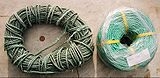
In fibre products like rope
used in outdoor applications, product life will be low because the outer fibres will be attacked first, and will easily be damaged by abrasion
for example. Discolouration of the rope may also occur, thus giving an early warning of the problem.
Polymers which possess UV-absorbing groups such as aromatic rings may also be sensitive to UV degradation. Aramid
fibres like Kevlar
for example are highly UV sensitive and must be protected from the deleterious effects of sunlight.
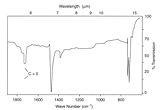 The problem can be detected before serious cracks are seen in a product using infra-red spectroscopy, where attack occurs by oxidation of bonds activated by the UV radiation forming carbonyl groups in the polymer chains.
In the example shown at left, carbonyl groups were easily detected by IR spectroscopy from a cast thin film. The product was a road cone made by rotational moulding in LDPE, which had cracked prematurely in service. Many similar cones also failed because an anti-UV additive had not been used during processing. Other plastic products which failed included polypropylene mancabs used at roadworks which cracked after service of only a few months.
for example. UV Stabilizers in plastics
usually act by absorbing the UV radiation preferentially, and dissipating the energy as low level heat. The chemicals used are similar to those used in sunscreen
cosmetic products, which protect skin from UV attack.
Modules degradation is a long-term issue according to material testings; the efficiency loss by UV degradation is about 6.81 to 9.54 % in 20 years.
Polymer
A polymer is a large molecule composed of repeating structural units. These subunits are typically connected by covalent chemical bonds...
s are attacked by ultra-violet radiation and products made using these materials may crack or disintegrate (if they're not UV-stable). The problem is known as UV degradation, and is a common problem in products exposed to sunlight
Sunlight
Sunlight, in the broad sense, is the total frequency spectrum of electromagnetic radiation given off by the Sun. On Earth, sunlight is filtered through the Earth's atmosphere, and solar radiation is obvious as daylight when the Sun is above the horizon.When the direct solar radiation is not blocked...
. Continuous exposure is a more serious problem than intermittent exposure, since attack is dependent on the extent and degree of exposure.
Many pigments and dyes can also be affected, when the problem is known as phototendering
Phototendering
Phototendering is the process by which organic fibres and textiles lose strength and flexibility as a result of exposure to sunlight. It is the ultraviolet component of the sun's spectrum which affects fibres, causing chain degradation and hence loss of strength. The rate of deterioration is also...
in textile
Textile
A textile or cloth is a flexible woven material consisting of a network of natural or artificial fibres often referred to as thread or yarn. Yarn is produced by spinning raw fibres of wool, flax, cotton, or other material to produce long strands...
s such as curtains
Curtain
A curtain is a piece of cloth intended to block or obscure light, or drafts, or water in the case of a shower curtain. Curtains hung over a doorway are known as portières...
or drapes.
Susceptible polymers
Polypropylene
Polypropylene , also known as polypropene, is a thermoplastic polymer used in a wide variety of applications including packaging, textiles , stationery, plastic parts and reusable containers of various types, laboratory equipment, loudspeakers, automotive components, and polymer banknotes...
and LDPE where tertiary carbon bonds in their chain structures are the centres of attack. The ultra-violet rays activate such bonds to form free radicals, which then react further with oxygen
Oxygen
Oxygen is the element with atomic number 8 and represented by the symbol O. Its name derives from the Greek roots ὀξύς and -γενής , because at the time of naming, it was mistakenly thought that all acids required oxygen in their composition...
in the atmosphere, producing carbonyl groups in the main chain. The exposed surfaces of products may then discolour and crack, although in bad cases, complete product disintegration can occur.
In fibre products like rope
Rope
A rope is a length of fibres, twisted or braided together to improve strength for pulling and connecting. It has tensile strength but is too flexible to provide compressive strength...
used in outdoor applications, product life will be low because the outer fibres will be attacked first, and will easily be damaged by abrasion
Abrasion (mechanical)
Abrasion is the process of scuffing, scratching, wearing down, marring, or rubbing away. It can be intentionally imposed in a controlled process using an abrasive...
for example. Discolouration of the rope may also occur, thus giving an early warning of the problem.
Polymers which possess UV-absorbing groups such as aromatic rings may also be sensitive to UV degradation. Aramid
Aramid
Aramid fibers are a class of heat-resistant and strong synthetic fibers. They are used in aerospace and military applications, for ballistic rated body armor fabric and ballistic composites, in bicycle tires, and as an asbestos substitute. The name is a portmanteau of "aromatic polyamide"...
fibres like Kevlar
Kevlar
Kevlar is the registered trademark for a para-aramid synthetic fiber, related to other aramids such as Nomex and Technora. Developed at DuPont in 1965, this high strength material was first commercially used in the early 1970s as a replacement for steel in racing tires...
for example are highly UV sensitive and must be protected from the deleterious effects of sunlight.
Detection
In the example shown at left, carbonyl groups were easily detected by IR spectroscopy from a cast thin film. The product was a road cone made by rotational moulding in LDPE, which had cracked prematurely in service. Many similar cones also failed because an anti-UV additive had not been used during processing. Other plastic products which failed included polypropylene mancabs used at roadworks which cracked after service of only a few months.
Prevention
UV attack by sunlight can be ameliorated or prevented by adding anti-UV chemicals to the polymer when mixing the ingredients, prior to shaping the product by injection mouldingInjection moulding
Injection molding is a manufacturing process for producing parts from both thermoplastic and thermosetting plastic materials. Material is fed into a heated barrel, mixed, and forced into a mold cavity where it cools and hardens to the configuration of the cavity...
for example. UV Stabilizers in plastics
UV Stabilizers in plastics
UV light stabilizers are used frequently in plastics, including cosmetics and films. The primary function is to protect the substance from the long-term degradation effects from light, most frequently ultraviolet light...
usually act by absorbing the UV radiation preferentially, and dissipating the energy as low level heat. The chemicals used are similar to those used in sunscreen
Sunscreen
Sunblock is a lotion, spray, gel or other topical product that absorbs or reflects some of the sun's ultraviolet radiation on the skin exposed to sunlight and thus helps protect against sunburn...
cosmetic products, which protect skin from UV attack.
UV degradation in material testing
The effects of UV degradation on materials that require a long service life can be measured with accelerated exposure tests. With modern solar concentrator technologies, it is possible to simulate 63 years of natural UV radiation exposure on a test device in a single year. In Solar PowerSolar power
Solar energy, radiant light and heat from the sun, has been harnessed by humans since ancient times using a range of ever-evolving technologies. Solar radiation, along with secondary solar-powered resources such as wind and wave power, hydroelectricity and biomass, account for most of the available...
Modules degradation is a long-term issue according to material testings; the efficiency loss by UV degradation is about 6.81 to 9.54 % in 20 years.
See also
- Forensic polymer engineeringForensic polymer engineeringThe study of failure in polymeric products is called forensic polymer engineering. The topic includes the fracture of plastic products, or any other reason why such a product fails in service, or fails to meet its specification...
- Polymer degradationPolymer degradationPolymer degradation is a change in the properties—tensile strength, colour, shape, etc.—of a polymer or polymer-based product under the influence of one or more environmental factors such as heat, light or chemicals such as acids, alkalis and some salts...
- DepolymerizationDepolymerizationDepolymerization is the process of converting a polymer into a monomer or a mixture of monomers.Thioglycolysis, thiolysis and phloroglucinolysis are reactions used to study condensed tannins by means of their depolymerisation. Thioglycolysis is also used to study lignin....
- Stress corrosion crackingStress corrosion crackingStress corrosion cracking is the unexpected sudden failure of normally ductile metals subjected to a tensile stress in a corrosive environment, especially at elevated temperature in the case of metals. SCC is highly chemically specific in that certain alloys are likely to undergo SCC only when...