

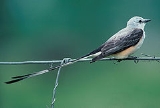
Tyranni

Encyclopedia
The suborder of passerine
bird
s Tyranni (the suboscines) includes about 1,000 species
, the large majority of which are South America
n. It is named after the type genus
Tyrannus.
These have a different anatomy
of the syrinx
musculature than the oscines (songbirds of the larger suborder Passeri), hence its common name of sub-oscines. The available morphological
, mt and nDNA sequence
, and biogeographical data, as well as the (scant) fossil
record, agrees that these two major passerine suborders are evolution
arily distinct clade
s.
The Eurylaimides contain the Old World
suboscines - mainly distributed in tropical regions around the Indian Ocean
- and a single American
species, the Broad-billed Sapayoa
:
The former three are usually placed into a distinct superfamily
from the pittas, Eurylaimoidea. More recently, as passeriform relationships become better resolved, there is an increasing trend to elevate the Eurylaimides to suborder rank.
The Tyrannides contain all the suboscines from the Americas
, except the Broad-billed Sapayoa:
This group has been separated into three parvorders by Sibley & Ahlquist. However, as indicated above, DNA-DNA hybridization has shown to be not very well suited to reliably resolve the suboscine phylogeny. It was eventually determined that there was a simple dichotomy
between the antbirds and allies (tracheophones), and the tyrant-flycatchers and allies. Given that the "parvorder" arrangement originally advanced is certainly obsolete (see e.g. Irestedt et al. 2002 for tracheophone phylogeny) - more so if the Eurylaimides are elevated to a distinct suborder - it would be advisable to rank the clades as superfamilies
, or if the broadbill group is considered a separate suborder, as infraorders. In the former case, the name Furnarioidea would be available for the tracheophones, whereas "Tyrannoidea", the "bronchophone" equivalent, has not yet been formally defined.
In the latter case, the tracheophones would be classified as "Furnariides",
while the Tyrannides would be restricted to the tyrant-flycatchers and other "bronchophone" families.
The tracheophones contain the Furnariidae, Thamnophilidae, Formicariidae (probably including most tapaculos), and Conopophagidae. The tyrant-flycatcher clade includes the namesake family, the Tityridae, the Cotingidae, and the Pipridae.
Passerine
A passerine is a bird of the order Passeriformes, which includes more than half of all bird species. Sometimes known as perching birds or, less accurately, as songbirds, the passerines form one of the most diverse terrestrial vertebrate orders: with over 5,000 identified species, it has roughly...
bird
Bird
Birds are feathered, winged, bipedal, endothermic , egg-laying, vertebrate animals. Around 10,000 living species and 188 families makes them the most speciose class of tetrapod vertebrates. They inhabit ecosystems across the globe, from the Arctic to the Antarctic. Extant birds range in size from...
s Tyranni (the suboscines) includes about 1,000 species
Species
In biology, a species is one of the basic units of biological classification and a taxonomic rank. A species is often defined as a group of organisms capable of interbreeding and producing fertile offspring. While in many cases this definition is adequate, more precise or differing measures are...
, the large majority of which are South America
South America
South America is a continent situated in the Western Hemisphere, mostly in the Southern Hemisphere, with a relatively small portion in the Northern Hemisphere. The continent is also considered a subcontinent of the Americas. It is bordered on the west by the Pacific Ocean and on the north and east...
n. It is named after the type genus
Type genus
In biological classification, a type genus is a representative genus, as with regard to a biological family. The term and concept is used much more often and much more formally in zoology than it is in botany, and the definition is dependent on the nomenclatural Code that applies:* In zoological...
Tyrannus.
These have a different anatomy
Anatomy
Anatomy is a branch of biology and medicine that is the consideration of the structure of living things. It is a general term that includes human anatomy, animal anatomy , and plant anatomy...
of the syrinx
Syrinx (biology)
Syrinx is the name for the vocal organ of birds. Located at the base of a bird's trachea, it produces sounds without the vocal cords of mammals. The sound is produced by vibrations of some or all of the membrana tympaniformis and the pessulus caused by air flowing through the syrinx...
musculature than the oscines (songbirds of the larger suborder Passeri), hence its common name of sub-oscines. The available morphological
Morphology (biology)
In biology, morphology is a branch of bioscience dealing with the study of the form and structure of organisms and their specific structural features....
, mt and nDNA sequence
DNA sequence
The sequence or primary structure of a nucleic acid is the composition of atoms that make up the nucleic acid and the chemical bonds that bond those atoms. Because nucleic acids, such as DNA and RNA, are unbranched polymers, this specification is equivalent to specifying the sequence of...
, and biogeographical data, as well as the (scant) fossil
Fossil
Fossils are the preserved remains or traces of animals , plants, and other organisms from the remote past...
record, agrees that these two major passerine suborders are evolution
Evolution
Evolution is any change across successive generations in the heritable characteristics of biological populations. Evolutionary processes give rise to diversity at every level of biological organisation, including species, individual organisms and molecules such as DNA and proteins.Life on Earth...
arily distinct clade
Clade
A clade is a group consisting of a species and all its descendants. In the terms of biological systematics, a clade is a single "branch" on the "tree of life". The idea that such a "natural group" of organisms should be grouped together and given a taxonomic name is central to biological...
s.
Systematics
According to Sibley and Ahlquist's DNA-DNA hybridization studies the Tyranni can be divided into three suborders: Acanthisittides, Eurylaimides, and Tyrannides. The first, containing the Acanthisittidae (New Zealand "wrens"), is of disputed position. Current opinion is that they are more likely a very distinct and ancient lineage, and constitute a suborder on their own.The Eurylaimides contain the Old World
Old World
The Old World consists of those parts of the world known to classical antiquity and the European Middle Ages. It is used in the context of, and contrast with, the "New World" ....
suboscines - mainly distributed in tropical regions around the Indian Ocean
Indian Ocean
The Indian Ocean is the third largest of the world's oceanic divisions, covering approximately 20% of the water on the Earth's surface. It is bounded on the north by the Indian Subcontinent and Arabian Peninsula ; on the west by eastern Africa; on the east by Indochina, the Sunda Islands, and...
- and a single American
Americas
The Americas, or America , are lands in the Western hemisphere, also known as the New World. In English, the plural form the Americas is often used to refer to the landmasses of North America and South America with their associated islands and regions, while the singular form America is primarily...
species, the Broad-billed Sapayoa
Broad-billed Sapayoa
The Sapayoa or Broad-billed Sapayoa is a suboscine passerine found in lowland rainforests in Panama and northwest South America. As the epithet aenigma implies, its relationships have long been elusive...
:
- EurylaimidaeBroadbillThe broadbills are a family of small passerine birds, Eurylaimidae. The Smithornis and Pseudocalyptomena species occur in sub-Saharan Africa; the rest extend from the eastern Himalayas to Sumatra and Borneo. The family possibly also includes the Sapayoa from the Neotropics and the asities from...
: broadbills - PhilepittidaeAsityThe asities, are a family, the Philepittidae, of small suboscine passerine birds. The family consists of four species in two genera endemic to Madagascar. They were thought to have been related to the pittas, hence the scientific name of the family, but a 1993 study suggested that they are actually...
: asities - Sapayoidae: Broad-billed Sapayoa
- PittidaePittaPitta may stand for:*Pittas, a family of tropical birds*Pitta bread *Pitta , an island in the Dodecanese archipelago, in the Aegean Sea...
: pittas
The former three are usually placed into a distinct superfamily
Taxonomic rank
In biological classification, rank is the level in a taxonomic hierarchy. Examples of taxonomic ranks are species, genus, family, and class. Each rank subsumes under it a number of less general categories...
from the pittas, Eurylaimoidea. More recently, as passeriform relationships become better resolved, there is an increasing trend to elevate the Eurylaimides to suborder rank.
The Tyrannides contain all the suboscines from the Americas
Americas
The Americas, or America , are lands in the Western hemisphere, also known as the New World. In English, the plural form the Americas is often used to refer to the landmasses of North America and South America with their associated islands and regions, while the singular form America is primarily...
, except the Broad-billed Sapayoa:
- Furnariidae: ovenbirds and woodcreepers
- ThamnophilidaeAntbirdThe antbirds are a large family, Thamnophilidae, of passerine birds found across subtropical and tropical Central and South America, from Mexico to Argentina. There are more than 200 species, known variously as antshrikes, antwrens, antvireos, fire-eyes, bare-eyes and bushbirds...
: antbirds - FormicariidaeFormicariidaeThe Formicariidae, formicariids, or ground antbirds are a family of smallish passerine birds of subtropical and tropical Central and South America. They are between 10 and 20 cm in length, and are related to the antbirds, Thamnophilidae, and gnateaters, Conopophagidae...
: antpittas and antthrushes, probably including most tapaculos - Rhinocryptidae: tapaculos
- Conopophagidae: gnateaters and gnatpittas
- Tyrannidae: tyrant-flycatchers
- TityridaeTityridaeTityridae is family of suboscine passerine birds found in forest and woodland in the Neotropics. The approximately 30 species in this family were formerly spread over the families Tyrannidae, Pipridae and Cotingidae . As yet, no widely accepted common name exists for the family, although Tityras...
: Tityras and allies; probably includes the SharpbillSharpbillThe Sharpbill is a small drab bird. Its range is from the mountainous areas of tropical South America and southern Central America ....
. - Cotingidae: cotingas
- Pipridae: manakins
This group has been separated into three parvorders by Sibley & Ahlquist. However, as indicated above, DNA-DNA hybridization has shown to be not very well suited to reliably resolve the suboscine phylogeny. It was eventually determined that there was a simple dichotomy
Dichotomy
A dichotomy is any splitting of a whole into exactly two non-overlapping parts, meaning it is a procedure in which a whole is divided into two parts...
between the antbirds and allies (tracheophones), and the tyrant-flycatchers and allies. Given that the "parvorder" arrangement originally advanced is certainly obsolete (see e.g. Irestedt et al. 2002 for tracheophone phylogeny) - more so if the Eurylaimides are elevated to a distinct suborder - it would be advisable to rank the clades as superfamilies
Taxonomic rank
In biological classification, rank is the level in a taxonomic hierarchy. Examples of taxonomic ranks are species, genus, family, and class. Each rank subsumes under it a number of less general categories...
, or if the broadbill group is considered a separate suborder, as infraorders. In the former case, the name Furnarioidea would be available for the tracheophones, whereas "Tyrannoidea", the "bronchophone" equivalent, has not yet been formally defined.
In the latter case, the tracheophones would be classified as "Furnariides",
while the Tyrannides would be restricted to the tyrant-flycatchers and other "bronchophone" families.
The tracheophones contain the Furnariidae, Thamnophilidae, Formicariidae (probably including most tapaculos), and Conopophagidae. The tyrant-flycatcher clade includes the namesake family, the Tityridae, the Cotingidae, and the Pipridae.