
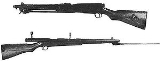
The
Type 44 Cavalry Rifle (四四式騎銃
Yonyon-shiki kijū or
Yonjūyon-shiki kijū) is a Japanese bolt-action rifle. This rifle is also often referred to as a
Type 44 Carbine. It was a development of the
Arisaka Type 38 Cavalry RifleThe Japanese was a short barreled version of the bolt-action Type 38 rifle, it was used by the Japanese cavalry, engineers and artillery troops during World War II. It entered service in 1905. The rifle was very accurate. The rifle barrel was 310 mm shorter than the standard rifle...
, the main difference being the
bayonetA bayonet is a knife, dagger, sword, or spike-shaped weapon designed to fit in, on, over or underneath the muzzle of a rifle, musket or similar weapon, effectively turning the gun into a spear...
is a needle type and it can be folded backwards and locks underneath the barrel. The Type 44 also included a compartment in the buttstock for which to store a unique two-piece cleaning rod. The cleaning rod storage compartment was accessed via an ingenious rotating door.
Discussion
Ask a question about 'Type 44 Cavalry Rifle'
Start a new discussion about 'Type 44 Cavalry Rifle'
Answer questions from other users
|
The
Type 44 Cavalry Rifle (四四式騎銃
Yonyon-shiki kijū or
Yonjūyon-shiki kijū) is a Japanese bolt-action rifle. This rifle is also often referred to as a
Type 44 Carbine. It was a development of the
Arisaka Type 38 Cavalry RifleThe Japanese was a short barreled version of the bolt-action Type 38 rifle, it was used by the Japanese cavalry, engineers and artillery troops during World War II. It entered service in 1905. The rifle was very accurate. The rifle barrel was 310 mm shorter than the standard rifle...
, the main difference being the
bayonetA bayonet is a knife, dagger, sword, or spike-shaped weapon designed to fit in, on, over or underneath the muzzle of a rifle, musket or similar weapon, effectively turning the gun into a spear...
is a needle type and it can be folded backwards and locks underneath the barrel. The Type 44 also included a compartment in the buttstock for which to store a unique two-piece cleaning rod. The cleaning rod storage compartment was accessed via an ingenious rotating door.
It fired the 6.5×50mm Arisaka round, and capacity was an internal five-round box magazine, it was fed via five-round stripper loaded clips.
It entered production in 1911 and entered service in 1912, and served on until the end of the
Second World WarWorld War II, or the Second World War , was a global conflict lasting from 1939 to 1945, involving most of the world's nations—including all of the great powers—eventually forming two opposing military alliances: the Allies and the Axis...
in 1945, production of the rifle ran until three years prior to the end of the Second World War; 1942. Approximately 91,900 Type 44 rifles were produced by Japanese arsenals during these years.
The Type 44 was produced in three variations (referred to as First, Second, and Third variations). The major differences between variations was in the folding bayonet housing, which increased the length and durability with each variation.
A minor difference between variations may be found in the cleaning rod compartment found beneath the buttplate. First variation stocks had two holes drilled for each half of the cleaning rod, while second and third variations had a single larger hole to house both halves of the cleaning rod.