

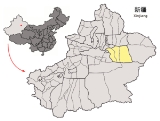
Turfan

Encyclopedia
Turpan also known as Turfan or Tulufan, is an oasis
county-level city
in Turpan Prefecture, in Xinjiang Uyghur Autonomous Region of the People's Republic of China
. Its population was 254,900 at the end of 2003.
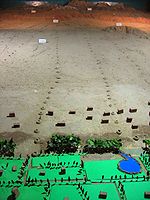
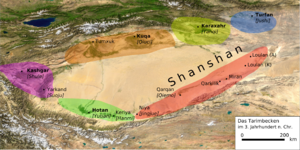 Turpan has long been the centre of a fertile oasis
(with water provided by karez) and an important trade centre. It was historically located along the Silk Road
's northern route, at which time it was adjacent to the kingdoms of Korla
and Karashahr to the southwest and the town of Qarakhoja (Gaochang
) to the southeast.
The peoples of the Kingdoms of Nearer and Further Jushi 車師 (the Turpan Oasis and the region to the north of the mountains near modern Jimasa), were closely related. It was originally one kingdom called Gushi 故師 (Wade-Giles: Ku-shih) which the Chinese conquered in 107 BCE. It was subdivided into two kingdoms by the Chinese in 60 BCE. During the Han
era the city changed hands several times between the Xiongnu and the Han, interspersed with short periods of independence.
After the fall of the Han Dynasty, the region was virtually independent but tributary to various dynasties. Until the 5th century CE, the capital of this kingdom was Jiaohe (modern Yarghul - 16 km west of Turpan).
From 487 to 541 AD, Turpan was an independent Kingdom ruled by a Turkic tribe known to the Chinese as the Tiele
. The Rouran
Khaganate defeated the Tiele and subjugated Turpan, but soon afterwards the Rouran were destroyed by the Göktürks
.
The Tang Dynasty
reconquered the Tarim Basin by the 7th century AD. During the 7th, 8th, and early 9th centuries the Tibetan Empire
, Tang, and Turks fought to conquer the Tarim Basin. Sogdians and Chinese engaged in extensive commercial activities with each other under Tang rule. Sogdians were mostly Mazdaist, in Turpan inns were located, many brothels catering to merchants were available Kucha
and Khotan
. In Astana, a contract written in Sogdian detailing the sale of a Sogdian girl to a Chinese man was discovered dated to 639 AD. Wu Zhen, who worked on the Astana site asserted that, despite the fact that individualslaves were common among silk route houses, from early Niya
documents an increase in the selling of slaves was recorded in Turpan documents.
Rong Xinjiang has located 21 7th century marriage contracts where one Sogdian spouse was present, 18 out of these 21 showed the other partner was also a Sogdian. The only Sogdian men who married Chinese women were highly eminent officials. Sogdian men usually married Sogdian women, any miscegenation between Chinese and Sogdians was between Chinese master and Sogdian slave girl. Several commercial interactions were recorded Kang Wupoyan sold a camel to a commander of a company priced at 14 silk bolts in 673. a merchant from Samarkand (Kangzhou) although he did not live in there. A Chang'an
native called Tang Rong bought a girl aged 11 for 40 silk bolts in 731 from a Sogdian merchant. Five men swore that the girl was never free before enslavement, since The Tang Code
forbade commoners to be sold as slaves.
The Uyghurs established a Kingdom in Turpan (known as the Uyghuria Idikut state or Kara-Khoja Uyghur Idikut Kingdom) that lasted from 856 to 1389 AD, surviving as a vassal of the Mongol Empire
. This Kingdom, led by Idikuts, or Saint Spiritual Rulers, was established after the fall of the Uyghur Empire
to the Kyrgyz Turks
. Last Idikut left Turpan area in 1284 for Kumul, then Gansu
to seek protection of Yuan Dynasty
, but local uyghur Buddhist rulers still held power until Invasion of Moghul
Hizir Khoja in 1389. The conversion of the local Buddhist population to Islam was completed nevertheless only in the second half of the 15th century
 The Moghul ruler of Turpan Yunus Khan
, also known as Ḥājjī `Ali, (ruled 1462-1478) unified Moghulistan
(roughly corresponding to today's Eastern Xinjiang) under his authority in 1472. Around that time, a conflict with the Ming China
started over the issues of tribute trade: Turpanians benefited from sending "tribute missions" to China, which allowed them to receive valuable gifts from the Ming emperors and to do plenty of trading on the sides; the Chinese, however, felt that receiving and entertaining these missions was just too expensive. Yunus Khan was irritated by the restrictions on the frequency and size of Turpanian missions (no more than one mission in 5 years, with no more than 10 members) imposed by the Ming government in 1465, and by the Ming's refusal to bestow sufficiently luxurious gifts on his envoys (1469). According, in 1473 he went to war against China, and even succeeded in capturing Hami in 1473 from the Oirat Mongol Henshen and holding it for a while, until Ali was repulsed by the Ming Dynasty into Turfan, but he reoccupied it after Ming left. Henshen's Mongols recaptured Hami twice in 1482 and 1483, but the son of Ali, Ahmed, reconqured it in 1493 and captured the Hami leader and the resident of China in Hami (hami was a vassal state to Ming). In response, the Ming Dynasty imposed an economic blockade on Turfan and kicked out all the Uyghurs from Gansu. It became so harsh for Turfan that Ahmed left. Ahmed's son Mansur then took over Hami in 1517. These conflicts were called the Ming Turpan Border Wars. Several times, after occupying Hami, Mansur tried to attack China in 1524 with 20,000 men, but was beaten by Chinese forces. The Turpan kingdom under Mansur in alliance with Oirat Mongols tried to raid Suzhou in Gansu in 1528, but were severely defeated by Ming Chinese forces and suffered heavy casualties. The Chinese refused to lift the economic blockade and restrictions that had led to the battles, and continued restricting Turpan's tribute and trade with China. Turfan also annexed Hami.
 Francis Younghusband
visited Turpan in 1887 on his overland journey from Beijing
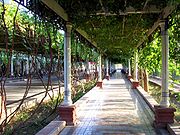
to India. He said it consisted of two walled towns, a Chinese one with a population of no more than 5,000 and, about a mile (1.6 km) to the west, a Turk town of "probably" 12,000 to 15,000 inhabitants. The town (presumably the "Turk town") had four gateways, one for each of the cardinal directions, of solid brickwork and massive wooden doors plated with iron and covered by a semicircular bastion. The well-kept walls were of mud and about 35 ft (10.7 m) tall and 20 to 30 feet (6 to 9 m) thick, with loopholes at the top. There was a level space about 15 yards (14 m) wide outside the main walls surrounded by a musketry wall about 8 ft (2.4 m) high, with a ditch around it some 12 ft (3.7 m) deep and 20 ft (6 m) wide). There were drumtowers over the gateways, small square towers at the corners and two small square bastions between the corners and the gateways, "two to each front." Wheat, cotton, poppies, melons and grapes were grown in the surrounding fields.
Turpan grapes impressed other travelers to the region as well. The 19th-century Russian explorer Grigory Grumm-Grzhimaylo
,
thought the local raisins may be "the best in the world", and noted the buildings
of a "perfectly peculiar design" used for drying them.
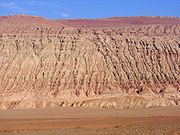 Turpan is located about 150 km (93 mi) southeast of Ürümqi
, Xinjiang's capital, in a mountain basin, on the northern side of the Turpan Depression, at an elevation of 30 m (98 ft) above sea level. Outside of Turpan is a small volcanic cone that is said to have erupted in 1120 as described in the Song Dynasty
Turpan has a harsh, cold desert climate
(Köppen
BWk), with long and very hot summers, winters that are quite cold and moderately long, and brief spring and autumn in between. Annual precipitation is very low, amounting to only 15.7 millimetre (0.618110236220472 in). July is the hottest month, averaging 32.2 °C (90 °F), while January is the coldest, at −7.6 °C, for an annual mean of 14.4 °C (57.9 °F).
Extremes have ranged from −28.9 °C to 48.1 °C (119 °F).
However, the very heat and dryness of the summer, when combined with the area's ancient system of irrigation, allows the countryside around Turpan to produce great quantities of high-quality fruit.
. It is the junction for the Lanzhou-Xinjiang and the Southern Xinjiang
Railways.
Oasis
In geography, an oasis or cienega is an isolated area of vegetation in a desert, typically surrounding a spring or similar water source...
county-level city
County-level city
A county-level city is a county-level administrative division of mainland China. County-level cities are usually governed by prefecture-level divisions, but a few are governed directly by province-level divisions....
in Turpan Prefecture, in Xinjiang Uyghur Autonomous Region of the People's Republic of China
People's Republic of China
China , officially the People's Republic of China , is the most populous country in the world, with over 1.3 billion citizens. Located in East Asia, the country covers approximately 9.6 million square kilometres...
. Its population was 254,900 at the end of 2003.
History
Oasis
In geography, an oasis or cienega is an isolated area of vegetation in a desert, typically surrounding a spring or similar water source...
(with water provided by karez) and an important trade centre. It was historically located along the Silk Road
Silk Road
The Silk Road or Silk Route refers to a historical network of interlinking trade routes across the Afro-Eurasian landmass that connected East, South, and Western Asia with the Mediterranean and European world, as well as parts of North and East Africa...
's northern route, at which time it was adjacent to the kingdoms of Korla
Korla
-Economy:Korla has long been the biggest centre in the region after Karashahr itself, having abundant water and extensive farmlands, as well as controlling the main routes to the south and west of Karashahr. Due to the discovery of oil in the Taklamakan Desert, Korla is now both more populous and...
and Karashahr to the southwest and the town of Qarakhoja (Gaochang
Gaochang
Gaochang is the site of an ancient oasis city built on the northern rim of the inhospitable Taklamakan Desert in Xinjiang, China. A busy trading center, it was a stopping point for merchant traders traveling on the Silk Road...
) to the southeast.
The peoples of the Kingdoms of Nearer and Further Jushi 車師 (the Turpan Oasis and the region to the north of the mountains near modern Jimasa), were closely related. It was originally one kingdom called Gushi 故師 (Wade-Giles: Ku-shih) which the Chinese conquered in 107 BCE. It was subdivided into two kingdoms by the Chinese in 60 BCE. During the Han
Han Dynasty
The Han Dynasty was the second imperial dynasty of China, preceded by the Qin Dynasty and succeeded by the Three Kingdoms . It was founded by the rebel leader Liu Bang, known posthumously as Emperor Gaozu of Han. It was briefly interrupted by the Xin Dynasty of the former regent Wang Mang...
era the city changed hands several times between the Xiongnu and the Han, interspersed with short periods of independence.
After the fall of the Han Dynasty, the region was virtually independent but tributary to various dynasties. Until the 5th century CE, the capital of this kingdom was Jiaohe (modern Yarghul - 16 km west of Turpan).
From 487 to 541 AD, Turpan was an independent Kingdom ruled by a Turkic tribe known to the Chinese as the Tiele
Tiele people
The Tiele or Tele , were a confederation of nine Turkic peoples living to the north of China and in Central Asia, emerging after the disintegration of the Xiongnu confederacy...
. The Rouran
Rouran
Rouran , Mongolia name Jujan or Nirun Ruanruan/Ruru , Tan Tan , Juan-Juan or Zhu-Zhuwas the name of a confederation of nomadic tribes on the northern borders of Inner China from the late 4th century until the middle 6th century...
Khaganate defeated the Tiele and subjugated Turpan, but soon afterwards the Rouran were destroyed by the Göktürks
Göktürks
The Göktürks or Kök Türks, were a nomadic confederation of peoples in medieval Inner Asia. Known in Chinese sources as 突厥 , the Göktürks under the leadership of Bumin Qaghan The Göktürks or Kök Türks, (Old Turkic: Türük or Kök Türük or Türük; Celestial Turks) were a nomadic confederation of...
.
The Tang Dynasty
Tang Dynasty
The Tang Dynasty was an imperial dynasty of China preceded by the Sui Dynasty and followed by the Five Dynasties and Ten Kingdoms Period. It was founded by the Li family, who seized power during the decline and collapse of the Sui Empire...
reconquered the Tarim Basin by the 7th century AD. During the 7th, 8th, and early 9th centuries the Tibetan Empire
Tibetan Empire
The historic name for the Tibetan Empire is different from Tibet's present name.Traditional Tibetan history preserves a lengthy list of rulers, whose exploits become subject to external verification in the Chinese histories by the seventh century. From the 7th to the 11th century a series of...
, Tang, and Turks fought to conquer the Tarim Basin. Sogdians and Chinese engaged in extensive commercial activities with each other under Tang rule. Sogdians were mostly Mazdaist, in Turpan inns were located, many brothels catering to merchants were available Kucha
Kucha
Kuchaor Kuche Uyghur , Chinese Simplified: 库车; Traditional: 庫車; pinyin Kùchē; also romanized as Qiuzi, Qiuci, Chiu-tzu, Kiu-che, Kuei-tzu from the traditional Chinese forms 屈支 屈茨; 龜玆; 龟兹, 丘玆, also Po ; Sanskrit: Kueina, Standard Tibetan: Kutsahiyui was an ancient Buddhist kingdom...
and Khotan
Khotan
Hotan , or Hetian , also spelled Khotan, is the seat of the Hotan Prefecture in Xinjiang, China. It was previously known in Chinese as 于窴/於窴 and to 19th-century European explorers as Ilchi....
. In Astana, a contract written in Sogdian detailing the sale of a Sogdian girl to a Chinese man was discovered dated to 639 AD. Wu Zhen, who worked on the Astana site asserted that, despite the fact that individualslaves were common among silk route houses, from early Niya
Niya
Niya may refer to* Ruins of Niya , a site on the southern edge of the Tarim Basin, in modern-day Xinjiang, China* Niya, county seat of Minfeng County in the Tarim Basin, China...
documents an increase in the selling of slaves was recorded in Turpan documents.
Rong Xinjiang has located 21 7th century marriage contracts where one Sogdian spouse was present, 18 out of these 21 showed the other partner was also a Sogdian. The only Sogdian men who married Chinese women were highly eminent officials. Sogdian men usually married Sogdian women, any miscegenation between Chinese and Sogdians was between Chinese master and Sogdian slave girl. Several commercial interactions were recorded Kang Wupoyan sold a camel to a commander of a company priced at 14 silk bolts in 673. a merchant from Samarkand (Kangzhou) although he did not live in there. A Chang'an
Chang'an
Chang'an is an ancient capital of more than ten dynasties in Chinese history, today known as Xi'an. Chang'an literally means "Perpetual Peace" in Classical Chinese. During the short-lived Xin Dynasty, the city was renamed "Constant Peace" ; yet after its fall in AD 23, the old name was restored...
native called Tang Rong bought a girl aged 11 for 40 silk bolts in 731 from a Sogdian merchant. Five men swore that the girl was never free before enslavement, since The Tang Code
Tang Code
The Tang Code was a penal code that was established and used during the Tang Dynasty in China. Supplemented by civil statutes and regulations, it became the basis for later dynastic codes not only in China but elsewhere in East Asia. The Code synthesised Legalist and Confucian interpretations of...
forbade commoners to be sold as slaves.
The Uyghurs established a Kingdom in Turpan (known as the Uyghuria Idikut state or Kara-Khoja Uyghur Idikut Kingdom) that lasted from 856 to 1389 AD, surviving as a vassal of the Mongol Empire
Mongol Empire
The Mongol Empire , initially named as Greater Mongol State was a great empire during the 13th and 14th centuries...
. This Kingdom, led by Idikuts, or Saint Spiritual Rulers, was established after the fall of the Uyghur Empire
Uyghur Empire
The Uyghur Khaganate, or, Uyghur Empire or Uighur Khaganate or Toquz Oghuz Country was a Turkic empire that existed for about a century between the mid 8th and 9th centuries...
to the Kyrgyz Turks
Turkic peoples
The Turkic peoples are peoples residing in northern, central and western Asia, southern Siberia and northwestern China and parts of eastern Europe. They speak languages belonging to the Turkic language family. They share, to varying degrees, certain cultural traits and historical backgrounds...
. Last Idikut left Turpan area in 1284 for Kumul, then Gansu
Gansu
' is a province located in the northwest of the People's Republic of China.It lies between the Tibetan and Huangtu plateaus, and borders Mongolia, Inner Mongolia, and Ningxia to the north, Xinjiang and Qinghai to the west, Sichuan to the south, and Shaanxi to the east...
to seek protection of Yuan Dynasty
Yuan Dynasty
The Yuan Dynasty , or Great Yuan Empire was a ruling dynasty founded by the Mongol leader Kublai Khan, who ruled most of present-day China, all of modern Mongolia and its surrounding areas, lasting officially from 1271 to 1368. It is considered both as a division of the Mongol Empire and as an...
, but local uyghur Buddhist rulers still held power until Invasion of Moghul
Moghulistan
Moghulistan or Mughalistan is a historical geographic unit in Central Asia that included parts of modern-day Kazakhstan, Kyrgyzstan, and the Chinese Autonomous Region of Xinjiang...
Hizir Khoja in 1389. The conversion of the local Buddhist population to Islam was completed nevertheless only in the second half of the 15th century
Yunus Khan
Yunus Khan , was Khan of Moghulistan from 1462 until his death. He is identified by many historians with Ḥājjī `Ali , of the contemporary Chinese records.- Background and Family :...
, also known as Ḥājjī `Ali, (ruled 1462-1478) unified Moghulistan
Moghulistan
Moghulistan or Mughalistan is a historical geographic unit in Central Asia that included parts of modern-day Kazakhstan, Kyrgyzstan, and the Chinese Autonomous Region of Xinjiang...
(roughly corresponding to today's Eastern Xinjiang) under his authority in 1472. Around that time, a conflict with the Ming China
Ming Dynasty
The Ming Dynasty, also Empire of the Great Ming, was the ruling dynasty of China from 1368 to 1644, following the collapse of the Mongol-led Yuan Dynasty. The Ming, "one of the greatest eras of orderly government and social stability in human history", was the last dynasty in China ruled by ethnic...
started over the issues of tribute trade: Turpanians benefited from sending "tribute missions" to China, which allowed them to receive valuable gifts from the Ming emperors and to do plenty of trading on the sides; the Chinese, however, felt that receiving and entertaining these missions was just too expensive. Yunus Khan was irritated by the restrictions on the frequency and size of Turpanian missions (no more than one mission in 5 years, with no more than 10 members) imposed by the Ming government in 1465, and by the Ming's refusal to bestow sufficiently luxurious gifts on his envoys (1469). According, in 1473 he went to war against China, and even succeeded in capturing Hami in 1473 from the Oirat Mongol Henshen and holding it for a while, until Ali was repulsed by the Ming Dynasty into Turfan, but he reoccupied it after Ming left. Henshen's Mongols recaptured Hami twice in 1482 and 1483, but the son of Ali, Ahmed, reconqured it in 1493 and captured the Hami leader and the resident of China in Hami (hami was a vassal state to Ming). In response, the Ming Dynasty imposed an economic blockade on Turfan and kicked out all the Uyghurs from Gansu. It became so harsh for Turfan that Ahmed left. Ahmed's son Mansur then took over Hami in 1517. These conflicts were called the Ming Turpan Border Wars. Several times, after occupying Hami, Mansur tried to attack China in 1524 with 20,000 men, but was beaten by Chinese forces. The Turpan kingdom under Mansur in alliance with Oirat Mongols tried to raid Suzhou in Gansu in 1528, but were severely defeated by Ming Chinese forces and suffered heavy casualties. The Chinese refused to lift the economic blockade and restrictions that had led to the battles, and continued restricting Turpan's tribute and trade with China. Turfan also annexed Hami.
Francis Younghusband
Lieutenant Colonel Sir Francis Edward Younghusband, KCSI, KCIE was a British Army officer, explorer, and spiritual writer...
visited Turpan in 1887 on his overland journey from Beijing
Beijing
Beijing , also known as Peking , is the capital of the People's Republic of China and one of the most populous cities in the world, with a population of 19,612,368 as of 2010. The city is the country's political, cultural, and educational center, and home to the headquarters for most of China's...
to India. He said it consisted of two walled towns, a Chinese one with a population of no more than 5,000 and, about a mile (1.6 km) to the west, a Turk town of "probably" 12,000 to 15,000 inhabitants. The town (presumably the "Turk town") had four gateways, one for each of the cardinal directions, of solid brickwork and massive wooden doors plated with iron and covered by a semicircular bastion. The well-kept walls were of mud and about 35 ft (10.7 m) tall and 20 to 30 feet (6 to 9 m) thick, with loopholes at the top. There was a level space about 15 yards (14 m) wide outside the main walls surrounded by a musketry wall about 8 ft (2.4 m) high, with a ditch around it some 12 ft (3.7 m) deep and 20 ft (6 m) wide). There were drumtowers over the gateways, small square towers at the corners and two small square bastions between the corners and the gateways, "two to each front." Wheat, cotton, poppies, melons and grapes were grown in the surrounding fields.
Turpan grapes impressed other travelers to the region as well. The 19th-century Russian explorer Grigory Grumm-Grzhimaylo
Grigory Grumm-Grzhimaylo
Grigory Yefimovich Grumm-Grzhimaylo was a Russian entomologist, best known for his expeditions to Central Asia , West Mongolia and Tuva, and the Russian Far East.-Life and work:...
,
thought the local raisins may be "the best in the world", and noted the buildings
Chunche
Chunche is an Uyghur word that refers to a kind of building used to make raisins in Turpan, Xinjiang Uyghur Autonomous Region, China. The building has a dark interior, and the walls are covered with a large number of holes to allow wind to pass through and assist in the drying process through...
of a "perfectly peculiar design" used for drying them.
Geography and climate
Ürümqi
Ürümqi , formerly Tihwa , is the capital of Xinjiang Uyghur Autonomous Region of the People's Republic of China, in the northwest of the country....
, Xinjiang's capital, in a mountain basin, on the northern side of the Turpan Depression, at an elevation of 30 m (98 ft) above sea level. Outside of Turpan is a small volcanic cone that is said to have erupted in 1120 as described in the Song Dynasty
Turpan has a harsh, cold desert climate
Desert climate
A desert climate , also known as an arid climate, is a climate that does not meet the criteria to be classified as a polar climate, and in which precipitation is too low to sustain any vegetation at all, or at most a very scanty scrub.An area that features this climate usually experiences less than...
(Köppen
Köppen climate classification
The Köppen climate classification is one of the most widely used climate classification systems. It was first published by Crimea German climatologist Wladimir Köppen in 1884, with several later modifications by Köppen himself, notably in 1918 and 1936...
BWk), with long and very hot summers, winters that are quite cold and moderately long, and brief spring and autumn in between. Annual precipitation is very low, amounting to only 15.7 millimetre (0.618110236220472 in). July is the hottest month, averaging 32.2 °C (90 °F), while January is the coldest, at −7.6 °C, for an annual mean of 14.4 °C (57.9 °F).
Extremes have ranged from −28.9 °C to 48.1 °C (119 °F).
However, the very heat and dryness of the summer, when combined with the area's ancient system of irrigation, allows the countryside around Turpan to produce great quantities of high-quality fruit.
Demography
According to the 2000 census, the city of Turpan had a population of 251,652 (population density 15.99 inh./km²). The breakdown by nationality was as follows:| Ethnicity | Inhabitants | Percentage |
|---|---|---|
| Uyghur Uyghur people The Uyghur are a Turkic ethnic group living in Eastern and Central Asia. Today, Uyghurs live primarily in the Xinjiang Uyghur Autonomous Region in the People's Republic of China... |
177,106 | 70.38% |
| Han Han Chinese Han Chinese are an ethnic group native to China and are the largest single ethnic group in the world.Han Chinese constitute about 92% of the population of the People's Republic of China , 98% of the population of the Republic of China , 78% of the population of Singapore, and about 20% of the... |
55,238 | 21.95% |
| Hui Hui people The Hui people are an ethnic group in China, defined as Chinese speaking people descended from foreign Muslims. They are typically distinguished by their practice of Islam, however some also practice other religions, and many are direct descendants of Silk Road travelers.In modern People's... |
18,482 | 7.34% |
| Tujia | 182 | 0.07% |
| Manchu Manchu The Manchu people or Man are an ethnic minority of China who originated in Manchuria . During their rise in the 17th century, with the help of the Ming dynasty rebels , they came to power in China and founded the Qing Dynasty, which ruled China until the Xinhai Revolution of 1911, which... |
132 | 0.05% |
| Tu Tu people The Monguor or Tu people , White Mongol/Chagan Mongol are one of the 56 officially recognized ethnic groups in the People's Republic of China. The "Tu" ethnic category was created in the 1950s.... |
98 | 0.04% |
| Mongol Mongols Mongols ) are a Central-East Asian ethnic group that lives mainly in the countries of Mongolia, China, and Russia. In China, ethnic Mongols can be found mainly in the central north region of China such as Inner Mongolia... |
77 | 0.03% |
| Tibetan Tibetan people The Tibetan people are an ethnic group that is native to Tibet, which is mostly in the People's Republic of China. They number 5.4 million and are the 10th largest ethnic group in the country. Significant Tibetan minorities also live in India, Nepal, and Bhutan... |
70 | 0.03% |
| Kazakh Kazakhs The Kazakhs are a Turkic people of the northern parts of Central Asia .... |
56 | 0.02% |
| Miao Hmong people The Hmong , are an Asian ethnic group from the mountainous regions of China, Vietnam, Laos, and Thailand. Hmong are also one of the sub-groups of the Miao ethnicity in southern China... |
45 | 0.02% |
| Russian Russians The Russian people are an East Slavic ethnic group native to Russia, speaking the Russian language and primarily living in Russia and neighboring countries.... |
33 | 0.01% |
| Zhuang | 31 | 0.01% |
| Dongxiang Dongxiang people The Dongxiang people are one of 56 ethnic groups officially recognized by the People's Republic of China... |
30 | 0.01% |
| Iranian | 72 | 0.03% |
Transport
Turpan is served by China National Highway 312China National Highway 312
China National Highway 312 , also referred to as Route 312 or The Mother Road, is an important highway that runs east-west across the breadth of People's Republic of China. It begins at the port city Shanghai and ends at Khorgas in the Ili River valley, on the border with Kazakhstan. In total it...
. It is the junction for the Lanzhou-Xinjiang and the Southern Xinjiang
Southern Xinjiang Railway
The Southern Xinjiang Railway or Nanjiang Railway is a railway between Turpan and Kashgar in Xinjiang, China. The railway is 1,446 km in length and runs along the southern slope of the Tian Shan mountain range, connecting all major cities and towns of the northern Tarim Basin, including Turpan,...
Railways.
See also
- Bezeklik Thousand Buddha CavesBezeklik Thousand Buddha CavesThe Bezeklik Thousand Buddha Caves are complex of Buddhist cave grottos dating from the 5th to the 9th centuries between the cities of Turpan and Shanshan at the north-east of the Taklamakan Desert near the ancient ruins of Gaochang in the Mutou Valley, a gorge in the Flaming Mountains, China...
- Silk Road transmission of BuddhismSilk Road transmission of BuddhismThe Silk Road transmission of Buddhism to China is most commonly thought to have started in the late 2nd or the 1st century CE.The first documented translation efforts by Buddhist monks in China were in the 2nd century CE, possibly as a consequence of the expansion of the Kushan Empire into the...
- GaochangGaochangGaochang is the site of an ancient oasis city built on the northern rim of the inhospitable Taklamakan Desert in Xinjiang, China. A busy trading center, it was a stopping point for merchant traders traveling on the Silk Road...
- Tarim mummiesTarim mummiesThe Tarim mummies are a series of mummies discovered in the Tarim Basin in present-day Xinjiang, China, which date from 1900 BC to 200 AD. Some of the mummies are frequently associated with the presence of the Indo-European Tocharian languages in the Tarim Basin, although the evidence is not...
- Jiaohe RuinsJiaohe RuinsThe Jiaohe Ruins is an ancient Chinese archaeological site found in the Yarnaz Valley, 10 km west of the city of Turpan, Xinjiang province, China...
- Flaming MountainsFlaming MountainsThe Flaming Mountains or Gaochang Mountains are barren, eroded, red sandstone hills in Tian Shan Mountain range, Xinjiang, China. They lie near the northern rim of the Taklamakan Desert and east of the city of Turpan...
- DinglingDinglingThe Dingling were an ancient Siberian people. They originally lived on the bank of the Lena River in the area west of Lake Baikal, gradually moving southward to Mongolia and northern China...
(with a special section about the Fufuluo) - Turpan MuseumTurpan MuseumTurpan Museum is a museum in Turpan, Xinjiang, China. It has items from the Tang dynasty excavated from the Astana Graves which are located outside the town. Items include ancient silks, clothes and preserved corpses.-See also:...
- Ayding Lake
- ChuncheChuncheChunche is an Uyghur word that refers to a kind of building used to make raisins in Turpan, Xinjiang Uyghur Autonomous Region, China. The building has a dark interior, and the walls are covered with a large number of holes to allow wind to pass through and assist in the drying process through...
- Grape Valley (Traditional Chinese:葡萄溝)
External links
- Silk Road Seattle (The Silk Road Seattle website contains many useful resources including a number of full-text historical works, maps, photos, etc.)
- Karez (Qanats) of Turpan, China
- Images and travel impressions along the Silk Road - Turpan PPS in Spanish