


Tulip mania

Encyclopedia
Tulip mania or tulipomania (Dutch
names include: tulpenmanie, tulpomanie, tulpenwoede, tulpengekte and bollengekte) was a period in the Dutch Golden Age
during which contract prices for bulbs of the recently introduced tulip
reached extraordinarily high levels and then suddenly collapsed. At the peak of tulip mania, in February 1637, some single tulip bulbs sold for more than 10 times the annual income of a skilled craftsman. It is generally considered the first recorded speculative bubble (or economic bubble
), although some researchers have noted that the Kipper- und Wipperzeit episode in 1619–22, a Europe-wide chain of debasement of the metal content of coins to fund warfare, featured mania-like similarities to a bubble. The term "tulip mania" is now often used metaphor
ically to refer to any large economic bubble (when asset prices deviate from intrinsic value
s).
The event was popularized in 1841 by the book Extraordinary Popular Delusions and the Madness of Crowds
, written by British journalist Charles Mackay
. According to Mackay, at one point 12 acres (5 ha) of land were offered for a Semper augustus bulb. Mackay claims that many such investors were ruined by the fall in prices, and Dutch commerce suffered a severe shock. Although Mackay's book is a classic that is widely reprinted today, his account is contested. Many modern scholars believe that the mania was not as extraordinary as Mackay described, with some arguing that the price changes may not have constituted a bubble.
Research on the tulip mania is difficult because of the limited data from the 1630s—much of which comes from biased and anti-speculative sources. Although these explanations are not generally accepted, some modern economists have proposed rational explanations, rather than a speculative mania, for the rise and fall in prices. For example, other flowers, such as the hyacinth, also had high prices on the flower's introduction, which then fell dramatically. The high prices may also have been driven by expectations of a parliamentary decree that contracts could be voided for a small cost—thus lowering the risk to buyers.
was introduced to Europe in the mid-16th century from the Ottoman Empire
, and became very popular in the United Provinces
(now the Netherlands
). Tulip cultivation in the United Provinces is generally thought to have started in earnest around 1593 after the Flemish botanist Charles de l'Écluse
had taken up a post at the University of Leiden
and established the
hortus academicus
. There, he planted his collection of tulip bulbs—sent to him from Turkey
by the Emperor's (Ferdinand I, Holy Roman Emperor
) ambassador to the Sultan, Ogier de Busbecq—which were able to tolerate the harsher conditions of the Low Countries
, and it was shortly thereafter they began to grow in popularity.
The flower rapidly became a coveted luxury item and a status symbol
, and a profusion of varieties followed. They were classified in groups; one-coloured tulips of red, yellow, or white were known as Couleren, but it was the multicoloured Rosen (red or pink on white background), Violetten
(purple or lilac on white background), and, to a lesser extent, the Bizarden (red, brown or purple on yellow background) that were the most popular. These spectacular and highly sought-after tulip bulbs would grow flowers with vivid colors, lines, and flames on the petals, as a result, it is now understood, of being infected with a tulip-specific virus
known as the "Tulip breaking virus
", a type of mosaic virus.
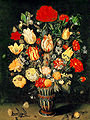 Growers named their new varieties with exalted titles. Many early forms were prefixed Admirael ("admiral"), often combined with the growers' names—Admirael van der Eijck was perhaps the most highly regarded of about fifty so named. Generael ("general") was another prefix that found its way into the names of around thirty varieties. Later came varieties with even more superb names, derived from Alexander the Great or Scipio
, or even "Admiral of Admirals" and "General of Generals". However, naming could be haphazard and varieties highly variable in quality. Most of these varieties have now died out, though similar "broken" tulips continue in the trade.
Tulips grow from bulb
s, and can be propagated through both seeds and buds. Seeds from a tulip will form a flowering bulb after 7–12 years. When a bulb grows into the flower, the original bulb will disappear, but a clone bulb forms in its place, as do several buds. Properly cultivated, these buds will become bulbs of their own. The mosaic virus spreads only through buds, not seeds, and so cultivating the most appealing varieties takes years. Propagation is greatly slowed down by the virus. Tulips bloom in April and May for only about a week, and the secondary buds appear shortly thereafter. Bulbs can be uprooted and moved about from June to September, and thus actual purchases (in the spot market
) occurred during these months.
During the rest of the year, traders signed contracts before a notary
to purchase tulips at the end of the season (effectively futures contract
s). Thus the Dutch, who developed many of the techniques of modern finance, created a market for durable
tulip bulbs. Short selling was banned by an edict of 1610, which was reiterated or strengthened in 1621 and 1630, and again in 1636. Short sellers were not prosecuted under these edicts, but their contracts were deemed unenforceable.
As the flowers grew in popularity, professional growers paid higher and higher prices for bulbs with the virus. By 1634, in part as a result of demand from the French, speculators began to enter the market. In 1636, the Dutch created a type of formal futures markets
where contracts to buy bulbs at the end of the season were bought and sold. Traders met in "colleges" at taverns and buyers were required to pay a 2.5% "wine money" fee, up to a maximum of three florins, per trade. Neither party paid an initial margin
nor a mark-to-market margin, and all contracts were with the individual counter-parties rather than with the exchange. No deliveries were ever made to fulfill these contracts because of the market collapse in February 1637. This trade was centered in Haarlem
during the height of a bubonic plague
epidemic, which may have contributed to a culture of fatalistic risk-taking.
The contract price of rare bulbs continued to rise throughout 1636. That November, the contract price of common bulbs without the valuable mosaic virus also began to rise in value. The Dutch derogatorily described tulip contract trading as windhandel (literally "wind trade"), because no bulbs were actually changing hands. However in February 1637, tulip bulb contract prices collapsed abruptly and the trade of tulips ground to a halt.
The modern discussion of tulip mania began with the book Extraordinary Popular Delusions and the Madness of Crowds
, published in 1841 by the Scottish journalist Charles Mackay
; he proposed that crowds of people often behave irrationally, and tulip mania was, along with the South Sea Bubble and the Mississippi Company
scheme, one of his primary examples. His account was largely sourced to a 1797 work by Johann Beckmann
titled A History of Inventions, Discoveries, and Origins. In fact, Beckmann's account, and thus Mackay's by association, was primarily sourced to three anonymous pamphlets published in 1637 with an anti-speculative agenda. Mackay's vivid book was popular among generations of economists and stock market participants. His popular but flawed description of tulip mania as a speculative bubble remains prominent, even though since the 1980s economists have debunked many aspects of his account.
According to Mackay, the growing popularity of tulips in the early 17th century caught the attention of the entire nation; "the population, even to its lowest dregs, embarked in the tulip trade". By 1635, a sale of 40 bulbs for 100,000 florins (also known as Dutch guilders) was recorded. By way of comparison, a ton of butter cost around 100 florins, a skilled laborer might earn 150 florins a year, and "eight fat swine" cost 240 florins. (According to the International Institute of Social History
, one florin had the purchasing power
of €
10.28 in 2002.)
By 1636, tulips were traded on the exchanges
of numerous Dutch towns and cities. This encouraged trading in tulips by all members of society; Mackay recounted people selling or trading their other possessions in order to speculate in the tulip market, such as an offer of 12 acres (48,562.3 m²) of land for one of two existing Semper Augustus bulbs, or a single bulb of the Viceroy that was purchased for a basket of goods (shown at right) worth 2,500 florins.
The increasing mania contributed several amusing, but unlikely, anecdotes that Mackay recounted, such as a sailor who mistook the valuable tulip bulb of a merchant for an onion and grabbed it to eat. The merchant and his family chased the sailor to find him "eating a breakfast whose cost might have regaled a whole ship's crew for a twelvemonth". The sailor was jailed for eating the bulb. This anecdote is unlikely if only because, like most Liliaceae
bulbs, tulips are somewhat poison
ous, and taste quite differently from onions.
People were purchasing bulbs at higher and higher prices, intending to re-sell them for a profit. However, such a scheme could not last unless someone was ultimately willing to pay such high prices and take possession of the bulbs. In February 1637, tulip traders could no longer find new buyers willing to pay increasingly inflated prices for their bulbs. As this realization set in, the demand for tulips collapsed, and prices plummeted—the speculative bubble
burst. Some were left holding contracts to purchase tulips at prices now ten times greater than those on the open market, while others found themselves in possession of bulbs now worth a fraction of the price they had paid. Mackay claims the Dutch devolved into distressed accusations and recriminations against others in the trade.
In Mackay's account, the panicked tulip speculators sought help from the government of the Netherlands, which responded by declaring that anyone who had bought contracts to purchase bulbs in the future could void their contract by payment of a 10 percent fee. Attempts were made to resolve the situation to the satisfaction of all parties, but these were unsuccessful. The mania finally ended, Mackay says, with individuals stuck with the bulbs they held at the end of the crash—no court would enforce payment of a contract, since judges regarded the debts as contracted through gambling, and thus not enforceable by law.
According to Mackay, lesser tulip manias also occurred in other parts of Europe, although matters never reached the state they had in the Netherlands. He also claimed that the aftermath of the tulip price deflation led to a widespread economic chill throughout the Netherlands for many years afterwards.
, who are more skeptical of speculative bubbles in general, suggests that his story was incomplete and inaccurate. In her 2007 scholarly analysis Tulipmania, Anne Goldgar states that the phenomenon was limited to "a fairly small group", and that most accounts from the period "are based on one or two contemporary pieces of propaganda
and a prodigious amount of plagiarism
". Peter Garber argues that the bubble "was no more than a meaningless winter drinking game, played by a plague-ridden population that made use of the vibrant tulip market."
While Mackay's account held that a wide array of society was involved in the tulip trade, Goldgar's study of archived contracts found that even at its peak the trade in tulips was conducted almost exclusively by merchants and skilled craftsmen who were wealthy, but not members of the nobility. Any economic fallout from the bubble was very limited. Goldgar, who identified many prominent buyers and sellers in the market, found fewer than half a dozen who experienced financial troubles in the time period, and even of these cases it is not clear that tulips were to blame. This is not altogether surprising. Although prices had risen, money had not exchanged hands between buyers and sellers. Thus profits were never realized for sellers; unless sellers had made other purchases on credit in expectation of the profits, the collapse in prices did not cause anyone to lose money.
or speculative bubble developed and then burst. For tulip mania to have qualified as an economic bubble, the price of tulip bulbs would need to have become unhinged from the intrinsic value
of the bulbs. Modern economists have advanced several possible reasons for why the rise and fall in prices may not have constituted a bubble.
The increases of the 1630s corresponded with a lull in the Thirty Years' War
. Hence market prices (at least initially) were responding rationally to a rise in demand. However, the fall in prices was faster and more dramatic than the rise. Data on sales largely disappeared after the February 1637 collapse in prices, but a few other data points on bulb prices after tulip mania show that bulbs continued to lose value for decades thereafter.
Before this parliamentary decree, the purchaser of a tulip contract—known in modern finance as a futures contract
—was legally obliged to buy the bulbs. The decree changed the nature of these contracts, so that if the current market price
fell, the purchaser could opt to pay a penalty and forgo receipt of the bulb, rather than pay the full contracted price. This change in law meant that, in modern terminology, the futures contracts had been transformed into options contracts
. This proposal began to be debated in the fall of 1636, and if it became clear to investors that the decree was likely to be enacted, prices probably would have risen.
This decree allowed someone who purchased a contract to void the contract with a payment of only 3.5 percent of the contract price (or about 1/30th the contract). Thus, investors bought increasingly expensive contracts. A speculator could sign a contract to purchase a tulip for 100 guilders. If the price rose above 100 guilders, the speculator would pocket the difference as profit. If the price remained low, the speculator could void the contract for only 3½ guilders. Thus, a contract nominally for 100 guilders, would actually cost an investor no more than 3½ guilders. In early February, as contract prices reached a peak, Dutch authorities stepped in and halted the trading of these contracts.
Thompson states that actual sales of tulip bulbs remained at ordinary levels throughout the period. Thus, Thompson concludes that the "mania" was a rational response to changes in contractual obligations. Using data about the specific payoffs present in the futures and option contracts, Thompson argues that tulip bulb contract prices hewed closely to what a rational economic model would dictate, "Tulip contract prices before, during, and after the 'tulipmania' appear to provide a remarkable illustration of 'market efficiency'."
, demonstrated by an increase in deposits at the Bank of Amsterdam during that period.
 The popularity of Mackay's tale has continued to this day, with new editions of Extraordinary Popular Delusions appearing regularly, with introductions by writers such as financier Bernard Baruch
(1932), financial writers Andrew Tobias
(1980), psychologist David J. Schneider
(1993), and Michael Lewis
(2008). At least six editions are currently in print.
Goldgar argues that although tulip mania may not have constituted an economic or speculative bubble, it was nonetheless traumatic to the Dutch for other reasons. "Even though the financial crisis affected very few, the shock of tulipmania was considerable. A whole network of values was thrown into doubt." In the 17th century, it was unimaginable to most people that something as common as a flower could be worth so much more money than most people earned in a year. The idea that the prices of flowers that grow only in the summer could fluctuate so wildly in the winter, threw into chaos the very understanding of "value".
 Many of the sources telling of the woes of tulip mania, such as the anti-speculative pamphlets that were later reported by Beckmann and Mackay, have been cited as evidence of the extent of the economic damage. These pamphlets, however, were not written by victims of a bubble, but were primarily religiously motivated. The upheaval was viewed as a perversion of the moral order—proof that "concentration on the earthly, rather than the heavenly flower could have dire consequences". Thus, it is possible that a relatively minor economic event took on a life of its own as a morality tale.
Nearly a century later, during the crash of the Mississippi Company
and the South Sea Company in about 1720, tulip mania appeared in satires of these manias. When Johann Beckmann
first described tulip mania in the 1780s, he compared it to the failing lotteries of the time. In Goldgar's view, even many modern popular works about financial markets, such as Burton Malkiel
's A Random Walk Down Wall Street
(1973) and John Kenneth Galbraith
's A Short History of Financial Euphoria (1990; written soon after the stock market crash of 1987), used the tulip mania as a lesson in morality. Tulip mania again became a popular reference during the dot-com bubble
of 1995–2001.
More recently, journalists have compared it to the subprime mortgage crisis
. Despite the mania's enduring popularity, Daniel Gross
of Slate
has said of economists offering efficient market
explanations for the mania, that "If they're correct ... then business writers will have to delete Tulipmania from their handy-pack of bubble analogies." Also in Oliver Stone
's drama Wall Street: Money Never Sleeps from 2010, a sequel to the 1987 film Wall Street, the tulip mania is referenced. Gordon Gekko, played by Michael Douglas
, uses a historical chart displaying the market value of tulips and compares it to the late-2000s financial crisis
.
Dutch language
Dutch is a West Germanic language and the native language of the majority of the population of the Netherlands, Belgium, and Suriname, the three member states of the Dutch Language Union. Most speakers live in the European Union, where it is a first language for about 23 million and a second...
names include: tulpenmanie, tulpomanie, tulpenwoede, tulpengekte and bollengekte) was a period in the Dutch Golden Age
Dutch Golden Age
The Golden Age was a period in Dutch history, roughly spanning the 17th century, in which Dutch trade, science, military and art were among the most acclaimed in the world. The first half is characterised by the Eighty Years' War till 1648...
during which contract prices for bulbs of the recently introduced tulip
Tulip
The tulip is a perennial, bulbous plant with showy flowers in the genus Tulipa, which comprises 109 species and belongs to the family Liliaceae. The genus's native range extends from as far west as Southern Europe, North Africa, Anatolia, and Iran to the Northwest of China. The tulip's centre of...
reached extraordinarily high levels and then suddenly collapsed. At the peak of tulip mania, in February 1637, some single tulip bulbs sold for more than 10 times the annual income of a skilled craftsman. It is generally considered the first recorded speculative bubble (or economic bubble
Economic bubble
An economic bubble is "trade in high volumes at prices that are considerably at variance with intrinsic values"...
), although some researchers have noted that the Kipper- und Wipperzeit episode in 1619–22, a Europe-wide chain of debasement of the metal content of coins to fund warfare, featured mania-like similarities to a bubble. The term "tulip mania" is now often used metaphor
Metaphor
A metaphor is a literary figure of speech that uses an image, story or tangible thing to represent a less tangible thing or some intangible quality or idea; e.g., "Her eyes were glistening jewels." Metaphor may also be used for any rhetorical figures of speech that achieve their effects via...
ically to refer to any large economic bubble (when asset prices deviate from intrinsic value
Intrinsic value (finance)
In finance, intrinsic value refers to the value of a security which is intrinsic to or contained in the security itself. It is also frequently called fundamental value. It is ordinarily calculated by summing the future income generated by the asset, and discounting it to the present value...
s).
The event was popularized in 1841 by the book Extraordinary Popular Delusions and the Madness of Crowds
Extraordinary Popular Delusions and the Madness of Crowds
Extraordinary Popular Delusions and the Madness of Crowds is a history of popular folly by Scottish journalist Charles Mackay, first published in 1841. The book chronicles its subjects in three parts: "National Delusions", "Peculiar Follies", and "Philosophical Delusions"...
, written by British journalist Charles Mackay
Charles Mackay
Charles Mackay was a Scottish poet, journalist, and song writer.-Life:Charles Mackay was born in Perth, Scotland. His father was by turns a naval officer and a foot soldier; his mother died shortly after his birth. Charles was educated at the Caledonian Asylum, London, and at Brussels, but spent...
. According to Mackay, at one point 12 acres (5 ha) of land were offered for a Semper augustus bulb. Mackay claims that many such investors were ruined by the fall in prices, and Dutch commerce suffered a severe shock. Although Mackay's book is a classic that is widely reprinted today, his account is contested. Many modern scholars believe that the mania was not as extraordinary as Mackay described, with some arguing that the price changes may not have constituted a bubble.
Research on the tulip mania is difficult because of the limited data from the 1630s—much of which comes from biased and anti-speculative sources. Although these explanations are not generally accepted, some modern economists have proposed rational explanations, rather than a speculative mania, for the rise and fall in prices. For example, other flowers, such as the hyacinth, also had high prices on the flower's introduction, which then fell dramatically. The high prices may also have been driven by expectations of a parliamentary decree that contracts could be voided for a small cost—thus lowering the risk to buyers.
History
The tulipTulip
The tulip is a perennial, bulbous plant with showy flowers in the genus Tulipa, which comprises 109 species and belongs to the family Liliaceae. The genus's native range extends from as far west as Southern Europe, North Africa, Anatolia, and Iran to the Northwest of China. The tulip's centre of...
was introduced to Europe in the mid-16th century from the Ottoman Empire
Ottoman Empire
The Ottoman EmpireIt was usually referred to as the "Ottoman Empire", the "Turkish Empire", the "Ottoman Caliphate" or more commonly "Turkey" by its contemporaries...
, and became very popular in the United Provinces
Dutch Republic
The Dutch Republic — officially known as the Republic of the Seven United Netherlands , the Republic of the United Netherlands, or the Republic of the Seven United Provinces — was a republic in Europe existing from 1581 to 1795, preceding the Batavian Republic and ultimately...
(now the Netherlands
Netherlands
The Netherlands is a constituent country of the Kingdom of the Netherlands, located mainly in North-West Europe and with several islands in the Caribbean. Mainland Netherlands borders the North Sea to the north and west, Belgium to the south, and Germany to the east, and shares maritime borders...
). Tulip cultivation in the United Provinces is generally thought to have started in earnest around 1593 after the Flemish botanist Charles de l'Écluse
Charles de l'Écluse
Charles de l'Écluse, L'Escluse, or Carolus Clusius , seigneur de Watènes, was a Flemish doctor and pioneering botanist, perhaps the most influential of all 16th century scientific horticulturists....
had taken up a post at the University of Leiden
Leiden University
Leiden University , located in the city of Leiden, is the oldest university in the Netherlands. The university was founded in 1575 by William, Prince of Orange, leader of the Dutch Revolt in the Eighty Years' War. The royal Dutch House of Orange-Nassau and Leiden University still have a close...
and established the
hortus academicus
Hortus Botanicus Leiden
The Hortus botanicus of Leiden is the oldest botanical garden of the Netherlands, and one of the oldest in the world. It is located in the southwestern part of the historical centre of the city, between the Academy building and the Leiden Observatory....
. There, he planted his collection of tulip bulbs—sent to him from Turkey
Turkey
Turkey , known officially as the Republic of Turkey , is a Eurasian country located in Western Asia and in East Thrace in Southeastern Europe...
by the Emperor's (Ferdinand I, Holy Roman Emperor
Ferdinand I, Holy Roman Emperor
Ferdinand I was Holy Roman Emperor from 1558 and king of Bohemia and Hungary from 1526 until his death. Before his accession, he ruled the Austrian hereditary lands of the Habsburgs in the name of his elder brother, Charles V, Holy Roman Emperor.The key events during his reign were the contest...
) ambassador to the Sultan, Ogier de Busbecq—which were able to tolerate the harsher conditions of the Low Countries
Low Countries
The Low Countries are the historical lands around the low-lying delta of the Rhine, Scheldt, and Meuse rivers, including the modern countries of Belgium, the Netherlands, Luxembourg and parts of northern France and western Germany....
, and it was shortly thereafter they began to grow in popularity.
The flower rapidly became a coveted luxury item and a status symbol
Status symbol
A status symbol is a perceived visible, external denotation of one's social position and perceived indicator of economic or social status. Many luxury goods are often considered status symbols...
, and a profusion of varieties followed. They were classified in groups; one-coloured tulips of red, yellow, or white were known as Couleren, but it was the multicoloured Rosen (red or pink on white background), Violetten
(purple or lilac on white background), and, to a lesser extent, the Bizarden (red, brown or purple on yellow background) that were the most popular. These spectacular and highly sought-after tulip bulbs would grow flowers with vivid colors, lines, and flames on the petals, as a result, it is now understood, of being infected with a tulip-specific virus
Plant virus
Plant viruses are viruses that affect plants. Like all other viruses, plant viruses are obligate intracellular parasites that do not have the molecular machinery to replicate without a host. Plant viruses are pathogenic to higher plants...
known as the "Tulip breaking virus
Tulip breaking virus
The Tulip breaking virus, also known as the "Tulip break virus", "Tulip breaking potyvirus", "Lily streak virus", "Tulip mosaic virus", "Lily mottle virus", "Lily mosaic virus", or simply "TBV" is a plant virus that is most famous for its infection of tulips...
", a type of mosaic virus.
Scipio Africanus
Publius Cornelius Scipio Africanus , also known as Scipio Africanus and Scipio the Elder, was a general in the Second Punic War and statesman of the Roman Republic...
, or even "Admiral of Admirals" and "General of Generals". However, naming could be haphazard and varieties highly variable in quality. Most of these varieties have now died out, though similar "broken" tulips continue in the trade.
Tulips grow from bulb
Bulb
A bulb is a short stem with fleshy leaves or leaf bases. The leaves often function as food storage organs during dormancy.A bulb's leaf bases, known as scales, generally do not support leaves, but contain food reserves to enable the plant to survive adverse conditions. At the center of the bulb is...
s, and can be propagated through both seeds and buds. Seeds from a tulip will form a flowering bulb after 7–12 years. When a bulb grows into the flower, the original bulb will disappear, but a clone bulb forms in its place, as do several buds. Properly cultivated, these buds will become bulbs of their own. The mosaic virus spreads only through buds, not seeds, and so cultivating the most appealing varieties takes years. Propagation is greatly slowed down by the virus. Tulips bloom in April and May for only about a week, and the secondary buds appear shortly thereafter. Bulbs can be uprooted and moved about from June to September, and thus actual purchases (in the spot market
Spot market
The spot market or cash market is a public financial market, in which financial instruments or commodities are traded for immediate delivery. It contrasts with a futures market in which delivery is due at a later date...
) occurred during these months.
During the rest of the year, traders signed contracts before a notary
Civil law notary
Civil-law notaries, or Latin notaries, are lawyers of noncontentious private civil law who draft, take, and record legal instruments for private parties, provide legal advice and give attendance in person, and are vested as public officers with the authentication power of the State...
to purchase tulips at the end of the season (effectively futures contract
Futures contract
In finance, a futures contract is a standardized contract between two parties to exchange a specified asset of standardized quantity and quality for a price agreed today with delivery occurring at a specified future date, the delivery date. The contracts are traded on a futures exchange...
s). Thus the Dutch, who developed many of the techniques of modern finance, created a market for durable
Durable good
In economics, a durable good or a hard good is a good that does not quickly wear out, or more specifically, one that yields utility over time rather than being completely consumed in one use. Items like bricks or jewellery could be considered perfectly durable goods, because they should...
tulip bulbs. Short selling was banned by an edict of 1610, which was reiterated or strengthened in 1621 and 1630, and again in 1636. Short sellers were not prosecuted under these edicts, but their contracts were deemed unenforceable.
As the flowers grew in popularity, professional growers paid higher and higher prices for bulbs with the virus. By 1634, in part as a result of demand from the French, speculators began to enter the market. In 1636, the Dutch created a type of formal futures markets
Futures exchange
A futures exchange or futures market is a central financial exchange where people can trade standardized futures contracts; that is, a contract to buy specific quantities of a commodity or financial instrument at a specified price with delivery set at a specified time in the future. These types of...
where contracts to buy bulbs at the end of the season were bought and sold. Traders met in "colleges" at taverns and buyers were required to pay a 2.5% "wine money" fee, up to a maximum of three florins, per trade. Neither party paid an initial margin
Margin (finance)
In finance, a margin is collateral that the holder of a financial instrument has to deposit to cover some or all of the credit risk of their counterparty...
nor a mark-to-market margin, and all contracts were with the individual counter-parties rather than with the exchange. No deliveries were ever made to fulfill these contracts because of the market collapse in February 1637. This trade was centered in Haarlem
Haarlem
Haarlem is a municipality and a city in the Netherlands. It is the capital of the province of North Holland, the northern half of Holland, which at one time was the most powerful of the seven provinces of the Dutch Republic...
during the height of a bubonic plague
Bubonic plague
Plague is a deadly infectious disease that is caused by the enterobacteria Yersinia pestis, named after the French-Swiss bacteriologist Alexandre Yersin. Primarily carried by rodents and spread to humans via fleas, the disease is notorious throughout history, due to the unrivaled scale of death...
epidemic, which may have contributed to a culture of fatalistic risk-taking.
The contract price of rare bulbs continued to rise throughout 1636. That November, the contract price of common bulbs without the valuable mosaic virus also began to rise in value. The Dutch derogatorily described tulip contract trading as windhandel (literally "wind trade"), because no bulbs were actually changing hands. However in February 1637, tulip bulb contract prices collapsed abruptly and the trade of tulips ground to a halt.
Available price data
The lack of consistently recorded price data from the 1630s makes the extent of the tulip mania difficult to estimate. The bulk of available data comes from anti-speculative pamphlets by "Gaergoedt and Warmondt" (GW) written just after the bubble. Economist Peter Garber collected data on the sales of 161 bulbs of 39 varieties between 1633 and 1637, with 53 being recorded by GW. Ninety-eight sales were recorded for the last date of the bubble, February 5, 1637, at wildly varying prices. The sales were made using several market mechanisms: futures trading at the colleges, spot sales by growers, notarized futures sales by growers, and estate sales. "To a great extent, the available price data are a blend of apples and oranges," according to Garber.Mackay's Madness of Crowds
| Goods allegedly exchanged for a single bulb of the Viceroy | |
|---|---|
| Two lasts Last (measure) A last was a medieval measure of gunpowder used mainly in England. It was defined by the English Ordnance Board as 24 barrels of gunpowder, each of 100lbs net weight.... of wheat |
448ƒ |
| Four lasts Last (measure) A last was a medieval measure of gunpowder used mainly in England. It was defined by the English Ordnance Board as 24 barrels of gunpowder, each of 100lbs net weight.... of rye |
558ƒ |
| Four fat oxen | 480ƒ |
| Eight fat swine | 240ƒ |
| Twelve fat sheep | 120ƒ |
| Two hogshead Hogshead A hogshead is a large cask of liquid . More specifically, it refers to a specified volume, measured in either Imperial units or U.S. customary units, primarily applied to alcoholic beverages such as wine, ale, or cider.... s of wine |
70ƒ |
| Four tuns of beer | 32ƒ |
| Two tons of butter | 192ƒ |
| 1,000 lb. of cheese | 120ƒ |
| A complete bed | 100ƒ |
| A suit of clothes | 80ƒ |
| A silver drinking cup | 60ƒ |
| Total | 2500ƒ |
The modern discussion of tulip mania began with the book Extraordinary Popular Delusions and the Madness of Crowds
Extraordinary Popular Delusions and the Madness of Crowds
Extraordinary Popular Delusions and the Madness of Crowds is a history of popular folly by Scottish journalist Charles Mackay, first published in 1841. The book chronicles its subjects in three parts: "National Delusions", "Peculiar Follies", and "Philosophical Delusions"...
, published in 1841 by the Scottish journalist Charles Mackay
Charles Mackay
Charles Mackay was a Scottish poet, journalist, and song writer.-Life:Charles Mackay was born in Perth, Scotland. His father was by turns a naval officer and a foot soldier; his mother died shortly after his birth. Charles was educated at the Caledonian Asylum, London, and at Brussels, but spent...
; he proposed that crowds of people often behave irrationally, and tulip mania was, along with the South Sea Bubble and the Mississippi Company
Mississippi Company
The "Mississippi Company" became the "Company of the West" and expanded as the "Company of the Indies" .-The Banque Royale:...
scheme, one of his primary examples. His account was largely sourced to a 1797 work by Johann Beckmann
Johann Beckmann
Johann Beckmann was a German scientific author and coiner of the word technology, to mean the science of trades. He was the first man to teach technology and write about it as an academic subject....
titled A History of Inventions, Discoveries, and Origins. In fact, Beckmann's account, and thus Mackay's by association, was primarily sourced to three anonymous pamphlets published in 1637 with an anti-speculative agenda. Mackay's vivid book was popular among generations of economists and stock market participants. His popular but flawed description of tulip mania as a speculative bubble remains prominent, even though since the 1980s economists have debunked many aspects of his account.
According to Mackay, the growing popularity of tulips in the early 17th century caught the attention of the entire nation; "the population, even to its lowest dregs, embarked in the tulip trade". By 1635, a sale of 40 bulbs for 100,000 florins (also known as Dutch guilders) was recorded. By way of comparison, a ton of butter cost around 100 florins, a skilled laborer might earn 150 florins a year, and "eight fat swine" cost 240 florins. (According to the International Institute of Social History
International Institute of Social History
The International Institute of Social History is a historical research institute in Amsterdam. It was founded in 1935 by Nicolaas Posthumus. The IISG is part of the Royal Netherlands Academy of Arts and Sciences....
, one florin had the purchasing power
Purchasing power
Purchasing power is the number of goods/services that can be purchased with a unit of currency. For example, if you had taken one dollar to a store in the 1950s, you would have been able to buy a greater number of items than you would today, indicating that you would have had a greater purchasing...
of €
Euro
The euro is the official currency of the eurozone: 17 of the 27 member states of the European Union. It is also the currency used by the Institutions of the European Union. The eurozone consists of Austria, Belgium, Cyprus, Estonia, Finland, France, Germany, Greece, Ireland, Italy, Luxembourg,...
10.28 in 2002.)
By 1636, tulips were traded on the exchanges
Stock exchange
A stock exchange is an entity that provides services for stock brokers and traders to trade stocks, bonds, and other securities. Stock exchanges also provide facilities for issue and redemption of securities and other financial instruments, and capital events including the payment of income and...
of numerous Dutch towns and cities. This encouraged trading in tulips by all members of society; Mackay recounted people selling or trading their other possessions in order to speculate in the tulip market, such as an offer of 12 acres (48,562.3 m²) of land for one of two existing Semper Augustus bulbs, or a single bulb of the Viceroy that was purchased for a basket of goods (shown at right) worth 2,500 florins.
The increasing mania contributed several amusing, but unlikely, anecdotes that Mackay recounted, such as a sailor who mistook the valuable tulip bulb of a merchant for an onion and grabbed it to eat. The merchant and his family chased the sailor to find him "eating a breakfast whose cost might have regaled a whole ship's crew for a twelvemonth". The sailor was jailed for eating the bulb. This anecdote is unlikely if only because, like most Liliaceae
Liliaceae
The Liliaceae, or the lily family, is a family of monocotyledons in the order Liliales. Plants in this family have linear leaves, mostly with parallel veins but with several having net venation , and flower arranged in threes. Several have bulbs, while others have rhizomes...
bulbs, tulips are somewhat poison
Poison
In the context of biology, poisons are substances that can cause disturbances to organisms, usually by chemical reaction or other activity on the molecular scale, when a sufficient quantity is absorbed by an organism....
ous, and taste quite differently from onions.
People were purchasing bulbs at higher and higher prices, intending to re-sell them for a profit. However, such a scheme could not last unless someone was ultimately willing to pay such high prices and take possession of the bulbs. In February 1637, tulip traders could no longer find new buyers willing to pay increasingly inflated prices for their bulbs. As this realization set in, the demand for tulips collapsed, and prices plummeted—the speculative bubble
Stock market bubble
A stock market bubble is a type of economic bubble taking place in stock markets when market participants drive stock prices above their value in relation to some system of stock valuation....
burst. Some were left holding contracts to purchase tulips at prices now ten times greater than those on the open market, while others found themselves in possession of bulbs now worth a fraction of the price they had paid. Mackay claims the Dutch devolved into distressed accusations and recriminations against others in the trade.
In Mackay's account, the panicked tulip speculators sought help from the government of the Netherlands, which responded by declaring that anyone who had bought contracts to purchase bulbs in the future could void their contract by payment of a 10 percent fee. Attempts were made to resolve the situation to the satisfaction of all parties, but these were unsuccessful. The mania finally ended, Mackay says, with individuals stuck with the bulbs they held at the end of the crash—no court would enforce payment of a contract, since judges regarded the debts as contracted through gambling, and thus not enforceable by law.
According to Mackay, lesser tulip manias also occurred in other parts of Europe, although matters never reached the state they had in the Netherlands. He also claimed that the aftermath of the tulip price deflation led to a widespread economic chill throughout the Netherlands for many years afterwards.
Modern views
Mackay's account of inexplicable mania was unchallenged, and mostly unexamined, until the 1980s. However, research into tulip mania since then, especially by proponents of the efficient market hypothesisEfficient market hypothesis
In finance, the efficient-market hypothesis asserts that financial markets are "informationally efficient". That is, one cannot consistently achieve returns in excess of average market returns on a risk-adjusted basis, given the information available at the time the investment is made.There are...
, who are more skeptical of speculative bubbles in general, suggests that his story was incomplete and inaccurate. In her 2007 scholarly analysis Tulipmania, Anne Goldgar states that the phenomenon was limited to "a fairly small group", and that most accounts from the period "are based on one or two contemporary pieces of propaganda
Propaganda
Propaganda is a form of communication that is aimed at influencing the attitude of a community toward some cause or position so as to benefit oneself or one's group....
and a prodigious amount of plagiarism
Plagiarism
Plagiarism is defined in dictionaries as the "wrongful appropriation," "close imitation," or "purloining and publication" of another author's "language, thoughts, ideas, or expressions," and the representation of them as one's own original work, but the notion remains problematic with nebulous...
". Peter Garber argues that the bubble "was no more than a meaningless winter drinking game, played by a plague-ridden population that made use of the vibrant tulip market."
While Mackay's account held that a wide array of society was involved in the tulip trade, Goldgar's study of archived contracts found that even at its peak the trade in tulips was conducted almost exclusively by merchants and skilled craftsmen who were wealthy, but not members of the nobility. Any economic fallout from the bubble was very limited. Goldgar, who identified many prominent buyers and sellers in the market, found fewer than half a dozen who experienced financial troubles in the time period, and even of these cases it is not clear that tulips were to blame. This is not altogether surprising. Although prices had risen, money had not exchanged hands between buyers and sellers. Thus profits were never realized for sellers; unless sellers had made other purchases on credit in expectation of the profits, the collapse in prices did not cause anyone to lose money.
Rational explanations
There is no dispute that prices for tulip bulb contracts rose and then fell in 1636–37, but even a dramatic rise and fall in prices does not necessarily mean that an economicEconomic bubble
An economic bubble is "trade in high volumes at prices that are considerably at variance with intrinsic values"...
or speculative bubble developed and then burst. For tulip mania to have qualified as an economic bubble, the price of tulip bulbs would need to have become unhinged from the intrinsic value
Intrinsic value (finance)
In finance, intrinsic value refers to the value of a security which is intrinsic to or contained in the security itself. It is also frequently called fundamental value. It is ordinarily calculated by summing the future income generated by the asset, and discounting it to the present value...
of the bulbs. Modern economists have advanced several possible reasons for why the rise and fall in prices may not have constituted a bubble.
The increases of the 1630s corresponded with a lull in the Thirty Years' War
Thirty Years' War
The Thirty Years' War was fought primarily in what is now Germany, and at various points involved most countries in Europe. It was one of the most destructive conflicts in European history....
. Hence market prices (at least initially) were responding rationally to a rise in demand. However, the fall in prices was faster and more dramatic than the rise. Data on sales largely disappeared after the February 1637 collapse in prices, but a few other data points on bulb prices after tulip mania show that bulbs continued to lose value for decades thereafter.
Volatility in flower prices
Garber compared the available price data on tulips to hyacinth prices at the beginning of the 19th century—when the hyacinth replaced the tulip as the fashionable flower—and found a similar pattern. When hyacinths were introduced florists strove with one another to grow beautiful hyacinth flowers, as demand was strong. However, as people became more accustomed to hyacinths the prices began to fall. The most expensive bulbs fell to 1–2 percent of their peak value within 30 years. Garber also notes that, "a small quantity of prototype lily bulbs recently was sold for 1 million guilders ($480,000 at 1987 exchange rates)", demonstrating that even today flowers can command extremely high prices. Additionally, because the rise in prices occurred after bulbs were planted for the year, growers would not have had an opportunity to increase production in response to price.Legal changes
UCLA economics professor Earl A. Thompson argues in a 2007 paper that Garber's explanation cannot account for the extremely swift drop in tulip bulb contract prices. The annualized rate of price decline was 99.999%, instead of the average 40% for other flowers. He provides another explanation for Dutch tulip mania. The Dutch parliament was considering a decree (originally sponsored by Dutch tulip investors who had lost money because of a German setback in the Thirty Years' War) that changed the way tulip contracts functioned:Before this parliamentary decree, the purchaser of a tulip contract—known in modern finance as a futures contract
Futures contract
In finance, a futures contract is a standardized contract between two parties to exchange a specified asset of standardized quantity and quality for a price agreed today with delivery occurring at a specified future date, the delivery date. The contracts are traded on a futures exchange...
—was legally obliged to buy the bulbs. The decree changed the nature of these contracts, so that if the current market price
Spot price
The spot price or spot rate of a commodity, a security or a currency is the price that is quoted for immediate settlement . Spot settlement is normally one or two business days from trade date...
fell, the purchaser could opt to pay a penalty and forgo receipt of the bulb, rather than pay the full contracted price. This change in law meant that, in modern terminology, the futures contracts had been transformed into options contracts
Option (finance)
In finance, an option is a derivative financial instrument that specifies a contract between two parties for a future transaction on an asset at a reference price. The buyer of the option gains the right, but not the obligation, to engage in that transaction, while the seller incurs the...
. This proposal began to be debated in the fall of 1636, and if it became clear to investors that the decree was likely to be enacted, prices probably would have risen.
This decree allowed someone who purchased a contract to void the contract with a payment of only 3.5 percent of the contract price (or about 1/30th the contract). Thus, investors bought increasingly expensive contracts. A speculator could sign a contract to purchase a tulip for 100 guilders. If the price rose above 100 guilders, the speculator would pocket the difference as profit. If the price remained low, the speculator could void the contract for only 3½ guilders. Thus, a contract nominally for 100 guilders, would actually cost an investor no more than 3½ guilders. In early February, as contract prices reached a peak, Dutch authorities stepped in and halted the trading of these contracts.
Thompson states that actual sales of tulip bulbs remained at ordinary levels throughout the period. Thus, Thompson concludes that the "mania" was a rational response to changes in contractual obligations. Using data about the specific payoffs present in the futures and option contracts, Thompson argues that tulip bulb contract prices hewed closely to what a rational economic model would dictate, "Tulip contract prices before, during, and after the 'tulipmania' appear to provide a remarkable illustration of 'market efficiency'."
Critiques
Other economists believe that these elements cannot completely explain the dramatic rise and fall in tulip prices. Garber's theory has also been challenged for failing to explain a similar dramatic rise and fall in prices for regular tulip bulb contracts. Some economists also point to other factors associated with speculative bubbles, such as a growth in the supply of moneyExpansionary monetary policy
In economics, expansionary policies are fiscal policies, like higher spending and tax cuts, that encourage economic growth. In turn, an expansionary monetary policy is monetary policy that seeks to increase the size of the money supply...
, demonstrated by an increase in deposits at the Bank of Amsterdam during that period.
Social mania and legacy
Bernard Baruch
Bernard Mannes Baruch was an American financier, stock-market speculator, statesman, and political consultant. After his success in business, he devoted his time toward advising U.S. Presidents Woodrow Wilson and Franklin D. Roosevelt on economic matters and became a philanthropist.-Early life...
(1932), financial writers Andrew Tobias
Andrew Tobias
Andrew Tobias is an American journalist, author, and columnist. His main body of work is on investment, but he has also written on politics, insurance, and other topics. Since 1999, he has been the treasurer of the Democratic National Committee.-Biography:Tobias graduated from Harvard College in...
(1980), psychologist David J. Schneider
David J. Schneider
David J. Schneider is an American psychologist. He is a professor of psychology and the director of the cognitive sciences program at Rice University.-Career and work:...
(1993), and Michael Lewis
Michael Lewis (author)
Michael Lewis is an American non-fiction author and financial journalist. His bestselling books include The Big Short: Inside the Doomsday Machine, Liar's Poker, The New New Thing, Moneyball: The Art of Winning an Unfair Game, The Blind Side: Evolution of a Game, Panic and Home Game: An...
(2008). At least six editions are currently in print.
Goldgar argues that although tulip mania may not have constituted an economic or speculative bubble, it was nonetheless traumatic to the Dutch for other reasons. "Even though the financial crisis affected very few, the shock of tulipmania was considerable. A whole network of values was thrown into doubt." In the 17th century, it was unimaginable to most people that something as common as a flower could be worth so much more money than most people earned in a year. The idea that the prices of flowers that grow only in the summer could fluctuate so wildly in the winter, threw into chaos the very understanding of "value".
Nearly a century later, during the crash of the Mississippi Company
Mississippi Company
The "Mississippi Company" became the "Company of the West" and expanded as the "Company of the Indies" .-The Banque Royale:...
and the South Sea Company in about 1720, tulip mania appeared in satires of these manias. When Johann Beckmann
Johann Beckmann
Johann Beckmann was a German scientific author and coiner of the word technology, to mean the science of trades. He was the first man to teach technology and write about it as an academic subject....
first described tulip mania in the 1780s, he compared it to the failing lotteries of the time. In Goldgar's view, even many modern popular works about financial markets, such as Burton Malkiel
Burton Malkiel
Burton Gordon Malkiel is an American economist and writer, most famous for his classic finance book A Random Walk Down Wall Street...
's A Random Walk Down Wall Street
A Random Walk Down Wall Street
A Random Walk Down Wall Street, written by Burton Malkiel, a Princeton economist, is an influential book on the subject of stock markets which introduced the random walk hypothesis. Malkiel argues that asset prices typically exhibit signs of random walk and that one cannot consistently outperform...
(1973) and John Kenneth Galbraith
John Kenneth Galbraith
John Kenneth "Ken" Galbraith , OC was a Canadian-American economist. He was a Keynesian and an institutionalist, a leading proponent of 20th-century American liberalism...
's A Short History of Financial Euphoria (1990; written soon after the stock market crash of 1987), used the tulip mania as a lesson in morality. Tulip mania again became a popular reference during the dot-com bubble
Dot-com bubble
The dot-com bubble was a speculative bubble covering roughly 1995–2000 during which stock markets in industrialized nations saw their equity value rise rapidly from growth in the more...
of 1995–2001.
More recently, journalists have compared it to the subprime mortgage crisis
Subprime mortgage crisis
The U.S. subprime mortgage crisis was one of the first indicators of the late-2000s financial crisis, characterized by a rise in subprime mortgage delinquencies and foreclosures, and the resulting decline of securities backed by said mortgages....
. Despite the mania's enduring popularity, Daniel Gross
Daniel Gross
Daniel Gross is an American journalist and author, a former Senior Editor at Newsweek, and since September 2010 employed at Yahoo! Finance. A native of East Lansing, Michigan, Gross graduated from East Lansing High School and Cornell University , and holds an A.M...
of Slate
Slate (magazine)
Slate is a US-based English language online current affairs and culture magazine created in 1996 by former New Republic editor Michael Kinsley, initially under the ownership of Microsoft as part of MSN. On 21 December 2004 it was purchased by the Washington Post Company...
has said of economists offering efficient market
Efficient market hypothesis
In finance, the efficient-market hypothesis asserts that financial markets are "informationally efficient". That is, one cannot consistently achieve returns in excess of average market returns on a risk-adjusted basis, given the information available at the time the investment is made.There are...
explanations for the mania, that "If they're correct ... then business writers will have to delete Tulipmania from their handy-pack of bubble analogies." Also in Oliver Stone
Oliver Stone
William Oliver Stone is an American film director, producer and screenwriter. Stone became well known in the late 1980s and the early 1990s for directing a series of films about the Vietnam War, for which he had previously participated as an infantry soldier. His work frequently focuses on...
's drama Wall Street: Money Never Sleeps from 2010, a sequel to the 1987 film Wall Street, the tulip mania is referenced. Gordon Gekko, played by Michael Douglas
Michael Douglas
Michael Kirk Douglas is an American actor and producer, primarily in movies and television. He has won three Golden Globes and two Academy Awards; first as producer of 1975's Best Picture, One Flew Over the Cuckoo's Nest, and as Best Actor in 1987 for his role in Wall Street. Douglas received the...
, uses a historical chart displaying the market value of tulips and compares it to the late-2000s financial crisis
Late-2000s financial crisis
The late-2000s financial crisis is considered by many economists to be the worst financial crisis since the Great Depression of the 1930s...
.
See also
- Tulip period of the Ottoman EmpireOttoman EmpireThe Ottoman EmpireIt was usually referred to as the "Ottoman Empire", the "Turkish Empire", the "Ottoman Caliphate" or more commonly "Turkey" by its contemporaries...
. - OrchideliriumOrchideliriumOrchidelirium is the name given to the Victorian era of flower madness when collecting and discovering Orchids reached extraordinarily high levels. Wealthy orchid fanatics of the 19th century sent explorers and collectors to almost every part of the world in search of new varieties of orchids....
the Victorian eraVictorian eraThe Victorian era of British history was the period of Queen Victoria's reign from 20 June 1837 until her death on 22 January 1901. It was a long period of peace, prosperity, refined sensibilities and national self-confidence...
of flower madness in which the collecting of orchids reached extraordinary levels. - South Sea Bubble - Another huge speculative bubble.
- Greater fool theory
External links
- Early Speculative Bubbles and Increases in the Supply of Money, a book by economist Douglas FrenchDouglas FrenchDouglas Charles French is a retired Conservative Party politician in the United Kingdom.He was elected to the House of Commons at the 1987 general election as Member of Parliament for Gloucester, succeeding former minister Sally Oppenheim...
detailing the Dutch crisis - Wageningen Tulip Portal, an extensive collection of historical resources, including scanned images of 17th century Dutch tulip books and pamphlets, from Wageningen UR Library
- Page on the Tulip Breaking potyvirus from Plant Viruses Online
- Charles McKay's Account of Tulipomania in Modern English
- Charles Mackay's The Madness of Crowds is available from Project Gutenberg
- part of the Encyclopædia Romana by James Grout.