

Try

Encyclopedia
Rugby league
Rugby league football, usually called rugby league, is a full contact sport played by two teams of thirteen players on a rectangular grass field. One of the two codes of rugby football, it originated in England in 1895 by a split from Rugby Football Union over paying players...
and rugby union
Rugby union
Rugby union, often simply referred to as rugby, is a full contact team sport which originated in England in the early 19th century. One of the two codes of rugby football, it is based on running with the ball in hand...
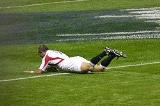
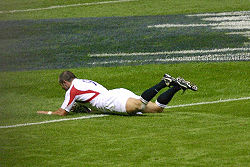
football. A try is scored by grounding the ball in the opposition's in-goal area (on or behind the goal line). Rugby union and league differ slightly in defining 'grounding the ball' and the 'in-goal' area (see next section).
The term try comes from try at goal, signifying that originally, grounding the ball only gave the opportunity to try to score with a kick at goal.
A try is analogous to a touchdown
Touchdown
A touchdown is a means of scoring in American and Canadian football. Whether running, passing, returning a kickoff or punt, or recovering a turnover, a team scores a touchdown by advancing the ball into the opponent's end zone.-Description:...
in American
American football
American football is a sport played between two teams of eleven with the objective of scoring points by advancing the ball into the opposing team's end zone. Known in the United States simply as football, it may also be referred to informally as gridiron football. The ball can be advanced by...
and Canadian football
Canadian football
Canadian football is a form of gridiron football played exclusively in Canada in which two teams of 12 players each compete for territorial control of a field of play long and wide attempting to advance a pointed prolate spheroid ball into the opposing team's scoring area...
, with the major difference being that a try requires the ball be simultaneously touching the ground in the in-goal area and an attacking player who is in the field of play or in-goal. (Oddly enough, the official name of the extra point
Extra Point
Extra Point is a twice-daily, two-minute segment on ESPN Radio that covers generic sports-related topical news and opinion. The AM edition airs Monday through Saturday at various times between 6 a.m. and 10 a.m. ET, and the PM edition airs Monday through Friday between 3 p.m. and 7 p.m. ET...
in American football according to NFL rules is the try.) In the laws of both forms of rugby, the term touch down formally refers only to grounding the ball by the defensive team in their in-goal. Although occasionally people refer to a try as a 'touchdown', the correct usage for the action is 'grounding the ball'.
Aspects common to both union and league
There are differences in the fine detail of the laws and their interpretation between the two rugby codes. These are the common aspects, while the differences are treated below.- The player holding the ball to score a try and the ball itself must not be in touch or touch-in-goal (including on or over the dead ball line). The touchline, touch-in-goal lines and dead ball lines count as being 'out'. There has to be contact with the ground or corner flag by a player or the ball for it to be ruled in touch or touch-in-goal. Parts of the body in the air above the lines and outside the field of play or in-goal are not touch, and it is common to see players who are partly in the air over the lines still ground the ball successfully.
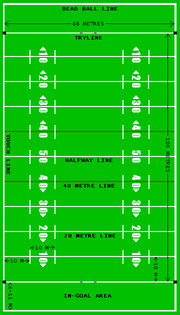
- The in-goal area in which the ball must be grounded includes the goal line but not the touch-in-goal and dead ball lines.
- Grounding the ball in both codes means either holding it and touching it to the ground in-goal, or placing hand, arm or front of body between waist and neck (the front torso) on top of the ball which is on the ground in-goal.
- A player does not need to be holding the ball to ground it. If the ball is on the ground or just above it, it can be touched to the ground with a hand, arm or front torso. Match officials interpret dropping the ball in-goal as a knock-on, and disallow a try. For a try to be awarded they consider whether the player had the intention to ground the ball and the control of it when they did. Grounding of the ball can be instantaneous, it does not matter if the player immediately lets go and the ball then bounces forward.
- An attacking player who falls to the ground before reaching the goal line scores a try if momentum carries the player so that the ball touches the in-goal including the goal line.
Variations specific to rugby union
- A player may ground the ball in one of two ways: (1) if the ball is held in the hand(s) or arm(s), merely touching the ball to the ground in-goal suffices and no downward pressure is required; (2) if the ball is on the ground in-goal, downward pressure from the hand(s), arm(s) or upper body (waist to neck) is required. For a try to be awarded, an attacking player must ground the ball before a defender does so. If there is doubt about which team first grounded the ball, the attacking team are awarded a 5-metre scrum.
- A player who is in touch or touch-in-goal, but who is not carrying the ball, may score a try by grounding the ball in-goal.
- The goal-posts and padding at ground level are part of the goal line and therefore of the in-goal, so a try may be scored by grounding the ball at the foot of the posts.
- A player may ground the ball in a scrum as soon as the ball reaches or crosses the goal line. (The laws governing the scrum do not apply to the in-goal area so as soon as the ball crosses the line, players may unbind and ground the ball.)
- If an attacking player is tackled short of the goal-line but immediately reaches out and places the ball on or over the goal-line, a try is scored. (This is a direct contrast to rugby league which would award a penalty for "double movement", see below. There is occasionally confusion amongst spectators and players at community levels of the game and an incorrect protest of "double movement" is a common one at English rugby union matches.)
- If a television match official (TMO, or video referee) has been appointed, the referee may ask for advice before deciding whether to award a try, but under current protocols the TMO may only advise on whether the ball was properly grounded, on whether the ball or ball-carrier went into touch or touch-in-goal in the act of scoring; and on any foul play that may have occurred.
Variations specific to rugby league
.jpg)
- The laws of rugby league still refer to the need for "downward pressure" to be exerted in grounding the ball with hand or arm.
- The laws of rugby league specify that a try is scored if an attacker grounds the ball simultaneously with a defender.
- An attacking player whose momentum does not allow the ball to reach the try-line or in-goal after their ball-carrying arm touches the ground may not reach out to score if a defender is in contact with them; this is disallowed by interpretation as a "double movement".
- The goal posts and padding are not part of the goal line so grounding the ball at the foot of the posts will not result in a try.
- Players who are in touch-in-goal and not carrying the ball may not score a try by pressing a loose ball still in play to the ground.
- A try may not be scored in a scrum which crosses the goal line, but when the ball comes out of scrum a player may pick it up and 'bore through' their own scrum to score a try.
- Video referees in rugby league are given a wider scope to look at the validity of a try and if the video is inconclusive, the decision is sent back to the referee ("ref's call"). Referees often give the benefit of the doubt in favour of the attacking team in such cases.
Point value
In rugby league, a try is worth four points, having been this case since 1983. Before that, a try was worth three points. In rugby union, a try is worth five points; this point value having varied over time. Although a try is worth less in rugby league, it is more often the main method of scoring due to the much smaller value of goalsGoal (sport)
Goal refers to a method of scoring in many sports. It can also refer to the physical structure or area of the playing surface where scoring occurs....
. In rugby union, however, there is heavier relevance placed on goals to accumulate points at elite levels due to the significant value of goals and the defending team's skills.
Penalty try
In both rugby league and in rugby union, if the referee believes that a try has been prevented by the defending team's misconduct, he may award the attacking team a penalty try. Penalty tries are always awarded under the posts regardless of where the offence took place. In rugby union, the standard applied by the referee is that a try "probably" would have been scored. The referee does not have to be certain a try would have been scored. In rugby league, the referee "may award a penalty try if, in his opinion, a try would have been scored but for the unfair play of the defending team." In rugby league, an 8-point try is awarded if a penalty is conceded after the ball has been grounded. This is awarded in the form of a try beneath the posts, followed by a conversion attempt and then a penalty kick from in front of the postsConversion

Touch-line
The touch line is the line on either side of the playing area of a games of rugby league, rugby union and association football . In many other sports it is called a side-line....
s. This is so the kicker can position the ball in a more advantageous position to increase the chance of scoring. If successful, additional points are scored. For the conversion to be successful the ball must pass over the crossbar and between the uprights. This kick at conversion in rugby union may take place as either a place kick (from the ground) or a drop kick
Drop kick
A drop kick is a type of kick in various codes of football. It involves a player dropping the ball and then kicking it when it bounces off the ground. It contrasts to a punt, wherein the player kicks the ball without letting it hit the ground first....
whereas in rugby league, a conversion may only take place as a place kick. Most players will nevertheless opt for a place kick, this being generally regarded as the easier skill. Note, however, that in both rugby sevens
Rugby sevens
Rugby sevens, also known as seven-a-side or VIIs, is a variant of rugby union in which teams are made up of seven players, instead of the usual 15, with shorter matches. Rugby sevens is administered by the International Rugby Board , the body responsible for rugby union worldwide...
(usually, but not always, played under union rules) and rugby league nines
Rugby league nines
Rugby league nines is a version of rugby league football played with nine players on each side. The game is substantially the same as full rugby league, with some differences in rules and shorter games. Nines is usually played in festivals, as its shorter game play allows for a tournament to be...
, conversions may only take place as drop kicks. In rugby league, the game clock continues during preparation and execution of a conversion, hence a team may decline a conversion attempt if recommencing play as quickly as possible is advantageous to them.
To make the conversion easier, attacking players will try to ground the ball as close to the centre of the in goal area as possible. The attacking player will however ground the ball when confronted by a defender rather than risk losing the ball by being tackled or passing it to a team mate.
In both rugby union and rugby league a conversion is worth two points; a successful kick at goal thus converts a five-point try to seven for rugby union, and a four-point try to six for rugby league.
Past to present
Modern rugby and all derived forms now favour the try over a goal and thus the try has a definite value, that has increased over time and has for many years surpassed the number of points awarded for a goal. In rugby league and rugby union, a conversion attempt is still given, but is simply seen as adding extra 'bonus' points. These points however can mean the difference between winning or losing a match, so thought is given to fielding players with good goal-kicking skill.
See also
- Drop/field goalsField goal (rugby)A drop goal, also referred to as a dropped goal or field goal, is a method of scoring points in rugby union and rugby league. A drop goal cannot be scored in open play by punting the ball, and instead must be scored by drop kicking the ball over the crossbar and between the uprights. After the...
- Line-outLine-outA line-out is the means by which, in rugby union, the ball is put back into play after it has gone into touch. It is the equivalent of the throw-in in soccer. Rugby league abolished line-outs in 1897...
- PenaltyPenalty (rugby)In rugby football, the penalty is the main disciplinary sanction available to the referee to penalise players who commit deliberate infringements. The team who did not commit the infringement are given possession of the ball and may either kick it towards touch , attempt a place kick at goal, or...
- Rugby leagueRugby leagueRugby league football, usually called rugby league, is a full contact sport played by two teams of thirteen players on a rectangular grass field. One of the two codes of rugby football, it originated in England in 1895 by a split from Rugby Football Union over paying players...
- Rugby unionRugby unionRugby union, often simply referred to as rugby, is a full contact team sport which originated in England in the early 19th century. One of the two codes of rugby football, it is based on running with the ball in hand...
- ScrumScrum (rugby)Scrum , in the sports of rugby union and rugby league, is a way of restarting the game, either after an accidental infringement or when the ball has gone out of play...
- ShotShot (ice hockey)A shot in ice hockey is an attempt by a player to score a goal by striking the puck with their stick in the direction of the net.-Shovel:The shovel shot is the simplest most basic shot in a shooter's arsenal. Its execution is simply a shoveling motion to push the puck in the desired direction...
- TouchdownTouchdownA touchdown is a means of scoring in American and Canadian football. Whether running, passing, returning a kickoff or punt, or recovering a turnover, a team scores a touchdown by advancing the ball into the opponent's end zone.-Description:...