

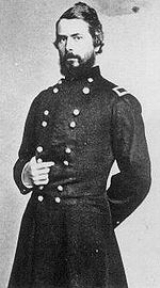
Truman Seymour

Encyclopedia
Truman Seymour was an a career soldier and an accomplished painter. He served in the Union Army
during the American Civil War
, rising to the rank of major general
. He commanded the Union troops at the Battle of Olustee
, the largest Civil War battle fought in Florida
.
. The son of a Methodist minister, he attended Norwich University
for two years before enrolling at the United States Military Academy
at West Point. After graduating in 1846, he was assigned to the 1st U.S. Artillery.
He served in the Mexican-American War in 1846. During the war, he was promoted to the rank of first lieutenant for his performance in the battles of Contreras
and Churubusco
. After returning to the United States following the war, he was an assistant professor of drawing at West Point from 1850 to 1853 and fought against the Seminoles in Florida from 1856 to 1858. He was promoted to captain on November 22, 1860.
assault on Fort Sumter
, after which he received the brevet
of major
.
Major Seymour commanded the 5th Regiment of Artillery and the U.S. Camp of Instruction
at Harrisburg
, Pennsylvania
, from December 1861 to March 1862. He was Chief of Artillery for General George A. McCall
's division of Pennsylvania Reserves
from March 6, 1862, until July 25, 1862. He became a brigadier general
of volunteers on April 28, 1862.
Seymour served in the Army of the Potomac
's V Corps
during the Peninsula Campaign
of April–July 1862. He commanded the left wing of the Reserves at Mechanicsville on June 26, Gaines' Mill
on June 27, Glendale
on June 30 and led the division at Malvern Hill
on July 1 after McCall was captured at the Battle of Glendale
.
After the Peninsula Campaign, the Pennsylvania Reserves joined the III Corps
of the Army of Virginia
, later I Corps
in the Army of the Potomac
. Seymour performed well at the battles of Second Bull Run
, South Mountain
, and Antietam
in the latter half of 1862, especially in his brigade's capture of Frosttown Gap
, Maryland
, on September 14. Seymour took command of the Reserves after Brig. Gen. George G. Meade became acting corps commander. He received the brevet from the regular army of lieutenant colonel
after South Mountain and that of colonel
after Antietam.
After November 18, 1862, General Seymour was sent to the Department of the South where he served as chief of staff to the commanding general from January 8 to April 23, 1863. He led a division on Folly Island
, South Carolina
, on July 4, participated in the attack on Morris Island
on July 10, and commanded the unsuccessful attack on Fort Wagner
on July 18. Seymour gained notoriety for this controversial attack. He was also seriously wounded there and saw little field duty for the rest of 1863.
. Subsequently, Gillmore returned to South Carolina and left Seymour in tactical command.
On February 20, Seymour’s force of about 5,500 men met a Confederate force of about 5,000, commanded by Brigadier General Joseph Finegan
. The battle took place near the town of Olustee
, about 40 miles west of Jacksonville. The ensuing battle produced some of the heaviest losses, by percentage, of any major battle of the war. Although Seymour’s division inflicted nearly 1,000 casualties, it received nearly 2,000 in return. General Seymour’s force returned, defeated, to Jacksonville, where Union troops retained control until the war ended.
and led Robert H. Milroy
's former brigade as part of the Third Division of VI Corps
in the Battle of the Wilderness
that May. He was captured there in a flank attack by Brig. Gen. John B. Gordon, as was Brig. Gen. Alexander Shaler
. After his exchange on August 9, Seymour took command of the Third Division of VI Corps
, after James B. Ricketts
was wounded, in the last stages of the Shenandoah Valley
and the final battles of Petersburg
, the Sayler's Creek
, and the Appomattox Campaign
. He was present at General Robert E. Lee
's surrender on April 9, 1865. After the capture of Petersburg, he received the brevet of major general
of volunteers and the brevet of brigadier general of the United States Army
, both to date from March 13, 1865.
, Massachusetts
(1869–70), and Fort Preble
, Maine
(1870–75). He retired from the army on November 1, 1876.
He received the degree of A.M. from Williams College
in 1865. Seymour spent his retirement in Europe. He painted much in watercolor, and died while living in Florence
, Italy
. He was buried there in the Cimitero Evangelico degli Allori.
Union Army
The Union Army was the land force that fought for the Union during the American Civil War. It was also known as the Federal Army, the U.S. Army, the Northern Army and the National Army...
during the American Civil War
American Civil War
The American Civil War was a civil war fought in the United States of America. In response to the election of Abraham Lincoln as President of the United States, 11 southern slave states declared their secession from the United States and formed the Confederate States of America ; the other 25...
, rising to the rank of major general
Major general (United States)
In the United States Army, United States Marine Corps, and United States Air Force, major general is a two-star general-officer rank, with the pay grade of O-8. Major general ranks above brigadier general and below lieutenant general...
. He commanded the Union troops at the Battle of Olustee
Battle of Olustee
The Battle of Olustee or Battle of Ocean Pond was fought in Baker County, Florida on 20 February 1864, during the American Civil War. It was the largest battle fought in Florida during the war.-Background:In February 1864, Major General Quincy A...
, the largest Civil War battle fought in Florida
Florida
Florida is a state in the southeastern United States, located on the nation's Atlantic and Gulf coasts. It is bordered to the west by the Gulf of Mexico, to the north by Alabama and Georgia and to the east by the Atlantic Ocean. With a population of 18,801,310 as measured by the 2010 census, it...
.
Early life and career
Seymour was born in Burlington, VermontBurlington, Vermont
Burlington is the largest city in the U.S. state of Vermont and the shire town of Chittenden County. Burlington lies south of the U.S.-Canadian border and some south of Montreal....
. The son of a Methodist minister, he attended Norwich University
Norwich University
Norwich University is a private university located in Northfield, Vermont . The university was founded in 1819 at Norwich, Vermont, as the American Literary, Scientific and Military Academy. It is the oldest of six Senior Military Colleges, and is recognized by the United States Department of...
for two years before enrolling at the United States Military Academy
United States Military Academy
The United States Military Academy at West Point is a four-year coeducational federal service academy located at West Point, New York. The academy sits on scenic high ground overlooking the Hudson River, north of New York City...
at West Point. After graduating in 1846, he was assigned to the 1st U.S. Artillery.
He served in the Mexican-American War in 1846. During the war, he was promoted to the rank of first lieutenant for his performance in the battles of Contreras
Battle of Contreras
The Battle of Contreras, also known as the Battle of Padierna, took place during August 19–20, 1847, in the final encounters of the Mexican-American War. In the Battle of Churubusco, fighting continued the following day.-Background:...
and Churubusco
Battle of Churubusco
The Battle of Churubusco took place on August 20, 1847, in the immediate aftermath of the Battle of Contreras during the Mexican-American War. After defeating the Mexican army at Churubusco, the U.S. Army was only 5 miles away from Mexico City, the capital of the nation...
. After returning to the United States following the war, he was an assistant professor of drawing at West Point from 1850 to 1853 and fought against the Seminoles in Florida from 1856 to 1858. He was promoted to captain on November 22, 1860.
Civil War
When the Civil War began in 1861, Seymour participated in the defense against the ConfederateConfederate States of America
The Confederate States of America was a government set up from 1861 to 1865 by 11 Southern slave states of the United States of America that had declared their secession from the U.S...
assault on Fort Sumter
Fort Sumter
Fort Sumter is a Third System masonry coastal fortification located in Charleston Harbor, South Carolina. The fort is best known as the site upon which the shots initiating the American Civil War were fired, at the Battle of Fort Sumter.- Construction :...
, after which he received the brevet
Brevet (military)
In many of the world's military establishments, brevet referred to a warrant authorizing a commissioned officer to hold a higher rank temporarily, but usually without receiving the pay of that higher rank except when actually serving in that role. An officer so promoted may be referred to as being...
of major
Major (United States)
In the United States Army, Air Force, and Marine Corps, major is a field grade military officer rank just above the rank of captain and just below the rank of lieutenant colonel...
.
Major Seymour commanded the 5th Regiment of Artillery and the U.S. Camp of Instruction
Camp Curtin
Camp Curtin was a military training camp in Harrisburg, Pennsylvania, during the American Civil War.When news of the bombardment and subsequent surrender of Fort Sumter in Charleston, South Carolina reached Washington, D.C. on April 14, 1861, President Abraham Lincoln called for 75,000 volunteers...
at Harrisburg
Harrisburg, Pennsylvania
Harrisburg is the capital of Pennsylvania. As of the 2010 census, the city had a population of 49,528, making it the ninth largest city in Pennsylvania...
, Pennsylvania
Pennsylvania
The Commonwealth of Pennsylvania is a U.S. state that is located in the Northeastern and Mid-Atlantic regions of the United States. The state borders Delaware and Maryland to the south, West Virginia to the southwest, Ohio to the west, New York and Ontario, Canada, to the north, and New Jersey to...
, from December 1861 to March 1862. He was Chief of Artillery for General George A. McCall
George A. McCall
George Archibald McCall was a United States Army officer who became a brigadier general and prisoner of war during the American Civil War. He was also a naturalist.-Biography:...
's division of Pennsylvania Reserves
Pennsylvania Reserves
The Pennsylvania Reserves were an infantry division in the Union Army during the American Civil War. Noted for its famous commanders and high casualties, it served in the Eastern Theater, and fought in many important battles, including Antietam and Gettysburg....
from March 6, 1862, until July 25, 1862. He became a brigadier general
Brigadier general (United States)
A brigadier general in the United States Army, Air Force, and Marine Corps, is a one-star general officer, with the pay grade of O-7. Brigadier general ranks above a colonel and below major general. Brigadier general is equivalent to the rank of rear admiral in the other uniformed...
of volunteers on April 28, 1862.
Seymour served in the Army of the Potomac
Army of the Potomac
The Army of the Potomac was the major Union Army in the Eastern Theater of the American Civil War.-History:The Army of the Potomac was created in 1861, but was then only the size of a corps . Its nucleus was called the Army of Northeastern Virginia, under Brig. Gen...
's V Corps
V Corps (ACW)
The V Corps was a unit of the Union Army of the Potomac during the American Civil War.-1862:The corps was first organized briefly under Nathaniel P. Banks, but then permanently on May 18, 1862, designated as the "V Corps Provisional"...
during the Peninsula Campaign
Peninsula Campaign
The Peninsula Campaign of the American Civil War was a major Union operation launched in southeastern Virginia from March through July 1862, the first large-scale offensive in the Eastern Theater. The operation, commanded by Maj. Gen. George B...
of April–July 1862. He commanded the left wing of the Reserves at Mechanicsville on June 26, Gaines' Mill
Battle of Gaines' Mill
The Battle of Gaines's Mill, sometimes known as the First Battle of Cold Harbor or the Battle of Chickahominy River, took place on June 27, 1862, in Hanover County, Virginia, as the third of the Seven Days Battles of the American Civil War...
on June 27, Glendale
Battle of Glendale
The Battle of Glendale, also known as the Battle of Frayser's Farm, Frazier's Farm, Nelson's Farm, Charles City Crossroads, New Market Road, or Riddell's Shop, took place on June 30, 1862, in Henrico County, Virginia, on the sixth day of the Seven Days Battles of the American Civil War.The...
on June 30 and led the division at Malvern Hill
Battle of Malvern Hill
The Battle of Malvern Hill, also known as the Battle of Poindexter's Farm, took place on July 1, 1862, in Henrico County, Virginia, on the seventh and last day of the Seven Days Battles of the American Civil War. Gen. Robert E. Lee launched a series of disjointed assaults on the nearly impregnable...
on July 1 after McCall was captured at the Battle of Glendale
Battle of Glendale
The Battle of Glendale, also known as the Battle of Frayser's Farm, Frazier's Farm, Nelson's Farm, Charles City Crossroads, New Market Road, or Riddell's Shop, took place on June 30, 1862, in Henrico County, Virginia, on the sixth day of the Seven Days Battles of the American Civil War.The...
.
After the Peninsula Campaign, the Pennsylvania Reserves joined the III Corps
III Corps (ACW)
There were four formations in the Union Army designated as III Corps during the American Civil War.Three were short-lived:*In the Army of Virginia:**Irvin McDowell ;**James B...
of the Army of Virginia
Army of Virginia
The Army of Virginia was organized as a major unit of the Union Army and operated briefly and unsuccessfully in 1862 in the American Civil War. It should not be confused with its principal opponent, the Confederate Army of Northern Virginia, commanded by Robert E...
, later I Corps
I Corps (ACW)
I Corps was the designation of three different corps-sized units in the Union Army during the American Civil War. The units served in the following armies:...
in the Army of the Potomac
Army of the Potomac
The Army of the Potomac was the major Union Army in the Eastern Theater of the American Civil War.-History:The Army of the Potomac was created in 1861, but was then only the size of a corps . Its nucleus was called the Army of Northeastern Virginia, under Brig. Gen...
. Seymour performed well at the battles of Second Bull Run
Second Battle of Bull Run
The Second Battle of Bull Run or Second Manassas was fought August 28–30, 1862, as part of the American Civil War. It was the culmination of an offensive campaign waged by Confederate Gen. Robert E. Lee's Army of Northern Virginia against Union Maj. Gen...
, South Mountain
Battle of South Mountain
The Battle of South Mountain was fought September 14, 1862, as part of the Maryland Campaign of the American Civil War. Three pitched battles were fought for possession of three South Mountain passes: Crampton's, Turner's, and Fox's Gaps. Maj. Gen. George B...
, and Antietam
Battle of Antietam
The Battle of Antietam , fought on September 17, 1862, near Sharpsburg, Maryland, and Antietam Creek, as part of the Maryland Campaign, was the first major battle in the American Civil War to take place on Northern soil. It was the bloodiest single-day battle in American history, with about 23,000...
in the latter half of 1862, especially in his brigade's capture of Frosttown Gap
Battle of South Mountain
The Battle of South Mountain was fought September 14, 1862, as part of the Maryland Campaign of the American Civil War. Three pitched battles were fought for possession of three South Mountain passes: Crampton's, Turner's, and Fox's Gaps. Maj. Gen. George B...
, Maryland
Maryland
Maryland is a U.S. state located in the Mid Atlantic region of the United States, bordering Virginia, West Virginia, and the District of Columbia to its south and west; Pennsylvania to its north; and Delaware to its east...
, on September 14. Seymour took command of the Reserves after Brig. Gen. George G. Meade became acting corps commander. He received the brevet from the regular army of lieutenant colonel
Lieutenant Colonel (United States)
In the United States Army, United States Air Force, and United States Marine Corps, a lieutenant colonel is a field grade military officer rank just above the rank of major and just below the rank of colonel. It is equivalent to the naval rank of commander in the other uniformed services.The pay...
after South Mountain and that of colonel
Colonel (United States)
In the United States Army, Air Force, and Marine Corps, colonel is a senior field grade military officer rank just above the rank of lieutenant colonel and just below the rank of brigadier general...
after Antietam.
After November 18, 1862, General Seymour was sent to the Department of the South where he served as chief of staff to the commanding general from January 8 to April 23, 1863. He led a division on Folly Island
Folly Island
Folly Island is a barrier island in the Atlantic Ocean near Charleston, South Carolina. It is one of the Sea Islands and is within the boundaries of Charleston County, South Carolina. During the American Civil War, the island served as a major staging area for troops of the Union Army that were...
, South Carolina
South Carolina
South Carolina is a state in the Deep South of the United States that borders Georgia to the south, North Carolina to the north, and the Atlantic Ocean to the east. Originally part of the Province of Carolina, the Province of South Carolina was one of the 13 colonies that declared independence...
, on July 4, participated in the attack on Morris Island
Morris Island
Morris Island is an 840 acre uninhabited island in Charleston Harbor in South Carolina, accessible only by boat. The island lies in the outer reaches of the harbor and was thus a strategic location in the American Civil War.-History:...
on July 10, and commanded the unsuccessful attack on Fort Wagner
Fort Wagner
Fort Wagner was a beachhead fortification on Morris Island, South Carolina, that covered the southern approach to Charleston harbor...
on July 18. Seymour gained notoriety for this controversial attack. He was also seriously wounded there and saw little field duty for the rest of 1863.
The Battle of Olustee
Maj. Gen. Quincy A. Gillmore, commanding general of the Department of the South, placed Seymour in charge of the newly created District of Florida. The division made an expedition to Florida in February 1864, landing at and taking possession of JacksonvilleJacksonville, Florida
Jacksonville is the largest city in the U.S. state of Florida in terms of both population and land area, and the largest city by area in the contiguous United States. It is the county seat of Duval County, with which the city government consolidated in 1968...
. Subsequently, Gillmore returned to South Carolina and left Seymour in tactical command.
On February 20, Seymour’s force of about 5,500 men met a Confederate force of about 5,000, commanded by Brigadier General Joseph Finegan
Joseph Finegan
Joseph Finegan was an attorney, politician, and railroad builder in Florida, but is primarily known as the general who commanded the Confederate States Army in its victory at the Battle of Olustee....
. The battle took place near the town of Olustee
Olustee, Florida
Olustee is an unincorporated community in Baker County, Florida, United States.-Geography:Olustee is located at .-External links:*...
, about 40 miles west of Jacksonville. The ensuing battle produced some of the heaviest losses, by percentage, of any major battle of the war. Although Seymour’s division inflicted nearly 1,000 casualties, it received nearly 2,000 in return. General Seymour’s force returned, defeated, to Jacksonville, where Union troops retained control until the war ended.
The last year of the war
After Olustee, General Seymour retained command of the District of Florida until March 28, 1864. He then returned to VirginiaVirginia
The Commonwealth of Virginia , is a U.S. state on the Atlantic Coast of the Southern United States. Virginia is nicknamed the "Old Dominion" and sometimes the "Mother of Presidents" after the eight U.S. presidents born there...
and led Robert H. Milroy
Robert H. Milroy
Robert Huston Milroy was a lawyer, judge, and a Union Army general in the American Civil War, most noted for his defeat at the Second Battle of Winchester in 1863.-Early life:...
's former brigade as part of the Third Division of VI Corps
VI Corps (ACW)
The VI Corps was a corps of the Union Army during the American Civil War.-Formation:The corps was organized as the Sixth Provisional Corps on May 18, 1862, by uniting Maj. Gen. William B. Franklin's Division, which had just arrived on the Virginia Peninsula, with Maj. Gen. William F. Smith's...
in the Battle of the Wilderness
Battle of the Wilderness
The Battle of the Wilderness, fought May 5–7, 1864, was the first battle of Lt. Gen. Ulysses S. Grant's 1864 Virginia Overland Campaign against Gen. Robert E. Lee and the Confederate Army of Northern Virginia. Both armies suffered heavy casualties, a harbinger of a bloody war of attrition by...
that May. He was captured there in a flank attack by Brig. Gen. John B. Gordon, as was Brig. Gen. Alexander Shaler
Alexander Shaler
Alexander Shaler was a Union Army general in the American Civil War. He received the United States military's highest decoration, the Medal of Honor, for his actions at the Second Battle of Fredericksburg...
. After his exchange on August 9, Seymour took command of the Third Division of VI Corps
VI Corps (ACW)
The VI Corps was a corps of the Union Army during the American Civil War.-Formation:The corps was organized as the Sixth Provisional Corps on May 18, 1862, by uniting Maj. Gen. William B. Franklin's Division, which had just arrived on the Virginia Peninsula, with Maj. Gen. William F. Smith's...
, after James B. Ricketts
James B. Ricketts
James Brewerton Ricketts was a career officer in the United States Army, serving as a Union Army general in the Eastern Theater during the American Civil War.-Early life and career:...
was wounded, in the last stages of the Shenandoah Valley
Shenandoah Valley
The Shenandoah Valley is both a geographic valley and cultural region of western Virginia and West Virginia in the United States. The valley is bounded to the east by the Blue Ridge Mountains, to the west by the eastern front of the Ridge-and-Valley Appalachians , to the north by the Potomac River...
and the final battles of Petersburg
Siege of Petersburg
The Richmond–Petersburg Campaign was a series of battles around Petersburg, Virginia, fought from June 9, 1864, to March 25, 1865, during the American Civil War...
, the Sayler's Creek
Battle of Sayler's Creek
-External links:* * : Maps, histories, photos, and preservation news...
, and the Appomattox Campaign
Appomattox Campaign
The Appomattox Campaign was a series of battles fought March 29 – April 9, 1865, in Virginia that culminated in the surrender of Confederate General Robert E...
. He was present at General Robert E. Lee
Robert E. Lee
Robert Edward Lee was a career military officer who is best known for having commanded the Confederate Army of Northern Virginia in the American Civil War....
's surrender on April 9, 1865. After the capture of Petersburg, he received the brevet of major general
Major general (United States)
In the United States Army, United States Marine Corps, and United States Air Force, major general is a two-star general-officer rank, with the pay grade of O-8. Major general ranks above brigadier general and below lieutenant general...
of volunteers and the brevet of brigadier general of the United States Army
United States Army
The United States Army is the main branch of the United States Armed Forces responsible for land-based military operations. It is the largest and oldest established branch of the U.S. military, and is one of seven U.S. uniformed services...
, both to date from March 13, 1865.
Postbellum career
After the war ended, Seymour stayed in the Army. He served again in the 5th Artillery, and later commanded forts in Florida, Fort WarrenFort Warren (Massachusetts)
Fort Warren is a historic fort on the Georges Island at the entrance to Boston Harbor. The fort is pentagonal, made with stone and granite, and was constructed from 1833–1861, completed shortly after the beginning of the American Civil War...
, Massachusetts
Massachusetts
The Commonwealth of Massachusetts is a state in the New England region of the northeastern United States of America. It is bordered by Rhode Island and Connecticut to the south, New York to the west, and Vermont and New Hampshire to the north; at its east lies the Atlantic Ocean. As of the 2010...
(1869–70), and Fort Preble
Fort Preble
Fort Preble is a military fort in South Portland, Maine, United States. It is now on the campus of Southern Maine Community College.Henry A. S. Dearborn built this second-system fortification as an "embargo fort" in 1808 and named it in honor of Commodore Edward Preble...
, Maine
Maine
Maine is a state in the New England region of the northeastern United States, bordered by the Atlantic Ocean to the east and south, New Hampshire to the west, and the Canadian provinces of Quebec to the northwest and New Brunswick to the northeast. Maine is both the northernmost and easternmost...
(1870–75). He retired from the army on November 1, 1876.
He received the degree of A.M. from Williams College
Williams College
Williams College is a private liberal arts college located in Williamstown, Massachusetts, United States. It was established in 1793 with funds from the estate of Ephraim Williams. Originally a men's college, Williams became co-educational in 1970. Fraternities were also phased out during this...
in 1865. Seymour spent his retirement in Europe. He painted much in watercolor, and died while living in Florence
Florence
Florence is the capital city of the Italian region of Tuscany and of the province of Florence. It is the most populous city in Tuscany, with approximately 370,000 inhabitants, expanding to over 1.5 million in the metropolitan area....
, Italy
Italy
Italy , officially the Italian Republic languages]] under the European Charter for Regional or Minority Languages. In each of these, Italy's official name is as follows:;;;;;;;;), is a unitary parliamentary republic in South-Central Europe. To the north it borders France, Switzerland, Austria and...
. He was buried there in the Cimitero Evangelico degli Allori.
See also
- List of American Civil War generals