
All Topics  
Tris


   Email Print
   Bookmark   Link


Tris


Tris (also known as THAM) is an abbreviation of the organic compound
Organic compound

An organic compound is any member of a large class of chemical compounds whose molecules contain carbon. For historical reasons discussed below, a few types of compounds such as carbonates, simple oxides of carbon and cyanides, as well as the allotropes of carbon, are considered Inorganic compound....
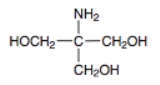
 known as tris(hydroxymethyl)aminomethane, with the formula (HOCH2)3CNH2. Tris is extensively used in biochemistry
Biochemistry

Biochemistry is the study of the chemistry processes in living organisms. It deals with the structure and function of cellular components such as proteins, carbohydrates, lipids, nucleic acids and other biomolecules....
 and molecular biology
Molecular biology

Molecular biology is the study of biology at a molecule level. The field overlaps with other areas of biology and chemistry, particularly genetics and biochemistry....
. In biochemistry
Biochemistry

Biochemistry is the study of the chemistry processes in living organisms. It deals with the structure and function of cellular components such as proteins, carbohydrates, lipids, nucleic acids and other biomolecules....
, tris is widely used as a component of buffer solution
Buffer solution

A buffer solution is an aqueous solution consisting of a mixture of a weak acid and its conjugate base or a weak base and its conjugate acid. It has the property that the pH of the solution changes very little when a small amount of acid or base is added to it....
s, such as in TAE
TAE buffer

TAE buffer is a buffer solution used in agarose electrophoresis, typically for the separation of nucleic acids such as DNA and RNA. It is made up of Tris-acetate buffer, usually at pH 8.0, and EDTA, which sequesters divalent cations....
 and TBE buffer
TBE Buffer

TBE or Tris/Borate/EDTA, is a buffer solution containing a mixture of Tris, boric acid and EDTA.In molecular biology, TBE and TAE buffer buffers are often used in procedures involving nucleic acids, the most common being electrophoresis....
, especially for solutions of nucleic acid
Nucleic acid

A nucleic acid is a macromolecule composed of chains of monomeric nucleotides. In biochemistry these molecules carry genetic information or form structures within Cell ....
s. It is a primary amine and thus undergoes the reactions associated with typical amines, e.g.


Discussion
Ask a question about 'Tris'
Start a new discussion about 'Tris'
Answer questions from other users
Full Discussion Forum


Recent Posts


Encyclopedia


Tris (also known as THAM) is an abbreviation of the organic compound
Organic compound

An organic compound is any member of a large class of chemical compounds whose molecules contain carbon. For historical reasons discussed below, a few types of compounds such as carbonates, simple oxides of carbon and cyanides, as well as the allotropes of carbon, are considered Inorganic compound....
 known as tris(hydroxymethyl)aminomethane, with the formula (HOCH2)3CNH2. Tris is extensively used in biochemistry
Biochemistry

Biochemistry is the study of the chemistry processes in living organisms. It deals with the structure and function of cellular components such as proteins, carbohydrates, lipids, nucleic acids and other biomolecules....
 and molecular biology
Molecular biology

Molecular biology is the study of biology at a molecule level. The field overlaps with other areas of biology and chemistry, particularly genetics and biochemistry....
. In biochemistry
Biochemistry

Biochemistry is the study of the chemistry processes in living organisms. It deals with the structure and function of cellular components such as proteins, carbohydrates, lipids, nucleic acids and other biomolecules....
, tris is widely used as a component of buffer solution
Buffer solution

A buffer solution is an aqueous solution consisting of a mixture of a weak acid and its conjugate base or a weak base and its conjugate acid. It has the property that the pH of the solution changes very little when a small amount of acid or base is added to it....
s, such as in TAE
TAE buffer

TAE buffer is a buffer solution used in agarose electrophoresis, typically for the separation of nucleic acids such as DNA and RNA. It is made up of Tris-acetate buffer, usually at pH 8.0, and EDTA, which sequesters divalent cations....
 and TBE buffer
TBE Buffer

TBE or Tris/Borate/EDTA, is a buffer solution containing a mixture of Tris, boric acid and EDTA.In molecular biology, TBE and TAE buffer buffers are often used in procedures involving nucleic acids, the most common being electrophoresis....
, especially for solutions of nucleic acid
Nucleic acid

A nucleic acid is a macromolecule composed of chains of monomeric nucleotides. In biochemistry these molecules carry genetic information or form structures within Cell ....
s. It is a primary amine and thus undergoes the reactions associated with typical amines, e.g. condensations with aldehydes.

Buffering features

Tris has a pKa
Acid dissociation constant

An acid dissociation constant, Ka, is a quantitative measure of the strong acid in solution. It is the equilibrium constant for a chemical reaction known as Dissociation in the context of acid-base reactions....
 of 8.06, which implies that the buffer has an effective pH
PH

pH is a measure of the Acid or Base of a solution. It is defined as the cologarithm of the Activity of dissolved hydrogen ions . Hydrogen ion activity coefficients cannot be measured experimentally, so they are based on theoretical calculations....
 range between 7.0 and 9.2.

Buffer details

  • The pKa declines approximately 0.03 units per degree Celsius rise in temperature.
  • Silver
    Silver

    Silver is a chemical element with the chemical symbol Ag and atomic number 47. A soft, white, lustrous transition metal, it has the highest electrical conductivity of any element and the highest thermal conductivity of any metal....
    -containing single-junction pH electrodes (e.g., silver chloride electrode
    Silver chloride electrode

    A silver chloride electrode is a type of reference electrode, commonly used in Electrochemistry measurements. For example, it is usually the internal reference electrode in pH meters....
    ) are incompatible with Tris (Ag-tris precipitation clogs the junction). Double-junction electrodes are resistant to this problem, and non-silver containing electrodes are immune.
  • It is toxic to mammalian cells.
  • A common variant of tris (aka tris base) is tris-HCl, the acid salt. When titrated to a specific pH with the corresponding counterion
    Counterion

    A counterion is the ion that accompanies an ionic species in order to maintain electric neutrality. In table salt the sodium cation is the counterion for the chlorine anion and vice versa....
     (OH- for tris-HCl, H+ for tris base) they are equivalent. However, the molecular weights are different and must be correctly accounted for in order to arrive at the expected buffer strength.


Preparation

Tris is prepared in two steps from nitromethane
Nitromethane

Nitromethane is an organic compound with the chemical formula CH3NO2. It is the simplest organic nitro compound. It is a slightly viscous, highly polar liquid commonly used as a solvent in a variety of industrial applications such as in extractions, as a reaction medium, and as a cleaning solvent....
 via the intermediate (HOCH2)3CNO2 . Reduction of the latter gives tris(hydroxymethyl)aminomethane.

Uses

The useful buffer range for tris (7-9) coincides with the typical physiological pH of most living organisms. This, and its low cost, make tris one of the most common buffers used in the biology/biochemistry lab.

Tris Structure

Medical


Tris (usually known as THAM in this context) is used as alternative to sodium bicarbonate
Sodium bicarbonate

Sodium bicarbonate or sodium hydrogen carbonate is the chemical compound with the formula NaHCO3. Sodium bicarbonate is a white solid that is crystalline but often appears as a fine powder....
 in the treatment of metabolic acidosis
Metabolic acidosis

In medicine, metabolic acidosis is a process which if unchecked leads to acidemia, i.e. blood pH is low due to increased production of hydrogen by the body or the inability of the body to form bicarbonate in the kidney....
.