

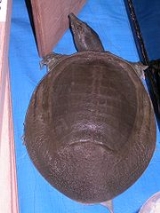
Trionychidae

Overview
Trionychidae is a taxonomic
family
which comprises a number of turtle
genera
commonly known as softshells. They are also sometimes called pancake turtles. Softshells consist of some of the world's largest fresh water
turtles, though many can adapt to living in highly brackish areas. Members of this family occur in Africa, Asia, North America, and Southeast Asia. North American members of genus Trionyx were fairly recently (1987) assigned the resurrected genus name Apalone
by Meylan, though they are still listed semi-correctly as Trionyx in some texts.
They are called "softshell" because their carapace
lacks horny scute
s (scales), though the spiny softshell, Apalone spinifera, does have some scale-like projections, hence its name.
Taxonomy
Taxonomy is the science of identifying and naming species, and arranging them into a classification. The field of taxonomy, sometimes referred to as "biological taxonomy", revolves around the description and use of taxonomic units, known as taxa...
family
Family (biology)
In biological classification, family is* a taxonomic rank. Other well-known ranks are life, domain, kingdom, phylum, class, order, genus, and species, with family fitting between order and genus. As for the other well-known ranks, there is the option of an immediately lower rank, indicated by the...
which comprises a number of turtle
Turtle
Turtles are reptiles of the order Testudines , characterised by a special bony or cartilaginous shell developed from their ribs that acts as a shield...
genera
Genus
In biology, a genus is a low-level taxonomic rank used in the biological classification of living and fossil organisms, which is an example of definition by genus and differentia...
commonly known as softshells. They are also sometimes called pancake turtles. Softshells consist of some of the world's largest fresh water
Fresh Water
Fresh Water is the debut album by Australian rock and blues singer Alison McCallum, released in 1972. Rare for an Australian artist at the time, it came in a gatefold sleeve...
turtles, though many can adapt to living in highly brackish areas. Members of this family occur in Africa, Asia, North America, and Southeast Asia. North American members of genus Trionyx were fairly recently (1987) assigned the resurrected genus name Apalone
Apalone
Apalone is a North American genus in the Trionychidae family of turtles, a family whose members are commonly referred to as softshell turtles. Apalone species are native primarily to the United States, though they are also found in parts of southern Canada and northern Mexico...
by Meylan, though they are still listed semi-correctly as Trionyx in some texts.
They are called "softshell" because their carapace
Carapace
A carapace is a dorsal section of the exoskeleton or shell in a number of animal groups, including arthropods such as crustaceans and arachnids, as well as vertebrates such as turtles and tortoises. In turtles and tortoises, the underside is called the plastron.-Crustaceans:In crustaceans, the...
lacks horny scute
Scute
A scute or scutum is a bony external plate or scale, as on the shell of a turtle, the skin of crocodilians, the feet of some birds or the anterior portion of the mesonotum in insects.-Properties:...
s (scales), though the spiny softshell, Apalone spinifera, does have some scale-like projections, hence its name.
Unanswered Questions

Discussions
