
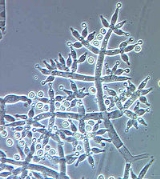
Trichoderma is a
genusIn biology, a genus is a low-level taxonomic rank used in the biological classification of living and fossil organisms, which is an example of definition by genus and differentia...
of fungi that is present in all soils, where they are the most prevalent
culturableCell culture is the complex process by which cells are grown under controlled conditions. In practice, the term "cell culture" has come to refer to the culturing of cells derived from singlecellular eukaryotes, especially animal cells. However, there are also cultures of plants, fungi and microbes,...
fungi. Many species in this genus can be characterized as opportunistic avirulent plant symbionts.
Species
There are 89 species in the
Trichoderma genus.
HypocreaHypocrea is a genus of fungi in the Hypocreaceae family. The widespread genus is estimated to contain 171 species that grow on rotten wood, and are often associated with other fungi. Anamorphic genera associated with Hypocrea include Acremonium, Gliocladium, Trichoderma, and Verticillium...
are teleomorphs of
Trichoderma which themselves have
Hypocrea as anamorphs.
Trichoderma species include:
- Trichoderma aggressivum
- Trichoderma amazonicum
- Trichoderma asperellum
- Trichoderma atroviride
- Trichoderma aureoviride
- Trichoderma austrokoningii
- Trichoderma brevicompactum
- Trichoderma candidum
- Trichoderma caribbaeum var. aequatoriale
- Trichoderma caribbaeum var. caribbaeum
- Trichoderma catoptron
- Trichoderma cremeum
- Trichoderma ceramicum
- Trichoderma cerinum
- Trichoderma chlorosporum
- Trichoderma chromospermum
- Trichoderma cinnamomeum
- Trichoderma citrinoviride
- Trichoderma crassum
- Trichoderma cremeum
- Trichoderma dingleyeae
- Trichoderma dorotheae
- Trichoderma effusum
- Trichoderma erinaceum
- Trichoderma estonicum
- Trichoderma fertile
- Trichoderma gelatinosus
- Trichoderma ghanense
- Trichoderma hamatum
- Trichoderma harzianum
Trichoderma harzianum is a fungus that is also used as a fungicide. It is used for foliar application, seed treatment and soil treatment for suppression of various disease causing fungal pathogens. Commercial biotechnological products such as 3Tac have been useful for treatment of Botrytis,...
- Trichoderma helicum
- Trichoderma intricatum
- Trichoderma konilangbra
- Trichoderma koningii
Trichoderma koningii is a plant pathogen.- External links :* *...
- Trichoderma koningiopsis
- Trichoderma longibrachiatum
- Trichoderma longipile
- Trichoderma minutisporum
- Trichoderma oblongisporum
- Trichoderma ovalisporum
- Trichoderma petersenii
- Trichoderma phyllostahydis
- Trichoderma piluliferum
- Trichoderma pleuroticola
- Trichoderma pleurotum
- Trichoderma polysporum
- Trichoderma pseudokoningii
- Trichoderma pubescens
- Trichoderma reesei
Trichoderma reesei is a mesophilic and filamentous fungus. It is an anamorph of the fungus Hypocrea jecorina.T. reesei has the capacity to secrete large amounts of cellulolytic enzymes...
- Trichoderma rogersonii
- Trichoderma rossicum
- Trichoderma saturnisporum
- Trichoderma sinensis
- Trichoderma sinuosum
- Trichoderma sp. MA 3642
- Trichoderma sp. PPRI 3559
- Trichoderma spirale
- Trichoderma stramineum
- Trichoderma strigosum
- Trichoderma stromaticum
- Trichoderma surrotundum
- Trichoderma taiwanense
- Trichoderma thailandicum
- Trichoderma thelephoricolum
- Trichoderma theobromicola
- Trichoderma tomentosum
- Trichoderma velutinum
- Trichoderma virens
- Trichoderma viride
Trichoderma viride is a fungus and a biofungicide.It is used for seed and soil treatment for suppression of various diseases caused by fungal pathogens. It is also a pathogen in its own right, causing green mould rot of onion.-Biology:...
- Trichoderma viridescens
Characteristics
Cultures are typically fast growing at 25-30°C, but will not grow at 35°C. Colonies are transparent at first on media such as cornmeal dextrose agar (CMD) or white on richer media such as potato dextrose agar (PDA). Mycelium are not typically obvious on CMD, conidia typically form within one week in compact or loose tufts in shades of green or yellow or less frequently white. A yellow pigment may be secreted into the agar, especially on PDA. Some species produce a characteristic sweet or 'coconut' odor.
Conidiophores are highly branched and thus difficult to define or measure, loosely or compactly tufted, often formed in distinct concentric rings or borne along the scant aerial hyphae. Main branches of the conidiophores produce lateral side branches that may be paired or not, the longest branches distant from the tip and often phialides arising directly from the main axis near the tip. The branches may rebranch, with the secondary branches often paired and longest secondary branches being closest to the main axis. All primary and secondary branches arise at or near 90° with respect to the main axis. The typical
Trichoderma conidiophore, with paired branches assumes a pyramidal aspect. Typically the conidiophore terminates in one or a few phialides. In some species (e.g.
T. polysporum) the main branches are terminated by long, simple or branched, hooked, straight or sinuous, septate, thin-walled, sterile or terminally fertile elongations. The main axis may be the same width as the base of the phialide or it may be much wider.
PhialidePhialide .*A flask-shaped projection from the vesicle of certain fungi.*Projects from the mycelium without increasing in length unless there is a subsequent increase in the formation of conidia....
s are typically enlarged in the middle but may be cylindrical or nearly subglobose. Phialides may be held in whorls, at an angle of 90° with respect to other members of the whorl, or they may be variously penicillate (gliocladium-like). Phialides may be densely clustered on wide main axis (e.g.
T. polysporum,
T. hamatum) or they may be solitary (e.g.
T. longibrachiatum).
Conidia typically appear dry but in some species they may be held in drops of clear green or yellow liquid (e.g.
T. virens,
T. flavofuscum). Conidia of most species are ellipsoidal, 3-5 x 2-4 µm (L/W = > 1.3); globose conidia (L/W < 1.3) are rare. Conidia are typically smooth but tuberculate to finely warted conidia are known in a few species.
Synanamorphs are formed by some species that also have typical
Trichoderma pustules. Synanamorphs are recognized by their solitary conidiophores that are verticillately branched and that bear conidia in a drop of clear green liquid at the tip of each phialide.
ChlamydosporeA Chlamydospore is the thick-walled big resting spore of several kinds of fungi. It is the life-stage which survives in unfavourable conditions, such as dry or hot seasons....
s may be produced by all species, but not all species produce chlamydospores on CMD at 20°C within 10 days. Chlamydospores are typically unicellular subglobose and terminate short hyphae; they may also be formed within hyphal cells. Chlamydospores of some species are multicellular (e.g.
T. stromaticum).
Teleomorph
Teleomorphs of
Trichoderma are species of the ascomycete genus
HypocreaHypocrea is a genus of fungi in the Hypocreaceae family. The widespread genus is estimated to contain 171 species that grow on rotten wood, and are often associated with other fungi. Anamorphic genera associated with Hypocrea include Acremonium, Gliocladium, Trichoderma, and Verticillium...
. These are characterized by the formation of fleshy, stromata in shades of light or dark brown, yellow or orange. Typically the stroma is discoidal to pulvinate and limited in extent but stromata of some species are effused, sometimes covering extensive areas. Stromata of some species (Podostroma) are clavate or turbinate. Perithecia are completely immersed. Ascospores are bicellular but disarticulate at the septum early in development into 16 part-ascospores so that the ascus appears to contain 16 ascospores. Ascospores are hyaline or green and typically spinulose. More than 200 species of
Hypocrea have been described but few have been grown in pure culture and even fewer have been described in modern terms.
Habitat
Trichoderma species are frequently isolated from forest or agricultural soils at all
latitudeIn geography, the latitude of a location on the Earth is the angular distance of that location south or north of the Equator. The latitude is an angle, and is usually measured in degrees . The equator has a latitude of 0°, the North pole has a latitude of 90° north , and the South pole has a...
s.
Hypocrea species are most frequently found on bark or on decorticated wood but many species grow on bracket fungi (e.g.
H. pulvinata), Exidia (
H. sulphurea) or bird's nest fungi (
H. latizonata) or agarics (
H. avellanea).
Biocontrol agent
Several strains of
Trichoderma have been developed as biocontrol agents against fungal diseases of plants. The various mechanisms include antibiosis, parasitism, inducing host-plant resistance, and competition. Most biocontrol agents are from the species
T. harzianumTrichoderma harzianum is a fungus that is also used as a fungicide. It is used for foliar application, seed treatment and soil treatment for suppression of various disease causing fungal pathogens. Commercial biotechnological products such as 3Tac have been useful for treatment of Botrytis,...
,
T. viride and
T. hamatum. The biocontrol agent generally grows in its natural habitat on the root surface, and so affects root disease in particular, but can also be effective against foliar diseases.
Causal agent of disease
T. aggressivum (formerly T. harzianum biotype 4) is the causal agent of green mold, a disease of cultivated button mushrooms.
.
Trichoderma virideTrichoderma viride is a fungus and a biofungicide.It is used for seed and soil treatment for suppression of various diseases caused by fungal pathogens. It is also a pathogen in its own right, causing green mould rot of onion.-Biology:...
is the causal agent of green mold rot of onion.
Medical uses
Cyclosporine A (CsA), a
calcineurinCalcineurin is a protein phosphatase also known as protein phosphatase 3, PPP3CA, and calcium-dependent serine-threonine phosphatase, and formerly known as protein phosphatase 2B . It activates the T cells of the immune system and can be blocked by drugs...
inhibitor produced by the fungi
Trichoderma polysporum and
Cylindrocarpon lucidum, is an immunosuppressant prescribed in organ transplants to prevent rejection.
Industrial use
Trichoderma, being a saprophyte adapted to thrive in diverse situations, produces a wide array of enzymes. By selecting strains that produce a particular kind of enzyme, and culturing these in suspension, industrial quantities of enzyme can be produced.
- T. reesei
Trichoderma reesei is a mesophilic and filamentous fungus. It is an anamorph of the fungus Hypocrea jecorina.T. reesei has the capacity to secrete large amounts of cellulolytic enzymes...
is used to produce cellulase400px|thumb|right|alt = Colored dice with checkered background|Ribbon representation of the Streptomyces lividans beta-1,4-endoglucanase catalytic domain - an example from the family 12 glycoside hydrolases...
and hemicellulase
- T. longibratum is used to produce xylanase
Xylanase is the name given to a class of enzymes which degrade the linear polysaccharide beta-1,4-xylan into xylose, thus breaking down hemicellulose, one of the major components of plant cell walls....
- T. harzianum
Trichoderma harzianum is a fungus that is also used as a fungicide. It is used for foliar application, seed treatment and soil treatment for suppression of various disease causing fungal pathogens. Commercial biotechnological products such as 3Tac have been useful for treatment of Botrytis,...
is used to produce chitinaseChitinases are hydrolytic enzymes that break down glycosidic bonds in chitin. As chitin is a component of the cell walls of fungi and exoskeletal elements of some animals , chitinases are generally found in organisms that either need to reshape their own chitin or dissolve and digest the chitin of...
.
External links
- Samuels, G.J., Chaverri, P., Farr, D.F., & McCray, E.B. (n.d.) Trichoderma Online, Systematic Botany & Mycology Laboratory, ARS, USDA. Retrieved August 3, 2007 This site presents descriptions and over 500 images for the 32 species of Trichoderma that represent a majority of the taxa found in temperate regions
- International Subcommission on Trichoderma and Hypocrea Taxonomy site.