
All Topics  
Tribe of Judah

 
Tribe of Judah

   Email Print
   Bookmark   Link


Tribe of Judah


According to the Hebrew Bible
Hebrew Bible

The term Hebrew Bible is a generic reference to those books of the Bible originally written mostly in Biblical Hebrew with some Biblical Aramaic....
, the Tribe of Judah was one of the twelve Tribes of Israel.

Following the completion of the conquest of Canaan
Canaan

Canaan is an ancient term for a region encompassing modern-day Israel and Lebanon, the Palestinian Territories, plus adjoining coastal lands and parts of Jordan, Syria and northeastern Egypt....
 by the Israelite
Israelite

According to the Tanakh, the Israelites were the descendants of the Biblical patriarch Jacob. They were divided into twelve tribes, each descended from one of twelve sons or grandsons of Jacob....
 tribes after about 1200 BCE, Joshua
Joshua

Joshua, Jehoshuah or Yehoshua , born in Egypt, was a biblical Israelite leader who succeeded Moses. His story is told in the Hebrew Bible, chiefly in the books Book of Exodus, Book of Numbers and Book of Joshua....
 allocated the land among the twelve tribes.

From after the conquest of the land by Joshua until the formation of the first Kingdom of Israel
Kingdom of Israel

The Kingdom of Israel was one of the successor states to the older United Monarchy . It existed roughly from the 930s BC until about the 720s BC....
 in c. 1050 BCE, the Tribe of Judah was a part of a loose confederation of Israelite tribes.


Discussion
Ask a question about 'Tribe of Judah'
Start a new discussion about 'Tribe of Judah'
Answer questions from other users
Full Discussion Forum


Recent Posts


Encyclopedia


According to the Hebrew Bible
Hebrew Bible

The term Hebrew Bible is a generic reference to those books of the Bible originally written mostly in Biblical Hebrew with some Biblical Aramaic....
, the Tribe of Judah was one of the twelve Tribes of Israel.

Following the completion of the conquest of Canaan
Canaan

Canaan is an ancient term for a region encompassing modern-day Israel and Lebanon, the Palestinian Territories, plus adjoining coastal lands and parts of Jordan, Syria and northeastern Egypt....
 by the Israelite
Israelite

According to the Tanakh, the Israelites were the descendants of the Biblical patriarch Jacob. They were divided into twelve tribes, each descended from one of twelve sons or grandsons of Jacob....
 tribes after about 1200 BCE, Joshua
Joshua

Joshua, Jehoshuah or Yehoshua , born in Egypt, was a biblical Israelite leader who succeeded Moses. His story is told in the Hebrew Bible, chiefly in the books Book of Exodus, Book of Numbers and Book of Joshua....
 allocated the land among the twelve tribes.

From after the conquest of the land by Joshua until the formation of the first Kingdom of Israel
Kingdom of Israel

The Kingdom of Israel was one of the successor states to the older United Monarchy . It existed roughly from the 930s BC until about the 720s BC....
 in c. 1050 BCE, the Tribe of Judah was a part of a loose confederation of Israelite tribes. No central government existed, and in times of crisis the people were led by ad hoc leaders known as Judges
Biblical judges

Biblical judges were chief magistrates of the Israelites in the ancients' sense , distinct from modern, merely judicial judges. While judge is the closest literal translation of the Hebrew language used in the masoretic text, the position is more one of unelected non-hereditary leadership than that of legal pronouncement....
. (see the Book of Judges
Book of Judges

The Book of Judges is a Books of the Bible originally written in Hebrew language. It appears in the Tanakh and in the Christian Old Testament. Its title refers to its contents; it contains the history of Biblical judges , who helped rule and guide the ancient Israelites, and of their times....
) With the growth of the threat from Philistine incursions, the Israelite tribes decided to form a strong centralised monarchy to meet the challenge. The first king of this new entity was Saul
Saul

Saul or Shaul may also refer to:...
, who came from the Tribe of Benjamin, which at the time was the smallest of the tribes.

After the death of Saul, all the tribes other than Judah remained loyal to the House of Saul, while Judah chose David
David

David , was the second king of the united Kingdom of Israel according to the Hebrew Bible/Old Testament. He is depicted as a righteous king, although not without fault, as well as an acclaimed warrior, musician and poet ....
 as its king. However, after the death of Ish-bosheth
Ish-bosheth

Ish-bosheth also called Eshbaal , Ashbaal or Ishbaal, appears in the Hebrew Bible. He was born in c. 1047 BCE and was one of the four sons of King Saul with Ahinoam, daughter of Ahimaaz....
, Saul's son and successor to the throne of Israel, all the other Israelite tribes made David, who was then the king of Judah, king of a re-united Kingdom of Israel. However, on the accession of Rehoboam
Rehoboam

Rehoboam was a king of United Monarchy and later king of the Kingdom of Judah after the ten northern tribes of Israel rebelled in 932/931 BC to form the independent Kingdom of Israel....
, David's grandson, in c. 930 BCE the northern tribes split from the House of David
House of David

The House of David was a religious commune founded in 1903 by Benjamin and Mary Purnell. Based in and around Benton Harbor, Michigan, and High Island , the commune required its members to refrain from sex, haircuts, shaving, and the eating of meat....
 to reform a Kingdom of Israel as the Northern Kingdom. The tribes of Judah and Benjamin remained loyal to the House of David.

At its height, it was the leading tribe of the Kingdom of Judah
Kingdom of Judah

The Kingdom of Judah existed at two periods in Jewish history. According to the Hebrew Bible, a kingdom emerged in Judah after the death of Saul, when the tribe of Judah elevated David to rule over it....
, and occupied most of the territory of the kingdom, except for a small region in the north east occupied by Benjamin
Tribe of Benjamin

According to the Hebrew Bible, the Tribe of Benjamin was one of the twelve Israelites.Following the completion of the conquest of Canaan by the Israelite tribes after about 1200 BCE, Joshua allocated the land among the twelve tribes....
, and an enclave towards the south west which was occupied by Simeon
Tribe of Simeon

The Tribe of Simeon was one of the Israelites. At its height, the territory it occupied was in the southwest of Canaan, bordered on the east and south by the tribe of Judah; the boundaries with the tribe of Judah are vague, and it seems that Simeon may have been an enclave within the west of the territory of the tribe of Judah....
.

The size of the territory of the tribe of Judah meant that in practice it had four distinct regions:
  • The Negev
    Negev

    The Negev is a desert and semidesert region of southern Israel. The indigenous Negev Bedouin inhabitants of the region refer to the desert as al-Naqab ....
     (Hebrew: south) - the southern portion of the land, which was highly suitable for pasture
    Pasture

    Pasture is land with herbaceous vegetation cover used for grazing of ungulate livestock as part of a farm or ranch. Prior to the advent of factory farming, pasture was the primary source of food for grazing animals such as cattle and horses....
  • The Shephelah
    Shephelah

    The Shephelah is a designation usually applied to the region in south-central Israel of 10-15 km of low hills between the central Mount Hebron and the coastal plains of Philistia within the area of the Judea, at an altitude of 120-450 metres above sea level....
     (Hebrew: lowland) - the coastal region, between the highlands and the Mediterranean sea, which was used for agriculture
    Agriculture

    Agriculture refers to the production of food and goods through farming and forestry. Agriculture was the key development that led to the rise of civilization, with the animal husbandry of domestication animals and plants creating food surpluses that enabled the development of more Population density and Social stratification societies....
    , in particular for grain
    GRAIN

    GRAIN is an international non-governmental organization based in Barcelona, Spain, which works toward sustainable agriculture. It was formed upon the realization that the genetic diversity of the world's food crops are being drastically eliminated....
    s.
  • The wilderness - the barren region immediately next to the Dead Sea
    Dead Sea

    For the Brian Keene book of the same name, see Dead Sea The Dead Sea is a salt lake between Israel and the West Bank to the west, and Jordan to the east....
    , and below sea level
    Sea level

    Mean sea level is the average height of the sea, with reference to a suitable reference surface. Defining the reference level , however, involves complex measurement, and accurately determining MSL can prove difficult....
    ; it was wild, and barely inhabitable, to the extent that animals and people which were made unwelcome elsewhere, such as bear
    Bear

    Bears are mammals of the family Ursidae. Bears are classified as caniforms, or doglike carnivorans, with the pinnipeds being their closest living relatives....
    s, leopards, and outlaw
    Outlaw

    An outlaw or bandit is a person living the lifestyle of outlawry; the word literally means "outside the law", by folk-etymology from the original meaning "laid outside" of the Old Norse word ?tlagi, from which the word outlaw was borrowed into English....
    s, made it their home. In biblical times, this region was further subdivided into three sections - the wilderness of En Gedi, the wilderness of Judah, and the wilderness of Maon
    Maon

    Maon can refer to:*Preon, theoretical component of quarks*Ma'on, in the Land of Israel...
    .
  • The hill country - the elevated plateau situated between the Shephelah and the wilderness, with rocky slopes but very fertile soil. This region was used for the production of corn
    Corn (term)

    Corn is an English word dating back to Anglo-Saxon times or earlier meaning cereal or grain. It commonly refers, in modern American usage, to Indian corn, that is, maize, but in other times and places is used to refer to wheat, barley, rye and so on....
    , olives, grapes, and other fruit, and hence produced oil
    Oil

    An oil is a chemical substance that is in a viscosity liquid state at room temperature or slightly warmer, and is both hydrophobic and lipophilic ....
     and wine
    Wine

    Wine is an alcoholic beverage often made of fermentation grape juice. The natural chemical balance of grapes is such that they can ferment without the addition of sugars, acids, enzymes or other nutrients....
    .


The Kingdom of Judah was conquered by Babylon
Babylon

Babylon was a city-state of ancient Mesopotamia, sometimes considered an empire, the remains of which can be found in present-day Al Hillah, Babil Governorate, Iraq, about 85 kilometers south of Baghdad....
 in c. 586 BCE and the population deported.

When the Jews returned from Babylonian exile, residual tribal affiliations were abandoned, probably because of the impossibility of reestablishing previous tribal land holdings. However, the special religious roles decreed for the Levi
Levi

Levi/Levy, Hebrew language#Modern Hebrew Levy ??? Tiberian vocalization ; "joining") was, according to the Book of Genesis, the third son of Jacob and Leah, and the founder of the Israelites of Levites ....
s and Kohanim
Kohen

A kohen is a Jew who is a direct male descendant of the Bible Aaron, brother of Moses, with a separate status in Judaism. Another term for the descendants of Aaron are the Aaronites or Aaronids....
 were preserved, and the general population was called Israel. These designations are still followed today.

Origin


According to the Torah
Torah

The term "Torah" , or Five Books of Moses or Pentateuch, refers to the entirety of Judaism's founding Halakha and ethical religious texts....
, the tribe consisted of descendants of Judah
Judah

Judah is the name of several Biblical and historical figures. The original Judah was the fourth son of Jacob and Leah, as recorded in Genesis 29:35....
, the fourth son of Jacob
Jacob

According to the Hebrew Bible, Jacob , also known as Israel , was the third Biblical patriarchs and the ancestor of the twelve Israelites....
 and of Leah
Leah

Leah is the first of the Polygamy in Judaism of the Hebrew patriarch Jacob, and mother of six of the Twelve Tribes of Israel, along with one daughter from Genesis in the Old Testament of the Bible....
; however some Biblical scholars
Biblical criticism

Biblical criticism is "the study and investigation of biblical writings that seeks to make discerning and discriminating judgments about these writings." It asks when and where a particular text originated; how, why, by whom, for whom, and in what circumstances it was produced; what influences were at work in its production; what sources we...
 view this as postdiction, an eponym
Eponym

An eponym is a person, whether real or fictitious, after whom a particular toponym, ethnonym, regnal year, discovery, or other item is named or thought to be named....
ous metaphor
Metaphor

Metaphor is language that directly compares seemingly unrelated subjects. It is a figure of speech that compares two or more things without using the words "like" or "as." More generally, a metaphor describes a first subject as being or equal to a second object in some way....
 providing an aetiology of the connectedness of the tribe to others in the Israelite confederation. With Leah as a matriarch, Biblical scholars regard the tribe as having been believed by the text's authors to have been part of the original Israelite confederation.

Like the other tribes of the kingdom of Judah, the tribe of Judah is entirely absent from the ancient Song of Deborah, rather than present but described as unwilling to assist in the battle between Israelites and their enemy. Traditionally, this has been explained as being due to the southern kingdom being too far away to be involved in the battle, but Israel Finkelstein et al. claim the alternative explanation that the southern kingdom was simply an insignificant rural backwater at the time the poem was written.

Character


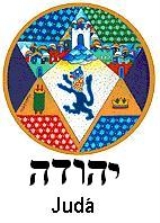
Lion of Judah
The tribe of Judah stood apart from the others as the leading tribe of the Kingdom of Judah, and from the tribe came the kingdom's rulers (though not the later Hasmonean
Hasmonean

The Hasmoneans were the ruling dynasty of the Hasmonean Kingdom of Israel , an independent Jewish state. The Hasmonean dynasty was established under the leadership of Simon Maccabaeus, two decades after his brother Judas Maccabeus defeated the Seleucid army during the Maccabean Revolt in 165 BCE....
 kings of Judea, who were Levites). The regal status of Judah is seemingly prophesied in the Blessing of Jacob
Blessing of Jacob

The Blessing of Jacob is a poem that appears in Book of Genesis at .The poem presents an opinion of the merits and attributes of each of the Tribes of Israel, and so can be compared with the Blessing of Moses, which has the same theme....
, which argues that the staff shall not depart from Judah, nor the sceptre
Sceptre

A sceptre or scepter is a symbolic ornamental Staff held by a ruling monarch, a prominent item of royal regalia. While some sceptres resemble a Ceremonial mace, their use is quite different....
 from between his feet...
though some textual scholars
Textual criticism

Textual criticism is a branch of literary criticism that is concerned with the identification and removal of transcription errors in the Writing of manuscripts....
 view this as postdiction
Postdiction

According to critics of paranormal beliefs, postdiction is an effect of hindsight bias that explains claimed predictions of significant events, such as plane crashes and natural disasters....
, since they date the poem to a few centuries after the Song of Deborah, to roughly 800-700 BC. With the Davidic line
Davidic line

The Davidic line refers to the tracing of lineage to the King David referred to in the Hebrew Bible, as well as the New Testament. Though this is especially relevant to kings claiming royal lineage and to major leaders in Jewish history, it is also relevant in a general sense to anyone who claims descent from King David....
 thus being from the tribe, the tribe counted David
David

David , was the second king of the united Kingdom of Israel according to the Hebrew Bible/Old Testament. He is depicted as a righteous king, although not without fault, as well as an acclaimed warrior, musician and poet ....
 among its members, as well as his ancestors Boaz
Boaz

Boaz is a major figure in The Book of Ruth in the Bible. The term is found 24 times on the Scriptures, being two in Greek .The Semitic root ???, just used on the Bible in relation to "Boaz", perhaps expresses 'quick' ....
, Obed
Obed

In the Tanakh, Obed was a son of Boaz and Book of Ruth , the father of Jesse, and the grandfather of DavidIn the Christian Scriptures, He is one of Jesus' ancestors through the aforementioned genealogy found in the gospels....
, and Jesse
Jesse

Jesse or Yishay is the father of the Biblical David, who became the king of the nation of Israel. His son David is sometimes called simply "Son of Jesse" ....
. According to Jewish belief, since the Blessing appears to promise that Judah would always rule the kingdom, the (Jewish) Messiah
Jewish Messiah

Messiah In Jewish eschatology, the term came to refer to a future Jewish monarch from the Davidic line, who will be "anointed" with holy anointing oil and rule the Jewish people during the Messianic Age....
 had to be a member of the tribe.

Many other important leaders were also from the tribe. Some of the most important literary prophets
Literary prophets

The literary prophets is a name given to the Biblical figures who wrote down their prophecies and personal histories, rather than histories of the Israelites....
, including Isaiah
Isaiah

Isaiah is the main figure in the Biblical Book of Isaiah, and is traditionally considered to be its author. He was an 8th-century Before Christ Judean prophet who declared that all the world belonged to God and that God will destroy it....
, as well as Amos
Amos (prophet)

Amos is one of the twelve minor prophets in the Hebrew Bible, and putative author of the speeches reported in the Book of Amos. The only direct information about him comes from this book....
, Habakkuk
Habakkuk

Habakkuk or Havakuk was a prophet in the Hebrew Bible. The etymology of the name of Habakkuk is not clear. The name is possibly related to the Akkadian language khabbaququ, the name of a fragrant plant, or the Hebrew root ???, meaning "embrace"....
, Joel
Joel (prophet)

Joel was a prophet of ancient Israel whose prophecies are recorded in the brief Biblical book that bears his name. His name occurs only once in the Old Testament....
, Micah
Micah (prophet)

Micah the titular prophet of the Book of Micah, also called "The Morasthite". He is not the same as another prophet, Micaiah son of Imlah. He is counted among the minor prophets in the Tanakh ....
, Obadiah
Obadiah

Obadiah is a Bible Theophory in the Bible name, meaning "servant of Jehovah" It is cognate to the Arabic language name `Ubaidallah . The form of his name used in the Septuagint is Obdios; in Latin it is Abdias....
, Zechariah, and Zephaniah
Zephaniah

Zephaniah or Tzfanya is the name of several people in the Bible Old Testament and Judaism Tanakh. He is also called Sophonias as in the New Catholic Encyclopaedia and in Easton's [Bible] Dictionary....
, hailed from Judah. Later, during the Babylonian Exile, the Exilarch
Exilarch

Exilarch refers to the leaders of the Diaspora Jewish community following the deportation of the population of Judah into Babylonian captivity after the destruction of the kingdom of Judah....
s (officially recognised community leaders) were from the tribe, and when the Exile ended, the tribe included Zerubbabel
Zerubbabel

Zerubbabel was a governor of Judah and the grandson of Jehoiachin, penultimate king of Judah. Zerubbabel led the first band of Jews, numbering 42,360, who returned from the Babylonian captivity of Judah in the first year of Cyrus the Great, King of Persia ....
 (the leader of the first Jews to return to what became Judea
Judea

Judea or Jud?a is the name given to the mountainous southern part of the historic Land of Israel , an area now divided between Israel and the West Bank ....
), Shealtiel
Shealtiel

Shealtiel or Greek-derived variant Salathiel is a significant but problematic member in the genealogies of the kings of Kingdom of Judah, all of whom belong to the Davidic Dynasty, being the descendants of David through his son Solomon....
 (a somewhat mysterious figure), and Nehemiah
Nehemiah

Nehemiah or Nechemya is a major figure in the Babylonian captivity history of the Jews as recorded in the Bible, and is believed to be the primary author of the Book of Nehemiah....
 (one of the earliest and most prominent Achamenid-appointed governors of Judea). In the time of Roman rule
Roman Empire

The Roman Empire was the Roman Republic phase of the Ancient Rome, characterised by an autocracy form of government and large territorial holdings in Europe and around the Mediterranean....
, all the holders of the office of Nasi
Nasi

Nasi? is a Hebrew language title meaning prince, in Biblical Hebrew, or president, in Hebrew_language#Modern_Israeli_Hebrew....
 (prince) after Shemaiah, were rumoured to be from the tribe of Judah, since they were all descended from Hillel
Hillel the Elder

Hillel was a famous Jewish religious leader, one of the most important figures in Jewish history. He is associated with the development of the Mishnah and the Talmud....
, who was rumoured to have maternal lineage from the Davidic line (in Judaism, maternal lineage is more important to ethnicity).

Fate


As part of the kingdom of Judah, the tribe of Judah survived the destruction of Israel by the Assyrians
Assyrian Captivity of Israel

The Northern Kingdom of Israel was extorted, invaded, conquered, and taken captive primarily by the Neo-Assyrian monarchs, Tiglath-Pileser III and Shalmaneser V....
, and instead was subjected to the Babylonian captivity
Babylonian captivity

The Babylonian captivity, or Babylonian exile, is the name typically given to the deportation and exile of the Jews of the ancient Kingdom of Judah to Babylon by Nebuchadnezzar II of Babylon in 586 BCE....
; when the captivity ended, the distinction between the tribes were lost in favour of a common identity. Since Simeon and Benjamin had been very much the junior partners in the Kingdom of Judah, it was Judah that gave its name to the identity - that of the Jews. Most modern-day Jew
Jew

A Jew is a member of the Jewish people, an ethnoreligious group that traces its ancestry to the Israelites or Hebrews of the Ancient Near East....
s are descended from the tribe of Judah. Some are descended from converts
Conversion to Judaism

Conversion to Judaism is a formal act undertaken by a gentile person who wishes to be recognised as a full member of the Jewish community. A Jewish religious conversion is both a religious act and an expression of association with the Jewish people....
.

See also

  • History of ancient Israel and Judah
    History of ancient Israel and Judah

    The history of ancient Kingdom of Israel and Kingdom of Judah is known to us essentially from the Hebrew Bible . Certain aspects of that history may also be derived from, elaborated and confirmed by other ancient sources and later classical writings such as the Talmud, the writings of Nicolaus of Damascus, Artapanus of Alexandria, Philo of A...


External links

  • (Jewish Encyclopedia
    Jewish Encyclopedia

    The Jewish Encyclopedia was an encyclopedia originally published between 1901 and 1906 by Funk and Wagnalls. It contained over 15,000 articles in 12 volumes on the history and then-current state of Judaism and the Jews as of 1901....
    )