
The
Triangle Shirtwaist Factory fire in
New York CityNew York is the most populous city in the United States, and the center of the New York metropolitan area, which is among the most populous urban areas in the world. A leading global city, New York exerts a powerful influence over worldwide commerce, finance, culture, fashion and entertainment...
on March 25, 1911, was one of the largest
industrialAn industry is the manufacturing of a good or service within a category. Although industry is a broad term for any kind of economic production, in economics and urban planning industry is a synonym for the secondary sector, which is a type of economic activity involved in the manufacturing of raw...
disasterA disaster is the tragedy of a natural or human-made hazard that negatively affects society or environment....
s in the history of the city of New York, causing the death of 146 garment workers who either died from the
fireFire is the rapid oxidation of a combustible material releasing heat, light, and various reaction products such as carbon dioxide and water. If hot enough, the gases may become ionized to produce plasma. Depending on the substances alight, and any impurities outside, the color of the flame and the...
or jumped to their deaths. It was the worst workplace disaster in New York City until September 11, 2001. The
fireFire is the rapid oxidation of a combustible material releasing heat, light, and various reaction products such as carbon dioxide and water. If hot enough, the gases may become ionized to produce plasma. Depending on the substances alight, and any impurities outside, the color of the flame and the...
led to legislation requiring improved
factory safetyOccupational safety and health is a cross-disciplinary area concerned with protecting the safety, health and welfare of people engaged in work or employment. The goal of all occupational safety and health programs is to foster a safe work environment...
standards and helped spur the growth of the
International Ladies' Garment Workers' UnionThe International Ladies' Garment Workers' Union was once one of the largest labor unions in the United States, one of the first U.S. unions to have a primarily female membership, and a key player in the labor history of the 1920s and 1930s...
, which fought for better and safer working conditions for
sweatshopA sweatshop is a working environment with conditions that are considered by many people of industrialised nations to be difficult or dangerous, usually where the workers have few opportunities to address their situation. This can include exposure to harmful materials, hazardous situations, extreme...
workers in that industry.
The
Triangle Shirtwaist Factory fire in
New York CityNew York is the most populous city in the United States, and the center of the New York metropolitan area, which is among the most populous urban areas in the world. A leading global city, New York exerts a powerful influence over worldwide commerce, finance, culture, fashion and entertainment...
on March 25, 1911, was one of the largest
industrialAn industry is the manufacturing of a good or service within a category. Although industry is a broad term for any kind of economic production, in economics and urban planning industry is a synonym for the secondary sector, which is a type of economic activity involved in the manufacturing of raw...
disasterA disaster is the tragedy of a natural or human-made hazard that negatively affects society or environment....
s in the history of the city of New York, causing the death of 146 garment workers who either died from the
fireFire is the rapid oxidation of a combustible material releasing heat, light, and various reaction products such as carbon dioxide and water. If hot enough, the gases may become ionized to produce plasma. Depending on the substances alight, and any impurities outside, the color of the flame and the...
or jumped to their deaths. It was the worst workplace disaster in New York City until September 11, 2001. The
fireFire is the rapid oxidation of a combustible material releasing heat, light, and various reaction products such as carbon dioxide and water. If hot enough, the gases may become ionized to produce plasma. Depending on the substances alight, and any impurities outside, the color of the flame and the...
led to legislation requiring improved
factory safetyOccupational safety and health is a cross-disciplinary area concerned with protecting the safety, health and welfare of people engaged in work or employment. The goal of all occupational safety and health programs is to foster a safe work environment...
standards and helped spur the growth of the
International Ladies' Garment Workers' UnionThe International Ladies' Garment Workers' Union was once one of the largest labor unions in the United States, one of the first U.S. unions to have a primarily female membership, and a key player in the labor history of the 1920s and 1930s...
, which fought for better and safer working conditions for
sweatshopA sweatshop is a working environment with conditions that are considered by many people of industrialised nations to be difficult or dangerous, usually where the workers have few opportunities to address their situation. This can include exposure to harmful materials, hazardous situations, extreme...
workers in that industry. The
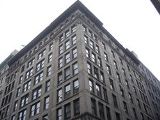
Triangle Shirtwaist Factory was located inside the Asch Building, now known as the
Brown Building of ScienceThe Brown Building of Science is a ten-story building owned by New York University located at 23-29 Washington Place, just east of Washington Square Park in Manhattan. It was formerly the Asch Building which contained the Triangle Shirtwaist Factory, the site of the tragic Triangle Shirtwaist...
. It has been designated as a
National Historic LandmarkA National Historic Landmark is a building, site, structure, object, or district, that is officially recognized by the United States government for its historical significance. All NHLs are listed in the National Register of Historic Places...
and a New York City
landmarkThis is a list of landmarks around the world.Landmarks may be split into two categories: natural phenomena and man-made features, like buildings, bridges, statues, public squares, and so forth...
.
The company
The Triangle Shirtwaist Company, owned by Max Blanck and Isaac Harris, occupied the top three floors of the ten-story Asch Building in New York City at the intersection of Greene Street and Washington Place, just east of Washington Square. The company manufactured women's
blouseThe word blouse most commonly refers to a woman's shirt, although the term is also used for some men's military uniform jackets.-Description and History:Blouses were rarely part of the fashionable woman's wardrobe until the 1890s...
s, which at this period of time were called "shirtwaists" or simply
"waists".
The company employed approximately 600 workers, mostly young immigrant women from
GermanyGermany , officially the Federal Republic of Germany , is a country in Central Europe. It is bordered to the north by the North Sea, Denmark, and the Baltic Sea; to the east by Poland and the Czech Republic; to the south by Austria and Switzerland; and to the west by France, Luxembourg, Belgium,...
,
ItalyItaly , officially the Italian Republic , is a country located on the Italian Peninsula in Southern Europe and on the two largest islands in the Mediterranean Sea, Sicily and Sardinia. Italy shares its northern, Alpine boundary with France, Switzerland, Austria and Slovenia...
and
Eastern EuropeEastern Europe is a region lying in the Eastern part of Europe. The term is highly context-dependent and there are "almost as many definitions of Eastern Europe as there are scholars of the region"...
. Some of the women were as young as twelve or thirteen and worked fourteen-hour shifts during a 60-hour to 72-hour workweek. According to Pauline Newman, a worker at the factory, the average wage was six to seven dollars a week, at a time when the average yearly income was $791. At most, Triangle Factory employees earned $338 a year.
By 1911 the Triangle Shirtwaist Company had already become well known outside the
garment industryTextile manufacture is a major industry. It is based in the conversion of three types of fibre into yarn, then fabric, then textiles. These are then fabricated into clothes or other artifacts. Cotton remains the most important natural fibre, so is treated in depth...
: the massive strike by women's shirtwaist makers in 1909, known as the Uprising of 20,000, began with a spontaneous
walkoutIn labor disputes, a walkout is a labor strike, the act of employees collectively leaving the workplace as an act of protest.A walkout can also mean the act of leaving a place of work, school, a meeting, a company, or an organization, especially if meant as an expression of protest or disapproval.A...
at the Triangle Company. During the strike, owners Blanck and Harris, two anti-union leaders, paid hoodlums to attack the protesting workers and hired prostitutes as replacement workers to show contempt for the strikers.
While the
International Ladies' Garment Workers' UnionThe International Ladies' Garment Workers' Union was once one of the largest labor unions in the United States, one of the first U.S. unions to have a primarily female membership, and a key player in the labor history of the 1920s and 1930s...
negotiated a collective bargaining agreement covering most of those workers after a four-month strike, the Triangle Shirtwaist Company refused to sign the agreement.
The conditions of the factory were typical of the time. Flammable textiles were stored throughout the factory, scraps of fabric littered the floors, patterns and designs on sheets of tissue paper hung above the tables, the men who worked as cutters sometimes smoked, illumination was provided by open
gas lightingGas lighting refers to a technology used to produce light from a gaseous fuel including hydrogen, methane, carbon monoxide, propane, butane, or ethylene....
, and there were only a few buckets of water to extinguish fires.
The fire
On the afternoon of March 25, 1911, a fire began on the eighth floor, possibly sparked by a lit match or a cigarette or because of faulty
electrical wiringElectrical wiring in general refers to insulated conductors used to carry electricity, and associated devices. This article describes general aspects of electrical wiring as used to provide power in buildings and structures, commonly referred to as building wiring...
. A
New York Times article also theorized that the fire may have been started by the
engineAn engine is a machine that produces mechanical force and motion from another form of energy . It is also referred to as a prime mover. An automobile makes use of several motors to start the car and drive the car's various pumps – but the power plant that propels the car is called an engine...
s running the
sewing machineA sewing machine is a textile machine used to stitch fabric or other material together with thread. Sewing machines were invented during the first Industrial Revolution to decrease the amount of manual sewing work performed in clothing companies...
s in the building. To this day, no one knows whether it was accidental or intentional. Most of the workers who were alerted on the tenth and eighth floors were able to evacuate. However, the warning about the fire did not reach the ninth floor in time.
The ninth floor had only two doors leading out. One stairwell was already filling with smoke and flames by the time the seamstresses realized the building was on fire. The other door had been locked.
The single exterior
fire escapeA fire escape is a special kind of emergency exit, usually mounted to the outside of a building or occasionally inside but separate from the main areas of the building. It provides a method of escape in the event of a fire or other emergency that makes the stairwells inside a building inaccessible...
, a flimsy and poorly-anchored iron structure which may already have been broken, soon twisted and collapsed under the weight of people trying to escape. The
elevatorAn elevator or lift is a vertical transport vehicle that efficiently moves people or goods between floors of a building...
also stopped working, cutting off that means of escape, partly because the panicked workers tried to save themselves by jumping down the shaft onto the elevator's roof.
Much to the horror of the large crowd of bystanders gathered on the street, sixty-two of the women who died did so after realizing there was no way to avoid the flames except to break the windows and jump to the pavement, nine floors below.
Socialist
Louis WaldmanLouis Waldman was a leading figure in the Socialist Party of America from the late 1910s and through the middle 1930s, a founding member of the Social Democratic Federation, and a prominent labor lawyer.-Early years:...
, later a New York state assemblyman, described the grim scene in his memoirs published in 1944:
Others pried open the elevator doors and tumbled down the shaft. Of the jumpers, a single survivor was found close to drowning in water collecting in the
elevatorAn elevator or lift is a vertical transport vehicle that efficiently moves people or goods between floors of a building...
shaft. The fallen bodies and falling victims made it difficult for the fire department to reach the building.
The remainder waited until smoke and fire overcame them. The
fire departmentFirefighters, or firemen, are rescuers extensively trained primarily to put out hazardous fires that threaten civilian populations and property, to rescue people from car accidents, collapsed and burning buildings and other such situations...
arrived quickly but was unable to stop the flames, as there were no
ladderA ladder is a vertical or inclined set of rungs or steps. There are two types: rigid ladders that can be leaned against a vertical surface such as a wall, and rope ladders that are hung from the top. The vertical members of a rigid ladder are called stringers or stiles...
s available that could reach beyond the sixth floor. The ultimate death toll was 148, including 141 who died at the scene and seven survivors who later died at hospitals.
Twenty-three victims of the fire were buried by the
Hebrew Free Burial AssociationThe Hebrew Free Burial Association was established in 1888 as a free burial society serving the residents of Manhattan's Lower East Side and was incorporated as a non-profit organization in 1889. As the need grew in adjacent Jewish communities, HFBA also grew to serve the broader metropolitan area...
in a special section at Mount Richmond Cemetery. In some instances, their tombstones make reference to the fire. Another eight unidentified victims were buried in the Cemetery of the Evergreens in Brooklyn. Originally interred elsewhere in the grounds, the remains are now lie underneath a monument to the tragedy, a large marble slab featuring a kneeling woman .
Consequences


The company's owners, Max Blanck and Isaac Harris, had fled to the building's roof when the fire began and survived. They were later put on trial, at which Max Steuer, counsel for the defendants, managed to destroy the credibility of one of the survivors, Kate Alterman, by asking her to repeat her testimony a number of times — which she did without altering key phrases that Steuer believed were perfected before trial. Steuer argued to the jury that Alterman and probably other witnesses had memorized their statements and might even have been told what to say by the prosecutors. The defense also stressed that the prosecution had failed to prove that the owners knew the exit doors were locked at the time in question. The jury acquitted the owners. However, they lost a subsequent civil suit in 1913 and plaintiffs won compensation in the amount of $75 per deceased victim. The insurance company paid Blanck and Harris about $60,000 more than the reported losses, or about $400 per casualty. In 1913, Blanck was once again arrested for locking the door in his factory during working hours. He was fined $20.
Rose SchneidermanRose Schneiderman was a prominent United States labor union leader and socialist of the first part of the twentieth century.-Early years:...
, a prominent
socialistThe Socialist Party of America was a democratic socialist political party in the United States, formed in 1901 by a merger between the three-year-old Social Democratic Party of America and disaffected elements of the Socialist Labor Party which had split from the main organization in 1899.In the...
and union activist, said in a speech at the memorial meeting held in the
Metropolitan OperaThe Metropolitan Opera Association of New York City, founded in April 1880, is a major presenter of all types of opera including Grand Opera. Peter Gelb is the company's general manager. The music director is James Levine....
House on April 2, 1911, to an audience largely made up of the members of the Women's Trade Union League, a group that had provided moral and financial support for the Uprising of 20,000:
Others in the community, and in particular in the ILGWU, drew a different lesson from events. Working with local
Tammany HallTammany Hall , was the Democratic Party political machine that played a major role in controlling New York City politics and helping immigrants rise up in American politics from the 1790s to the 1960s...
officials such as
Al SmithAlfred Emanuel Smith, Jr. , known in private and public life as Al Smith, was an American politician who was elected Governor of New York four times, and was the Democratic U.S. presidential candidate in 1928. He was the first Roman Catholic and Irish-American to run for President as a major party...
and
Robert F. WagnerRobert Ferdinand Wagner was an American politician. He was a Democratic U.S. Senator from New York from 1927 to 1949.-Origin and early life:...
, and progressive reformers such as
Frances PerkinsFrances Perkins Frances Perkins Frances Perkins (born Fannie Coralie Davies, (April 10, 1880 – May 14, 1965) was the U.S. Secretary of Labor from 1933 to 1945, and the first woman appointed to the U.S. Cabinet. As a loyal supporter of her friend, Franklin D. Roosevelt, she helped pull the labor...
, the future Secretary of Labor in the Roosevelt administration, who had witnessed the fire from the street below, pushed for comprehensive safety and workers’ compensation laws. The ILGWU leadership formed bonds with those reformers and politicians that would continue for another forty years, through the
New DealThe New Deal was the name that United States President Franklin D. Roosevelt gave to his complex package of economic programs 1933-36 with the goals of what historians call the 3 Rs, of giving Relief to the unemployed and badly hurt farmers, Reform of business and financial practices, and promoting...
and beyond.
As a result of the fire, the
American Society of Safety EngineersThe American Society of Safety Engineers , founded October 14, 1911, is the oldest and largest professional safety organization. Its more than 32,000 members manage, supervise and consult on occupational safety and health and environmental issues in industry, insurance, government and education.The...
was founded soon after in New York City, October 14, 1911.
See also
- History of the United States (1865-1918)
- New York City Fire Department
The New York City Fire Department or the Fire Department City of New York has the responsibility for protecting the citizens and property of New York City's five boroughs from fires and fire hazards, providing emergency medical services, technical rescue as well as providing first response to...
- Rhinelander Waldo
Rhinelander Waldo was appointed the 7th New York City Fire Commissioner by Mayor William Jay Gaynor on January 13, 1910, and resigned his position on May 23, 1911 to accept an appointment as the 8th New York City Police Commissioner...
- NYC Fire Commissioner at the time of the fire
- International Women's Day
International Women's Day is marked on March 8 every year. It is a major day of global celebration for the economic, political and social achievements of women....
- American Society of Safety Engineers
The American Society of Safety Engineers , founded October 14, 1911, is the oldest and largest professional safety organization. Its more than 32,000 members manage, supervise and consult on occupational safety and health and environmental issues in industry, insurance, government and education.The...
- Union Organizer
A union organizer is a specific type of trade union member or an appointed union official. A majority of unions appoint rather than elect their organizers....
External links