


Treuhand

Encyclopedia
The Treuhandanstalt was the agency that privatized the East German
enterprises, Volkseigener Betrieb
(VEBs), owned as public property
. Created by the Volkskammer
on June 17, 1990, it oversaw the restructuring and selling of about 8,500 firms with initially over 4 million employees. At that time it was the world's largest industrial enterprise, controlling everything from steel works to the Babelsberg Studios
.
e or VEBs). It also took over around 2.4m hectare
s of agricultural land and forests; the property of the former Stasi
; large parts of the property of the former National People's Army
, largescale public housing property as well as the property of the state pharmacy network. At reunification
on 3 October 1990 it also took over the property of the political parties and mass organisations of the German Democratic Republic.
was shot and murdered on 1 April 1991 by an unknown assassin (possibly the Red Army Faction
). He was succeeded by Birgit Breuel
.
When its operations ended in 1994, it had amassed 260 to 270b DM in debt. Supporters argued that without placing the former state-owned enterprises into private hands, job losses would have been much higher, and economic recovery slower.
 Although the Treuhand closed operations in 1994, it still retained much property and some other legal responsibilities. These were transferred to 3 successor agencies:
The BvS ceased operations at the end of 2000; although it remains legally in existence, its remaining tasks are all delegated to other bodies. TLG and BVVG remain the largest real estate owners in the new federal states
. In 2000 TLG was reoriented from focussing on privatisation of its assets to "active portfolio management" with a view to making profits for the German federal government. By 2007, having sold 45,000 properties in 6 years and reinvested EUR1.5bn, it was managing 1500 properties worth EUR1.4bn. The planned privatisation of TLG itself was put on hold in July 2008, due to adverse economic conditions.
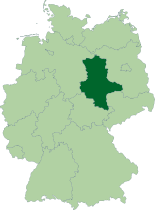
In July 2008 the BVVG announced total privatization receipts of EUR3.5bn since its establishment in 1992, which it had gained through the sale of around 525,000 hectares of agricultural land, with a similar amount of forest land and a small amount of other land. Total land sales amounted to around half the area of the state of Saxony-Anhalt
. At the end of 2007 it still owned over 500,000 hectares of agricultural land, and just under 100,000 of forest land.
German Democratic Republic
The German Democratic Republic , informally called East Germany by West Germany and other countries, was a socialist state established in 1949 in the Soviet zone of occupied Germany, including East Berlin of the Allied-occupied capital city...
enterprises, Volkseigener Betrieb
Volkseigener Betrieb
The Volkseigener Betrieb was the legal form of industrial enterprise in East Germany...
(VEBs), owned as public property
Public property
Public property is property, which is dedicated to the use of the public. It is a subset of state property. The term may be used either to describe the use to which the property is put, or to describe the character of its ownership...
. Created by the Volkskammer
Volkskammer
The People's Chamber was the unicameral legislature of the German Democratic Republic . From its founding in 1949 until the first free elections on 18 March 1990, all members of the Volkskammer were elected on a slate controlled by the Socialist Unity Party of Germany , called the National Front...
on June 17, 1990, it oversaw the restructuring and selling of about 8,500 firms with initially over 4 million employees. At that time it was the world's largest industrial enterprise, controlling everything from steel works to the Babelsberg Studios
Babelsberg Studios
The Studio Babelsberg, located in Potsdam-Babelsberg, Germany, is the oldest large-scale film studio in the world. Founded in 1912, it covers an area of about . Hundreds of films, including Fritz Lang's Metropolis and Josef von Sternberg's The Blue Angel were filmed there...
.
Responsibilities
The Treuhand was responsible for more than just the 8500 state-owned enterprises (Volkseigener BetriebVolkseigener Betrieb
The Volkseigener Betrieb was the legal form of industrial enterprise in East Germany...
e or VEBs). It also took over around 2.4m hectare
Hectare
The hectare is a metric unit of area defined as 10,000 square metres , and primarily used in the measurement of land. In 1795, when the metric system was introduced, the are was defined as being 100 square metres and the hectare was thus 100 ares or 1/100 km2...
s of agricultural land and forests; the property of the former Stasi
Stasi
The Ministry for State Security The Ministry for State Security The Ministry for State Security (German: Ministerium für Staatssicherheit (MfS), commonly known as the Stasi (abbreviation , literally State Security), was the official state security service of East Germany. The MfS was headquartered...
; large parts of the property of the former National People's Army
National People's Army
The National People’s Army were the armed forces of the German Democratic Republic .The NVA was established in 1956 and disestablished in 1990. There were frequent reports of East German advisors with Communist African countries during the Cold War...
, largescale public housing property as well as the property of the state pharmacy network. At reunification
German reunification
German reunification was the process in 1990 in which the German Democratic Republic joined the Federal Republic of Germany , and when Berlin reunited into a single city, as provided by its then Grundgesetz constitution Article 23. The start of this process is commonly referred by Germans as die...
on 3 October 1990 it also took over the property of the political parties and mass organisations of the German Democratic Republic.
Opposition
Its operations drew criticism from some quarters for unnecessarily closing of allegedly profitable businesses, misuse and waste of funds and layoffs that were claimed to be unnecessary. It also drew substantial protests from the workforces affected, as 2.5m employees in state-owned enterprises (out of 4m in total) were laid off in the early 1990s. The then chairman of the Treuhand, Detlev Karsten RohwedderDetlev Karsten Rohwedder
Detlev Karsten Rohwedder was a German manager and politician, as member of the Social Democratic Party. He was manager of the Treuhandanstalt....
was shot and murdered on 1 April 1991 by an unknown assassin (possibly the Red Army Faction
Red Army Faction
The radicalized were, like many in the New Left, influenced by:* Sociological developments, pressure within the educational system in and outside Europe and the U.S...
). He was succeeded by Birgit Breuel
Birgit Breuel
Birgit Breuel is a German politician, representative of the German Christian Democratic Union. She is the former President of the Treuhand Agency, and Commissioner General of the Expo 2000 in Hannover, and later worked in several honorary positions.Birgit Münchmeyer came from a Lower Saxony...
.
When its operations ended in 1994, it had amassed 260 to 270b DM in debt. Supporters argued that without placing the former state-owned enterprises into private hands, job losses would have been much higher, and economic recovery slower.
Successors
- the Bundesanstalt für vereinigungsbedingte Sonderaufgaben, BvS (Federal Agency for Unification-derived Special Tasks), which managed remaining state-owned enterprises;
- the Treuhandliegenschaftsgesellschaft (now TLG Immobilien GmbH), which manages the remaining state-owned urban and industrial real estate;
- the Bodenverwertungs- und -verwaltungs GmbH (BVVG), a subsidiary of the Treuhand created in 1992, which manages the state-owned agricultural land, forest lands, and related real estate.
The BvS ceased operations at the end of 2000; although it remains legally in existence, its remaining tasks are all delegated to other bodies. TLG and BVVG remain the largest real estate owners in the new federal states
New federal states
The new federal states of Germany are the five re-established states in the former German Democratic Republic that acceded to the Federal Republic of Germany with its 10 states upon German reunification on 3 October 1990....
. In 2000 TLG was reoriented from focussing on privatisation of its assets to "active portfolio management" with a view to making profits for the German federal government. By 2007, having sold 45,000 properties in 6 years and reinvested EUR1.5bn, it was managing 1500 properties worth EUR1.4bn. The planned privatisation of TLG itself was put on hold in July 2008, due to adverse economic conditions.
In July 2008 the BVVG announced total privatization receipts of EUR3.5bn since its establishment in 1992, which it had gained through the sale of around 525,000 hectares of agricultural land, with a similar amount of forest land and a small amount of other land. Total land sales amounted to around half the area of the state of Saxony-Anhalt
Saxony-Anhalt
Saxony-Anhalt is a landlocked state of Germany. Its capital is Magdeburg and it is surrounded by the German states of Lower Saxony, Brandenburg, Saxony, and Thuringia.Saxony-Anhalt covers an area of...
. At the end of 2007 it still owned over 500,000 hectares of agricultural land, and just under 100,000 of forest land.
Further reading
- Mark Cassell, How Governments Privatize: the Politics of Divestment in the United States and Germany, Georgetown University Press, 2002.