
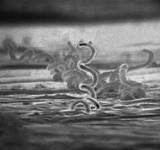
Treponema pallidum is a
spirochaeteSpirochaetes belong to a phylum of distinctive Gram-negative bacteria, which have long, helically coiled cells...
bacterium. It is not seen on a
Gram stainedGram staining is an empirical method of differentiating bacterial species into two large groups based on the chemical and physical properties of their cell walls...
smear because the organism is too thin.
Habitat: Human genital tract. Transmission by sexual contact and from mother to fetus across placenta.
Subspecies
There are at least four known
subspeciesSubspecies in biological classification, is 1) a taxonomic rank subordinate to species, or 2) a taxonomic unit, a taxon in that rank...
:
- Treponema pallidum endemicum, which causes bejel
Bejel, or endemic syphilis, is a chronic skin and tissue disease caused by infection by a subspecies of the spirochete Treponema pallidum....
- T. pallidum carateum, which causes pinta
Pinta is a human skin disease endemic to Mexico, Central America, and South America. It is caused by infection with a spirochete, Treponema pallidum carateum, which is morphologically and serologically indistinguishable from the organism that causes syphilis.-Presentation:Pinta is thought to be...
- T. pallidum pertenue, which causes yaws
Yaws is a tropical infection of the skin, bones and joints caused by the spirochete bacterium Treponema pallidum pertenue...
- T. pallidum pallidum, which causes syphilis
Syphilis is a sexually transmitted disease caused by the spirochetal bacterium Treponema pallidum subspecies pallidum. The route of transmission of syphilis is almost always through sexual contact, although there are examples of congenital syphilis via transmission from mother to child in utero.The...
There is some variation as to which are considered subspecies, and which are species. The cause of pinta is sometimes described as "Treponema carateum", rather than a subspecies of Treponema pallidum, even when the subspecies convention is used for the other agents.
Laboratory identification
This bacterium is too thin to be visualized with a standard Gram stain so two techniques to visualize it with a light microscope are
dark field microscopyDark field microscopy describes microscopy methods, in both light and electron microscopy, which exclude the unscattered beam from the image. As a result, the field around the specimen Dark field microscopy (dark ground microscopy) describes microscopy methods, in both light and electron...
and
immunofluorescenceImmunofluorescence is the labeling of antibodies or antigens with fluorescent dyes. This technique is often used to visualize the subcellular distribution of biomolecules of interest...
.
Treponema pallidum is also detected by
serologySerology is the scientific study of blood serum. In practice, the term usually refers to the diagnostic identification of antibodies in the serum...
, including
nontreponemalNontreponemal tests refer to a class of syphilis diagnostics that detect infection by indirect markers of infection. Nontreponemal Tests detect biomarkers that are released during cellular damage that occurs from the syphilis spirochete...
(
VDRLThe Venereal Disease Research Laboratory test or VDRL was developed by the former Venereal Disease Research Laboratory, now the Treponemal Pathogenesis and Immunology Branch, of the United States Public Health Service...
,
Rapid plasma reaginRapid Plasma Reagin refers to a type of test that looks for non-specific antibodies in the blood of the patient that may indicate that the organism that causes syphilis is present...
(RPR) and treponemal antibody tests (
FTA-ABSFTA-ABS is a treponemal test for Syphilis. Using antibodies specific for the Treponema pallidum species, such tests are more specific than Non-Treponemal testing such as VDRL....
, Treponema pallidum immobilization reaction (TPI) and
Syphilis TPHA testThe Syphilis TPHA test is a classic, indirect hemagglutination test used for the detection and titration of antibodies against the causative agent of syphilis,Treponema pallidum....
).
Clinical significance
T. pallidum pallidum is a motile spirochaete that is generally acquired by close
sexualA sexually transmitted disease , also known as sexually transmitted infection or venereal disease , is an illness that has a significant probability of transmission between humans or animals by means of sexual contact, including vaginal intercourse, oral sex, and anal sex...
contact, entering the host via breaches in squamous or columnar epithelium. The organism can also be transmitted to a fetus by
transplacentalThe placenta is an organ unique to mammals that connects the developing fetus to the uterine wall. The placenta supplies the fetus with oxygen and food, and allows fetal waste to be disposed of via the maternal kidneys...
passage during the later stages of pregnancy, giving rise to congenital syphilis. The helical structure of
T. pallidum pallidum allows it to move in a corkscrew motion through a viscous medium such as mucus. It gains access to host's blood and lymph systems through tissue and mucous membranes.
The subspecies causing
yawsYaws is a tropical infection of the skin, bones and joints caused by the spirochete bacterium Treponema pallidum pertenue...
,
pintaPinta is a human skin disease endemic to Mexico, Central America, and South America. It is caused by infection with a spirochete, Treponema pallidum carateum, which is morphologically and serologically indistinguishable from the organism that causes syphilis.-Presentation:Pinta is thought to be...
, and
bejelBejel, or endemic syphilis, is a chronic skin and tissue disease caused by infection by a subspecies of the spirochete Treponema pallidum....
are
morphologicallyComparative anatomy is the study of similarities and differences in the anatomy of organisms. It is closely related to evolutionary biology and phylogeny .-Description:Two major concepts of comparative anatomy are:...
and
serologicallySerology is the scientific study of blood serum. In practice, the term usually refers to the diagnostic identification of antibodies in the serum...
indistinguishable from
T. pallidum pallidum (syphilis); however, their transmission is not venereal in nature and the course of each disease is significantly different.
Genome
In the July 17, 1998 issue of the journal
ScienceScience is the academic journal of the American Association for the Advancement of Science and is considered one of the world's most prestigious scientific journals. The peer-reviewed journal, first published in 1880 is circulated weekly and has a print subscriber base of around 130,000...
, a group of biologists reported how they sequenced the
genomeIn modern molecular biology the genome refers to all of its hereditary information encoded in DNA .The genome includes both the genes and the non-coding sequences of the DNA. The term was adapted in 1920 by Hans Winkler, Professor of Botany at the University of Hamburg, Germany...
of
T. pallidum. The recent sequencing of the genomes of several spirochetes permits a thorough analysis of the similarities and differences within this bacterial phylum.
Treponema pallidum subsp. pallidum has one of the smallest bacterial genomes at 1.14 million base pairs (Mb) and has limited metabolic capabilities, reflecting its adaptation through genome reduction to the rich environment of mammalian tissue.
Vaccine
There is no vaccine for syphilis. The outer membrane of
T. pallidum has too few surface proteins for an antibody to be effective. Efforts to develop a safe and effective syphilis vaccine have been hindered by uncertainty about the relative importance of humoral and cellular mechanisms to protective immunity and the fact that
T. pallidum outer membrane proteins have not been unambiguously identified.
External links