


Transform fault

Encyclopedia
Lithosphere
The lithosphere is the rigid outermost shell of a rocky planet. On Earth, it comprises the crust and the portion of the upper mantle that behaves elastically on time scales of thousands of years or greater.- Earth's lithosphere :...
, is a type of fault whose relative motion
Motion (physics)
In physics, motion is a change in position of an object with respect to time. Change in action is the result of an unbalanced force. Motion is typically described in terms of velocity, acceleration, displacement and time . An object's velocity cannot change unless it is acted upon by a force, as...
is predominantly horizontal
Horizontal plane
In geometry, physics, astronomy, geography, and related sciences, a plane is said to be horizontal at a given point if it is perpendicular to the gradient of the gravity field at that point— in other words, if apparent gravity makes a plumb bob hang perpendicular to the plane at that point.In...
in either sinistral or dextral direction. Furthermore, transform faults end abruptly and are connected on both ends to other faults, ridges, or subduction zones. While most transform faults are hidden in the deep oceans where they form a series of short zigzag
Zigzag
A zigzag is a pattern made up of small corners at variable angles, though constant within the zigzag, tracing a path between two parallel lines; it can be described as both jagged and fairly regular....
s accommodating seafloor spreading
Seafloor spreading
Seafloor spreading is a process that occurs at mid-ocean ridges, where new oceanic crust is formed through volcanic activity and then gradually moves away from the ridge. Seafloor spreading helps explain continental drift in the theory of plate tectonics....
(see graphic at right), the best-known (and most destructive
Earthquake
An earthquake is the result of a sudden release of energy in the Earth's crust that creates seismic waves. The seismicity, seismism or seismic activity of an area refers to the frequency, type and size of earthquakes experienced over a period of time...
) are those on land at the margins of tectonic plates
Plate tectonics
Plate tectonics is a scientific theory that describes the large scale motions of Earth's lithosphere...
. Transform faults are the only type of strike-slip fault that can be classified as a plate boundary.
Background
John Tuzo Wilson recognized that the offsets of oceanic ridges by faults do not follow the classical pattern of an offset fence or geological marker in Reid’s rebound theory of faulting, from which the sense of slip is derived. The new class of faults, called transform faults, produce slip in the opposite direction from what one would surmise from the standard interpretation of an offset geological feature. Slip along transform faults does not increase the distance between the ridges it separates; the distance remains constant in earthquakes because the ridges are spreading centers. This hypothesisHypothesis
A hypothesis is a proposed explanation for a phenomenon. The term derives from the Greek, ὑποτιθέναι – hypotithenai meaning "to put under" or "to suppose". For a hypothesis to be put forward as a scientific hypothesis, the scientific method requires that one can test it...
was confirmed in a beautifully simple study of the fault plane solutions that showed the slip on transform faults points in the opposite direction than classical interpretation would suggest.
Difference between transform and transcurrent faults
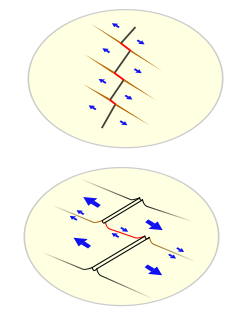
Transform faults are closely related to transcurrent faults. Both types of faults are strike-slip or side-to-side in movement, (see diagrams to the right) however transform faults end at the junction of another plate boundary or fault type, while transcurrent faults die out without a junction. In addition, transform faults have equal deformation across the entire fault line, while transcurrent faults have greater displacement in the middle of the fault zone and less on the margins. Finally, transform faults can form a tectonic plate boundary, while transcurrent faults cannot.Mechanics
The purpose of a fault is to relieve strain, which can be caused by compression, extension, or lateral stress in the rock layers at the surface or deep in the Earth’s subsurface. Transform faults specifically relieve strain by transporting the strain between ridges or subduction zones. Transform faults also act as the plane of weakness allowing for the splitting in rift zones.Examples
Transform faults are commonly found linking segments of mid-oceanic ridges or spreading centers. These mid-oceanic ridges are where new sea floor is constantly created through the up welling of new basaltic magma. With new sea floor being pushed and pulled out, the older sea floor slowly slides away from the mid-oceanic ridges toward the continents. Although, separated only by tens of kilometers, this separation between the ridges causes the sea floor to be pushed pass each other in opposing directions. This lateral movement of sea floors past each other is where transform faults are currently active.Transform faults move differently than a strike-slip fault at the mid-oceanic ridge. Instead of the ridges moving away from each other, like other strike-slip faults, transform fault ridges will stay in the same fixed location, and the new ocean sea floor being created at the ridges is pushed away from the ridge. The proof of this is found in paleo-magnetic striping on the sea floor.
A paper written by Gerya theorizes that the creation of the transform faults between the ridges of the mid-oceanic ridge is attributed to rotated and stretched sections of the mid-oceanic ridge. This occurs over long period of time with the spreading center or ridge slowly deforming from a straight line to a curved line and then finally fracturing along these planes forming transform faults. As this takes place, the fault changes from a normal fault with extensional stress to a strike slip fault with lateral stress. In the study done by Bonatti & Crane, peridotite
Peridotite
A peridotite is a dense, coarse-grained igneous rock, consisting mostly of the minerals olivine and pyroxene. Peridotite is ultramafic, as the rock contains less than 45% silica. It is high in magnesium, reflecting the high proportions of magnesium-rich olivine, with appreciable iron...
and gabbro
Gabbro
Gabbro refers to a large group of dark, coarse-grained, intrusive mafic igneous rocks chemically equivalent to basalt. The rocks are plutonic, formed when molten magma is trapped beneath the Earth's surface and cools into a crystalline mass....
rocks were discovered in the edges of the transform ridges. These rocks are created deep inside the Earth’s mantle and then rapidly exhumed to the surface. This evidence helps to prove that new sea floor is being created at the mid-oceanic ridges and further supports the theory of plate tectonics.
As previously stated, active transform faults are between two tectonic structures or faults. Fracture zone
Fracture zone
A fracture zone is a linear oceanic feature--often hundreds, even thousands of kilometers long--resulting from the action of offset mid-ocean ridge axis segments. They are a consequence of plate tectonics. Lithospheric plates on either side of an active transform fault move in opposite directions;...
s represent the previously active transform fault lines, which have since passed the active transform zone and are being pushed toward the continents. These elevated ridges on the ocean floor can be traced for hundreds of miles and in some cases even from one continent across an ocean to the other continent.
The most prominent examples of the mid-oceanic ridge transform zones are located in Atlantic Ocean
Atlantic Ocean
The Atlantic Ocean is the second-largest of the world's oceanic divisions. With a total area of about , it covers approximately 20% of the Earth's surface and about 26% of its water surface area...
between South America
South America
South America is a continent situated in the Western Hemisphere, mostly in the Southern Hemisphere, with a relatively small portion in the Northern Hemisphere. The continent is also considered a subcontinent of the Americas. It is bordered on the west by the Pacific Ocean and on the north and east...
and Africa
Africa
Africa is the world's second largest and second most populous continent, after Asia. At about 30.2 million km² including adjacent islands, it covers 6% of the Earth's total surface area and 20.4% of the total land area...
. Known as the St. Paul, Romanche
Romanche Trench
The Romanche Trench, also called the Romanche Furrow or Romanche Gap, is the third deepest of the major trenches of the Atlantic Ocean, after the Puerto Rico Trench and the South Sandwich Trench. It bisects the Mid-Atlantic Ridge just north of the equator at the narrowest part of the Atlantic...
, Chain, and Ascension fracture zones, these areas have with deep, easily identifiable transfrom faults and ridges. Other locations include: the East Pacific Ridge located in the South Eastern Pacific Ocean, which meets up with San Andreas Transform fault to the North.
Transform faults are not limited to oceanic crust and spreading centers; many transform faults are located on continental margins. The best example is the San Andreas fault
San Andreas Fault
The San Andreas Fault is a continental strike-slip fault that runs a length of roughly through California in the United States. The fault's motion is right-lateral strike-slip...
on the Pacific coast of the United States. The San Andreas Fault links the East Pacific Rise
East Pacific Rise
The East Pacific Rise is a mid-oceanic ridge, a divergent tectonic plate boundary located along the floor of the Pacific Ocean. It separates the Pacific Plate to the west from the North American Plate, the Rivera Plate, the Cocos Plate, the Nazca Plate, and the Antarctic Plate...
off of the West coast of Mexico (Gulf of California) to the Mendocino Triple Junction
Mendocino Triple Junction
The Mendocino Triple Junction is a geologic triple junction where the San Andreas Fault meets the Mendocino Fault and the Cascadia subduction zone, separating three tectonic plates: the Pacific Plate, the North American Plate and the Gorda Plate...
(Part of the Juan de Fuca plate
Juan de Fuca Plate
The Juan de Fuca Plate, named after the explorer of the same name, is a tectonic plate, generated from the Juan de Fuca Ridge, and subducting under the northerly portion of the western side of the North American Plate at the Cascadia subduction zone...
) located off the coast of the North Western United States making it a ridge-to-transform style transform fault. The formation of the San Andreas Fault system occurred fairly recently during the Oligocene
Oligocene
The Oligocene is a geologic epoch of the Paleogene Period and extends from about 34 million to 23 million years before the present . As with other older geologic periods, the rock beds that define the period are well identified but the exact dates of the start and end of the period are slightly...
Period between 34 million and 24 million years ago. During this period, the Farallon plate
Farallon Plate
The Farallon Plate was an ancient oceanic plate, which began subducting under the west coast of the North American Plate— then located in modern Utah— as Pangaea broke apart during the Jurassic Period...
, followed by the Pacific plate, collided into the North American plate. The collision led to the subduction of the Farallon plate underneath the North American plate. Once the spreading center separating the Pacific and Farallon plate was subducted underneath the North American plate, the San Andreas Continental Transform Fault system was created.

- Middle EastMiddle EastThe Middle East is a region that encompasses Western Asia and Northern Africa. It is often used as a synonym for Near East, in opposition to Far East...
's Dead Sea TransformDead Sea TransformThe Dead Sea Transform fault system, also sometimes referred to as the Dead Sea Rift, is a geologic fault which runs from the Maras Triple Junction to the northern end of the Red Sea Rift...
fault - New ZealandNew ZealandNew Zealand is an island country in the south-western Pacific Ocean comprising two main landmasses and numerous smaller islands. The country is situated some east of Australia across the Tasman Sea, and roughly south of the Pacific island nations of New Caledonia, Fiji, and Tonga...
's Alpine FaultAlpine FaultThe Alpine Fault is a geological fault, more specifically known as a right-lateral strike-slip fault, that runs almost the entire length of New Zealand's South Island. It forms a transform boundary between the Pacific Plate and the Indo-Australian Plate. Earthquakes along the fault, and the... - PakistanPakistanPakistan , officially the Islamic Republic of Pakistan is a sovereign state in South Asia. It has a coastline along the Arabian Sea and the Gulf of Oman in the south and is bordered by Afghanistan and Iran in the west, India in the east and China in the far northeast. In the north, Tajikistan...
's Chaman FaultChaman FaultThe Chaman Fault is a major, active geological fault in Pakistan and Afghanistan that runs for over 850 km. Tectonically, it is actually a system of related geologic faults that separates the Eurasian Plate from the Indo-Australian Plate. It is a terrestrial, primarily transform, left-lateral... - TurkeyTurkeyTurkey , known officially as the Republic of Turkey , is a Eurasian country located in Western Asia and in East Thrace in Southeastern Europe...
's North Anatolian FaultNorth Anatolian FaultThe North Anatolian Fault is a major active right lateral-moving strike-slip fault in northern Anatolia which runs along the transform boundary between the Eurasian Plate and the Anatolian Plate. The fault extends westward from a junction with the East Anatolian Fault at the Karliova Triple... - North AmericaNorth AmericaNorth America is a continent wholly within the Northern Hemisphere and almost wholly within the Western Hemisphere. It is also considered a northern subcontinent of the Americas...
's Queen Charlotte FaultQueen Charlotte FaultThe Queen Charlotte Fault is an active transform fault, located between the North American Plate and the Pacific Plate, Canada's equivalent of the San Andreas Fault. The Queen Charlotte Fault forms a triple junction on its south with the Cascadia subduction zone and the Explorer Ridge...
Transform fault types
In his groundbreaking work on transform fault systems, Tuzo Wilson said that transform faults must be connected to other faults or tectonic plate boundaries on both ends; because of that requirement, transform faults can grow in length, keep a constant length, or decrease in length. These length changes are dependant on which type of faults or tectonic structures connect with the transform fault. With this in mind, Wilson described six types of transform faults:Growing length faults: In situations where a transform fault links together a spreading center and the upper block of a subduction zone or when two upper blocks of subduction zones are linked the transform fault itself will grow in length.
Constant length faults: In other cases, transform faults will remain at a constant length. This consistency can be attributed to many different reasons. In the case of a ridge-to-ridge transforms, it is caused by the continuous growth by both ridges outward, canceling any change in length. The opposite occurs when a ridge linked to a subducting plate, where all the lithosphere (new sea floor) being created by the ridge is being subducted, or swallowed up, by the subduction zone. Finally, when two upper subduction plates are linked there is no change in length. This is due to the plates moving parallel with each other and no new lithosphere is being created to change that length.
Decreasing length faults: In rare cases, transform faults can shrink in length. These occur when two descending subduction plates are linked by a transform fault. In time as the plates are subducted, the transform fault will decrease in length until the transform fault disappears completely, leaving only two subduction zones facing in opposite directions.
See also
- EarthquakeEarthquakeAn earthquake is the result of a sudden release of energy in the Earth's crust that creates seismic waves. The seismicity, seismism or seismic activity of an area refers to the frequency, type and size of earthquakes experienced over a period of time...
- Fracture zoneFracture zoneA fracture zone is a linear oceanic feature--often hundreds, even thousands of kilometers long--resulting from the action of offset mid-ocean ridge axis segments. They are a consequence of plate tectonics. Lithospheric plates on either side of an active transform fault move in opposite directions;...
- Plate tectonicsPlate tectonicsPlate tectonics is a scientific theory that describes the large scale motions of Earth's lithosphere...
- Strike-slip tectonicsStrike-slip tectonicsStrike-slip tectonics is concerned with the structures formed by, and the tectonic processes associated with, zones of lateral displacement within the crust or lithosphere.-Deformation styles:-Riedel shear structures:...
- Structural geologyStructural geologyStructural geology is the study of the three-dimensional distribution of rock units with respect to their deformational histories. The primary goal of structural geology is to use measurements of present-day rock geometries to uncover information about the history of deformation in the rocks, and...
- List of tectonic plate interactions