
Home      Discussion      Topics      Dictionary      Almanac
Signup       Login
Trail running

Trail running

Overview

Discussion
Ask a question about 'Trail running'
Start a new discussion about 'Trail running'
Answer questions from other users
Full Discussion Forum
 
Recent Discussions
Encyclopedia


Trail running is a variant on running
Running
Running is a means of terrestrial locomotion allowing humans and other animals to move rapidly on foot. It is simply defined in athletics terms as a gait in which at regular points during the running cycle both feet are off the ground...

 that differs markedly from road running
Road running
Road running is the sport of running on a measured course over an established road . These events would be classified as long distance according to athletics terminology, with distances typically ranging from 5 kilometers to 42.2 kilometers in the marathon. They may involve large numbers of runners...

 and track running. Trail
Trail
A trail is a path with a rough beaten or dirt/stone surface used for travel. Trails may be for use only by walkers and in some places are the main access route to remote settlements...

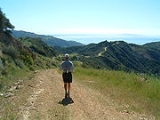
 running generally takes place on hiking trails, most commonly single track trails, although fire roads are not uncommon. A distinguishing characteristic of the trails is that they are often inaccessible by road except at the trail heads. The trails tend to traverse varying terrain; hills, mountains, deserts, forests, and narrow passages are common. Likewise, steep inclines or rough terrain sometimes may require hiking or scrambling. Runners participating in trail runs must often descend these same steep grades. It is not unusual for trail runs to ascend and descend thousands of feet.

There are as many variations of trail running as there are runners. Many individuals prefer running trails for daily training and exercise, while other trail runners spend weeks out in the backcountry. There is a growing number of people participating in solo backcountry trail running trips, which are a sort of ultralight backpacking. While an ordinary backpacking expedition may last for eight days, averaging eight to ten miles per day, with participants carrying fifty to sixty pound backpacks, backcountry trail runner will do the same trip in three to four days, covering much greater distances each day, and carrying only minimal equipment. This type of backpacking is rare, as it is very difficult and dangerous, but it is growing in popularity.

According to a 2010 special report on trail running published by the Outdoor Industry Foundation, "4.8 million Americans ages 6 and older participated in trail running in 2009." This research shows a particularly heavy following in the Mountain States, the Western US, and California
California
California is a state located on the West Coast of the United States. It is by far the most populous U.S. state, and the third-largest by land area...

.

In the United Kingdom
United Kingdom
The United Kingdom of Great Britain and Northern IrelandIn the United Kingdom and Dependencies, other languages have been officially recognised as legitimate autochthonous languages under the European Charter for Regional or Minority Languages...

, the British Athletic Federation
UK Athletics
UK Athletics is the governing body for the sport of athletics in the United Kingdom. It is responsible for overseeing the governance of athletics events in the UK as well as athletes, their development, and athletics officials....

 authorised this definition in 1995:
In the context of athletics, trail races are primarily along footpaths and bridlepaths marked on Ordnance Survey maps as "public rights of way". They are "highways" to which pedestrians have unrestricted access in English law. Towpaths, forest drives, farm cart tracks and paths in parks etc, from which motorised traffic is excluded, are
also trails when the owners' permission is obtained.
Some trail races take place in less isolated areas, and routes can include public parks or canal towpath
Towpath
A towpath is a road or trail on the bank of a river, canal, or other inland waterway. The purpose of a towpath is to allow a land vehicle, beasts of burden, or a team of human pullers to tow a boat, often a barge...

s.

Equipment


Many trail runners use specially designed shoes that have aggressively knobby soles that are generally more rigid than road running shoes. The usually EVA
Ethylene-vinyl acetate
Ethylene vinyl acetate is the copolymer of ethylene and vinyl acetate. The weight percent vinyl acetate usually varies from 10 to 40%, with the remainder being ethylene....

 compound midsole often contain a lightweight, flexible nylon
Nylon
Nylon is a generic designation for a family of synthetic polymers known generically as polyamides, first produced on February 28, 1935, by Wallace Carothers at DuPont's research facility at the DuPont Experimental Station...

 plastic layer to protect the feet from puncture wounds from sharp rocks or other objects. Since trail running take place on softer surfaces (e.g., grass, dirt) than road races, cushioning is not as important so often the shoes are less 'cushioned' than their counterparts designed for tarmac. Additionally, trail running shoes are low to the ground which provides the best stability on uneven terrain.

Other equipment includes wicking garments, water bottles, sunscreen, sunglasses, gaiters, anti-insect spray, and ivy block. Some trail runners attach lightweight crampons
Crampons
Crampons are traction devices used to improve mobility on snow and ice. There are three main attachment systems for footwear: step-in, hybrid, and strap bindings. The first two require boots with welts, the last adapt to any type....

 to the bottom of their shoes to aid with traction in the snow and on ice. An alternative way to carry water is use a hydration bladder with drinking tube carried in a backpack
Backpack
A backpack is, in its simplest form, a cloth sack carried on one's back and secured with two straps that go over the shoulders, but there can be exceptions...

 or waistpack. Carrying the Ten Essentials
Ten Essentials
The "Ten Essentials" are survival items that hiking organizations recommend for safe travel in the backcountry.The Ten Essentials were first described in the 1930s by The Mountaineers, a hiking and mountain climbing club. Many regional organizations and authors recommend that hikers, backpackers,...

 may reduce the hazards inherent in wilderness travel
Hazards of outdoor activities
Any outdoor activity entails many risks, even if participants do not recklessly place themselves in harm's way. Even a simple accident may create a dangerous situation that requires survival skills. However, with the correct precautions, outdoor recreation can be enjoyable and safe.- General...

. Some trail runners use ultra light hiking poles (which are often not allowed during competition) to increase speed and stability.

Training and events


Trail running takes place in both organized trail races, and as a recreational activity. Trail running is usually an individual sport, although training is commonly done in groups.

Common distances in races are 5 km, 10 km, 20 km, 30 km, Marathon (42 km), 50 km, and 50 miles. Anything over Marathon distance is considered an Ultramarathon
Ultramarathon
An ultramarathon is any sporting event involving running longer than the traditional marathon length of .There are two types of ultramarathon events: those that cover a specified distance, and events that take place during specified time...

, and many "ultras" range beyond 100 mile mark. The quintessential North American 100 mile trail run is the Western States Endurance Run
Western States Endurance Run
The Western States Endurance Run, known commonly as the Western States 100, is a 100-mile ultramarathon that takes place on trails in California's Sierra Nevada Mountains annually on the last full weekend of June. The race starts at the base of the Squaw Valley ski resort and finishes at the...

, also known as the Western States 100. In Europe, the UTMB, won by the young Kílian Jornet Burgada
Kílian Jornet Burgada
Kílian Jornet Burgada is a Spanish ski mountaineer, long-distance runner, mountain biker and duathlete . He is a three time champion of the Skyrunner World Series from 2007–09 and the winner of the 2011 Western States Endurance Run.- Biography :Jornet was born in Sabadell in Catalonia, Spain...

 (see image) is gathering more than 4000 participants who compete on the legendary 160K trail touring around the Mont Blanc mountain. Another similar running event is held on an annual basis in Odessa
Odessa
Odessa or Odesa is the administrative center of the Odessa Oblast located in southern Ukraine. The city is a major seaport located on the northwest shore of the Black Sea and the fourth largest city in Ukraine with a population of 1,029,000 .The predecessor of Odessa, a small Tatar settlement,...

, Ukraine
Ukraine
Ukraine is a country in Eastern Europe. It has an area of 603,628 km², making it the second largest contiguous country on the European continent, after Russia...

 in the closest Saturday to 10 April, celebrated as the Liberation Day from Nazi Germans in the World War II
World War II
World War II, or the Second World War , was a global conflict lasting from 1939 to 1945, involving most of the world's nations—including all of the great powers—eventually forming two opposing military alliances: the Allies and the Axis...

, 100 km in distance, around the city's defense lines at World War II
World War II
World War II, or the Second World War , was a global conflict lasting from 1939 to 1945, involving most of the world's nations—including all of the great powers—eventually forming two opposing military alliances: the Allies and the Axis...

.

There are also many Trail Running Series that combine multiple races over the course of the season. The most popular of these include the Grand Tree, which had 2100 participants in 2009, the Rock/Creek Trail Series, which had 1900 racers and volunteers in 2009, and the Montrail Ultra Cup, which includes 11 races in the 2010 series.

The Kokoda Challenge Race is an annual 96 km endurance race held in late August that runs the length of the historic Kokoda Track
Kokoda Track
The Kokoda Trail or Track is a single-file foot thoroughfare that runs overland — in a straight line — through the Owen Stanley Range in Papua New Guinea...

 in Papua New Guinea
Papua New Guinea
Papua New Guinea , officially the Independent State of Papua New Guinea, is a country in Oceania, occupying the eastern half of the island of New Guinea and numerous offshore islands...

.

In Great Britain, the new "Lakeland Trails" is the biggest trail running series with over 3000 competitors in 2006. In South Africa, there is 3 day, 112 km wilderness stage race along the beautiful 'Wild Coast' region called the "Wildcoast Wildrun". Another popular 3 day event in the Kleinmond wilderness is the "African-X". One of the toughest and most prestigious of all the Trail Runs in the country is the Marathon Distance Otter-African Trail Run" which follows the entire distance of the famous 5 day Otter Trail
Otter Trail
The Otter Trail is a hiking trail along the Garden Route coast of South Africa and is named for the Cape Clawless Otter which occurs in this region. This trail is widely regarded as one of the finest in the world and stretches from Storms River Mouth in the east to Nature's Valley in the west, is...

. Another annual event is the 80 km Peninsula Ultra Fun Run
Peninsula Ultra Fun Run
The PUFfeR is a no-frills ultra Trail Run which has been held annually in Cape Town, South Africa since 1995. There is no prize money and no major media coverage...

 or "PUFfeR", from Cape Point to Cape Town's waterfront district via the summit of Table Mountain. A variant of this trail run is the "Tuffer Puffer" starting at the usual finish and doubling the distance. By far the biggest and most popular trail running race series in South Africa is the "Trail Series" with 20 races per year and over 4100 unique participants. The Rhodes Trail Run
Rhodes Trail Run
The Rhodes Trail Run is a 52 km trail run that takes place in the southern Drakensberg of South Africa. The event starts in the Victorian-era hamlet of Rhodes at an altitude of 1800m , and climbs to 2677m at Lesotho View running along the Ben MacDhui snowfields before returning to Rhodes.There...

 and Skyrun are two events staged in the southern Drakensberg
Drakensberg
The Drakensberg is the highest mountain range in Southern Africa, rising to in height. In Zulu, it is referred to as uKhahlamba , and in Sesotho as Maluti...

 mountains (Witteberg
Witteberg
The Witteberg or Witteberge is a South African mountain range just off the south-west corner of Lesotho. The range, which rises to 2408 metres, stretches for about 60km from Lundin's Nek in the east to Lady Grey in the west...

). The 'Big Daddy' of South African trail running since 2000, the Kalahari Augrabies Extreme Marathon
Kalahari Augrabies Extreme Marathon
The Kalahari Augrabies Extreme Marathon is a self-sufficient run over seven days, covering an approximate distance of . The event takes place in the Kalahari Desert in the proximity of the Augrabies Falls on the Orange River. The route traverses the Augrabies Falls National Park, private game...

, is a 7-day, 250 km self-sufficiency run through the Kalahari Desert. The South African trail calendar is available on the internet.

A new class of fully supported trail running stage races has also emerged in recent years, such as the GORE-TEX Transalpine Run in Europe (8-days, 250 km) and the GORE-TEX TransRockies Run in Colorado, USA (6-days, 106 miles). These
multiday stage races offer complete support and runner amenities between stages.

Trail races differ considerably from other races, since runners enjoy the solitude of nature for the bulk of these runs. In addition due to the smaller number of participants, the odds of running with no other participants in sight are very good. Similarly, runners in these events must rely on their own inner resolve, since crowd support is very limited given the inaccessibility of the courses. Trail races are commonly equipped with aid stations supplying food and beverages every 5 to 10 kilometers. Nevertheless, runners in trail races, particularly longer ones, usually carry their own water and food along the course.

During training runs, carrying one's own beverages is a necessity. Additionally, navigational skills are much more important during training runs, where one invents the course oneself, compared to organized races where the courses are very well marked (this is a matter of interpretation). Carrying maps when training in unfamiliar areas is highly recommended, as runners cover large distances and veering off course is not uncommon, especially in areas where signage is limited.

External links