

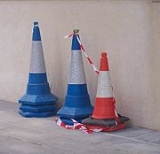
Traffic cone

Encyclopedia

Cone (geometry)
A cone is an n-dimensional geometric shape that tapers smoothly from a base to a point called the apex or vertex. Formally, it is the solid figure formed by the locus of all straight line segments that join the apex to the base...
-shaped markers that are placed on roads or footpaths to temporarily redirect traffic
Traffic
Traffic on roads may consist of pedestrians, ridden or herded animals, vehicles, streetcars and other conveyances, either singly or together, while using the public way for purposes of travel...
in a safe manner. They are often used to create separation or merge lanes
Lane
A lane is a part of the roadway within a road marked out for use by a single line of vehicles in such a way as to control and guide drivers for the purpose of reducing traffic conflicts. Most public roads have at least two lanes, one for traffic in each direction, separated by Lane markings...
during road construction projects or automobile accidents, although heavier, more permanent markers or signs are used if the diversion is to stay in place for a long period of time.
Creation
Traffic cones were invented in 1914 by Howard Taft. Although originally made of concrete, today's versions are more commonly brightly-coloured thermoplasticThermoplastic
Thermoplastic, also known as a thermosoftening plastic, is a polymer that turns to a liquid when heated and freezes to a very glassy state when cooled sufficiently...
or rubber
Rubber
Natural rubber, also called India rubber or caoutchouc, is an elastomer that was originally derived from latex, a milky colloid produced by some plants. The plants would be ‘tapped’, that is, an incision made into the bark of the tree and the sticky, milk colored latex sap collected and refined...
cones
Cone (geometry)
A cone is an n-dimensional geometric shape that tapers smoothly from a base to a point called the apex or vertex. Formally, it is the solid figure formed by the locus of all straight line segments that join the apex to the base...
. Recycled
Recycling
Recycling is processing used materials into new products to prevent waste of potentially useful materials, reduce the consumption of fresh raw materials, reduce energy usage, reduce air pollution and water pollution by reducing the need for "conventional" waste disposal, and lower greenhouse...
PVC
Polyvinyl chloride
Polyvinyl chloride, commonly abbreviated PVC, is a thermoplastic polymer. It is a vinyl polymer constructed of repeating vinyl groups having one hydrogen replaced by chloride. Polyvinyl chloride is the third most widely produced plastic, after polyethylene and polypropylene. PVC is widely used in...
s from bottles can be used to create modern traffic cones. Not all traffic cones are conical. Pillar shaped movable bollard
Bollard
A bollard is a short vertical post. Originally it meant a post used on a ship or a quay, principally for mooring. The word now also describes a variety of structures to control or direct road traffic, such as posts arranged in a line to obstruct the passage of motor vehicles...
s fulfil a similar function.
Traffic management
Traffic cones are typically used outdoors during road work or other situations requiring traffic redirection or advance warning of hazards or dangers, or the prevention of traffic. Traffic cones are also used to mark where children are playing or to block off an area.For night time use or low-light situations traffic cones are usually fitted with a retroreflective sleeve to increase visibility.
With the addition of retroreflective collars, traffic cones meet the requirements in the US Federal Highway Administration's Manual on Uniform Traffic Control Devices
Manual on Uniform Traffic Control Devices
The Manual on Uniform Traffic Control Devices is a document issued by the Federal Highway Administration of the United States Department of Transportation to specify the standards by which traffic signs, road surface markings, and signals are designed, installed, and used...
(MUTCD), which was amended in 1989 to mandate increased night-time visibility via the placement of additional reflective white bands on cones. Reflective collars, white strips made from white reflective plastic, slip over cones snugly, and tape or adhesive can be used to attach the collars to the cones permanently.
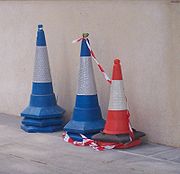
Traffic cones are designed to be highly visible and easily movable. Various sizes are used, commonly ranging from around 30 cm (11.8 in) to a little over 1 m (39.4 in). Traffic cones come in many different colors, with orange, yellow, pink, and red being the most common colors due to their brightness
Brightness
Brightness is an attribute of visual perception in which a source appears to be radiating or reflecting light. In other words, brightness is the perception elicited by the luminance of a visual target...
. Others come in green and blue, and may also have a retroreflective strip to increase their visibility.
Types and sizes
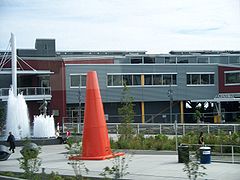
In the United States they come in such sizes as:, 1.5 lb (0.680388555 kg) – for indoor/outdoor applications, 3 lb (1.4 kg) – for outdoor applications such as free-way line painting, 7 lb (3.2 kg) – for Non-highway applications e.g. Local street, 10 lb (4.5 kg) – for free-way/high-way applications (With reflective stripes), 10 lb (4.5 kg) – for free-way/high-way applications (With reflective stripes)
Other forms
Cones are easy to move or remove. Where sturdier (and larger) markers are needed, construction sites use traffic barrelsConstruction Barrel
Construction barrels are traffic control devices used to channel motor vehicle traffic through construction sites. They are used primarily in the United States, but are occasionally used in Canada and Mexico....
(plastic orange barrels with reflective stripes, normally about the same size as a 55 US gal (46 imp gal; 208 l) drum), which may be weighted with sandbag
Sandbag
A sandbag is a sack made of hessian/burlap, polypropylene or other materials that is filled with sand or soil and used for such purposes as flood control, military fortification, shielding glass windows in war zones and ballast....
s. When a lane closure must also be a physical barrier against cars accidentally crossing it, a Jersey barrier
Jersey barrier
A Jersey barrier or Jersey wall is a modular concrete barrier employed to separate lanes of traffic. It is designed to both minimize vehicle damage in cases of incidental contact while still preventing crossover in the case of head-on accidents....
is preferred. See also Fitch Barrier.
In many countries such as Australia
Australia
Australia , officially the Commonwealth of Australia, is a country in the Southern Hemisphere comprising the mainland of the Australian continent, the island of Tasmania, and numerous smaller islands in the Indian and Pacific Oceans. It is the world's sixth-largest country by total area...
or American states such as California
California
California is a state located on the West Coast of the United States. It is by far the most populous U.S. state, and the third-largest by land area...
, traffic barrels are rarely seen. Devices called bollard
Bollard
A bollard is a short vertical post. Originally it meant a post used on a ship or a quay, principally for mooring. The word now also describes a variety of structures to control or direct road traffic, such as posts arranged in a line to obstruct the passage of motor vehicles...
s are used instead of cones where larger and sturdier warning or delineation devices are needed. Typically, bollards are 1150 mm (45.3 in) high fluorescent orange posts with reflective sleeve and heavy weight rubber bases. Larger devices such as barrier board
Barrier board
Barrier boards are typically long plastic or wooden beams used during road works and similar activities to cordon off areas, close roads or direct traffic....
s may be used instead of cones where larger areas need to be excluded or for longer periods. In Canada they are often referred to as pylons.
Indoor and non traffic use
Cones are also frequently used in indoor public spaces to mark off areas which are closed to pedestrians, such as a restroom being out of order, or to denote a dangerous condition, such as a slippery floor. They can be used on school playgrounds to limit areas of a playing field. Some of the cones used for this purpose are miniature, as small as 5 cm tall, and some are disposable full size cones made of biodegradable paper.Being distinctive, easily portable and usually left unguarded, traffic cones are often stolen. Students are frequently blamed
Student prank
University students have a long association with pranks and japes. These can often involve petty crime, such as the theft of traffic cones and other public property, or hoaxes...
, to the extent that the British National Union of Students has attempted to play down this "outdated stereotype".
The term "road cone" is also commonly used in the construction industry as a lighthearted insult. It is used to describe an individual who spends most of the day just standing still, making no attempt to get involved in the work they should be doing.
Traffic cones in popular culture
Traffic cones are ubiquitous in many urban environments and around highway construction or repair projects. In 2007 the artist Dennis Oppenheim commemorated the traffic cone with a monumental sculpture of five five-metre tall cones. They were installed temporarily in Miami, Seattle's Olympic Sculpture ParkOlympic Sculpture Park
The Olympic Sculpture Park is a public park in Seattle, Washington that opened on January 20, 2007.The park consists of a outdoor sculpture museum and beach. The park was designed by Weiss/Manfredi Architects, along with Charles Anderson Landscape Architecture and other consultants. It is...
, and Seoul
Seoul
Seoul , officially the Seoul Special City, is the capital and largest metropolis of South Korea. A megacity with a population of over 10 million, it is the largest city proper in the OECD developed world...
, Korea
Korea
Korea ) is an East Asian geographic region that is currently divided into two separate sovereign states — North Korea and South Korea. Located on the Korean Peninsula, Korea is bordered by the People's Republic of China to the northwest, Russia to the northeast, and is separated from Japan to the...
. An orange cone is the logo
Logo
A logo is a graphic mark or emblem commonly used by commercial enterprises, organizations and even individuals to aid and promote instant public recognition...
used by VideoLAN
VideoLAN
VideoLAN is a project that develops software for playing video and other media formats across a local area network . It originally developed two programs for media streaming, VideoLAN Client and VideoLAN Server , but most of the features of VLS have been incorporated into VLC, with the result...
(best known for its VLC media player
VLC media player
VLC media player is a free and open source media player and multimedia framework written by the VideoLAN project.VLC is a portable multimedia player, encoder, and streamer supporting many audio and video codecs and file formats as well as DVDs, VCDs, and various streaming protocols. It is able to...
software).
See also
- AmsterdammertjeAmsterdammertjeAn Amsterdammertje is the typical red-brown steel bollard that is used to separate the sidewalk from the street in Amsterdam. Amsterdammertje means literally 'little one from Amsterdam' in Dutch...
- BollardBollardA bollard is a short vertical post. Originally it meant a post used on a ship or a quay, principally for mooring. The word now also describes a variety of structures to control or direct road traffic, such as posts arranged in a line to obstruct the passage of motor vehicles...
- Cones HotlineCones HotlineThe Cones Hotline was a hotline introduced in June 1992 by the then Prime Minister, John Major to allow members of the public to enquire about roadworks on the country's roads and report areas where traffic cones had been deployed on a road for no apparent reason...
- Construction BarrelConstruction BarrelConstruction barrels are traffic control devices used to channel motor vehicle traffic through construction sites. They are used primarily in the United States, but are occasionally used in Canada and Mexico....
- Road traffic control
- Traffic guardTraffic GuardA traffic guard, "traffic controller", "flagman", or "flagger" is a person who directs traffic through a construction site or other temporary traffic control zone past an area using signs or flags. They are responsible for maintaining the safety and efficiency of traffic, as well as the safety of...
- Wellington Statue, GlasgowWellington Statue, GlasgowThe equestrian Wellington Statue, with a humorous traffic cone on its head, on Royal Exchange Square in Glasgow, Scotland, is one of the city's most iconic images...
External links
- wikt:traffic cone
- Federal Highway Administration Manual on Uniform Traffic Control Devices
- Traffic Cone Preservation Society
- The Cone Epicentre -- Many photos of traffic cones