
|
|
|
|
Toyota Carina
|
| |
|
| |
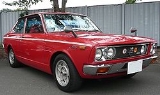
The Toyota Carina was a Japanese large family car, initially launched in 1970 and exported to Europe and the United States. It finished production in 2000 as a mid-sized four-door sedan sold in the Japanese market. It was typically marketed as a four-door version of the Celica. Over time, it became a sister car to the Corona but was sportier, with distinctive bodywork and interior—aimed at the youth market and generally filling a niche between the Corolla and Corona.

Discussion
Ask a question about 'Toyota Carina'
Start a new discussion about 'Toyota Carina'
Answer questions from other users
|
Recent Posts

Encyclopedia
The Toyota Carina was a Japanese large family car, initially launched in 1970 and exported to Europe and the United States. It finished production in 2000 as a mid-sized four-door sedan sold in the Japanese market. It was typically marketed as a four-door version of the Celica. Over time, it became a sister car to the Corona but was sportier, with distinctive bodywork and interior—aimed at the youth market and generally filling a niche between the Corolla and Corona. At that point it was replaced by the Allion.
The Carina name has been used in markets other than the USA at various times to represent other cars, usually the Corona. However, the Japanese-market Carina was a different car entirely.
The inspiration for the name Carina came from the Carina star cluster.
First generation (1970-1977) A10 series
The first-generation Carina was manufactured in 1970 (and launched in Europe in October 1971). It was also exported to the US, but sales volumes were disappointing. US exports stopped after only two years.
The original model featured a 1588-cc OHV engine, with 4-speed gearbox and front-wheel disc brakes.. It was revised in 1972 with a restyled body, new rear light cluster and filler cap repositioned in rear quarter panel, restyled front grille and fascia. The specification was once again revised in 1974 including sealed cooling system, improved brakes, restyled wheels with flared wheel arches, and restyled interior fittings. For 1976, it received a new front and rear-end styling, dual-line braking system with servo and a repositioned handbrake and gear lever. Wheelbase was increased slightly.
Second generation (1977-1981) A40 Series
Originally launched in 1977, it reached Europe in 1978. From this generation, an automatic transmission option was available. The car was fitted with the same 2T motor as the Celica's first generation. The Carina estate model was introduced with heavy-duty leaf-spring rear suspension. In 1980, all models had revised front- and rear-end styling and lighting equipment, also improved interior specification. The following year, saloon and coupé models were fitted with 5-speed gearbox as standard and automatic transmission option, but not the estate.
Third generation (1981-1988) A60 Series
Fourth generation (1984-1988) T150 series
Starting from the fourth Generation, the Carina shared the Corona platform for four-door sedans. The Carina RWD platform of 2-door coupés, Carina Surf, and Carina Van continued to use the A series platform until 1988.
Carina II
For the European market, the Carina II was the eighth generation Toyota Corona.
Carina ED
Fifth generation (1988-1992) T170 series
Corona EXiV
A sister car was introduced as the Corona EXiV. In 1992, Toyota repeated the product planning on a Corolla-based hardtop, the Sprinter Marino and Corolla Ceres.
Sixth generation (1992-1996) T190 series
In 1993 the Celica, Carina ED and EXiV were redesigned similar to the larger Toyota JZX90 Mark II, after which the product names were discontinued in 1998.
Carina E
The Carina E was the European version of the ninth generation Corona.
Seventh generation (1996-2001) T210 series In 1996, a GT version was reintroduced with a 5-valve-A-cylindered "KURO head" (means "black head") 4A-GE engine and 5-speed C56 manual transmission. In 1998, the GT was equipped with a 6-speed C160 manual transmission.
European Confusion
In 1984 in Europe, the Carina was replaced by the Corona but rebadged as the "Carina II". This continued with the new model introduced in 1988 and, subsequently, the "Carina E" introduced in 1992 was also a Corona, as was a so-called "Avensis" which replaced it in 1997. In 2003, this was in turn replaced by the car badged also in Japan as the Avensis.
|
| |
|
|