

Tower of Hercules

Encyclopedia
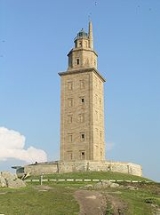
The Tower of Hercules is an ancient Roman
lighthouse
on a peninsula about 2.4 kilometres (1.5 mi) from the centre of A Coruña
, Galicia, in north-western Spain
. Until the 20th century, the tower itself was known as the "Farum Brigantium". The Latin word farum is derived from the Greek pharos for the Lighthouse of Alexandria
. The structure is 55 metres (180.4 ft) tall and overlooks the North Atlantic coast of Spain. The structure, almost 1900 years old and rehabilitated in 1791, is the oldest Roman lighthouse in use today.
There is a sculpture garden
featuring works by Pablo Serrano and Francisco Leiro.
The Tower of Hercules is a National Monument of Spain, and since June 27, 2009, has been a UNESCO World Heritage Site
. It is the second tallest lighthouse in Spain, after the Faro de Chipiona
.
, possibly on foundations following a design that was Phoenicia
n in origin. It is thought to be modeled after the Lighthouse of Alexandria
. At its base is preserved the cornerstone with the inscription MARTI AUG.SACR C.SEVIVS LUPUS ARCHTECTUS AEMINIENSIS LVSITANVS.EX.VO, permitting the original lighthouse tower to be ascribed to the architect Gaius Sevius Lupus, from Aeminium
(present-day Coimbra
, Portugal
) in the former province of Lusitania
, as an offering
dedicated to Mars. The tower has been in constant use since the 2nd century and is considered to be the oldest existing lighthouse in the world.
The earliest known reference to the lighthouse at Brigantium is by Paulus Orosius in Historiae adversum Paganos written around 415-417:
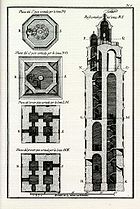 In 1788, the original 34 metres (111.5 ft), 3-storey tower was given a neoclassical restoration, including a new 21 metres (68.9 ft) fourth storey. The restoration was undertaken by naval engineer Eustaquio Giannini during the reign of Charles III of Spain
, and was finished in 1791. Within, the much-repaired Roman and medieval masonry may be inspected.
The Romans who conquered this region of Spain believed it to be, in a figurative sense, the end of the earth, as described in "Finisterra". This region is notorious for shipwrecks, earning the name Costa da Morte
, "Coast of Death".
to indicate that it was not built as a marker for the end of the known earth.
slew the giant tyrant Geryon
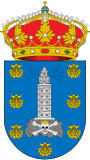
after three days and three nights of continuous battle. Hercules then—in a Celtic gesture— buried the head of Geryon with his weapons and ordered that a city be built on the site. The lighthouse atop a skull and crossbones representing the buried head of Hercules’ slain enemy appears in the coat-of-arms of the city of Corunna.
Another legend embodied in the 11th-century compilation Lebor Gabala Erren
— the "Book of Invasions"— King Breogán
, the founding father of the Galician Celtic nation, constructed here a massive tower of such a grand height that his sons could see a distant green shore from its top. The glimpse of that distant green land lured them to sail north to Ireland. A colossal statue of Breogán has been erected near the Tower.
 Early geographical description on the location of Brigantia point out that the town was actually located where the modern city of Betanzos
is. This is sustained by the fact that Betanzos was referred to as "the former city of Brigancia" until the 17th century, both in literary accounts as well as in maps. It is also believed that the name Betanzos is a phonetical evolution from Brigantium > Breganzo > Betanzos.
The port of Betanzos was getting too small for the larger mediaeval ships and king Alphons IX of Leon decided to create a bigger port nearby in the 13th century. The place he chose was an uninhabited place called Clunia, which later on evolved to Cruña and Coruña. The place name Clunia is believed to come from the Galician Celtic name Cluain, which means The Meadow.
During the 19th and 20th century it was promoted the idea that the city of Brigantia was actually at the same place where the modern city of Corunna is today. This quickly rooted among the citizens of Corunna, who nowadays believe that the city of Brigantia was the former name of Corunna.
Ancient Rome
Ancient Rome was a thriving civilization that grew on the Italian Peninsula as early as the 8th century BC. Located along the Mediterranean Sea and centered on the city of Rome, it expanded to one of the largest empires in the ancient world....
lighthouse
Lighthouse
A lighthouse is a tower, building, or other type of structure designed to emit light from a system of lamps and lenses or, in older times, from a fire, and used as an aid to navigation for maritime pilots at sea or on inland waterways....
on a peninsula about 2.4 kilometres (1.5 mi) from the centre of A Coruña
A Coruña
A Coruña or La Coruña is a city and municipality of Galicia, Spain. It is the second-largest city in the autonomous community and seventeenth overall in the country...
, Galicia, in north-western Spain
Spain
Spain , officially the Kingdom of Spain languages]] under the European Charter for Regional or Minority Languages. In each of these, Spain's official name is as follows:;;;;;;), is a country and member state of the European Union located in southwestern Europe on the Iberian Peninsula...
. Until the 20th century, the tower itself was known as the "Farum Brigantium". The Latin word farum is derived from the Greek pharos for the Lighthouse of Alexandria
Lighthouse of Alexandria
The Lighthouse of Alexandria, also known as the Pharos of Alexandria , was a tower built between 280 and 247 BC on the island of Pharos at Alexandria, Egypt...
. The structure is 55 metres (180.4 ft) tall and overlooks the North Atlantic coast of Spain. The structure, almost 1900 years old and rehabilitated in 1791, is the oldest Roman lighthouse in use today.
There is a sculpture garden
Sculpture garden
A sculpture garden is an outdoor garden dedicated to the presentation of sculpture, usually several permanently sited works in durable materials in landscaped surroundings....
featuring works by Pablo Serrano and Francisco Leiro.
The Tower of Hercules is a National Monument of Spain, and since June 27, 2009, has been a UNESCO World Heritage Site
UNESCO World Heritage Sites in Spain
The United Nations Educational, Scientific and Cultural Organization World Heritage Sites are places of importance to cultural or natural heritage as described in the UNESCO World Heritage Convention, established in 1972...
. It is the second tallest lighthouse in Spain, after the Faro de Chipiona
Chipiona Light
Chipiona Light, also known as Punta del Perro Light is an active lighthouse in Chipiona, in the province of Cádiz, Spain. At a height of it is the seventeenth tallest "traditional lighthouse" in the world, as well as the tallest in Spain.. It is located on Punta del Perro Chipiona Light, also...
.
Construction and history
The tower is known to have existed by the 2nd century, built or perhaps rebuilt under TrajanTrajan
Trajan , was Roman Emperor from 98 to 117 AD. Born into a non-patrician family in the province of Hispania Baetica, in Spain Trajan rose to prominence during the reign of emperor Domitian. Serving as a legatus legionis in Hispania Tarraconensis, in Spain, in 89 Trajan supported the emperor against...
, possibly on foundations following a design that was Phoenicia
Phoenicia
Phoenicia , was an ancient civilization in Canaan which covered most of the western, coastal part of the Fertile Crescent. Several major Phoenician cities were built on the coastline of the Mediterranean. It was an enterprising maritime trading culture that spread across the Mediterranean from 1550...
n in origin. It is thought to be modeled after the Lighthouse of Alexandria
Lighthouse of Alexandria
The Lighthouse of Alexandria, also known as the Pharos of Alexandria , was a tower built between 280 and 247 BC on the island of Pharos at Alexandria, Egypt...
. At its base is preserved the cornerstone with the inscription MARTI AUG.SACR C.SEVIVS LUPUS ARCHTECTUS AEMINIENSIS LVSITANVS.EX.VO, permitting the original lighthouse tower to be ascribed to the architect Gaius Sevius Lupus, from Aeminium
Aeminium
Aeminium was the ancient name of the city of Coimbra, in Portugal.The Romans founded the civitas of Aeminium in this place at the time of Augustus, which came under the protection of nearby Conimbriga situated some 15 km away to the south....
(present-day Coimbra
Coimbra
Coimbra is a city in the municipality of Coimbra in Portugal. Although it served as the nation's capital during the High Middle Ages, it is better-known for its university, the University of Coimbra, which is one of the oldest in Europe and the oldest academic institution in the...
, Portugal
Portugal
Portugal , officially the Portuguese Republic is a country situated in southwestern Europe on the Iberian Peninsula. Portugal is the westernmost country of Europe, and is bordered by the Atlantic Ocean to the West and South and by Spain to the North and East. The Atlantic archipelagos of the...
) in the former province of Lusitania
Lusitania
Lusitania or Hispania Lusitania was an ancient Roman province including approximately all of modern Portugal south of the Douro river and part of modern Spain . It was named after the Lusitani or Lusitanian people...
, as an offering
Ex-voto
An ex-voto is a votive offering to a saint or divinity. It is given in fulfillment of a vow or in gratitude or devotion...
dedicated to Mars. The tower has been in constant use since the 2nd century and is considered to be the oldest existing lighthouse in the world.
The earliest known reference to the lighthouse at Brigantium is by Paulus Orosius in Historiae adversum Paganos written around 415-417:
Secundus angulus circium intendit, ubi Brigantia Gallaeciae civitas sita altissimum farum et inter pauca memorandi operis ad speculam Britanniae erigit ("At the second angle of the circuit [circumnavigating HispaniaHispaniaAnother theory holds that the name derives from Ezpanna, the Basque word for "border" or "edge", thus meaning the farthest area or place. Isidore of Sevilla considered Hispania derived from Hispalis....
], where the GallaeciaGallaeciaGallaecia or Callaecia, also known as Hispania Gallaecia, was the name of a Roman province and an early Mediaeval kingdom that comprised a territory in the north-west of Hispania...
n city of Brigantia is sited, a very tall lighthouse is erected among a few commemorative works, for looking towards BritanniaBritanniaBritannia is an ancient term for Great Britain, and also a female personification of the island. The name is Latin, and derives from the Greek form Prettanike or Brettaniai, which originally designated a collection of islands with individual names, including Albion or Great Britain. However, by the...
.")
Charles III of Spain
Charles III was the King of Spain and the Spanish Indies from 1759 to 1788. He was the eldest son of Philip V of Spain and his second wife, the Princess Elisabeth Farnese...
, and was finished in 1791. Within, the much-repaired Roman and medieval masonry may be inspected.
The Romans who conquered this region of Spain believed it to be, in a figurative sense, the end of the earth, as described in "Finisterra". This region is notorious for shipwrecks, earning the name Costa da Morte
Costa da Morte
Costa da Morte is part of the Spanish Galician coast. The Costa da Morte extends from the villages of Fisterra and Malpica.The Costa da Morte received its name because there have been so many shipwrecks along its treacherous rocky shore...
, "Coast of Death".
Position and purpose
The position of the lighthouse is not understood since it strongly favours an approach from the northwest. It does not provide a guide to safe harbour to vessels approaching either up the West coast of the Iberian peninsula, nor along the Rias of the north coast. This would imply that the lighthouse was built to satisfy the needs of regular traffic coming in from the Atlantic, perhaps taking a Westerly route from the Cap Gris Nez area to avoid the Bay of Biscay or direct from Ireland or South West England. The position of the lighthouse is sufficiently far from Cape FinisterreCape Finisterre
right|thumb|300px|Position of Cape Finisterre on the [[Iberian Peninsula]]Cape Finisterre is a rock-bound peninsula on the west coast of Galicia, Spain....
to indicate that it was not built as a marker for the end of the known earth.
Myths
Through the millennia many mythical stories of its origin have been told. According to a myth that blends Celtic and Greco-Roman elements, the hero HerculesHercules
Hercules is the Roman name for Greek demigod Heracles, son of Zeus , and the mortal Alcmene...
slew the giant tyrant Geryon
Geryon
In Greek mythology, Geryon , son of Chrysaor and Callirrhoe and grandson of Medusa, was a fearsome giant who dwelt on the island Erytheia of the mythic Hesperides in the far west of the Mediterranean. A more literal-minded later generation of Greeks associated the region with Tartessos in southern...
after three days and three nights of continuous battle. Hercules then—in a Celtic gesture— buried the head of Geryon with his weapons and ordered that a city be built on the site. The lighthouse atop a skull and crossbones representing the buried head of Hercules’ slain enemy appears in the coat-of-arms of the city of Corunna.
Another legend embodied in the 11th-century compilation Lebor Gabala Erren
Lebor Gabála Érenn
Lebor Gabála Érenn is the Middle Irish title of a loose collection of poems and prose narratives recounting the mythical origins and history of the Irish from the creation of the world down to the Middle Ages...
— the "Book of Invasions"— King Breogán
Breogán
Breogán son of Brath was a mythical Celtic king from Galicia. Various accounts exist of this mythological father of the Galician nation. His sons were Ith and Bile . Bile was the father of Mil Espaine....
, the founding father of the Galician Celtic nation, constructed here a massive tower of such a grand height that his sons could see a distant green shore from its top. The glimpse of that distant green land lured them to sail north to Ireland. A colossal statue of Breogán has been erected near the Tower.
Possible locations of Brigantia
Betanzos
Betanzos is a municipality in Galicia, Spain, in the Province of A Coruña. In Roman times Betanzos was called Carunium or Brigantium. During the Medieval period the settlement was known as Carunio....
is. This is sustained by the fact that Betanzos was referred to as "the former city of Brigancia" until the 17th century, both in literary accounts as well as in maps. It is also believed that the name Betanzos is a phonetical evolution from Brigantium > Breganzo > Betanzos.
The port of Betanzos was getting too small for the larger mediaeval ships and king Alphons IX of Leon decided to create a bigger port nearby in the 13th century. The place he chose was an uninhabited place called Clunia, which later on evolved to Cruña and Coruña. The place name Clunia is believed to come from the Galician Celtic name Cluain, which means The Meadow.
During the 19th and 20th century it was promoted the idea that the city of Brigantia was actually at the same place where the modern city of Corunna is today. This quickly rooted among the citizens of Corunna, who nowadays believe that the city of Brigantia was the former name of Corunna.
See also
- Roman architectureRoman architectureAncient Roman architecture adopted certain aspects of Ancient Greek architecture, creating a new architectural style. The Romans were indebted to their Etruscan neighbors and forefathers who supplied them with a wealth of knowledge essential for future architectural solutions, such as hydraulics...
- Roman engineeringRoman engineeringRomans are famous for their advanced engineering accomplishments, although some of their own inventions were improvements on older ideas, concepts and inventions. Technology for bringing running water into cities was developed in the east, but transformed by the Romans into a technology...
- Roman technologyRoman technologyRoman technology is the engineering practice which supported Roman civilization and made the expansion of Roman commerce and Roman military possible over nearly a thousand years....
- List of Roman sites in Spain