


Tourism in Peru

Encyclopedia
Tourism in Peru make up the nation's third largest industry, behind fishing
and mining
. Tourism is directed towards archeological monuments, ecotourism in the Peruvian Amazon
, cultural tourism
in colonial cities, gastronomic tourism, adventure tourism, and beach tourism. According to a Peruvian government
study, the satisfaction rate for tourists after visiting Peru
is 94%. Tourism is the most rapidly growing industry in Peru
, growing annually at a rate of 25% over the past five years. Tourism is growing in Peru faster than any other country in South America. The most popular countries of origin for tourists are the United States
, Chile
, Argentina
, United Kingdom
, France
, Germany
, Brazil
, Spain
, Canada
, and Italy
.
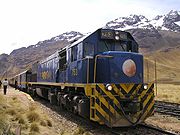
from North America
, South America
, Europe
, and Asia
. Some of the most popular airlines are LAN Perú
(domestic and international), TACA Peru
(international), and Star Peru (domestic). The country's airports are also served by many international airlines from other nations. The Jorge Chavez International Airport
in Lima
is the nation's leading international airport and received 7,507,811 passengers in 2007. Domestic air travel serves as a major method for tourists to traverse the country with multiple airlines offering service between many of Peru's cities.
. International bus routes are operated on each of these highways providing service from Peru
vian cities to other South American cities. Domestically, the highway system is extensive and covers nearly the entire country excluding the department of Loreto
which can only be accessed by boat or airplane. There are frequent buses traveling throughout the country. But, bus travel is dangerous as many of these highways are built on cliffs, and accidents leading to death are frequently reported by the media. Occasionally buses are held up by highwaymen in remote areas. The buses range in size and comfort but they usually have cushioned reclining seats and a form of onboard entertainment, such as a movie or music. Many offer bus-camas, or sleeper buses, with seats that recline to become beds.
and traverses the Andes
, crossing through the Junin
and Huancavelica
departments
.
The southern railway is the one most commonly used by tourists, as a segment of its route goes from the city of Cusco
to the citadel of Machu Picchu
, a major tourist attraction. This route offers seating options ranging from economy class to first class. The railway originates in the city of Mollendo
in the Arequipa Department and goes through the Puno
and Cusco
departments, passing through the cities of Arequipa
, Puno
, Juliaca
, the citadel of Machu Picchu
, and ends at Cusco
. The railway is operated by PeruRail
, the largest railway manager in Peru.
area is river transport. River transportation companies operate routes between the cities of the Peruvian Amazon
. The main hubs of this network are the cities of Iquitos
, Puerto Maldonado
, Pucallpa
, and Yurimaguas
. Because of the lack of roads in this region, river transport, along with air travel, are the most efficient and important methods of transport.
. It employs 10.8% of the labor force
in Peru
(484,000 direct and 340,000 indirect jobs) the majority of them belonging to the hotel and transportation industries. The industry makes up 7% of the Peru
vian gross domestic product
and is the fastest growing industry in the country. It is regulated by the Commission for the Promotion of Peru (PromPeru) belonging to the Ministry of Foreign Commerce and Tourism
.
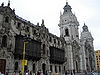 Cultural tourism forms the largest sector of the tourism industry in Peru. Pre-Columbian civilizations — most notably the Incan Empire, Chavín
, Moche
, and Nasca
— left a large archeological and cultural impact on the nation. The ruins of Machu Picchu
are the most internationally recognized of all the ruins of Peru and therefore receive the most tourists. The other popular ruins are those of Chan Chan
, Sipan
, Kuelap
, Nazca lines
, Ollantaytambo
, Caral
, Sacsayhuamán
, and Sillustani
.
Tourists also visit the Spanish colonial architecture in many cities in Peru. Some of the most outstanding examples of Spanish colonial architecture are in the cities of Lima, Arequipa
, and Cusco. These areas, many built over 500 years ago, demonstrate the superb architectural ingenuity of the colonists during the Viceroyalty of Peru
. The city of Lima
has many acclaimed museums holding works of art reflecting the diverse history of the country. These museums include the National Museum, National Museum of Anthropology, Archeology and History; Rafael Larco Herrera Archeological Museum, National Museum of Peruvian Culture, and Museum of Italian Art, among many others.
 60% of the land of Peru is in the Amazon Basin
. Peru has a higher percentage of land area protected in national parks and preserves than any other country in South America
. The Peruvian Amazon
is one of the most pristine, virgin, and untouched rainforests on the earth, making it a destination for tourists interested in nature and ecology. Increased tourist infrastructure has been developed.
The Peruvian Amazon is divided into two areas: the High Jungle and the Lower Jungle. The High Jungle is more easily accessible, while the Lower Jungle is more pristine and untouched. In recent times, however, the government has increased accessibility to the Lower Jungle. Both areas contain an unrivaled diversity of animal and plant life. Large national preserves of interest to tourists include the Manú National Park
, Rio Abiseo National Park
, and the Tambopata-Candamo Protected Area
. Tourist agencies in these areas promote eco-friendly tourism to preserve the fragile ecosystems of the rainforest.
, sandboarding
, 4x4, dune buggy
, alpinism, rafting
, rappelling, downhill
, rally
, trekking
, skiing
, and mountain climbing. Surfing
is extremely popular in Peru, and the country has been host to numerous national and international competitions in the sport. The country is home to the world-famous surfer Sofía Mulánovich
.
Peru is divided into three geographical regions: the coast, the sierra, and the jungle. Each one has numerous activities suited to its particular climate and environment. The sport of skiing is developing in the city of Huaraz
, and new resorts are created to suit the rising tourist demand. The sand dunes of Ica
are popular for dune buggies. River rafting has become very popular among national and international tourists in recent years, and availability in Lima
and Cusco
is high. Rapids range in difficulty and there is rafting options from novices to experts. Trekking has become the most popular type of adventure sport among tourists in Peru
. This is because of the treks offered from Cusco
to Machu Picchu
, as well as trails in other parts of the country such as Ancash
. Mountain climbing is a popular sport among tourists in the sierra region.
For more information on adventure tourism see the Ancash section of this article below.
and chestnuts in Peru. It is next to impossible to find authentic foreign cuisine to this day because of a lack of ingredients. For example, one can not find authentic Chinese dishes such as Mapo dofu. Instead one finds a curious mixture of Chinese cooking that has been adapted to the ingredients available in Peru. This cuisine is known as Chifa
. Cusco restaurants are home to the tastiest meals of the country and in places such as Aguas Calientes (the small town below Macchu Picchu) some say the best flavour of the world can found.
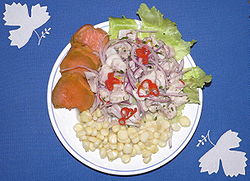
The three traditional staples of Peruvian cuisine are corn
, potatoes and beans. These ingredients have been combined with a number of staples brought by the Spanish, such as rice
, wheat
and meat (such as beef, pork and chicken). Many traditional foods, such as quinoa
, kiwicha, chili peppers and several roots and tubers which had previously been tossed aside for European products, have seen a resurgence in popularity in recent decades with a revival of interest in native Peruvian food crops.
 Peru boasts a 2,414-kilometer coastline littered with many beaches attractive to any type of traveler. Beachgoing in Peru
is extremely popular among domestic and international travelers alike. Beach resorts and towns are abundant along the coast and many are in popular areas which attract visitors. Two of the most popular beach areas are Mancora
and Punta Sal
in the Piura
and Tumbes
departments respectively, and Asia
in the Lima Department
.
The northern beaches of Mancora
and Punta Sal
have a pleasant beach climate year round whereas Asia is primarily a summertime beach. Because Asia is located near the city of Lima
, many beachgoers own houses in that area. In contrast, Mancora
is many hours from major cities so visitors usually stay in hotels or resorts.
Beachgoing in Peru is affected by fads: Beach homeowners moved from beach to beach resulting from the oversaturation of one beach. In previous years, the beach of Ancon
was the most popular of Lima; it became oversaturated and beachgoers moved south of the city to the beaches of Punta Hermosa, San Bartolo
, Santa Maria and Pucusana
. In the last decade, these beaches have become oversaturated as well and beachgoers have moved further south to the development of Asia, which has now become extremely popular and is the primary beach destination for Limeans.
Mancora
, 17 hours north of Lima by bus and 1.5 hours by plane from Talara
, is older than Asia but still a relatively new development. In recent years it has experienced a tourist boom and beachgoers flock there. Its beaches have white sand and the town has many nightclubs and bars frequented by thousands of tourists. The popularity of this beach has become so great that a movie has been made about the beach: Mancora. Punta Sal
is another beach a half hour north of Mancora, less popular among young people, and the destination for older people seeking relaxation.
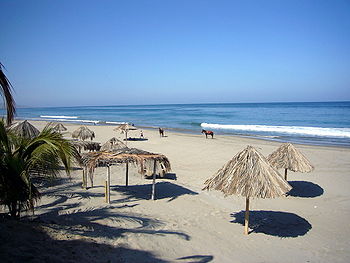 Nonetheless it remains a large tourist attraction and is characterized by its white sand beaches and turquoise color waters.
Peruvian beaches are popular places for surfing and their waves are world renowned.
, Urubamba
, and Machu Picchu
. Recently this segment has been expanding to other area such as the Puno region
and Lake Titicaca
, as well as Iquitos
and the Colca Canyon
in Arequipa, as local and international tourism firms have made large investments in hotels and tourism development.
Nowadays there are entrepreneurs of the best hotel brands of USA ready to invest millions of dollars (minimum of US$10 million) in 5 star hotels and resorts in the Mancora and Punta Sal area under capital investment or joint venture schemes. The investors are comprised by more than 115 investment funds of USA and Europe.
and its historic centre
, and Cusco
whose principal attractions are the Sacred Valley of the Incas, Machu Picchu
, and incan and colonial
architecture.
is a land of microclimates each containing an extensive amount of biodiversity. Additionally, the department was home to pre-Columbian civilizations that have left stunning remnants of their once great culture. The capital of the department, Chachapoyas
, adds to the diversity of ecology and culture as it is home to picturesque colonial architecture. The streets of this city are narrow. It contains a main square as common throughout Peruvian cities and maintains colonial mansions and balconies which add to the flavor of the area's mixed culture.
Arguably the most impressive destination of the department is the ancient fortress of Kuélap
. Often referred to as the Machu Picchu
of the north, Kuleap was built by the Chachapoyas civilization, an ancient tribe of warriors who resisted the Incas imperial expansion. The Gocta Waterfall
is in this department and is the third highest waterfall in the world. As it was only recently discovered in 2005, the Peruvian government
is making plans to develop it for tourism.
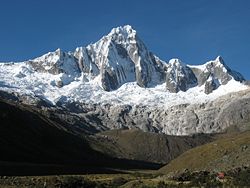 The region of Ancash
is home to the Cordillera Blanca
, the highest mountain range in Peru. The department is the epicenter of Peru's adventure tourism sector and attracts visitors seeking to participate in all sorts of activities. The department is a paradise for trekkers and hikers as there is a vast network of trails. The benefit of trekking in Ancash is that only a select few trails have been commercialized. The scenery along these pre-Columbian trails is spectacular and there are more than 12,000 lakes. Picturesque villages are scattered throughout the department and are very hospitable. The most popular treks in the department are that of the Llama trek, the Cordillera Blanca
, and the Cordillera Huayhuash
.
The capital city, Huaraz
, has a small but reasonably developed skiing industry. Mountain biking is the fastest growing sport in the region. Mountain bikes are available to the traveler at each level of expertise. White water rafting is a significant activity in the department. Rapids range in difficulty from novice to expert. Mountain climbing is a very large industry in the area. The department has a high concentration of peaks and is not very crowded. The weather is mild year-round and is easily accessible from Huaraz
. Twelve of Peru's twenty tallest mountains are located in the department ranging from 5,000 to 6,700 meters (15,000 to 22,000 feet).
To the cultural tourist Ancash also has much to offer. The Callejon de Huaylas
is home to Chavin de Huantar
, an ancient archeological complex built over 3,200 years ago. The area is a UNESCO World Heritage Site. Picturesque cities litter the Callejon such as that of Recuay
, Carhuaz
, Yungay
, Chacas
and Caraz
. These cities retain a unique blend of Europe
an and Andean architecture. One of the principal attractions of the department is the Huascaran National Park
which is a UNESCO World Heritage Site. The park is home to Peru
's highest mountain, Mt. Huascarán
.
is in the southern Andes of Peru
and is home to many villages and towns characterized by uncommercialized natural beauty. In addition to natural beauty, the cities of Abancay
and Andahuaylas
are home to Spanish colonial architecture each with a main square and narrow cobblestone streets. The main tourist activities in this area are hiking and white water rafting. Since the regions are close to Cusco
, many tourists make offshoot trips from Cusco to Apurímac.
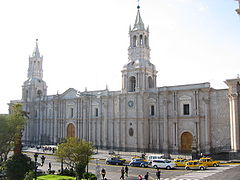 The Arequipa region
is one of the most geographically, culturally, and socially varied of Peru
. Main attractions of the department are the city of Arequipa
, the Colca Canyon
, adventure tourism, and wildlife observation. The city of Arequipa, the second largest in the nation, is known as the "white city." The name comes from the colour of the city's buildings which are made of sillar
that comes from the volcanoes in the area.
The city is overshadowed by the El Misti
volcano which adds to the city's charm. It is the most developed city in Peru after Lima
. The Historic centre of Arequipa
was made a UNESCO World Heritage Site by the United Nations
for its abundance of Spanish baroque
colonial churches and mansions, and the Santa Catalina Monastery
, a city within a city with cobblestone roads, plazas, and patios. Arequipan cuisine has remained more heavily influenced by Spanish colonial cuisine than that in Lima and it has remained relatively free from the later influence of immigrants that migrated to Lima, such as the Chinese and Japanese. The Colca Canyon
is 100 miles northwest of Arequipa and is double the depth of the Grand Canyon
in the United States
. The Cotahuasi Canyon
, located nearer to the city but considered less picturesque, is the deepest in the Western Hemisphere
.
 The Ayacucho department
is in the southern Andes and contains a number of tourist sites attracting many visitors. The capital city, also known as Ayacucho
, is said to have a church on every corner. These churches were built by the Spanish
in the colonial period and contain much artwork. The department is home to various Wari archeological sites. The cities and towns of Ayacucho
specialize in creating and selling handicrafts. Many of the handicrafts are created in Huamanga stone which is native to the department. The Vilcashuaman archeological site is an important Incan site.
is a melting pot of colonial architecture, historical significance, and a beautiful countryside. The city played an important part in South American history as it was an Incan stronghold that was taken by the Spanish
who eventually conquered the continent and formed the Viceroyalty of Peru
. From the conquest of the area, the city of Cajamarca
ceased to be Incan and the Spanish imposed their magnificent colonial architecture upon the city. The city retains this architecture and it is a focal point to tourism in the region.
Tourist destinations include Inca Baths, medicinal hot springs that were built by the Incas; the Ventanillas de Otuzco, an Incan cemetery carved into volcanic rock; Cumbemayo, a pre-Incan hydraulic engineering complex still working today; a picturesque hacienda called La Colpa; Kuntur Wasi, a commercial centre dating to 1100 B.C. containing a museum thought to have the oldest gold artifacts known to man; and a zoo. The city of Cajamarca
is home to the Ransom Room
, an Incan room that the Spanish
ordered to be filled with gold and silver to secure the release of the Incan ruler Atahualpa
. The ransom was met but the emperor was still killed.
and is the transportation hub of the country. It is the location of the Jorge Chavez International Airport
, the largest in the country. Callao
is Peru's largest maritime port and was founded in 1537. During the Viceroyalty of Peru
, all wealth extracted from the South American Continent
had to pass through this city. This wealth is evident through the remaining colonial mansions and elaborately carved balconies which characterize the city.
The Real Felipe Fortress
is an important tourist attraction which was built in 1747 to protect the city from pirates such as Sir Francis Drake. The fortress played a key role in the Peruvian War of Independence. Chucuito, a neighborhood of Callao
, is known for its Gothic
and neo-Renaissance houses as well as brightly colored homes. The district of La Punta was once home to the beach houses of Lima
's aristocracy and contains stately homes dating back to the early 19th century. The La Punta district is characterized by an ocean boardwalk, pebble beaches, and elegant mansions. The islands of El Camotal, San Lorenzo, El Frontón, Cavinzas and Palomino are just off the coast and home to sea birds and sea lions. The island of El Fronton once housed some of Peru
's most dangerous criminals.
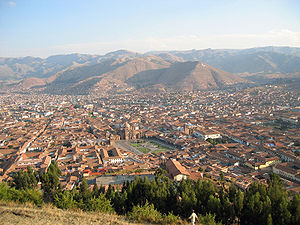 Cusco
Cusco
is the most visited department in Peru. It is home to the city of Cusco
, the Sacred Valley of the Incas, and the citadel of Machu Picchu
, one of the Seven Wonders of the World. The city of Cusco
was the capital of the Incan Empire and was placed on the UNESCO World Heritage Site by the United Nations
in 1983.
Incan monuments are throughout the city and are some of the most impressive in Peru. Additionally, after conquest by the Spanish
, they attempted to bring their architectural and cultural influence to the city and rid of the Incan presence. Their goal was only partially successful as their architecture and culture did remain. With the occurrence of earthquakes and other natural event over the centuries, the more well-built Incan buildings also remained. This is what has given Cusco
its unique blend of culture.
It is the most touristically developed area in Peru; tourism is by far the largest industry and infrastructure is extremely well developed. The city has thousands of hotel rooms ranging from hostels to five-star hotels. Gastronomy is representative of all of Peru as well as local cuisine. International cuisine is also largely present in the city's many restaurants. The city has a wide variety of languages due to the large tourist presence with many common languages spoken other than Spanish
being English
, German
, and French
. In addition to these languages, Quechua is spoken by many residents of the city along with Spanish
. Most tourism agencies have offices in this city.
Major attractions include the historic downtown with colonial architecture and the main plaza, Sacsayhuamán
, the palace of Inca Roca, neighborhood of San Blas, and the archeological sites of Qenko, Pukapukara, and Tambomachay. The Sacred Valley
has a multitude of picturesque towns such as Písac, Maras, and Chinchero. Additionally, a variety of archeological sites such as Ollantaytambo
are located in the valley. Arguably the most popular tourist attraction in Peru is located a few hours from Cusco by train: the citadel of Machu Picchu
. These ruins are beyond description and are the most beautiful and important legacy of the Incan people. The site is one of the Seven Wonders of the World and a UNESCO World Heritage Site. Machu Picchu
can be accessed by the PeruRail
train or a hike on the Inca Trail. Other routes like the Salkantay
trek, Inca Jungle Trek or even the Cacao & Coffee route have been recently opened to access MachuPicchu.
 The Huancavelica department
is the least developed and poorest department of Peru. Despite this, the department has a rich history and maintains evidence of it through beautiful colonial architecture and archeological monuments. This department was inhabited by the Wari and the Chancas before being conquered and incorporated into the Incan Empire. Following this, with the Spanish conquest of Peru, Huancavelica became part of the Viceroyalty of Peru
. The Spanish established themselves in this area because of silver and mercury mines found here. They left magnificent colonial mansions and churches in the capital city, also known as Huancavelica
.
is divided into two distinct geographical regions, the sierra and the jungle. The capital city, also known as Huanuco
is in the Andean
sierra. It was founded in 1539 by the Spanish and ever since it has been a site of colonial architecture typical of the Peru
vian Andes. On the opposite side of the department, in the jungle area, is Tingo Maria
, the department's second largest city. It is home to the Tingo Maria National Park
which contains a variety of flora such as orchids, cat’s claw
, and dragon’s blood
, as well as animals such as little spotted cats, jaguars, reptiles, sachavacas
, oilbirds, Andean Cock-of-the-rock
, and the howler monkey
. A tourist destination in this area is the Owl's Cave home to nocturnal birds and the Turkey's Cave home to abundant vegetation.
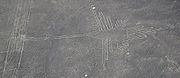
region was the location of various ancient civilizations that literally left their mark. One of the most popular attractions of this area are the Nazca lines
, an enigma that modern archeologists have not been able to figure out. These lines stretch for miles in the desert and form pictures of animals and figures only viewable from the air. The Paracas National Reservation
is another point on this circuit which attracts many ecological and cultural tourists alike as it is a refuge to sea lions
, otters, penguins, dolphins, more than 200 species of birds from flamingos, waders, and guano birds. Additionally in the preserve, there are magnificent beaches, like La Mina, La Catedral and Mendieta beaches, and beautiful rock formations. Elsewhere in the department there are a variety of vineyards which produce pisco
and wines. Wine tasting in this area is among the best in Peru. Another popular destination is the oasis of Huacachina
which is visited by tourists on behalf of its beauty and for the fact that it was the birthplace of Afro-Peruvian
music.
, just as Huánuco
, is divided by the sierra and the jungle. The western side is made up of steep mountain ranges, and the east is made up of jungle vegetation. The capital city, Huancayo
, is one of the largest of Peru
and is in the Mantaro River
valley. The area in western Junín was one of the first settled by the Spanish
and preserves much of the colonial architecture from that time. Tourist attractions include the Convent of Santa Rosa of Ocopa which contains a library with over 25,000 volumes. The city of Jauja
was the first capital of the Viceroyalty of Peru
and still contains many of the remnants of its important colonial past. The city of
Tarma
, known as the city of flowers, has a spectacular climate and a picturesque countryside. Other important attractions are the Junin National Reservation
and the Chacamarca Historic Sanctuary.
, the city of Trujillo
is known as the city of eternal spring and tourists are attracted to its pre-Incan monuments such as the Huaca of the Sun and the Moon temple, El Brujo, and most notably the ancient Chimu city of Chan Chan
. To the west of Trujillo is the beach resort of Huanchaco which is famous for the caballitos de totora — reed boat
s used by local fisherman since ancient times. Trujillan colonial architecture is some of the finest in Peru. The historic centre contains magnificent examples of colonial architecture and ambiance including various churches, the main cathedral, the main plaza, and 100-year-old colonial houses.
is one of the most touristic in the nation. It was home to the ancient civilization of the Moche
who created some of the most ingenious monuments and works of art known to ancient Peru. In 1987, royal tombs of ancient Moche rulers were excavated. The artifacts found in the tomb were transferred to the Royal Tomb of Sipan Museum in the city of Lambayeque
. Also there are the Brunning Museum and the Sicán Museum in Ferreñafe
. These museums display the magnificent ancient artwork produced by the ancient Moche. The pyramids of Túcume
are also in this area. In 2007, more than 306,000 tourists visited the museums of Lambayeque
. There are more than 20 adobe pyramids all of which are 40 meters (131 feet) in height and are in an abundance of vegetation and wildlife. Also in the area is the Chaparrí Ecological Reserve which has abundant biodiversity.
The department of Lambayeque boasts some of the best cuisine in Peru. The most popular dish in this area is duck with rice. The city of Chiclayo
, the capital of the department, is the second largest in the Peru
vian north and has a vibrant nightlife.
is the most populous of Peru since the city of Lima is there. The city of Lima
is the transportation, cultural, economic, social, political, and touristic hub of the nation. Because Peru is a highly centralized nation, much its organization and commerce are centered on this city.
Lima
was founded in 1535 by the conquistador Francisco Pizarro
. What he founded is now known as the Historic Centre of Lima
which contains much of Lima's colonial architecture which is known to be arguably the best in South America
. During the colonial era, Lima
was the centre of Spanish
rule in South America
and administration of the continent passed through this city. Because of this, a large colonial presence was built up until independence. After independence, cultures from all over the world began to melt together until creating what Lima is today.
An example of this union of cultures is the city's gastronomy. Lima's cuisine is a combination representing all the groups of people who are part of the city. European
, Asian
, and Andean cuisine was mixed together to create what is now known as Limean cuisine. The food sector is an extremely important part of Lima's tourist economy as many of South America's best restaurants and chefs are there.
Not only is the mixing of cuisines evident in Lima but the mixing of cultures is as well. Nothing exemplifies this more than the multiple museums found throughout Lima. Among these, the largest and most recognized are the National Museum, National Museum of Anthropology, Arqueology and History, Rafael Larco Herrera Archeological Museum, National Museum of Peruvian Culture, and the Museum of Italian Art. The district of Miraflores
is one that is frequently appealing to tourists because of the multitude of restaurants, hotels, parks, events, and attractions in the area. The Barranco District along with the Miraflores District
has a vibrant nightlife with various nightclubs and pubs. Peñas a special type of venue are popular in Barranco among tourists.
The Park of the Reserve
and the Park of the Exposition are in the city and are one of Lima's main greenspaces. Lomas de Lanchay National Reserve
is 105 kilometers north of Lima and is home to a variety of wildlife and vegetation. Caral
, located in the middle of the desert, is the oldest city in the Western Hemisphere
as it was built 5,000 years ago. Lunahuana, to the south of Lima, is a centre of adventure tourism with white water rafting and other activities. The beach of Asia, 100 kilometers to the south, is popular among residents as a summer getaway.
is the largest yet least-populated department in Peru. Its geography is made up of dense Amazonic vegetation characterizing the type of tourism that occurs there. Iquitos, the capital, is the largest city in the Peruvian Amazon
and has various tourist attractions. The city is home to European architecture brought by the rubber boom
at the end of the 19th century. One of the main attractions is the Iron House, a building designed by the French architect Gustave Eiffel who designed the Eiffel Tower
. The city has buildings constructed during the Art Nouveau
era.
The Belen district of Iquitos is in sharp contrast to the Art Nouveau architecture of other parts of the city. Belen lies on a series of canals and is often referred to as the Venice
of the Peruvian jungle. Buildings are built atop rafts and other flotation devices to protect from flooding. Loreto's rivers contain many beautiful beaches that serve as day trips from Iquitos
. The region of Loreto contains numerous national parks as well as private reserves. These protected areas are home to an extreme diversity of animal and plant life unmatched in the world. These areas are served by organized guides many of which can be obtained in Lima
or Iquitos
.
contains some of the most pristine virgin rainforest on the earth. The department is criss-crossed by rivers; boats are the primary mode of transport in the region. The capital, Puerto Maldonado
, is the tourist hub of the department and is a necessary stop to gain access to the department's national parks.
The Manu National Park
is the largest protected area in the department and the most diverse. It is home to 800 species of birds and 200 species of mammals. This park set the record for the greatest amount of bird sightings in one day with 324 species of birds seen.
The Tambopata-Candamo National Park
is the most biodiverse
area in the world with the world record for the greatest diversity among species of butterflies. Another protected area in this department is the Bahuaja-Sonene National Park
. One of the reasons for tourist attraction is the lack of population in the department. The Madre de Dios department
is the least populated in Peru
. Because of this, the rainforest has remained almost untouched. Accessibility to the department is easy as there are daily flights to Puerto Maldonado
from Lima
and Cusco
. There is a road connecting it to the Cusco department
that is being repaved as part of the Interoceanic Highway
.
in southern Peru
is an area characterized by picturesque towns whose charm is that they retain their centuries-old traditions. Moquegua is a wine growing region and wine tasting is activity which can be enjoyed by tourists. The region is also a producer of the Peruvian beverage, Pisco
.
The quaint capital city, also known as Moquegua
, is characterized by traditional houses with slanted roofs. The main square of the city contains a fountain designed and built by Gustave Eiffel
, the designer of the Eiffel Tower
. The main cathedral, known as the Cathedral of Santo Domingo, is home to the remains of Santa Fortunata, an early Christian
martyr. Outside of the city, beaches along the coast have white sand and beautiful rock formations. The port of Ilo
, a commercial centre, is west of the capital on the coast.
is as varied as its people. The western half of the department is characterized by the Andes
while the eastern half is made up of Amazonic tropical rainforest
. In the 19th century, German
and Austria
n immigrants populated the area and brought their Central Europe
an architecture with them. Oxapampa
and Pozuzo are picturesque towns and are beautiful examples of Austrian and German architecture. Further adding to their charm is their jungle setting. The descendants of the immigrants still live much how their ancestors lived, cultivating crops. Pasco
is home to the Yanachaga–Chemillen National Park
which contains 350 species of orchids, more than 520 species of birds, and nearly 125 species of mammals like the otter
, the jaguar
, the spectacled bear
, and the dwarf brocket deer
, all of which are endangered and nearing extinction.
is one of the most touristical in the country. The department is characterized by the Sechura Desert
in the west and the Andes in the east. The capital city, also known as Piura
, was the first city founded by the Spanish
in Peru
. Catacaos
a town 12 kilometers from the city has a beautiful main plaza and a magnificent cathedral. This town has many works of pottery and its restaurants are exquisite. The Piuran
coast is home to many attractions and receives tourists from all over the world.
Mancora
, in northern Piura
, is one of the largest beach resorts in Peru
. It is commonly visited by international tourists as well as domestic tourists. Not only are the beaches known for their quality and secludedness, their waves are a favorite among surfers. The town of Mancora
is home to nightclubs and bars frequented by youth throughout the year. Cabo Blanco
, south of Mancora
, was once home to Ernest Hemingway
. Cabo Blanco is known to have some of the best waves for surfing in all of Peru
.
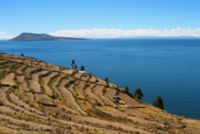 The department of Puno
was home to the great civilization of the Tiwanaku
who were once the most advanced civilization of all the Aymara people. The area was conquered by the Incas in the 15th century and by the Spanish Empire
in the 16th century.
The capital city, also known as Puno
, serves as magnificent evidence of the combination of cultures that have left their mark. Puno lies on the shores of Lake Titicaca
and is the folklore capital of Peru
. The city's beauty is characterized by its location next to Lake Titicaca
and its colonial architecture. The nearby city of Juliaca
is a transportation hub for the department. Nearby are the Chullpas de Sillustani
a monument built by the Colla
s which is still perfectly preserved today. Lake Titicaca
is home to the Uros
, artificially made floating islands made of totora reeds. Titicaca National Reservation
is refuge to many species of plants and animals, as well as breathtaking stretches of Lake Titicaca
.
is home to both high and low jungles. One key attraction is the Rio Abiseo National Park
. This park is registered as a UNESCO World Heritage Site by the United Nations
and is home to 36 archeological sites. In addition to this cultural aspect, the park contains 980 species of flora, particularly bromeliads, orchids, and fern
s, 220 species of birds and over 50 species of mammals such as the yellow-tailed woolly monkey
, the Andean deer
, the spectacled bear
, and the jaguar
, all of which are endangered and nearing extinction. The department is dotted with lakes, hot springs with medicinal properties, and waterfalls. In addition to the Rio Abiseo National Park
, San Martín is home to the Alto Mayo Protection Forest
and the Cordillera Azul National Park
both equal in excellence to Rio Abiseo.
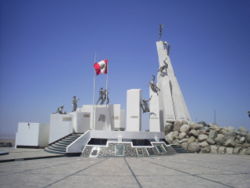 The department of Tacna
has a mild climate and a strong economy. There are many wineries in the region as well as pisco producers. The capital city, also named as Tacna
, is known to be the most patriotic city of Peru
. There are many monuments throughout the city honoring the heroes of the Peruvian War of Independence and the War of the Pacific
. The city preserves much of its colonial architecture and retains colonial churches, mansions, and other buildings. The beaches of the department are equally popular among tourists and residents alike and become popular during the summer.
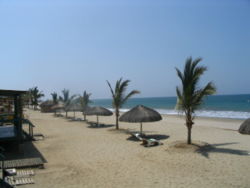 The Tumbes
region is the smallest in Peru and also the northernmost. It is near the border with Ecuador
. Despite its size, it is home to extremely varied terrain which attracts equally varied tourists. The coast of the department is defined by white sand beaches such as Punta Sal
and Zorritos
. The protected areas of Cerros de Amotape National Park
, Tumbes Reserved Zone
, and the Manglares de Tumbes National Sanctuary
are all visited by tourists worldwide. The Cerros de Amotape National Park
is home wildlife such as the Andean condor
, the little spotted cat
, the red deer
, the peccary
, the northern anteater
, the spectacled bear
, the grey deer
, and the Guayaquil squirrel
. The mangroves forests are home to birds such as black hawks
, egrets, and other types of birds. The swamps contain American crocodile
farms, a species nearing extinction. The department’s cuisine is exquisite and uses local resources such as black scallops and crabs. More than 50% of the land area of this department is in national parks.
is in the Peruvian Amazon
. Its capital, Pucallpa
, is the second largest city in the Peruvian Amazon after Iquitos
. The department is home to a variety of geological monuments such as waterfalls. Tourist lodges are abundant, allowing visitors to experience the Peruvian Amazon
firsthand. The large bodies of water such as the jungle rivers and lakes are perfect for aquatic sports such as water skiing, rowing, and fishing. The Ucayali
river passes through the department and is the most important mode of transportation.
, gives free and neutral information for travelers that covers destinations, attractions, street map
s, recommended routes, and recommended tourism companies in Peru
. It provides assistance on procedures and helps tourists who have problems (complaints, claims and suggestions for destinations and tourism companies (lodging, travel agencies, cruisers, airlines, buses, etc.).)
organization, UNESCO
. These monuments receive many tourists due to their uniqueness, aesthetic attraction, and cultural significance.
Fishing
Fishing is the activity of trying to catch wild fish. Fish are normally caught in the wild. Techniques for catching fish include hand gathering, spearing, netting, angling and trapping....
and mining
Mining
Mining is the extraction of valuable minerals or other geological materials from the earth, from an ore body, vein or seam. The term also includes the removal of soil. Materials recovered by mining include base metals, precious metals, iron, uranium, coal, diamonds, limestone, oil shale, rock...
. Tourism is directed towards archeological monuments, ecotourism in the Peruvian Amazon
Peruvian Amazon
The Peruvian Amazon is the area of the Amazon jungle included in the territory of Peru, from the east of the Andes to borders with Ecuador, Colombia, Brazil and Bolivia. This region comprises 60% of the country and is marked by a large degree of biodiversity...
, cultural tourism
Cultural tourism
Cultural tourism is the subset of tourism concerned with a country or region's culture, specifically the lifestyle of the people in those geographical areas, the history of those peoples, their art, architecture, religion, and other elements that helped shape their way of life...
in colonial cities, gastronomic tourism, adventure tourism, and beach tourism. According to a Peruvian government
Government of Peru
Peru is a presidential representative democratic republic with a multi-party system. Under the current constitution, the President is the head of state and government; he or she is elected for five years and cannot seek immediate re-election, he or she must stand down for at least one full...
study, the satisfaction rate for tourists after visiting Peru
Peru
Peru , officially the Republic of Peru , is a country in western South America. It is bordered on the north by Ecuador and Colombia, on the east by Brazil, on the southeast by Bolivia, on the south by Chile, and on the west by the Pacific Ocean....
is 94%. Tourism is the most rapidly growing industry in Peru
Peru
Peru , officially the Republic of Peru , is a country in western South America. It is bordered on the north by Ecuador and Colombia, on the east by Brazil, on the southeast by Bolivia, on the south by Chile, and on the west by the Pacific Ocean....
, growing annually at a rate of 25% over the past five years. Tourism is growing in Peru faster than any other country in South America. The most popular countries of origin for tourists are the United States
United States
The United States of America is a federal constitutional republic comprising fifty states and a federal district...
, Chile
Chile
Chile ,officially the Republic of Chile , is a country in South America occupying a long, narrow coastal strip between the Andes mountains to the east and the Pacific Ocean to the west. It borders Peru to the north, Bolivia to the northeast, Argentina to the east, and the Drake Passage in the far...
, Argentina
Argentina
Argentina , officially the Argentine Republic , is the second largest country in South America by land area, after Brazil. It is constituted as a federation of 23 provinces and an autonomous city, Buenos Aires...
, United Kingdom
United Kingdom
The United Kingdom of Great Britain and Northern IrelandIn the United Kingdom and Dependencies, other languages have been officially recognised as legitimate autochthonous languages under the European Charter for Regional or Minority Languages...
, France
France
The French Republic , The French Republic , The French Republic , (commonly known as France , is a unitary semi-presidential republic in Western Europe with several overseas territories and islands located on other continents and in the Indian, Pacific, and Atlantic oceans. Metropolitan France...
, Germany
Germany
Germany , officially the Federal Republic of Germany , is a federal parliamentary republic in Europe. The country consists of 16 states while the capital and largest city is Berlin. Germany covers an area of 357,021 km2 and has a largely temperate seasonal climate...
, Brazil
Brazil
Brazil , officially the Federative Republic of Brazil , is the largest country in South America. It is the world's fifth largest country, both by geographical area and by population with over 192 million people...
, Spain
Spain
Spain , officially the Kingdom of Spain languages]] under the European Charter for Regional or Minority Languages. In each of these, Spain's official name is as follows:;;;;;;), is a country and member state of the European Union located in southwestern Europe on the Iberian Peninsula...
, Canada
Canada
Canada is a North American country consisting of ten provinces and three territories. Located in the northern part of the continent, it extends from the Atlantic Ocean in the east to the Pacific Ocean in the west, and northward into the Arctic Ocean...
, and Italy
Italy
Italy , officially the Italian Republic languages]] under the European Charter for Regional or Minority Languages. In each of these, Italy's official name is as follows:;;;;;;;;), is a unitary parliamentary republic in South-Central Europe. To the north it borders France, Switzerland, Austria and...
.
Transportation
Air
Peru does not have one clear national airline, but rather a number of different airlines offering service to PeruPeru
Peru , officially the Republic of Peru , is a country in western South America. It is bordered on the north by Ecuador and Colombia, on the east by Brazil, on the southeast by Bolivia, on the south by Chile, and on the west by the Pacific Ocean....
from North America
North America
North America is a continent wholly within the Northern Hemisphere and almost wholly within the Western Hemisphere. It is also considered a northern subcontinent of the Americas...
, South America
South America
South America is a continent situated in the Western Hemisphere, mostly in the Southern Hemisphere, with a relatively small portion in the Northern Hemisphere. The continent is also considered a subcontinent of the Americas. It is bordered on the west by the Pacific Ocean and on the north and east...
, Europe
Europe
Europe is, by convention, one of the world's seven continents. Comprising the westernmost peninsula of Eurasia, Europe is generally 'divided' from Asia to its east by the watershed divides of the Ural and Caucasus Mountains, the Ural River, the Caspian and Black Seas, and the waterways connecting...
, and Asia
Asia
Asia is the world's largest and most populous continent, located primarily in the eastern and northern hemispheres. It covers 8.7% of the Earth's total surface area and with approximately 3.879 billion people, it hosts 60% of the world's current human population...
. Some of the most popular airlines are LAN Perú
LAN Peru
LAN Perú S.A. is an airline based in Lima, Peru. It is a subsidiary of Chilean publicly-traded company LAN Airlines , which owns 49% of the airline. It operates scheduled domestic and international services. Its main base is on the grounds of Jorge Chávez International Airport...
(domestic and international), TACA Peru
TACA Peru
TACA Peru is an airline based in Lima, Peru. It operates domestic services and international services. Its main base is Jorge Chávez International Airport , Lima. The airline operates out of 18 airports. It is part of Grupo TACA and operates its flights with TACA's codes.- History :The airline was...
(international), and Star Peru (domestic). The country's airports are also served by many international airlines from other nations. The Jorge Chavez International Airport
Jorge Chávez International Airport
Jorge Chávez International Airport , known as Aeropuerto Internacional Jorge Chávez in Spanish, is Peru's main international and domestic airport. It is located in Callao, 11 kilometers from the Historic Centre of Lima and 17 km from Miraflores. Callao is the port city now fully...
in Lima
Lima
Lima is the capital and the largest city of Peru. It is located in the valleys of the Chillón, Rímac and Lurín rivers, in the central part of the country, on a desert coast overlooking the Pacific Ocean. Together with the seaport of Callao, it forms a contiguous urban area known as the Lima...
is the nation's leading international airport and received 7,507,811 passengers in 2007. Domestic air travel serves as a major method for tourists to traverse the country with multiple airlines offering service between many of Peru's cities.
Highways
Additionally, Peru has land borders with five countries and has highway connections with all but ColombiaColombia
Colombia, officially the Republic of Colombia , is a unitary constitutional republic comprising thirty-two departments. The country is located in northwestern South America, bordered to the east by Venezuela and Brazil; to the south by Ecuador and Peru; to the north by the Caribbean Sea; to the...
. International bus routes are operated on each of these highways providing service from Peru
Peru
Peru , officially the Republic of Peru , is a country in western South America. It is bordered on the north by Ecuador and Colombia, on the east by Brazil, on the southeast by Bolivia, on the south by Chile, and on the west by the Pacific Ocean....
vian cities to other South American cities. Domestically, the highway system is extensive and covers nearly the entire country excluding the department of Loreto
Loreto Region
Loreto is Peru's northernmost region. Covering almost one-third of Peru's territory, Loreto is by far the nation's largest region and also one of the most sparsely populated ones, due to its remote location in the Amazon Rainforest...
which can only be accessed by boat or airplane. There are frequent buses traveling throughout the country. But, bus travel is dangerous as many of these highways are built on cliffs, and accidents leading to death are frequently reported by the media. Occasionally buses are held up by highwaymen in remote areas. The buses range in size and comfort but they usually have cushioned reclining seats and a form of onboard entertainment, such as a movie or music. Many offer bus-camas, or sleeper buses, with seats that recline to become beds.
Rail
Peru is starting to build a metro in Lima, but other regions do not have this system. Tourists must travel by bus or taxi within the city. Outside of Lima, there are only two major railway systems in operation, one in the central part of the country and the other in the south. The central railway starts at sea level in LimaLima
Lima is the capital and the largest city of Peru. It is located in the valleys of the Chillón, Rímac and Lurín rivers, in the central part of the country, on a desert coast overlooking the Pacific Ocean. Together with the seaport of Callao, it forms a contiguous urban area known as the Lima...
and traverses the Andes
Andes
The Andes is the world's longest continental mountain range. It is a continual range of highlands along the western coast of South America. This range is about long, about to wide , and of an average height of about .Along its length, the Andes is split into several ranges, which are separated...
, crossing through the Junin
Junín Region
Junín is a region in the central highlands and westernmost Amazonia of Peru. Its capital is Huancayo.-Geography:The region has a very heterogeneous topography. The western cordillera located near the border with the Lima Region, has snowy and ice covered peaks. On the east, there are high glacier...
and Huancavelica
Huancavelica Region
Huancavelica is a region in Peru. Area: 22,131.47 km². Population: 447,054 . The capital is the city of Huancavelica.It is bordered by Lima Region and Ica in the west, Junín in the north, and Ayacucho in the east....
departments
Regions of Peru
The regions of Peru are the first-level administrative subdivisions of Peru. Since its 1821 independence, Peru had been divided into departments but faced the problem of an increasing centralization of political and economic power in its capital, Lima...
.
The southern railway is the one most commonly used by tourists, as a segment of its route goes from the city of Cusco
Cusco
Cusco , often spelled Cuzco , is a city in southeastern Peru, near the Urubamba Valley of the Andes mountain range. It is the capital of the Cusco Region as well as the Cuzco Province. In 2007, the city had a population of 358,935 which was triple the figure of 20 years ago...
to the citadel of Machu Picchu
Machu Picchu
Machu Picchu is a pre-Columbian 15th-century Inca site located above sea level. It is situated on a mountain ridge above the Urubamba Valley in Peru, which is northwest of Cusco and through which the Urubamba River flows. Most archaeologists believe that Machu Picchu was built as an estate for...
, a major tourist attraction. This route offers seating options ranging from economy class to first class. The railway originates in the city of Mollendo
Mollendo
Mollendo is a town bordering the Pacific Ocean in southern Peru. It is located in the Arequipa Region and is the capital of both the Islay Province and the Mollendo District...
in the Arequipa Department and goes through the Puno
Puno Region
Puno is a region in southeastern Peru. It is bordered by Bolivia on the east, the Madre de Dios Region on the north, the Cusco and Arequipa regions on the west, the Moquegua Region on the southwest, and the Tacna Region on the south...
and Cusco
Cusco Region
Cusco is a region in Peru. It is bordered by the Ucayali Region on the north; the Madre de Dios and Puno regions on the east; the Arequipa Region on the south; and the Apurímac, Ayacucho and Junín regions on the west...
departments, passing through the cities of Arequipa
Arequipa
Arequipa is the capital city of the Arequipa Region in southern Peru. With a population of 836,859 it is the second most populous city of the country...
, Puno
Puno
Puno is a city in southeastern Peru, located on the shore of Lake Titicaca. It is the capital city of the Puno Region and the Puno Province with a population of approximately 100,000. The city was established in 1668 by viceroy Pedro Antonio Fernández de Castro as capital of the province of...
, Juliaca
Juliaca
Juliaca is San Roman's capital city in Puno Region, which is situated in southeastern Peru. It is the region's largest city with a population of 225,146 inhabitants , on the Altiplano, Juliaca above sea level, is located in the Collao Plateau and it is northwest of Lake Titicaca...
, the citadel of Machu Picchu
Machu Picchu
Machu Picchu is a pre-Columbian 15th-century Inca site located above sea level. It is situated on a mountain ridge above the Urubamba Valley in Peru, which is northwest of Cusco and through which the Urubamba River flows. Most archaeologists believe that Machu Picchu was built as an estate for...
, and ends at Cusco
Cusco
Cusco , often spelled Cuzco , is a city in southeastern Peru, near the Urubamba Valley of the Andes mountain range. It is the capital of the Cusco Region as well as the Cuzco Province. In 2007, the city had a population of 358,935 which was triple the figure of 20 years ago...
. The railway is operated by PeruRail
PeruRail
PeruRail is a railway operator working tourist, freight, and charter services in southern Peru.The main line between the port of Matarani, Arequipa , Cuzco and Puno on Lake Titicaca was formerly known as the Ferrocarril del Sur , and was for a time owned and operated by the ENAFER state company...
, the largest railway manager in Peru.
River
Another mode of transportation in the AmazonianAmazon Basin
The Amazon Basin is the part of South America drained by the Amazon River and its tributaries that drains an area of about , or roughly 40 percent of South America. The basin is located in the countries of Bolivia, Brazil, Colombia, Ecuador, Guyana, Peru, and Venezuela...
area is river transport. River transportation companies operate routes between the cities of the Peruvian Amazon
Peruvian Amazon
The Peruvian Amazon is the area of the Amazon jungle included in the territory of Peru, from the east of the Andes to borders with Ecuador, Colombia, Brazil and Bolivia. This region comprises 60% of the country and is marked by a large degree of biodiversity...
. The main hubs of this network are the cities of Iquitos
Iquitos
Iquitos is the largest city in the Peruvian rainforest, with a population of 370,962. It is the capital of Loreto Region and Maynas Province.Located on the Amazon River, it is only above sea level, although it is more than from the mouth of the Amazon at Belém on the Atlantic Ocean...
, Puerto Maldonado
Puerto Maldonado
Puerto Maldonado is a city in Southeastern Peru in the Amazon forest west of the Bolivian border on the confluence of the Tambopata and Madre de Dios River, a tributary of the Amazon River. It is the capital of the Madre de Dios Region....
, Pucallpa
Pucallpa
Pucallpa is a city in eastern Peru located on the banks of the Ucayali River, a major tributary of the Amazon River. It is the capital of the Ucayali region, the Coronel Portillo Province and the Calleria District....
, and Yurimaguas
Yurimaguas
Yurimaguas is a thriving port-town in the Loreto Region of northeastern Peruvian Amazonia. Historically associated with Maynas Pais de los Maynas, the culturally diverse town is affectionately known as the "Pearl of the Huallaga"...
. Because of the lack of roads in this region, river transport, along with air travel, are the most efficient and important methods of transport.
Data
Tourism is the third largest industry in PeruPeru
Peru , officially the Republic of Peru , is a country in western South America. It is bordered on the north by Ecuador and Colombia, on the east by Brazil, on the southeast by Bolivia, on the south by Chile, and on the west by the Pacific Ocean....
. It employs 10.8% of the labor force
Labor force
In economics, a labor force or labour force is a region's combined civilian workforce, including both the employed and unemployed.Normally, the labor force of a country consists of everyone of working age In economics, a labor force or labour force is a region's combined civilian workforce,...
in Peru
Peru
Peru , officially the Republic of Peru , is a country in western South America. It is bordered on the north by Ecuador and Colombia, on the east by Brazil, on the southeast by Bolivia, on the south by Chile, and on the west by the Pacific Ocean....
(484,000 direct and 340,000 indirect jobs) the majority of them belonging to the hotel and transportation industries. The industry makes up 7% of the Peru
Peru
Peru , officially the Republic of Peru , is a country in western South America. It is bordered on the north by Ecuador and Colombia, on the east by Brazil, on the southeast by Bolivia, on the south by Chile, and on the west by the Pacific Ocean....
vian gross domestic product
Gross domestic product
Gross domestic product refers to the market value of all final goods and services produced within a country in a given period. GDP per capita is often considered an indicator of a country's standard of living....
and is the fastest growing industry in the country. It is regulated by the Commission for the Promotion of Peru (PromPeru) belonging to the Ministry of Foreign Commerce and Tourism
Ministry of Foreign Commerce and Tourism (Peru)
The Ministry of Foreign Commerce and Tourism of Peru or MINCETUR is the ministry in charge of issues pertaining to foreign commerce of the Government of Peru and the promotion of Tourism in Peru...
.
Cultural tourism
Chavín culture
The Chavín were a civilization that developed in the northern Andean highlands of Peru from 900 BC to 200 BC. They extended their influence to other civilizations along the coast. The Chavín were located in the Mosna Valley where the Mosna and Huachecsa rivers merge...
, Moche
Moche
'The Moche civilization flourished in northern Peru from about 100 AD to 800 AD, during the Regional Development Epoch. While this issue is the subject of some debate, many scholars contend that the Moche were not politically organized as a monolithic empire or state...
, and Nasca
Nazca culture
The Nazca culture was the archaeological culture that flourished from 100 to 800 CE beside the dry southern coast of Peru in the river valleys of the Rio Grande de Nazca drainage and the Ica Valley...
— left a large archeological and cultural impact on the nation. The ruins of Machu Picchu
Machu Picchu
Machu Picchu is a pre-Columbian 15th-century Inca site located above sea level. It is situated on a mountain ridge above the Urubamba Valley in Peru, which is northwest of Cusco and through which the Urubamba River flows. Most archaeologists believe that Machu Picchu was built as an estate for...
are the most internationally recognized of all the ruins of Peru and therefore receive the most tourists. The other popular ruins are those of Chan Chan
Chan Chan
The largest Pre-Columbian city in South America, Chan Chan is an archaeological site located in the Peruvian region of La Libertad, five km west of Trujillo. Chan Chan covers an area of approximately 20 km² and had a dense urban center of about 6km²...
, Sipan
Sipán
Sipán is a Moche archaeological site in northern Peru that is famous for the tomb of El Señor de Sipán , excavated by Walter Alva and his wife Susana Meneses. It is considered to be one of the most important archaeological discoveries in the last 30 years, because the main tomb was found intact...
, Kuelap
Kuelap
The fortress of Kuelap or Cuélap , associated with the Chachapoyas culture, consists of massive exterior stone walls containing more than four hundred buildings. The structure, situated on a ridge overlooking the Utcubamba Valley in northern Peru, is roughly 600 meters in length and 110 meters in...
, Nazca lines
Nazca Lines
The Nazca Lines are a series of ancient geoglyphs located in the Nazca Desert in southern Peru. They were designated a UNESCO World Heritage Site in 1994. The high, arid plateau stretches more than between the towns of Nazca and Palpa on the Pampas de Jumana about 400 km south of Lima...
, Ollantaytambo
Ollantaytambo
Ollantaytambo is a town and an Inca archaeological site in southern Peru some 60 kilometers northwest of the city of Cusco. It is located at an altitude of 2,792 meters above sea level in the district of Ollantaytambo, province of Urubamba, Cusco region...
, Caral
Caral
Caral was a large settlement in the Supe Valley, near Supe, Barranca province, Peru, some 200 km north of Lima. Caral is the most ancient city of the Americas, and is a well-studied site of the Caral civilization or Norte Chico civilization.- History :...
, Sacsayhuamán
Sacsayhuamán
-External links:* BBC Article...
, and Sillustani
Sillustani
Sillustani is a pre-Incan burial ground on the shores of Lake Umayo near Puno in Peru. The tombs, which are built above ground in tower-like structures called chullpas, are the vestiges of the Colla people, Aymara who were conquered by the Inca in the 15th century. The structures housed the...
.
Tourists also visit the Spanish colonial architecture in many cities in Peru. Some of the most outstanding examples of Spanish colonial architecture are in the cities of Lima, Arequipa
Arequipa
Arequipa is the capital city of the Arequipa Region in southern Peru. With a population of 836,859 it is the second most populous city of the country...
, and Cusco. These areas, many built over 500 years ago, demonstrate the superb architectural ingenuity of the colonists during the Viceroyalty of Peru
Viceroyalty of Peru
Created in 1542, the Viceroyalty of Peru was a Spanish colonial administrative district that originally contained most of Spanish-ruled South America, governed from the capital of Lima...
. The city of Lima
Lima
Lima is the capital and the largest city of Peru. It is located in the valleys of the Chillón, Rímac and Lurín rivers, in the central part of the country, on a desert coast overlooking the Pacific Ocean. Together with the seaport of Callao, it forms a contiguous urban area known as the Lima...
has many acclaimed museums holding works of art reflecting the diverse history of the country. These museums include the National Museum, National Museum of Anthropology, Archeology and History; Rafael Larco Herrera Archeological Museum, National Museum of Peruvian Culture, and Museum of Italian Art, among many others.
Ecotourism
Amazon Basin
The Amazon Basin is the part of South America drained by the Amazon River and its tributaries that drains an area of about , or roughly 40 percent of South America. The basin is located in the countries of Bolivia, Brazil, Colombia, Ecuador, Guyana, Peru, and Venezuela...
. Peru has a higher percentage of land area protected in national parks and preserves than any other country in South America
South America
South America is a continent situated in the Western Hemisphere, mostly in the Southern Hemisphere, with a relatively small portion in the Northern Hemisphere. The continent is also considered a subcontinent of the Americas. It is bordered on the west by the Pacific Ocean and on the north and east...
. The Peruvian Amazon
Peruvian Amazon
The Peruvian Amazon is the area of the Amazon jungle included in the territory of Peru, from the east of the Andes to borders with Ecuador, Colombia, Brazil and Bolivia. This region comprises 60% of the country and is marked by a large degree of biodiversity...
is one of the most pristine, virgin, and untouched rainforests on the earth, making it a destination for tourists interested in nature and ecology. Increased tourist infrastructure has been developed.
The Peruvian Amazon is divided into two areas: the High Jungle and the Lower Jungle. The High Jungle is more easily accessible, while the Lower Jungle is more pristine and untouched. In recent times, however, the government has increased accessibility to the Lower Jungle. Both areas contain an unrivaled diversity of animal and plant life. Large national preserves of interest to tourists include the Manú National Park
Manú National Park
Manú National Park is a biosphere reserve located in Madre de Dios and Paucartambo, Cusco. Before becoming an area protected by the Peruvian government, the Manú National Park was conserved thanks to its inaccessibility. The park remains fairly inaccessible by road to this day. In 1977, UNESCO...
, Rio Abiseo National Park
Rio Abiseo National Park
The Rio Abiseo National Park is located in the San Martín department of Peru. UNESCO pronounced it as Natural and Cultural Heritage of Humanity in 1990. The park is home to a large number of species of flora and fauna, as well as the location of over 30 pre-Columbian archaeological sites...
, and the Tambopata-Candamo Protected Area
Tambopata-Candamo
Tambopata-Candamo is a nature reserve in the Peruvian Amazon Basin south of the Madre de Dios River in Tambopata Province's Inambari and Tambopata districts...
. Tourist agencies in these areas promote eco-friendly tourism to preserve the fragile ecosystems of the rainforest.
Adventure tourism
Because of Peru's geographical diversity, it is possible to go surfingSurfing
Surfing' is a surface water sport in which the surfer rides a surfboard on the crest and face of a wave which is carrying the surfer towards the shore...
, sandboarding
Sandboarding
Sandboarding is a board sport similar to snowboarding.It is a recreational activity that takes place on sand dunes rather than snow-covered mountains....
, 4x4, dune buggy
Dune buggy
A dune buggy is a recreational vehicle with large wheels, and wide tires, designed for use on sand dunes or beaches. The design is usually a modified vehicle and engine mounted on an open chassis. The modifications usually attempt to increase the power-to-weight ratio by either lightening the...
, alpinism, rafting
Rafting
Rafting or white water rafting is a challenging recreational outdoor activity using an inflatable raft to navigate a river or other bodies of water. This is usually done on white water or different degrees of rough water, in order to thrill and excite the raft passengers. The development of this...
, rappelling, downhill
Downhill
Downhill is an alpine skiing discipline. The rules for the Downhill were originally developed by Sir Arnold Lunn for the 1921 British National Ski Championships....
, rally
Rallying
Rallying, also known as rally racing, is a form of auto racing that takes place on public or private roads with modified production or specially built road-legal cars...
, trekking
Backpacking (wilderness)
Backpacking combines the activities of hiking and camping for an overnight stay in backcountry wilderness...
, skiing
Skiing
Skiing is a recreational activity using skis as equipment for traveling over snow. Skis are used in conjunction with boots that connect to the ski with use of a binding....
, and mountain climbing. Surfing
Surfing
Surfing' is a surface water sport in which the surfer rides a surfboard on the crest and face of a wave which is carrying the surfer towards the shore...
is extremely popular in Peru, and the country has been host to numerous national and international competitions in the sport.
Sofia Mulanovich
Sofía Mulánovich Aljovín is a Peruvian surfer. She is the first Peruvian surfer ever to win an Association of Surfing Professionals World Championship Tour event. She is the first South American ever to win the World Title. In 2004, she won three out of the six World Championship Tour events, and...
.
Peru is divided into three geographical regions: the coast, the sierra, and the jungle. Each one has numerous activities suited to its particular climate and environment. The sport of skiing is developing in the city of Huaraz
Huaraz
Huaraz is a city in Peru. It is the capital of the Departmento de Ancash and the seat of government of the Provincia de Huaraz . The urban agglomerations population is distributed over the districts of Huaraz and Independencia. It was estimated in 2007 to exceed 120,000...
, and new resorts are created to suit the rising tourist demand. The sand dunes of Ica
Ica Region
Ica is a region in Peru. It borders the Pacific Ocean on the west; the Lima Region on the north; the Huancavelica and Ayacucho regions on the east; and the Arequipa Region on the south. Its capital is the city of Ica.- Geography :...
are popular for dune buggies. River rafting has become very popular among national and international tourists in recent years, and availability in Lima
Lima
Lima is the capital and the largest city of Peru. It is located in the valleys of the Chillón, Rímac and Lurín rivers, in the central part of the country, on a desert coast overlooking the Pacific Ocean. Together with the seaport of Callao, it forms a contiguous urban area known as the Lima...
and Cusco
Cusco
Cusco , often spelled Cuzco , is a city in southeastern Peru, near the Urubamba Valley of the Andes mountain range. It is the capital of the Cusco Region as well as the Cuzco Province. In 2007, the city had a population of 358,935 which was triple the figure of 20 years ago...
is high. Rapids range in difficulty and there is rafting options from novices to experts. Trekking has become the most popular type of adventure sport among tourists in Peru
Peru
Peru , officially the Republic of Peru , is a country in western South America. It is bordered on the north by Ecuador and Colombia, on the east by Brazil, on the southeast by Bolivia, on the south by Chile, and on the west by the Pacific Ocean....
. This is because of the treks offered from Cusco
Cusco
Cusco , often spelled Cuzco , is a city in southeastern Peru, near the Urubamba Valley of the Andes mountain range. It is the capital of the Cusco Region as well as the Cuzco Province. In 2007, the city had a population of 358,935 which was triple the figure of 20 years ago...
to Machu Picchu
Machu Picchu
Machu Picchu is a pre-Columbian 15th-century Inca site located above sea level. It is situated on a mountain ridge above the Urubamba Valley in Peru, which is northwest of Cusco and through which the Urubamba River flows. Most archaeologists believe that Machu Picchu was built as an estate for...
, as well as trails in other parts of the country such as Ancash
Ancash Region
Ancash is a region in northern Peru. It is bordered by the La Libertad region on the north, the Huánuco and Pasco regions on the east, the Lima region on the south, and the Pacific Ocean on the west. Its capital is the city of Huaraz, and its largest city and port is Chimbote...
. Mountain climbing is a popular sport among tourists in the sierra region.
For more information on adventure tourism see the Ancash section of this article below.
Gastronomic tourism
Peruvian cuisine stems mainly from the combination of Spanish cuisine with traditional native Peruvian ingredients, with later influences from the cuisines of China, Italy, West Africa and Japan, due to the arrival of immigrants from those locations. Each of these cuisines has had to be heavily adapted because of a lack or scarcity of many ingredients. For example, it is still impossible to find such commonplace items as lemons, turnips, kaleKale
Kale is very high in beta carotene, vitamin K, vitamin C, lutein, zeaxanthin, and reasonably rich in calcium. Kale, as with broccoli and other brassicas, contains sulforaphane , a chemical with potent anti-cancer properties. Boiling decreases the level of sulforaphane; however, steaming,...
and chestnuts in Peru. It is next to impossible to find authentic foreign cuisine to this day because of a lack of ingredients. For example, one can not find authentic Chinese dishes such as Mapo dofu. Instead one finds a curious mixture of Chinese cooking that has been adapted to the ingredients available in Peru. This cuisine is known as Chifa
Chifa
Chifa is a term used in Peru to refer to a style of Chinese cooking in which ingredients which are available in Peru have been substituted for those originally used in China. Chinese immigrants came to Peru mainly from the southern province of Guangdong and particularly its capital city Guangzhou...
. Cusco restaurants are home to the tastiest meals of the country and in places such as Aguas Calientes (the small town below Macchu Picchu) some say the best flavour of the world can found.
The three traditional staples of Peruvian cuisine are corn
Maize
Maize known in many English-speaking countries as corn or mielie/mealie, is a grain domesticated by indigenous peoples in Mesoamerica in prehistoric times. The leafy stalk produces ears which contain seeds called kernels. Though technically a grain, maize kernels are used in cooking as a vegetable...
, potatoes and beans. These ingredients have been combined with a number of staples brought by the Spanish, such as rice
Rice
Rice is the seed of the monocot plants Oryza sativa or Oryza glaberrima . As a cereal grain, it is the most important staple food for a large part of the world's human population, especially in East Asia, Southeast Asia, South Asia, the Middle East, and the West Indies...
, wheat
Wheat
Wheat is a cereal grain, originally from the Levant region of the Near East, but now cultivated worldwide. In 2007 world production of wheat was 607 million tons, making it the third most-produced cereal after maize and rice...
and meat (such as beef, pork and chicken). Many traditional foods, such as quinoa
Quinoa
Quinoa , a species of goosefoot , is a grain-like crop grown primarily for its edible seeds. It is a pseudocereal rather than a true cereal, or grain, as it is not a member of the grass family...
, kiwicha, chili peppers and several roots and tubers which had previously been tossed aside for European products, have seen a resurgence in popularity in recent decades with a revival of interest in native Peruvian food crops.
Beach tourism
Peru
Peru , officially the Republic of Peru , is a country in western South America. It is bordered on the north by Ecuador and Colombia, on the east by Brazil, on the southeast by Bolivia, on the south by Chile, and on the west by the Pacific Ocean....
is extremely popular among domestic and international travelers alike. Beach resorts and towns are abundant along the coast and many are in popular areas which attract visitors. Two of the most popular beach areas are Mancora
Máncora
Máncora is a town and beach resort in the Piura Region, in northwestern Peru. It is located in the Talara Province and is capital of the Máncora District. The town has 8,852 inhabitants ....
and Punta Sal
Punta Sal
Punta Sal is a small beach resort located in the department of Tumbes, in northern Peru. Due to its location near the warm current of El Niño and the cold Humboldt Current which collide in this area, Punta Sal benefits with year round sunshine....
in the Piura
Piura Region
Piura is a coastal region in northwestern Peru. The region's capital is Piura and its largest port cities, Paita and Talara, are also among the most important in Peru...
and Tumbes
Tumbes Region
Tumbes is a coastal region in northwestern Peru and southwestern Ecuador. Due to the region's location near the Equator it has a warm climate, with beaches that are considered among the finest in Peru...
departments respectively, and Asia
Asia District, Peru
The Asia District is one of 16 that make up the Peru province of Cañete. Founded by Beinto Chumpitaz Chavez on July 24, 1964, it was originally part of the Coayllo District...
in the Lima Department
Lima Department
Lima Department was a department of Peru. It was formed by the territories of present day Lima Region, Callao Region and Ica Region, and Casma Province, Huarmey Province and Santa Province, which later would be part of the La Costa Department....
.
The northern beaches of Mancora
Máncora
Máncora is a town and beach resort in the Piura Region, in northwestern Peru. It is located in the Talara Province and is capital of the Máncora District. The town has 8,852 inhabitants ....
and Punta Sal
Punta Sal
Punta Sal is a small beach resort located in the department of Tumbes, in northern Peru. Due to its location near the warm current of El Niño and the cold Humboldt Current which collide in this area, Punta Sal benefits with year round sunshine....
have a pleasant beach climate year round whereas Asia is primarily a summertime beach. Because Asia is located near the city of Lima
Lima
Lima is the capital and the largest city of Peru. It is located in the valleys of the Chillón, Rímac and Lurín rivers, in the central part of the country, on a desert coast overlooking the Pacific Ocean. Together with the seaport of Callao, it forms a contiguous urban area known as the Lima...
, many beachgoers own houses in that area. In contrast, Mancora
Máncora
Máncora is a town and beach resort in the Piura Region, in northwestern Peru. It is located in the Talara Province and is capital of the Máncora District. The town has 8,852 inhabitants ....
is many hours from major cities so visitors usually stay in hotels or resorts.
Beachgoing in Peru is affected by fads: Beach homeowners moved from beach to beach resulting from the oversaturation of one beach. In previous years, the beach of Ancon
Ancón District
Ancón is a district of northern Lima Province in Peru. It is a popular beach resort, visited every summer by hundreds of people from Lima.Officially established as a district on October 29, 1874, the current mayor of Ancón is Jaime Jesús Pajuelo Torres. The district's postal code is...
was the most popular of Lima; it became oversaturated and beachgoers moved south of the city to the beaches of Punta Hermosa, San Bartolo
San Bartolo District
San Bartolo is a district in southern Lima Province in Peru. It is bordered by the Pacific Ocean on the west, the district of Punta Negra on the north, the Huarochirí Province on the east, and the Santa María del Mar District on the south....
, Santa Maria and Pucusana
Pucusana District
Pucusana is a district in southern Lima Province in Peru. It is bordered by the Pacific Ocean on the west, the district of Santa María del Mar on the north, the Chilca District of the Cañete Province on the east, and the Pacific Ocean on the south....
. In the last decade, these beaches have become oversaturated as well and beachgoers have moved further south to the development of Asia, which has now become extremely popular and is the primary beach destination for Limeans.
Mancora
Máncora
Máncora is a town and beach resort in the Piura Region, in northwestern Peru. It is located in the Talara Province and is capital of the Máncora District. The town has 8,852 inhabitants ....
, 17 hours north of Lima by bus and 1.5 hours by plane from Talara
Talara
Talara is a city in the Talara Province of the Piura Region, in northwestern Peru. It is a port city on the Pacific Ocean with a population of 103,200 as of 2005. Its climate is hot and dry. Due to its oil reserves, and ability to produce aviation fuel, Talara hosted a United States air base during...
, is older than Asia but still a relatively new development. In recent years it has experienced a tourist boom and beachgoers flock there. Its beaches have white sand and the town has many nightclubs and bars frequented by thousands of tourists. The popularity of this beach has become so great that a movie has been made about the beach: Mancora. Punta Sal
Punta Sal
Punta Sal is a small beach resort located in the department of Tumbes, in northern Peru. Due to its location near the warm current of El Niño and the cold Humboldt Current which collide in this area, Punta Sal benefits with year round sunshine....
is another beach a half hour north of Mancora, less popular among young people, and the destination for older people seeking relaxation.
Peruvian beaches are popular places for surfing and their waves are world renowned.
Luxury travel
Peru has also been experiencing a continuous growth in luxury travel. This niche of tourists seeking high-end hotels in unique destinations, travel mainly from the U.S. and Europe to visit CuscoCusco
Cusco , often spelled Cuzco , is a city in southeastern Peru, near the Urubamba Valley of the Andes mountain range. It is the capital of the Cusco Region as well as the Cuzco Province. In 2007, the city had a population of 358,935 which was triple the figure of 20 years ago...
, Urubamba
Urubamba, Peru
Urubamba is a small town in Peru, located near the Urubamba River under the snow-capped mountain of Chicón. Located one hour from Cusco, Urubamba is the largest town in the Sacred Valley of the Incas. It is also located near a number of significant ruins of the Inca Empire, including Machu Picchu...
, and Machu Picchu
Machu Picchu
Machu Picchu is a pre-Columbian 15th-century Inca site located above sea level. It is situated on a mountain ridge above the Urubamba Valley in Peru, which is northwest of Cusco and through which the Urubamba River flows. Most archaeologists believe that Machu Picchu was built as an estate for...
. Recently this segment has been expanding to other area such as the Puno region
Puno Region
Puno is a region in southeastern Peru. It is bordered by Bolivia on the east, the Madre de Dios Region on the north, the Cusco and Arequipa regions on the west, the Moquegua Region on the southwest, and the Tacna Region on the south...
and Lake Titicaca
Lake Titicaca
Lake Titicaca is a lake located on the border of Peru and Bolivia. It sits 3,811 m above sea level, making it the highest commercially navigable lake in the world...
, as well as Iquitos
Iquitos
Iquitos is the largest city in the Peruvian rainforest, with a population of 370,962. It is the capital of Loreto Region and Maynas Province.Located on the Amazon River, it is only above sea level, although it is more than from the mouth of the Amazon at Belém on the Atlantic Ocean...
and the Colca Canyon
Colca Canyon
Colca Canyon is a canyon of the Colca River in southern Peru. Peru's third most-visited tourist destination with about 160,000 visitors annually, it's located about 100 miles northwest of Arequipa...
in Arequipa, as local and international tourism firms have made large investments in hotels and tourism development.
Nowadays there are entrepreneurs of the best hotel brands of USA ready to invest millions of dollars (minimum of US$10 million) in 5 star hotels and resorts in the Mancora and Punta Sal area under capital investment or joint venture schemes. The investors are comprised by more than 115 investment funds of USA and Europe.
Destinations by department
The two most frequented areas by tourists in Peru are the cities of LimaLima
Lima is the capital and the largest city of Peru. It is located in the valleys of the Chillón, Rímac and Lurín rivers, in the central part of the country, on a desert coast overlooking the Pacific Ocean. Together with the seaport of Callao, it forms a contiguous urban area known as the Lima...
and its historic centre
Historic Centre of Lima
Located principally in the city centre or Cercado de Lima and Rímac areas, the Historic Centre of Lima is among the most important tourist destinations in Peru.-Foundation:...
, and Cusco
Cusco
Cusco , often spelled Cuzco , is a city in southeastern Peru, near the Urubamba Valley of the Andes mountain range. It is the capital of the Cusco Region as well as the Cuzco Province. In 2007, the city had a population of 358,935 which was triple the figure of 20 years ago...
whose principal attractions are the Sacred Valley of the Incas, Machu Picchu
Machu Picchu
Machu Picchu is a pre-Columbian 15th-century Inca site located above sea level. It is situated on a mountain ridge above the Urubamba Valley in Peru, which is northwest of Cusco and through which the Urubamba River flows. Most archaeologists believe that Machu Picchu was built as an estate for...
, and incan and colonial
Viceroyalty of Peru
Created in 1542, the Viceroyalty of Peru was a Spanish colonial administrative district that originally contained most of Spanish-ruled South America, governed from the capital of Lima...
architecture.
Amazonas
The region of AmazonasAmazonas Region
Amazonas is a department of northern Peru bordered by Ecuador on the north and west, Cajamarca Department on the west, La Libertad Department on the south, and Loreto Department and San Martín Department on the east. Its capital is the city of Chachapoyas....
is a land of microclimates each containing an extensive amount of biodiversity. Additionally, the department was home to pre-Columbian civilizations that have left stunning remnants of their once great culture. The capital of the department, Chachapoyas
Chachapoyas, Peru
In this part of Peru, located in the eyebrow of the jungle, the climate is subtropical highland, described by the Köppen climate classification as Cwb, with an average temperature of 18 °C and an average relative humidity of 74 percent. However, in some areas the temperature can drop to 2 °C....
, adds to the diversity of ecology and culture as it is home to picturesque colonial architecture. The streets of this city are narrow. It contains a main square as common throughout Peruvian cities and maintains colonial mansions and balconies which add to the flavor of the area's mixed culture.
Arguably the most impressive destination of the department is the ancient fortress of Kuélap
Kuelap
The fortress of Kuelap or Cuélap , associated with the Chachapoyas culture, consists of massive exterior stone walls containing more than four hundred buildings. The structure, situated on a ridge overlooking the Utcubamba Valley in northern Peru, is roughly 600 meters in length and 110 meters in...
. Often referred to as the Machu Picchu
Machu Picchu
Machu Picchu is a pre-Columbian 15th-century Inca site located above sea level. It is situated on a mountain ridge above the Urubamba Valley in Peru, which is northwest of Cusco and through which the Urubamba River flows. Most archaeologists believe that Machu Picchu was built as an estate for...
of the north, Kuleap was built by the Chachapoyas civilization, an ancient tribe of warriors who resisted the Incas imperial expansion. The Gocta Waterfall
Gocta Cataracts
Gocta is a perennial waterfall with two drops located in Peru's province of Chachapoyas in Amazonas, approximately to the northeast of Lima. It flows into the Cocahuayco River...
is in this department and is the third highest waterfall in the world. As it was only recently discovered in 2005, the Peruvian government
Government of Peru
Peru is a presidential representative democratic republic with a multi-party system. Under the current constitution, the President is the head of state and government; he or she is elected for five years and cannot seek immediate re-election, he or she must stand down for at least one full...
is making plans to develop it for tourism.
Ancash
Ancash Region
Ancash is a region in northern Peru. It is bordered by the La Libertad region on the north, the Huánuco and Pasco regions on the east, the Lima region on the south, and the Pacific Ocean on the west. Its capital is the city of Huaraz, and its largest city and port is Chimbote...
is home to the Cordillera Blanca
Cordillera Blanca
The Cordillera Blanca is a mountain range in the Ancash Region of Peru. Part of the larger Andes range, it includes 33 major peaks over high in an area wide and long.-Overview:...
, the highest mountain range in Peru. The department is the epicenter of Peru's adventure tourism sector and attracts visitors seeking to participate in all sorts of activities. The department is a paradise for trekkers and hikers as there is a vast network of trails. The benefit of trekking in Ancash is that only a select few trails have been commercialized. The scenery along these pre-Columbian trails is spectacular and there are more than 12,000 lakes. Picturesque villages are scattered throughout the department and are very hospitable. The most popular treks in the department are that of the Llama trek, the Cordillera Blanca
Cordillera Blanca
The Cordillera Blanca is a mountain range in the Ancash Region of Peru. Part of the larger Andes range, it includes 33 major peaks over high in an area wide and long.-Overview:...
, and the Cordillera Huayhuash
Cordillera Huayhuash
The Cordillera Huayhuash is a mountain range in the Andes of Peru. It is located in the boundaries of the Ancash Region, Lima Region, y Huanuco Region...
.
The capital city, Huaraz
Huaraz
Huaraz is a city in Peru. It is the capital of the Departmento de Ancash and the seat of government of the Provincia de Huaraz . The urban agglomerations population is distributed over the districts of Huaraz and Independencia. It was estimated in 2007 to exceed 120,000...
, has a small but reasonably developed skiing industry. Mountain biking is the fastest growing sport in the region. Mountain bikes are available to the traveler at each level of expertise. White water rafting is a significant activity in the department. Rapids range in difficulty from novice to expert. Mountain climbing is a very large industry in the area. The department has a high concentration of peaks and is not very crowded. The weather is mild year-round and is easily accessible from Huaraz
Huaraz
Huaraz is a city in Peru. It is the capital of the Departmento de Ancash and the seat of government of the Provincia de Huaraz . The urban agglomerations population is distributed over the districts of Huaraz and Independencia. It was estimated in 2007 to exceed 120,000...
. Twelve of Peru's twenty tallest mountains are located in the department ranging from 5,000 to 6,700 meters (15,000 to 22,000 feet).
To the cultural tourist Ancash also has much to offer. The Callejon de Huaylas
Callejón de Huaylas
The Santa Valley is a inter-andean valley in the Ancash Region in the north-central highlands of Peru. Due to its location between two mountain ranges it is known as Callejón de Huaylas —Alley of Huaylas—, whereas Huaylas refers to the name of the territorial division's name during the Viceroyalty...
is home to Chavin de Huantar
Chavín de Huantar
Chavín de Huántar is an archaeological site containing ruins and artifacts constructed beginning at least by 1200 BCE and occupied by later cultures until around 400-500 BCE by the Chavín, a major pre-Inca culture. The site is located north of Lima, Peru, at an elevation of , east of the...
, an ancient archeological complex built over 3,200 years ago. The area is a UNESCO World Heritage Site. Picturesque cities litter the Callejon such as that of Recuay
Recuay, Peru
Recuay is a town in the Ancash Region, Peru. It is located at the border of the Santa river, 3422 msnm, and it the capital of the province of Recuay. it was created by law 11326 on April 14, 1950....
, Carhuaz
Carhuaz
Carhuaz is a city in the Ancash Region, Peru. It is located at 34 km from Huaraz, around , at 2,688 msnm. Its temperature average is from 12 to 14 degrees Celsius...
, Yungay
Yungay, Peru
-Location:Yungay is located in the Callejón de Huaylas on Río Santa at an elevation of 2,500 m, 450 km north of Lima, the country's capital. East of the small town are the mountain ridges of snow-covered Cordillera Blanca, with Huascarán, Peru's highest mountain, no more than 15 km east...
, Chacas
Chacas
San Martin de Chacas, is a city in Ancash,Perú . It is the capital of the eponymous district and province Assumption. Its urban population of 2,000 inhabitants is located at the 3336 meters. The district population has approximately 5,000 people...
and Caraz
Caraz
Caraz is a town in the Caraz District in the southeastern part of Huaylas Province of the Ancash Region in Peru.-Political Creation:Recent investigations propose that it's political creation was dated on 12 February 1821, when Grl...
. These cities retain a unique blend of Europe
Europe
Europe is, by convention, one of the world's seven continents. Comprising the westernmost peninsula of Eurasia, Europe is generally 'divided' from Asia to its east by the watershed divides of the Ural and Caucasus Mountains, the Ural River, the Caspian and Black Seas, and the waterways connecting...
an and Andean architecture. One of the principal attractions of the department is the Huascaran National Park
Huascarán National Park
Huascarán National Park is a national park in the Cordillera Blanca, a range of the Andes, in Ancash of central Peru. It was also pronounced as Natural Heritage of Humanity and recognized as Reserve of Biosphere Core. The highest mountain in Peru is located in the park...
which is a UNESCO World Heritage Site. The park is home to Peru
Peru
Peru , officially the Republic of Peru , is a country in western South America. It is bordered on the north by Ecuador and Colombia, on the east by Brazil, on the southeast by Bolivia, on the south by Chile, and on the west by the Pacific Ocean....
's highest mountain, Mt. Huascarán
Huascarán
Huascarán or Nevado Huascarán is a mountain in the Peruvian province of Yungay, situated in the Cordillera Blanca range of the Western Andes. The highest southern summit of Huascarán is the highest point in Peru, and all the Earth's Tropics...
.
Apurímac
ApurímacApurímac Region
Apurímac is a region in southern-central Peru. It is bordered on the east by the Cusco Region, on the west by the Ayacucho Region, and on the south by the Arequipa and Ayacucho regions...
is in the southern Andes of Peru
Peru
Peru , officially the Republic of Peru , is a country in western South America. It is bordered on the north by Ecuador and Colombia, on the east by Brazil, on the southeast by Bolivia, on the south by Chile, and on the west by the Pacific Ocean....
and is home to many villages and towns characterized by uncommercialized natural beauty. In addition to natural beauty, the cities of Abancay
Abancay
Abancay is a city in southern-central Peru. It is the most important city in the Apurímac Region, and is the capital of the Abancay Province.-Location:...
and Andahuaylas
Andahuaylas
Andahuaylas is a Peruvian city, capital of the Andahuaylas Province. It is known as the pradera de los celajes, the prairie of colored clouds. It's approximate population of 34,000 inhabitants makes it the second largest city in the region after the region's capital Abancay.-Location:Andahuyalas is...
are home to Spanish colonial architecture each with a main square and narrow cobblestone streets. The main tourist activities in this area are hiking and white water rafting. Since the regions are close to Cusco
Cusco
Cusco , often spelled Cuzco , is a city in southeastern Peru, near the Urubamba Valley of the Andes mountain range. It is the capital of the Cusco Region as well as the Cuzco Province. In 2007, the city had a population of 358,935 which was triple the figure of 20 years ago...
, many tourists make offshoot trips from Cusco to Apurímac.
Arequipa
Arequipa Region
Arequipa is a region in southwestern Peru. It is bordered by the Ica, Ayacucho, Apurímac and Cusco regions on the north; the Puno Region on the east; the Moquegua Region on the south; and the Pacific Ocean on the west...
is one of the most geographically, culturally, and socially varied of Peru
Peru
Peru , officially the Republic of Peru , is a country in western South America. It is bordered on the north by Ecuador and Colombia, on the east by Brazil, on the southeast by Bolivia, on the south by Chile, and on the west by the Pacific Ocean....
. Main attractions of the department are the city of Arequipa
Arequipa
Arequipa is the capital city of the Arequipa Region in southern Peru. With a population of 836,859 it is the second most populous city of the country...
, the Colca Canyon
Colca Canyon
Colca Canyon is a canyon of the Colca River in southern Peru. Peru's third most-visited tourist destination with about 160,000 visitors annually, it's located about 100 miles northwest of Arequipa...
, adventure tourism, and wildlife observation. The city of Arequipa, the second largest in the nation, is known as the "white city." The name comes from the colour of the city's buildings which are made of sillar
Sillar
Sillar is a whitish volcanic stone from which many colonial buildings in the city of Arequipa, Peru, are made. A fine example are the Arcs of the "Mirador of Yanahuara" in Arequipa, from which the entire city can be appreciated....
that comes from the volcanoes in the area.
The city is overshadowed by the El Misti
El Misti
El Misti, also known as Guagua-Putinais a stratovolcano located in southern Peru near the city of Arequipa. With its seasonally snow-capped, symmetrical cone, El Misti stands at above sea level and lies between the mountain Chachani and the volcano Pichu-Pichu . Its last eruption was in...
volcano which adds to the city's charm. It is the most developed city in Peru after Lima
Lima
Lima is the capital and the largest city of Peru. It is located in the valleys of the Chillón, Rímac and Lurín rivers, in the central part of the country, on a desert coast overlooking the Pacific Ocean. Together with the seaport of Callao, it forms a contiguous urban area known as the Lima...
. The Historic centre of Arequipa
Historic centre of Arequipa
In December 2000, UNESCO declared the historical center of Arequipa a World Heritage Site, stating the following:"The historical center of Arequipa is an example of ornamented architecture, represents a masterpiece of the creative coalition of European and native characteristics...
was made a UNESCO World Heritage Site by the United Nations
United Nations
The United Nations is an international organization whose stated aims are facilitating cooperation in international law, international security, economic development, social progress, human rights, and achievement of world peace...
for its abundance of Spanish baroque
Baroque
The Baroque is a period and the style that used exaggerated motion and clear, easily interpreted detail to produce drama, tension, exuberance, and grandeur in sculpture, painting, literature, dance, and music...
colonial churches and mansions, and the Santa Catalina Monastery
Santa Catalina Monastery
The Monastery of Saint Catherine is a monastery of nuns of the Domincan Second Order, located in Arequipa, Peru. It was built in 1580 and was enlarged in the 17th century. The over 20,000-square-meter monastery was built predominantly in the Mudéjar style, and is characterized by its vividly...
, a city within a city with cobblestone roads, plazas, and patios. Arequipan cuisine has remained more heavily influenced by Spanish colonial cuisine than that in Lima and it has remained relatively free from the later influence of immigrants that migrated to Lima, such as the Chinese and Japanese. The Colca Canyon
Colca Canyon
Colca Canyon is a canyon of the Colca River in southern Peru. Peru's third most-visited tourist destination with about 160,000 visitors annually, it's located about 100 miles northwest of Arequipa...
is 100 miles northwest of Arequipa and is double the depth of the Grand Canyon
Grand Canyon
The Grand Canyon is a steep-sided canyon carved by the Colorado River in the United States in the state of Arizona. It is largely contained within the Grand Canyon National Park, the 15th national park in the United States...
in the United States
United States
The United States of America is a federal constitutional republic comprising fifty states and a federal district...
. The Cotahuasi Canyon
Cotahuasi Canyon
Cotahuasi Canyon near the city of Arequipa in Peru is the deepest canyon in the world. Its maximum depth is 3535 metres in the vicinity of Ninancocha, 335 metres more than the Colca Canyon. The Cotahuasi Canyon is an impressive chasm that the river has eroded between two enormous mountain massifs:...
, located nearer to the city but considered less picturesque, is the deepest in the Western Hemisphere
Western Hemisphere
The Western Hemisphere or western hemisphere is mainly used as a geographical term for the half of the Earth that lies west of the Prime Meridian and east of the Antimeridian , the other half being called the Eastern Hemisphere.In this sense, the western hemisphere consists of the western portions...
.
Ayacucho
Ayacucho Region
Ayacucho is a region of Peru, located in the south-central Andes of the country. Its capital is the city of Ayacucho. The region was one of the hardest hit by terrorism during the 1980s during the guerrilla war waged by Shining Path known as the internal conflict in Peru.A referendum was held on...
is in the southern Andes and contains a number of tourist sites attracting many visitors. The capital city, also known as Ayacucho
Ayacucho
Ayacucho is the capital city of Huamanga Province, Ayacucho Region, Peru.Ayacucho is famous for its 33 churches, which represent one for each year of Jesus's life. Ayacucho has large religious celebrations, especially during the Holy Week of Easter...
, is said to have a church on every corner. These churches were built by the Spanish
Spain
Spain , officially the Kingdom of Spain languages]] under the European Charter for Regional or Minority Languages. In each of these, Spain's official name is as follows:;;;;;;), is a country and member state of the European Union located in southwestern Europe on the Iberian Peninsula...
in the colonial period and contain much artwork. The department is home to various Wari archeological sites. The cities and towns of Ayacucho
Ayacucho Region
Ayacucho is a region of Peru, located in the south-central Andes of the country. Its capital is the city of Ayacucho. The region was one of the hardest hit by terrorism during the 1980s during the guerrilla war waged by Shining Path known as the internal conflict in Peru.A referendum was held on...
specialize in creating and selling handicrafts. Many of the handicrafts are created in Huamanga stone which is native to the department. The Vilcashuaman archeological site is an important Incan site.
Cajamarca
The region of CajamarcaCajamarca Region
Cajamarca is a region in Peru. The capital is the city of Cajamarca. It is located in the north part of the country and shares a border with Ecuador...
is a melting pot of colonial architecture, historical significance, and a beautiful countryside. The city played an important part in South American history as it was an Incan stronghold that was taken by the Spanish
Spain
Spain , officially the Kingdom of Spain languages]] under the European Charter for Regional or Minority Languages. In each of these, Spain's official name is as follows:;;;;;;), is a country and member state of the European Union located in southwestern Europe on the Iberian Peninsula...
who eventually conquered the continent and formed the Viceroyalty of Peru
Viceroyalty of Peru
Created in 1542, the Viceroyalty of Peru was a Spanish colonial administrative district that originally contained most of Spanish-ruled South America, governed from the capital of Lima...
. From the conquest of the area, the city of Cajamarca
Cajamarca
Cajamarca may refer to:Colombia*Cajamarca, Tolima a town and municipality in Tolima DepartmentPeru* Cajamarca, city in Peru.* Cajamarca District, district in the Cajamarca province.* Cajamarca Province, province in the Cajamarca region....
ceased to be Incan and the Spanish imposed their magnificent colonial architecture upon the city. The city retains this architecture and it is a focal point to tourism in the region.
Tourist destinations include Inca Baths, medicinal hot springs that were built by the Incas; the Ventanillas de Otuzco, an Incan cemetery carved into volcanic rock; Cumbemayo, a pre-Incan hydraulic engineering complex still working today; a picturesque hacienda called La Colpa; Kuntur Wasi, a commercial centre dating to 1100 B.C. containing a museum thought to have the oldest gold artifacts known to man; and a zoo. The city of Cajamarca
Cajamarca
Cajamarca may refer to:Colombia*Cajamarca, Tolima a town and municipality in Tolima DepartmentPeru* Cajamarca, city in Peru.* Cajamarca District, district in the Cajamarca province.* Cajamarca Province, province in the Cajamarca region....
is home to the Ransom Room
Ransom Room
The Ransom Room is a small room located in Cajamarca, Peru. It is considered by most Peruvian historians to be the place where the Inca Empire came to an end with the capture and eventual execution of the Inca Emperor Atahualpa.When Francisco Pizarro arrived in Cajamarca on November 15, 1532, he...
, an Incan room that the Spanish
Spain
Spain , officially the Kingdom of Spain languages]] under the European Charter for Regional or Minority Languages. In each of these, Spain's official name is as follows:;;;;;;), is a country and member state of the European Union located in southwestern Europe on the Iberian Peninsula...
ordered to be filled with gold and silver to secure the release of the Incan ruler Atahualpa
Atahualpa
Atahualpa, Atahuallpa, Atabalipa, or Atawallpa , was the last Sapa Inca or sovereign emperor of the Tahuantinsuyu, or the Inca Empire, prior to the Spanish conquest of Peru...
. The ransom was met but the emperor was still killed.
Callao
The Constitutional Province of Callao is really a city rather than a political entity. It forms part of the Lima Metropolitan AreaLima Metropolitan Area
The Lima Metropolitan Area , is an area formed by the conurbation of the Peruvian cities of Lima and Callao. It is the largest metropolitan area in Peru, the eighth largest in the Americas, and among the thirty largest in the world. The conurbation process started to be evident in the 1980s. The...
and is the transportation hub of the country. It is the location of the Jorge Chavez International Airport
Jorge Chávez International Airport
Jorge Chávez International Airport , known as Aeropuerto Internacional Jorge Chávez in Spanish, is Peru's main international and domestic airport. It is located in Callao, 11 kilometers from the Historic Centre of Lima and 17 km from Miraflores. Callao is the port city now fully...
, the largest in the country. Callao
Callao
Callao is the largest and most important port in Peru. The city is coterminous with the Constitutional Province of Callao, the only province of the Callao Region. Callao is located west of Lima, the country's capital, and is part of the Lima Metropolitan Area, a large metropolis that holds almost...
is Peru's largest maritime port and was founded in 1537. During the Viceroyalty of Peru
Viceroyalty of Peru
Created in 1542, the Viceroyalty of Peru was a Spanish colonial administrative district that originally contained most of Spanish-ruled South America, governed from the capital of Lima...
, all wealth extracted from the South American Continent
South America
South America is a continent situated in the Western Hemisphere, mostly in the Southern Hemisphere, with a relatively small portion in the Northern Hemisphere. The continent is also considered a subcontinent of the Americas. It is bordered on the west by the Pacific Ocean and on the north and east...
had to pass through this city. This wealth is evident through the remaining colonial mansions and elaborately carved balconies which characterize the city.
The Real Felipe Fortress
Real Felipe Fortress
The Real Felipe Fortress was built to defend the main Peruvian port and the city of Lima from pirates and corsairs during colonial times. The fortress was pivotal in the 1866 naval battle between a Spanish fleet sent to South America to "reclaim" its colonies and land batteries in the coast of Peru...
is an important tourist attraction which was built in 1747 to protect the city from pirates such as Sir Francis Drake. The fortress played a key role in the Peruvian War of Independence. Chucuito, a neighborhood of Callao
Callao
Callao is the largest and most important port in Peru. The city is coterminous with the Constitutional Province of Callao, the only province of the Callao Region. Callao is located west of Lima, the country's capital, and is part of the Lima Metropolitan Area, a large metropolis that holds almost...
, is known for its Gothic
Gothic Revival architecture
The Gothic Revival is an architectural movement that began in the 1740s in England...
and neo-Renaissance houses as well as brightly colored homes. The district of La Punta was once home to the beach houses of Lima
Lima
Lima is the capital and the largest city of Peru. It is located in the valleys of the Chillón, Rímac and Lurín rivers, in the central part of the country, on a desert coast overlooking the Pacific Ocean. Together with the seaport of Callao, it forms a contiguous urban area known as the Lima...
's aristocracy and contains stately homes dating back to the early 19th century. The La Punta district is characterized by an ocean boardwalk, pebble beaches, and elegant mansions. The islands of El Camotal, San Lorenzo, El Frontón, Cavinzas and Palomino are just off the coast and home to sea birds and sea lions. The island of El Fronton once housed some of Peru
Peru
Peru , officially the Republic of Peru , is a country in western South America. It is bordered on the north by Ecuador and Colombia, on the east by Brazil, on the southeast by Bolivia, on the south by Chile, and on the west by the Pacific Ocean....
's most dangerous criminals.
Cusco
Cusco Region
Cusco is a region in Peru. It is bordered by the Ucayali Region on the north; the Madre de Dios and Puno regions on the east; the Arequipa Region on the south; and the Apurímac, Ayacucho and Junín regions on the west...
is the most visited department in Peru. It is home to the city of Cusco
Cusco
Cusco , often spelled Cuzco , is a city in southeastern Peru, near the Urubamba Valley of the Andes mountain range. It is the capital of the Cusco Region as well as the Cuzco Province. In 2007, the city had a population of 358,935 which was triple the figure of 20 years ago...
, the Sacred Valley of the Incas, and the citadel of Machu Picchu
Machu Picchu
Machu Picchu is a pre-Columbian 15th-century Inca site located above sea level. It is situated on a mountain ridge above the Urubamba Valley in Peru, which is northwest of Cusco and through which the Urubamba River flows. Most archaeologists believe that Machu Picchu was built as an estate for...
, one of the Seven Wonders of the World. The city of Cusco
Cusco
Cusco , often spelled Cuzco , is a city in southeastern Peru, near the Urubamba Valley of the Andes mountain range. It is the capital of the Cusco Region as well as the Cuzco Province. In 2007, the city had a population of 358,935 which was triple the figure of 20 years ago...
was the capital of the Incan Empire and was placed on the UNESCO World Heritage Site by the United Nations
United Nations
The United Nations is an international organization whose stated aims are facilitating cooperation in international law, international security, economic development, social progress, human rights, and achievement of world peace...
in 1983.
Incan monuments are throughout the city and are some of the most impressive in Peru. Additionally, after conquest by the Spanish
Spain
Spain , officially the Kingdom of Spain languages]] under the European Charter for Regional or Minority Languages. In each of these, Spain's official name is as follows:;;;;;;), is a country and member state of the European Union located in southwestern Europe on the Iberian Peninsula...
, they attempted to bring their architectural and cultural influence to the city and rid of the Incan presence. Their goal was only partially successful as their architecture and culture did remain. With the occurrence of earthquakes and other natural event over the centuries, the more well-built Incan buildings also remained. This is what has given Cusco
Cusco
Cusco , often spelled Cuzco , is a city in southeastern Peru, near the Urubamba Valley of the Andes mountain range. It is the capital of the Cusco Region as well as the Cuzco Province. In 2007, the city had a population of 358,935 which was triple the figure of 20 years ago...
its unique blend of culture.
It is the most touristically developed area in Peru; tourism is by far the largest industry and infrastructure is extremely well developed. The city has thousands of hotel rooms ranging from hostels to five-star hotels. Gastronomy is representative of all of Peru as well as local cuisine. International cuisine is also largely present in the city's many restaurants. The city has a wide variety of languages due to the large tourist presence with many common languages spoken other than Spanish
Spanish language
Spanish , also known as Castilian , is a Romance language in the Ibero-Romance group that evolved from several languages and dialects in central-northern Iberia around the 9th century and gradually spread with the expansion of the Kingdom of Castile into central and southern Iberia during the...
being English
English language
English is a West Germanic language that arose in the Anglo-Saxon kingdoms of England and spread into what was to become south-east Scotland under the influence of the Anglian medieval kingdom of Northumbria...
, German
German language
German is a West Germanic language, related to and classified alongside English and Dutch. With an estimated 90 – 98 million native speakers, German is one of the world's major languages and is the most widely-spoken first language in the European Union....
, and French
French language
French is a Romance language spoken as a first language in France, the Romandy region in Switzerland, Wallonia and Brussels in Belgium, Monaco, the regions of Quebec and Acadia in Canada, and by various communities elsewhere. Second-language speakers of French are distributed throughout many parts...
. In addition to these languages, Quechua is spoken by many residents of the city along with Spanish
Spanish language
Spanish , also known as Castilian , is a Romance language in the Ibero-Romance group that evolved from several languages and dialects in central-northern Iberia around the 9th century and gradually spread with the expansion of the Kingdom of Castile into central and southern Iberia during the...
. Most tourism agencies have offices in this city.
Major attractions include the historic downtown with colonial architecture and the main plaza, Sacsayhuamán
Sacsayhuamán
-External links:* BBC Article...
, the palace of Inca Roca, neighborhood of San Blas, and the archeological sites of Qenko, Pukapukara, and Tambomachay. The Sacred Valley
Sacred Valley
The Sacred Valley of the Incas or Urubamba Valley is a valley in the Andes of Peru, close to the Inca capital of Cusco and below the ancient sacred city of Machu Picchu...
has a multitude of picturesque towns such as Písac, Maras, and Chinchero. Additionally, a variety of archeological sites such as Ollantaytambo
Ollantaytambo
Ollantaytambo is a town and an Inca archaeological site in southern Peru some 60 kilometers northwest of the city of Cusco. It is located at an altitude of 2,792 meters above sea level in the district of Ollantaytambo, province of Urubamba, Cusco region...
are located in the valley. Arguably the most popular tourist attraction in Peru is located a few hours from Cusco by train: the citadel of Machu Picchu
Machu Picchu
Machu Picchu is a pre-Columbian 15th-century Inca site located above sea level. It is situated on a mountain ridge above the Urubamba Valley in Peru, which is northwest of Cusco and through which the Urubamba River flows. Most archaeologists believe that Machu Picchu was built as an estate for...
. These ruins are beyond description and are the most beautiful and important legacy of the Incan people. The site is one of the Seven Wonders of the World and a UNESCO World Heritage Site. Machu Picchu
Machu Picchu
Machu Picchu is a pre-Columbian 15th-century Inca site located above sea level. It is situated on a mountain ridge above the Urubamba Valley in Peru, which is northwest of Cusco and through which the Urubamba River flows. Most archaeologists believe that Machu Picchu was built as an estate for...
can be accessed by the PeruRail
PeruRail
PeruRail is a railway operator working tourist, freight, and charter services in southern Peru.The main line between the port of Matarani, Arequipa , Cuzco and Puno on Lake Titicaca was formerly known as the Ferrocarril del Sur , and was for a time owned and operated by the ENAFER state company...
train or a hike on the Inca Trail. Other routes like the Salkantay
Salcantay
Salcantay or Salkantay , Sallqantay in Quechua is the highest peak of the Cordillera Vilcabamba, part of the Peruvian Andes. It is located in the Cusco Region, about west-northwest of the city of Cusco. It is the 38th highest peak in the Andes, and the twelfth highest in Peru...
trek, Inca Jungle Trek or even the Cacao & Coffee route have been recently opened to access MachuPicchu.
Huancavelica
Huancavelica Region
Huancavelica is a region in Peru. Area: 22,131.47 km². Population: 447,054 . The capital is the city of Huancavelica.It is bordered by Lima Region and Ica in the west, Junín in the north, and Ayacucho in the east....
is the least developed and poorest department of Peru. Despite this, the department has a rich history and maintains evidence of it through beautiful colonial architecture and archeological monuments. This department was inhabited by the Wari and the Chancas before being conquered and incorporated into the Incan Empire. Following this, with the Spanish conquest of Peru, Huancavelica became part of the Viceroyalty of Peru
Viceroyalty of Peru
Created in 1542, the Viceroyalty of Peru was a Spanish colonial administrative district that originally contained most of Spanish-ruled South America, governed from the capital of Lima...
. The Spanish established themselves in this area because of silver and mercury mines found here. They left magnificent colonial mansions and churches in the capital city, also known as Huancavelica
Huancavelica
Huancavelica is a city in Peru. It is the capital of the Huancavelica region and has a population of approximately 40,000. Indigenous peoples represent a major percentage of the population. It has an approximate altitude of 3,600 meters; the climate is cold and dry between the months of February...
.
Huánuco
The Huánuco regionHuánuco Region
Huánuco is a region in central Peru. It is bordered by the La Libertad, San Martín, Loreto and Ucayali regions on the north; the Ucayali Region on the east; the Pasco Region on the south; and the Lima and Ancash regions on the west. Its capital is the city of Huánuco.Huánuco has a rough topography...
is divided into two distinct geographical regions, the sierra and the jungle. The capital city, also known as Huanuco
Huánuco
-Famous Natives:* Daniel Alomía Robles - Musical composer and ethnologist born in 1871, famous for El Cóndor Pasa* Johan Fano- Professional football player-External links:*** - Catholic Encyclopedia article...
is in the Andean
Andes
The Andes is the world's longest continental mountain range. It is a continual range of highlands along the western coast of South America. This range is about long, about to wide , and of an average height of about .Along its length, the Andes is split into several ranges, which are separated...
sierra. It was founded in 1539 by the Spanish and ever since it has been a site of colonial architecture typical of the Peru
Peru
Peru , officially the Republic of Peru , is a country in western South America. It is bordered on the north by Ecuador and Colombia, on the east by Brazil, on the southeast by Bolivia, on the south by Chile, and on the west by the Pacific Ocean....
vian Andes. On the opposite side of the department, in the jungle area, is Tingo Maria
Tingo Maria
Tingo María is the capital of Leoncio Prado Province in the Huánuco Region in central Peru. It has an urban population of around 55,000 ....
, the department's second largest city. It is home to the Tingo Maria National Park
Tingo Maria National Park
The Tingo Maria National Park is located in José Crespo Y Castillo District, Huánuco Region, Peru. Its principal attraction is the Cueva de las Lechuzas where the guacharos live. The park has a surface of 180 km2 with a mountain range in the shape of a woman that slept, which is called "The...
which contains a variety of flora such as orchids, cat’s claw
Uncaria tomentosa
Uncaria tomentosa is a woody vine found in the tropical jungles of South and Central America, which derives its name from its claw-shaped thorns...
, and dragon’s blood
Dragon's blood
Dragon's blood is a bright red resin that is obtained from different species of a number of distinct plant genera: Croton, Dracaena, Daemonorops, Calamus rotang and Pterocarpus. The red resin was used in ancient times as varnish, medicine, incense, and dye...
, as well as animals such as little spotted cats, jaguars, reptiles, sachavacas
Brazilian Tapir
The South American Tapir , or Brazilian Tapir or Lowland Tapir or Anta, is one of four species in the tapir family, along with the Mountain Tapir, the Malayan Tapir, and Baird's Tapir...
, oilbirds, Andean Cock-of-the-rock
Andean Cock-of-the-rock
The Andean Cock-of-the-rock is a medium-sized passerine bird of the Cotinga family native to Andean cloud forests in South America. The plural is Andean Cocks-of-the-rock...
, and the howler monkey
Howler monkey
Howler monkeys are among the largest of the New World monkeys. Fifteen species are currently recognised. Previously classified in the family Cebidae, they are now placed in the family Atelidae. These monkeys are native to South and Central American forests...
. A tourist destination in this area is the Owl's Cave home to nocturnal birds and the Turkey's Cave home to abundant vegetation.
Ica
The IcaIca Region
Ica is a region in Peru. It borders the Pacific Ocean on the west; the Lima Region on the north; the Huancavelica and Ayacucho regions on the east; and the Arequipa Region on the south. Its capital is the city of Ica.- Geography :...
region was the location of various ancient civilizations that literally left their mark. One of the most popular attractions of this area are the Nazca lines
Nazca Lines
The Nazca Lines are a series of ancient geoglyphs located in the Nazca Desert in southern Peru. They were designated a UNESCO World Heritage Site in 1994. The high, arid plateau stretches more than between the towns of Nazca and Palpa on the Pampas de Jumana about 400 km south of Lima...
, an enigma that modern archeologists have not been able to figure out. These lines stretch for miles in the desert and form pictures of animals and figures only viewable from the air. The Paracas National Reservation
Paracas National Reservation
The Paracas National Reserve is located in Ica, Peru and consists of the Paracas Peninsula, coastal areas and tropical desert extending to the south slightly past Punta Caimán, a total of 335,000 ha . It includes Bahía de la Independencia and miles of coastal waters...
is another point on this circuit which attracts many ecological and cultural tourists alike as it is a refuge to sea lions
South American Sea Lion
The South American sea lion , also called the southern sea lion and the Patagonian sea lion, is a sea lion found on the Chilean, Peruvian, Uruguayan, Argentine and Southern Brazilian coasts. It is the only member of the genus Otaria...
, otters, penguins, dolphins, more than 200 species of birds from flamingos, waders, and guano birds. Additionally in the preserve, there are magnificent beaches, like La Mina, La Catedral and Mendieta beaches, and beautiful rock formations. Elsewhere in the department there are a variety of vineyards which produce pisco
Pisco
Pisco is a colorless or yellowish-to-amber colored grape brandy produced in winemaking regions of Chile and Peru. Pisco was developed by Spanish settlers in the 16th century as an alternative to orujo, a pomace brandy that was being imported from Spain...
and wines. Wine tasting in this area is among the best in Peru. Another popular destination is the oasis of Huacachina
Huacachina
Huacachina is a village in the Ica Region, in southwestern Peru. It is located in the Ica Province, near the city of Ica in the Ica District. Huacachina has a population of 115 . The oasis features on the back of the 50 Nuevo Sol note....
which is visited by tourists on behalf of its beauty and for the fact that it was the birthplace of Afro-Peruvian
Afro-Peruvian
Afro Peruvians are citizens of Peru mostly descended from African slaves who were brought to the Western hemisphere with the arrival of the conquistadors towards the end of the slave trade.-Early history:...
music.
Junín
The region of JunínJunín Region
Junín is a region in the central highlands and westernmost Amazonia of Peru. Its capital is Huancayo.-Geography:The region has a very heterogeneous topography. The western cordillera located near the border with the Lima Region, has snowy and ice covered peaks. On the east, there are high glacier...
, just as Huánuco
Huánuco Region
Huánuco is a region in central Peru. It is bordered by the La Libertad, San Martín, Loreto and Ucayali regions on the north; the Ucayali Region on the east; the Pasco Region on the south; and the Lima and Ancash regions on the west. Its capital is the city of Huánuco.Huánuco has a rough topography...
, is divided by the sierra and the jungle. The western side is made up of steep mountain ranges, and the east is made up of jungle vegetation. The capital city, Huancayo
Huancayo
Huancayo with a rock') is the capital of the Junín Region, in the central highlands of Peru. It is located in Junín Province, of which it is also capital. Situated near the Mantaro Valley at an altitude of 3,271 meters, it has a population of 377,000 and is the fifth most populous city of the...
, is one of the largest of Peru
Peru
Peru , officially the Republic of Peru , is a country in western South America. It is bordered on the north by Ecuador and Colombia, on the east by Brazil, on the southeast by Bolivia, on the south by Chile, and on the west by the Pacific Ocean....
and is in the Mantaro River
Mantaro River
The Mantaro River is a long river running through the central region of Peru. Its Quechua name means "great river".-Geography:The river has its source at Lake Junín at a height of 4.080 m and runs through Junín, Yauli, Jauja, Concepción and Huancayo provinces in Junín Region, then through...
valley. The area in western Junín was one of the first settled by the Spanish
Spain
Spain , officially the Kingdom of Spain languages]] under the European Charter for Regional or Minority Languages. In each of these, Spain's official name is as follows:;;;;;;), is a country and member state of the European Union located in southwestern Europe on the Iberian Peninsula...
and preserves much of the colonial architecture from that time. Tourist attractions include the Convent of Santa Rosa of Ocopa which contains a library with over 25,000 volumes. The city of Jauja
Jauja
Jauja is a city and capital of Jauja Province in Peru. It is situated in the fertile Mantaro Valley, to the northwest of Huancayo , at an altitude of . Its population according to the 2007 census was 16,424....
was the first capital of the Viceroyalty of Peru
Viceroyalty of Peru
Created in 1542, the Viceroyalty of Peru was a Spanish colonial administrative district that originally contained most of Spanish-ruled South America, governed from the capital of Lima...
and still contains many of the remnants of its important colonial past. The city of
Tarma
Tarma
Santa Ana de la Ribera de Tarma is a city in Junín Region, Perú. Tarma is the capital city of the Province of Tarma, and is also called the Pearl of the Andes. The city is located at around , at an elevation of around 3000 m...
, known as the city of flowers, has a spectacular climate and a picturesque countryside. Other important attractions are the Junin National Reservation
Junin National Reservation
The Junin National Reservation is located in Junin. One of its main purposes is to protect the ecosystem and biodiversity of Junin lake and the surrounding Central Andean wet puna....
and the Chacamarca Historic Sanctuary.
La Libertad
Located in the region of La LibertadLa Libertad Region
La Libertad is a region in northwestern Peru. Formerly it was known as the 'Department of La Libertad" , a political division that generally corresponds to a state in the United States of America...
, the city of Trujillo
Trujillo, Peru
Trujillo, in northwestern Peru, is the capital of the La Libertad Region, and the third largest city in Peru. The urban area has 811,979 inhabitants and is an economic hub in northern Peru...
is known as the city of eternal spring and tourists are attracted to its pre-Incan monuments such as the Huaca of the Sun and the Moon temple, El Brujo, and most notably the ancient Chimu city of Chan Chan
Chan Chan
The largest Pre-Columbian city in South America, Chan Chan is an archaeological site located in the Peruvian region of La Libertad, five km west of Trujillo. Chan Chan covers an area of approximately 20 km² and had a dense urban center of about 6km²...
. To the west of Trujillo is the beach resort of Huanchaco which is famous for the caballitos de totora — reed boat
Reed boat
Reed boats and rafts, along with dugout canoes and other rafts, are among the oldest known types of boats. Often used as traditional fishing boats, they are still used in a few places around the world, though they have generally been replaced with planked boats. Reed boats can be distinguished from...
s used by local fisherman since ancient times. Trujillan colonial architecture is some of the finest in Peru. The historic centre contains magnificent examples of colonial architecture and ambiance including various churches, the main cathedral, the main plaza, and 100-year-old colonial houses.
Lambayeque
The department of LambayequeLambayeque Region
Lambayeque is a region in northwestern Peru known for its rich Moche and Chimú historical past. The region's name originates from the ancient pre-Inca civilization of the Lambayeque.-Etymology:...
is one of the most touristic in the nation. It was home to the ancient civilization of the Moche
Moche
'The Moche civilization flourished in northern Peru from about 100 AD to 800 AD, during the Regional Development Epoch. While this issue is the subject of some debate, many scholars contend that the Moche were not politically organized as a monolithic empire or state...
who created some of the most ingenious monuments and works of art known to ancient Peru. In 1987, royal tombs of ancient Moche rulers were excavated. The artifacts found in the tomb were transferred to the Royal Tomb of Sipan Museum in the city of Lambayeque
Lambayeque, Peru
Lambayeque is a city in the Lambayeque region of northern Peru. It is notable for its exceptional museums featuring artefacts from local archaeological sites. The Bruning Museum, established in the early 1900s, contains hundreds of gold and silver pieces, as well as textiles and ceramics, from the...
. Also there are the Brunning Museum and the Sicán Museum in Ferreñafe
Ferreñafe
Ferreñafe is a town in Northern Peru, capital of the province Ferreñafe in the region Lambayeque.-External links:* Video Marinera composed by Alejandro Segura Dávila...
. These museums display the magnificent ancient artwork produced by the ancient Moche. The pyramids of Túcume
Túcume
Purgatorio is the name by which local people refer to the dozens of pre-Hispanic pyramids, enclosures and mounds found on the plain around La Raya Mountain, south of the La Leche River...
are also in this area. In 2007, more than 306,000 tourists visited the museums of Lambayeque
Lambayeque, Peru
Lambayeque is a city in the Lambayeque region of northern Peru. It is notable for its exceptional museums featuring artefacts from local archaeological sites. The Bruning Museum, established in the early 1900s, contains hundreds of gold and silver pieces, as well as textiles and ceramics, from the...
. There are more than 20 adobe pyramids all of which are 40 meters (131 feet) in height and are in an abundance of vegetation and wildlife. Also in the area is the Chaparrí Ecological Reserve which has abundant biodiversity.
The department of Lambayeque boasts some of the best cuisine in Peru. The most popular dish in this area is duck with rice. The city of Chiclayo
Chiclayo
Chiclayo is the capital city of the Lambayeque region in northern Peru. It is located 13 kilometers inland from the Pacific coast and 770 kilometers from the nation's capital, Lima...
, the capital of the department, is the second largest in the Peru
Peru
Peru , officially the Republic of Peru , is a country in western South America. It is bordered on the north by Ecuador and Colombia, on the east by Brazil, on the southeast by Bolivia, on the south by Chile, and on the west by the Pacific Ocean....
vian north and has a vibrant nightlife.
Lima
The department of LimaLima Region
Lima Region, also known as Lima Provincias, is one of twenty-five regions of Peru. Located in the central coast of the country, its regional seat is Huacho....
is the most populous of Peru since the city of Lima is there. The city of Lima
Lima
Lima is the capital and the largest city of Peru. It is located in the valleys of the Chillón, Rímac and Lurín rivers, in the central part of the country, on a desert coast overlooking the Pacific Ocean. Together with the seaport of Callao, it forms a contiguous urban area known as the Lima...
is the transportation, cultural, economic, social, political, and touristic hub of the nation. Because Peru is a highly centralized nation, much its organization and commerce are centered on this city.
Lima
Lima
Lima is the capital and the largest city of Peru. It is located in the valleys of the Chillón, Rímac and Lurín rivers, in the central part of the country, on a desert coast overlooking the Pacific Ocean. Together with the seaport of Callao, it forms a contiguous urban area known as the Lima...
was founded in 1535 by the conquistador Francisco Pizarro
Francisco Pizarro
Francisco Pizarro González, Marquess was a Spanish conquistador, conqueror of the Incan Empire, and founder of Lima, the modern-day capital of the Republic of Peru.-Early life:...
. What he founded is now known as the Historic Centre of Lima
Historic Centre of Lima
Located principally in the city centre or Cercado de Lima and Rímac areas, the Historic Centre of Lima is among the most important tourist destinations in Peru.-Foundation:...
which contains much of Lima's colonial architecture which is known to be arguably the best in South America
South America
South America is a continent situated in the Western Hemisphere, mostly in the Southern Hemisphere, with a relatively small portion in the Northern Hemisphere. The continent is also considered a subcontinent of the Americas. It is bordered on the west by the Pacific Ocean and on the north and east...
. During the colonial era, Lima
Lima
Lima is the capital and the largest city of Peru. It is located in the valleys of the Chillón, Rímac and Lurín rivers, in the central part of the country, on a desert coast overlooking the Pacific Ocean. Together with the seaport of Callao, it forms a contiguous urban area known as the Lima...
was the centre of Spanish
Spain
Spain , officially the Kingdom of Spain languages]] under the European Charter for Regional or Minority Languages. In each of these, Spain's official name is as follows:;;;;;;), is a country and member state of the European Union located in southwestern Europe on the Iberian Peninsula...
rule in South America
South America
South America is a continent situated in the Western Hemisphere, mostly in the Southern Hemisphere, with a relatively small portion in the Northern Hemisphere. The continent is also considered a subcontinent of the Americas. It is bordered on the west by the Pacific Ocean and on the north and east...
and administration of the continent passed through this city. Because of this, a large colonial presence was built up until independence. After independence, cultures from all over the world began to melt together until creating what Lima is today.
An example of this union of cultures is the city's gastronomy. Lima's cuisine is a combination representing all the groups of people who are part of the city. European
European cuisine
European cuisine, or alternatively Western cuisine, is a generalised term collectively referring to the cuisines of Europe and other Western countries...
, Asian
Asian cuisine
Asian cuisine styles can be broken down into several tiny regional styles that have roots in the peoples and cultures of those regions. The major types can be roughly defined as East Asian with its origins in Imperial China and now encompassing modern Japan and the Korean peninsula; Southeast Asian...
, and Andean cuisine was mixed together to create what is now known as Limean cuisine. The food sector is an extremely important part of Lima's tourist economy as many of South America's best restaurants and chefs are there.
Not only is the mixing of cuisines evident in Lima but the mixing of cultures is as well. Nothing exemplifies this more than the multiple museums found throughout Lima. Among these, the largest and most recognized are the National Museum, National Museum of Anthropology, Arqueology and History, Rafael Larco Herrera Archeological Museum, National Museum of Peruvian Culture, and the Museum of Italian Art. The district of Miraflores
Miraflores District
Miraflores is a district of the Lima Province in Peru. Known for its shopping areas, gardens, flower-filled parks and beaches, it is one of the upscale districts that make up the city of Lima....
is one that is frequently appealing to tourists because of the multitude of restaurants, hotels, parks, events, and attractions in the area. The Barranco District along with the Miraflores District
Miraflores District
Miraflores is a district of the Lima Province in Peru. Known for its shopping areas, gardens, flower-filled parks and beaches, it is one of the upscale districts that make up the city of Lima....
has a vibrant nightlife with various nightclubs and pubs. Peñas a special type of venue are popular in Barranco among tourists.
The Park of the Reserve
Park of the Reserve
The Park of the Reserve or the Parque de la Reserva in Spanish is a park located in downtown Lima, in Peru. Built in an irregular shape, it is located between two of the city's principal streets, the Paseo de la Republica expressway and Arequipa Avenue....
and the Park of the Exposition are in the city and are one of Lima's main greenspaces. Lomas de Lanchay National Reserve
Lomas de Lachay
The Lomas de Lachay is a national reserve in the desert foothills of Huaura Province in Lima region of Peru. The reserve is located north from the capital Lima and features a unique mist-fed ecosystem of wild plant and animal species...
is 105 kilometers north of Lima and is home to a variety of wildlife and vegetation. Caral
Caral
Caral was a large settlement in the Supe Valley, near Supe, Barranca province, Peru, some 200 km north of Lima. Caral is the most ancient city of the Americas, and is a well-studied site of the Caral civilization or Norte Chico civilization.- History :...
, located in the middle of the desert, is the oldest city in the Western Hemisphere
Western Hemisphere
The Western Hemisphere or western hemisphere is mainly used as a geographical term for the half of the Earth that lies west of the Prime Meridian and east of the Antimeridian , the other half being called the Eastern Hemisphere.In this sense, the western hemisphere consists of the western portions...
as it was built 5,000 years ago. Lunahuana, to the south of Lima, is a centre of adventure tourism with white water rafting and other activities. The beach of Asia, 100 kilometers to the south, is popular among residents as a summer getaway.
Loreto
LoretoLoreto Region
Loreto is Peru's northernmost region. Covering almost one-third of Peru's territory, Loreto is by far the nation's largest region and also one of the most sparsely populated ones, due to its remote location in the Amazon Rainforest...
is the largest yet least-populated department in Peru. Its geography is made up of dense Amazonic vegetation characterizing the type of tourism that occurs there. Iquitos, the capital, is the largest city in the Peruvian Amazon
Peruvian Amazon
The Peruvian Amazon is the area of the Amazon jungle included in the territory of Peru, from the east of the Andes to borders with Ecuador, Colombia, Brazil and Bolivia. This region comprises 60% of the country and is marked by a large degree of biodiversity...
and has various tourist attractions. The city is home to European architecture brought by the rubber boom
Rubber boom
The rubber boom was an important part of the economic and social history of Brazil and Amazonian regions of neighboring countries, being related with the extraction and commercialization of rubber...
at the end of the 19th century. One of the main attractions is the Iron House, a building designed by the French architect Gustave Eiffel who designed the Eiffel Tower
Eiffel Tower
The Eiffel Tower is a puddle iron lattice tower located on the Champ de Mars in Paris. Built in 1889, it has become both a global icon of France and one of the most recognizable structures in the world...
. The city has buildings constructed during the Art Nouveau
Art Nouveau
Art Nouveau is an international philosophy and style of art, architecture and applied art—especially the decorative arts—that were most popular during 1890–1910. The name "Art Nouveau" is French for "new art"...
era.
The Belen district of Iquitos is in sharp contrast to the Art Nouveau architecture of other parts of the city. Belen lies on a series of canals and is often referred to as the Venice
Venice
Venice is a city in northern Italy which is renowned for the beauty of its setting, its architecture and its artworks. It is the capital of the Veneto region...
of the Peruvian jungle. Buildings are built atop rafts and other flotation devices to protect from flooding. Loreto's rivers contain many beautiful beaches that serve as day trips from Iquitos
Iquitos
Iquitos is the largest city in the Peruvian rainforest, with a population of 370,962. It is the capital of Loreto Region and Maynas Province.Located on the Amazon River, it is only above sea level, although it is more than from the mouth of the Amazon at Belém on the Atlantic Ocean...
. The region of Loreto contains numerous national parks as well as private reserves. These protected areas are home to an extreme diversity of animal and plant life unmatched in the world. These areas are served by organized guides many of which can be obtained in Lima
Lima
Lima is the capital and the largest city of Peru. It is located in the valleys of the Chillón, Rímac and Lurín rivers, in the central part of the country, on a desert coast overlooking the Pacific Ocean. Together with the seaport of Callao, it forms a contiguous urban area known as the Lima...
or Iquitos
Iquitos
Iquitos is the largest city in the Peruvian rainforest, with a population of 370,962. It is the capital of Loreto Region and Maynas Province.Located on the Amazon River, it is only above sea level, although it is more than from the mouth of the Amazon at Belém on the Atlantic Ocean...
.
Madre de Dios
The Madre de Dios departmentMadre de Dios Region
Madre de Dios is a region in southeastern Peru, bordering Brazil, Bolivia and the Peruvian regions of Puno, Cusco and Ucayali. Its capital is the city of Puerto Maldonado. The name of the region is a very common Spanish language designation for the Virgin Mary, literally meaning Mother of...
contains some of the most pristine virgin rainforest on the earth. The department is criss-crossed by rivers; boats are the primary mode of transport in the region. The capital, Puerto Maldonado
Puerto Maldonado
Puerto Maldonado is a city in Southeastern Peru in the Amazon forest west of the Bolivian border on the confluence of the Tambopata and Madre de Dios River, a tributary of the Amazon River. It is the capital of the Madre de Dios Region....
, is the tourist hub of the department and is a necessary stop to gain access to the department's national parks.
The Manu National Park
Manú National Park
Manú National Park is a biosphere reserve located in Madre de Dios and Paucartambo, Cusco. Before becoming an area protected by the Peruvian government, the Manú National Park was conserved thanks to its inaccessibility. The park remains fairly inaccessible by road to this day. In 1977, UNESCO...
is the largest protected area in the department and the most diverse. It is home to 800 species of birds and 200 species of mammals. This park set the record for the greatest amount of bird sightings in one day with 324 species of birds seen.
The Tambopata-Candamo National Park
Tambopata-Candamo
Tambopata-Candamo is a nature reserve in the Peruvian Amazon Basin south of the Madre de Dios River in Tambopata Province's Inambari and Tambopata districts...
is the most biodiverse
Biodiversity
Biodiversity is the degree of variation of life forms within a given ecosystem, biome, or an entire planet. Biodiversity is a measure of the health of ecosystems. Biodiversity is in part a function of climate. In terrestrial habitats, tropical regions are typically rich whereas polar regions...
area in the world with the world record for the greatest diversity among species of butterflies. Another protected area in this department is the Bahuaja-Sonene National Park
Bahuaja-Sonene National Park
The Bahuaja-Sonene National Park is located in south-eastern Peru. It contains the tropical forests and tropical foothills of Puno, dwarf forests, and the Heath Pampas. It was created in July 1996 out of the Tambopata-Candamo Reserved Zone and expanded on Sept...
. One of the reasons for tourist attraction is the lack of population in the department. The Madre de Dios department
Madre de Dios Region
Madre de Dios is a region in southeastern Peru, bordering Brazil, Bolivia and the Peruvian regions of Puno, Cusco and Ucayali. Its capital is the city of Puerto Maldonado. The name of the region is a very common Spanish language designation for the Virgin Mary, literally meaning Mother of...
is the least populated in Peru
Peru
Peru , officially the Republic of Peru , is a country in western South America. It is bordered on the north by Ecuador and Colombia, on the east by Brazil, on the southeast by Bolivia, on the south by Chile, and on the west by the Pacific Ocean....
. Because of this, the rainforest has remained almost untouched. Accessibility to the department is easy as there are daily flights to Puerto Maldonado
Puerto Maldonado
Puerto Maldonado is a city in Southeastern Peru in the Amazon forest west of the Bolivian border on the confluence of the Tambopata and Madre de Dios River, a tributary of the Amazon River. It is the capital of the Madre de Dios Region....
from Lima
Lima
Lima is the capital and the largest city of Peru. It is located in the valleys of the Chillón, Rímac and Lurín rivers, in the central part of the country, on a desert coast overlooking the Pacific Ocean. Together with the seaport of Callao, it forms a contiguous urban area known as the Lima...
and Cusco
Cusco
Cusco , often spelled Cuzco , is a city in southeastern Peru, near the Urubamba Valley of the Andes mountain range. It is the capital of the Cusco Region as well as the Cuzco Province. In 2007, the city had a population of 358,935 which was triple the figure of 20 years ago...
. There is a road connecting it to the Cusco department
Cusco Region
Cusco is a region in Peru. It is bordered by the Ucayali Region on the north; the Madre de Dios and Puno regions on the east; the Arequipa Region on the south; and the Apurímac, Ayacucho and Junín regions on the west...
that is being repaved as part of the Interoceanic Highway
Interoceanic Highway
The Interoceanic Highway or Trans-oceanic highway is an international, transcontinental highway in Peru and Brazil that is conecting the two coutries . It entails the renovation and construction of roughly 2,600 kilometers of roads and 22 bridges...
.
Moquegua
The department of MoqueguaMoquegua Region
Moquegua is a small department in southern Peru that extends from the coast to the highlands. The region's name is of Quechua origin and means "quiet place". The regional capital is the city of Moquegua, but the port city of Ilo is more commercially active....
in southern Peru
Peru
Peru , officially the Republic of Peru , is a country in western South America. It is bordered on the north by Ecuador and Colombia, on the east by Brazil, on the southeast by Bolivia, on the south by Chile, and on the west by the Pacific Ocean....
is an area characterized by picturesque towns whose charm is that they retain their centuries-old traditions. Moquegua is a wine growing region and wine tasting is activity which can be enjoyed by tourists. The region is also a producer of the Peruvian beverage, Pisco
Pisco
Pisco is a colorless or yellowish-to-amber colored grape brandy produced in winemaking regions of Chile and Peru. Pisco was developed by Spanish settlers in the 16th century as an alternative to orujo, a pomace brandy that was being imported from Spain...
.
The quaint capital city, also known as Moquegua
Moquegua
Moquegua is a city in southern Peru, located in the Moquegua Region, of which it is the regional capital. It is also capital of Mariscal Nieto Province and Moquegua District. It is located 1144 kilometers south from the capital city of Lima.-History:...
, is characterized by traditional houses with slanted roofs. The main square of the city contains a fountain designed and built by Gustave Eiffel
Gustave Eiffel
Alexandre Gustave Eiffel was a French structural engineer from the École Centrale Paris, an architect, an entrepreneur and a specialist of metallic structures...
, the designer of the Eiffel Tower
Eiffel Tower
The Eiffel Tower is a puddle iron lattice tower located on the Champ de Mars in Paris. Built in 1889, it has become both a global icon of France and one of the most recognizable structures in the world...
. The main cathedral, known as the Cathedral of Santo Domingo, is home to the remains of Santa Fortunata, an early Christian
Christianity
Christianity is a monotheistic religion based on the life and teachings of Jesus as presented in canonical gospels and other New Testament writings...
martyr. Outside of the city, beaches along the coast have white sand and beautiful rock formations. The port of Ilo
Ilo
Ilo is a port city in southern Peru, with some 58,000 inhabitants. It is the largest city in the Moquegua Region and capital of the province of Ilo.-History:...
, a commercial centre, is west of the capital on the coast.
Pasco
The geography of the Pasco departmentPasco Region
Pasco is a region in central Peru. Its capital is Cerro de Pasco.-Political division:The region is divided into 3 provinces , which are composed of 28 districts .-Provinces:...
is as varied as its people. The western half of the department is characterized by the Andes
Andes
The Andes is the world's longest continental mountain range. It is a continual range of highlands along the western coast of South America. This range is about long, about to wide , and of an average height of about .Along its length, the Andes is split into several ranges, which are separated...
while the eastern half is made up of Amazonic tropical rainforest
Amazon Rainforest
The Amazon Rainforest , also known in English as Amazonia or the Amazon Jungle, is a moist broadleaf forest that covers most of the Amazon Basin of South America...
. In the 19th century, German
Germany
Germany , officially the Federal Republic of Germany , is a federal parliamentary republic in Europe. The country consists of 16 states while the capital and largest city is Berlin. Germany covers an area of 357,021 km2 and has a largely temperate seasonal climate...
and Austria
Austria
Austria , officially the Republic of Austria , is a landlocked country of roughly 8.4 million people in Central Europe. It is bordered by the Czech Republic and Germany to the north, Slovakia and Hungary to the east, Slovenia and Italy to the south, and Switzerland and Liechtenstein to the...
n immigrants populated the area and brought their Central Europe
Central Europe
Central Europe or alternatively Middle Europe is a region of the European continent lying between the variously defined areas of Eastern and Western Europe...
an architecture with them. Oxapampa
Oxapampa
Oxapampa is a town in Peru, on the eastern side of the department of the Pasco Region. A ranching and coffee centre, it was founded by German settlers in the 19th century....
and Pozuzo are picturesque towns and are beautiful examples of Austrian and German architecture. Further adding to their charm is their jungle setting. The descendants of the immigrants still live much how their ancestors lived, cultivating crops. Pasco
Pasco Region
Pasco is a region in central Peru. Its capital is Cerro de Pasco.-Political division:The region is divided into 3 provinces , which are composed of 28 districts .-Provinces:...
is home to the Yanachaga–Chemillen National Park
Yanachaga–Chemillen National Park
The Yanachaga–Chemillén National Park is located in the Pasco Region in Peru. It preserves part of the Peruvian Yungas and Ucayali moist forests ecoregions. The Palcazu river, Huancabamba river, Pozuzo river and their affluents flow through this National Park. Some native communities still live in...
which contains 350 species of orchids, more than 520 species of birds, and nearly 125 species of mammals like the otter
Otter
The Otters are twelve species of semi-aquatic mammals which feed on fish and shellfish, and also other invertebrates, amphibians, birds and small mammals....
, the jaguar
Jaguar
The jaguar is a big cat, a feline in the Panthera genus, and is the only Panthera species found in the Americas. The jaguar is the third-largest feline after the tiger and the lion, and the largest in the Western Hemisphere. The jaguar's present range extends from Southern United States and Mexico...
, the spectacled bear
Spectacled Bear
The spectacled bear , also known as the Andean bear and locally as ukuko, jukumari or ucumari, is the last remaining short-faced bear and the closest living relative to the Florida spectacled bear and short-faced bears of the Middle Pleistocene to Late Pleistocene age.The spectacled bear is a...
, and the dwarf brocket deer
Dwarf Brocket
The Dwarf Brocket , or Chunyi, is a small species of deer native to the Andean highlands in western Bolivia and south-eastern Peru, where found in forest and páramo. Its pelage is redddish-brown with dark grey foreparts and neck. The underparts are lighter brown, and the muzzle short and thick...
, all of which are endangered and nearing extinction.
Piura
The department of PiuraPiura Region
Piura is a coastal region in northwestern Peru. The region's capital is Piura and its largest port cities, Paita and Talara, are also among the most important in Peru...
is one of the most touristical in the country. The department is characterized by the Sechura Desert
Sechura Desert
The Sechura Desert is located south of the Piura Region of Peru along the Pacific Ocean coast and inland to the foothills of the Andes Mountains...
in the west and the Andes in the east. The capital city, also known as Piura
Piura
Piura is a city in northwestern Peru. It is the capital of the Piura Region and the Piura Province. The population is 377,496.It was here that Spanish Conqueror Francisco Pizarro founded the third Spanish city in South America and first in Peru, San Miguel de Piura, in July 1532...
, was the first city founded by the Spanish
Spain
Spain , officially the Kingdom of Spain languages]] under the European Charter for Regional or Minority Languages. In each of these, Spain's official name is as follows:;;;;;;), is a country and member state of the European Union located in southwestern Europe on the Iberian Peninsula...
in Peru
Peru
Peru , officially the Republic of Peru , is a country in western South America. It is bordered on the north by Ecuador and Colombia, on the east by Brazil, on the southeast by Bolivia, on the south by Chile, and on the west by the Pacific Ocean....
. Catacaos
Catacaos
Catacaos is a town in the Piura Province, Piura Region, Peru. It is located at around ....
a town 12 kilometers from the city has a beautiful main plaza and a magnificent cathedral. This town has many works of pottery and its restaurants are exquisite. The Piuran
Piura Region
Piura is a coastal region in northwestern Peru. The region's capital is Piura and its largest port cities, Paita and Talara, are also among the most important in Peru...
coast is home to many attractions and receives tourists from all over the world.
Mancora
Máncora
Máncora is a town and beach resort in the Piura Region, in northwestern Peru. It is located in the Talara Province and is capital of the Máncora District. The town has 8,852 inhabitants ....
, in northern Piura
Piura Region
Piura is a coastal region in northwestern Peru. The region's capital is Piura and its largest port cities, Paita and Talara, are also among the most important in Peru...
, is one of the largest beach resorts in Peru
Peru
Peru , officially the Republic of Peru , is a country in western South America. It is bordered on the north by Ecuador and Colombia, on the east by Brazil, on the southeast by Bolivia, on the south by Chile, and on the west by the Pacific Ocean....
. It is commonly visited by international tourists as well as domestic tourists. Not only are the beaches known for their quality and secludedness, their waves are a favorite among surfers. The town of Mancora
Máncora
Máncora is a town and beach resort in the Piura Region, in northwestern Peru. It is located in the Talara Province and is capital of the Máncora District. The town has 8,852 inhabitants ....
is home to nightclubs and bars frequented by youth throughout the year. Cabo Blanco
Cabo Blanco, Peru
Cabo Blanco is a fishing village in northwestern Peru, 3 km northwest from El Alto, Talara, Piura. It was famous in the past among big-game fishermen and today is a noted surf break. The village takes its name from the light coloured nearby mountains....
, south of Mancora
Máncora
Máncora is a town and beach resort in the Piura Region, in northwestern Peru. It is located in the Talara Province and is capital of the Máncora District. The town has 8,852 inhabitants ....
, was once home to Ernest Hemingway
Ernest Hemingway
Ernest Miller Hemingway was an American author and journalist. His economic and understated style had a strong influence on 20th-century fiction, while his life of adventure and his public image influenced later generations. Hemingway produced most of his work between the mid-1920s and the...
. Cabo Blanco is known to have some of the best waves for surfing in all of Peru
Peru
Peru , officially the Republic of Peru , is a country in western South America. It is bordered on the north by Ecuador and Colombia, on the east by Brazil, on the southeast by Bolivia, on the south by Chile, and on the west by the Pacific Ocean....
.
Puno
Puno Region
Puno is a region in southeastern Peru. It is bordered by Bolivia on the east, the Madre de Dios Region on the north, the Cusco and Arequipa regions on the west, the Moquegua Region on the southwest, and the Tacna Region on the south...
was home to the great civilization of the Tiwanaku
Tiwanaku
Tiwanaku, is an important Pre-Columbian archaeological site in western Bolivia, South America. Tiwanaku is recognized by Andean scholars as one of the most important precursors to the Inca Empire, flourishing as the ritual and administrative capital of a major state power for approximately five...
who were once the most advanced civilization of all the Aymara people. The area was conquered by the Incas in the 15th century and by the Spanish Empire
Spanish Empire
The Spanish Empire comprised territories and colonies administered directly by Spain in Europe, in America, Africa, Asia and Oceania. It originated during the Age of Exploration and was therefore one of the first global empires. At the time of Habsburgs, Spain reached the peak of its world power....
in the 16th century.
The capital city, also known as Puno
Puno
Puno is a city in southeastern Peru, located on the shore of Lake Titicaca. It is the capital city of the Puno Region and the Puno Province with a population of approximately 100,000. The city was established in 1668 by viceroy Pedro Antonio Fernández de Castro as capital of the province of...
, serves as magnificent evidence of the combination of cultures that have left their mark. Puno lies on the shores of Lake Titicaca
Lake Titicaca
Lake Titicaca is a lake located on the border of Peru and Bolivia. It sits 3,811 m above sea level, making it the highest commercially navigable lake in the world...
and is the folklore capital of Peru
Peru
Peru , officially the Republic of Peru , is a country in western South America. It is bordered on the north by Ecuador and Colombia, on the east by Brazil, on the southeast by Bolivia, on the south by Chile, and on the west by the Pacific Ocean....
. The city's beauty is characterized by its location next to Lake Titicaca
Lake Titicaca
Lake Titicaca is a lake located on the border of Peru and Bolivia. It sits 3,811 m above sea level, making it the highest commercially navigable lake in the world...
and its colonial architecture. The nearby city of Juliaca
Juliaca
Juliaca is San Roman's capital city in Puno Region, which is situated in southeastern Peru. It is the region's largest city with a population of 225,146 inhabitants , on the Altiplano, Juliaca above sea level, is located in the Collao Plateau and it is northwest of Lake Titicaca...
is a transportation hub for the department. Nearby are the Chullpas de Sillustani
Sillustani
Sillustani is a pre-Incan burial ground on the shores of Lake Umayo near Puno in Peru. The tombs, which are built above ground in tower-like structures called chullpas, are the vestiges of the Colla people, Aymara who were conquered by the Inca in the 15th century. The structures housed the...
a monument built by the Colla
Kolla people
The Kolla are an indigenous people of Western Bolivia, Chile, and Argentina, living in Jujuy and Salta Provinces. The 2004 Complementary Indigenous Survey reported 53,019 Kolla households living in Argentina. They moved freely between the borders of Argentina and Bolivia...
s which is still perfectly preserved today. Lake Titicaca
Lake Titicaca
Lake Titicaca is a lake located on the border of Peru and Bolivia. It sits 3,811 m above sea level, making it the highest commercially navigable lake in the world...
is home to the Uros
Uros
The Uros are a pre-Incan people who live on forty-two self-fashioned floating islands in Lake Titicaca Puno, Peru and Bolivia. They form three main groups: Uru-Chipayas, Uru-Muratos and the Uru-Iruitos...
, artificially made floating islands made of totora reeds. Titicaca National Reservation
Titicaca National Reservation
The Titicaca National Reservation is located in the Puno Region, Peru, in the Puno and Huancané provinces. Its main purpose is to preserve the ecosystems and landscapes of the Titicaca lake and surrounding Central Andean wet puna ecoregion.- External links :...
is refuge to many species of plants and animals, as well as breathtaking stretches of Lake Titicaca
Lake Titicaca
Lake Titicaca is a lake located on the border of Peru and Bolivia. It sits 3,811 m above sea level, making it the highest commercially navigable lake in the world...
.
San Martín
The San Martin departmentSan Martín Region
San Martín is a region in northern Peru. Most of the region is located in the upper part of the Peruvian Amazon rainforest. Its capital is Moyobamba and the largest city in the region is Tarapoto.-Boundaries:* North and East: Loreto Region...
is home to both high and low jungles. One key attraction is the Rio Abiseo National Park
Rio Abiseo National Park
The Rio Abiseo National Park is located in the San Martín department of Peru. UNESCO pronounced it as Natural and Cultural Heritage of Humanity in 1990. The park is home to a large number of species of flora and fauna, as well as the location of over 30 pre-Columbian archaeological sites...
. This park is registered as a UNESCO World Heritage Site by the United Nations
United Nations
The United Nations is an international organization whose stated aims are facilitating cooperation in international law, international security, economic development, social progress, human rights, and achievement of world peace...
and is home to 36 archeological sites. In addition to this cultural aspect, the park contains 980 species of flora, particularly bromeliads, orchids, and fern
Fern
A fern is any one of a group of about 12,000 species of plants belonging to the botanical group known as Pteridophyta. Unlike mosses, they have xylem and phloem . They have stems, leaves, and roots like other vascular plants...
s, 220 species of birds and over 50 species of mammals such as the yellow-tailed woolly monkey
Yellow-tailed Woolly Monkey
The yellow-tailed woolly monkey is a New World monkey endemic to Peru. It is a rare primate species found only in the Peruvian Andes, in the departments of Amazonas and San Martin as well as bordering areas of La Libertad, Huanuco and Loreto...
, the Andean deer
South Andean Deer
The South Andean Deer, Hippocamelus bisulcus, also known as the Huemul , is an endangered species of deer native to the mountains of Argentina and Chile. One of two mid-sized deer of the Hippocamelus genus, the South Andean Deer ranges across the high mountainsides and cold valleys of the Andes...
, the spectacled bear
Spectacled Bear
The spectacled bear , also known as the Andean bear and locally as ukuko, jukumari or ucumari, is the last remaining short-faced bear and the closest living relative to the Florida spectacled bear and short-faced bears of the Middle Pleistocene to Late Pleistocene age.The spectacled bear is a...
, and the jaguar
Jaguar
The jaguar is a big cat, a feline in the Panthera genus, and is the only Panthera species found in the Americas. The jaguar is the third-largest feline after the tiger and the lion, and the largest in the Western Hemisphere. The jaguar's present range extends from Southern United States and Mexico...
, all of which are endangered and nearing extinction. The department is dotted with lakes, hot springs with medicinal properties, and waterfalls. In addition to the Rio Abiseo National Park
Rio Abiseo National Park
The Rio Abiseo National Park is located in the San Martín department of Peru. UNESCO pronounced it as Natural and Cultural Heritage of Humanity in 1990. The park is home to a large number of species of flora and fauna, as well as the location of over 30 pre-Columbian archaeological sites...
, San Martín is home to the Alto Mayo Protection Forest
Alto Mayo Protection Forest
The Alto Mayo Protection Forest is an area of protected forest land in the Yungas of northern Peru. It is situated in the departments of San Martín, in the Yorongos, Rioja, Elías Soplín Vargas, Nuevo Cajamarca districts, and in the Rioja and Moyobamba provinces....
and the Cordillera Azul National Park
Biabo Cordillera Azul National Forest
The Biabo Cordillera Azul National Forest in Peru was created as a product of the process of categorization and definitive delimitation of the Reserved Zone Blue Biabo mountain range. As soon as the process was finished, the zone corresponding to the Blue Mountain range was declared as National...
both equal in excellence to Rio Abiseo.
Tacna
Tacna Region
Tacna is the southernmost region in Peru. Its name originates from the Quechua words taka and na , which would mean "a place to hit". This expression is thought to be related to the Quechua conquest of the Aymara people...
has a mild climate and a strong economy. There are many wineries in the region as well as pisco producers. The capital city, also named as Tacna
Tacna
- Rail :Tacna is served by a cross-border standard gauge railway to Arica, Chile.It is also the location of the National Railway Museum of Peru.-Air:Tacna is served by the Crnl. FAP...
, is known to be the most patriotic city of Peru
Peru
Peru , officially the Republic of Peru , is a country in western South America. It is bordered on the north by Ecuador and Colombia, on the east by Brazil, on the southeast by Bolivia, on the south by Chile, and on the west by the Pacific Ocean....
. There are many monuments throughout the city honoring the heroes of the Peruvian War of Independence and the War of the Pacific
War of the Pacific
The War of the Pacific took place in western South America from 1879 through 1883. Chile fought against Bolivia and Peru. Despite cooperation among the three nations in the war against Spain, disputes soon arose over the mineral-rich Peruvian provinces of Tarapaca, Tacna, and Arica, and the...
. The city preserves much of its colonial architecture and retains colonial churches, mansions, and other buildings. The beaches of the department are equally popular among tourists and residents alike and become popular during the summer.
Tumbes
Tumbes Region
Tumbes is a coastal region in northwestern Peru and southwestern Ecuador. Due to the region's location near the Equator it has a warm climate, with beaches that are considered among the finest in Peru...
region is the smallest in Peru and also the northernmost. It is near the border with Ecuador
Ecuador
Ecuador , officially the Republic of Ecuador is a representative democratic republic in South America, bordered by Colombia on the north, Peru on the east and south, and by the Pacific Ocean to the west. It is one of only two countries in South America, along with Chile, that do not have a border...
. Despite its size, it is home to extremely varied terrain which attracts equally varied tourists. The coast of the department is defined by white sand beaches such as Punta Sal
Punta Sal
Punta Sal is a small beach resort located in the department of Tumbes, in northern Peru. Due to its location near the warm current of El Niño and the cold Humboldt Current which collide in this area, Punta Sal benefits with year round sunshine....
and Zorritos
Zorritos
Zorritos is a town in the Tumbes Region, in northwestern Peru. It has a population of 6,605 and is the capital of the Contralmirante Villar Province...
. The protected areas of Cerros de Amotape National Park
Cerros de Amotape National Park
The Amotape Hills National Park is located around the Amotape District, in the northern section of the Piura Region and the extreme southern section of the Tumbes Region in Peru. It is the best well kept example of equatorial dry forests in the whole Pacific region...
, Tumbes Reserved Zone
Tumbes Reserved Zone
The Tumbes Reserved Zone is a coastal ecological reserve in the Tumbes Region of northern Peru, near the border of Ecuador.Its purpose is to protect both animal and floral species found in the subtropical, relatively hilly dry tropical forest, species that developed in these unique environmental...
, and the Manglares de Tumbes National Sanctuary
Manglares de Tumbes National Sanctuary
The Tumbes Mangals National Sanctuary is a national park located in the Tumbes Department of Peru. They contain many different species of flora and fauna from many different animal groups...
are all visited by tourists worldwide. The Cerros de Amotape National Park
Cerros de Amotape National Park
The Amotape Hills National Park is located around the Amotape District, in the northern section of the Piura Region and the extreme southern section of the Tumbes Region in Peru. It is the best well kept example of equatorial dry forests in the whole Pacific region...
is home wildlife such as the Andean condor
Andean Condor
The Andean Condor is a species of South American bird in the New World vulture family Cathartidae and is the only member of the genus Vultur...
, the little spotted cat
Little Spotted Cat
The Oncilla , also known as the Little Spotted Cat, Tigrillo, Cunaguaro or Tiger Cat, is a small spotted felid found in the tropical rainforests of Central and South America. It is a close relative of the Ocelot and the Margay, and has a rich ochre coat, spotted with black rosettes...
, the red deer
Red Deer
The red deer is one of the largest deer species. Depending on taxonomy, the red deer inhabits most of Europe, the Caucasus Mountains region, Asia Minor, parts of western Asia, and central Asia. It also inhabits the Atlas Mountains region between Morocco and Tunisia in northwestern Africa, being...
, the peccary
Peccary
A peccary is a medium-sized mammal of the family Tayassuidae, or New World Pigs. Peccaries are members of the artiodactyl suborder Suina, as are the pig family and possibly the hippopotamus family...
, the northern anteater
Northern Tamandua
The northern tamandua is a species of tamandua, a small anteater in the family Myrmecophagidae. They live in tropical and subtropical forests from southern Mexico, through Central America, and to the edge of the northern Andes....
, the spectacled bear
Spectacled Bear
The spectacled bear , also known as the Andean bear and locally as ukuko, jukumari or ucumari, is the last remaining short-faced bear and the closest living relative to the Florida spectacled bear and short-faced bears of the Middle Pleistocene to Late Pleistocene age.The spectacled bear is a...
, the grey deer
Gray Brocket
The Gray Brocket , also known as the brown brocket, is a species of brocket deer from northern Argentina, Bolivia, eastern and southern Brazil, Paraguay and Uruguay. It formerly included the Amazonian Brown Brocket and sometimes also the Yucatan Brown Brocket as subspecies...
, and the Guayaquil squirrel
Guayaquil Squirrel
The Guayaquil squirrel is a tree squirrel in the genus Sciurus endemic to Ecuador and Peru....
. The mangroves forests are home to birds such as black hawks
Hawk
The term hawk can be used in several ways:* In strict usage in Australia and Africa, to mean any of the species in the subfamily Accipitrinae, which comprises the genera Accipiter, Micronisus, Melierax, Urotriorchis and Megatriorchis. The large and widespread Accipiter genus includes goshawks,...
, egrets, and other types of birds. The swamps contain American crocodile
American Crocodile
The American crocodile is a species of crocodilian found in the Neotropics. It is the most widespread of the four extant species of crocodiles from the Americas. Populations occur from the Atlantic and Pacific coasts of southern Mexico to South America as far as Peru and Venezuela. It also lives...
farms, a species nearing extinction. The department’s cuisine is exquisite and uses local resources such as black scallops and crabs. More than 50% of the land area of this department is in national parks.
Ucayali
The region of UcayaliUcayali Region
Ucayali is an inland region in Peru. Located in the Amazon rainforest, its name is derived from the Ucayali River. The regional capital is the city of Pucallpa.-Boundaries:...
is in the Peruvian Amazon
Peruvian Amazon
The Peruvian Amazon is the area of the Amazon jungle included in the territory of Peru, from the east of the Andes to borders with Ecuador, Colombia, Brazil and Bolivia. This region comprises 60% of the country and is marked by a large degree of biodiversity...
. Its capital, Pucallpa
Pucallpa
Pucallpa is a city in eastern Peru located on the banks of the Ucayali River, a major tributary of the Amazon River. It is the capital of the Ucayali region, the Coronel Portillo Province and the Calleria District....
, is the second largest city in the Peruvian Amazon after Iquitos
Iquitos
Iquitos is the largest city in the Peruvian rainforest, with a population of 370,962. It is the capital of Loreto Region and Maynas Province.Located on the Amazon River, it is only above sea level, although it is more than from the mouth of the Amazon at Belém on the Atlantic Ocean...
. The department is home to a variety of geological monuments such as waterfalls. Tourist lodges are abundant, allowing visitors to experience the Peruvian Amazon
Peruvian Amazon
The Peruvian Amazon is the area of the Amazon jungle included in the territory of Peru, from the east of the Andes to borders with Ecuador, Colombia, Brazil and Bolivia. This region comprises 60% of the country and is marked by a large degree of biodiversity...
firsthand. The large bodies of water such as the jungle rivers and lakes are perfect for aquatic sports such as water skiing, rowing, and fishing. The Ucayali
Ucayali
The Ucayali River arises about north of Lake Titicaca, in the Arequipa region of South America. The Amazon River takes its name close to Nauta city , in the confluence among Ucayali and Marañón rivers....
river passes through the department and is the most important mode of transportation.
Tourist information and assistance
The Peruvian national tourist office, iperúIperu, tourist information and assistance
Iperú, Tourist Information and Assistance, or simply iperú is the free tourism office provided by the Peruvian government through the Commission for the Promotion of Export and Tourism Peru and the National Institute for Defense Competition and Protection of...
, gives free and neutral information for travelers that covers destinations, attractions, street map
Street map
A street map is a map showing roads and streets in a district or entire city. Street maps are great tools for navigating cities, towns or communities. They are available in printed forms, online on the Internet or on mobile phones with GPRS connection....
s, recommended routes, and recommended tourism companies in Peru
Peru
Peru , officially the Republic of Peru , is a country in western South America. It is bordered on the north by Ecuador and Colombia, on the east by Brazil, on the southeast by Bolivia, on the south by Chile, and on the west by the Pacific Ocean....
. It provides assistance on procedures and helps tourists who have problems (complaints, claims and suggestions for destinations and tourism companies (lodging, travel agencies, cruisers, airlines, buses, etc.).)
World Heritage Sites
The following monuments are designated as World Heritage Sites by the United NationsUnited Nations
The United Nations is an international organization whose stated aims are facilitating cooperation in international law, international security, economic development, social progress, human rights, and achievement of world peace...
organization, UNESCO
UNESCO
The United Nations Educational, Scientific and Cultural Organization is a specialized agency of the United Nations...
. These monuments receive many tourists due to their uniqueness, aesthetic attraction, and cultural significance.
- CaralCaralCaral was a large settlement in the Supe Valley, near Supe, Barranca province, Peru, some 200 km north of Lima. Caral is the most ancient city of the Americas, and is a well-studied site of the Caral civilization or Norte Chico civilization.- History :...
- Chan Chan Archaeological ZoneChan ChanThe largest Pre-Columbian city in South America, Chan Chan is an archaeological site located in the Peruvian region of La Libertad, five km west of Trujillo. Chan Chan covers an area of approximately 20 km² and had a dense urban center of about 6km²...
- Chavin de Huantar (Archaeological site)Chavín de HuantarChavín de Huántar is an archaeological site containing ruins and artifacts constructed beginning at least by 1200 BCE and occupied by later cultures until around 400-500 BCE by the Chavín, a major pre-Inca culture. The site is located north of Lima, Peru, at an elevation of , east of the...
- City of CuscoCuscoCusco , often spelled Cuzco , is a city in southeastern Peru, near the Urubamba Valley of the Andes mountain range. It is the capital of the Cusco Region as well as the Cuzco Province. In 2007, the city had a population of 358,935 which was triple the figure of 20 years ago...
- Historic centre of LimaHistoric centre of LimaLocated principally in the city centre or Cercado de Lima and Rímac areas, the Historic Centre of Lima is among the most important tourist destinations in Peru.-Foundation:...
- Historic Sanctuary of Machu PicchuMachu PicchuMachu Picchu is a pre-Columbian 15th-century Inca site located above sea level. It is situated on a mountain ridge above the Urubamba Valley in Peru, which is northwest of Cusco and through which the Urubamba River flows. Most archaeologists believe that Machu Picchu was built as an estate for...
- Historic centre of ArequipaHistoric centre of ArequipaIn December 2000, UNESCO declared the historical center of Arequipa a World Heritage Site, stating the following:"The historical center of Arequipa is an example of ornamented architecture, represents a masterpiece of the creative coalition of European and native characteristics...
- Huascaran National ParkHuascarán National ParkHuascarán National Park is a national park in the Cordillera Blanca, a range of the Andes, in Ancash of central Peru. It was also pronounced as Natural Heritage of Humanity and recognized as Reserve of Biosphere Core. The highest mountain in Peru is located in the park...
- Lines and Geoglyphs of Nazca and Pampas de JumanaNazca LinesThe Nazca Lines are a series of ancient geoglyphs located in the Nazca Desert in southern Peru. They were designated a UNESCO World Heritage Site in 1994. The high, arid plateau stretches more than between the towns of Nazca and Palpa on the Pampas de Jumana about 400 km south of Lima...
- Manu National ParkManú National ParkManú National Park is a biosphere reserve located in Madre de Dios and Paucartambo, Cusco. Before becoming an area protected by the Peruvian government, the Manú National Park was conserved thanks to its inaccessibility. The park remains fairly inaccessible by road to this day. In 1977, UNESCO...
- Rio Abiseo National ParkRio Abiseo National ParkThe Rio Abiseo National Park is located in the San Martín department of Peru. UNESCO pronounced it as Natural and Cultural Heritage of Humanity in 1990. The park is home to a large number of species of flora and fauna, as well as the location of over 30 pre-Columbian archaeological sites...
See also
- Iperu, tourist information and assistanceIperu, tourist information and assistanceIperú, Tourist Information and Assistance, or simply iperú is the free tourism office provided by the Peruvian government through the Commission for the Promotion of Export and Tourism Peru and the National Institute for Defense Competition and Protection of...
- List of sites of interest in the Lima Metropolitan area
- List of national parks in Peru
- Peruvian cuisinePeruvian cuisinePeruvian cuisine reflects local cooking practices and ingredients—and, through immigration, influences from Spain, China, Italy, West Africa, and Japan. Due to a lack of ingredients from their home countries, immigrants to Peru modified their traditional cuisines by using ingredients...
- PeruPeruPeru , officially the Republic of Peru , is a country in western South America. It is bordered on the north by Ecuador and Colombia, on the east by Brazil, on the southeast by Bolivia, on the south by Chile, and on the west by the Pacific Ocean....