

Total Nonstop Action Wrestling

Encyclopedia
Total Nonstop Action Wrestling is a privately held
professional wrestling promotion
founded by Jeff Jarrett
and Jerry Jarrett
. The company broadcasts its events on television
and the Internet
fifty two weeks a year with over a million weekly viewers on its primary television program, Impact Wrestling on Spike. TNA also gains revenue
from live events, product licensing, and direct product sales. In 2002 Panda Energy International
purchased a controlling share in TNA. Dixie Carter is President
of the company.
TNA headquarters is located Nashville, Tennessee
; its trading company TNA Entertainment, LLC
. operates out of Universal Studios Florida
in Orlando, Florida
. The company previously bore the name "NWA Total Nonstop Action" as, at the time of its formation, it was a member of the National Wrestling Alliance
(NWA). TNA was granted exclusive rights to both the NWA World Heavyweight Championship
and the NWA World Tag Team Championship
. TNA abdicated from the NWA in 2004, but was permitted to continue to use the championships until the NWA abrogated their contract agreement with TNA in May of 2007, after which TNA created its own championship
titles.
In 2004 TNA became the first American wrestling company to make exclusive use of a hexagonal wrestling ring
(as opposed to the more conventional square ring). In 2010 the company reverted back to the original square ring which the company used in the Asylum
years. The organization also employed the unconventional rule that a championship
can change hands as the result of a disqualification or countout, but has since phased out this rule. TNA is broadcast in more than 120 countries all over the world reaching a global audience.
(WCW) in 2001. Bob Ryder, Jeff Jarrett
, and Jerry Jarrett
went on a fishing trip and contemplated their futures in the business
of wrestling. The World Wrestling Federation (WWF) remained at that time, the only wrestling product on U.S. national television
— WWF had purchased WCW in March 2001, and Extreme Championship Wrestling
had filed for Chapter 11 bankruptcy
in April 2001. Ryder felt that this situation led many television stations to regard wrestling as bad for business and suggested a company that does not need television, but rather just goes straight to pay-per-view
. Of the three, only Jeff Jarrett took the discussion seriously (the other two thought of it as "just fishing talk").
The Jarretts found the help they needed, and the company put on its first show on June 19, 2002. This night, however, in a dark match just before they went on the air, a 450 lb
wrestler named Cheex hit the ropes with so much force that one of them broke. The estimated repair time was 30–60 minute
s, which they did not have because the schedule called for them to go live in a few minutes, whether the ring was ready or not. Backstage, the producers shuffled the schedule so that some non-wrestling segments went first to give the ring crew some more time, but they did not have many of them. The ring crew fixed the rope with the help of Ron and Don Harris, and everyone went live hoping for the best.
where TNA supplied YouTube with exclusive video content in exchange for hosting
, leading to the production of internet shows. In January 2007, TNA's mobile content deal with New Motion, Inc. led to the introduction of TNA Mobile and mobile fan voting. TNA has also launched the TNA U program to help promote the brand and has started airing podcast
s through YouTube which they call TNA U TV.
TNA footage appears in the wrestling documentary, Bloodstained Memoirs
. On June 21, TNA launched an online video vault subscription service, where subscribers could watch past pay-per-views by choosing either one of three payment options.
On October 23, 2008, TNA made the transition to HD
and since then all Impacts! and pay-per-views are broadcast in High Definition. In addition, TNA introduced a new HD set that included new lighting and several very large -high-resolution screens. This set is currently used for all Impacts! and pay-per-views, even though it has been altered several times.
On November 7, 2011, TNA announced that it had reached a deal with Ohio Valley Wrestling
(OVW) to become TNA's official training and developmental territory.
in Nashville, Tennessee. After 27 months and 111 PPVs, TNA felt that they had enough of a fanbase to begin holding a weekly television show and monthly three-hour pay-per-views. The last weekly PPV was held on September 8, 2004.
TNA Xplosion
was launched on November 27, 2002 as TNA's first regular cable show and featured exclusive matches from the TNA Asylum
as well as exclusive interviews with TNA Superstars. On November 18, 2004, the show became a recap show of the previous week's Impact! in light of alterations in the taping schedule. However, Xplosion
resumed airing exclusive matches (billed as "Xplosion Xclusives") once more on October 7, 2005 in addition to recapping Impact!. The "Xplosion Xclusives" also aired on the now-ceased TNA Global Impact!
internet show. Airing of Xplosion in the United States ceased at the end of 2006 although some of the exclusive matches can be seen on TNA Today
.
(officially typeset "TNA iMPACT!") on June 4, 2004 on Fox Sports Net
. After TNA's contract with Fox Sports Net was not renewed the following year, TNA was forced to broadcast Impact! from their official website, while seeking a new television outlet. TNA later secured a deal with Spike TV and aired its first episode on October 1, 2005. Impact! expanded to a two-hour format on October 4, 2007.
On February 15, 2010, TNA made a new deal with Spike TV which moved Impact! to Monday nights. The first episode took place March 8, 2010.
In December 2009, Dixie Carter announced in an interview that TNA Epics
, which had recently aired its first season exclusively in the United Kingdom
, would be debuting in the United States in January 2010. The second season began on Thursday, January 14, 2010. TNA Epics showcased matches and events from the history of TNA Wrestling, much like WWE Vintage Collection
. The show was hosted by Mick Foley
, and aired on one Thursday each month on Spike, until April 2010, On April 12, 2010, TNA wrestling aired a pilot episode
of their new show TNA Reaction
, which is a documentary-style show that presents an exclusive behind-the-scenes look at the stars of TNA speaking about taking on their rivals.
On May 3, 2010, TNA announced that TNA Impact! will be moved back to Thursday nights re-branded as "TNA Thursdays". At the same time the company also announced that Spike had picked up Reaction, which would start airing weekly prior to each episode of Impact!, starting June 24. The premiere date for Reaction was later changed to July 15, when it would start airing after Impact! instead of before it. However, in late June Reaction was pulled from Spike's schedule. On August 3, 2010, TNA announced that Reaction would premiere on August 12 and air every Thursday following Impact! on 11pm ET/10C. Also in June, TNA revamped Xplosion, still airing on international markets, making it more of an original program instead of a highlight show. On December 27, 2010, Reaction was officially canceled by Spike, with its final episode airing three days later.
In the UK, Impact! was broadcast on Bravo which ceased by British Sky Broadcasting
on January 1, 2011. A new deal was struck later in January 25, 2011 with Sky to start broadcasting Impact! on Challenge TV. On May 3, 2011, TNA Impact! was re-branded Impact Wrestling.
, TNA started running house show
s on March 17, 2006. In August 2007, live-events coordinator Craig Jenkins stated that TNA intended to stage eight pay-per-views and 96 house shows outside Orlando, Florida in 2008. In 2008 TNA conducted its first tour of the UK, with most shows selling out. 2009 saw the promotion first touring Germany
. On July 2, 2010, MCU Park hosted a live Total Nonstop Action Wrestling house show, which also has broke TNA attendance record and is currently the most attended live TNA house show in the USA with an almost capacity crowd of 5,550 TNA fans.
. Also, although TNA runs some house shows and a few PPV events in arenas, TNA holds most of its events at a set location (Universal Studios in Orlando, Florida) as opposed to an arena, presenting more of a rustic regional feel to the events.
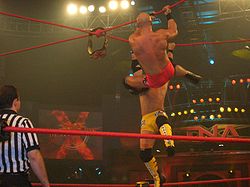 Since its origin, TNA has featured a high-flying, high risk style of wrestling called its X Division
. Rather than emphasizing the fact that most wrestlers who perform this style are under 220 lb (99.8 kg) by calling it a cruiserweight division, TNA decided to emphasize the high risk nature of the moves that these wrestlers perform, removing all restraints on its wrestlers, allowing them to perform almost stunt
like wrestling moves. Originally, there was no upper weight limit on the X Division or its title, though in practice, most of the wrestlers in this division have been cruiserweights, with Samoa Joe, billed at 280 lb (127 kg), Kurt Angle, billed at 230 lb (104.3 kg), and Abyss, billed at 350 lb (158.8 kg), being notable exceptions. To further emphasize this point, the slogan "It's not about weight limits, it's about no limits" was used to describe the division. Although it was de-emphasized throughout 2007, the X Division is generally regarded as one of the key attractions of TNA and was replicated in several other promotions. In August 2011, the division was given a 225 lb (102.1 kg) weight limit.
appeared on Impact! to unveil the TNA Championship ranking system. According to Bischoff, the system combines several factors to determine the #1 contender for the TNA Heavyweight Championship. These factors include the overall performance and achievements throughout a wrestler's career, the TNA win/loss record of the wrestler, and online voting by the fans, which takes place on the promotion's website. It was also announced that a "TNA Championship Committee" had been set up to make the final decision based on these factors. The committee consisted of TNA President Dixie Carter, Hulk Hogan
, and Bischoff himself.
The ten wrestlers chosen to appear on the first ballot were Kurt Angle
, Jeff Hardy
, Mr. Anderson, D'Angelo Dinero
, Sting
, Jeff Jarrett
, Abyss, Rob Terry
, Desmond Wolfe
, and A.J. Styles
. The first round of voting ended on May 3 and was won by Desmond Wolfe, who received his title shot that night on Impact! against Rob Van Dam
. The second round started that same night. New names included in the new poll were Matt Morgan, Brother Ray, Brother Devon, Rhino and Hernandez
. The first Top 10 ranking was revealed on May 20, with Sting claiming the number one spot. On the second Top 10 ranking Abyss, Jeff Hardy, and Mr. Anderson were tied for the top three spots. A month later Abyss claimed the top spot. The ranking system was abandoned shortly thereafter.
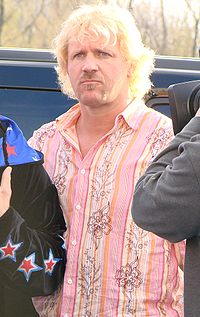 , Bruce Prichard
operates as the head booker of TNA, with the collaboration of Vince Russo
and Matt Conway. Former bookers, whether temporary or semi-permanent, include Jeff Jarrett
, Jerry Jarrett
, Jeremy Borash
, Mike Tenay
, Abyss, and Dutch Mantel
. At times, the position of booker has been coterminous with the on-screen position of Director of Authority.
made his return to TNA as the Director of Authority. Watts started feuding with Don Callis
(TNA Management Consultant), ending with Watts forced to quit. On February 18, 2004, TNA named Vince Russo the new Director of Authority, a position he held until November 7, 2004 when Dusty Rhodes
defeated and replaced him.
The NWA Championship Committee, established in 2004, comprised a group of wrestling veterans who acted as arbitrators, determining a winner in the event of a time-limit draw. The committee consisted of Harley Race
, Larry Zbyszko
and Terry Funk
, with Funk later replaced by Roddy Piper
without ever having appeared on TNA television. After Race and Piper left TNA, the Committee essentially ceased to exist as a physical on-screen body, although Zbyszko continued to be referred to as a member of the committee while simultaneously acting as on-screen authority figure, booking matches and giving title
shots. As of October 2011, Sting is the current on-air authority figure.
in addition to TNA's weekly shows. The majority of TNA wrestlers are paid on a per appearance basis. Like any other wrestling company, TNA wrestlers are classified as independent contractors and are not entitled to form workers' unions or employer health coverage.
, titled TNA Impact!
, released in 2008. In May 2011, Namco Bandai
released a TNA game for mobile phones, iPhone
and the iPad
.
Privately held company
A privately held company or close corporation is a business company owned either by non-governmental organizations or by a relatively small number of shareholders or company members which does not offer or trade its company stock to the general public on the stock market exchanges, but rather the...
professional wrestling promotion
Professional wrestling promotion
A professional wrestling promotion is a company or business that regularly performs shows involving professional wrestling. Promotion also describes a role which entails management, advertising and logistics of running a wrestling event...
founded by Jeff Jarrett
Jeff Jarrett
Jeffrey Leonard Jarrett is an American professional wrestler and wrestling promoter. He is currently signed to Total Nonstop Action Wrestling , an organization he co-founded along with his father and in which he holds some stock but not total control...
and Jerry Jarrett
Jerry Jarrett
Jerry W. Jarrett is an American promoter and former professional wrestler, and the father of wrestler Jeff Jarrett. He is the co-founder and former part-owner of Total Nonstop Action Wrestling...
. The company broadcasts its events on television
Television
Television is a telecommunication medium for transmitting and receiving moving images that can be monochrome or colored, with accompanying sound...
and the Internet
Internet
The Internet is a global system of interconnected computer networks that use the standard Internet protocol suite to serve billions of users worldwide...
fifty two weeks a year with over a million weekly viewers on its primary television program, Impact Wrestling on Spike. TNA also gains revenue
Revenue
In business, revenue is income that a company receives from its normal business activities, usually from the sale of goods and services to customers. In many countries, such as the United Kingdom, revenue is referred to as turnover....
from live events, product licensing, and direct product sales. In 2002 Panda Energy International
Panda Energy International
Panda Energy International, Inc. is an American privately held company that constructs, maintains and operates environmentally friendly power plants, with the name of the company a reference to the endangered Giant Panda. The company is headquartered in Dallas, Texas. It is a division of The Panda...
purchased a controlling share in TNA. Dixie Carter is President
President
A president is a leader of an organization, company, trade union, university, or country.Etymologically, a president is one who presides, who sits in leadership...
of the company.
TNA headquarters is located Nashville, Tennessee
Nashville, Tennessee
Nashville is the capital of the U.S. state of Tennessee and the county seat of Davidson County. It is located on the Cumberland River in Davidson County, in the north-central part of the state. The city is a center for the health care, publishing, banking and transportation industries, and is home...
; its trading company TNA Entertainment, LLC
Limited liability company
A limited liability company is a flexible form of enterprise that blends elements of partnership and corporate structures. It is a legal form of company that provides limited liability to its owners in the vast majority of United States jurisdictions...
. operates out of Universal Studios Florida
Universal Studios Florida
Universal Studios Florida is an American theme park located in Orlando, Florida. Opened on June 7, 1990, the park's theme is the entertainment industry, in particular movies and television. Universal Studios Florida inspires its guests to "ride the movies," and it features numerous attractions and...
in Orlando, Florida
Orlando, Florida
Orlando is a city in the central region of the U.S. state of Florida. It is the county seat of Orange County, and the center of the Greater Orlando metropolitan area. According to the 2010 US Census, the city had a population of 238,300, making Orlando the 79th largest city in the United States...
. The company previously bore the name "NWA Total Nonstop Action" as, at the time of its formation, it was a member of the National Wrestling Alliance
National Wrestling Alliance
The National Wrestling Alliance is a wrestling promotion company and sanctions various NWA championships in the United States. The NWA has been in operation since 1948...
(NWA). TNA was granted exclusive rights to both the NWA World Heavyweight Championship
NWA World Heavyweight Championship
The National Wrestling Alliance World Heavyweight Championship is a professional wrestling world heavyweight championship in the National Wrestling Alliance. Its lineage has been traced from the first World Heavyweight Championship, which traces its lineage to Georg Hackenschmidt's 1905 title and...
and the NWA World Tag Team Championship
NWA World Tag Team Championship
The National Wrestling Alliance World Tag Team Championship is the professional wrestling world tag team championship within the NWA framework.-History:...
. TNA abdicated from the NWA in 2004, but was permitted to continue to use the championships until the NWA abrogated their contract agreement with TNA in May of 2007, after which TNA created its own championship
Championship
Championship is a term used in sport to refer to various forms of competition in which the aim is to decide which individual or team is the champion.- Title match system :...
titles.
In 2004 TNA became the first American wrestling company to make exclusive use of a hexagonal wrestling ring
Wrestling ring
A wrestling ring is the ring stage on which professional wrestlers wrestle.-Configuration and construction:The configuration and construction of the "traditional" ring is very similar to that of a boxing ring, though the wrestling version has three ring ropes...
(as opposed to the more conventional square ring). In 2010 the company reverted back to the original square ring which the company used in the Asylum
TNA Asylum
The Asylum is the nickname given to the Tennessee State Fairgrounds arena that housed Total Nonstop Action Wrestling for two-and-a-half years...
years. The organization also employed the unconventional rule that a championship
Championship (professional wrestling)
A Championship or "title" in professional wrestling is a recognition promoted by professional wrestling organizations.Championship reigns are determined by professional wrestling matches, in which competitors are involved in scripted rivalries...
can change hands as the result of a disqualification or countout, but has since phased out this rule. TNA is broadcast in more than 120 countries all over the world reaching a global audience.
Formation
The concept of TNA originated shortly after the end of World Championship WrestlingWorld Championship Wrestling
World Championship Wrestling, Inc. was an American professional wrestling promotion which existed from 1988 to 2001. Based in Atlanta, Georgia, it began as a regional promotion affiliated with the National Wrestling Alliance , named Jim Crockett Promotions until November 1988, when Ted Turner and...
(WCW) in 2001. Bob Ryder, Jeff Jarrett
Jeff Jarrett
Jeffrey Leonard Jarrett is an American professional wrestler and wrestling promoter. He is currently signed to Total Nonstop Action Wrestling , an organization he co-founded along with his father and in which he holds some stock but not total control...
, and Jerry Jarrett
Jerry Jarrett
Jerry W. Jarrett is an American promoter and former professional wrestler, and the father of wrestler Jeff Jarrett. He is the co-founder and former part-owner of Total Nonstop Action Wrestling...
went on a fishing trip and contemplated their futures in the business
Business
A business is an organization engaged in the trade of goods, services, or both to consumers. Businesses are predominant in capitalist economies, where most of them are privately owned and administered to earn profit to increase the wealth of their owners. Businesses may also be not-for-profit...
of wrestling. The World Wrestling Federation (WWF) remained at that time, the only wrestling product on U.S. national television
Television
Television is a telecommunication medium for transmitting and receiving moving images that can be monochrome or colored, with accompanying sound...
— WWF had purchased WCW in March 2001, and Extreme Championship Wrestling
Extreme Championship Wrestling
Extreme Championship Wrestling was a professional wrestling promotion that was founded in Philadelphia, Pennsylvania in 1992 by Tod Gordon and closed when his successor, Paul Heyman, declared bankruptcy in April 2001...
had filed for Chapter 11 bankruptcy
Chapter 11, Title 11, United States Code
Chapter 11 is a chapter of the United States Bankruptcy Code, which permits reorganization under the bankruptcy laws of the United States. Chapter 11 bankruptcy is available to every business, whether organized as a corporation or sole proprietorship, and to individuals, although it is most...
in April 2001. Ryder felt that this situation led many television stations to regard wrestling as bad for business and suggested a company that does not need television, but rather just goes straight to pay-per-view
Pay-per-view
Pay-per-view provides a service by which a television audience can purchase events to view via private telecast. The broadcaster shows the event at the same time to everyone ordering it...
. Of the three, only Jeff Jarrett took the discussion seriously (the other two thought of it as "just fishing talk").
The Jarretts found the help they needed, and the company put on its first show on June 19, 2002. This night, however, in a dark match just before they went on the air, a 450 lb
Pound (mass)
The pound or pound-mass is a unit of mass used in the Imperial, United States customary and other systems of measurement...
wrestler named Cheex hit the ropes with so much force that one of them broke. The estimated repair time was 30–60 minute
Minute
A minute is a unit of measurement of time or of angle. The minute is a unit of time equal to 1/60th of an hour or 60 seconds. In the UTC time scale, a minute on rare occasions has 59 or 61 seconds; see leap second. The minute is not an SI unit; however, it is accepted for use with SI units...
s, which they did not have because the schedule called for them to go live in a few minutes, whether the ring was ready or not. Backstage, the producers shuffled the schedule so that some non-wrestling segments went first to give the ring crew some more time, but they did not have many of them. The ring crew fixed the rope with the help of Ron and Don Harris, and everyone went live hoping for the best.
Expansion
In November 2006, TNA started holding select pay-per-views outside of its central filming location, the TNA Impact! Zone in Orlando. In April 2006, TNA announced a partnership with YouTubeYouTube
YouTube is a video-sharing website, created by three former PayPal employees in February 2005, on which users can upload, view and share videos....
where TNA supplied YouTube with exclusive video content in exchange for hosting
File hosting service
A file hosting service, online file storage provider, or cyberlocker is an Internet hosting service specifically designed to host user files. Typically they allow HTTP and FTP access. Related services are content-displaying hosting services A file hosting service, online file storage provider, or...
, leading to the production of internet shows. In January 2007, TNA's mobile content deal with New Motion, Inc. led to the introduction of TNA Mobile and mobile fan voting. TNA has also launched the TNA U program to help promote the brand and has started airing podcast
Podcast
A podcast is a series of digital media files that are released episodically and often downloaded through web syndication...
s through YouTube which they call TNA U TV.
TNA footage appears in the wrestling documentary, Bloodstained Memoirs
Bloodstained Memoirs
Bloodstained Memoirs is a professional wrestling documentary released online via an official stream in 2009. It is compiled by interviews featuring wrestlers synonymous with different eras in wrestling and different wrestling regions . Production was filmed in the UK, USA, France, Japan, and Italy...
. On June 21, TNA launched an online video vault subscription service, where subscribers could watch past pay-per-views by choosing either one of three payment options.
On October 23, 2008, TNA made the transition to HD
High-definition television
High-definition television is video that has resolution substantially higher than that of traditional television systems . HDTV has one or two million pixels per frame, roughly five times that of SD...
and since then all Impacts! and pay-per-views are broadcast in High Definition. In addition, TNA introduced a new HD set that included new lighting and several very large -high-resolution screens. This set is currently used for all Impacts! and pay-per-views, even though it has been altered several times.
On November 7, 2011, TNA announced that it had reached a deal with Ohio Valley Wrestling
Ohio Valley Wrestling
Ohio Valley Wrestling is an American independent professional wrestling promotion based in Louisville, Kentucky. OVW is run by owner Danny Davis and was a member of the National Wrestling Alliance from 1997 until 2000...
(OVW) to become TNA's official training and developmental territory.
Former programming
Initially, TNA's weekly pay-per-view show operated as the company's main source of revenue, in place of monthly pay-per-view events used by other promotions. These shows started on June 19, 2002 and were held mostly at the AsylumTNA Asylum
The Asylum is the nickname given to the Tennessee State Fairgrounds arena that housed Total Nonstop Action Wrestling for two-and-a-half years...
in Nashville, Tennessee. After 27 months and 111 PPVs, TNA felt that they had enough of a fanbase to begin holding a weekly television show and monthly three-hour pay-per-views. The last weekly PPV was held on September 8, 2004.
TNA Xplosion
TNA Xplosion
TNA Xplosion is a television program produced by Total Nonstop Action Wrestling , featuring both highlights from Impact Wrestling and exclusive taped matches. It is now produced only for international markets, no longer airing in the United States...
was launched on November 27, 2002 as TNA's first regular cable show and featured exclusive matches from the TNA Asylum
TNA Asylum
The Asylum is the nickname given to the Tennessee State Fairgrounds arena that housed Total Nonstop Action Wrestling for two-and-a-half years...
as well as exclusive interviews with TNA Superstars. On November 18, 2004, the show became a recap show of the previous week's Impact! in light of alterations in the taping schedule. However, Xplosion
TNA Xplosion
TNA Xplosion is a television program produced by Total Nonstop Action Wrestling , featuring both highlights from Impact Wrestling and exclusive taped matches. It is now produced only for international markets, no longer airing in the United States...
resumed airing exclusive matches (billed as "Xplosion Xclusives") once more on October 7, 2005 in addition to recapping Impact!. The "Xplosion Xclusives" also aired on the now-ceased TNA Global Impact!
TNA Global iMPACT!
Global iMPACT! was a free online professional wrestling show produced by Total Nonstop Action Wrestling that existed in 2006. Global iMPACT!, which was hosted by TNA interviewers Jeremy Borash and Christy Hemme, featured "exclusive footage, interviews, news updates, matches and more".-Original...
internet show. Airing of Xplosion in the United States ceased at the end of 2006 although some of the exclusive matches can be seen on TNA Today
TNA Today
TNA Today was a free online professional wrestling program produced by Total Nonstop Action Wrestling . It is hosted by TNA interviewer Jeremy Borash, with occasional appearances by Don West...
.
Current programming
TNA began airing TNA Impact!TNA iMPACT!
Impact Wrestling is a professional wrestling television program for Total Nonstop Action Wrestling that currently airs in the United States and Canada on Spike...
(officially typeset "TNA iMPACT!") on June 4, 2004 on Fox Sports Net
Fox Sports Net
The Fox Sports Regional Networks, or simply Fox Sports Net , are a collection of cable TV regional sports networks in the United States owned and operated by News Corporation.- Beginnings :...
. After TNA's contract with Fox Sports Net was not renewed the following year, TNA was forced to broadcast Impact! from their official website, while seeking a new television outlet. TNA later secured a deal with Spike TV and aired its first episode on October 1, 2005. Impact! expanded to a two-hour format on October 4, 2007.
On February 15, 2010, TNA made a new deal with Spike TV which moved Impact! to Monday nights. The first episode took place March 8, 2010.
In December 2009, Dixie Carter announced in an interview that TNA Epics
TNA Epics
Epics was a professional wrestling television program for Impact Wrestling that aired on Spike in the United States and Bravo in the United Kingdom. The show was hosted by Mick Foley and showed matches and events from the history much like WWE Vintage Collection. In December 2009, Dixie Carter...
, which had recently aired its first season exclusively in the United Kingdom
United Kingdom
The United Kingdom of Great Britain and Northern IrelandIn the United Kingdom and Dependencies, other languages have been officially recognised as legitimate autochthonous languages under the European Charter for Regional or Minority Languages...
, would be debuting in the United States in January 2010. The second season began on Thursday, January 14, 2010. TNA Epics showcased matches and events from the history of TNA Wrestling, much like WWE Vintage Collection
WWE Vintage Collection
WWE Vintage Collection is a professional wrestling television program from World Wrestling Entertainment showcasing action from the extensive WWE video library...
. The show was hosted by Mick Foley
Mick Foley
Michael Francis "Mick" Foley, Sr. is an American semi-retired professional wrestler, author, comedian, actor, voice actor and former color commentator. He has worked for many wrestling promotions, including WWE, WCW, ECW and TNA. He is often referred to as "The Hardcore Legend", a nickname he...
, and aired on one Thursday each month on Spike, until April 2010, On April 12, 2010, TNA wrestling aired a pilot episode
Television pilot
A "television pilot" is a standalone episode of a television series that is used to sell the show to a television network. At the time of its inception, the pilot is meant to be the "testing ground" to see if a series will be possibly desired and successful and therefore a test episode of an...
of their new show TNA Reaction
TNA Reaction
TNA Reaction was a professional wrestling-focused documentary-style television program by Total Nonstop Action Wrestling that aired in the United States and Canada on Spike...
, which is a documentary-style show that presents an exclusive behind-the-scenes look at the stars of TNA speaking about taking on their rivals.
On May 3, 2010, TNA announced that TNA Impact! will be moved back to Thursday nights re-branded as "TNA Thursdays". At the same time the company also announced that Spike had picked up Reaction, which would start airing weekly prior to each episode of Impact!, starting June 24. The premiere date for Reaction was later changed to July 15, when it would start airing after Impact! instead of before it. However, in late June Reaction was pulled from Spike's schedule. On August 3, 2010, TNA announced that Reaction would premiere on August 12 and air every Thursday following Impact! on 11pm ET/10C. Also in June, TNA revamped Xplosion, still airing on international markets, making it more of an original program instead of a highlight show. On December 27, 2010, Reaction was officially canceled by Spike, with its final episode airing three days later.
In the UK, Impact! was broadcast on Bravo which ceased by British Sky Broadcasting
British Sky Broadcasting
British Sky Broadcasting Group plc is a satellite broadcasting, broadband and telephony services company headquartered in London, United Kingdom, with operations in the United Kingdom and the Ireland....
on January 1, 2011. A new deal was struck later in January 25, 2011 with Sky to start broadcasting Impact! on Challenge TV. On May 3, 2011, TNA Impact! was re-branded Impact Wrestling.
House shows and touring
Apart from their weekly shows in Universal StudiosUniversal Studios Florida
Universal Studios Florida is an American theme park located in Orlando, Florida. Opened on June 7, 1990, the park's theme is the entertainment industry, in particular movies and television. Universal Studios Florida inspires its guests to "ride the movies," and it features numerous attractions and...
, TNA started running house show
House show
A house show is a professional wrestling show run by a major promotion that is not televised, though they can be recorded. Promotions use house shows mainly to cash in on the exposure that they and their wrestlers receive during televised events, as well as test reactions to matches, wrestlers, and...
s on March 17, 2006. In August 2007, live-events coordinator Craig Jenkins stated that TNA intended to stage eight pay-per-views and 96 house shows outside Orlando, Florida in 2008. In 2008 TNA conducted its first tour of the UK, with most shows selling out. 2009 saw the promotion first touring Germany
Germany
Germany , officially the Federal Republic of Germany , is a federal parliamentary republic in Europe. The country consists of 16 states while the capital and largest city is Berlin. Germany covers an area of 357,021 km2 and has a largely temperate seasonal climate...
. On July 2, 2010, MCU Park hosted a live Total Nonstop Action Wrestling house show, which also has broke TNA attendance record and is currently the most attended live TNA house show in the USA with an almost capacity crowd of 5,550 TNA fans.
Ring shape and locations
TNA originally used a traditional four-sided square ring. In 2004, in an effort to make themselves different from other United States professional wrestling promotions, TNA switched to a hexagonal ring. In 2010, they returned to using a four-sided ring. The six sided ring returned for one night on July 10, 2011, at Destination XDestination X (2011)
Destination X was a professional wrestling pay-per-view event produced by the Total Nonstop Action Wrestling promotion, which took place on July 10, 2011 at the Impact Wrestling Zone in Orlando, Florida...
. Also, although TNA runs some house shows and a few PPV events in arenas, TNA holds most of its events at a set location (Universal Studios in Orlando, Florida) as opposed to an arena, presenting more of a rustic regional feel to the events.
X Division
X Division
The X Division is a high-flying, high-risk, fast-paced style of professional wrestling seen originally in Total Nonstop Action Wrestling and since then in various NWA member promotions...
. Rather than emphasizing the fact that most wrestlers who perform this style are under 220 lb (99.8 kg) by calling it a cruiserweight division, TNA decided to emphasize the high risk nature of the moves that these wrestlers perform, removing all restraints on its wrestlers, allowing them to perform almost stunt
Stunt
A stunt is an unusual and difficult physical feat, or any act requiring a special skill, performed for artistic purposes in TV, theatre, or cinema...
like wrestling moves. Originally, there was no upper weight limit on the X Division or its title, though in practice, most of the wrestlers in this division have been cruiserweights, with Samoa Joe, billed at 280 lb (127 kg), Kurt Angle, billed at 230 lb (104.3 kg), and Abyss, billed at 350 lb (158.8 kg), being notable exceptions. To further emphasize this point, the slogan "It's not about weight limits, it's about no limits" was used to describe the division. Although it was de-emphasized throughout 2007, the X Division is generally regarded as one of the key attractions of TNA and was replicated in several other promotions. In August 2011, the division was given a 225 lb (102.1 kg) weight limit.
Ranking system
On April 26, 2010, Eric BischoffEric Bischoff
Eric Aaron Bischoff is an American entrepreneur, and professional wrestling booker and on-screen personality currently signed to Total Nonstop Action Wrestling...
appeared on Impact! to unveil the TNA Championship ranking system. According to Bischoff, the system combines several factors to determine the #1 contender for the TNA Heavyweight Championship. These factors include the overall performance and achievements throughout a wrestler's career, the TNA win/loss record of the wrestler, and online voting by the fans, which takes place on the promotion's website. It was also announced that a "TNA Championship Committee" had been set up to make the final decision based on these factors. The committee consisted of TNA President Dixie Carter, Hulk Hogan
Hulk Hogan
Terrance Gene "Terry" Bollea , better known by his ring name Hulk Hogan, is an American Semi-retired professional wrestler, actor, television personality, and musician currently signed to Total Nonstop Action Wrestling ....
, and Bischoff himself.
The ten wrestlers chosen to appear on the first ballot were Kurt Angle
Kurt Angle
Kurt Steven Angle is an American professional wrestler, amateur wrestler, and 1996 Olympic gold medalist. He is currently under contract with Total Nonstop Action Wrestling, where he is recognized as a 15-time World Heavyweight Champion...
, Jeff Hardy
Jeff Hardy
Jeffrey Nero "Jeff" Hardy is an American professional wrestler, who is currently signed to Total Nonstop Action Wrestling , where he is a former two–time TNA World Heavyweight Champion...
, Mr. Anderson, D'Angelo Dinero
Elijah Burke
Elijah Samuel Burke is an American professional wrestler, currently signed to Total Nonstop Action Wrestling under the name of "The Pope" D'Angelo Dinero; a gimmick in which he portrays a Harlem street preacher...
, Sting
Sting (wrestler)
Steven James "Steve" Borden , better known by his ring name Sting, is an American semi-retired professional wrestler, currently signed to Total Nonstop Action Wrestling...
, Jeff Jarrett
Jeff Jarrett
Jeffrey Leonard Jarrett is an American professional wrestler and wrestling promoter. He is currently signed to Total Nonstop Action Wrestling , an organization he co-founded along with his father and in which he holds some stock but not total control...
, Abyss, Rob Terry
Rob Terry
Robert "Rob" Terry is a Welsh professional wrestler and bodybuilder. He is currently signed to Total Nonstop Action Wrestling . Before signing with TNA, he was under contract with World Wrestling Entertainment and competed in the company's developmental territory, Florida Championship...
, Desmond Wolfe
Nigel McGuinness
Steven Haworth is an English professional wrestler, better known by the ring names Desmond Wolfe and Nigel McGuinness. As McGuinness he first gained notoriety working for Ring of Honor in the United States and Pro Wrestling Noah in Japan...
, and A.J. Styles
A.J. Styles
Allen Neal Jones , better known by his ring name A.J. Styles is an American professional wrestler currently working for Total Nonstop Action Wrestling...
. The first round of voting ended on May 3 and was won by Desmond Wolfe, who received his title shot that night on Impact! against Rob Van Dam
Rob Van Dam
Robert Alexander "Rob" Szatkowski , better known by his ring name Rob Van Dam , is an American professional wrestler and actor who is currently signed to Total Nonstop Action Wrestling ....
. The second round started that same night. New names included in the new poll were Matt Morgan, Brother Ray, Brother Devon, Rhino and Hernandez
Shawn Hernandez
Shawn Hernandez is an American professional wrestler of Mexican and Puerto Rican descent, better known by his ring names, "Hotstuff Hernandez" and "Hernandez"....
. The first Top 10 ranking was revealed on May 20, with Sting claiming the number one spot. On the second Top 10 ranking Abyss, Jeff Hardy, and Mr. Anderson were tied for the top three spots. A month later Abyss claimed the top spot. The ranking system was abandoned shortly thereafter.
Creative team
Bruce Prichard
Bruce Prichard is a professional wrestling personality, best known as a manager and producer for World Wrestling Entertainment , where he portrayed Brother Love, the original manager of The Undertaker...
operates as the head booker of TNA, with the collaboration of Vince Russo
Vince Russo
Vincent James "Vince" Russo is an American creative writer and author, well known for his work in the professional wrestling industry. He is notable for his tenure with World Wrestling Federation, World Championship Wrestling and Total Nonstop Action Wrestling...
and Matt Conway. Former bookers, whether temporary or semi-permanent, include Jeff Jarrett
Jeff Jarrett
Jeffrey Leonard Jarrett is an American professional wrestler and wrestling promoter. He is currently signed to Total Nonstop Action Wrestling , an organization he co-founded along with his father and in which he holds some stock but not total control...
, Jerry Jarrett
Jerry Jarrett
Jerry W. Jarrett is an American promoter and former professional wrestler, and the father of wrestler Jeff Jarrett. He is the co-founder and former part-owner of Total Nonstop Action Wrestling...
, Jeremy Borash
Jeremy Borash
Jeremy Borash , is an American professional wrestling play-by-play commentator, announcer, ring announcer, booker, interviewer, producer and website designer...
, Mike Tenay
Mike Tenay
Michael William "Mike" Tenay is a professional wrestling play-by-play announcer currently employed by Total Nonstop Action Wrestling . Prior to signing with TNA in 2002, he had a notable tenure with World Championship Wrestling from 1994-2001...
, Abyss, and Dutch Mantel
Dutch Mantel
Wayne Keown is an American professional wrestler, and author better known by his ring name, Dutch Mantel or Dutch Mantell. He currently is semi-retired but still makes occasional wrestling appearances. He was previously with Total Nonstop Action Wrestling as a writer behind the scenes...
. At times, the position of booker has been coterminous with the on-screen position of Director of Authority.
Authority figures
When TNA first launched, it billed the on-air authority figure as a representative appointed by the National Wrestling Alliance. It did this for storyline purposes only, however, and the actual "representatives" already worked in some capacity for TNA. From February 19, 2003, TNA had no active authority figure until July 23, 2003 when Erik WattsErik Watts
Erik Watts is an American professional wrestler. He is best known for his appearances with World Championship Wrestling in the early 1990s. He is the son of legendary wrestler "Cowboy" Bill Watts.-Debut:...
made his return to TNA as the Director of Authority. Watts started feuding with Don Callis
Don Callis
Don Callis is a Canadian former professional wrestler and manager, known for his appearances with the World Wrestling Federation as The Jackyl, and Extreme Championship Wrestling as color commentator Cyrus.-Early life:...
(TNA Management Consultant), ending with Watts forced to quit. On February 18, 2004, TNA named Vince Russo the new Director of Authority, a position he held until November 7, 2004 when Dusty Rhodes
Dusty Rhodes (wrestler)
Virgil Riley Runnels, Jr. , better known as "The American Dream" Dusty Rhodes, is a semi-retired American professional wrestler currently working for WWE...
defeated and replaced him.
The NWA Championship Committee, established in 2004, comprised a group of wrestling veterans who acted as arbitrators, determining a winner in the event of a time-limit draw. The committee consisted of Harley Race
Harley Race
Harley Leland Race is a retired American professional wrestler and current promoter and trainer. During his career as a wrestler, he held the NWA World Heavyweight Championship 7 times...
, Larry Zbyszko
Larry Zbyszko
Lawrence "Larry" Whistler is a professional wrestler, better known by his ring name, Larry Zbyszko. Zbyszko is perhaps best known for his feud with his mentor, wrestling legend Bruno Sammartino during the early 1980s....
and Terry Funk
Terry Funk
Terrence "Terry" Funk is an American professional wrestler and actor known chiefly for the hardcore wrestling style he adopted in the latter part of his career that inspired many younger wrestlers, including Mick Foley...
, with Funk later replaced by Roddy Piper
Roddy Piper
Roderick George Toombs , better known by his ring name "Rowdy" Roddy Piper, is a Canadian semi-retired professional wrestler and film actor who is currently signed to WWE. In professional wrestling, he is best known for his work with WWE...
without ever having appeared on TNA television. After Race and Piper left TNA, the Committee essentially ceased to exist as a physical on-screen body, although Zbyszko continued to be referred to as a member of the committee while simultaneously acting as on-screen authority figure, booking matches and giving title
Championship (professional wrestling)
A Championship or "title" in professional wrestling is a recognition promoted by professional wrestling organizations.Championship reigns are determined by professional wrestling matches, in which competitors are involved in scripted rivalries...
shots. As of October 2011, Sting is the current on-air authority figure.
TNA contracts
TNA wrestlers are forbidden by contract from working for WWE, but are free to perform non-televised work for any other independent wrestling promotion, domestic or international. Many TNA wrestlers perform regularly for various promotions on the independent circuitIndependent circuit
In professional wrestling, the independent circuit or indy circuit refers to the many independent promotions which are much smaller than major televised promotions. They are roughly analagous to a minor league for pro wrestling, or community or regional theatre.Specific promotions on the...
in addition to TNA's weekly shows. The majority of TNA wrestlers are paid on a per appearance basis. Like any other wrestling company, TNA wrestlers are classified as independent contractors and are not entitled to form workers' unions or employer health coverage.
Video games
TNA has also expanded into other areas with the development of a video game with Midway GamesMidway Games
Midway Games, Inc. is an American company that was formerly a major video game publisher. Following a bankruptcy filing in 2009, it is no longer active and is in the process of liquidating all of its assets. Midway's titles included Mortal Kombat, Ms.Pac-Man, Spy Hunter, Tron, Rampage, the...
, titled TNA Impact!
TNA iMPACT! (video game)
TNA Impact! is the first video game released by the professional wrestling promotion, Total Nonstop Action Wrestling . The game was developed by Midway Studios in Los Angeles and published by Midway Games...
, released in 2008. In May 2011, Namco Bandai
Namco Bandai
, also known as the Bandai Namco Group, is a Japanese holding company formed from the merger of Namco and Bandai. It has interests in toys, video games and arcades, anime, and amusement parks. The new entity was founded on September 29, 2005...
released a TNA game for mobile phones, iPhone
IPhone
The iPhone is a line of Internet and multimedia-enabled smartphones marketed by Apple Inc. The first iPhone was unveiled by Steve Jobs, then CEO of Apple, on January 9, 2007, and released on June 29, 2007...
and the iPad
IPad
The iPad is a line of tablet computers designed, developed and marketed by Apple Inc., primarily as a platform for audio-visual media including books, periodicals, movies, music, games, and web content. The iPad was introduced on January 27, 2010 by Apple's then-CEO Steve Jobs. Its size and...
.
Sanctioned
| Former Title | Last TNA holder | Date won | Event | Previous champion |
|---|---|---|---|---|
| NWA World Heavyweight Championship NWA World Heavyweight Championship The National Wrestling Alliance World Heavyweight Championship is a professional wrestling world heavyweight championship in the National Wrestling Alliance. Its lineage has been traced from the first World Heavyweight Championship, which traces its lineage to Georg Hackenschmidt's 1905 title and... |
Christian Cage | January 14, 2007 | Final Resolution | Abyss |
| NWA World Tag Team Championship NWA World Tag Team Championship The National Wrestling Alliance World Tag Team Championship is the professional wrestling world tag team championship within the NWA framework.-History:... |
Team 3D Dudley Boyz Team 3D was a professional wrestling tag team, consisting of Brother Ray and Brother Devon, formerly sporadically joined into a stable by Brother Runt on several intervals... (Brother Ray and Brother Devon) |
April 15, 2007 | Lockdown Lockdown (2007) Lockdown was a professional wrestling pay-per-view event produced by Total Nonstop Action Wrestling, which took place on April 15, 2007 at the Family Arena in Saint Charles, Missouri. This was the second monthly pay-per-view, after Bound for Glory , to be held outside Orlando, Florida. It was the... |
The Latin American Xchange (Homicide, and Hernandez Shawn Hernandez Shawn Hernandez is an American professional wrestler of Mexican and Puerto Rican descent, better known by his ring names, "Hotstuff Hernandez" and "Hernandez".... ) |
| IWGP World Heavyweight Championship | Kurt Angle Kurt Angle Kurt Steven Angle is an American professional wrestler, amateur wrestler, and 1996 Olympic gold medalist. He is currently under contract with Total Nonstop Action Wrestling, where he is recognized as a 15-time World Heavyweight Champion... |
June 29, 2007 | Fighting Now Bom-Ba-Ye | Brock Lesnar Brock Lesnar Brock Edward Lesnar is an American mixed martial artist, actor and a former professional and amateur wrestler. He is a former UFC Heavyweight Champion and is ranked the No.5 Heavyweight in the world by Sherdog... |
| IWGP World Tag Team Championship | Team 3D Dudley Boyz Team 3D was a professional wrestling tag team, consisting of Brother Ray and Brother Devon, formerly sporadically joined into a stable by Brother Runt on several intervals... (Brother Devon and Brother Ray) |
October 18, 2009 | Bound for Glory Bound for Glory (2009) Bound for Glory was a professional wrestling pay-per-view event produced by the Total Nonstop Action Wrestling promotion, which took place on October 18, 2009 at the Bren Events Center in Irvine, California. It was the fifth event under the Bound for Glory chronology. The Event was the Premiere... |
The British Invasion The British Invasion (professional wrestling) The British Invasion is a professional wrestling alliance in the American promotion Total Nonstop Action Wrestling , currently consisting of English wrestlers Douglas Williams and Magnus. The group previously also included their Welsh enforcer Rob Terry... (Brutus Magnus Nick Aldis Nicholas Harry "Nick" Aldis is an English professional wrestler and actor. He is currently working for Total Nonstop Action Wrestling under the ring name Magnus, where he is a one time World Tag Team Champion with Doug Williams... and Doug Williams Doug Williams (wrestler) Douglas Clayton Durdle is an English professional wrestler, better known by his ring name Doug Williams. He is currently signed to Total Nonstop Action Wrestling under the ring name Douglas Williams... ) |
| IWGP Junior Tag Team Championship IWGP Junior Heavyweight Tag Team Championship The IWGP Junior Heavyweight Tag Team Championship is a professional wrestling tag team championship owned by the New Japan Pro Wrestling promotion. "IWGP" is the acronym of NJPW's governing body, the International Wrestling Grand Prix. The title was introduced on August 8, 1998 at a NJPW live event... |
The Motor City Machine Guns (Alex Shelley Alex Shelley Patrick Martin , is an American professional wrestler, better known by the ring name Alex Shelley. He wrestles for Total Nonstop Action Wrestling, where he currently teams with Chris Sabin as The Motor City Machine Guns. He previously gained fame on the independent circuit, working most notably for... and Chris Sabin Chris Sabin Joshua Harter is an American professional wrestler, better known by his ring name Chris Sabin. He is currently working for Total Nonstop Action Wrestling , where he currently teams with Alex Shelley as The Motor City Machine Guns.After being trained by Scott D'Amore, Sabin debuted in 2000 for... ) |
January 4, 2009 | Wrestle Kingdom III in Tokyo Dome | No Limit (Tetsuya Naitō Tetsuya Naitō is a Japanese professional wrestler trained by and currently performing for New Japan Pro Wrestling , where he is a former IWGP Tag Team and IWGP Junior Heavyweight Tag Team Champion with former partner Yujiro Takahashi, with whom he teamed as No Limit.... and Yujiro Yujiro Takahashi , also known by his shortened ring name is a Japanese professional wrestler trained by and currently performing for New Japan Pro Wrestling , where he is a former IWGP Tag Team and IWGP Junior Heavyweight Tag Team Champion with former partner Tetsuya Naitō, with whom he teamed as No... ) |
Unsanctioned
| Championship | Last TNA holder | Date won | Date aired | Event | Previous champion |
|---|---|---|---|---|---|
| TNA World Beer Drinking Championship TNA World Beer Drinking Championship The TNA World Beer Drinking Championship was a professional wrestling championship owned by the Total Nonstop Action Wrestling promotion.... |
James Storm James Storm James Allen Cox is an American professional wrestler who competes under the ring name "The Cowboy" James Storm. Since 2002, Storm has been employed by Total Nonstop Action Wrestling, where he, along with A.J... |
February 25, 2008 | February 28, 2008 | TNA Impact! TNA iMPACT! Impact Wrestling is a professional wrestling television program for Total Nonstop Action Wrestling that currently airs in the United States and Canada on Spike... |
Eric Young Eric Young (wrestler) Jeremy Fritz is a Canadian professional wrestler, best known under his ring name Eric Young. He currently performs for Total Nonstop Action Wrestling, where he has gained popularity using a variety of comic relief gimmicks.... |
Other accomplishments
| Accomplishments | Latest Winner | Date won | Event | Previous Champion |
|---|---|---|---|---|
| Queen of the Cage | ODB | April 19, 2009 | Lockdown (2009) Lockdown (2009) Lockdown was a professional wrestling pay-per-view event produced by the Total Nonstop Action Wrestling promotion, which took place on April 19, 2009 at the Liacouras Center in Philadelphia, Pennsylvania. It was the fifth event under the Lockdown chronology... |
Roxxi Laveaux Nicole Raczynski Nicole Raczynski is an American professional wrestler, best known for working for Total Nonstop Action Wrestling under the ring name Roxxi... (Lockdown (2008) Lockdown (2008) Lockdown was a professional wrestling pay-per-view event produced by Total Nonstop Action Wrestling , which took place on April 13, 2008 at the Tsongas Arena in Lowell, Massachusetts. It was the fourth annual event under the Lockdown chronology. Eight professional wrestling matches were featured... ) |
| King of the Mountain King of the Mountain match The King of the Mountain match is a professional wrestling match exclusive to Total Nonstop Action Wrestling . It consists of five competitors competing for the TNA World Heavyweight Championship or the TNA X Division Championship as of Slammiversary 2009... |
Kurt Angle Kurt Angle Kurt Steven Angle is an American professional wrestler, amateur wrestler, and 1996 Olympic gold medalist. He is currently under contract with Total Nonstop Action Wrestling, where he is recognized as a 15-time World Heavyweight Champion... |
June 21, 2009 | Slammiversary (2009) Slammiversary (2009) Slammiversary was a professional wrestling pay-per-view event produced by Total Nonstop Action Wrestling , which took place on June 21, 2009 at The Palace of Auburn Hills in Auburn Hills, Michigan. It was the fifth event under the Slammiversary chronology and used to commemorate the seventh... |
Samoa Joe Samoa Joe Nuufolau Joel "Joe" Seanoa is an American professional wrestler, better known by his ring name, Samoa Joe. He is currently under contract with Total Nonstop Action Wrestling.... (Slammiversary (2008) Slammiversary (2008) Slammiversary was a professional wrestling pay-per-view event produced by Total Nonstop Action Wrestling , which took place on June 8, 2008 from the DeSoto Civic Center in Southaven, Mississippi. It was the fourth event under the Slammiversary chronology and marked the sixth anniversary of the... ) |
| X Division King of the Mountain | Suicide Suicide (character) Suicide is a fictional character from TNA Impact! the video game. In December 2008, the Suicide character was introduced on television as a real-life wrestler in Total Nonstop Action Wrestling... |
June 21, 2009 | Slammiversary (2009) Slammiversary (2009) Slammiversary was a professional wrestling pay-per-view event produced by Total Nonstop Action Wrestling , which took place on June 21, 2009 at The Palace of Auburn Hills in Auburn Hills, Michigan. It was the fifth event under the Slammiversary chronology and used to commemorate the seventh... |
Kaz Frankie Kazarian Frank B. Gerdelman is an Armenian-American professional wrestler, better known by his ring name Frankie Kazarian or simply Kazarian. He is currently signed to Total Nonstop Action Wrestling... (June 5, 2008 edition of Impact! TNA iMPACT! Impact Wrestling is a professional wrestling television program for Total Nonstop Action Wrestling that currently airs in the United States and Canada on Spike... ) |
See also
- List of Total Nonstop Action Wrestling employees
- List of Total Nonstop Action Wrestling alumni
- List of TNA pay-per-view events
External links
- ImpactWrestling.com
- ImpactWrestlingworldtour.com
- Impact Wrestling on FacebookFacebookFacebook is a social networking service and website launched in February 2004, operated and privately owned by Facebook, Inc. , Facebook has more than 800 million active users. Users must register before using the site, after which they may create a personal profile, add other users as...
- Impact Wrestling on TwitterTwitterTwitter is an online social networking and microblogging service that enables its users to send and read text-based posts of up to 140 characters, informally known as "tweets".Twitter was created in March 2006 by Jack Dorsey and launched that July...
- Impact Wrestling on YouTubeYouTubeYouTube is a video-sharing website, created by three former PayPal employees in February 2005, on which users can upload, view and share videos....
- TNAondemand.com
- TNAeurostore.com
- TNA Figure Collection Database
- TNA Title Histories
- ShopTNA.com