

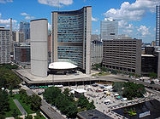
Toronto City Hall

Encyclopedia
The City Hall of Toronto
, Ontario
, Canada
is the home of the city's municipal government and one of its most distinctive landmarks. Designed by Finnish
architect Viljo Revell
(with Heikki Castrén, Bengt Lundsten, Seppo Valjus) and landscape architect Richard Strong, and engineered by Hannskarl Bandel
, the building opened in 1965. It was built to replace Old City Hall
, which was built in 1899. The current City Hall, located at Nathan Phillips Square
, is actually Toronto’s fourth city hall and was built in order to replace the former city hall due to a shortage of space. The area of Toronto City Hall and the civic square was formerly the location of Toronto's old chinatown, which was expropriated and bulldozed during the mid-1950's in preparation for a new civic building.
In 1958, an international architectural competition was launched by Mayor Nathan Phillips
in order to find a design for the New City Hall. This competition was won by Finnish architect Viljo Revell whose winning proposal came first amongst submissions from forty-two countries. Revell’s design consists of twin towers surrounding a white disk-like council chamber which is mounted on a raised platform, with entrances located below that are open to the public. There is also a ramp from the square that connects to the podium green roof and also leads to the council chamber. The two towers are of unequal height as the east tower is taller than the west. The City Hall is nicknamed “The Eye of the Government” because it resembles a large eye in a plan view. Revell died a year before the New City Hall was completed.
, Bay Street
, and Chestnut Street. The recommendation was rejected by the electorate in a referendum on New Year's Day in 1947. However, in October 1952, a panel of citizens appointed by city council made the same recommendation. In 1954, a partnership of three of Toronto's largest architectural firms was selected to do the design: Marani and Morris, Mathers and Haldenby, and Shore and Moffat
. Presented in November 1955, their design proposed a conservative, limestone-clad building in the Modernist
style. It was symmetrical and faced a landscaped square. Unlike the design that would ultimately be built, it retained the stone Beaux-Arts Registry Office on the western part of the site and also included a landscaped public space in front of it. The podium of the new city hall was to house the council chambers, and had columns complimenting the eight columns of the Registry Building, with which it was aligned in facing the new public space.
Yet the plan did not satisfy Mayor Nathan Phillips, who called for an international design competition. A joint letter was sent by all classes of the University of Toronto Faculty of Architecture condemning the proposal and calling for an international competition. Frank Lloyd Wright
called the design a "sterilization" and "a cliché already dated", while Walter Gropius
criticized it as "very poor pseudo-modern design unworthy of the city of Toronto". It died when voters rejected plans for a new $18 million city hall in a December 1955 referendum, though the design was adapted and built as the Imperial Oil Building elsewhere in the city.
to choose the new design under terms drawn up by the International Union of Architects
, which itself caused some controversy as some felt the work should be done by a Canadian. A five-person panel of judges was drawn up with some of the world's greatest architecture experts. Eric Arthur
served as advisor. Over 500 designs from 42 countries were submitted by the deadline of 18 April 1958, from which eight semi-finalists were selected. In September 1958, Viljo Revell's design was selected by three of the judges, though it had almost not made the short list. Eero Saarinen
, as member of the panel of five judges, arrived a day and half late and chose Revell's design from the other judges' list of entrants that could summarily be rejected. He convinced two other judges on the panel that Revell's unique design should be the winner. One of the two dissenting judges was William Graham Holford, who was skeptical that the design could be built within the $18 million budget set by the city. Revell received a $25,000 prize plus what was estimated to be $1 million in fees to supervise construction. He complained that not enough credit was given to his design collaborators, Heikki Castren, Bengt Lundsten, and Seppo Valjus, and asked that all names be listed as the architects. Construction began in 1961, and the building was completed four years later. Revell died in 1964 before the project was finished.
 While the building's base is rectangular, its two towers are curved in cross-section and rise to differing heights.
The east tower is 27 storeys (99.5 metres (326 ft)) tall and the west tower is 20 storeys (79.4 metres (260 ft)). Between the towers is the saucer-like council chamber, and the overall arrangement is somewhat like two hands cradling the chamber. The outer concrete surfaces of the towers have been ribbed, to prevent collapse of the fabric as a result of the expansion of the exterior surfaces, and the tearing apart of the fabric as a result of differences in air pressure on the two sides of each wing-like tower during the high winds characteristic of the Great Lakes
. The north, west, and east elevations are more abstract and sculptural in contrast with the extensive glazing of south elevation facing the square; each presents a view of concave panels of concrete textured with split-faced strips of Botticino marble
. To the east of the square is Old City Hall
which is now a courthouse
. From the air, the building is seen as a giant unblinking eye, thus the building's original nickname of "The Eye of Government".
When finished, the building generated controversy among many people, who felt that it was extremely futuristic, too futuristic for the city. Even half a century later, it still appears very modern.
The design for the public space in front of the new city hall, Nathan Phillips Square
, was part of the competition. The square's reflecting pool
and concrete arches, fountain, and overhead walkways were thus also part of Revell's submission. It has since seen several monuments, sculptures, and other works of public art added, and is undergoing a renovation, but it continues to compliment the city hall with its original Modernist design elements.
City Hall was designated as a property of historical and architectural significance under the Ontario Heritage Act
in 1991. In 2005 the building celebrated its 40th birthday.
starring William Shatner
and Hal Holbrook
the city hall and Nathan Phillips Square provided the location for a protracted hostage scene. The city hall was seen in the Star Trek: The Next Generation
episode "Contagion
" as one of the possible destinations of an alien portal.
In the 2002 film The Tuxedo
, the city hall was playing the role of "CSA Headquarters". In the 2004 film Resident Evil: Apocalypse
, the building portrayed the City Hall in Raccoon City. It was destroyed by a neutron bomb blowing up over the building. In the 2006 film The Sentinel
, an assassination attempt takes place at a Group of Eight summit meeting in Toronto's city hall.
In the 2007 novel Consolation by Michael Redhill
, Toronto's city hall is described as an ice cream cone with a tumour in between.
The Devon Corporation headquarters in the popular Pokémon
anime franchise bears a striking resemblance to Toronto's city hall.
Various locations inside the building are accessible to the public during Doors Open Toronto
; council chambers, the Mayor's office, and 27th floor were included in 2009.

Toronto
Toronto is the provincial capital of Ontario and the largest city in Canada. It is located in Southern Ontario on the northwestern shore of Lake Ontario. A relatively modern city, Toronto's history dates back to the late-18th century, when its land was first purchased by the British monarchy from...
, Ontario
Ontario
Ontario is a province of Canada, located in east-central Canada. It is Canada's most populous province and second largest in total area. It is home to the nation's most populous city, Toronto, and the nation's capital, Ottawa....
, Canada
Canada
Canada is a North American country consisting of ten provinces and three territories. Located in the northern part of the continent, it extends from the Atlantic Ocean in the east to the Pacific Ocean in the west, and northward into the Arctic Ocean...
is the home of the city's municipal government and one of its most distinctive landmarks. Designed by Finnish
Finland
Finland , officially the Republic of Finland, is a Nordic country situated in the Fennoscandian region of Northern Europe. It is bordered by Sweden in the west, Norway in the north and Russia in the east, while Estonia lies to its south across the Gulf of Finland.Around 5.4 million people reside...
architect Viljo Revell
Viljo Revell
Viljo Revell was a Finnish architect of the functionalist school. Internationally Revell is best known for designing the Toronto City Hall....
(with Heikki Castrén, Bengt Lundsten, Seppo Valjus) and landscape architect Richard Strong, and engineered by Hannskarl Bandel
Hannskarl Bandel
Hannskarl Bandel , was a German American structural engineer.-Early life:...
, the building opened in 1965. It was built to replace Old City Hall
Old City Hall (Toronto)
Toronto's Old City Hall was home to its city council from 1899 to 1966 and remains one of the city's most prominent structures. The building is located at the corner of Queen and Bay Streets, across Bay Street from Nathan Phillips Square and the new City Hall in the centre of downtown Toronto...
, which was built in 1899. The current City Hall, located at Nathan Phillips Square
Nathan Phillips Square
Nathan Phillips Square is an urban plaza that forms the forecourt to Toronto City Hall, or New City Hall, at the intersection of Queen Street West and Bay Street, and named for Nathan Phillips, mayor of Toronto from 1955 to 1962. The square opened in 1965, and, as with the City Hall, the square was...
, is actually Toronto’s fourth city hall and was built in order to replace the former city hall due to a shortage of space. The area of Toronto City Hall and the civic square was formerly the location of Toronto's old chinatown, which was expropriated and bulldozed during the mid-1950's in preparation for a new civic building.
In 1958, an international architectural competition was launched by Mayor Nathan Phillips
Nathan Phillips (politician)
Nathan Phillips, KC was a Canadian politician and popular Mayor of Toronto, Ontario.-Early life:Born in Brockville, Ontario, the son of Jacob Phillips and Mary Rosenbloom, he was educated in public and high schools in Cornwall. In 1908, he articled with the Cornwall lawyer, Robert Smith, who later...
in order to find a design for the New City Hall. This competition was won by Finnish architect Viljo Revell whose winning proposal came first amongst submissions from forty-two countries. Revell’s design consists of twin towers surrounding a white disk-like council chamber which is mounted on a raised platform, with entrances located below that are open to the public. There is also a ramp from the square that connects to the podium green roof and also leads to the council chamber. The two towers are of unequal height as the east tower is taller than the west. The City Hall is nicknamed “The Eye of the Government” because it resembles a large eye in a plan view. Revell died a year before the New City Hall was completed.
History
Toronto had been looking to build a more modern city hall to house its growing municipal government since at least 1943, when a report to city council recommended a new city hall and square in the block bounded by Queen Street WestQueen Street West
Queen Street West describes both the western branch of Queen Street, a major east-west thoroughfare, and a series of neighbourhoods or commercial districts, situated west of Yonge Street in downtown Toronto, Ontario, Canada. Queen Street begins in the west at the intersection of King Street, The...
, Bay Street
Bay Street
Bay Street, originally known as Bear Street, is a major thoroughfare in Downtown Toronto. It is the centre of Toronto's Financial District and is often used by metonymy to refer to Canada's financial industry since succeeding Montreal's St. James Street in that role in the 1970s...
, and Chestnut Street. The recommendation was rejected by the electorate in a referendum on New Year's Day in 1947. However, in October 1952, a panel of citizens appointed by city council made the same recommendation. In 1954, a partnership of three of Toronto's largest architectural firms was selected to do the design: Marani and Morris, Mathers and Haldenby, and Shore and Moffat
Shore Tilbe Irwin + Partners
Shore Tilbe Irwin + Partners , now Shore Tilbe Perkins+Will, is an architecture firm based in Toronto, Ontario. Since its founding as Shore and Moffat in 1945, STI&P completed numerous buildings, complexes, and master plans across Canada, as well as in locations in the United States and Bermuda...
. Presented in November 1955, their design proposed a conservative, limestone-clad building in the Modernist
Modern architecture
Modern architecture is generally characterized by simplification of form and creation of ornament from the structure and theme of the building. It is a term applied to an overarching movement, with its exact definition and scope varying widely...
style. It was symmetrical and faced a landscaped square. Unlike the design that would ultimately be built, it retained the stone Beaux-Arts Registry Office on the western part of the site and also included a landscaped public space in front of it. The podium of the new city hall was to house the council chambers, and had columns complimenting the eight columns of the Registry Building, with which it was aligned in facing the new public space.
Yet the plan did not satisfy Mayor Nathan Phillips, who called for an international design competition. A joint letter was sent by all classes of the University of Toronto Faculty of Architecture condemning the proposal and calling for an international competition. Frank Lloyd Wright
Frank Lloyd Wright
Frank Lloyd Wright was an American architect, interior designer, writer and educator, who designed more than 1,000 structures and completed 500 works. Wright believed in designing structures which were in harmony with humanity and its environment, a philosophy he called organic architecture...
called the design a "sterilization" and "a cliché already dated", while Walter Gropius
Walter Gropius
Walter Adolph Georg Gropius was a German architect and founder of the Bauhaus School who, along with Ludwig Mies van der Rohe and Le Corbusier, is widely regarded as one of the pioneering masters of modern architecture....
criticized it as "very poor pseudo-modern design unworthy of the city of Toronto". It died when voters rejected plans for a new $18 million city hall in a December 1955 referendum, though the design was adapted and built as the Imperial Oil Building elsewhere in the city.
Design competition
Led by Mayor Nathan Phillips, Toronto city council decided in 1956 to have an international competitionArchitectural design competition
An architectural design competition is a special type of competition in which an organization or government body that plans to build a new building asks for architects to submit a proposed design for a building. The winning design is usually chosen by an independent panel of design professionals...
to choose the new design under terms drawn up by the International Union of Architects
International Union of Architects
The International Union of Architects is an international non-governmental organization that represents over a million architects in 124 countries. The UIA was founded in Lausanne, Switzerland, in 1948. The General Secretariat is located in Paris...
, which itself caused some controversy as some felt the work should be done by a Canadian. A five-person panel of judges was drawn up with some of the world's greatest architecture experts. Eric Arthur
Eric Arthur
Eric Ross Arthur, was a Canadian architect, writer and educator.Born in Dunedin, New Zealand and educated in England, he served in World War I with the New Zealand Rifle Brigade...
served as advisor. Over 500 designs from 42 countries were submitted by the deadline of 18 April 1958, from which eight semi-finalists were selected. In September 1958, Viljo Revell's design was selected by three of the judges, though it had almost not made the short list. Eero Saarinen
Eero Saarinen
Eero Saarinen was a Finnish American architect and industrial designer of the 20th century famous for varying his style according to the demands of the project: simple, sweeping, arching structural curves or machine-like rationalism.-Biography:Eero Saarinen shared the same birthday as his father,...
, as member of the panel of five judges, arrived a day and half late and chose Revell's design from the other judges' list of entrants that could summarily be rejected. He convinced two other judges on the panel that Revell's unique design should be the winner. One of the two dissenting judges was William Graham Holford, who was skeptical that the design could be built within the $18 million budget set by the city. Revell received a $25,000 prize plus what was estimated to be $1 million in fees to supervise construction. He complained that not enough credit was given to his design collaborators, Heikki Castren, Bengt Lundsten, and Seppo Valjus, and asked that all names be listed as the architects. Construction began in 1961, and the building was completed four years later. Revell died in 1964 before the project was finished.
Design
The east tower is 27 storeys (99.5 metres (326 ft)) tall and the west tower is 20 storeys (79.4 metres (260 ft)). Between the towers is the saucer-like council chamber, and the overall arrangement is somewhat like two hands cradling the chamber. The outer concrete surfaces of the towers have been ribbed, to prevent collapse of the fabric as a result of the expansion of the exterior surfaces, and the tearing apart of the fabric as a result of differences in air pressure on the two sides of each wing-like tower during the high winds characteristic of the Great Lakes
Great Lakes
The Great Lakes are a collection of freshwater lakes located in northeastern North America, on the Canada – United States border. Consisting of Lakes Superior, Michigan, Huron, Erie, and Ontario, they form the largest group of freshwater lakes on Earth by total surface, coming in second by volume...
. The north, west, and east elevations are more abstract and sculptural in contrast with the extensive glazing of south elevation facing the square; each presents a view of concave panels of concrete textured with split-faced strips of Botticino marble
Marble
Marble is a metamorphic rock composed of recrystallized carbonate minerals, most commonly calcite or dolomite.Geologists use the term "marble" to refer to metamorphosed limestone; however stonemasons use the term more broadly to encompass unmetamorphosed limestone.Marble is commonly used for...
. To the east of the square is Old City Hall
Old City Hall (Toronto)
Toronto's Old City Hall was home to its city council from 1899 to 1966 and remains one of the city's most prominent structures. The building is located at the corner of Queen and Bay Streets, across Bay Street from Nathan Phillips Square and the new City Hall in the centre of downtown Toronto...
which is now a courthouse
Courthouse
A courthouse is a building that is home to a local court of law and often the regional county government as well, although this is not the case in some larger cities. The term is common in North America. In most other English speaking countries, buildings which house courts of law are simply...
. From the air, the building is seen as a giant unblinking eye, thus the building's original nickname of "The Eye of Government".
When finished, the building generated controversy among many people, who felt that it was extremely futuristic, too futuristic for the city. Even half a century later, it still appears very modern.
The design for the public space in front of the new city hall, Nathan Phillips Square
Nathan Phillips Square
Nathan Phillips Square is an urban plaza that forms the forecourt to Toronto City Hall, or New City Hall, at the intersection of Queen Street West and Bay Street, and named for Nathan Phillips, mayor of Toronto from 1955 to 1962. The square opened in 1965, and, as with the City Hall, the square was...
, was part of the competition. The square's reflecting pool
Reflecting pool
A reflecting pool or reflection pool is a water feature found in gardens, parks, and at memorial sites. It usually consists of a shallow pool of water, undisturbed by fountain jets, for a calm reflective...
and concrete arches, fountain, and overhead walkways were thus also part of Revell's submission. It has since seen several monuments, sculptures, and other works of public art added, and is undergoing a renovation, but it continues to compliment the city hall with its original Modernist design elements.
Additions and changes
City Hall has changed over the last four decades:- Minor upgrades by Toronto architect Bruce KuwabaraBruce KuwabaraBruce Bunji Kuwabara, B.Arch, OAA, FRAIC, RCA, AIA is a Canadian architect and partner in the firm Kuwabara Payne McKenna Blumberg Architects ....
to connect the two towers and upgrade council chambers in 1997-1998 - Observation deck closed
- Gift shop closed
- City Hall library reduced in size
- The ice rink is still used for skating during winter, but people cannot use the pool/fountain area to wade in during summer
City Hall was designated as a property of historical and architectural significance under the Ontario Heritage Act
Ontario Heritage Act
The Ontario Heritage Act, first enacted on March 5, 1975, allows municipalities and the provincial government to designate individual properties and districts in the Province of Ontario, Canada, as being of cultural heritage value or interest....
in 1991. In 2005 the building celebrated its 40th birthday.
In popular culture
In the 1980 film The Kidnapping of the PresidentThe Kidnapping of the President
The Kidnapping of the President is a 1980 political thriller film made by Presidential Films and Sefel Films and distributed by Crown International Pictures. It was produced and directed by George Mendeluk and co-produced by John Ryan from a screenplay by Richard Murphy and Charles Templeton,...
starring William Shatner
William Shatner
William Alan Shatner is a Canadian actor, musician, recording artist, and author. He gained worldwide fame and became a cultural icon for his portrayal of James T...
and Hal Holbrook
Hal Holbrook
Harold Rowe "Hal" Holbrook, Jr. is an American actor. His television roles include Abraham Lincoln in the 1976 TV series Lincoln, Hays Stowe on The Bold Ones: The Senator and Capt. Lloyd Bucher on Pueblo. He is also known for his role in the 2007 film Into the Wild, for which he was nominated for...
the city hall and Nathan Phillips Square provided the location for a protracted hostage scene. The city hall was seen in the Star Trek: The Next Generation
Star Trek: The Next Generation
Star Trek: The Next Generation is an American science fiction television series created by Gene Roddenberry as part of the Star Trek franchise. Roddenberry, Rick Berman, and Michael Piller served as executive producers at different times throughout the production...
episode "Contagion
Contagion (TNG episode)
-Overview:Picard and company try to protect the Enterprise against a catastrophic malfunction and simultaneously unlock the secrets of the once-powerful Iconian empire while keeping those secrets from the watchful Romulans.-Plot:...
" as one of the possible destinations of an alien portal.
In the 2002 film The Tuxedo
The Tuxedo
The Tuxedo is a 2002 American comedy-action film directed by Kevin Donovan and starring Jackie Chan and Jennifer Love Hewitt. It is a spy spoof that involves a special tuxedo that grants its wearer special abilities and a corporate terrorist threatening to poison the United States' fresh water...
, the city hall was playing the role of "CSA Headquarters". In the 2004 film Resident Evil: Apocalypse
Resident Evil: Apocalypse
Resident Evil: Apocalypse is a Canadian-British 2004 science fiction action horror film directed by Alexander Witt, from a screenplay written by producer Paul W.S. Anderson...
, the building portrayed the City Hall in Raccoon City. It was destroyed by a neutron bomb blowing up over the building. In the 2006 film The Sentinel
The Sentinel (2006 film)
The Sentinel is a 2006 action thriller film about a veteran United States Secret Service bodyguard who is suspected as a traitor after an attempted assassination of the president reveals that someone within the Service is providing information to the assassins...
, an assassination attempt takes place at a Group of Eight summit meeting in Toronto's city hall.
In the 2007 novel Consolation by Michael Redhill
Michael Redhill
Michael Redhill is an American-born Canadian poet, playwright and novelist.Born in Baltimore, Maryland, Redhill was raised in the metropolitan Toronto, Ontario area. He pursued one year of study at Indiana University, and then returned to Canada, completing his education at York University and the...
, Toronto's city hall is described as an ice cream cone with a tumour in between.
The Devon Corporation headquarters in the popular Pokémon
Pokémon
is a media franchise published and owned by the video game company Nintendo and created by Satoshi Tajiri in 1996. Originally released as a pair of interlinkable Game Boy role-playing video games developed by Game Freak, Pokémon has since become the second most successful and lucrative video...
anime franchise bears a striking resemblance to Toronto's city hall.
Festivals
City hall is one of the main host of different festivals and events in Toronto. Great New Year celebration is held there every year including fireworks, sparkling & singing of different music bands. One of the other major festivals at Toronto city hall is the annual Cavalcade of Lights sets which is held from ends of November until end of December.Various locations inside the building are accessible to the public during Doors Open Toronto
Doors Open Toronto
Doors Open Toronto, now in its 12th year, has evolved into a weekend festival that is recognized as one of Toronto's greatest cultural events....
; council chambers, the Mayor's office, and 27th floor were included in 2009.
See also
- Mayor of Toronto
- Toronto City CouncilToronto City CouncilThe Toronto City Council is the governing body of the city of Toronto, Ontario, Canada.Members represent wards throughout the city, and are known as councillors....
- Old City HallOld City Hall (Toronto)Toronto's Old City Hall was home to its city council from 1899 to 1966 and remains one of the city's most prominent structures. The building is located at the corner of Queen and Bay Streets, across Bay Street from Nathan Phillips Square and the new City Hall in the centre of downtown Toronto...
, next door, now a court house - Metro HallMetro HallMetro Hall is a 27-storey Postmodern office tower at the corner of Wellington and John Streets in Toronto, Canada. It looks out onto Pecaut Square. Part of the three-tower Metro Centre complex, the building was completed in 1992 to house the Municipality of Metropolitan Toronto and its employees...
- East York Civic CentreEast York Civic CentreThe East York Civic Centre was the municipal office of the former Borough of East York, Canada, now part of Toronto as the result of municipal amalgamation...
, Etobicoke Civic CentreEtobicoke Civic CentreThe Etobicoke Civic Centre in the Eatonville neighbourhood of Toronto, once housed the municipal government of the former City of Etobicoke. The building was built in 1958 to replace the single storey brick Township of Etobicoke Municipal Hall at 4096 Dundas Street...
, North York Civic CentreNorth York Civic CentreThe North York Civic Centre is a building that once served as the city hall for the former City of North York, Ontario, Canada.Designed by Adamson Associates Architects, the building is located on Yonge Street north of Sheppard Avenue, and features Mel Lastman Square along the Yonge Street frontage...
, Scarborough Civic CentreScarborough Civic CentreThe Scarborough Civic Centre, located in Toronto, Ontario, was designed by architect Raymond Moriyama for the then Borough of Scarborough. It was officially opened by then mayor Albert Campbell and Queen Elizabeth II in 1973...
, York Civic CentreYork Civic CentreThe York Civic Centre housed the municipal government of the former city of York, Ontario, now part of the city of Toronto. It is located at 2700 Eglinton Avenue West in the neighbourhood of Beechborough-Greenbrook...