
Toluene
Toluene, also known as methylbenzene or phenylmethane is a clear,
water-insoluble liquid with the typical smell of paint thinners, reminiscent of the sweet smell of the related compound
benzene. It is an
aromatic hydrocarbon that is widely used as an industrial feedstock and as a solvent.
Encyclopedia
>| Toluene |
|---|
| |
| General |
|---|
| Systematic name | toluene |
| Other names | methylbenzene phenylmethane toluol |
| Molecular formula | C7H8 |
| SMILES | Cc1ccccc1 |
| Molar mass | 92.14 g/mol |
| Appearance | Clear, colourless liquid |
| CAS number | [108-88-3] |
| Properties |
|---|
| Density and phase | 0.8669 g/cm3, liquid |
| Solubility in water | 0.053 g/100 mL |
In ethanol, acetone, hexane, dichloromethane | Fully miscible |
| Melting point | -93 °C / |
| Boiling point | 110.6 °C / 231.08°F |
| Critical temperature | 320 °C / 608°F |
| Viscosity | 0.590 cP at 20°C/ 68°F |
| Dipole moment | 0.36 D |
| Hazards |
|---|
| MSDS | External MSDS |
| Main hazards | highly flammable |
| NFPA 704 | |
| Flash point | 4 °C/ 39.2 °F |
| R-phrases | , |
| S-phrases | , , , |
| RTECS number | XS5250000 |
| Supplementary data page |
|---|
| Structure & properties | n, er, etc. |
| Thermodynamic data | Phase behaviour Solid, liquid, gas |
| Spectral data | UV, IR, NMR, MS |
| Related compounds |
|---|
Related aromatic hydrocarbons | benzene xylene naphthalene |
| Related compounds | methylcyclohexane |
Except where noted otherwise, data are given for materials in their standard state
|
|
Toluene, also known as
methylbenzene or
phenylmethane is a clear,
water-insoluble liquid with the typical smell of paint thinners, reminiscent of the sweet smell of the related compound
benzene. It is an
aromatic hydrocarbon that is widely used as an industrial feedstock and as a solvent.
History
The name
toluene was derived from the older name
toluol that refers to tolu balsam, an aromatic extract from the tropical American tree
Myroxylon balsamum, from which it was first isolated. It was originally named by
Jöns Jakob Berzelius.
Chemical properties
Toluene reacts as a normal
aromatic hydrocarbon towards
electrophilic aromatic substitution. The methyl group makes it around 25 times more reactive than
benzene in such reactions. It undergoes smooth
sulfonation to give
p-toluenesulfonic acid, and chlorination by Cl
2 in the presence of FeCl
3 to give ortho and para
isomers of
chlorotoluene. It undergoes
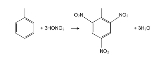
nitration to give ortho and para nitrotoluene isomers, but if heated it can give dinitrotoluene and ultimately the explosive
trinitrotoluene .
With other reagents the methyl side chain in toluene may react, undergoing oxidation. Reaction with
potassium permanganate leads to
benzoic acid, whereas reaction with
chromyl chloride leads to
benzaldehyde .
Halogenation can be performed under
free radical conditions. For example,
N-bromosuccinimide heated with toluene in the presence of
AIBN leads to
benzyl bromide.
Catalytic hydrogenation of toluene to methylcyclohexane requires a high pressure of
hydrogen to go to completion, because of the stability of the aromatic system.
Preparation
Toluene occurs naturally at low levels in
crude oil and is usually produced in the processes of making
gasoline via a catalytic reformer, in an
ethylene cracker or making coke from
coal. Final separation takes place in a BTX plant.
Uses
Toluene is a common solvent, able to dissolve:
paints, paint thinners, many
chemical reactants,
rubber,
printing ink,
adhesives ,
lacquers,
leather tanners, and disinfectants. It can also be used as a
fullerene indicator, and is a raw material for
toluene diisocyanate ,
phenol and
TNT. Toluene can be used as an
octane booster in
gasoline fuels used in
internal combustion engines. Toluene at 84% by volume, fueled all the turbo Formula 1 teams in the 1980s. Small 1.5L turbo engines were known to operate at 5 bar boost in qualifying and 4 bars while racing. More than 1500bhp from 1.5L engines was possible. For proper atomization, the Toluene fuel blend was preheated. Industrial uses of toluene include dealkylation to benzene and disproportionation to a mixture of benzene and
xylene.
Toxicology and metabolism
Inhalation of toluene fumes can be intoxicating, but in larger doses nausea-inducing.
Chronic or frequent inhalation of toluene over long time periods leads to irreversible brain damage. Toluene may enter the human system not only through vapour inhalation from the liquid evaporation, but also following
soil contamination events, where human contact with soil, ingestion of contaminated groundwater or soil vapour off-gassing can occur.
The toxicity of toluene can be explained mostly by its metabolism. As toluene has very low water solubility, it cannot exit the body via the normal routes . It must be metabolized in order to be excreted. The methyl group of toluene is more easily oxidized by
cytochrome P450 than the benzene ring. Therefore, in the metabolism of toluene, 95% is oxidized to become
benzyl alcohol. The toxic metabolites are created by the remaining 5% that are ring oxidized to epoxides. Most of the epoxides become
glutathione conjugated. However, the remainder will severely damage cells.
Toluene is mainly excreted as
benzoic acid and
hippuric acid, both formed by further metabolic oxidation of benzyl alcohol.
Behavioural Effects of Long Term Exposure
Serious adverse behavioural effects are often associated with toluene abuse related to the deliberate inhalation of solvents.
4 Long term toluene exposure is often associated with effects such as: psychoorganic syndrome;
5 visual evoked potential abnormality;
5 toxic polyneuropathy,
cerebellar,
cognitive, and pyramidal dysfunctions;
5 optic atrophy; and brain lesions.
4Toluene causes postural tremors by increasing extracellular concentrations of ?-aminobutyric acid within the
cerebellar cortex.
4 Treatment with GABA agonists such as,
benzodiazepines provide some relief from toluene induced tremor and ataxia.
4 An alternative to drug treatment is vim thalamotomy.
4 The tremors associated with toluene misuse do not seem to be a transient symptom, but an irreversible and progressive symptom which continues after solvent abuse has been discontinued.
4There is some evidence that low level toluene exposure may cause disruption in the differentiation of astrocyte precursor cells.
6 This does not appear to be a major hazard to adults; however, exposure of pregnant women to toluene during critical stages of fetal development could cause serious disruption to neuronal development.
6See also
External links
References
- B. S. Furnell et al., Vogel's Textbook of Practical Organic Chemistry, 5th edition, Longman/Wiley, New York, 1989.
- L. G. Wade, Organic Chemistry, 5th ed., p. 871, Prentice Hall, Upper Saddle RIver, New Jersey, 2003.
- J. March, Advanced Organic Chemistry, 4th ed., p. 723, Wiley, New York, 1992.
- Miyagi, Y., Shima, F., Ishido, K. et al. Tremor induced by toluene misuse successfully treated by a Vim thalamotomy. Journal of Neurology Neurosurgery and Psychiatry 66:794-6, .
- Urban, P., Lukáš, E., Pelclová, D. et al. Neurological and Neurophysiological Follow-up on Workers With Severe Chronic Exposure to Toluene. Neurotoxicity P25:s130, .
- Yamaguchi, H., Kidachi, Y. and Ryoyama, K. Toluene at Environmentally Relevant Low Levels Disrupts Differentiation of Astrocyte Precursor Cells. Archives of Environmental Health 57:232-8, .