

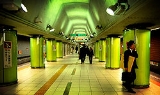
Tokyo Subway

Encyclopedia

Rapid transit
A rapid transit, underground, subway, elevated railway, metro or metropolitan railway system is an electric passenger railway in an urban area with a high capacity and frequency, and grade separation from other traffic. Rapid transit systems are typically located either in underground tunnels or on...
system in a single metropolitan area
Metropolitan area
The term metropolitan area refers to a region consisting of a densely populated urban core and its less-populated surrounding territories, sharing industry, infrastructure, and housing. A metropolitan area usually encompasses multiple jurisdictions and municipalities: neighborhoods, townships,...
, Greater Tokyo. While the subway system itself is largely within the city center, the lines extend far out via extensive through services onto suburban railway lines.
Networks
As of June 2008, the entire network of Tokyo MetroTokyo Metro
is one of two rapid transit systems making up the Tokyo subway system, the other being Toei. It is the most used subway system in the world in terms of annual passenger rides.-Organization:...
and Toei
Tokyo Metropolitan Bureau of Transportation
The is Tokyo's public transportation authority. Its subway lines are commonly described as 都営 Toei, meaning "operated by the metropolitan government ." It is one of two rapid transit systems making up the Tokyo subway system, the other being Tokyo Metro.-Toei Subway:The lines were originally...
has 274 stations and 13 lines. The Tokyo Metro and Toei networks together carry a combined average of over eight million passengers daily. Despite being ranked first in worldwide subway usage
Metro systems by annual passenger rides
The most-used metro systems in terms of passenger rides per year:# Tokyo Subway 3.161 billion # Moscow Metro 2.348 billion # Seoul Subway 2.048 billion...
, subways make up a small fraction of heavy rail rapid transit in Tokyo alone—only 274 out of 882 railway stations, as of 2007. The Tokyo subway at 8.7 million daily passengers only represents 22% of Tokyo's 40 million daily rail passengers (see Transport in Greater Tokyo).
There are two primary subway operators in Tokyo:
- Tokyo MetroTokyo Metrois one of two rapid transit systems making up the Tokyo subway system, the other being Toei. It is the most used subway system in the world in terms of annual passenger rides.-Organization:...
. Formerly Teito Rapid Transit Authority (Eidan), privatized in 2004 and presently operating 168 stations and nine lines. The minimum price for one ride is 160 yen. - Toei Subway (Tokyo Metropolitan Bureau of Transportation). An arm of the Tokyo Metropolitan Government, operates 106 stations in four lines. The minimum price for one ride is 170 yen.
| Line color | | Mark | | Line number | | Line | | Japanese | |||||
|---|---|---|---|---|---|---|---|---|---|
| Tokyo Metro | |||||||||
| Line 3 | Ginza Line Tokyo Metro Ginza Line The is a subway line located in Tokyo, Japan. It is part of the of Tokyo Metro network. The official name is . It is 14.3 km long and serves the wards of Shibuya, Minato, Chūō, Chiyoda, and Taitō.... |
||||||||
| Line 4 | Marunouchi Line | ||||||||
| Marunouchi Line Branch Line | |||||||||
| Line 2 | Hibiya Line Tokyo Metro Hibiya Line The is a metro line owned and operated by Tokyo Metro located in Tokyo, Japan. The line was named after the district of Hibiya, under which it passes.-Overview:The Hibiya Line runs between in Meguro and in Adachi... |
||||||||
| Line 5 | Tōzai Line Tokyo Metro Tozai Line The is a rapid transit line owned and operated by Tokyo Metro located in Tokyo and Chiba Prefecture, Japan. Its name literally means East-West Line. The line runs between Nakano Station in Nakano, Tokyo and Nishi-Funabashi Station in Funabashi, Chiba... |
||||||||
| Line 9 | Chiyoda Line | ||||||||
| Line 8 | Yūrakuchō Line Tokyo Metro Yurakucho Line The is a subway line owned and operated by Tokyo Metro. The line connects Wakōshi Station in Wakō, Saitama and Shin-Kiba Station in Kōtō, Tokyo. On maps, diagrams and signboards, the line is shown using the color "gold" , and its stations are given numbers using the letter Y.The proper name as... |
||||||||
| Line 11 | Hanzōmon Line Tokyo Metro Hanzomon Line The is a subway line owned and operated by Tokyo Metro located in Tokyo, Japan.-Overview:The 16.8 km line serves the wards of Shibuya, Minato, Chiyoda, Chūō, Kōtō and Sumida. Hanzōmon Line trains run through onto the Tōkyū Den-en-toshi Line from Shibuya Station and the Tōbu Isesaki Line from... |
||||||||
| Line 7 | Namboku Line Tokyo Metro Namboku Line The is a subway line owned and operated by Tokyo Metro in Tokyo, Japan. Its name literally means South-North Line. The line runs between Meguro in Shinagawa and Akabane-Iwabuchi in Kita... |
||||||||
| Line 13 | Fukutoshin Line | ||||||||
| Toei Subway | |||||||||
| Line 1 | Asakusa Line | ||||||||
| Line 6 | Mita Line Toei Mita Line The is a subway line of the Tokyo Metropolitan Bureau of Transportation network in Tokyo, Japan. The line runs between Nishi-Takashimadaira in Itabashi and Meguro in Shinagawa. Trains continue with direct service into the Meguro Line of Tokyu Corporation for... |
||||||||
| Line 10 | Shinjuku Line Toei Shinjuku Line The is a subway line in Tokyo and Chiba Prefecture, Japan, operated by Tokyo Metropolitan Bureau of Transportation . The line runs between Motoyawata Station in Ichikawa, Chiba in the east and Shinjuku Station in the west... |
||||||||
| Line 12 | Ōedo Line Toei Oedo Line The is a subway line in Tokyo, Japan operated by the Tokyo Metropolitan Bureau of Transportation . It commenced full operations on December 12, 2000; using the Japanese calendar this reads "12/12/12" as the year 2000 equals Heisei 12... |
||||||||
In addition, but not formally designated as subways:
- The Tokyo Waterfront Area Rapid Transit (TWR) operates a single mostly-underground line with eight stations, and 200,200 daily passengers in 2010
- Saitama Railway Line which is essentially an extension of the Tokyo Metro Namboku LineTokyo Metro Namboku LineThe is a subway line owned and operated by Tokyo Metro in Tokyo, Japan. Its name literally means South-North Line. The line runs between Meguro in Shinagawa and Akabane-Iwabuchi in Kita...
operates a single mostly-underground line with eight stations.
The Yamanote Line
Yamanote Line
The is commuter rail loop line in Tokyo, Japan, operated by East Japan Railway Company . It is one of Tokyo's busiest and most important lines, connecting most of Tokyo's major stations and urban centres, including the Yūrakuchō/Ginza area, Shibuya, Shinjuku, and Ikebukuro, with all but two of its...
and the Chūō-Sōbu Line
Chuo-Sobu Line
The is a railway line located in Tokyo and Chiba Prefecture, Japan. Part of the East Japan Railway Company network, it runs on separate tracks along the right-of-way of the Chūō Main Line and Sōbu Main Line , providing service between Mitaka Station in the cities of Mitaka and Musashino and...
are not subway lines, but above-ground busy commuter lines which operate with metro-like frequencies and trains owned by JR East
East Japan Railway Company
is the largest passenger railway company in the world and one of the seven Japan Railways Group companies. The company name is officially abbreviated as JR East in English, and as in Japanese. The company's headquarters are in Yoyogi, Shibuya, Tokyo....
. They act as key transportation arteries in central Tokyo, and are often marked on Tokyo subway maps.
The Yokohama Subway, Minatomirai Line (and the planned Kawasaki Subway) also operate in the Greater Tokyo Area, but they are not directly linked to the Tokyo subway network. However, on special occasions (typically holiday weekends), the Tokyo Metro Hibiya Line
Tokyo Metro Hibiya Line
The is a metro line owned and operated by Tokyo Metro located in Tokyo, Japan. The line was named after the district of Hibiya, under which it passes.-Overview:The Hibiya Line runs between in Meguro and in Adachi...
and Namboku Line
Tokyo Metro Namboku Line
The is a subway line owned and operated by Tokyo Metro in Tokyo, Japan. Its name literally means South-North Line. The line runs between Meguro in Shinagawa and Akabane-Iwabuchi in Kita...
operate special direct through services onto Yokohama's Minatomirai Line via the Tōkyū Tōyoko Line railway. From 2012, the Tokyo Metro Fukutoshin Line will also have regular through service to the Minatomirai Line.
System administration
Both Tokyo Metro and Toei Subway systems are closely integrated with a unified system of line colors, line codes, and station numbers. However, the separate administration of metro systems has some ramifications:- For single rides across Metro and Toei systems, a special transfer ticket is required. It costs 70 yen less than the sum of the Metro fare and the Toei fare, calculated based on the shortest possible route between the origin and destination stations. The PassnetPassnetwas a stored-fare system using magnetic cards of the 22 members of the Passnet Association in the Kantō region of Japan. It was available between October 14, 2000 and January 11, 2008 in 1,000, 3,000 and 5,000 yen varieties....
system simplified such ticketing problems, by allowing one stored-fare card to be used on most of the rail operators in the Greater Tokyo AreaGreater Tokyo AreaThe Greater Tokyo Area is a large metropolitan area in Kantō region, Japan, consisting of most of the prefectures of Chiba, Kanagawa, Saitama, and Tokyo . In Japanese, it is referred to by various terms, including the , , and others....
(with the noticeable exception of JR East which continued to use its own SuicaSuicais a rechargeable contactless smart card used as a fare card on train lines in Japan. Launched in November 2001, the card is usable currently in the Kantō region, at JR East stations near Sendai and Niigata...
system). The new PASMOPASMOis a rechargeable contactless smart card ticketing system for public transport introduced in Tokyo, Japan, on March 18, 2007.Pasmo is a development of the system used by many non JR railway lines in the Tokyo region...
system was introduced in 2007 and completely replaced the Passnet in 2008, finally allowing for one unified stored fare system for most of the Tokyo transit system, including JR East. The fare charged by the stored fare system is the same as for the users of paper tickets. - The systems represent the metro network differently in station, train, and customer information diagrams. For example, the Toei map represents the Toei Ōedo LineToei Oedo LineThe is a subway line in Tokyo, Japan operated by the Tokyo Metropolitan Bureau of Transportation . It commenced full operations on December 12, 2000; using the Japanese calendar this reads "12/12/12" as the year 2000 equals Heisei 12...
as a circle in the centre, whereas the Tokyo Metro's map saves the central ring line for the Marunouchi Line and the JR Yamanote LineYamanote LineThe is commuter rail loop line in Tokyo, Japan, operated by East Japan Railway Company . It is one of Tokyo's busiest and most important lines, connecting most of Tokyo's major stations and urban centres, including the Yūrakuchō/Ginza area, Shibuya, Shinjuku, and Ikebukuro, with all but two of its...
. As well, each system's lines are generally rendered with thicker lines on their respective system maps.
Reciprocal operation
As is common with Japanese subway systems, many above-ground and underground lines in the Greater Tokyo AreaGreater Tokyo Area
The Greater Tokyo Area is a large metropolitan area in Kantō region, Japan, consisting of most of the prefectures of Chiba, Kanagawa, Saitama, and Tokyo . In Japanese, it is referred to by various terms, including the , , and others....
operate through services with the Tokyo Metro and Toei lines, in a broader meaning they consist as a part of the Tokyo subway network, allowing the subway to that reach far out into the suburbs.
Tokyo MetroTokyo Metrois one of two rapid transit systems making up the Tokyo subway system, the other being Toei. It is the most used subway system in the world in terms of annual passenger rides.-Organization:...
| | Line | Through Lines | |
|---|---|---|
| Hibiya Line Tokyo Metro Hibiya Line The is a metro line owned and operated by Tokyo Metro located in Tokyo, Japan. The line was named after the district of Hibiya, under which it passes.-Overview:The Hibiya Line runs between in Meguro and in Adachi... |
Tōkyū Tōyoko Line ( Naka-Meguro Naka-Meguro Station is a railway station located in Meguro, Tokyo, Japan.Naka-Meguro is a convenient transfer point between the Tōkyū Tōyoko Line and the Tokyo Metro Hibiya Line, connecting Yokohama with the districts of Roppongi, Akihabara, Ginza, and Tsukiji in Tokyo, and beyond... to Kikuna Kikuna Station is a commuter railway station on the East Japan Railway Company's Yokohama Line and on the Tokyu Corporation’s Tōkyū Tōyoko Line located in Kanagawa Ward, Yokohama, Kanagawa Prefecture, Japan... ) |
|
| Tōbu Isesaki Line ( Kita-Senju Kita-Senju Station is a railway station in Adachi, Tokyo, Japan.Kita-Senju is the second-busiest station on the Tobu Railway and Tokyo Metro networks... to Tōbu-Dōbutsu-Kōen) |
||
| Tōzai Line Tokyo Metro Tozai Line The is a rapid transit line owned and operated by Tokyo Metro located in Tokyo and Chiba Prefecture, Japan. Its name literally means East-West Line. The line runs between Nakano Station in Nakano, Tokyo and Nishi-Funabashi Station in Funabashi, Chiba... |
JR East East Japan Railway Company is the largest passenger railway company in the world and one of the seven Japan Railways Group companies. The company name is officially abbreviated as JR East in English, and as in Japanese. The company's headquarters are in Yoyogi, Shibuya, Tokyo.... Chūō-Sōbu Line Chuo-Sobu Line The is a railway line located in Tokyo and Chiba Prefecture, Japan. Part of the East Japan Railway Company network, it runs on separate tracks along the right-of-way of the Chūō Main Line and Sōbu Main Line , providing service between Mitaka Station in the cities of Mitaka and Musashino and... (Chūō Main Line Chuo Main Line The , commonly called the Chūō Line, is one of the major trunk railway lines in Japan. It runs between Tokyo and Nagoya, although it is the slowest direct railway connection between the two cities; the coastal Tōkaidō Main Line is slightly faster, while the Tōkaidō Shinkansen is the fastest rail... ) ( Nakano Nakano Station (Tokyo) is a railway station in Japan located on the JR Chūō Main Line in Nakano, Tokyo, just west of Shinjuku.-Lines:Nakano Station is served by the JR East Chūō Line and Chūō-Sōbu Line, and the Tokyo Metro Tōzai Line... to Mitaka Mitaka Station is a railway station in Mitaka, Tokyo, Japan, operated by the East Japan Railway Company .-Lines:Mitaka Station is served by the Chūō Main Line, acting as the terminus for all-stations Chūō-Sōbu Line services from , with Chūō Line limited stop services from... ) |
|
| JR East Chūō-Sōbu Line (Sōbu Main Line) ( Nishi-Funabashi Nishi-Funabashi Station is a railway station in Funabashi, Chiba, Japan, operated by East Japan Railway Company , Tokyo Metro, and the Tōyō Rapid Railway. It is the eastern-most station of the Tokyo subway network, lying in Chiba prefecture.-Lines:... to Tsudanuma Tsudanuma Station is a railway station located in Narashino, Chiba, Japan.It is served by the Sōbu Main Line operated by East Japan Railway Company .-Adjacent stations:... ) |
||
| Toyo Rapid Line (Nishi-Funabashi Nishi-Funabashi Station is a railway station in Funabashi, Chiba, Japan, operated by East Japan Railway Company , Tokyo Metro, and the Tōyō Rapid Railway. It is the eastern-most station of the Tokyo subway network, lying in Chiba prefecture.-Lines:... to Tōyō-Katsutadai Toyo-Katsutadai Station is a terminal railway station operated by Tōyō Rapid Railway's Tōyō Rapid Railway Line located in Yachiyo, Chiba Prefecture Japan. It is 16.2 kilometers from the opposing terminus of the Tōyō Rapid Railway Line at Nishi-Funabashi Station. -History:... ) |
||
| Chiyoda Line | Odakyu Odawara Line and Odakyu Tama Line (Yoyogi-Uehara Yoyogi-Uehara Station is a railway station on the Odakyū Odawara and Tokyo Metro Chiyoda lines located in Shibuya, Tokyo. The Tokyo Metro station number is C-01. The station was opened as a stop on the Odakyū Odawara Line on April 1, 1927; Eidan began service at the station on March 31, 1978.Both lines share platforms... to Karakida Karakida Station is the station of Odakyū Tama Line in Tama, Tokyo, Japan.-Station layout:The station has one side platform with one track and one island platform with two tracks.-Service pattern:Trains operate 0510-0010 every day.... and Hon-Atsugi Hon-Atsugi Station is a major stop on the Odakyu Electric Railway’s Odawara Line serving the city of Atsugi in Kanagawa Prefecture, Japan. The station is 45.5 rail kilometers from the line’s terminal at Shinjuku Station. Most local, section semi-express, and semi-express trains inbound from Shinjuku Station... ) |
|
| JR East East Japan Railway Company is the largest passenger railway company in the world and one of the seven Japan Railways Group companies. The company name is officially abbreviated as JR East in English, and as in Japanese. The company's headquarters are in Yoyogi, Shibuya, Tokyo.... Jōban Line Joban Line The is a railway line in Japan operated by East Japan Railway Company . It begins at Nippori Station in Taitō, Tokyo and follows the Pacific coasts of Chiba, Ibaraki, and Fukushima Prefectures before the line officially ends at Iwanuma Station in Iwanuma, Miyagi... (Ayase Ayase Station is a JR East and Tokyo Metro station located in Adachi, Tokyo, Japan. Tokyo Metro operates this station.-Lines:*East Japan Railway Company**Jōban Line*Tokyo Metro**Chiyoda Line- Station layout :... to Toride Toride Station is a train station located in Toride, Ibaraki, Japan.-Platforms:-Adjacent stations:-2010 knife attack:A Japanese man, identified as 27-year old, was arrested after stabbing 14 people outside of the west entrance of Toride Station on the morning of December 17, 2010... ) |
||
| Yūrakuchō Line Tokyo Metro Yurakucho Line The is a subway line owned and operated by Tokyo Metro. The line connects Wakōshi Station in Wakō, Saitama and Shin-Kiba Station in Kōtō, Tokyo. On maps, diagrams and signboards, the line is shown using the color "gold" , and its stations are given numbers using the letter Y.The proper name as... |
Tōbu Tōjō Line (Wakōshi Wakoshi Station is a railway station in Wakō, Saitama, Japan, operated by Tobu Railway and Tokyo Metro. It is the only Tokyo Metro station located in Saitama Prefecture.-Lines:Wakōshi Station is served by the Tōbu Tōjō Line from to and in Saitama Prefecture... to Shinrinkōen) |
|
| Seibu Yūrakuchō Line Seibu Yurakucho Line is a commuter subway line of the Seibu Railway, a major private railroad in Japan. This line connects the Nerima Station and Kotake-Mukaihara Station in Nerima, Tokyo.-Line Data:* Length: 2.6 km* Track gauge: 1,067 mm... via the Seibu Ikebukuro Line Seibu Ikebukuro Line The is a commuter railway line of the Japanese private railway operator Seibu Railway. It originates at Ikebukuro Station, a large railway junction in north-western Tokyo, extending to northwest suburbs as far as Tokorozawa, Saitama, and nominally terminates at Agano Station.The Seibu Chichibu... (Kotake-Mukaihara Station Kotake-mukaihara Station is a train station in Nerima, Tokyo Prefecture, Japan. Its station numbers for the Yūrakuchō and Fukutoshin Lines are Y-06 and F-06 respectively. The station opened on 24 June 1983, and consists of two parallel island platforms serving four tracks... to Hannō Hanno Station is a railway station in Hannō, Saitama, Japan. This station is served by the Seibu Ikebukuro Line. Hannō is the 26th station leaving from Ikebukuro Station on the Seibu Ikebukuro Line.-Adjacent stations:... ) |
||
| Hanzōmon Line Tokyo Metro Hanzomon Line The is a subway line owned and operated by Tokyo Metro located in Tokyo, Japan.-Overview:The 16.8 km line serves the wards of Shibuya, Minato, Chiyoda, Chūō, Kōtō and Sumida. Hanzōmon Line trains run through onto the Tōkyū Den-en-toshi Line from Shibuya Station and the Tōbu Isesaki Line from... |
Tōkyū Den-en-toshi Line (Shibuya Shibuya Station is a train station located in Shibuya, Tokyo, Japan. With 2.4 million passengers on an average weekday in 2004, it is the fourth-busiest commuter rail station in Japan handling a large amount of commuter traffic between the center city and suburbs to the south and west.-JR East:*Saikyō Line /... to Chūō-Rinkan Chuo-Rinkan Station is an interchange railway station operated by Tokyu Corporation's Tōkyū Den-en-toshi Line and the Odakyu Electric Railway's Odakyū Enoshima Line in Yamato, Kanagawa Prefecture, Japan... ) |
|
| Tōbu Isesaki Line and Tobu Nikkō Line (Oshiage Oshiage Station Oshiage Station is a train station located at the Oshiage-eki-mae intersection of Metropolitan Routes 453 and 465 in Sumida, Tokyo, Japan... to Minami-Kurihashi Minami-Kurihashi Station is a train station in Kuki, Saitama Prefecture, Japan.- Adjacent stations :... and Kuki Kuki Station (Saitama) is a railway station in Kuki, Saitama, Japan, operated by the East Japan Railway Company and Tobu Railway.-JR East platforms:One ground-level island platform and one ground-level side platform serving three tracks.-Tobu platforms:... ) |
||
| Namboku Line Tokyo Metro Namboku Line The is a subway line owned and operated by Tokyo Metro in Tokyo, Japan. Its name literally means South-North Line. The line runs between Meguro in Shinagawa and Akabane-Iwabuchi in Kita... |
Tokyu Meguro Line (Meguro Meguro Station is a railway station located in Tokyo's Shinagawa ward close to the boundary with Meguro ward. The station is just south of Meguro Dori .-Lines:Meguro Station is served by the following lines:*East Japan Railway Company Yamanote Line... to Hiyoshi Hiyoshi Station (Kanagawa) is an interchange railway station on the Tokyu Corporation's Tōyoko Line and Meguro Line, as well as the Yokohama Municipal Subway's Green Line. It is located in located in Kōhoku Ward, Yokohama, Kanagawa Prefecture, Japan... ) |
|
| Saitama Rapid Railway Line Saitama Rapid Railway Line The is the continuation of the Namboku Line, starting at Akabane-Iwabuchi station in Tokyo and ending at Urawa Misono Station in Saitama. It was completed on March 28, 2001.... (Akabane-Iwabuchi Akabane-iwabuchi Station is a subway station in the Tokyo Metro network. It is located in Kita, Tokyo. The station is number N-19 in the Tokyo Metro labeling system.- References :... to Urawa-Misono) |
||
| Fukutoshin Line | Tōbu and Seibu line (same stations served as the Yūrakuchō Line) | |
| Minatomirai Line via Tōkyū Tōyoko Line (Shibuya Shibuya Station is a train station located in Shibuya, Tokyo, Japan. With 2.4 million passengers on an average weekday in 2004, it is the fourth-busiest commuter rail station in Japan handling a large amount of commuter traffic between the center city and suburbs to the south and west.-JR East:*Saikyō Line /... to Motomachi-Chūkagai Motomachi-Chukagai Station is an underground terminus of the Minatomirai Line subway located in Naka-ku, Yokohama, Kanagawa Prefecture, Japan. It is 4.1 kilometers from the opposite terminus of the Minatomirai Line at Yokohama Station. Its official name, as shown on signage in the station, is with the sub-name in... , planned and under construction) |
Toei Subway
| | Line | Through Lines | |
|---|---|---|
| Asakusa Line | Keikyu Kurihama Line Keikyu Kurihama Line The is a commuter rail line operated by Keikyu in Japan. Keikyū Main Line trains from Oshiage and Shinagawa in Tokyo run through the Miura Peninsula on the Keikyū Kurihama Line.-Stations:... and Keikyu Airport Line Keikyu Airport Line The is a commuter line operated by Keihin Kyuko Electric Railway. It runs from Keikyū Kamata to in Tokyo, and has Airport Express , Ltd. Express , Rapid Ltd. Express , and Airport Rapid Ltd. Express services.-Station list:... both via the Keikyu Main Line (Sengakuji Sengakuji Station is a railway station in Minato, Tokyo, Japan.It is entirely owned and operated by the Tokyo Metropolitan Bureau of Transportation, but also serves as the northern terminus of the Keikyu Main Line operated by the Keihin Electric Express Railway... to Haneda Airport Haneda Airport Station is a train station in Ōta, Tokyo, Japan, operated by Keikyu. The station is located beneath the Shuto Expressway Wangan Line and Route 357. The West Exit leads to Terminal 1 of Tokyo International Airport, and the East Exit leads to Terminal 2.- Station layout :... (Tokyo International Airport Tokyo International Airport , commonly known as , is one of the two primary airports that serve the Greater Tokyo Area in Japan. It is located in Ōta, Tokyo, south of Tokyo Station.... ) or Misakiguchi) |
|
| Keisei Oshiage Line, Keisei Main Line, Hokuso Railway Line, Keisei Higashi-Narita Line Keisei Higashi-Narita Line The is a branch line of the Keisei Main Line from Keisei Narita Station to Higashi-Narita Station .-Stations:... and Shibayama Railway Line (Oshiage Oshiage Station Oshiage Station is a train station located at the Oshiage-eki-mae intersection of Metropolitan Routes 453 and 465 in Sumida, Tokyo, Japan... to Narita Airport Narita Airport Station is an underground train station located beneath Terminal 1 of Narita International Airport in Narita, Chiba Prefecture, Japan. The station is shared between East Japan Railway Company and Keisei Electric Railway.-Station layout:... , Inba-Nihon-Idai Inba-Nihon-Idai Station is a train station in Inzai, Chiba Prefecture, Japan. In July 2010 this station was connected to the Narita Sky Access Line to Narita Airport.- Lines :* Hokusō Railway** Hokusō Line* Keisei Electric Railway** Narita Sky Access-Service pattern:... or Shibayama-Chiyoda Shibayama-Chiyoda Station Shibayama-Chiyoda Station is a terminus of the Shibayama Railway Line, located on the border between Shibayama and Narita, Chiba Prefecture, on the eastern boundary of Narita International Airport.... ) |
||
| Mita Line Toei Mita Line The is a subway line of the Tokyo Metropolitan Bureau of Transportation network in Tokyo, Japan. The line runs between Nishi-Takashimadaira in Itabashi and Meguro in Shinagawa. Trains continue with direct service into the Meguro Line of Tokyu Corporation for... |
Tokyu Meguro Line (Meguro Meguro Station is a railway station located in Tokyo's Shinagawa ward close to the boundary with Meguro ward. The station is just south of Meguro Dori .-Lines:Meguro Station is served by the following lines:*East Japan Railway Company Yamanote Line... to Hiyoshi Hiyoshi Station (Kanagawa) is an interchange railway station on the Tokyu Corporation's Tōyoko Line and Meguro Line, as well as the Yokohama Municipal Subway's Green Line. It is located in located in Kōhoku Ward, Yokohama, Kanagawa Prefecture, Japan... ) |
|
| Shinjuku Line Toei Shinjuku Line The is a subway line in Tokyo and Chiba Prefecture, Japan, operated by Tokyo Metropolitan Bureau of Transportation . The line runs between Motoyawata Station in Ichikawa, Chiba in the east and Shinjuku Station in the west... |
Keio New Line Keio New Line The is a 3.6 km link which connects Keio Corporation's Keiō Line from Sasazuka Station in Shibuya to Shinjuku Station with through service on to the Shinjuku Line of the Tokyo Metropolitan Bureau of Transportation.-Synopsis:... and Keio Sagamihara Line Keio Sagamihara Line The is a Japanese railway line operated by Keio Corporation, connecting Hashimoto Station in Sagamihara, Kanagawa Prefecture and Chōfu Station in Chōfu, Tokyo.-History:... both via the Keiō Line (Shinjuku Shinjuku Station is a train station located in Shinjuku and Shibuya wards in Tokyo, Japan.Serving as the main connecting hub for rail traffic between central Tokyo and its western suburbs on inter-city rail, commuter rail and metro lines, the station was used by an average of 3.64 million people per day in 2007,... to Hashimoto Hashimoto Station (Kanagawa) is a major stop on the East Japan Railway Company Yokohama Line, Sagami Line and the Keio Sagamihara Line straddling the city of Sagamihara in Kanagawa Prefecture, Japan.- JR East:- Keiō :-Surrounding area:*Midori Ward Office... or Takosanguchi) |
1995 sarin attack
In 1995, Aum Shinri Kyo, a doomsday cultDoomsday cult
Doomsday cult is an expression used to describe groups who believe in Apocalypticism and Millenarianism, and can refer both to groups that prophesy catastrophe and destruction, and to those that attempt to bring it about...
, attacked the subway system with sarin
Sarin
Sarin, or GB, is an organophosphorus compound with the formula [2CHO]CH3PF. It is a colorless, odorless liquid, which is used as a chemical weapon. It has been classified as a weapon of mass destruction in UN Resolution 687...
nerve gas at Kasumigaseki Station
Kasumigaseki Station (Tokyo)
is a Tokyo Metro station in Chiyoda, Tokyo, Japan, serving the Kasumigaseki government district.- History :* October 15, 1958 Marunouchi Line station opens.* March 25, 1964 Hibiya Line station opens.* March 20, 1971 Chiyoda Line station opens....
and a few others, leading to 12 deaths and 1,034 people injured.