

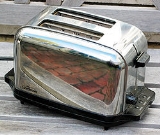
Toaster

Encyclopedia
The toaster is typically a small electric kitchen appliance designed to toast
multiple types of bread
products. A typical modern two-slice toaster draws anywhere between 600 and 1200 W (watt)
and makes toast in 1 to 3 minutes. There are also non-electrical toasters that can be used to toast bread products over an open fire or flame.
or by holding it near to a fire using a long-handled fork or under the grill of a kitchen cooker. Simple utensils for toasting bread over open flames go back at least 200 years, and earlier people simply speared bread with a stick, sword or knife and held it over a fire.
In 1905, Irishman Connor Neeson (1877–1944) of Detroit, Michigan
, and his employer, American chemist, electrical engineer, inventor and entrepreneur William Hoskins (1862–1934) of Chicago, Illinois, invented (and in 1906 patent
ed) chromel
(later and still today marketed as nichrome
), an alloy
from which could be made the first high-resistance
wire of the sort used in all early electric heating appliances (and many modern ones).
The first electric bread toaster was created by Maddy Kennedy in 1872. In 1893, Crompton, Stephen J. Cook & Company of the UK marketed an electric, iron-wired toasting appliance called the Eclipse. Early attempts at producing electrical appliances using iron wiring were unsuccessful, because the wiring was easily melted and a serious fire hazard. Meanwhile electricity was not readily available, and when it was, mostly only at night. The first US patent application for an electric toaster was filed by George Schneider of the American Electrical Heater Company of Detroit. AEH's proximity to Hoskins Manufacturing and the fact that the patent was filed only two months after the Marsh patents suggests collaboration and that the device was to use chromel wiring. One of the first applications the Hoskins company had considered for chromel was toasters, but eventually abandoned such efforts to focus on making just the wire itself.
At least two other brands of toasters had been introduced commercially around the time General Electric
submitted their first patent application in 1909 for one, the GE model D-12, designed by technician Frank Shailor, "the first commercially successful electric toaster".
In 1913, Lloyd Groff Copeman
and his wife Hazel Berger Copeman applied for various toaster patents and in that same year the Copeman Electric Stove Company introduced the toaster with automatic bread turner. The company also produced the "toaster that turns toast." Before this, electric toasters cooked bread on one side and then it was flipped by hand to toast the other side. Copeman's toaster turned the bread around without having to touch it. Copeman also invented the first electric stove
and the rubber (flexible) ice cube tray.
The next development was the semi-automatic toaster, which turned off the heating element automatically after the bread toasted, using either a clockwork mechanism or a bimetallic strip. However, the toast was still manually lowered and raised from the toaster via a lever mechanism.
in 1919. In 1925, using a redesigned version of Strite's toaster, the Waters Genter Company introduced the Model 1-A-1 Toastmaster, the first automatic pop-up, household toaster that could brown bread on both sides simultaneously, set the heating element on a timer, and eject the toast when finished.
Meanwhile, the first machine-sliced and machine-wrapped loaf of bread was sold on July 7, 1928, using Otto Frederick Rohwedder
's technology. In 1930 the Continental Baking Company
introduced pre-sliced Wonder Bread
.
T-20, T-35 and T-50 models (identical except for details such as control positioning) made from the late 1940s through the 1960s, which used the mechanically multiplied thermal expansion of the resistance wire in the center element assembly to lower the bread; the inserted slice of bread tripped a lever to switch on the power which immediately caused the heating element to begin expanding thus lowering the bread. When the toast was done, as determined by a small bimetallic sensor actuated by the heat passing through the toast, the heaters were shut off and the pull-down mechanism returned to its room-temperature
position, slowly raising the finished toast. This sensing of the heat passing through the toast, meant that regardless of the color of the bread (white or wholemeal) and the initial temperature of the bread (even frozen), the bread would always be toasted to the same degree. If a piece of toast was re-inserted into the toaster, it would only be reheated.
As in most such toasters, one sensing unit controls the toasting of two (or four) slices, so the slot with the sensor is marked "ONE SLICE" because operating the toaster without bread in that slot will result in almost immediate shut-off as the heat from the heating element impinges directly on the sensor. On these Sunbeam models, the trip wire was only in one slot, so if bread was inserted in the wrong slot, the toaster simply would not turn on.
Many of these Sunbeams models are still in service, some over 60 years old, and being used every day. They are easily repaired, and apart from physical damage and heating-element failures, most repairs consist of only cleaning and minor adjustments. There is a secondary market for refurbished units that ranges into the hundreds of dollars.
Significant ultramodern chrome designs were the Sunbeam T-9 "Half-Round" or "World's Fair" toaster, designed by George Scharfenberg and Bartek Pociecha, and the General Electric 139T81, produced in quantity from 1946. Automatic electric toasters were very much a luxury item, with the better models costing up to $25 in 1939 (approximately $360 in 2006 dollars). Most toasters produced from the late 1930s through 1960 are generally considered to be of the highest standard in workmanship and material quality; many were built well enough to last for decades. Due to their aesthetic popularity, some of the classic toaster designs from the 1940s and 1950s are now being reintroduced into the market, though these reproductions for the most part are not constructed to the high standard of the original designs.
More newer additions to toaster technology include wider toasting slots for bagels and thick breads, the ability to toast frozen breads, and a single-side heating mode. Most toasters can also be used to toast other foods such as teacake
s, Pop Tarts, and crumpet
s, though the addition of melted butter and/or sugar to the interior components of automatic electric toasters often contributes to eventual mechanical or electrical failure.
Some toasters can be modified to print images and logos on bread slices.
 Modern toasters are typically one of three varieties: pop-up toasters, oven
s, and conveyors
.
In earlier days, the completion of the toasting operation was determined by a mechanical clockwork timer; the user could adjust the running time of the timer to determine the degree of "doneness" of the toast, but the first cycle produced less toasted toast than subsequent cycles because the toaster was not yet warmed up. Toasters made since the 1930s frequently use a thermal sensor, such as a bimetallic strip, located close to the toast. This allows the first cycle to run longer than subsequent cycles. The thermal device is also slightly responsive to the actual temperature of the toast itself. Like the timer, it can be adjusted by the user to determine the "doneness" of the toast.
There are in fact two possible methods of adjusting the heat that is applied to toast. The first is the method most commonly observed in modern toasters, namely that of fixed distance and either variable time or a heat sensor. The second, less often seen, is to vary the distance of the heaters from the toast, with or without other features. Although a sensor will accurately measure the temperature of the toast-slice's surface with both methods, the outcomes are by no means the same. When heaters are closer to the toast, the surface is crisp and darkened quickly, leaving a softer internal texture at the time when the temperature sensor asserts its readiness. Many enjoy toast made like this. With increased heater distance, the inside of the toast is dried out more by the time that the surface is deemed ready. Perhaps owing to the increased complexity, variable heater distance is rarely found.
 There have been a number of projects adding advanced technology to toasters.
In 1990, Simon Hackett and John Romkey created The Internet Toaster, a toaster which could be controlled from the Internet
.
In 2001, Robin Southgate from Brunel University
in England created a toaster that could toast a graphic of the weather prediction
(limited to sunny or cloudy) onto a piece of bread. The toaster dials a pre-coded phone number to get the weather forecast.
In 2005, Technologic Systems, a vendor of embedded systems hardware, designed a toaster running the NetBSD
Unix-like
operating system
as a sales demonstration system.
, like fish sticks
and potato waffle
s.
With permanent modifications a toaster oven can be used as a reflow oven
for the purpose of soldering
electronic components to circuit boards.
In 2002, a product called ToastaBags was released. It is a re-usable, washable heat resistant plastic bag that allows one to cook other products in a toaster, including toasted sandwiches to scrambled eggs
.
Toast
Toast is bread that has been browned by exposure to radiant heat. This browning reaction is known as the Maillard reaction. Toasting warms the bread and makes it firmer, so it holds toppings more securely...
multiple types of bread
Bread
Bread is a staple food prepared by cooking a dough of flour and water and often additional ingredients. Doughs are usually baked, but in some cuisines breads are steamed , fried , or baked on an unoiled frying pan . It may be leavened or unleavened...
products. A typical modern two-slice toaster draws anywhere between 600 and 1200 W (watt)
Watt
The watt is a derived unit of power in the International System of Units , named after the Scottish engineer James Watt . The unit, defined as one joule per second, measures the rate of energy conversion.-Definition:...
and makes toast in 1 to 3 minutes. There are also non-electrical toasters that can be used to toast bread products over an open fire or flame.
Before the pop-up toaster
Before the development of the electric toaster, sliced bread was toasted by placing it in a metal frame and holding it over a fireFire
Fire is the rapid oxidation of a material in the chemical process of combustion, releasing heat, light, and various reaction products. Slower oxidative processes like rusting or digestion are not included by this definition....
or by holding it near to a fire using a long-handled fork or under the grill of a kitchen cooker. Simple utensils for toasting bread over open flames go back at least 200 years, and earlier people simply speared bread with a stick, sword or knife and held it over a fire.
In 1905, Irishman Connor Neeson (1877–1944) of Detroit, Michigan
Detroit, Michigan
Detroit is the major city among the primary cultural, financial, and transportation centers in the Metro Detroit area, a region of 5.2 million people. As the seat of Wayne County, the city of Detroit is the largest city in the U.S. state of Michigan and serves as a major port on the Detroit River...
, and his employer, American chemist, electrical engineer, inventor and entrepreneur William Hoskins (1862–1934) of Chicago, Illinois, invented (and in 1906 patent
Patent
A patent is a form of intellectual property. It consists of a set of exclusive rights granted by a sovereign state to an inventor or their assignee for a limited period of time in exchange for the public disclosure of an invention....
ed) chromel
Chromel
Chromel is an alloy made of approximately 90 percent nickel and 10 percent chromium that is used to make the positive conductors of ANSI Type E and K thermocouples. It can be used up to 1100 °C in oxidizing atmospheres...
(later and still today marketed as nichrome
Nichrome
Nichrome is a non-magnetic alloy of nickel, chromium, and often iron, usually used as a resistance wire. Patented in 1905, it is the oldest documented form of resistance heating alloy. A common alloy is 80% nickel and 20% chromium, by mass, but there are many others to accommodate various...
), an alloy
Alloy
An alloy is a mixture or metallic solid solution composed of two or more elements. Complete solid solution alloys give single solid phase microstructure, while partial solutions give two or more phases that may or may not be homogeneous in distribution, depending on thermal history...
from which could be made the first high-resistance
Electrical resistance
The electrical resistance of an electrical element is the opposition to the passage of an electric current through that element; the inverse quantity is electrical conductance, the ease at which an electric current passes. Electrical resistance shares some conceptual parallels with the mechanical...
wire of the sort used in all early electric heating appliances (and many modern ones).
The first electric bread toaster was created by Maddy Kennedy in 1872. In 1893, Crompton, Stephen J. Cook & Company of the UK marketed an electric, iron-wired toasting appliance called the Eclipse. Early attempts at producing electrical appliances using iron wiring were unsuccessful, because the wiring was easily melted and a serious fire hazard. Meanwhile electricity was not readily available, and when it was, mostly only at night. The first US patent application for an electric toaster was filed by George Schneider of the American Electrical Heater Company of Detroit. AEH's proximity to Hoskins Manufacturing and the fact that the patent was filed only two months after the Marsh patents suggests collaboration and that the device was to use chromel wiring. One of the first applications the Hoskins company had considered for chromel was toasters, but eventually abandoned such efforts to focus on making just the wire itself.
At least two other brands of toasters had been introduced commercially around the time General Electric
General Electric
General Electric Company , or GE, is an American multinational conglomerate corporation incorporated in Schenectady, New York and headquartered in Fairfield, Connecticut, United States...
submitted their first patent application in 1909 for one, the GE model D-12, designed by technician Frank Shailor, "the first commercially successful electric toaster".
In 1913, Lloyd Groff Copeman
Lloyd Groff Copeman
Lloyd Groff Copeman was a prolific American inventor who devised the first electric stove and the flexible rubber ice cube tray, among other products. Copeman was raised by his Canadian parents on a farm in Hadley Township, Michigan which was later incorporated into Farmer's Creek, Michigan -...
and his wife Hazel Berger Copeman applied for various toaster patents and in that same year the Copeman Electric Stove Company introduced the toaster with automatic bread turner. The company also produced the "toaster that turns toast." Before this, electric toasters cooked bread on one side and then it was flipped by hand to toast the other side. Copeman's toaster turned the bread around without having to touch it. Copeman also invented the first electric stove
Electric stove
An electric stove converts electricity into heat to cook and bake.- History :On September 20, 1859, George B. Simpson was awarded US patent #25532 for an 'electro-heater' surface heated by an platinum-wire coil powered by batteries; in his words, useful to "warm rooms, boil water, cook...
and the rubber (flexible) ice cube tray.
The next development was the semi-automatic toaster, which turned off the heating element automatically after the bread toasted, using either a clockwork mechanism or a bimetallic strip. However, the toast was still manually lowered and raised from the toaster via a lever mechanism.
Advent of the pop-up toaster
The automatic pop-up toaster, which ejects the toast after toasting it, was first patented by Charles StriteCharles Strite
Charles P. Strite was an American inventor.Strite was born in Minneapolis, Minnesota. He received U.S. patent #1,394,450 on October 18, 1921 for the pop-up bread toaster.- External links :*...
in 1919. In 1925, using a redesigned version of Strite's toaster, the Waters Genter Company introduced the Model 1-A-1 Toastmaster, the first automatic pop-up, household toaster that could brown bread on both sides simultaneously, set the heating element on a timer, and eject the toast when finished.
Meanwhile, the first machine-sliced and machine-wrapped loaf of bread was sold on July 7, 1928, using Otto Frederick Rohwedder
Otto Frederick Rohwedder
Otto Frederick Rohwedder is an American inventor and engineer who created the first automatic bread-slicing machine for commercial use...
's technology. In 1930 the Continental Baking Company
Continental Baking Company
The Continental Baking Company was one of the first bakeries to introduce fortified bread. It was the maker of the Twinkie and Wonder bread. Through a series of acquisitions and mergers it became Hostess Brands.-History:...
introduced pre-sliced Wonder Bread
Wonder Bread
Wonder Bread is the name of three North American brands of white bread: One produced by George Weston Bakeries in Canada, another by Hostess Brands in the United States, and the third by Grupo Bimbo in Mexico.- United States :...
.
Later 20th century and beyond
By the middle of the 20th century, some high-end U.S. toasters featured automatic toast lowering and raising, with no levers to operate - simply dropping the slices into the machine commenced the toasting procedure. A notable example was the SunbeamSunbeam Products
Sunbeam Products is an American brand that has produced electric home appliances since 1910. Their products have included the Mixmaster mixer, the Sunbeam CG waffle iron, Coffeemaster and the fully automatic T20 toaster. Sunbeam is owned by Jarden Consumer Solutions after Jarden's acquisition in...
T-20, T-35 and T-50 models (identical except for details such as control positioning) made from the late 1940s through the 1960s, which used the mechanically multiplied thermal expansion of the resistance wire in the center element assembly to lower the bread; the inserted slice of bread tripped a lever to switch on the power which immediately caused the heating element to begin expanding thus lowering the bread. When the toast was done, as determined by a small bimetallic sensor actuated by the heat passing through the toast, the heaters were shut off and the pull-down mechanism returned to its room-temperature
Room temperature
-Comfort levels:The American Society of Heating, Refrigerating and Air-Conditioning Engineers has listings for suggested temperatures and air flow rates in different types of buildings and different environmental circumstances. For example, a single office in a building has an occupancy ratio per...
position, slowly raising the finished toast. This sensing of the heat passing through the toast, meant that regardless of the color of the bread (white or wholemeal) and the initial temperature of the bread (even frozen), the bread would always be toasted to the same degree. If a piece of toast was re-inserted into the toaster, it would only be reheated.
As in most such toasters, one sensing unit controls the toasting of two (or four) slices, so the slot with the sensor is marked "ONE SLICE" because operating the toaster without bread in that slot will result in almost immediate shut-off as the heat from the heating element impinges directly on the sensor. On these Sunbeam models, the trip wire was only in one slot, so if bread was inserted in the wrong slot, the toaster simply would not turn on.
Many of these Sunbeams models are still in service, some over 60 years old, and being used every day. They are easily repaired, and apart from physical damage and heating-element failures, most repairs consist of only cleaning and minor adjustments. There is a secondary market for refurbished units that ranges into the hundreds of dollars.
Significant ultramodern chrome designs were the Sunbeam T-9 "Half-Round" or "World's Fair" toaster, designed by George Scharfenberg and Bartek Pociecha, and the General Electric 139T81, produced in quantity from 1946. Automatic electric toasters were very much a luxury item, with the better models costing up to $25 in 1939 (approximately $360 in 2006 dollars). Most toasters produced from the late 1930s through 1960 are generally considered to be of the highest standard in workmanship and material quality; many were built well enough to last for decades. Due to their aesthetic popularity, some of the classic toaster designs from the 1940s and 1950s are now being reintroduced into the market, though these reproductions for the most part are not constructed to the high standard of the original designs.
More newer additions to toaster technology include wider toasting slots for bagels and thick breads, the ability to toast frozen breads, and a single-side heating mode. Most toasters can also be used to toast other foods such as teacake
Teacake
This article is about a type of bread or cake. Tea cake can also be used to describe Compressed tea. For the chocolate-covered teacake, see Chocolate-coated marshmallow treats....
s, Pop Tarts, and crumpet
Crumpet
A crumpet is a savoury griddle cake made from flour and yeast. It is eaten mainly in the United Kingdom and other nations of the Commonwealth. Crumpets are somewhat similar in appearance, not in flavor, to North American pancakes, where both have pores caused by expanding air bubbles.- Etymology...
s, though the addition of melted butter and/or sugar to the interior components of automatic electric toasters often contributes to eventual mechanical or electrical failure.
Some toasters can be modified to print images and logos on bread slices.
Types
Oven
An oven is a thermally insulated chamber used for the heating, baking or drying of a substance. It is most commonly used for cooking. Kilns, and furnaces are special-purpose ovens...
s, and conveyors
Conveyor belt
A conveyor belt consists of two or more pulleys, with a continuous loop of material - the conveyor belt - that rotates about them. One or both of the pulleys are powered, moving the belt and the material on the belt forward. The powered pulley is called the drive pulley while the unpowered pulley...
.
Pop-up toasters
In pop-up or automatic toasters, bread slices are inserted vertically into the slots (generally only large enough to admit a single slice of bread) on the top of the toaster. A lever on the side of the toaster is depressed, activating the toaster. When an internal device determines that the toasting cycle is complete, the toaster turns off and the toast pops up out of the slots. The heating elements of a pop-up toaster are usually oriented vertically, parallel to the bread slice - although there are some variations.In earlier days, the completion of the toasting operation was determined by a mechanical clockwork timer; the user could adjust the running time of the timer to determine the degree of "doneness" of the toast, but the first cycle produced less toasted toast than subsequent cycles because the toaster was not yet warmed up. Toasters made since the 1930s frequently use a thermal sensor, such as a bimetallic strip, located close to the toast. This allows the first cycle to run longer than subsequent cycles. The thermal device is also slightly responsive to the actual temperature of the toast itself. Like the timer, it can be adjusted by the user to determine the "doneness" of the toast.
There are in fact two possible methods of adjusting the heat that is applied to toast. The first is the method most commonly observed in modern toasters, namely that of fixed distance and either variable time or a heat sensor. The second, less often seen, is to vary the distance of the heaters from the toast, with or without other features. Although a sensor will accurately measure the temperature of the toast-slice's surface with both methods, the outcomes are by no means the same. When heaters are closer to the toast, the surface is crisp and darkened quickly, leaving a softer internal texture at the time when the temperature sensor asserts its readiness. Many enjoy toast made like this. With increased heater distance, the inside of the toast is dried out more by the time that the surface is deemed ready. Perhaps owing to the increased complexity, variable heater distance is rarely found.
Toaster ovens
Toaster ovens are small electric ovens with a door on one side and a tray within. To toast bread with a toaster oven, slices of bread are placed horizontally on the tray, the door closed, and the toaster activated. When the toast is done, the toaster turns off, but in most cases the door must be opened manually. Most toaster ovens are significantly larger than toasters, but are capable of performing most of the functions of electric ovens, albeit on a much smaller scale. They can be used to cook toast with toppings, like garlic bread or cheese, though they tend to produce drier toast and require longer operating times, since their heating elements are located farther from the toast (to allow larger items to be cooked). They may also heat less evenly than either toasters or larger electric ovens, and some glass cookware cannot be used in them.Conveyor toasters
Conveyor toasters are designed to make many slices of toast and are generally used in the catering industry, being suitable for large-scale use. Bread is toasted 350-900 slices an hour, making conveyor toasters ideal for a large restaurant that is constantly busy with growing demand. However, such devices have occasionally been produced for home use as far back as 1938, when the Toast-O-Lator went into limited production.High-tech toasters
In 1990, Simon Hackett and John Romkey created The Internet Toaster, a toaster which could be controlled from the Internet
Internet
The Internet is a global system of interconnected computer networks that use the standard Internet protocol suite to serve billions of users worldwide...
.
In 2001, Robin Southgate from Brunel University
Brunel University
Brunel University is a public research university located in Uxbridge, London, United Kingdom. The university is named after the Victorian engineer Isambard Kingdom Brunel....
in England created a toaster that could toast a graphic of the weather prediction
Weather forecasting
Weather forecasting is the application of science and technology to predict the state of the atmosphere for a given location. Human beings have attempted to predict the weather informally for millennia, and formally since the nineteenth century...
(limited to sunny or cloudy) onto a piece of bread. The toaster dials a pre-coded phone number to get the weather forecast.
In 2005, Technologic Systems, a vendor of embedded systems hardware, designed a toaster running the NetBSD
NetBSD
NetBSD is a freely available open source version of the Berkeley Software Distribution Unix operating system. It was the second open source BSD descendant to be formally released, after 386BSD, and continues to be actively developed. The NetBSD project is primarily focused on high quality design,...
Unix-like
Unix-like
A Unix-like operating system is one that behaves in a manner similar to a Unix system, while not necessarily conforming to or being certified to any version of the Single UNIX Specification....
operating system
Operating system
An operating system is a set of programs that manage computer hardware resources and provide common services for application software. The operating system is the most important type of system software in a computer system...
as a sales demonstration system.
Alternative uses
Toasters can be used to defrost frozen foodFrozen food
Freezing food preserves it from the time it is prepared to the time it is eaten. Since early times, farmers, fishermen, and trappers have preserved their game and produce in unheated buildings during the winter season. Freezing food slows down decomposition by turning water to ice, making it...
, like fish sticks
Fish finger
Fish fingers, known as fish sticks in North America, are a processed food made using a whitefish such as cod, haddock or pollock which have been battered or breaded....
and potato waffle
Potato waffle
Potato waffles are a potato based savoury food in a waffle like lattice shape. They are common in the UK and Ireland and are also available in some other countries....
s.
With permanent modifications a toaster oven can be used as a reflow oven
Reflow oven
A reflow oven is a machine used primarily for reflow soldering of surface mount electronic components to printed circuit boards .- Infrared and convection ovens :...
for the purpose of soldering
Soldering
Soldering is a process in which two or more metal items are joined together by melting and flowing a filler metal into the joint, the filler metal having a lower melting point than the workpiece...
electronic components to circuit boards.
In 2002, a product called ToastaBags was released. It is a re-usable, washable heat resistant plastic bag that allows one to cook other products in a toaster, including toasted sandwiches to scrambled eggs
Scrambled eggs
Scrambled eggs is a dish made from beaten whites and yolks of eggs . Beaten eggs are put into a hot pot or pan and stirred frequently, forming curds as they coagulate.-Sample preparation:...
.
External links
- The Toaster Museum: A detailed site devoted entirely to toasters and their history
- The International Central Services Toaster Museum