

Titanium nitride

Encyclopedia
Titanium nitride (sometimes known as “Tinite” or “TiNite” or “TiN”) is an extremely hard ceramic
material, often used as a coating on titanium alloy
s, steel
, carbide
, and aluminium
components to improve the substrate's surface properties.
Applied as a thin coating, TiN is used to harden and protect cutting and sliding surfaces, for decorative purposes (due to its gold appearance), and as a non-toxic exterior for medical implants
. In most applications a coating of less than 5 um is applied.
TiN will oxidize at 800 °C at normal atmosphere. It is chemically stable at room temperature and is attacked by hot concentrated acids.
TiN has excellent infrared
(IR) reflectivity
properties, reflecting in a spectrum similar to elemental gold
(Au), which gives it a yellowish color. Depending on the substrate material and surface finish, TiN will have a coefficient of friction ranging from 0.4 to 0.9 versus itself (non-lubricated). Typical formation has a crystal structure
of NaCl-type with a roughly 1:1 stoichiometry
; however TiNx compounds with x ranging from 0.6 to 1.2 are thermodynamically stable. A thin film of titanium nitride was chilled to near absolute zero
converting it into the first known superinsulator
, with resistance suddenly increased by a factor of 100,000.
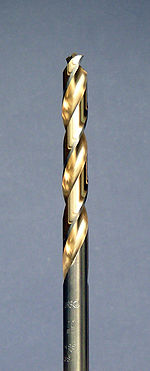
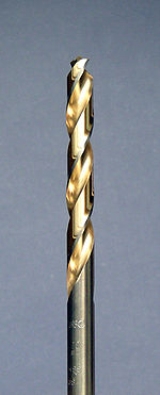
 A well-known use for TiN coating is for edge retention and corrosion resistance on machine tooling, such as drill bit
s and milling cutter
s, often improving their lifetime by a factor of three or more.
Because of TiN's metallic gold color, it is used to coat costume jewelry
and automotive trim for decorative purposes. TiN is also widely used as a top-layer coating, usually with nickel
(Ni) or chromium
(Cr) plated substrates, on consumer plumbing fixtures and door hardware. As a coating it is used in aerospace
and military applications and to protect the sliding surfaces of suspension
forks of bicycle
s and motorcycle
s as well as the shock shafts of radio controlled cars. TiN is non-toxic, meets FDA
guidelines and has seen use in medical device
s such as scalpel
blades and orthopedic bone saw
blades where sharpness and edge retention are important. TiN coatings have also been used in implanted prostheses
(especially hip replacement
implants) and other medical implants.
Though less visible, thin film
s of TiN are also used in microelectronics
, where they serve as conductive barrier between the active device and the metal contacts used to operate it. While the film blocks diffusion
of metal into the silicon, it is conductive enough (30–70 μΩ
·cm) to allow a good electrical connection. In this context, TiN is classified as a "barrier metal
", even though it is clearly a ceramic
from the perspective of chemistry
or mechanical behavior. Recent chip design in the 45 nm technology and beyond also makes use of TiN as a metal material for improved transistor
performance. In combination with gate dielectric
s (e.g. HfSiO) that have a higher permittivity
compared to standard SiO2
the gate length can be scaled down with low leakage
, higher drive current and same or better threshold voltage
.
Due to their high biostability, TiN layers may also be used as electrodes in bioelectronic applications
like in intelligent implants
or in-vivo biosensors that have to withstand the severe corrosion caused by the body fluid. TiN electrodes have already been applied in the subretinal prothesis project
as well as in biomedical microelectromechanical systems (BioMEMS).
(PVD, usually sputter deposition
, cathodic arc deposition
or electron beam heating
) and chemical vapor deposition
(CVD). In both methods, pure titanium is sublimated and reacted with nitrogen in a high-energy, vacuum
environment. TiN film may also be produced on Ti workpieces by reactive growth (for example, annealing
) in a nitrogen
atmosphere. PVD is preferred for steel parts because the deposition temperatures exceeds the austenitizing
temperature of steel. TiN layers are also sputtered on a variety of higher melting point materials such as stainless steel
s, titanium
and titanium alloys. Its high Young's modulus
(values between 450 and 590 GPa have been reported in the literature ) means that thick coatings tend to flake away, making them much less durable than thin ones. Titanium nitride coatings can also be deposited by thermal spraying
whereas TiN powders are produced by nitridation of titanium with nitrogen or ammonia at 1200 °C.
Bulk ceramic objects can be fabricated by packing powdered metallic titanium into the desired shape, compressing it to the proper density, then igniting it in an atmosphere of pure nitrogen. The heat released by the chemical reaction between the metal and gas is sufficient to sinter
the nitride reaction product into a hard, finished item. See powder metallurgy
.
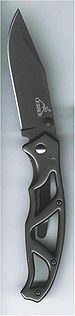
 There are several commercially-used variants of TiN that have been developed in the past decade, such as titanium carbon nitride (TiCN), titanium aluminium nitride
(TiAlN or AlTiN), and titanium aluminum carbon nitride, which may be used individually or in alternating layers with TiN. These coatings offer similar or superior enhancements in corrosion resistance and hardness, and additional colors ranging from light gray to nearly black, to a dark iridescent
bluish-purple depending on the exact process of application. These coatings are becoming common on sporting goods, particularly knives
and handgun
s, where they are used for both cosmetic and functional reasons.
. TiN forms at very high temperatures because of its very low enthalpy of formation
, and even nucleates
directly from the melt in secondary steelmaking. It forms discrete, micrometre-sized cubic
particles at grain boundaries
and triple points, and prevents grain growth
by Ostwald ripening
up to very high homologous temperature
s. Titanium nitride has the lowest solubility product
of any metal nitride or carbide in austenite, a useful attribute in microalloyed steel
formulas.
Ceramic
A ceramic is an inorganic, nonmetallic solid prepared by the action of heat and subsequent cooling. Ceramic materials may have a crystalline or partly crystalline structure, or may be amorphous...
material, often used as a coating on titanium alloy
Titanium alloy
Titanium alloys are metallic materials which contain a mixture of titanium and other chemical elements. Such alloys have very high tensile strength and toughness , light weight, extraordinary corrosion resistance, and ability to withstand extreme temperatures...
s, steel
Steel
Steel is an alloy that consists mostly of iron and has a carbon content between 0.2% and 2.1% by weight, depending on the grade. Carbon is the most common alloying material for iron, but various other alloying elements are used, such as manganese, chromium, vanadium, and tungsten...
, carbide
Carbide
In chemistry, a carbide is a compound composed of carbon and a less electronegative element. Carbides can be generally classified by chemical bonding type as follows: salt-like, covalent compounds, interstitial compounds, and "intermediate" transition metal carbides...
, and aluminium
Aluminium
Aluminium or aluminum is a silvery white member of the boron group of chemical elements. It has the symbol Al, and its atomic number is 13. It is not soluble in water under normal circumstances....
components to improve the substrate's surface properties.
Applied as a thin coating, TiN is used to harden and protect cutting and sliding surfaces, for decorative purposes (due to its gold appearance), and as a non-toxic exterior for medical implants
Implant (medicine)
An implant is a medical device manufactured to replace a missing biological structure, support a damaged biological structure, or enhance an existing biological structure. Medical implants are man-made devices, in contrast to a transplant, which is a transplanted biomedical tissue...
. In most applications a coating of less than 5 um is applied.
Characteristics
Summary of characteristics- Vickers hardness 18-21 GPa
- Modulus of elasticity 251 GPa
- Thermal conductivityThermal conductivityIn physics, thermal conductivity, k, is the property of a material's ability to conduct heat. It appears primarily in Fourier's Law for heat conduction....
19.2 W/(m·°C) - Thermal expansion coefficient 9.35×10⁻⁶ K−1
- Superconducting transition temperature 5.6 K
- Magnetic susceptibilityMagnetic susceptibilityIn electromagnetism, the magnetic susceptibility \chi_m is a dimensionless proportionality constant that indicates the degree of magnetization of a material in response to an applied magnetic field...
+38×10−6 emu/mol
TiN will oxidize at 800 °C at normal atmosphere. It is chemically stable at room temperature and is attacked by hot concentrated acids.
TiN has excellent infrared
Infrared
Infrared light is electromagnetic radiation with a wavelength longer than that of visible light, measured from the nominal edge of visible red light at 0.74 micrometres , and extending conventionally to 300 µm...
(IR) reflectivity
Reflectivity
In optics and photometry, reflectivity is the fraction of incident radiation reflected by a surface. In general it must be treated as a directional property that is a function of the reflected direction, the incident direction, and the incident wavelength...
properties, reflecting in a spectrum similar to elemental gold
Gold
Gold is a chemical element with the symbol Au and an atomic number of 79. Gold is a dense, soft, shiny, malleable and ductile metal. Pure gold has a bright yellow color and luster traditionally considered attractive, which it maintains without oxidizing in air or water. Chemically, gold is a...
(Au), which gives it a yellowish color. Depending on the substrate material and surface finish, TiN will have a coefficient of friction ranging from 0.4 to 0.9 versus itself (non-lubricated). Typical formation has a crystal structure
Crystal structure
In mineralogy and crystallography, crystal structure is a unique arrangement of atoms or molecules in a crystalline liquid or solid. A crystal structure is composed of a pattern, a set of atoms arranged in a particular way, and a lattice exhibiting long-range order and symmetry...
of NaCl-type with a roughly 1:1 stoichiometry
Stoichiometry
Stoichiometry is a branch of chemistry that deals with the relative quantities of reactants and products in chemical reactions. In a balanced chemical reaction, the relations among quantities of reactants and products typically form a ratio of whole numbers...
; however TiNx compounds with x ranging from 0.6 to 1.2 are thermodynamically stable. A thin film of titanium nitride was chilled to near absolute zero
Absolute zero
Absolute zero is the theoretical temperature at which entropy reaches its minimum value. The laws of thermodynamics state that absolute zero cannot be reached using only thermodynamic means....
converting it into the first known superinsulator
Superinsulator
A superinsulator is a material that at low temperatures under certain conditions has an infinite resistance and no current will pass through it. The superinsulating state has many parallels to the superconducting state, and can be destroyed by increased temperature, magnetic fields and voltage.The...
, with resistance suddenly increased by a factor of 100,000.
Uses
Drill bit
Drill bits are cutting tools used to create cylindrical holes. Bits are held in a tool called a drill, which rotates them and provides torque and axial force to create the hole. Specialized bits are also available for non-cylindrical-shaped holes....
s and milling cutter
Milling cutter
Milling cutters are cutting tools typically used in milling machines or machining centres . They remove material by their movement within the machine or directly from the cutter's shape .-Features of a milling cutter:Milling cutters come in several shapes and many sizes...
s, often improving their lifetime by a factor of three or more.
Because of TiN's metallic gold color, it is used to coat costume jewelry
Costume jewelry
Costume jewelry is jewelry manufactured as ornamentation to complement a particular fashionable costume or garment. Costume jewelry came into being in the 1930s as a cheap, disposable accessory meant to be worn with a specific outfit...
and automotive trim for decorative purposes. TiN is also widely used as a top-layer coating, usually with nickel
Nickel
Nickel is a chemical element with the chemical symbol Ni and atomic number 28. It is a silvery-white lustrous metal with a slight golden tinge. Nickel belongs to the transition metals and is hard and ductile...
(Ni) or chromium
Chromium
Chromium is a chemical element which has the symbol Cr and atomic number 24. It is the first element in Group 6. It is a steely-gray, lustrous, hard metal that takes a high polish and has a high melting point. It is also odorless, tasteless, and malleable...
(Cr) plated substrates, on consumer plumbing fixtures and door hardware. As a coating it is used in aerospace
Aerospace
Aerospace comprises the atmosphere of Earth and surrounding space. Typically the term is used to refer to the industry that researches, designs, manufactures, operates, and maintains vehicles moving through air and space...
and military applications and to protect the sliding surfaces of suspension
Suspension (vehicle)
Suspension is the term given to the system of springs, shock absorbers and linkages that connects a vehicle to its wheels. Suspension systems serve a dual purpose — contributing to the car's roadholding/handling and braking for good active safety and driving pleasure, and keeping vehicle occupants...
forks of bicycle
Bicycle
A bicycle, also known as a bike, pushbike or cycle, is a human-powered, pedal-driven, single-track vehicle, having two wheels attached to a frame, one behind the other. A person who rides a bicycle is called a cyclist, or bicyclist....
s and motorcycle
Motorcycle
A motorcycle is a single-track, two-wheeled motor vehicle. Motorcycles vary considerably depending on the task for which they are designed, such as long distance travel, navigating congested urban traffic, cruising, sport and racing, or off-road conditions.Motorcycles are one of the most...
s as well as the shock shafts of radio controlled cars. TiN is non-toxic, meets FDA
Food and Drug Administration
The Food and Drug Administration is an agency of the United States Department of Health and Human Services, one of the United States federal executive departments...
guidelines and has seen use in medical device
Medical device
A medical device is a product which is used for medical purposes in patients, in diagnosis, therapy or surgery . Whereas medicinal products achieve their principal action by pharmacological, metabolic or immunological means. Medical devices act by other means like physical, mechanical, thermal,...
s such as scalpel
Scalpel
A scalpel, or lancet, is a small and extremely sharp bladed instrument used for surgery, anatomical dissection, and various arts and crafts . Scalpels may be single-use disposable or re-usable. Re-usable scalpels can have attached, resharpenable blades or, more commonly, non-attached, replaceable...
blades and orthopedic bone saw
Bone cutter
-Unpowered:Unpowered bone cutting implements include varieties of hacksaw and sabre saw. In many applications, the saw is used in specialised jigs to provide accurate, measurable cuts, e.g. in knee surgery...
blades where sharpness and edge retention are important. TiN coatings have also been used in implanted prostheses
Prosthesis
In medicine, a prosthesis, prosthetic, or prosthetic limb is an artificial device extension that replaces a missing body part. It is part of the field of biomechatronics, the science of using mechanical devices with human muscle, skeleton, and nervous systems to assist or enhance motor control...
(especially hip replacement
Hip replacement
Hip replacement is a surgical procedure in which the hip joint is replaced by a prosthetic implant. Hip replacement surgery can be performed as a total replacement or a hemi replacement. Such joint replacement orthopaedic surgery generally is conducted to relieve arthritis pain or fix severe...
implants) and other medical implants.
Though less visible, thin film
Thin film
A thin film is a layer of material ranging from fractions of a nanometer to several micrometers in thickness. Electronic semiconductor devices and optical coatings are the main applications benefiting from thin film construction....
s of TiN are also used in microelectronics
Microelectronics
Microelectronics is a subfield of electronics. As the name suggests, microelectronics relates to the study and manufacture of very small electronic components. Usually, but not always, this means micrometre-scale or smaller,. These devices are made from semiconductors...
, where they serve as conductive barrier between the active device and the metal contacts used to operate it. While the film blocks diffusion
Diffusion
Molecular diffusion, often called simply diffusion, is the thermal motion of all particles at temperatures above absolute zero. The rate of this movement is a function of temperature, viscosity of the fluid and the size of the particles...
of metal into the silicon, it is conductive enough (30–70 μΩ
Ohm
The ohm is the SI unit of electrical resistance, named after German physicist Georg Simon Ohm.- Definition :The ohm is defined as a resistance between two points of a conductor when a constant potential difference of 1 volt, applied to these points, produces in the conductor a current of 1 ampere,...
·cm) to allow a good electrical connection. In this context, TiN is classified as a "barrier metal
Barrier metal
A barrier metal is a material used in integrated circuits to chemically isolate semiconductors from soft metal interconnects, while maintaining an electrical connection between them...
", even though it is clearly a ceramic
Ceramic
A ceramic is an inorganic, nonmetallic solid prepared by the action of heat and subsequent cooling. Ceramic materials may have a crystalline or partly crystalline structure, or may be amorphous...
from the perspective of chemistry
Chemistry
Chemistry is the science of matter, especially its chemical reactions, but also its composition, structure and properties. Chemistry is concerned with atoms and their interactions with other atoms, and particularly with the properties of chemical bonds....
or mechanical behavior. Recent chip design in the 45 nm technology and beyond also makes use of TiN as a metal material for improved transistor
Transistor
A transistor is a semiconductor device used to amplify and switch electronic signals and power. It is composed of a semiconductor material with at least three terminals for connection to an external circuit. A voltage or current applied to one pair of the transistor's terminals changes the current...
performance. In combination with gate dielectric
Gate dielectric
A gate dielectric is a dielectric used between the gate and substrate of a field effect transistor. In state-of-the-art processes, the gate dielectric is subject to many constraints, including:...
s (e.g. HfSiO) that have a higher permittivity
Permittivity
In electromagnetism, absolute permittivity is the measure of the resistance that is encountered when forming an electric field in a medium. In other words, permittivity is a measure of how an electric field affects, and is affected by, a dielectric medium. The permittivity of a medium describes how...
compared to standard SiO2
Silicon dioxide
The chemical compound silicon dioxide, also known as silica , is an oxide of silicon with the chemical formula '. It has been known for its hardness since antiquity...
the gate length can be scaled down with low leakage
Subthreshold leakage
The Subthreshold conduction or the subthreshold leakage or the subthreshold drain current is the current that flows between the source and drain of a MOSFET when the transistor is in subthreshold region, or weak-inversion region, that is, for gate-to-source voltages below the threshold voltage. The...
, higher drive current and same or better threshold voltage
Threshold voltage
The threshold voltage of a MOSFET is usually defined as the gate voltage where an inversion layer forms at the interface between the insulating layer and the substrate of the transistor. The purpose of the inversion layer's forming is to allow the flow of electrons through the gate-source junction...
.
Due to their high biostability, TiN layers may also be used as electrodes in bioelectronic applications
Bioelectronics
Bioelectronics is a recently coined term for a field of research that works to establish a synergy between electronics and biology. One of the main forums for information about the field is the Elsevier journal Biosensors and Bioelectronics, published since 1990...
like in intelligent implants
Implant (medicine)
An implant is a medical device manufactured to replace a missing biological structure, support a damaged biological structure, or enhance an existing biological structure. Medical implants are man-made devices, in contrast to a transplant, which is a transplanted biomedical tissue...
or in-vivo biosensors that have to withstand the severe corrosion caused by the body fluid. TiN electrodes have already been applied in the subretinal prothesis project
Visual prosthesis
For the non-functional prosthesis or glass eye see Ocular prosthesis and Craniofacial prosthesis.A visual prosthesis, often referred to as a bionic eye, is an experimental visual device intended to restore functional vision in those suffering from partial or total blindness...
as well as in biomedical microelectromechanical systems (BioMEMS).
Fabrication
The most common methods of TiN thin film creation are physical vapor depositionPhysical vapor deposition
Physical vapor deposition is a variety of vacuum deposition and is a general term used to describe any of a variety of methods to deposit thin films by the condensation of a vaporized form of the desired film material onto various workpiece surfaces...
(PVD, usually sputter deposition
Sputter deposition
Sputter deposition is a physical vapor deposition method of depositing thin films by sputtering, that is ejecting, material from a "target," that is source, which then deposits onto a "substrate," such as a silicon wafer...
, cathodic arc deposition
Cathodic Arc Deposition
Cathodic arc deposition or Arc-PVD is a physical vapor deposition technique in which an electric arc is used to vaporize material from a cathode target. The vaporized material then condenses on a substrate, forming a thin film...
or electron beam heating
Electron Beam Physical Vapor Deposition
Electron Beam Physical Vapor Deposition or EBPVD is a form of physical vapor deposition in which a target anode is bombarded with an electron beam given off by a charged tungsten filament under high vacuum. The electron beam causes atoms from the target to transform into the gaseous phase...
) and chemical vapor deposition
Chemical vapor deposition
Chemical vapor deposition is a chemical process used to produce high-purity, high-performance solid materials. The process is often used in the semiconductor industry to produce thin films. In a typical CVD process, the wafer is exposed to one or more volatile precursors, which react and/or...
(CVD). In both methods, pure titanium is sublimated and reacted with nitrogen in a high-energy, vacuum
Vacuum
In everyday usage, vacuum is a volume of space that is essentially empty of matter, such that its gaseous pressure is much less than atmospheric pressure. The word comes from the Latin term for "empty". A perfect vacuum would be one with no particles in it at all, which is impossible to achieve in...
environment. TiN film may also be produced on Ti workpieces by reactive growth (for example, annealing
Annealing (metallurgy)
Annealing, in metallurgy and materials science, is a heat treatment wherein a material is altered, causing changes in its properties such as strength and hardness. It is a process that produces conditions by heating to above the recrystallization temperature, maintaining a suitable temperature, and...
) in a nitrogen
Nitrogen
Nitrogen is a chemical element that has the symbol N, atomic number of 7 and atomic mass 14.00674 u. Elemental nitrogen is a colorless, odorless, tasteless, and mostly inert diatomic gas at standard conditions, constituting 78.08% by volume of Earth's atmosphere...
atmosphere. PVD is preferred for steel parts because the deposition temperatures exceeds the austenitizing
Austenite
Austenite, also known as gamma phase iron, is a metallic non-magnetic allotrope of iron or a solid solution of iron, with an alloying element. In plain-carbon steel, austenite exists above the critical eutectoid temperature of ; other alloys of steel have different eutectoid temperatures...
temperature of steel. TiN layers are also sputtered on a variety of higher melting point materials such as stainless steel
Stainless steel
In metallurgy, stainless steel, also known as inox steel or inox from French "inoxydable", is defined as a steel alloy with a minimum of 10.5 or 11% chromium content by mass....
s, titanium
Titanium
Titanium is a chemical element with the symbol Ti and atomic number 22. It has a low density and is a strong, lustrous, corrosion-resistant transition metal with a silver color....
and titanium alloys. Its high Young's modulus
Young's modulus
Young's modulus is a measure of the stiffness of an elastic material and is a quantity used to characterize materials. It is defined as the ratio of the uniaxial stress over the uniaxial strain in the range of stress in which Hooke's Law holds. In solid mechanics, the slope of the stress-strain...
(values between 450 and 590 GPa have been reported in the literature ) means that thick coatings tend to flake away, making them much less durable than thin ones. Titanium nitride coatings can also be deposited by thermal spraying
Thermal spraying
Thermal spraying techniques are coating processes in which melted materials are sprayed onto a surface. The "feedstock" is heated by electrical or chemical means ....
whereas TiN powders are produced by nitridation of titanium with nitrogen or ammonia at 1200 °C.
Bulk ceramic objects can be fabricated by packing powdered metallic titanium into the desired shape, compressing it to the proper density, then igniting it in an atmosphere of pure nitrogen. The heat released by the chemical reaction between the metal and gas is sufficient to sinter
Sintering
Sintering is a method used to create objects from powders. It is based on atomic diffusion. Diffusion occurs in any material above absolute zero, but it occurs much faster at higher temperatures. In most sintering processes, the powdered material is held in a mold and then heated to a temperature...
the nitride reaction product into a hard, finished item. See powder metallurgy
Powder metallurgy
Powder metallurgy is the process of blending fine powdered materials, pressing them into a desired shape , and then heating the compressed material in a controlled atmosphere to bond the material . The powder metallurgy process generally consists of four basic steps: powder manufacture, powder...
.
Other commercial variants
Titanium aluminium nitride
Titanium aluminium nitride or aluminium titanium nitride stands for a group of metastable hard coatings consisting of the metallic elements aluminium, titanium and nitrogen...
(TiAlN or AlTiN), and titanium aluminum carbon nitride, which may be used individually or in alternating layers with TiN. These coatings offer similar or superior enhancements in corrosion resistance and hardness, and additional colors ranging from light gray to nearly black, to a dark iridescent
Iridescence
Iridescence is generally known as the property of certain surfaces which appear to change color as the angle of view or the angle of illumination changes...
bluish-purple depending on the exact process of application. These coatings are becoming common on sporting goods, particularly knives
Knife
A knife is a cutting tool with an exposed cutting edge or blade, hand-held or otherwise, with or without a handle. Knives were used at least two-and-a-half million years ago, as evidenced by the Oldowan tools...
and handgun
Handgun
A handgun is a firearm designed to be held and operated by one hand. This characteristic differentiates handguns as a general class of firearms from long guns such as rifles and shotguns ....
s, where they are used for both cosmetic and functional reasons.
As a constituent in steel making
Titanium nitride is also produced intentionally within some steels by judicious addition of titanium to the alloyAlloy
An alloy is a mixture or metallic solid solution composed of two or more elements. Complete solid solution alloys give single solid phase microstructure, while partial solutions give two or more phases that may or may not be homogeneous in distribution, depending on thermal history...
. TiN forms at very high temperatures because of its very low enthalpy of formation
Standard enthalpy change of formation
The standard enthalpy of formation or standard heat of formation of a compound is the change of enthalpy that accompanies the formation of 1 mole of a substance in its standard state from its constituent elements in their standard states...
, and even nucleates
Nucleation
Nucleation is the extremely localized budding of a distinct thermodynamic phase. Some examples of phases that may form by way of nucleation in liquids are gaseous bubbles, crystals or glassy regions. Creation of liquid droplets in saturated vapor is also characterized by nucleation...
directly from the melt in secondary steelmaking. It forms discrete, micrometre-sized cubic
Cubic crystal system
In crystallography, the cubic crystal system is a crystal system where the unit cell is in the shape of a cube. This is one of the most common and simplest shapes found in crystals and minerals....
particles at grain boundaries
Grain boundary
A grain boundary is the interface between two grains, or crystallites, in a polycrystalline material. Grain boundaries are defects in the crystal structure, and tend to decrease the electrical and thermal conductivity of the material...
and triple points, and prevents grain growth
Grain growth
Grain growth is the increase in size of grains in a material at high temperature. This occurs when recovery and recrystallisation are complete and further reduction in the internal energy can only be achieved by reducing the total area of grain boundary...
by Ostwald ripening
Ostwald ripening
right|thumb|300px|Basic schematic of the Ostwald ripening process Ostwald ripening is an observed phenomenon in solid solutions or liquid sols which describes the change of an inhomogeneous structure over time...
up to very high homologous temperature
Homologous temperature
Homologous temperature expresses the temperature of a material as a fraction of its melting point temperature using the Kelvin scale. For example, the homologous temperature of lead at room temperature is approximately 0.50 ....
s. Titanium nitride has the lowest solubility product
Solubility equilibrium
Solubility equilibrium is a type of dynamic equilibrium. It exists when a chemical compound in the solid state is in chemical equilibrium with a solution of that compound. The solid may dissolve unchanged, with dissociation or with chemical reaction with another constituent of the solvent, such as...
of any metal nitride or carbide in austenite, a useful attribute in microalloyed steel
Microalloyed steel
Microalloyed steel is a type of alloy steel that contains small amounts of alloying elements . Standard alloying elements include: niobium, vanadium, titanium, molybdenum, zirconium, boron, and rare-earth metals...
formulas.