
|
|
|
|
Tintagel
|
| |
|
| |
Tintagel ( with the stress on the second syllable; ) is a village situated on the Atlantic coast of Cornwall, in England, UK. It is in the North Cornwall District and the population of the parish 1,820 persons; area of the parish 4,885 acres.
The village and nearby Tintagel Castle are associated with the legends surrounding King Arthur and the knights of the Round Table.

Discussion
Ask a question about 'Tintagel'
Start a new discussion about 'Tintagel'
Answer questions from other users
|
Encyclopedia
Tintagel ( with the stress on the second syllable; ) is a village situated on the Atlantic coast of Cornwall, in England, UK. It is in the North Cornwall District and the population of the parish 1,820 persons; area of the parish 4,885 acres.
The village and nearby Tintagel Castle are associated with the legends surrounding King Arthur and the knights of the Round Table. The village has, in recent times, become a magnet for tourists and day-trippers.
Tintagel, Trevena and Bossiney
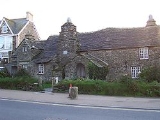
The modern-day village of Tintagel was known as Trevena until the Post Office established 'Tintagel' as the name in the mid 19th century (until then Tintagel had always been the name of the headland and of the parish). It was cited originally as a place of origin for King Arthur by the historian Geoffrey of Monmouth. Tintagel is also used as a locus for the Arthurian mythos by the poet Alfred, Lord Tennyson in the poem Idylls of the King. The village also features the 'Old Post Office', which dates from the 14th century. It became a post office during the nineteenth century, and is now in the hands of the National Trust. Etymologists have had difficulty explaining the origin of 'Tintagel': the probability is that it is Norman French as the Cornish of the 13th century would have lacked the soft 'g' ('i/j' in the earliest forms: see also Tintagel Castle). If it is Cornish then 'Dun' would = Fort (Oliver Padel proposes 'Dun' '-tagell' (narrow place) in his book on place name elements and may be right; there is a possible cognate form in the Channel Islands: Tente d'Agel, but that still leaves the question subject to doubt.)
In Norman times a small castle was established at Bossiney; Bossiney and Trevena were established as a borough in 1253 by Richard, 1st Earl of Cornwall. The
borough of Bossiney was given the right to send two MPs to Parliament ca. 1552 and continued to do so until 1832 when its status as a borough was abolished. The villages of Trevena and Bossiney were until the early 20th century separated by fields along Bossiney Road.
Treknow is the largest of the other settlements in the parish, which include Trethevy, Trebarwith, Tregatta and Trenale.
Archaeological discoveries
Major excavations beginning with C. A. Ralegh Radford's work in the 1930s on and around the site of the 12th century castle have revealed that Tintagel headland was the site of a high status Celtic monastery (according to Ralegh Radford) or a princely fortress / trading settlement dating to the 5th and 6th centuries (according to later excavators), in the period immediately following the withdrawal of the Romans from Britain. Finds of Mediterranean oil and wine jars show that Sub-Roman Britain was not the isolated outpost it was previously considered to be, for an extensive trade in high-value goods was taking place at the time with the Mediterranean region . In 1998, excavations discovered the "Arthur stone" which has added to Tintagel's Arthurian lore though historians do not believe the inscription refers to King Arthur himself.
Churches and chapels
Tintagel parish church
The Parish Church of St Materiana is Anglican (i.e. Church of England) and was built in Norman times (tower late medieval). Nikolaus Pevsner (writing in 1950) is uncertain about the dating and suggests that the Norman work has some Saxon features, while the tower may be 13th or 15th century in date. It stands on the cliffs between Trevena and Tintagel Castle and is listed Grade I. The first church on the site was probably in the 6th century, founded as a daughter church of Minster: these are the only churches dedicated to the saint though she is usually identified with Madryn, Princess of Gwent. The existing church may be late 11th / early 12th century: the tower is some three centuries later and the most significant change since then was the restoration in 1870 by Piers St Aubyn. Later changes include moving the organ (twice) and a number of new stained glass windows: many of these portray saints, including St Materiana, St George and St Piran. The tower has a peal of six bells. An area of the churchyard was excavated in 1990-91 by the Cornwall Archaeological Unit..
At Trethevy is St Piran's Chapel and there was formerly another Anglican chapel at Treknow. In the Middle Ages there was also a chapel of St Denys at Trevena: the annual fair was therefore celebrated in the week of his feast day (Oct 19th). From 1925 until 2008 part of the Vicarage outbuildings were also in use as a chapel (the Fontevrault Chapel). The name commemorates the abbey in France which held the patronage of Tintagel during the Middle Ages (now known as Fontevraud-l'Abbaye).
Methodist churches
The Methodist Church has chapels at Trevena & Bossiney. Formerly there were many more chapels of various Methodist sects (Wesleyans, Bible Christians), for example at Trenale and Trewarmett: the Methodist Cemetery is at Trewarmett. Wesleyan Methodism in Tintagel began in 1807 at Trenale and over the next sixty years gained many adherents though divided among a number of sects (Wesleyan Methodist, Methodist Association, Bible Christian): chapels were built at Trevena in 1838 and Bossiney in 1860. The various Methodist churches were united again by the agreements of 1907 and 1932.
Roman Catholic church
Tintagel has also the Catholic Church of St Paul the Apostle which has a thirty thousand piece mosaic within its walls. From January 2008 when the church celebrated its 40th anniversary, a modern day version of Leonardo Da Vinci's "Last Supper" by local artist Nicholas St John Rosse has hung above the main altar in the church. It has made international headlines due to its use of modern
Painting of the "Last Supper" by Nicholas St John Rosse local artist
clothing and local people as the apostles. People worldwide also come to Tintagel to view the names of their babies who have been lost due to miscarriage, stillbirth or other cause. The names are recorded in the Miscarriage & Infant Loss Memorial Book which is kept at the church.
Geology, scenery and sea bathing
The coastline around Tintagel is significant because it is composed of old Devonian slate; about a mile southwards from Tintagel towards Treknow the coastline was quarried extensively for this hard-wearing roofing surface. Quarries inland at Trebarwith and Trevillet continued to be worked until the mid 20th century.
The turquoise green water around this coast is caused by the slate/sand around Tintagel which contains elements of copper: strong sunlight turns the water a light turquoise green colour in warm weather. The rocks contain various metal ores in small amounts: a few of these were mined in the Victorian period.
Though very near the coast the hill of Condolden (or Kingsdown) is among the very few areas in Cornwall outside Bodmin Moor which exceeds 1000 feet. At Trethevy is the waterfall known as St Nectan's Kieve in a wooded valley. The beach at Bossiney Haven is close by and Trebarwith Strand, just half an hour's walk south of Tintagel, is one of Cornwall's finer beaches, boasting clear seas, golden sands, and superb surf: there is a small beach at Tintagel Haven immediately north of the castle. The voluntary life-saving club is based at Trebarwith Strand and also has members from Boscastle, Camelford, etc.
Shipwrecks
Trebarwith was the scene of the shipwreck of the Sarah Anderson in 1886 (all on board perished), but the most famous of the wrecks happened on December 20, 1893 at Lye Rock when the barque Iota was driven against the cliff. The crew were able to get onto the rock and apart from a youth of 14 were saved by four men (three of these from Tintagel: one of them Charles Hambly received a Vellum testimonial and three medals for bravery afterwards). The story is told in verse in 'Musings on Tintagel and its Heroes' by Joseph Brown, 1897; the youth was buried in Tintagel Churchyard and the grave is marked by a wooden cross (his name is given in the official Italian usage, surname first: Catanese Domenico).
National Trust properties
These include the Old Post Office, Trevena (see above) and fine stretches of the cliffs along the coast including Glebe Cliff, Barras Nose and Penhallick Point. The coastal footpaths include part of the South West Coast Path.
Hotels
The most notable of the hotels is the King Arthur's Castle Hotel (Castle Hotel) which was an enterprise of Sir Robert Harvey and opened in 1899: the architect was Silvanus Trevail. It stands alone on land previously known as Firebeacon and many fine building stones are used in its construction.
At Trevena are the Wharncliffe Hotel (next to the King Arthur's Hall): the Aelnat Cross (Hiberno-Saxon) stands in the grounds. It is named after the Earl of Wharncliffe who was the largest landowner in the parish until his holdings were sold at the beginning of the 20th century. Opposite the Wharncliffe is the Tintagel Hotel, once commonly known as Fry's Hotel: this was the terminus for coaches in the days before the railway to Camelford Station.
Bird and plant life
The birds of the coast are well worth observing: in 1935 an anonymous writer mentions Willapark as the scene of spectacular flocks of seabirds (eight species); inland he describes the crows (including the Cornish chough and the raven) and falcons which frequent the district. 'E.M.S.' contributes: "Within easy reach of Tintagel at least 385 varieties of flowers, 30 kinds of grasses, and 16 of ferns can be found ... a 'happy hunting ground' for botanists" and a list of thirty-nine of the rarest is given. (by the 1950s there were no longer choughs to be seen). This bird is emblematic of Cornwall and is also said to embody the spirit of King Arthur. B. H. Ryves mentions the razorbill as numerous at Tintagel (perhaps the largest colony in the county) and summarises reports from earlier in the century.
Notable residents and others associated with Tintagel
The Earls and Dukes of Cornwall (to whom the castle belonged) were never resident at Tintagel though a few of them are known to have visited. From 1552 to 1832 Tintagel was a parliamentary borough (generally known as the Borough of Bossiney) sending two members to the House of Commons. These included Sir Francis Drake, Sir Simon Harcourt and James Stuart-Wortley, 1st Baron Wharncliffe. During the same period there were also mayors of the borough of whom the best known is William Wade (fl. 1756-1786). Contemporaries of Mayor Wade were the Rev. Arthur Wade (vicar 1770-1810) and Charles Chilcott (known for his gigantic stature). The Rev. R. B. Kinsman (vicar 1851-1894) was also honorary constable of the castle. During the 19th century Tintagel was visited by many notable writers, including Robert Stephen Hawker, Charles Dickens, Alfred, Lord Tennyson and Thomas Hardy. It was also the occasional residence of John Douglas Cook, founder editor of the Saturday Review (d. 1868) who is buried at Tintagel. F. T. Glasscock, the businessman (d. 1934), was resident at Tintagel and responsible for the building of King Arthur's Hall (an extension of Trevena House which had been Cook's residence and had been built on the site of the former Town Hall and Market Hall).
Social and cultural life
Social and sporting activities
The Social Hall established by Mrs Ruth Homan and the Old School in Fore Street have been the chief meeting places during most of the 20th century. Both the Women's Institute and the football and cricket teams are well-supported. Tintagel A.F.C. were champions of Cornwall in 1955/56 and have been in existence over a hundred years; their most notable player was Harry Cann who was goalkeeper for Plymouth Argyle F.C. Until the 1930s there were two golf courses and a few tennis courts: neither golf course reopened in the postwar period.
Literary and musical associations
Tintagel is used as a locus for the Arthurian mythos by the poet Alfred, Lord Tennyson in the poem Idylls of the King and Algernon Charles Swinburne's Tristram of Lyonesse is one of the versions of the Tristan and Iseult legends where some of the events are set at Tintagel. Another version is Thomas Hardy's The Famous Tragedy of the Queen of Cornwall at Tintagel in Lyonnesse, a one act play which was published in 1923. R. S. Hawker's poem about the bells of Forrabury refers also to those of Tintagel, but more notable is his one on the Quest for the Sangraal (first published at Exeter in 1864). The novelist Dinah Maria Craik visited Tintagel in 1883 and published an informative account of her journey through Cornwall the following year. William Howitt's visit is quite different: his account is called 'A day-dream at Tintagel' (in 'Visits to Remarkable Places').
Arnold Bax was inspired to compose his symphonic poem Tintagel after a visit to the village. Edward Elgar also composed while on a visit to Tintagel. Ernest George Henham was a novelist resident in Devon who used the pseudonym, John Trevena, for many of his books. It is probable that the surname he chose was derived from the original name for Tintagel.
The film Knights of the Round Table (film) had some sequences filmed near Tintagel Castle with local people as extras: this was in 1953 though it was not released until 1954. Some other filming has been carried out in Tintagel, e.g. Malachi's Cove (film) at Trebarwith.
External links
- General and miscellaneous
- - A major source of current and historical information, with local news and Parish Council minutes
-
- - annual charity event in Tintagel
- Views of the district
-
-
- Full-screen high-resolution VR panorama on lookaroundcornwall.com
Bibliography
- Canner, A. C. (1982) The parish of Tintagel: some historical notes. Camelford: A. C. Canner.
- Craik, Dinah Maria (1884) An Unsentimental Journey Through Cornwall. [New ed.] Newmill, Penzance: Patten Press for the Jamieson Library, 1988. ISBN 0950768960
- Dyer, Peter (2005) Tintagel: a portrait of a parish. Cambridge: Cambridge Books. ISBN 0 9550097 0 7
- Maclean, John (1879) The parochial and family history of the deanery of Trigg Minor, volume 3. London: Nichols & Son. Includes very useful summaries of the public documents, etc. available at that time and fine illustrations
- Richards, Mark (1974) Walking the North Cornwall Coastal Footpath. Gloucester: Thornhill Press ISBN 0 904110 12 5
- Taylor, William (1930) History of Tintagel; compiled from ancient records and modern writers. Truro: Blackford
- Thomas, Charles (1993) English Heritage book of Tintagel: Arthur and archaeology. London: B. T. Batsford.
- All seven works are illustrated (only those by Thomas and Dyer include colour illustrations) -- Further reading: see the bibliographies in Thomas (1993) and Dyer (2005) above
See also
|
| |
|
|