


Timeline of the American Civil Rights Movement

Encyclopedia
This is a timeline of African-American Civil Rights Movement
.
1565
1640
1654
1662
1676
1712
1739
1760
1770
1773
1774
1775
1776–1783 American Revolution
1777
1780
1787
1788
1790–1810 Manumission of slaves
1791
1793
1794
1800
1807
1808
1816
1820
1821
1822
1829
1830
1831
1833
1837
1839
1840
1842
1843
1847
1849
1850
1852
1853
1855
1856
1857
1859
1862
1863–1877 Reconstruction
1863
1864
1865
1866
1867
1868
1870
1871
1872
1873
1874
1876
1877
1879
1880
1881
1882
1884
1886
1887
1888
1890
1892
1895
1896
1898
1899
1901
1903
1904
1905
1906
1907
1908
1909
1910
1913
1914
1915
1916
1917
1918
1919
1920
1921
1923
1924
1926
1928
1929
1930
1931
1932
1934
1935
 1936
1936
1937
1938
1939
1940s to 1970
1940
1941
1942
1943
1944
1945–1975 Second Reconstruction
/American Civil Rights Movement
1945
1946
1947
1948
1950
1951
1952
1953
1954
1955
1956
1957
1958
1959
1960
1961
1962
1963
1964
 1965
1965
1966
1967
1968
1969
1971
1972
1973
1974
1975
1976
1977
1978
1979
1982
1983
1984
1986
1987
1988
1989
1990
1991
1992
1994
1995
1997
1998
2000
2003
2005
2007
2008
2009
2010
2011
January 14 - Michael Steele, the first African-American Chairman of the RNC
lost his bid for re-election; Reince Priebus
was the winner of the election.
African-American Civil Rights Movement (1955-1968)
The African-American Civil Rights Movement refers to the movements in the United States aimed at outlawing racial discrimination against African Americans and restoring voting rights to them. This article covers the phase of the movement between 1955 and 1968, particularly in the South...
.
Pre-17th century
(Information in this section primarily taken from Slavery in Colonial United States.)1565
- unknown – The colony of St. AugustineSt. Augustine, FloridaSt. Augustine is a city in the northeast section of Florida and the county seat of St. Johns County, Florida, United States. Founded in 1565 by Spanish explorer and admiral Pedro Menéndez de Avilés, it is the oldest continuously occupied European-established city and port in the continental United...
in FloridaFloridaFlorida is a state in the southeastern United States, located on the nation's Atlantic and Gulf coasts. It is bordered to the west by the Gulf of Mexico, to the north by Alabama and Georgia and to the east by the Atlantic Ocean. With a population of 18,801,310 as measured by the 2010 census, it...
became the first permanent European settlement in what would become the US, and included an unknown number of African slaves.
17th century
1619- unknown – The first record of African slavery in English Colonial America.
1640
- unknown – John Punch, a black indentured servant, ran away with two white indentured servants, James Gregory and Victor. After the three were captured, the white men were sentenced to four more years of servitude but Punch was required to serve Virginia planter Hugh Gym for life. It is one of the first cases in which lifetime indentured servitude was based on race.
1654
- unknown – John CasorJohn CasorJohn Casor , a servant in Northampton County in the Virginia Colony, in 1654 became the first person of African descent in the Thirteen Colonies to be declared by the county court a slave for life. In one of the earliest freedom suits, Casor argued that he was an indentured servant who had been...
, a black man, became the first legally-recognized slave-for-life in the Virginia colony.
1662
- unknown – Virginia law defined that children of enslaved mothers followed the status of their mothers and were considered slaves, regardless of their father's status.
1676
- unknown – Both free and enslaved African Americans fought in Bacon's RebellionBacon's RebellionBacon's Rebellion was an uprising in 1676 in the Virginia Colony in North America, led by a 29-year-old planter, Nathaniel Bacon.About a thousand Virginians rose because they resented Virginia Governor William Berkeley's friendly policies towards the Native Americans...
along with English colonists.
18th century
1705- unknown – The Virginia Slave codesSlave codesSlave codes were laws each US state, which defined the status of slaves and the rights of masters. These codes gave slave-owners absolute power over the African slaves.-Definition of "slaves":Virginia, 1650:“Act XI...
defines as slaves all those servants brought into the colony who were not Christian in their original countries, as well as those Indians sold to colonists by other Indians.
1712
- April 6 – The New York Slave Revolt of 1712, one of the first of many such rebellions (see the article).
1739
- September 9 – In the Stono RebellionStono RebellionThe Stono Rebellion was a slave rebellion that commenced on 9 September 1739, in the colony of South Carolina...
, South Carolina slaves gather at the Stono RiverStono RiverThe Stono River is a tidal channel in southeast South Carolina, located southwest of Charleston. The channel runs southwest to northeast between the mainland and Wadmalaw Island and Johns Island, from north Edisto River between Johns and James Island. The Intracoastal Waterway runs through...
to plan an armed march for freedom.
1760
- unknown – Jupiter HammonJupiter HammonJupiter Hammon was a Black poet who became the first African-American published writer in America when a poem appeared in print in 1760. He was a slave his entire life, and the date of his death is unknown. He was living in 1790 at the age of 79, and died by 1806...
has a poem printed, becoming the first published African-American poet.
1770
- March 5 – Crispus AttucksCrispus AttucksCrispus Attucks was a dockworker of Wampanoag and African descent. He was the first person shot to death by British redcoats during the Boston Massacre, in Boston, Massachusetts...
is killed by British soldiers in the Boston MassacreBoston MassacreThe Boston Massacre, called the Boston Riot by the British, was an incident on March 5, 1770, in which British Army soldiers killed five civilian men. British troops had been stationed in Boston, capital of the Province of Massachusetts Bay, since 1768 in order to protect and support...
, a precursor to the American RevolutionAmerican RevolutionThe American Revolution was the political upheaval during the last half of the 18th century in which thirteen colonies in North America joined together to break free from the British Empire, combining to become the United States of America...
.
1773
- unknown – Phillis WheatleyPhillis WheatleyPhillis Wheatley was the first African American poet and first African-American woman whose writings were published. Born in Gambia, Senegal, she was sold into slavery at age seven...
has her book Poems on Various Subjects, Religious and Moral published.
1774
- – The first black Baptist congregations are organized in the SouthSouthern United StatesThe Southern United States—commonly referred to as the American South, Dixie, or simply the South—constitutes a large distinctive area in the southeastern and south-central United States...
: Silver Bluff Baptist ChurchSilver Bluff Baptist ChurchThe Silver Bluff Baptist Church in Aiken County, South Carolina, was founded by several enslaved African Americans who organized under elder David George in 1773-1775....
in South Carolina, and First African Baptist Church near Petersburg, VirginiaPetersburg, VirginiaPetersburg is an independent city in Virginia, United States located on the Appomattox River and south of the state capital city of Richmond. The city's population was 32,420 as of 2010, predominantly of African-American ethnicity...
.
1775
- April 14 – The Society for the Relief of Free Negroes Unlawfully held in Bondage holds four meetings. Re-formed in 1784 as the Pennsylvania Abolition Society, Benjamin FranklinBenjamin FranklinDr. Benjamin Franklin was one of the Founding Fathers of the United States. A noted polymath, Franklin was a leading author, printer, political theorist, politician, postmaster, scientist, musician, inventor, satirist, civic activist, statesman, and diplomat...
would later be its president.
1776–1783 American Revolution
- Thousands of enslaved African Americans in the South escape to BritishGreat BritainGreat Britain or Britain is an island situated to the northwest of Continental Europe. It is the ninth largest island in the world, and the largest European island, as well as the largest of the British Isles...
or LoyalistLoyalist (American Revolution)Loyalists were American colonists who remained loyal to the Kingdom of Great Britain during the American Revolutionary War. At the time they were often called Tories, Royalists, or King's Men. They were opposed by the Patriots, those who supported the revolution...
lines, as they were promised freedom if they fought with the British. In South CarolinaSouth CarolinaSouth Carolina is a state in the Deep South of the United States that borders Georgia to the south, North Carolina to the north, and the Atlantic Ocean to the east. Originally part of the Province of Carolina, the Province of South Carolina was one of the 13 colonies that declared independence...
, 25,000 enslaved African Americans, one-quarter of those held, escape to the British. After the war, many African Americans leave with the British for EnglandEnglandEngland is a country that is part of the United Kingdom. It shares land borders with Scotland to the north and Wales to the west; the Irish Sea is to the north west, the Celtic Sea to the south west, with the North Sea to the east and the English Channel to the south separating it from continental...
; others go with other Loyalists to CanadaCanadaCanada is a North American country consisting of ten provinces and three territories. Located in the northern part of the continent, it extends from the Atlantic Ocean in the east to the Pacific Ocean in the west, and northward into the Arctic Ocean...
and settle in Nova ScotiaNova ScotiaNova Scotia is one of Canada's three Maritime provinces and is the most populous province in Atlantic Canada. The name of the province is Latin for "New Scotland," but "Nova Scotia" is the recognized, English-language name of the province. The provincial capital is Halifax. Nova Scotia is the...
and New BrunswickNew BrunswickNew Brunswick is one of Canada's three Maritime provinces and is the only province in the federation that is constitutionally bilingual . The provincial capital is Fredericton and Saint John is the most populous city. Greater Moncton is the largest Census Metropolitan Area...
. Still others go to JamaicaJamaicaJamaica is an island nation of the Greater Antilles, in length, up to in width and 10,990 square kilometres in area. It is situated in the Caribbean Sea, about south of Cuba, and west of Hispaniola, the island harbouring the nation-states Haiti and the Dominican Republic...
and the West Indies. - Many free blacks in the North fight with the colonists for the rebellion.
1777
- July 8 – The Vermont RepublicVermont RepublicThe term Vermont Republic has been used by later historians for the government of what became modern Vermont from 1777 to 1791. In July 1777 delegates from 28 towns met and declared independence from jurisdictions and land claims of British colonies in New Hampshire and New York. They also...
(a sovereign nation at the time) abolishes slavery, the first future state to do so.
1780
- PennsylvaniaPennsylvaniaThe Commonwealth of Pennsylvania is a U.S. state that is located in the Northeastern and Mid-Atlantic regions of the United States. The state borders Delaware and Maryland to the south, West Virginia to the southwest, Ohio to the west, New York and Ontario, Canada, to the north, and New Jersey to...
becomes the first then-U.S.-state to abolish slavery.
1787
- July 13 – The Northwest OrdinanceNorthwest OrdinanceThe Northwest Ordinance was an act of the Congress of the Confederation of the United States, passed July 13, 1787...
bans the expansion of slavery into U.S. territories north of the Ohio RiverOhio RiverThe Ohio River is the largest tributary, by volume, of the Mississippi River. At the confluence, the Ohio is even bigger than the Mississippi and, thus, is hydrologically the main stream of the whole river system, including the Allegheny River further upstream...
and east of the Mississippi RiverMississippi RiverThe Mississippi River is the largest river system in North America. Flowing entirely in the United States, this river rises in western Minnesota and meanders slowly southwards for to the Mississippi River Delta at the Gulf of Mexico. With its many tributaries, the Mississippi's watershed drains...
.
1788
- – The First African Baptist Church of Savannah, GeorgiaSavannah, GeorgiaSavannah is the largest city and the county seat of Chatham County, in the U.S. state of Georgia. Established in 1733, the city of Savannah was the colonial capital of the Province of Georgia and later the first state capital of Georgia. Today Savannah is an industrial center and an important...
is organized under Andrew Bryan.
1790–1810 Manumission of slaves
- – Following the Revolution, numerous slaveholders in the Upper South freeManumissionManumission is the act of a slave owner freeing his or her slaves. In the United States before the passage of the Thirteenth Amendment to the United States Constitution, which abolished most slavery, this often happened upon the death of the owner, under conditions in his will.-Motivations:The...
their slaves; the percentage of free blacks rises from less than one to 10 percent. By 1810, 75 percent of all blacks in DelawareDelawareDelaware is a U.S. state located on the Atlantic Coast in the Mid-Atlantic region of the United States. It is bordered to the south and west by Maryland, and to the north by Pennsylvania...
are free, and 7.2 percent of blacks in VirginiaVirginiaThe Commonwealth of Virginia , is a U.S. state on the Atlantic Coast of the Southern United States. Virginia is nicknamed the "Old Dominion" and sometimes the "Mother of Presidents" after the eight U.S. presidents born there...
are free.
1791
- February – Major Andrew EllicottAndrew EllicottAndrew Ellicott was a U.S. surveyor who helped map many of the territories west of the Appalachians, surveyed the boundaries of the District of Columbia, continued and completed Pierre Charles L'Enfant's work on the plan for Washington, D.C., and served as a teacher in survey methods for...
hires Benjamin BannekerBenjamin BannekerBenjamin Banneker was a free African American astronomer, mathematician, surveyor, almanac author and farmer.-Family history and early life:It is difficult to verify much of Benjamin Banneker's family history...
to assist in a survey of the boundaries of the 100 square miles (259 km²) federal district that would later become the District of Columbia.
1793
- February 12 – The Fugitive Slave Act of 1793Fugitive Slave Act of 1793The Fugitive Slave Clause of the U.S. Constitution guaranteed the right of a slaveholder to recover an escaped slave...
is passed. (See also Fugitive slave lawsFugitive slave lawsThe fugitive slave laws were laws passed by the United States Congress in 1793 and 1850 to provide for the return of slaves who escaped from one state into another state or territory.-Pre-colonial and Colonial eras:...
.)
1794
- March 14 – Eli WhitneyEli WhitneyEli Whitney was an American inventor best known for inventing the cotton gin. This was one of the key inventions of the Industrial Revolution and shaped the economy of the Antebellum South...
is granted a patent on the cotton ginCotton ginA cotton gin is a machine that quickly and easily separates cotton fibers from their seeds, a job formerly performed painstakingly by hand...
. This enables the widespread cultivation and processing of short-staple cotton, dramatically increasing the need for enslaved labor, and leading to the development of King CottonKing CottonKing Cotton was a slogan used by southerners to support secession from the United States by arguing cotton exports would make an independent Confederacy economically prosperous, and—more important—would force Great Britain and France to support the Confederacy because their industrial economy...
in the Deep SouthDeep SouthThe Deep South is a descriptive category of the cultural and geographic subregions in the American South. Historically, it is differentiated from the "Upper South" as being the states which were most dependent on plantation type agriculture during the pre-Civil War period...
. It leads to the forced migrationForced migrationForced migration refers to the coerced movement of a person or persons away from their home or home region...
of one million slaves to the area in the antebellum period, mostly by internal slave trade. - July – Two independent black churches open in Philadelphia: the African Episcopal Church of St. Thomas, with Absalom JonesAbsalom JonesAbsalom Jones was an African-American abolitionist and clergyman. After founding a black congregation in 1794, in 1804 he was the first African-American ordained as a priest in the Episcopal Church of the United States...
, and the Bethel African Methodist Episcopal ChurchMother Bethel A.M.E. ChurchThe Mother Bethel African Methodist Episcopal Church was founded in 1794 by Richard Allen, an African-American Methodist minister. The church has been located at the corner of Sixth and Lombard Streets in Philadelphia, Pennsylvania, since that time, making it the oldest church property continuously...
, with Richard Allen, the first church of what would become a new black denomination in 1816.
1800–1859
Early 19th century- unknown – first Black Codes enacted.
1800
- August 30 – Gabriel ProsserGabriel ProsserGabriel , today commonly – if incorrectly – known as Gabriel Prosser, was a literate enslaved blacksmith who planned to lead a large slave rebellion in the Richmond area in the summer of 1800. However, information regarding the revolt was leaked prior to its execution, thus Gabriel's plans were...
's attempt to lead a slave rebellionSlave rebellionA slave rebellion is an armed uprising by slaves. Slave rebellions have occurred in nearly all societies that practice slavery, and are amongst the most feared events for slaveholders...
in Richmond, VirginiaRichmond, VirginiaRichmond is the capital of the Commonwealth of Virginia, in the United States. It is an independent city and not part of any county. Richmond is the center of the Richmond Metropolitan Statistical Area and the Greater Richmond area...
is suppressed.
1807
- unknown – Act Prohibiting Importation of SlavesAct Prohibiting Importation of SlavesThe Act Prohibiting Importation of Slaves of 1807 is a United States federal law that stated, in accordance with the Constitution of the United States, that no new slaves were permitted to be imported into the United States. This act ended the legality of the U.S.-based transatlantic slave trade...
1808
- January 1 – The importation of slaves into the United StatesUnited StatesThe United States of America is a federal constitutional republic comprising fifty states and a federal district...
is banned; this is also the earliest day under the United States ConstitutionUnited States ConstitutionThe Constitution of the United States is the supreme law of the United States of America. It is the framework for the organization of the United States government and for the relationship of the federal government with the states, citizens, and all people within the United States.The first three...
that an amendment could be made restricting slavery.
1816
- unknown – The first separate black denomination of the African Methodist Episcopal ChurchAfrican Methodist Episcopal ChurchThe African Methodist Episcopal Church, usually called the A.M.E. Church, is a predominantly African American Methodist denomination based in the United States. It was founded by the Rev. Richard Allen in Philadelphia, Pennsylvania, in 1816 from several black Methodist congregations in the...
(AME) is founded by Richard Allen, who is elected its first bishop. - unknown – The American Colonization SocietyAmerican Colonization SocietyThe American Colonization Society , founded in 1816, was the primary vehicle to support the "return" of free African Americans to what was considered greater freedom in Africa. It helped to found the colony of Liberia in 1821–22 as a place for freedmen...
is begun by Robert FinleyRobert FinleyRobert Finley was briefly the president of the University of Georgia. Finley was born in Princeton, New Jersey, and graduated from College of New Jersey at the age of 15.-Early life:Finley was born to James Finley and Ann Angrest, James was born 1737 in Glasgow, Scotland where he...
, to send free African Americans to what is to become LiberiaLiberiaLiberia , officially the Republic of Liberia, is a country in West Africa. It is bordered by Sierra Leone on the west, Guinea on the north and Côte d'Ivoire on the east. Liberia's coastline is composed of mostly mangrove forests while the more sparsely populated inland consists of forests that open...
in Africa.
1820
- March 6 – The Missouri CompromiseMissouri CompromiseThe Missouri Compromise was an agreement passed in 1820 between the pro-slavery and anti-slavery factions in the United States Congress, involving primarily the regulation of slavery in the western territories. It prohibited slavery in the former Louisiana Territory north of the parallel 36°30'...
allows for the entry as states of MaineMaineMaine is a state in the New England region of the northeastern United States, bordered by the Atlantic Ocean to the east and south, New Hampshire to the west, and the Canadian provinces of Quebec to the northwest and New Brunswick to the northeast. Maine is both the northernmost and easternmost...
and MissouriMissouriMissouri is a US state located in the Midwestern United States, bordered by Iowa, Illinois, Kentucky, Tennessee, Arkansas, Oklahoma, Kansas and Nebraska. With a 2010 population of 5,988,927, Missouri is the 18th most populous state in the nation and the fifth most populous in the Midwest. It...
, and decides which future states slavery would be allowed in. - unknown – The British West Africa SquadronWest Africa SquadronThe Royal Navy established the West Africa Squadron at substantial expense in 1808 after Parliament passed the Slave Trade Act of 1807. The squadron's task was to suppress the Atlantic slave trade by patrolling the coast of West Africa...
's slave trade suppression activities are assisted by forces from the United States NavyUnited States NavyThe United States Navy is the naval warfare service branch of the United States Armed Forces and one of the seven uniformed services of the United States. The U.S. Navy is the largest in the world; its battle fleet tonnage is greater than that of the next 13 largest navies combined. The U.S...
, starting in 1820 with the USS Cyane. With the Webster–Ashburton Treaty of 1842, the relationship is formalised and they jointly run the Africa SquadronAfrica SquadronThe Africa Squadron was a unit of the United States Navy that operated from 1819 to 1861 to suppress the slave trade along the coast of West Africa...
.
1821
- unknown – The African Methodist Episcopal Zion ChurchAfrican Methodist Episcopal Zion ChurchThe African Methodist Episcopal Zion Church, or AME Zion Church, is a historically African-American Christian denomination. It was officially formed in 1821, but operated for a number of years before then....
is officially formed.
1822
- July 14 – Denmark VeseyDenmark VeseyDenmark Vesey originally Telemaque, was an African American slave brought to the United States from the Caribbean of Coromantee background. After purchasing his freedom, he planned what would have been one of the largest slave rebellions in the United States...
's slave rebellion in Charleston, South CarolinaCharleston, South CarolinaCharleston is the second largest city in the U.S. state of South Carolina. It was made the county seat of Charleston County in 1901 when Charleston County was founded. The city's original name was Charles Towne in 1670, and it moved to its present location from a location on the west bank of the...
is suppressed.
1829
- September – David WalkerDavid Walker (abolitionist)David Walker was an outspoken African American activist who demanded the immediate end of slavery in the new nation...
begins publication of the abolitionist pamphlet Walker's Appeal.
1830
- October 28 - Josiah HensonJosiah HensonJosiah Henson was an author, abolitionist, and minister. Born into slavery in Charles County, Maryland, he escaped to Ontario, Canada in 1830, and founded a settlement and laborer's school for other fugitive slaves at Dawn, near Dresden in Kent County...
, a slave who fled and arrived in Canada, is an author, abolitionist, minister and the inspiration behind the book Uncle Tom's CabinUncle Tom's CabinUncle Tom's Cabin; or, Life Among the Lowly is an anti-slavery novel by American author Harriet Beecher Stowe. Published in 1852, the novel "helped lay the groundwork for the Civil War", according to Will Kaufman....
.
1831
- unknown – William Lloyd GarrisonWilliam Lloyd GarrisonWilliam Lloyd Garrison was a prominent American abolitionist, journalist, and social reformer. He is best known as the editor of the abolitionist newspaper The Liberator, and as one of the founders of the American Anti-Slavery Society, he promoted "immediate emancipation" of slaves in the United...
begins publication of the abolitionist newspaper The Liberator. - August – Nat TurnerNat TurnerNathaniel "Nat" Turner was an American slave who led a slave rebellion in Virginia on August 21, 1831 that resulted in 60 white deaths and at least 100 black deaths, the largest number of fatalities to occur in one uprising prior to the American Civil War in the southern United States. He gathered...
leads the most successful slave rebellion in U.S. history. The rebellion is suppressed, but only after many deaths.
1833
- unknown – The American Anti-Slavery SocietyAmerican Anti-Slavery SocietyThe American Anti-Slavery Society was an abolitionist society founded by William Lloyd Garrison and Arthur Tappan. Frederick Douglass was a key leader of this society and often spoke at its meetings. William Wells Brown was another freed slave who often spoke at meetings. By 1838, the society had...
, an abolitionistAbolitionismAbolitionism is a movement to end slavery.In western Europe and the Americas abolitionism was a movement to end the slave trade and set slaves free. At the behest of Dominican priest Bartolomé de las Casas who was shocked at the treatment of natives in the New World, Spain enacted the first...
society, is founded by William Lloyd GarrisonWilliam Lloyd GarrisonWilliam Lloyd Garrison was a prominent American abolitionist, journalist, and social reformer. He is best known as the editor of the abolitionist newspaper The Liberator, and as one of the founders of the American Anti-Slavery Society, he promoted "immediate emancipation" of slaves in the United...
and Arthur TappanArthur TappanArthur Tappan was an American abolitionist. He was the brother of Senator Benjamin Tappan, and abolitionist Lewis Tappan.-Biography:...
. Frederick DouglassFrederick DouglassFrederick Douglass was an American social reformer, orator, writer and statesman. After escaping from slavery, he became a leader of the abolitionist movement, gaining note for his dazzling oratory and incisive antislavery writing...
becomes a key leader of the society.
1837
- February - The first Institute of Higher Education for Afican-Americans is founded. Founded as the African Institute in February 1837 and renamed the Institute of Coloured Youth (ICY) in April 1837 and now known as Cheyney University of PennsylvaniaCheyney University of PennsylvaniaCheyney University of Pennsylvania is a public, co-educational historically black university that is a part of the Pennsylvania State System of Higher Education. Cheyney University has a campus that is located in the Cheyney community within Thornbury Township, Chester County and Thornbury...
.
1839
- July 2 – Slaves revolt on the La AmistadLa AmistadLa Amistad was a ship notable as the scene of a revolt by African captives being transported from Havana to Puerto Principe, Cuba. It was a 19th-century two-masted schooner built in Spain and owned by a Spaniard living in Cuba...
, resulting in a Supreme Court case (see Amistad (1841)Amistad (1841)The Amistad, also known as United States v. Libellants and Claimants of the Schooner Amistad, 40 U.S. 518 , was a United States Supreme Court case resulting from the rebellion of slaves on board the Spanish schooner Amistad in 1839...
).
1840
- unknown – The Liberty Party breaks away from the American Anti-Slavery SocietyAmerican Anti-Slavery SocietyThe American Anti-Slavery Society was an abolitionist society founded by William Lloyd Garrison and Arthur Tappan. Frederick Douglass was a key leader of this society and often spoke at its meetings. William Wells Brown was another freed slave who often spoke at meetings. By 1838, the society had...
due to grievances with William Lloyd GarrisonWilliam Lloyd GarrisonWilliam Lloyd Garrison was a prominent American abolitionist, journalist, and social reformer. He is best known as the editor of the abolitionist newspaper The Liberator, and as one of the founders of the American Anti-Slavery Society, he promoted "immediate emancipation" of slaves in the United...
's leadership.
1842
- unknown – The U.S. Supreme CourtSupreme Court of the United StatesThe Supreme Court of the United States is the highest court in the United States. It has ultimate appellate jurisdiction over all state and federal courts, and original jurisdiction over a small range of cases...
rules, in Prigg v. PennsylvaniaPrigg v. PennsylvaniaPrigg v. Pennsylvania, , was a United States Supreme Court case in which the court held that the Federal Fugitive Slave Act precluded a Pennsylvania state law that gave procedural protections to suspected escaped slaves, and overturned the conviction of Edward Prigg as a result.-Federal Law:In June...
(1842), that states do not have to offer aid in the hunting or recapture of slaves, greatly weakening the fugitive slave law of 1793.
1843
- June 1 – Isabella Baumfree, a former slave, changes her name to Sojourner TruthSojourner TruthSojourner Truth was the self-given name, from 1843 onward, of Isabella Baumfree, an African-American abolitionist and women's rights activist. Truth was born into slavery in Swartekill, New York, but escaped with her infant daughter to freedom in 1826. After going to court to recover her son, she...
and begins to preach for the abolition of slavery. - August – Henry Highland GarnetHenry Highland GarnetHenry Highland Garnet was an African American abolitionist and orator. An advocate of militant abolitionism, Garnet was a prominent member of the abolition movement that led against moral suasion toward more political action. Renowned for his skills as a public speaker, he urged blacks to take...
delivers his famous speech Call to Rebellion.
1847
- unknown – Frederick DouglassFrederick DouglassFrederick Douglass was an American social reformer, orator, writer and statesman. After escaping from slavery, he became a leader of the abolitionist movement, gaining note for his dazzling oratory and incisive antislavery writing...
begins publication of the abolitionist newspaper the North Star. - unknown – Joseph Jenkins RobertsJoseph Jenkins RobertsJoseph Jenkins Roberts was the first and seventh President of Liberia. Born free in Norfolk, Virginia, USA, Roberts emigrated to Liberia in 1829 as a young man. He opened a trading store in Monrovia, and later engaged in politics...
of Virginia becomes the first president of LiberiaLiberiaLiberia , officially the Republic of Liberia, is a country in West Africa. It is bordered by Sierra Leone on the west, Guinea on the north and Côte d'Ivoire on the east. Liberia's coastline is composed of mostly mangrove forests while the more sparsely populated inland consists of forests that open...
.
1849
- unknown – Roberts v. BostonRoberts v. BostonRoberts v. Boston, 59 Mass. 198 , was a lawsuit seeking to end racial discrimination in Boston public schools. The Massachusetts Supreme Judicial Court ruled in favor of Boston, finding no constitutional basis for the suit. The case was later cited by the US Supreme Court in Plessy v...
seeks to end racial discrimination in BostonBostonBoston is the capital of and largest city in Massachusetts, and is one of the oldest cities in the United States. The largest city in New England, Boston is regarded as the unofficial "Capital of New England" for its economic and cultural impact on the entire New England region. The city proper had...
public schools. - unknown – Harriet TubmanHarriet TubmanHarriet Tubman Harriet Tubman Harriet Tubman (born Araminta Harriet Ross; (1820 – 1913) was an African-American abolitionist, humanitarian, and Union spy during the American Civil War. After escaping from slavery, into which she was born, she made thirteen missions to rescue more than 70 slaves...
escapes from slavery to Philadelphia, and begins helping other slaves to escape via the Underground RailroadUnderground RailroadThe Underground Railroad was an informal network of secret routes and safe houses used by 19th-century black slaves in the United States to escape to free states and Canada with the aid of abolitionists and allies who were sympathetic to their cause. The term is also applied to the abolitionists,...
.
1850
- September 18 – As part of the Compromise of 1850Compromise of 1850The Compromise of 1850 was a package of five bills, passed in September 1850, which defused a four-year confrontation between the slave states of the South and the free states of the North regarding the status of territories acquired during the Mexican-American War...
, Congress passes the Fugitive Slave Act of 1850 which requires any federal official to arrest anyone suspected of being a runaway slave.
1852
- March 20 – Uncle Tom's CabinUncle Tom's CabinUncle Tom's Cabin; or, Life Among the Lowly is an anti-slavery novel by American author Harriet Beecher Stowe. Published in 1852, the novel "helped lay the groundwork for the Civil War", according to Will Kaufman....
by Harriet Beecher StoweHarriet Beecher StoweHarriet Beecher Stowe was an American abolitionist and author. Her novel Uncle Tom's Cabin was a depiction of life for African-Americans under slavery; it reached millions as a novel and play, and became influential in the United States and United Kingdom...
is published.
1853
- December – Clotel; or, The President's DaughterClotelClotel; or, The President's Daughter is an 1853 novel by U.S. author and playwright William Wells Brown, an escaped slave from Kentucky who was active on the anti-slavery circuit...
is the first novel published by an African-American.
1855
- unknown – John Mercer LangstonJohn Mercer LangstonJohn Mercer Langston was an American abolitionist, attorney, educator, and political activist. He was the first dean of the law school at Howard University and helped create the department. He was the first president of what is now Virginia State University. In 1888 he was the first African...
is one of the first African Americans elected to public office when elected as a town clerk in OhioOhioOhio is a Midwestern state in the United States. The 34th largest state by area in the U.S.,it is the 7th‑most populous with over 11.5 million residents, containing several major American cities and seven metropolitan areas with populations of 500,000 or more.The state's capital is Columbus...
.
1856
- May 21 – The Sacking of LawrenceSacking of LawrenceIn the northern spring of 1856, the Sacking of Lawrence helped ratchet up the guerrilla war in Kansas Territory that became known as Bleeding Kansas.-Background:...
in Bleeding KansasBleeding KansasBleeding Kansas, Bloody Kansas or the Border War, was a series of violent events, involving anti-slavery Free-Staters and pro-slavery "Border Ruffian" elements, that took place in the Kansas Territory and the western frontier towns of the U.S. state of Missouri roughly between 1854 and 1858...
. - May 25 – John BrownJohn Brown (abolitionist)John Brown was an American revolutionary abolitionist, who in the 1850s advocated and practiced armed insurrection as a means to abolish slavery in the United States. He led the Pottawatomie Massacre during which five men were killed, in 1856 in Bleeding Kansas, and made his name in the...
, whom Abraham Lincoln called a "misguided fanatic", retaliates for Lawrence's sacking in the Pottawatomie MassacrePottawatomie MassacreThe Pottawatomie Massacre occurred during the night of May 24 and the morning of May 25, 1856. In reaction to the sacking of Lawrence by pro-slavery forces, John Brown and a band of abolitionist settlers killed five settlers north of Pottawatomie Creek in Franklin County, Kansas...
. - unknown – Wilberforce UniversityWilberforce UniversityWilberforce University is a private, coed, liberal arts historically black university located in Wilberforce, Ohio. Affiliated with the African Methodist Episcopal Church, it was the first college to be owned and operated by African Americans...
is founded by collaboration between Methodist Episcopal and African Methodist Episcopal representatives.
1857
- March 6 – In Dred Scott v. SandfordDred Scott v. SandfordDred Scott v. Sandford, , also known as the Dred Scott Decision, was a ruling by the U.S. Supreme Court that people of African descent brought into the United States and held as slaves were not protected by the Constitution and could never be U.S...
, the Supreme CourtSupreme Court of the United StatesThe Supreme Court of the United States is the highest court in the United States. It has ultimate appellate jurisdiction over all state and federal courts, and original jurisdiction over a small range of cases...
upholds slaverySlaverySlavery is a system under which people are treated as property to be bought and sold, and are forced to work. Slaves can be held against their will from the time of their capture, purchase or birth, and deprived of the right to leave, to refuse to work, or to demand compensation...
. This decision is regarded as a key cause of the American Civil WarAmerican Civil WarThe American Civil War was a civil war fought in the United States of America. In response to the election of Abraham Lincoln as President of the United States, 11 southern slave states declared their secession from the United States and formed the Confederate States of America ; the other 25...
.
1859
- unknown – Harriet E. WilsonHarriet E. WilsonHarriet E. Wilson is traditionally considered the first female African-American novelist as well as the first African American of any gender to publish a novel on the North American continent...
writes the autobiographical novel Our NigOur NigOur Nig: Sketches from the Life of a Free Black is an autobiographical slave narrative by Harriet E. Wilson. It was published in 1859 and rediscovered in 1982 by professor Henry Louis Gates, Jr.. It is considered the first novel published by an African-American on the North American...
. - unknown – In Ableman v. BoothAbleman v. BoothAbleman v. Booth, , is a case in which the Supreme Court of the United States held that state courts cannot issue rulings that contradict the decisions of federal courts, overturning a decision by the Supreme Court of Wisconsin....
the Supreme Court of the United States holds that state courts cannot issue rulings that contradict the decisions of federal courts, thus upholding the Fugitive Slave Act of 1850.
1860–1874
1861- April 12 – The American Civil WarAmerican Civil WarThe American Civil War was a civil war fought in the United States of America. In response to the election of Abraham Lincoln as President of the United States, 11 southern slave states declared their secession from the United States and formed the Confederate States of America ; the other 25...
begins (secessions began in December, 1860), and lasts until April 9, 1865. Tens of thousands of enslaved African Americans of all ages escaped to UnionUnion (American Civil War)During the American Civil War, the Union was a name used to refer to the federal government of the United States, which was supported by the twenty free states and five border slave states. It was opposed by 11 southern slave states that had declared a secession to join together to form the...
lines for freedom. Contraband camps were set up in some areas, where blacks started learning to read and write. Others traveled with the Union ArmyUnion ArmyThe Union Army was the land force that fought for the Union during the American Civil War. It was also known as the Federal Army, the U.S. Army, the Northern Army and the National Army...
. By the end of the war, more than 180,000 African Americans, mostly from the South, fought with the Union Army and Navy as members of the US Colored TroopsUnited States Colored TroopsThe United States Colored Troops were regiments of the United States Army during the American Civil War that were composed of African American soldiers. First recruited in 1863, by the end of the Civil War, the men of the 175 regiments of the USCT constituted approximately one-tenth of the Union...
and sailors. - May 2 – The first North American military unit with African-American officers is the 1st Louisiana Native Guard1st Louisiana Native Guard (CSA)The 1st Louisiana Native Guard was a Confederate Louisiana militia of "free persons of color" formed in 1861 in New Orleans, Louisiana. It was disbanded in February 1862; some of the members joined the Union Army's 1st Louisiana Native Guard regiment The 1st Louisiana Native Guard (CSA) was a...
of the Confederate Army (disbanded in February 1862). - August 6 – The first of the Confiscation ActsConfiscation ActsThe Confiscation Acts were laws passed by the United States Congress during the Civil War with the intention of freeing the slaves still held by the Confederate forces in the South....
authorizes the confiscation of any Confederate property, including all slaves who fought or worked for the Confederate military. The second act in mid-1862 extends this.
1862
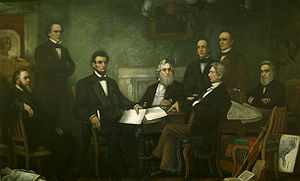
- March 13 – Act Prohibiting the Return of SlavesAct Prohibiting the Return of SlavesThe Act Prohibiting the Return of Slaves was a law passed by the United States Congress during the American Civil War forbidding the military to return escaped slaves to their owners. As Union armies entered Southern territory during the early years of the War, emboldened slaves began fleeing...
- September 22 – Announcement of the Emancipation ProclamationEmancipation ProclamationThe Emancipation Proclamation is an executive order issued by United States President Abraham Lincoln on January 1, 1863, during the American Civil War using his war powers. It proclaimed the freedom of 3.1 million of the nation's 4 million slaves, and immediately freed 50,000 of them, with nearly...
, after the Battle of AntietamBattle of AntietamThe Battle of Antietam , fought on September 17, 1862, near Sharpsburg, Maryland, and Antietam Creek, as part of the Maryland Campaign, was the first major battle in the American Civil War to take place on Northern soil. It was the bloodiest single-day battle in American history, with about 23,000...
, to go into effect January 1, 1863.
1863–1877 Reconstruction
1863
- January 1 – The Emancipation ProclamationEmancipation ProclamationThe Emancipation Proclamation is an executive order issued by United States President Abraham Lincoln on January 1, 1863, during the American Civil War using his war powers. It proclaimed the freedom of 3.1 million of the nation's 4 million slaves, and immediately freed 50,000 of them, with nearly...
goes into effect. - January 31 – U.S. Army commissions the 1st South Carolina Volunteers, a combat unit made up of escaped slaves.
- May 22 – U.S. Army recruits United States Colored TroopsUnited States Colored TroopsThe United States Colored Troops were regiments of the United States Army during the American Civil War that were composed of African American soldiers. First recruited in 1863, by the end of the Civil War, the men of the 175 regiments of the USCT constituted approximately one-tenth of the Union...
. (The 54th Massachusetts Volunteer Regiment54th Massachusetts Volunteer RegimentThe 54th Massachusetts Volunteer Regiment is a regiment of the Massachusetts Army National Guard. It is a descendent of the famous 54th Massachusetts Volunteer Infantry.-History:...
would be featured in the 1989 film Glory.) - July – Irish ethnic protests against the draft in New York CityNew York CityNew York is the most populous city in the United States and the center of the New York Metropolitan Area, one of the most populous metropolitan areas in the world. New York exerts a significant impact upon global commerce, finance, media, art, fashion, research, technology, education, and...
turn into riots against blacks – the so-called New York Draft RiotsNew York Draft RiotsThe New York City draft riots were violent disturbances in New York City that were the culmination of discontent with new laws passed by Congress to draft men to fight in the ongoing American Civil War. The riots were the largest civil insurrection in American history apart from the Civil War itself...
.
1864
- April 12 – The Battle of Fort PillowBattle of Fort PillowThe Battle of Fort Pillow, also known as the Fort Pillow Massacre, was fought on April 12, 1864, at Fort Pillow on the Mississippi River in Henning, Tennessee, during the American Civil War. The battle ended with a massacre of surrendered Federal black troops by soldiers under the command of...
, which results in controversy about whether a massacre of surrendered African-American troops was conducted or condoned.
1865
- March 3 – Congress passes the bill that forms the Freedman's BureauBureau of Refugees, Freedmen and Abandoned LandsThe Freedmen's Bureau, was a U.S. federal government agency that aided distressed freedmen in 1865–1869, during the Reconstruction era of the United States....
. - December 18 – The Thirteenth Amendment to the United States ConstitutionThirteenth Amendment to the United States ConstitutionThe Thirteenth Amendment to the United States Constitution officially abolished and continues to prohibit slavery and involuntary servitude, except as punishment for a crime. It was passed by the Senate on April 8, 1864, passed by the House on January 31, 1865, and adopted on December 6, 1865. On...
abolishes slaverySlaverySlavery is a system under which people are treated as property to be bought and sold, and are forced to work. Slaves can be held against their will from the time of their capture, purchase or birth, and deprived of the right to leave, to refuse to work, or to demand compensation...
in the U.S. - unknown – Shaw InstituteShaw UniversityShaw University, founded as Raleigh Institute, is a private liberal arts institution and historically black university in Raleigh, North Carolina, United States. Founded in 1865, it is the oldest HBCU in the Southern United States....
is founded in Raleigh, North CarolinaRaleigh, North CarolinaRaleigh is the capital and the second largest city in the state of North Carolina as well as the seat of Wake County. Raleigh is known as the "City of Oaks" for its many oak trees. According to the U.S. Census Bureau, the city's 2010 population was 403,892, over an area of , making Raleigh...
, as the first black collegeHistorically Black Colleges and UniversitiesHistorically black colleges and universities are institutions of higher education in the United States that were established before 1964 with the intention of serving the black community....
in the South. - unknown – Atlanta CollegeClark Atlanta UniversityClark Atlanta University is a private, historically black university in Atlanta, Georgia. It was formed in 1988 with the consolidation of Clark College and Atlanta University...
is founded. - unknown – Every southern state passes Black Codes that restrict the freedmen, who were emancipated but not yet full citizens.
1866
- April 9 – The Civil Rights Act of 1866Civil Rights Act of 1866The Civil Rights Act of 1866, , enacted April 9, 1866, is a federal law in the United States that was mainly intended to protect the civil rights of African-Americans, in the wake of the American Civil War...
is passed by Congress over Johnson's presidential vetoVetoA veto, Latin for "I forbid", is the power of an officer of the state to unilaterally stop an official action, especially enactment of a piece of legislation...
. All persons born in the United StatesUnited StatesThe United States of America is a federal constitutional republic comprising fifty states and a federal district...
are now citizens. - unknown – The Ku Klux KlanKu Klux KlanKu Klux Klan, often abbreviated KKK and informally known as the Klan, is the name of three distinct past and present far-right organizations in the United States, which have advocated extremist reactionary currents such as white supremacy, white nationalism, and anti-immigration, historically...
is formed in Pulaski, TennesseePulaski, TennesseePulaski is a city in Giles County, Tennessee, United States. The population was 7,870 at the 2010 census. It is the county seat of Giles County. It was named to honor the Polish-born American Revolutionary War hero Kazimierz Pułaski...
, made up of white Confederate veterans; it becomes a paramilitaryParamilitaryA paramilitary is a force whose function and organization are similar to those of a professional military, but which is not considered part of a state's formal armed forces....
insurgent group to enforce white supremacy. - July – New Orleans white citizens riot against blacks.
- September 21 – The U.S. Army regiment of Buffalo SoldierBuffalo SoldierBuffalo Soldiers originally were members of the U.S. 10th Cavalry Regiment of the United States Army, formed on September 21, 1866 at Fort Leavenworth, Kansas....
s (African Americans) is formed. - unknown – The Second Freedmen's Bureau Act would have provided longer enforcement of rights for freedmen, but it is vetoed by President Andrew JohnsonAndrew JohnsonAndrew Johnson was the 17th President of the United States . As Vice-President of the United States in 1865, he succeeded Abraham Lincoln following the latter's assassination. Johnson then presided over the initial and contentious Reconstruction era of the United States following the American...
.
1867
- March 2 – Howard UniversityHoward UniversityHoward University is a federally chartered, non-profit, private, coeducational, nonsectarian, historically black university located in Washington, D.C., United States...
is founded in Washington, D.C.
1868
- April 1 – Hampton InstituteHampton UniversityHampton University is a historically black university located in Hampton, Virginia, United States. It was founded by black and white leaders of the American Missionary Association after the American Civil War to provide education to freedmen.-History:...
is founded in Hampton, VirginiaHampton, VirginiaHampton is an independent city that is not part of any county in Southeast Virginia. Its population is 137,436. As one of the seven major cities that compose the Hampton Roads metropolitan area, it is on the southeastern end of the Virginia Peninsula. Located on the Hampton Roads Beltway, it hosts...
. - July 9 – The Fourteenth Amendment to the United States ConstitutionFourteenth Amendment to the United States ConstitutionThe Fourteenth Amendment to the United States Constitution was adopted on July 9, 1868, as one of the Reconstruction Amendments.Its Citizenship Clause provides a broad definition of citizenship that overruled the Dred Scott v...
's Section 1 requires due processDue processDue process is the legal code that the state must venerate all of the legal rights that are owed to a person under the principle. Due process balances the power of the state law of the land and thus protects individual persons from it...
and equal protection. - unknown – Through 1877, whites attack black and white Republicans to suppress voting. Every election cycle is accompanied by violence, increasing in the 1870s.
- unknown – Elizabeth KecklyElizabeth KecklyElizabeth Hobbs Keckley was a former slave turned successful seamstress who is most notably known as being Mary Todd Lincoln's personal modiste and confidante, and the author of her autobiography, Behind the Scenes Or, Thirty Years a Slave and Four Years in the White House. Mrs...
publishes Behind the Scenes (or, Thirty Years a Slave and Four Years in the White House).
1870
- February 3 – The Fifteenth Amendment to the United States ConstitutionFifteenth Amendment to the United States ConstitutionThe Fifteenth Amendment to the United States Constitution prohibits each government in the United States from denying a citizen the right to vote based on that citizen's "race, color, or previous condition of servitude"...
guarantees the right of male citizens of the United States to vote regardless of race, color or previous condition of servitude. - February 25 – Hiram Rhodes RevelsHiram Rhodes RevelsHiram Rhodes Revels was the first African American to serve in the United States Senate. Because he preceded any African American in the House, he was the first African American in the U.S. Congress as well. He represented Mississippi in 1870 and 1871 during Reconstruction...
becomes the first black member of the SenateUnited States SenateThe United States Senate is the upper house of the bicameral legislature of the United States, and together with the United States House of Representatives comprises the United States Congress. The composition and powers of the Senate are established in Article One of the U.S. Constitution. Each...
(see African Americans in the United States CongressAfrican Americans in the United States CongressAfrican Americans began serving in greater numbers in the United States Congress during the Reconstruction Era following the American Civil War after slaves were emancipated and granted citizenship rights. Freedmen gained political representation in the Southern United States for the first time...
). - unknown – Christian Methodist Episcopal ChurchChristian Methodist Episcopal ChurchThe Christian Methodist Episcopal Church is a historically black denomination within the broader context of Methodism. The group was organized in 1870 when several black ministers, with the full support of their white counterparts in the former Methodist Episcopal Church, South, met to form an...
founded.
1871
- October 10 – Octavius CattoOctavius CattoOctavius Valentine Catto was a black educator, intellectual, and civil rights activist. He was also known for being a cricket and baseball player in 19th-century Philadelphia, Pennsylvania...
, a civil rights activist, is murdered during harassment of blacks on Election Day in Philadelphia. - unknown – US Civil Rights Act of 1871Civil Rights Act of 1871The Civil Rights Act of 1871, , enacted April 20, 1871, is a federal law in force in the United States. The Act was originally enacted a few years after the American Civil War, along with the 1870 Force Act. One of the chief reasons for its passage was to protect southern blacks from the Ku Klux...
passed, also known as the Klan Act.
1872
- December 11 – P. B. S. PinchbackP. B. S. PinchbackPinckney Benton Stewart Pinchback was the first non-white and first person of African American descent to become governor of a U.S. state...
is sworn in as the first black member of the U.S. House of Representatives. - Disputed gubernatorial election in LouisianaLouisianaLouisiana is a state located in the southern region of the United States of America. Its capital is Baton Rouge and largest city is New Orleans. Louisiana is the only state in the U.S. with political subdivisions termed parishes, which are local governments equivalent to counties...
cause political violence for more than two years. Both Republican and Democratic governors hold inaugurations and certify local officials.
1873
- April 14 – In the Slaughter-House Cases the Supreme Court votes 5–4 for a narrow reading of the Fourteenth AmendmentFourteenth Amendment to the United States ConstitutionThe Fourteenth Amendment to the United States Constitution was adopted on July 9, 1868, as one of the Reconstruction Amendments.Its Citizenship Clause provides a broad definition of citizenship that overruled the Dred Scott v...
. The court also discusses dual citizenship: State citizens and U.S. citizens. - Easter, the Colfax MassacreColfax massacreThe Colfax massacre or Colfax Riot occurred on Easter Sunday, April 13, 1873, in Colfax, Louisiana, the seat of Grant Parish, during Reconstruction, when white militia attacked freedmen at the Colfax courthouse...
– More than 100 blacks in the Red RiverRed River Parish, LouisianaRed River Parish is a parish located in the U.S. state of Louisiana. Its seat is Coushatta. It was one of the newer parishes created in 1871 by the state legislature under Reconstruction...
area of Louisiana are killed when attacked by white militia after defending Republicans in local office – continuing controversy from gubernatorial election. - Coushatta MassacreCoushatta massacreThe Coushatta Massacre was the result of an attack by the White League, a paramilitary organization composed of white Southern Democrats, on Republican officeholders and freedmen in Coushatta, the parish seat of Red River Parish, Louisiana...
– Republican officeholders are run out of town and murdered by white militia before leaving the state – four of six were relatives of a Louisiana state senator, a northerner who had settled in the South, married into a local family and established a plantation. Five to twenty black witnesses are also killed.
1874
- Founding of paramilitaryParamilitaryA paramilitary is a force whose function and organization are similar to those of a professional military, but which is not considered part of a state's formal armed forces....
groups that act as the "military arm of the Democratic Party": the White LeagueWhite LeagueThe White League was a white paramilitary group started in 1874 that operated to turn Republicans out of office and intimidate freedmen from voting and political organizing. Its first chapter in Grant Parish, Louisiana was made up of many of the Confederate veterans who had participated in the...
in Louisiana and the Red Shirts in Mississippi, and North and South Carolina. They terrorize blacks and Republicans, turning them out of office, killing some, disrupting rallies, and suppressing voting. - September – In New Orleans, continuing political violence erupts related to the still-contested gubernatorial election of 1872. Thousands of the White League armed militia march into New Orleans, then the seat of government, where they outnumber the integrated city police and black state militia forces. They defeat Republican forces and demand that Gov. Kellogg leave office. The Democratic candidate McEnery is installed and White Leaguers occupy the capitol, state house and arsenal. This was called the "Battle of Liberty Place". The White League and McEnery withdraw after three days in advance of federal troops arriving to reinforce the Republican state government.
1875–1899
1875- March 1 – Civil Rights Act of 1875Civil Rights Act of 1875The Civil Rights Act of 1875 was a United States federal law proposed by Senator Charles Sumner and Representative Benjamin F. Butler in 1870...
signed. - unknown – The Mississippi PlanMississippi PlanThe Mississippi Plan of 1875 was devised by the Democratic Party to overthrow the Republican Party in the state of Mississippi by means of organized threats of violence and suppression or purchase of the black vote, in order to regain political control of the legislature and governor's office...
to intimidate blacks and suppress black voter registration and voting.
1876
- July 8 – The Hamburg MassacreHamburg MassacreThe Hamburg Massacre was a key event of South Carolina Reconstruction. Beginning with a dispute over free passage on a public road, this racially motivated incident concluded with the death of seven men...
occurs when local people riot against African Americans who were trying to celebrate the Fourth of July. - varied – White Democrats regain power in many southern state legislatures and pass the first Jim Crow lawsJim Crow lawsThe Jim Crow laws were state and local laws in the United States enacted between 1876 and 1965. They mandated de jure racial segregation in all public facilities, with a supposedly "separate but equal" status for black Americans...
.
1877
- unknown – With the Compromise of 1877Compromise of 1877The Compromise of 1877, also known as the Corrupt Bargain, refers to a purported informal, unwritten deal that settled the disputed 1876 U.S. Presidential election and ended Congressional Reconstruction. Through it, Republican Rutherford B. Hayes was awarded the White House over Democrat Samuel J...
, Republican Rutherford B. HayesRutherford B. HayesRutherford Birchard Hayes was the 19th President of the United States . As president, he oversaw the end of Reconstruction and the United States' entry into the Second Industrial Revolution...
withdraws federal troops from the South in exchange for being elected President of the United States, causing the collapse of the last three remaining Republican state governments. The compromise formally ends the Reconstruction era of the United States.
1879
- spring – Thousands of African Americans refuse to live under segregation in the South and migrate to KansasKansasKansas is a US state located in the Midwestern United States. It is named after the Kansas River which flows through it, which in turn was named after the Kansa Native American tribe, which inhabited the area. The tribe's name is often said to mean "people of the wind" or "people of the south...
. They become known as ExodustersExodustersExodusters was a name given to African Americans who fled the Southern United States for Kansas in 1879 and 1880. After the end of Reconstruction, racial oppression and rumors of the reinstitution of slavery led many freedmen to seek a new place to live....
.
1880
- unknown – In Strauder v. West VirginiaStrauder v. West VirginiaStrauder v. West Virginia, , was a United States Supreme Court case about racial discrimination.-Background:At the time, West Virginia excluded African-Americans from juries. Strauder was a Black man who, at trial, had been convicted of murder by an all-white jury...
, the Supreme CourtSupreme Court of the United StatesThe Supreme Court of the United States is the highest court in the United States. It has ultimate appellate jurisdiction over all state and federal courts, and original jurisdiction over a small range of cases...
rules that African Americans could not be excluded from juries. - During the 1880s, African Americans in the South reach a peak of numbers in being elected and holding local offices, even while white Democrats are working to assert control at state level.
1881
- April 11 – Spelman Seminary is founded as the Atlanta Baptist Female Seminary.
- July 4 – Booker T. WashingtonBooker T. WashingtonBooker Taliaferro Washington was an American educator, author, orator, and political leader. He was the dominant figure in the African-American community in the United States from 1890 to 1915...
opens the Tuskegee Normal and Industrial InstituteTuskegee UniversityTuskegee University is a private, historically black university located in Tuskegee, Alabama, United States. It is a member school of the Thurgood Marshall Scholarship Fund...
in Tuskegee, AlabamaTuskegee, AlabamaTuskegee is a city in Macon County, Alabama, United States. At the 2000 census the population was 11,846 and is designated a Micropolitan Statistical Area. Tuskegee has been an important site in various stages of African American history....
.
1882
- A biracial populist coalition achieves power in VirginiaVirginiaThe Commonwealth of Virginia , is a U.S. state on the Atlantic Coast of the Southern United States. Virginia is nicknamed the "Old Dominion" and sometimes the "Mother of Presidents" after the eight U.S. presidents born there...
(briefly). The legislature founds the first public college for African Americans, Virginia Normal and Collegiate InstituteVirginia State UniversityVirginia State University is a historically black and land-grant university located north of the Appomattox River in Chesterfield, in the Richmond area. Founded on , Virginia State was the United States's first fully state-supported four-year institution of higher learning for black Americans...
, as well as the first mental hospital for African Americans, both near Petersburg, VirginiaPetersburg, VirginiaPetersburg is an independent city in Virginia, United States located on the Appomattox River and south of the state capital city of Richmond. The city's population was 32,420 as of 2010, predominantly of African-American ethnicity...
. The hospital was established in December 1869, at Howard's Grove Hospital, a former Confederate unit, but is moved to a new campus in 1882.
1884
- unknown – Mark TwainMark TwainSamuel Langhorne Clemens , better known by his pen name Mark Twain, was an American author and humorist...
's Adventures of Huckleberry FinnAdventures of Huckleberry FinnAdventures of Huckleberry Finn is a novel by Mark Twain, first published in England in December 1884 and in the United States in February 1885. Commonly named among the Great American Novels, the work is among the first in major American literature to be written in the vernacular, characterized by...
is published, featuring the admirable African-American character Jim. - unknown – Judy W. Reed, of Washington, D.C.Washington, D.C.Washington, D.C., formally the District of Columbia and commonly referred to as Washington, "the District", or simply D.C., is the capital of the United States. On July 16, 1790, the United States Congress approved the creation of a permanent national capital as permitted by the U.S. Constitution....
, and Sarah E. Goode, of ChicagoChicagoChicago is the largest city in the US state of Illinois. With nearly 2.7 million residents, it is the most populous city in the Midwestern United States and the third most populous in the US, after New York City and Los Angeles...
, are the first African-American women inventors to receive patents. Signed with an "X", Reed's patent no. 305,474, granted September 23, 1884, is for a dough kneader and roller. Goode's patent for a cabinet bed, patent no. 322,177, is issued on July 14, 1885. Goode, the owner of a Chicago furniture store, invented a folding bed that could be formed into a desk when not in use. - unknown – Ida B. WellsIda B. WellsIda Bell Wells-Barnett was an African American journalist, newspaper editor and, with her husband, newspaper owner Ferdinand L. Barnett, an early leader in the civil rights movement. She documented lynching in the United States, showing how it was often a way to control or punish blacks who...
sues the Chesapeake, Ohio & South Western Railroad Company for its use of segregated "Jim Crow" cars.
1886
- Norris Wright CuneyNorris Wright CuneyNorris Wright Cuney, or simply Wright Cuney, was an American politician, union leader, and African American activist in Texas in the United States. He became active in Galveston politics serving as an alderman and a national Republican delegate...
becomes the chairman of the Texas Republican Party, the most powerful role held by any African American in the South during the 19th century.
1887
- October 3 – The State Normal School for Colored Students, which would become Florida A&M UniversityFlorida A&M UniversityFlorida Agricultural and Mechanical University, commonly known as Florida A&M or FAMU, is a historically black university located in Tallahassee, Florida, United States, the state capital, and is one of eleven member institutions of the State University System of Florida...
, is founded.
1888
- October 16 – In Civil Rights CasesCivil Rights CasesThe Civil Rights Cases, 109 U.S. 3 , were a group of five similar cases consolidated into one issue for the United States Supreme Court to review...
, the United States Supreme Court strikes down the Civil Rights Act of 1875 as unconstitutional.
1890
- MississippiMississippiMississippi is a U.S. state located in the Southern United States. Jackson is the state capital and largest city. The name of the state derives from the Mississippi River, which flows along its western boundary, whose name comes from the Ojibwe word misi-ziibi...
, with a white Democrat-dominated legislature, passes a new constitution that effectively disfranchises most blacks through voter registration and electoral requirements, e.g., poll taxPoll taxA poll tax is a tax of a portioned, fixed amount per individual in accordance with the census . When a corvée is commuted for cash payment, in effect it becomes a poll tax...
es, residency tests and literacy testLiteracy testA literacy test, in the context of United States political history, refers to the government practice of testing the literacy of potential citizens at the federal level, and potential voters at the state level. The federal government first employed literacy tests as part of the immigration process...
s. This shuts them out of the political process, including service on juries and in local offices. - By 1900 two-thirds of the farmers in the bottomlands of the Mississippi DeltaMississippi DeltaThe Mississippi Delta is the distinctive northwest section of the U.S. state of Mississippi that lies between the Mississippi and Yazoo Rivers. The region has been called "The Most Southern Place on Earth" because of its unique racial, cultural, and economic history...
are African Americans who cleared and bought land after the Civil War.
1892
- unknown – Ida B. WellsIda B. WellsIda Bell Wells-Barnett was an African American journalist, newspaper editor and, with her husband, newspaper owner Ferdinand L. Barnett, an early leader in the civil rights movement. She documented lynching in the United States, showing how it was often a way to control or punish blacks who...
publishes her pamphlet Southern Horrors: Lynch Law in All Its Phases.
1895
- September 18 – Booker T. WashingtonBooker T. WashingtonBooker Taliaferro Washington was an American educator, author, orator, and political leader. He was the dominant figure in the African-American community in the United States from 1890 to 1915...
delivers his Atlanta CompromiseAtlanta CompromiseThe Atlanta Cotton States and International Exposition Speech was an address on the topic of race relations given by Booker T. Washington on September 18, 1895...
address at the Cotton States and International Exposition in Atlanta, Georgia. - unknown – * W. E. B. Du Bois is the first African-American to be awarded a Ph.D by Harvard UniversityHarvard UniversityHarvard University is a private Ivy League university located in Cambridge, Massachusetts, United States, established in 1636 by the Massachusetts legislature. Harvard is the oldest institution of higher learning in the United States and the first corporation chartered in the country...
.
1896
- May 18 – In Plessy v. FergusonPlessy v. FergusonPlessy v. Ferguson, 163 U.S. 537 , is a landmark United States Supreme Court decision in the jurisprudence of the United States, upholding the constitutionality of state laws requiring racial segregation in private businesses , under the doctrine of "separate but equal".The decision was handed...
, the Supreme CourtSupreme Court of the United StatesThe Supreme Court of the United States is the highest court in the United States. It has ultimate appellate jurisdiction over all state and federal courts, and original jurisdiction over a small range of cases...
upholds de jureDe jureDe jure is an expression that means "concerning law", as contrasted with de facto, which means "concerning fact".De jure = 'Legally', De facto = 'In fact'....
racial segregationRacial segregationRacial segregation is the separation of humans into racial groups in daily life. It may apply to activities such as eating in a restaurant, drinking from a water fountain, using a public toilet, attending school, going to the movies, or in the rental or purchase of a home...
of "separate but equalSeparate but equalSeparate but equal was a legal doctrine in United States constitutional law that justified systems of segregation. Under this doctrine, services, facilities and public accommodations were allowed to be separated by race, on the condition that the quality of each group's public facilities was to...
" facilities. (see Jim Crow lawsJim Crow lawsThe Jim Crow laws were state and local laws in the United States enacted between 1876 and 1965. They mandated de jure racial segregation in all public facilities, with a supposedly "separate but equal" status for black Americans...
for historical discussion). - unknown – The National Association of Colored WomenNational Association of Colored WomenThe National Association of Colored Women Clubs was established in Washington, D.C., USA, by the merger in 1896 of the National Federation of Afro-American Women, the Women's Era Club of Boston, and the National League of Colored Women of Washington, DC, as well as smaller organizations that had...
is formed by the merger of smaller groups. - unknown – As one of the earliest Black Hebrew IsraelitesBlack Hebrew IsraelitesBlack Hebrew Israelites are groups of people mostly of Black African ancestry situated mainly in the United States who believe they are descendants of the ancient Israelites. Black Hebrews adhere in varying degrees to the religious beliefs and practices of mainstream Judaism...
in the United States, William Saunders CrowdyWilliam Saunders CrowdyWilliam Saunders Crowdy was an American soldier, preacher, entrepreneur, theologian, and pastor. As one of the earliest Black Hebrew Israelites in the United States, he established the Church of God and Saints of Christ in 1896.-Early life:In 1847, William Saunders Crowdy was born into slavery at...
re-establishes the Church of God and Saints of ChristChurch of God and Saints of ChristThe Church of God and Saints of Christ is a Hebrew Israelite religious group established in Lawrence, Kansas, by William Saunders Crowdy in 1896. William Crowdy began congregations in several cities in the Midwestern and Eastern United States, and sent an emissary to organize locations in at least...
. - unknown – George Washington CarverGeorge Washington CarverGeorge Washington Carver , was an American scientist, botanist, educator, and inventor. The exact day and year of his birth are unknown; he is believed to have been born into slavery in Missouri in January 1864....
is invited by Booker T. Washington to head the Agricultural Department at what would become Tuskegee UniversityTuskegee UniversityTuskegee University is a private, historically black university located in Tuskegee, Alabama, United States. It is a member school of the Thurgood Marshall Scholarship Fund...
. His work would revolutionize farming – he found about 300 uses for peanuts.
1898
- unknown – LouisianaLouisianaLouisiana is a state located in the southern region of the United States of America. Its capital is Baton Rouge and largest city is New Orleans. Louisiana is the only state in the U.S. with political subdivisions termed parishes, which are local governments equivalent to counties...
enacts the first state-wide grandfather clauseGrandfather clauseGrandfather clause is a legal term used to describe a situation in which an old rule continues to apply to some existing situations, while a new rule will apply to all future situations. It is often used as a verb: to grandfather means to grant such an exemption...
that provides exemption for illiterate whites to voter registration literacy test requirements. - unknown – In Williams v. MississippiWilliams v. MississippiWilliams v. Mississippi, 170 U.S. 213 is a United States Supreme Court case that reviewed provisions of the state constitution that set requirements for voter registration...
the Supreme CourtSupreme Court of the United StatesThe Supreme Court of the United States is the highest court in the United States. It has ultimate appellate jurisdiction over all state and federal courts, and original jurisdiction over a small range of cases...
upholds the voter registration and election provisions of Mississippi's constitution because they applied to all citizens. Effectively, however, they disenfranchise blacks and poor whites. The result is that other southern states copy these provisions in their new constitutions and amendments through 1908, disfranchising most African Americans and tens of thousands of poor whites until the 1960s.
1899
- September 18 – The "Maple Leaf RagMaple Leaf RagThe "Maple Leaf Rag" is an early ragtime musical composition for piano composed by Scott Joplin. It was one of Joplin's early works, and is one of the most famous of all ragtime pieces, and became the model for ragtime compositions by subsequent composers. As a result Joplin was called the "King...
" is an early ragtimeRagtimeRagtime is an original musical genre which enjoyed its peak popularity between 1897 and 1918. Its main characteristic trait is its syncopated, or "ragged," rhythm. It began as dance music in the red-light districts of American cities such as St. Louis and New Orleans years before being published...
composition for piano by Scott JoplinScott JoplinScott Joplin was an American composer and pianist. Joplin achieved fame for his ragtime compositions, and was later dubbed "The King of Ragtime". During his brief career, Joplin wrote 44 original ragtime pieces, one ragtime ballet, and two operas...
.
1900–1924
1900- Since the Civil War, 30,000 African-American teachers had been trained and put to work in the South. The majority of blacks had become literate.
1901
- Booker T. WashingtonBooker T. WashingtonBooker Taliaferro Washington was an American educator, author, orator, and political leader. He was the dominant figure in the African-American community in the United States from 1890 to 1915...
's autobiography Up from SlaveryUp From SlaveryUp from Slavery is the 1901 autobiography of Booker T. Washington detailing his slow and steady rise from a slave child during the Civil War, to the difficulties and obstacles he overcame to get an education at the new Hampton University, to his work establishing vocational schools—most notably the...
is published. - Benjamin TillmanBenjamin TillmanBenjamin Ryan Tillman was an American politician who served as the 84th Governor of South Carolina, from 1890 to 1894, and as a United States Senator, from 1895 until his death in office. Tillman's views were a matter of national controversy.Tillman was a member of the Democratic Party...
, senator from South Carolina, comments on Theodore RooseveltTheodore RooseveltTheodore "Teddy" Roosevelt was the 26th President of the United States . He is noted for his exuberant personality, range of interests and achievements, and his leadership of the Progressive Movement, as well as his "cowboy" persona and robust masculinity...
's dining with Booker T. WashingtonBooker T. WashingtonBooker Taliaferro Washington was an American educator, author, orator, and political leader. He was the dominant figure in the African-American community in the United States from 1890 to 1915...
: “The action of President Roosevelt in entertaining that nigger will necessitate our killing a thousand niggers in the South before they learn their place again.”
1903
- September – W. E. B. Du Bois's article The Talented TenthThe Talented TenthThe Talented Tenth is a term that designated a leadership class of African-Americans in the early twentieth century. The term was publicized by W. E. B. Du Bois in an influential essay of the same name, which he published in September 1903...
published. - W. E. B. Du Bois's seminal work The Souls of Black FolkThe Souls of Black FolkThe Souls of Black Folk is a classic work of American literature by W. E. B. Du Bois. It is a seminal work in the history of sociology, and a cornerstone of African-American literary history....
is published.
1904
- May 15 – Sigma Pi PhiSigma Pi PhiSigma Pi Phi is the first African-American Greek-lettered organization. Sigma Pi Phi was founded in Philadelphia, Pennsylvania, on May 15, 1904. The fraternity quickly established chapters in Chicago, IL and then Baltimore, MD....
, the first African-American Greek-letter organization, is founded by African-American men as a professional organization, in Philadelphia, Pennsylvania. - Orlando, FloridaOrlando, FloridaOrlando is a city in the central region of the U.S. state of Florida. It is the county seat of Orange County, and the center of the Greater Orlando metropolitan area. According to the 2010 US Census, the city had a population of 238,300, making Orlando the 79th largest city in the United States...
hires its first black postman.
1905
- July 11 – First meeting of the Niagara MovementNiagara MovementThe Niagara Movement was a black civil rights organization founded in 1905 by a group led by W. E. B. Du Bois and William Monroe Trotter. It was named for the "mighty current" of change the group wanted to effect and Niagara Falls, the Canadian side of which was where the first meeting took...
, an interracial group to work for civil rights.
1906
- The Brownsville AffairBrownsville AffairThe Brownsville Affair was a racial incident that arose out of tensions between black soldiers and white citizens in Brownsville, Texas, in 1906. When a white bartender was killed and a police officer wounded by gunshot, townspeople accused the members of the 25th Regiment, an all-black unit...
, which eventually involves President Roosevelt. - December 4 – African-American men found Alpha Phi AlphaAlpha Phi AlphaAlpha Phi Alpha is the first Inter-Collegiate Black Greek Letter fraternity. It was founded on December 4, 1906 at Cornell University in Ithaca, New York. Its founders are known as the "Seven Jewels". Alpha Phi Alpha developed a model that was used by the many Black Greek Letter Organizations ...
at Cornell UniversityCornell UniversityCornell University is an Ivy League university located in Ithaca, New York, United States. It is a private land-grant university, receiving annual funding from the State of New York for certain educational missions...
, the first intercollegiate fraternity for African-American men.
1907
- National Primitive Baptist Convention of the U.S.A.National Primitive Baptist Convention of the U.S.A.The National Primitive Baptist Convention, USA is a group of Black Primitive Baptists that has adopted progressive methods and policies not in keeping with the historical and theological background of Primitive Baptists in general. The Convention was organized in Huntsville, Alabama in 1907...
formed.
1908
- December 26 – Jack JohnsonJack Johnson (boxer)John Arthur Johnson , nicknamed the “Galveston Giant,” was an American boxer. At the height of the Jim Crow era, Johnson became the first African American world heavyweight boxing champion...
wins the World Heavyweight Title. - Alpha Kappa AlphaAlpha Kappa AlphaAlpha Kappa Alpha is the first Greek-lettered sorority established and incorporated by African American college women. The sorority was founded on January 15, 1908, at Howard University in Washington, D.C., by a group of nine students, led by Ethel Hedgeman Lyle...
– At Howard UniversityHoward UniversityHoward University is a federally chartered, non-profit, private, coeducational, nonsectarian, historically black university located in Washington, D.C., United States...
, African-American college women found the first college sorority for African-American women.
1909
- February 12 – Planned first meeting of group which would become the National Association for the Advancement of Colored PeopleNational Association for the Advancement of Colored PeopleThe National Association for the Advancement of Colored People, usually abbreviated as NAACP, is an African-American civil rights organization in the United States, formed in 1909. Its mission is "to ensure the political, educational, social, and economic equality of rights of all persons and to...
(NAACP), an interracial group devoted to civil rights. The meeting actually occurs on May 31, but February 12 is normally cited as the NAACP's founding date. - May 31 – The National Negro CommitteeNational Negro CommitteeThe National Negro Committee was composed of a group of activists, in order to address the social, economic, and political rights of African-Americans...
meets and is formed; it will be the precursor to the NAACP.
1910
- May 30 – The National Negro Committee chooses "National Association for the Advancement of Colored People" as its organization name.
- September 29 – Committee on Urban Conditions Among Negroes formed; the next year it will merge with other groups to form the National Urban LeagueNational Urban LeagueThe National Urban League , formerly known as the National League on Urban Conditions Among Negroes, is a nonpartisan civil rights organization based in New York City that advocates on behalf of African Americans and against racial discrimination in the United States. It is the oldest and largest...
. - The NAACP begins publishing The CrisisThe CrisisThe Crisis is the official magazine of the National Association for the Advancement of Colored People , and was founded in 1910 by W. E. B. Du Bois , Oswald Garrison Villard, J. Max Barber, Charles Edward Russell, Kelly Miller, W.S. Braithwaite, M. D. Maclean.The original title of the journal was...
.
1913
- The Moorish Science Temple of AmericaMoorish Science Temple of AmericaThe Moorish Science Temple of America is an American organization founded in the early 20th century by Timothy Drew. He claimed it was a sect of Islam but he also drew inspiration from Buddhism, Christianity, Freemasonry, Gnosticism and Taoism....
, a religious organization, is founded by Noble Drew Ali (Timothy Drew).
1914
- Newly elected president Woodrow WilsonWoodrow WilsonThomas Woodrow Wilson was the 28th President of the United States, from 1913 to 1921. A leader of the Progressive Movement, he served as President of Princeton University from 1902 to 1910, and then as the Governor of New Jersey from 1911 to 1913...
orders physical re-segregation of federal workplaces and employment after nearly 50 years of integrated facilities.
1915
- February 8 – The Birth of a NationThe Birth of a NationThe Birth of a Nation is a 1915 American silent film directed by D. W. Griffith and based on the novel and play The Clansman, both by Thomas Dixon, Jr. Griffith also co-wrote the screenplay , and co-produced the film . It was released on February 8, 1915...
is released to film theaters. The NAACP protests in cities across the country, convincing some not to show the film. - June 21 – In Guinn v. United StatesGuinn v. United StatesGuinn v. United States, 238 U.S. 347 , was an important United States Supreme Court decision that dealt with provisions of state constitutions that set qualifications for voters. It found grandfather clause exemptions to literacy tests to be unconstitutional...
, the Supreme CourtSupreme Court of the United StatesThe Supreme Court of the United States is the highest court in the United States. It has ultimate appellate jurisdiction over all state and federal courts, and original jurisdiction over a small range of cases...
rules against grandfather clauseGrandfather clauseGrandfather clause is a legal term used to describe a situation in which an old rule continues to apply to some existing situations, while a new rule will apply to all future situations. It is often used as a verb: to grandfather means to grant such an exemption...
s used to deny blacks the vote. - September 9 – Professor Carter G. WoodsonCarter G. WoodsonCarter Godwin Woodson was an African-American historian, author, journalist and the founder of the Association for the Study of African American Life and History. Woodson was one of the first scholars to study African American history. A founder of Journal of Negro History , Dr...
founds the Association for the Study of African American Life and HistoryAssociation for the Study of African American Life and HistoryThe Association for the Study of African American Life and History is an organization dedicated to the study and appreciation of African-American History. It is a non-profit organization founded in Chicago, Illinois, on September 9, 1915 and incorporated in Washington, D.C. on October 2, 1915 as...
in ChicagoChicagoChicago is the largest city in the US state of Illinois. With nearly 2.7 million residents, it is the most populous city in the Midwestern United States and the third most populous in the US, after New York City and Los Angeles...
. - A schism from the National Baptist Convention, USA, Inc.National Baptist Convention, USA, Inc.The National Baptist Convention, USA, Inc. is the largest predominantly African-American Christian denomination in the United States and is the world's second largest Baptist denomination...
forms the National Baptist Convention of America, Inc.National Baptist Convention of America, Inc.The National Baptist Convention of America, Inc. is an African-American Baptist body organized in 1915 as the result of a struggle to keep the National Baptist Publishing Board of Nashville independent. Those supporting the independence of the publishing board, headed by Rev. R. H...
1916
- January – Professor Carter Woodson and the Association for the Study of Negro Life and History begins publishing the Journal of Negro History, the first academic journal devoted to the study of African-American history.
- March 23 – Marcus GarveyMarcus GarveyMarcus Mosiah Garvey, Jr., ONH was a Jamaican publisher, journalist, entrepreneur, and orator who was a staunch proponent of the Black Nationalism and Pan-Africanism movements, to which end he founded the Universal Negro Improvement Association and African Communities League...
arrives in the U.S. (see GarveyismGarveyismGarveyism is an aspect of Black Nationalism which takes its source from the works, words and deeds of UNIA-ACL founder Marcus Garvey. The fundamental focus of Garveyism is the complete, total and never ending redemption of the continent of Africa by people of African ancestry, at home and abroad...
). - Los AngelesLos ÁngelesLos Ángeles is the capital of the province of Biobío, in the commune of the same name, in Region VIII , in the center-south of Chile. It is located between the Laja and Biobío rivers. The population is 123,445 inhabitants...
hires the country's first black female police officer. - The Great MigrationGreat Migration (African American)The Great Migration was the movement of 6 million blacks out of the Southern United States to the Northeast, Midwest, and West from 1910 to 1970. Some historians differentiate between a Great Migration , numbering about 1.6 million migrants, and a Second Great Migration , in which 5 million or more...
begins and lasts until 1940. Approximately one and a half million African-Americans move from the Southern United StatesSouthern United StatesThe Southern United States—commonly referred to as the American South, Dixie, or simply the South—constitutes a large distinctive area in the southeastern and south-central United States...
to the NorthNorthern United StatesNorthern United States, also sometimes the North, may refer to:* A particular grouping of states or regions of the United States of America. The United States Census Bureau divides some of the northernmost United States into the Midwest Region and the Northeast Region...
and MidwestMidwestern United StatesThe Midwestern United States is one of the four U.S. geographic regions defined by the United States Census Bureau, providing an official definition of the American Midwest....
. More than five million migrate in the Second Great Migration from 1940–1970, which includes more destinations in California and the WestWestern United States.The Western United States, commonly referred to as the American West or simply "the West," traditionally refers to the region comprising the westernmost states of the United States. Because the U.S. expanded westward after its founding, the meaning of the West has evolved over time...
.
1917
- May–June – East St. Louis RiotEast St. Louis RiotThe East St. Louis Riot was an outbreak of labor- and race-related violence that caused between 40 and 200 deaths and extensive property damage. East St. Louis, Illinois, is an industrial city on the east bank of the Mississippi River across from St. Louis, Missouri...
- In Buchanan v. WarleyBuchanan v. WarleyBuchanan v. Warley, 245 U.S. 60 was a unanimous United States Supreme Court decision addressing civil government instituted racial segregation in residential areas. The Court held that a Louisville, Kentucky, city ordinance prohibiting the sale of real property to African Americans violated the...
, the United States Supreme Court upholds that racially segregated housing violates the 14th Amendment.
1918
- OrlandoOrlando, FloridaOrlando is a city in the central region of the U.S. state of Florida. It is the county seat of Orange County, and the center of the Greater Orlando metropolitan area. According to the 2010 US Census, the city had a population of 238,300, making Orlando the 79th largest city in the United States...
's first black doctor opens practice. - Viola PettusViola PettusViola Pettus was an African-American woman, born about 1886, who lived in Marathon, Brewster County, Texas. Viola is remembered in Texas for her courageous work as a nurse during the 1918 flu pandemic...
, an African-American nurse in Marathon, TexasMarathon, TexasMarathon is a census-designated place in Brewster County, Texas, United States. The population was 470 in 2007, after growing from 455 in 2000, but had decreased to 430 by 2010.-Geography:Marathon is located at ....
, wins attention for her courageous care of victims of the Spanish Influenza, including members of the Ku Klux KlanKu Klux KlanKu Klux Klan, often abbreviated KKK and informally known as the Klan, is the name of three distinct past and present far-right organizations in the United States, which have advocated extremist reactionary currents such as white supremacy, white nationalism, and anti-immigration, historically...
.
1919
- summer – Red Summer of 1919Red Summer of 1919Red Summer describes the race riots that occurred in more than three dozen cities in the United States during the summer and early autumn of 1919. In most instances, whites attacked African Americans. In some cases groups of blacks fought back, notably in Chicago, where, along with Washington, D.C....
riots: ChicagoChicago Race Riot of 1919The Chicago Race Riot of 1919 was a major racial conflict that began in Chicago, Illinois on July 27, 1919 and ended on August 3. During the riot, dozens died and hundreds were injured. It is considered the worst of the approximately 25 riots during the Red Summer of 1919, so named because of the...
, Washington, D.C.Washington, D.C.Washington, D.C., formally the District of Columbia and commonly referred to as Washington, "the District", or simply D.C., is the capital of the United States. On July 16, 1790, the United States Congress approved the creation of a permanent national capital as permitted by the U.S. Constitution....
; KnoxvilleKnoxville Riot of 1919The Knoxville Riot of 1919 was a race riot that took place in Knoxville, Tennessee, USA, on August 30–31, 1919. The riot began when a lynch mob stormed the county jail in search of Maurice Mayes, a mulatto man who had been accused of murdering a white woman...
, IndianapolisIndianapolisIndianapolis is the capital of the U.S. state of Indiana, and the county seat of Marion County, Indiana. As of the 2010 United States Census, the city's population is 839,489. It is by far Indiana's largest city and, as of the 2010 U.S...
, and elsewhere. - September 28 – Omaha Race Riot of 1919Omaha Race Riot of 1919The Omaha Race Riot occurred in Omaha, Nebraska, on September 28–29, 1919. The race riot resulted in the brutal lynching of Will Brown, a black worker; the death of two white men; the attempted hanging of the mayor Edward Parsons Smith; and a public rampage by thousands of whites who set fire to...
, NebraskaNebraskaNebraska is a state on the Great Plains of the Midwestern United States. The state's capital is Lincoln and its largest city is Omaha, on the Missouri River....
. - October 1–5 – Elaine Race RiotElaine Race RiotThe Elaine Race Riot, also called the Elaine Massacre, occurred September 30, 1919 in the town of Elaine in Phillips County, Arkansas, in the Arkansas Delta, where sharecropping by African American farmers was prevalent on plantations of white landowners.Approximately 100 African American farmers,...
, Phillips County, Arkansas. Numerous blacks are convicted by an all-white jury or plead guilty. In Moore v. DempseyMoore v. DempseyMoore et al. v. Dempsey, , was a United States Supreme Court case in which the Court ruled 6-2 that the defendants' mob-dominated trials deprived them of due process guaranteed by the Due Process Clause of the Fourteenth Amendment and reversed the district court's decision declining the...
(1923), the Supreme CourtSupreme Court of the United StatesThe Supreme Court of the United States is the highest court in the United States. It has ultimate appellate jurisdiction over all state and federal courts, and original jurisdiction over a small range of cases...
overturns six convictions for denial of due process under the Fourteenth AmendmentFourteenth Amendment to the United States ConstitutionThe Fourteenth Amendment to the United States Constitution was adopted on July 9, 1868, as one of the Reconstruction Amendments.Its Citizenship Clause provides a broad definition of citizenship that overruled the Dred Scott v...
.
1920
- February 13 – Negro National League (1920–1931) established.
- Fritz PollardFritz PollardFrederick Douglass "Fritz" Pollard was the first African American head coach in the National Football League . Pollard along with Bobby Marshall were the first two African American players in the NFL in 1920...
and Bobby MarshallBobby MarshallRobert Wells "Bobby" Marshall was an American sports player. He was best known for playing football, however he also competed in baseball, track, boxing and ice hockey....
are the first two African-American players in the National Football LeagueNational Football LeagueThe National Football League is the highest level of professional American football in the United States, and is considered the top professional American football league in the world. It was formed by eleven teams in 1920 as the American Professional Football Association, with the league changing...
(NFL). Pollard goes on to become the first African-American coach in the NFL.
1921
- May 23 – Shuffle AlongShuffle AlongShuffle Along is the first major successful African American musical. Written by Flournoy Miller and Aubrey Lyles, with music and lyrics by Noble Sissle and Eubie Blake, the musical premiered on Broadway in 1921.-Plot:...
is the first major African American hit musical on Broadway. - May 31 – Tulsa Race RiotTulsa Race RiotThe Tulsa race riot was a large-scale racially motivated conflict, May 31 - June 1st 1921, between the white and black communities of Tulsa, Oklahoma, in which the wealthiest African-American community in the United States, the Greenwood District also known as 'The Negro Wall St' was burned to the...
, Oklahoma - Bessie ColemanBessie ColemanElizabeth “Bessie” Coleman was an American civil aviator. She was the first female pilot of African American descent and the first person of African American descent to hold an international pilot license.-Early life:...
becomes the first African American to earn a pilot's license.
1923
- January 1 – 7 Rosewood massacre: Six African Americans and two whites die in a week of violence when a white woman in Rosewood, FloridaRosewood, FloridaThe Rosewood massacre was a violent, racially motivated conflict that took place during the first week of January 1923 in rural Levy County, Florida, United States. At least six blacks and two whites were killed, and the town of Rosewood was abandoned and destroyed in what contemporary news reports...
, claims she was beaten and raped by a black man. - February 19 – In Moore v. DempseyMoore v. DempseyMoore et al. v. Dempsey, , was a United States Supreme Court case in which the Court ruled 6-2 that the defendants' mob-dominated trials deprived them of due process guaranteed by the Due Process Clause of the Fourteenth Amendment and reversed the district court's decision declining the...
, the Supreme Court holds that mob-dominated trials violate the Due Process Clause of the Fourteenth AmendmentFourteenth Amendment to the United States ConstitutionThe Fourteenth Amendment to the United States Constitution was adopted on July 9, 1868, as one of the Reconstruction Amendments.Its Citizenship Clause provides a broad definition of citizenship that overruled the Dred Scott v...
. - Jean ToomerJean ToomerJean Toomer was an American poet and novelist and an important figure of the Harlem Renaissance. His first book Cane is considered by many as his most significant.-Early life:...
's novel CaneCane (novel)Cane is a 1923 novel by noted Harlem Renaissance author Jean Toomer. The novel is structured as a series of vignettes revolving around the origins and experiences of African Americans in the United States. The vignettes alternate in structure between narrative prose, poetry, and play-like...
is published.
1924
- Spelman Seminary becomes Spelman CollegeSpelman CollegeSpelman College is a four-year liberal arts women's college located in Atlanta, Georgia, United States. The college is part of the Atlanta University Center academic consortium in Atlanta. Founded in 1881 as the Atlanta Baptist Female Seminary, Spelman was the first historically black female...
.
1925–1949
1925- spring – American Negro Labor CongressAmerican Negro Labor CongressThe American Negro Labor Congress was established in 1925 by the Communist Party as a vehicle for advancing the rights of African-Americans, propagandizing for communism within the black community and recruiting African-American members for the party...
founded. - August 8 – 35,000 Ku Klux KlanKu Klux KlanKu Klux Klan, often abbreviated KKK and informally known as the Klan, is the name of three distinct past and present far-right organizations in the United States, which have advocated extremist reactionary currents such as white supremacy, white nationalism, and anti-immigration, historically...
members march in Washington, D.C. (see List of protest marches on Washington, D.C.) - unknown – Countee CullenCountee CullenCountee Cullen was an American poet who was popular during the Harlem Renaissance.- Biography :Cullen was an American poet and a leading figure with Langston Hughes in the Harlem Renaissance. This 1920s artistic movement produced the first large body of work in the United States written by African...
publishes his first collection of poems in Color. - unknown – Brotherhood of Sleeping Car PortersBrotherhood of Sleeping Car PortersThe Brotherhood of Sleeping Car Porters was, in 1925, the first labor organization led by blacks to receive a charter in the American Federation of Labor . It merged in 1978 with the Brotherhood of Railway and Airline Clerks , now known as the Transportation Communications International Union.The...
organized. - unknown – The Harlem RenaissanceHarlem RenaissanceThe Harlem Renaissance was a cultural movement that spanned the 1920s and 1930s. At the time, it was known as the "New Negro Movement", named after the 1925 anthology by Alain Locke...
is named after the anthology The New NegroThe New NegroThe New Negro: An Interpretation is an anthology of fiction, poetry, and essays on African and African American art and literature edited by Alain Locke, who lived in Washington, DC and taught at Howard University during the Harlem Renaissance...
, edited by Alain LockeAlain LeRoy LockeAlain LeRoy Locke was an American writer, philosopher, educator, and patron of the arts. He is best known for his writings on and about the Harlem Renaissance. He is regarded as the "Father of the Harlem Renaissance"...
(also known as the New Negro Movement).
1926
- unknown – The Harlem GlobetrottersHarlem GlobetrottersThe Harlem Globetrotters are an exhibition basketball team that combines athleticism, theater and comedy. The executive offices for the team are currently in downtown Phoenix, Arizona; the team is owned by Shamrock Holdings, which oversees the various investments of the Roy E. Disney family.Over...
founded. - unknown – Historian Carter G. WoodsonCarter G. WoodsonCarter Godwin Woodson was an African-American historian, author, journalist and the founder of the Association for the Study of African American Life and History. Woodson was one of the first scholars to study African American history. A founder of Journal of Negro History , Dr...
proposes Negro History WeekBlack History MonthBlack History Month is an observance of the history of the African diaspora in a number of countries outside of Africa. Since 1976, it is observed annually in the United States and Canada in February, while in the United Kingdom it is observed in October...
. - Corrigan v Buckley challenges deed restrictions by which a white seller could not sell to a black buyer. As opposed to Buchanan v. WarleyBuchanan v. WarleyBuchanan v. Warley, 245 U.S. 60 was a unanimous United States Supreme Court decision addressing civil government instituted racial segregation in residential areas. The Court held that a Louisville, Kentucky, city ordinance prohibiting the sale of real property to African Americans violated the...
, this is a step in the wrong direction as the US Supreme Court rules in favor of Buckley, stating that the 14th Amendment does not apply because Washington, DC is a city and not a state, thereby rendering the Due Process Clause inapplicable. Also, that the Due Process Clause does not apply to private agreements.
1928
- unknown – Claude McKayClaude McKayClaude McKay was a Jamaican-American writer and poet. He was a seminal figure in the Harlem Renaissance and wrote three novels: Home to Harlem , a best-seller which won the Harmon Gold Award for Literature, Banjo , and Banana Bottom...
's Home to Harlem wins the Harmon Gold Award for Literature.
1929
- unknown – The League of United Latin American CitizensLeague of United Latin American CitizensThe League of United Latin American Citizens was created to combat the discrimination that Hispanics face in the United States. Established February 17, 1929 in Corpus Christi, Texas, LULAC was a consolidation of smaller, like-minded civil rights groups already in existence...
, the first organization to fight for the civil rights of HispanicHispanicHispanic is a term that originally denoted a relationship to Hispania, which is to say the Iberian Peninsula: Andorra, Gibraltar, Portugal and Spain. During the Modern Era, Hispanic sometimes takes on a more limited meaning, particularly in the United States, where the term means a person of ...
Americans, is founded in Corpus Christi, TexasCorpus Christi, TexasCorpus Christi is a coastal city in the South Texas region of the U.S. state of Texas. The county seat of Nueces County, it also extends into Aransas, Kleberg, and San Patricio counties. The MSA population in 2008 was 416,376. The population was 305,215 at the 2010 census making it the...
. - unknown – John HopeJohn Hope (educator)John Hope , born in Augusta, Georgia, was an African-American educator and political activist. He was the son of James Hope, a white Scottish merchant, born in Langholm, Scotland in 1805. Arriving in New York City in 1817, he was a successful grocer in Manhattan before moving south to Augusta in...
becomes president of Atlanta UniversityClark Atlanta UniversityClark Atlanta University is a private, historically black university in Atlanta, Georgia. It was formed in 1988 with the consolidation of Clark College and Atlanta University...
. Graduate classes are offered in liberal arts subjects, making Atlanta University the first predominantly black university to offer graduate education. - unknown - Hallelujah! is released and is one of the first films to star an all black cast.
1930
- unknown – The League of Struggle for Negro RightsLeague of Struggle for Negro RightsThe League of Struggle for Negro Rights was organized by the Communist Party in 1930 as the successor to the American Negro Labor Congress. The League was particularly active in organizing support for the "Scottsboro Boys", nine black men sentenced to death in 1931 for crimes they had not committed...
is founded in New York CityNew York CityNew York is the most populous city in the United States and the center of the New York Metropolitan Area, one of the most populous metropolitan areas in the world. New York exerts a significant impact upon global commerce, finance, media, art, fashion, research, technology, education, and...
. - unknown – Jessie Daniel AmesJessie Daniel AmesJessie Daniel Ames was a civil rights activist in the Southern United States. She was one of the first Southern white women to speak out and work publicly against lynching of blacks, which were often done by white men as a misguided act of chivalry to protect their "virtue"...
forms the Association of Southern Women for the Prevention of Lynching. She gets 40,000 white women to sign a pledge against lynching and for change in the South.
1931
- March 25 – Scottsboro BoysScottsboro BoysThe Scottsboro Boys were nine black teenage boys accused of rape in Alabama in 1931. The landmark set of legal cases from this incident dealt with racism and the right to a fair trial...
arrested. All are later freed, pardoned or paroled. The film Heavens FallHeavens Fall- Plot :In the film, two young white women accuse nine black youths of rape in the segregated South. Timothy Hutton stars as criminal defense attorney Samuel Leibowitz....
was made about the incident. - unknown – Walter Francis WhiteWalter Francis WhiteWalter Francis White was a civil rights activist who led the National Association for the Advancement of Colored People for almost a quarter of a century and directed a broad program of legal challenges to segregation and disfranchisement. He was also a journalist, novelist, and essayist...
becomes the executive secretary of the NAACP.
1932
- unknown – The Tuskegee Study of Untreated Syphilis in the Negro Male begins.
1934
- unknown – Wallace D. FardWallace Fard MuhammadWallace Fard Muhammad was a minister and founder of the Nation of Islam. He established the Nation of Islam's first mosque in Detroit, Michigan in 1930, and ministered his distinctive religion there for three years, before mysteriously disappearing in June 1934. He was succeeded by his follower...
, leader of the Nation of IslamNation of IslamThe Nation of Islam is a mainly African-American new religious movement founded in Detroit, Michigan by Wallace D. Fard Muhammad in July 1930 to improve the spiritual, mental, social, and economic condition of African-Americans in the United States of America. The movement teaches black pride and...
, mysteriously disappears. He is succeeded by Elijah MuhammadElijah MuhammadElijah Muhammad was an African American religious leader, and led the Nation of Islam from 1934 until his death in 1975...
.
1935
- June 18 – In Murray v. PearsonMurray v. PearsonPearson v. Murray was a Maryland Court of Appeals decision which found "the state has undertaken the function of education in the law, but has omitted students of one race from the only adequate provision made for it, and omitted them solely because of their color." On January 15, 1936, the court...
, Thurgood MarshallThurgood MarshallThurgood Marshall was an Associate Justice of the United States Supreme Court, serving from October 1967 until October 1991...
and Charles Hamilton HoustonCharles Hamilton HoustonCharles Hamilton Houston was an African American lawyer, Dean of Howard University Law School and NAACP Litigation Director who played a significant role in dismantling the Jim Crow laws and trained future Supreme Court Justice Thurgood Marshall.Houston was born in Washington, D.C. His father...
of the NAACP successfully argue the landmark case in Maryland to open admissions to the University of Maryland School of LawUniversity of Maryland School of LawThe University of Maryland Francis King Carey School of Law is the second-oldest law school in the United States by date of establishment and third-oldest by date of first classes. The school is located on the campus of the University of Maryland, Baltimore in Downtown Baltimore's West Side...
on the basis of equal protection under the Fourteenth AmendmentFourteenth Amendment to the United States ConstitutionThe Fourteenth Amendment to the United States Constitution was adopted on July 9, 1868, as one of the Reconstruction Amendments.Its Citizenship Clause provides a broad definition of citizenship that overruled the Dred Scott v...
.
- August – Sprinter Jesse OwensJesse OwensJames Cleveland "Jesse" Owens was an American track and field athlete who specialized in the sprints and the long jump. He participated in the 1936 Summer Olympics in Berlin, Germany, where he achieved international fame by winning four gold medals: one each in the 100 meters, the 200 meters, the...
wins four gold medals at the 1936 Summer Olympics1936 Summer OlympicsThe 1936 Summer Olympics, officially known as the Games of the XI Olympiad, was an international multi-sport event which was held in 1936 in Berlin, Germany. Berlin won the bid to host the Games over Barcelona, Spain on April 26, 1931, at the 29th IOC Session in Barcelona...
in BerlinBerlinBerlin is the capital city of Germany and is one of the 16 states of Germany. With a population of 3.45 million people, Berlin is Germany's largest city. It is the second most populous city proper and the seventh most populous urban area in the European Union...
.
1937
- unknown – Zora Neale HurstonZora Neale HurstonZora Neale Hurston was an American folklorist, anthropologist, and author during the time of the Harlem Renaissance...
authors the novel Their Eyes Were Watching GodTheir Eyes Were Watching GodTheir Eyes Were Watching God is a 1937 novel and the best-known work by African American writer Zora Neale Hurston. Set in central and southern Florida in the early 20th century, the novel garnered attention and controversy at the time of its publication, and has come to be regarded as a seminal... - unknown – Southern Negro Youth CongressSouthern Negro Youth CongressThe Southern Negro Youth Congress was established in 1937 at a conference in Richmond, Virginia. The first gathering of the Southern Negro Youth Congress consisted of a wide range of individuals...
founded.
1938
- Missouri ex rel. Gaines v. CanadaMissouri ex rel. Gaines v. CanadaMissouri ex rel. Gaines v. Canada, 305 U.S. 337 , was a United States Supreme Court decision holding that states that provide a school to white students must provide in-state education to blacks as well...
1939
- Easter Sunday – Marian AndersonMarian AndersonMarian Anderson was an African-American contralto and one of the most celebrated singers of the twentieth century...
performs on the steps of the Lincoln MemorialLincoln MemorialThe Lincoln Memorial is an American memorial built to honor the 16th President of the United States, Abraham Lincoln. It is located on the National Mall in Washington, D.C. The architect was Henry Bacon, the sculptor of the main statue was Daniel Chester French, and the painter of the interior...
in Washington, D.C.Washington, D.C.Washington, D.C., formally the District of Columbia and commonly referred to as Washington, "the District", or simply D.C., is the capital of the United States. On July 16, 1790, the United States Congress approved the creation of a permanent national capital as permitted by the U.S. Constitution....
at the instigation of Secretary of Interior Harold IckesHarold IckesHarold Ickes may refer to:*Harold L. Ickes , U.S. Secretary of the Interior in Franklin D. Roosevelt's administration*Harold M. Ickes , son of the U.S. Interior Secretary, deputy White House Chief of Staff during the administration of U.S. President Bill Clinton...
after the Daughters of the American RevolutionDaughters of the American RevolutionThe Daughters of the American Revolution is a lineage-based membership organization for women who are descended from a person involved in United States' independence....
(DAR) refused permission for Anderson to sing to an integrated audience in Constitution Hall and the federally controlled District of Columbia Board of Education declined a request to use the auditorium of a white public high school. - unknown – Billie HolidayBillie HolidayBillie Holiday was an American jazz singer and songwriter. Nicknamed "Lady Day" by her friend and musical partner Lester Young, Holiday had a seminal influence on jazz and pop singing...
first performs "Strange FruitStrange Fruit"Strange Fruit" is a song performed most famously by Billie Holiday, who released her first recording of it in 1939, the year she first sang it. Written by the teacher Abel Meeropol as a poem, it exposed American racism, particularly the lynching of African Americans. Such lynchings had occurred...
" in New York City. The song, a protest against lynching written by Abel MeeropolAbel MeeropolAbel Meeropol was an American writer and song-writer, best known under his pseudonym Lewis Allan and as the adoptive father of the young sons of Julius and Ethel Rosenberg.-Biography:...
under the pen name Lewis Allan, became a signature song for Holiday. - The Little LeagueLittle LeagueLittle League Baseball and Softball is a non-profit organization in South Williamsport, Pennsylvania, United States which organizes local youth baseball and softball leagues throughout the U.S...
is formed, becoming the nation's first non-segregated youth sport. - August 21 – Five African-American men recruited and trained by African-American attorney Samuel Wilbert TuckerSamuel Wilbert TuckerSamuel Wilbert Tucker was an American lawyer and a cooperating attorney with the National Association for the Advancement of Colored People . As a founding partner in the Richmond, Virginia firm of Hill, Tucker and Marsh, he is best remembered for one of his several civil rights cases before the...
conduct a sit-inSit-inA sit-in or sit-down is a form of protest that involves occupying seats or sitting down on the floor of an establishment.-Process:In a sit-in, protesters remain until they are evicted, usually by force, or arrested, or until their requests have been met...
at the then-segregated Alexandria, VirginiaAlexandria, VirginiaAlexandria is an independent city in the Commonwealth of Virginia. As of 2009, the city had a total population of 139,966. Located along the Western bank of the Potomac River, Alexandria is approximately six miles south of downtown Washington, D.C.Like the rest of northern Virginia, as well as...
, library and are arrested after being refused library cards. - September 21 – Followers of Father DivineFather DivineFather Divine , also known as Reverend M. J. Divine, was an African American spiritual leader from about 1907 until his death. His full self-given name was Reverend Major Jealous Divine, and he was also known as "the Messenger" early in his life...
and the International Peace Mission MovementInternational Peace Mission movementThe International Peace Mission movement was the religious movement started by Father Divine, an African-American who claimed to be God.-History:...
join with workers to protest racially unfair hiring practices by conducting "a kind of customers' nickel sit down strike" in a restaurant.
1940s to 1970
- Second Great MigrationSecond Great Migration (African American)The Second Great Migration was the migration of more than 5 million African Americans from the South to the North, Midwest and West. It took place from 1941, through World War II, and lasted until 1970. It was much larger and of a different character than the first Great Migration...
– In multiple acts of resistance, more than 5 million African Americans leave the violence and segregation of the South for jobs, education, and the chance to vote in northern, midwestern and California cities.
1940
- February 12 – In Chambers v. FloridaChambers v. FloridaChambers v. Florida, 309 U.S. 227 , was an important United States Supreme Court case that dealt with the extent that police pressure resulting in a criminal defendant's confession violates the Due Process clause.-Case:...
, the Supreme Court frees three black men who were coerced into confessing to a murder. - February 29 - Hattie McDanielHattie McDanielHattie McDaniel was the first African-American actress to win an Academy Award. She won the award for Best Supporting Actress for her role of Mammy in Gone with the Wind ....
becomes the first African-American to win an Academy Award. She wins Best Supporting ActressAcademy Award for Best Supporting ActressPerformance by an Actress in a Supporting Role is one of the Academy Awards of Merit presented annually by the Academy of Motion Picture Arts and Sciences to recognize an actress who has delivered an outstanding performance while working within the film industry. Since its inception, however, the...
for her performance as Mammy in Gone with the WindGone with the Wind (film)Gone with the Wind is a 1939 American historical epic film adapted from Margaret Mitchell's Pulitzer-winning 1936 novel of the same name. It was produced by David O. Selznick and directed by Victor Fleming from a screenplay by Sidney Howard...
. - October 25 – Benjamin O. Davis, Sr.Benjamin O. Davis, Sr.Brigadier General Benjamin Oliver Davis, Sr. was an American general and the father of Benjamin O. Davis Jr. He was the first African-American general officer in the United States Army....
is promoted to be the first African-American general in the U.S. Army. - unknown – Richard WrightRichard Wright (author)Richard Nathaniel Wright was an African-American author of sometimes controversial novels, short stories, poems, and non-fiction. Much of his literature concerns racial themes, especially those involving the plight of African-Americans during the late 19th to mid 20th centuries...
authors Native SonNative SonNative Son is a novel by American author Richard Wright. The novel tells the story of 20-year-old Bigger Thomas, an African American living in utter poverty. Bigger lived in Chicago's South Side ghetto in the 1930s... - unknown – NAACP Legal Defense and Educational FundNAACP Legal Defense and Educational FundThe NAACP Legal Defense and Educational Fund, Inc. is a leading United States civil rights organization and law firm based in New York City....
is formed.
1941
- January 25 – A. Philip RandolphA. Philip RandolphAsa Philip Randolph was a leader in the African American civil-rights movement and the American labor movement. He organized and led the Brotherhood of Sleeping Car Porters, the first predominantly Negro labor union. In the early civil-rights movement, Randolph led the March on Washington...
proposes a March on Washington, effectively beginning the March on Washington MovementMarch on Washington MovementThe March on Washington Movement lasted from 1933-1947. It was organized by A. Philip Randolph and Bayard Rustin. Martin Luther King was heavily influenced by Randolph and his ideals. The March on Washington Movement was formed as a tool to organize a mass march on Washington, D.C., designed to...
. - early 1941 – U.S. Army forms African-American air combat units, the Tuskegee AirmenTuskegee AirmenThe Tuskegee Airmen is the popular name of a group of African American pilots who fought in World War II. Formally, they were the 332nd Fighter Group and the 477th Bombardment Group of the U.S. Army Air Corps....
. - June 25 – President Franklin Delano Roosevelt issues Executive Order 8802Executive Order 8802Executive Order 8802 was signed by President Franklin D. Roosevelt on June 25, 1941, to prohibit racial discrimination in the national defense industry...
, the "Fair Employment Act", to require equal treatment and training of all employees by defense contractors. - Mitchell v US – the Interstate Commerce Clause is used to successfully desegregate seating on trains.
1942
- Six non-violence activists in the Fellowship of ReconciliationFellowship of ReconciliationThe Fellowship of Reconciliation is the name used by a number of religious nonviolent organizations, particularly in English-speaking countries...
— Bernice FisherBernice FisherBernice Fisher was a civil rights activist and union organizer. She was one of the original founders of the Congress of Racial Equality...
, James Russell Robinson, George HouserGeorge HouserGeorge M. Houser is a Methodist minister, civil rights activist, and activist for the independence of African nations. He served on the staff of the Fellowship of Reconciliation . With James Farmer, and Bernice Fisher, he co-founded the Congress of Racial Equality in 1942 in Chicago...
, James Farmer, Jr., Joe Guinn and Homer Jack — found the Committee on Racial Equality, which becomes Congress of Racial EqualityCongress of Racial EqualityThe Congress of Racial Equality or CORE was a U.S. civil rights organization that originally played a pivotal role for African-Americans in the Civil Rights Movement...
.
1943
- unknown – Doctor Charles R. DrewCharles R. DrewCharles Richard Drew was an American physician, surgeon and medical researcher. He researched in the field of blood transfusions, developing improved techniques for blood storage, and applied his expert knowledge to developing large-scale blood banks early in World War II. This allowed medics to...
's achievements are recognized when he becomes the first African-American surgeon to serve as an examiner on the American Board of SurgeryAmerican Board of SurgeryThe American Board of Surgery is an independent, non-profit organization based in Philadelphia, Pennsylvania founded for the purpose of certifying surgeons who have met a defined standard of education, training and knowledge...
. - unknown – Lena HorneLena HorneLena Mary Calhoun Horne was an American singer, actress, civil rights activist and dancer.Horne joined the chorus of the Cotton Club at the age of sixteen and became a nightclub performer before moving to Hollywood, where she had small parts in numerous movies, and more substantial parts in the...
stars in the all African-American film Stormy WeatherStormy Weather (1943 film)Stormy Weather is a 1943 American musical film produced and released by 20th Century Fox. The film is one of two major Hollywood musicals produced in 1943 with primarily African-American casts, the other being MGM's Cabin in the Sky, and is considered a time capsule showcasing some of the top...
.
1944
- April 3 – In Smith vs. Allwright, the Supreme Court rules that the whites-only Democratic Party primary in Texas was unconstitutional.
- April 25 – The United Negro College FundUnited Negro College FundThe United Negro College Fund is an American philanthropic organization that fundraises college tuition money for black students and general scholarship funds for 39 private historically black colleges and universities. The UNCF was incorporated on April 25, 1944 by Frederick D. Patterson , Mary...
is incorporated. - July 17 – Port Chicago disasterPort Chicago disasterThe Port Chicago disaster was a deadly munitions explosion that occurred on July 17, 1944, at the Port Chicago Naval Magazine in Port Chicago, California, United States. Munitions detonated while being loaded onto a cargo vessel bound for the Pacific Theater of Operations, killing 320 sailors and...
, which led to the Port Chicago mutiny. - August 1–7 - Philadelphia transit strike of 1944Philadelphia transit strike of 1944The Philadelphia transit strike of 1944 was a sickout strike by white transit workers in Philadelphia that lasted from August 1 to August 6, 1944....
- a strike by white transit workers protesting against job advancement by black workers is broken by the U.S. military under the provisions of the Smith-Connally Act - November 7 – Adam Clayton Powell, Jr.Adam Clayton Powell, Jr.Adam Clayton Powell, Jr., was an American politician and pastor who represented Harlem, New York City, in the United States House of Representatives . He was the first person of African-American descent elected to Congress from New York and became a powerful national politician...
is elected to the U.S. House of Representatives from HarlemHarlemHarlem is a neighborhood in the New York City borough of Manhattan, which since the 1920s has been a major African-American residential, cultural and business center. Originally a Dutch village, formally organized in 1658, it is named after the city of Haarlem in the Netherlands...
, New York. - unknown – Miami hires its first black police officers.
1945–1975 Second Reconstruction
Second Reconstruction
Second Reconstruction is a term, coined by historian C. Vann Woodward, that refers to the American Civil Rights Movement. In many respects, the mass movement against segregation and discrimination that erupted following World War II, shared many similarities with the period of Reconstruction which...
/American Civil Rights Movement
African-American Civil Rights Movement (1955-1968)
The African-American Civil Rights Movement refers to the movements in the United States aimed at outlawing racial discrimination against African Americans and restoring voting rights to them. This article covers the phase of the movement between 1955 and 1968, particularly in the South...
1945
- August – The first issue of EbonyEbony (magazine)Ebony, a monthly magazine for the African-American market, was founded by John H. Johnson and has published continuously since the autumn of 1945...
. - unknown – Freeman Field MutinyFreeman Field MutinyThe Freeman Field Mutiny was a series of incidents at Freeman Army Airfield, a United States Army Air Forces base near Seymour, Indiana, in 1945 in which African American members of the 477th Bombardment Group attempted to integrate an all-white officers' club. The mutiny resulted in 162 separate...
, where black officers attempt to desegregate an all-white officers club.
1946
- June 3 – In Morgan v. VirginiaIrene MorganIrene Morgan , later known as Irene Morgan Kirkaldy, was an important predecessor to Rosa Parks in the successful fight to overturn segregation laws in the United States...
, the US Supreme Court invalidates provisions of the Virginia Code which require the separation of white and colored passengers where applied to interstate bus transport. The state law is unconstitutional insofar as it is burdening interstate commerce – an area of federal jurisdiction. - unknown – In FloridaFloridaFlorida is a state in the southeastern United States, located on the nation's Atlantic and Gulf coasts. It is bordered to the west by the Gulf of Mexico, to the north by Alabama and Georgia and to the east by the Atlantic Ocean. With a population of 18,801,310 as measured by the 2010 census, it...
, Daytona BeachDaytona Beach, FloridaDaytona Beach is a city in Volusia County, Florida, USA. According to 2008 U.S. Census Bureau estimates, the city has a population of 64,211. Daytona Beach is a principal city of the Deltona – Daytona Beach – Ormond Beach, Florida Metropolitan Statistical Area, which the census bureau estimated had...
, DeLandDeLand, FloridaDeLand is the county seat of Volusia County, Florida. In 2006, the U.S. Census Bureau estimated the city's population to be 24,375. It is part of the Deltona-Daytona Beach-Ormond Beach, Florida Metropolitan Statistical Area, which had an estimated population of 436,575 in 2006...
, SanfordSanford, FloridaSanford is a city in, and the county seat of, Seminole County, Florida, United States. The population was 38,291 at the 2000 census. As of 2009, the population recorded by the U.S. Census Bureau was 50,998...
, Fort MyersFort Myers, FloridaFort Myers is the county seat and commercial center of Lee County, Florida, United States. Its population was 62,298 in the 2010 census, a 29.23 percent increase over the 2000 figure....
, TampaTampa, FloridaTampa is a city in the U.S. state of Florida. It serves as the county seat for Hillsborough County. Tampa is located on the west coast of Florida. The population of Tampa in 2010 was 335,709....
, and GainesvilleGainesville, FloridaGainesville is the largest city in, and the county seat of, Alachua County, Florida, United States as well as the principal city of the Gainesville, Florida Metropolitan Statistical Area . The preliminary 2010 Census population count for Gainesville is 124,354. Gainesville is home to the sixth...
all have black police officers. So does Little Rock, ArkansasLittle Rock, ArkansasLittle Rock is the capital and the largest city of the U.S. state of Arkansas. The Metropolitan Statistical Area had a population of 699,757 people in the 2010 census...
; Louisville, KentuckyLouisville, KentuckyLouisville is the largest city in the U.S. state of Kentucky, and the county seat of Jefferson County. Since 2003, the city's borders have been coterminous with those of the county because of a city-county merger. The city's population at the 2010 census was 741,096...
; Charlotte, North CarolinaCharlotte, North CarolinaCharlotte is the largest city in the U.S. state of North Carolina and the seat of Mecklenburg County. In 2010, Charlotte's population according to the US Census Bureau was 731,424, making it the 17th largest city in the United States based on population. The Charlotte metropolitan area had a 2009...
; AustinAustin, TexasAustin is the capital city of the U.S. state of :Texas and the seat of Travis County. Located in Central Texas on the eastern edge of the American Southwest, it is the fourth-largest city in Texas and the 14th most populous city in the United States. It was the third-fastest-growing large city in...
, Houston, Dallas, San AntonioSan Antonio, TexasSan Antonio is the seventh-largest city in the United States of America and the second-largest city within the state of Texas, with a population of 1.33 million. Located in the American Southwest and the south–central part of Texas, the city serves as the seat of Bexar County. In 2011,...
in TexasTexasTexas is the second largest U.S. state by both area and population, and the largest state by area in the contiguous United States.The name, based on the Caddo word "Tejas" meaning "friends" or "allies", was applied by the Spanish to the Caddo themselves and to the region of their settlement in...
; Richmond, VirginiaRichmond, VirginiaRichmond is the capital of the Commonwealth of Virginia, in the United States. It is an independent city and not part of any county. Richmond is the center of the Richmond Metropolitan Statistical Area and the Greater Richmond area...
; ChattanoogaChattanooga, TennesseeChattanooga is the fourth-largest city in the US state of Tennessee , with a population of 169,887. It is the seat of Hamilton County...
and KnoxvilleKnoxville, TennesseeFounded in 1786, Knoxville is the third-largest city in the U.S. state of Tennessee, U.S.A., behind Memphis and Nashville, and is the county seat of Knox County. It is the largest city in East Tennessee, and the second-largest city in the Appalachia region...
in TennesseeTennesseeTennessee is a U.S. state located in the Southeastern United States. It has a population of 6,346,105, making it the nation's 17th-largest state by population, and covers , making it the 36th-largest by total land area... - unknown – Renowned actor/singer Paul RobesonPaul RobesonPaul Leroy Robeson was an American concert singer , recording artist, actor, athlete, scholar who was an advocate for the Civil Rights Movement in the first half of the twentieth century...
founds the American Crusade Against LynchingAmerican Crusade Against LynchingThe American Crusade Against Lynching was an organization, created in 1946 and headed by Paul Robeson, dedicated to eliminating lynching in the United States. Many prominent intellectuals were members, including Albert Einstein. The Federal Bureau of Investigation had been long concerned about...
.
1947
- April 9 – The Congress of Racial EqualityCongress of Racial EqualityThe Congress of Racial Equality or CORE was a U.S. civil rights organization that originally played a pivotal role for African-Americans in the Civil Rights Movement...
(CORE) sends 16 men on the Journey of ReconciliationJourney of ReconciliationThe Journey of Reconciliation was a form of non-violent direct action to challenge segregation laws on interstate buses in the Southern United States....
. - April 15 – Jackie RobinsonJackie RobinsonJack Roosevelt "Jackie" Robinson was the first black Major League Baseball player of the modern era. Robinson broke the baseball color line when he debuted with the Brooklyn Dodgers in 1947...
plays his first game for the Brooklyn Dodgers, becoming the first black baseball player in professional baseball in 60 years. - unknown – John Hope FranklinJohn Hope FranklinJohn Hope Franklin was a United States historian and past president of Phi Beta Kappa, the Organization of American Historians, the American Historical Association, and the Southern Historical Association. Franklin is best known for his work From Slavery to Freedom, first published in 1947, and...
authors the non-fiction book From Slavery to Freedom
1948
- January 12 – In Sipuel v. Board of Regents of Univ. of Okla.Sipuel v. Board of Regents of Univ. of Okla.Sipuel v. Board of Regents of Univ. of Okla., 332 U.S. 631 is a United States Supreme Court case that dealt with the Fourteenth Amendment to the United States Constitution....
, the Supreme Court rules that the State of Oklahoma and the University of Oklahoma Law School could not deny admission based on race ("color"). - May 3 – In Shelley v. KraemerShelley v. KraemerShelley v. Kraemer, 334 U.S. 1 , is a United States Supreme Court case which held that courts could not enforce racial covenants on real estate.-Facts of the case:...
, and companion case Hurd v Hodge (ACLU) the Supreme Court rules that the government cannot enforce racially restrictive covenantRestrictive covenantA restrictive covenant is a type of real covenant, a legal obligation imposed in a deed by the seller upon the buyer of real estate to do or not to do something. Such restrictions frequently "run with the land" and are enforceable on subsequent buyers of the property...
s and asserts that they are in conflict with the nation's public policy. - July 12 – Hubert HumphreyHubert HumphreyHubert Horatio Humphrey, Jr. , served under President Lyndon B. Johnson as the 38th Vice President of the United States. Humphrey twice served as a United States Senator from Minnesota, and served as Democratic Majority Whip. He was a founder of the Minnesota Democratic-Farmer-Labor Party and...
makes a controversial speech in favor of American civil rights at the Democratic National ConventionDemocratic National ConventionThe Democratic National Convention is a series of presidential nominating conventions held every four years since 1832 by the United States Democratic Party. They have been administered by the Democratic National Committee since the 1852 national convention...
. - July 26 – President Harry S. TrumanHarry S. TrumanHarry S. Truman was the 33rd President of the United States . As President Franklin D. Roosevelt's third vice president and the 34th Vice President of the United States , he succeeded to the presidency on April 12, 1945, when President Roosevelt died less than three months after beginning his...
issues Executive Order 9981Executive Order 9981Executive Order 9981 is an executive order issued on July 26, 1948 by U.S. President Harry S. Truman. It expanded on Executive Order 8802 by establishing equality of treatment and opportunity in the Armed Services for people of all races, religions, or national origins."In 1947, Randolph, along...
ordering the end of segregation in the Armed Forces. - unknown – Atlanta hires its first black police officers.
1950–1959
- For more detail during this period, see Freedom Riders website chronology
1950
- June 5 – In McLaurin v. Oklahoma State RegentsMcLaurin v. Oklahoma State RegentsMcLaurin v. Oklahoma State Regents, 339 U.S. 637 , was a United States Supreme Court case that reversed a lower court decision upholding the efforts of the state-supported University of Oklahoma to adhere to the state law requiring African-Americans to be provided graduate or professional education...
the Supreme Court rules that a public institution of higher learningPublic universityA public university is a university that is predominantly funded by public means through a national or subnational government, as opposed to private universities. A national university may or may not be considered a public university, depending on regions...
could not provide different treatment to a student solely because of his race. - June 5 – In Sweatt v. PainterSweatt v. PainterSweatt v. Painter, , was a U.S. Supreme Court case that successfully proved lack of equality, in favor of a black applicant, the "separate but equal" doctrine of racial segregation established by the 1896 case Plessy v. Ferguson. The case was also influential in the landmark case of Brown v...
the Supreme Court rules that a separate-but-equal TexasTexasTexas is the second largest U.S. state by both area and population, and the largest state by area in the contiguous United States.The name, based on the Caddo word "Tejas" meaning "friends" or "allies", was applied by the Spanish to the Caddo themselves and to the region of their settlement in...
law school was actually unequal, partly in that it deprived black students from the collegiality of future white lawyers. - June 5 – In Henderson v. United StatesHenderson v. United StatesHenderson v. United States, 339 U.S. 816 , was a landmark United States Supreme Court decision in the jurisprudence of the United States that abolished segregation in railroad dining cars.-The decision:On May 17, 1942, Elmer W...
the Supreme Court abolishes segregation in railroad dining cars. - The Leadership Conference on Civil RightsLeadership Conference on Civil RightsThe Leadership Conference on Civil and Human Rights , formerly called The Leadership Conference on Civil Rights, is an umbrella group of American civil rights interest groups.-Organizational history:...
is created in Washington, DC to promote the enactment and enforcement of effective civil rights legislation and policy. - unknown – Orlando, FloridaOrlando, FloridaOrlando is a city in the central region of the U.S. state of Florida. It is the county seat of Orange County, and the center of the Greater Orlando metropolitan area. According to the 2010 US Census, the city had a population of 238,300, making Orlando the 79th largest city in the United States...
, hires its first black police officers. - unknown – Dr. Ralph BuncheRalph BuncheRalph Johnson Bunche or 1904December 9, 1971) was an American political scientist and diplomat who received the 1950 Nobel Peace Prize for his late 1940s mediation in Palestine. He was the first person of color to be so honored in the history of the Prize...
wins the 1950 Nobel Peace PrizeNobel Peace PrizeThe Nobel Peace Prize is one of the five Nobel Prizes bequeathed by the Swedish industrialist and inventor Alfred Nobel.-Background:According to Nobel's will, the Peace Prize shall be awarded to the person who...
. - unknown – Chuck Cooper, Nathaniel Clifton and Earl LloydEarl LloydEarl Francis Lloyd is a retired American basketball player. He was the first African-American to play in the National Basketball Association, in the 1950-51 NBA season...
break the barriers into the NBANational Basketball AssociationThe National Basketball Association is the pre-eminent men's professional basketball league in North America. It consists of thirty franchised member clubs, of which twenty-nine are located in the United States and one in Canada...
.
1951
- April 23 – High school students in Farmville, VirginiaFarmville, VirginiaFarmville is a town in Prince Edward and Cumberland counties in the U.S. state of Virginia. The population was 6,845 at the 2000 census. It is the county seat of Prince Edward County....
, go on strike: the case Davis v. County School Board of Prince Edward CountyDavis v. County School Board of Prince Edward CountyDavis v. County School Board of Prince Edward County was one of the five cases combined into Brown v. Board of Education, the famous case in which the U.S. Supreme Court, in 1954, officially overturned racial segregation in U.S. public schools...
is heard by the Supreme Court in 1954 as part of Brown v. Board of EducationBrown v. Board of EducationBrown v. Board of Education of Topeka, 347 U.S. 483 , was a landmark decision of the United States Supreme Court that declared state laws establishing separate public schools for black and white students unconstitutional. The decision overturned the Plessy v. Ferguson decision of 1896 which...
. - July 26 – The United States ArmyUnited States ArmyThe United States Army is the main branch of the United States Armed Forces responsible for land-based military operations. It is the largest and oldest established branch of the U.S. military, and is one of seven U.S. uniformed services...
high command announces it will desegregateDesegregationDesegregation is the process of ending the separation of two groups usually referring to races. This is most commonly used in reference to the United States. Desegregation was long a focus of the American Civil Rights Movement, both before and after the United States Supreme Court's decision in...
the Army. - December 24 – The home of NAACP activists Harry and Harriette MooreHarry T. MooreHarry Tyson Moore was an African-American teacher, and founder of the first branch of the National Association for the Advancement of Colored People in Brevard County, Florida....
in Mims, FloridaMims, FloridaMims is a census-designated place in Brevard County, Florida, United States. The population was 9,147 at the 2000 census. It is part of the Titusville, Florida Metropolitan Statistical Area.-Geography:Mims is located at ....
, is bombed by KKK group; both die of injuries. - December 28 – The Regional Council of Negro LeadershipRegional Council of Negro LeadershipThe Regional Council of Negro Leadership was a society in Mississippi founded by T. R. M. Howard in 1951 to promote a program of civil rights, self-help, and business ownership...
(RCNL) is founded in Cleveland, MississippiCleveland, MississippiCleveland is a city in Bolivar County, Mississippi, United States. The population was 12,334 as of the 2010 census.Cleveland has a fairly large commercial economy, with numerous restaurants, stores, and services along U.S. Highway 61...
by T.R.M. Howard, Amzie MooreAmzie MooreAmzie Moore was an African American, civil rights leader, and entrepreneur in the Mississippi Delta.-Early life:Moore was born on the Wilkin plantation near the Grenada and Carroll County lines...
, Aaron HenryAaron HenryAaron Henry was an American civil rights leader, politician, and head of the Mississippi branch of the NAACP. He was one of the founders of the Mississippi Freedom Democratic Party which tried to seat their delegation at the 1964 Democratic National Convention.-Early life:Henry was born in Dublin,...
, and other civil rights activists. Assisted by member Medgar EversMedgar EversMedgar Wiley Evers was an African American civil rights activist from Mississippi involved in efforts to overturn segregation at the University of Mississippi...
, the RCNL distributed more than 50,000 bumper stickers bearing the slogan, "Don't Buy Gas Where you Can't Use the Restroom." This campaign successfully pressured many Mississippi service stations to provide restrooms for blacks.
1952
- January 28 – Briggs v. ElliottBriggs v. ElliottBriggs et al. v. Elliott et al., , commonly Briggs v. Elliott, was the first of the five cases combined into Brown v. Board of Education , the famous case in which the U.S. Supreme Court officially overturned racial segregation in U.S. public schools...
: after a District Court orders separate but equalSeparate but equalSeparate but equal was a legal doctrine in United States constitutional law that justified systems of segregation. Under this doctrine, services, facilities and public accommodations were allowed to be separated by race, on the condition that the quality of each group's public facilities was to...
school facilities in South CarolinaSouth CarolinaSouth Carolina is a state in the Deep South of the United States that borders Georgia to the south, North Carolina to the north, and the Atlantic Ocean to the east. Originally part of the Province of Carolina, the Province of South Carolina was one of the 13 colonies that declared independence...
, the Supreme Court agrees to hear the case as part of Brown v. Board of EducationBrown v. Board of EducationBrown v. Board of Education of Topeka, 347 U.S. 483 , was a landmark decision of the United States Supreme Court that declared state laws establishing separate public schools for black and white students unconstitutional. The decision overturned the Plessy v. Ferguson decision of 1896 which...
. - April 1 – Chancellor Collins J. Seitz finds for the black plaintiffs (Gebhart v. BeltonGebhart v. BeltonGebhart v. Belton, 33 Del. Ch. 144, 87 A.2d 862 , aff'd, 91 A.2d 137 , was a case decided by the Delaware Court of Chancery in 1952 and affirmed by the Delaware Supreme Court in the same year. Gebhart was one of the five cases combined into Brown v...
, Gebhart v. Bulah) and orders the integration of Hockessin elementary and Claymont High School in DelawareDelawareDelaware is a U.S. state located on the Atlantic Coast in the Mid-Atlantic region of the United States. It is bordered to the south and west by Maryland, and to the north by Pennsylvania...
based on assessment of "separate but equal" public school facilities required by the Delaware constitution. - September 4 – Eleven black students attend the first day of school at Claymont High School, Delaware, becoming the first black students in the 17 segregated states to integrate a white public school. The day occurs without incident or notice by the community.
- September 5 – The Delaware State Attorney General informs Claymont Superintendent Stahl that the black students will have to go home because the case is being appealed. Stahl, the School Board and the faculty refuse and the students remain. The two Delaware cases are argued before the WarrenEarl WarrenEarl Warren was the 14th Chief Justice of the United States.He is known for the sweeping decisions of the Warren Court, which ended school segregation and transformed many areas of American law, especially regarding the rights of the accused, ending public-school-sponsored prayer, and requiring...
Supreme CourtSupreme Court of the United StatesThe Supreme Court of the United States is the highest court in the United States. It has ultimate appellate jurisdiction over all state and federal courts, and original jurisdiction over a small range of cases...
by Redding, Greenberg and Marshall and are used as an example of how integration can be achieved peacefully. It was a primary influence in the Brown v. Board case. The students become active in sports, music and theater. The first two black students graduated in June 1954 just one month after the Brown v. Board case. - unknown – Ralph EllisonRalph EllisonRalph Waldo Ellison was an American novelist, literary critic, scholar and writer. He was born in Oklahoma City, Oklahoma. Ellison is best known for his novel Invisible Man, which won the National Book Award in 1953...
authors the novel Invisible ManInvisible ManInvisible Man is a novel written by Ralph Ellison, and the only one that he published during his lifetime . It won him the National Book Award in 1953...
which wins the National Book AwardNational Book AwardThe National Book Awards are a set of American literary awards. Started in 1950, the Awards are presented annually to American authors for literature published in the current year. In 1989 the National Book Foundation, a nonprofit organization which now oversees and manages the National Book...
.
1953
- August 13 – Executive Order 10479Executive Order 10479Executive Order 10479 was a presidential order signed by President Dwight Eisenhower on August 13, 1953 that created the Government Contract Committee. The committee was established to help insure compliance with, and successful execution of, the equal employment opportunity program of the United...
signed by President Dwight D. EisenhowerDwight D. EisenhowerDwight David "Ike" Eisenhower was the 34th President of the United States, from 1953 until 1961. He was a five-star general in the United States Army...
establishes the anti-discrimination Committee on Government Contracts. - September 1 – In the landmark case Sarah Keys v. Carolina Coach CompanySarah Keys v. Carolina Coach CompanySarah Keys v. Carolina Coach Company, 64 MCC 769 is a landmark civil rights case in the United States in which the Interstate Commerce Commission, in response to a bus segregation complaint filed in 1953 by a Women's Army Corps private named Sarah Louise Keys, broke with its historic adherence to...
, WACWomen's Army CorpsThe Women's Army Corps was the women's branch of the US Army. It was created as an auxiliary unit, the Women's Army Auxiliary Corps on 15 May 1942 by Public Law 554, and converted to full status as the WAC in 1943...
Sarah Keys, represented by civil rights lawyer Dovey RoundtreeDovey Johnson RoundtreeDovey Johnson Roundtree is an African American civil rights activist, ordained minister, and attorney. Her 1955 victory before the Interstate Commerce Commission in the first bus desegregation case to be brought before the ICC resulted in the only explicit repudiation of the separate but equal...
, becomes the first black to challenge "separate but equalSeparate but equalSeparate but equal was a legal doctrine in United States constitutional law that justified systems of segregation. Under this doctrine, services, facilities and public accommodations were allowed to be separated by race, on the condition that the quality of each group's public facilities was to...
" in bus segregation before the Interstate Commerce CommissionInterstate Commerce CommissionThe Interstate Commerce Commission was a regulatory body in the United States created by the Interstate Commerce Act of 1887. The agency's original purpose was to regulate railroads to ensure fair rates, to eliminate rate discrimination, and to regulate other aspects of common carriers, including...
. - unknown – James BaldwinJames Baldwin (writer)James Arthur Baldwin was an American novelist, essayist, playwright, poet, and social critic.Baldwin's essays, for instance "Notes of a Native Son" , explore palpable yet unspoken intricacies of racial, sexual, and class distinctions in Western societies, most notably in mid-20th century America,...
's semi-autobiographical novel Go Tell It on the MountainGo Tell It on the Mountain (novel)Go Tell It on the Mountain is a 1953 semi-autobiographical novel by James Baldwin. The novel examines the role of the Christian Church in the lives of African-Americans, both as a source of repression and moral hypocrisy and as a source of inspiration and community...
is published.
1954
- May 3 – In Hernandez v. TexasHernandez v. TexasHernandez v. Texas, 347 U.S. 475 , was a landmark United States Supreme Court case that decided that Mexican Americans and all other racial groups in the United States had equal protection under the 14th Amendment of the U.S. Constitution....
, the Supreme Court of the United StatesSupreme Court of the United StatesThe Supreme Court of the United States is the highest court in the United States. It has ultimate appellate jurisdiction over all state and federal courts, and original jurisdiction over a small range of cases...
rules that Mexican AmericanMexican AmericanMexican Americans are Americans of Mexican descent. As of July 2009, Mexican Americans make up 10.3% of the United States' population with over 31,689,000 Americans listed as of Mexican ancestry. Mexican Americans comprise 66% of all Hispanics and Latinos in the United States...
s and all other racial groups in the United States are entitled to equal protection under the 14th AmendmentFourteenth Amendment to the United States ConstitutionThe Fourteenth Amendment to the United States Constitution was adopted on July 9, 1868, as one of the Reconstruction Amendments.Its Citizenship Clause provides a broad definition of citizenship that overruled the Dred Scott v...
to the U.S. ConstitutionUnited States ConstitutionThe Constitution of the United States is the supreme law of the United States of America. It is the framework for the organization of the United States government and for the relationship of the federal government with the states, citizens, and all people within the United States.The first three...
. - May 17 – The Supreme CourtSupreme Court of the United StatesThe Supreme Court of the United States is the highest court in the United States. It has ultimate appellate jurisdiction over all state and federal courts, and original jurisdiction over a small range of cases...
rules against the "separate but equal" doctrine in Brown v. Board of Education of Topeka, Kans.Brown v. Board of EducationBrown v. Board of Education of Topeka, 347 U.S. 483 , was a landmark decision of the United States Supreme Court that declared state laws establishing separate public schools for black and white students unconstitutional. The decision overturned the Plessy v. Ferguson decision of 1896 which...
and in Bolling v. SharpeBolling v. SharpeBolling v. Sharpe, 347 U.S. 497 , is a landmark United States Supreme Court case which deals with civil rights, specifically, segregation in the District of Columbia's public schools. Originally argued on December 10–11, 1952, a year before Brown v. Board of Education, 347 U.S...
, thus overturning Plessy v. FergusonPlessy v. FergusonPlessy v. Ferguson, 163 U.S. 537 , is a landmark United States Supreme Court decision in the jurisprudence of the United States, upholding the constitutionality of state laws requiring racial segregation in private businesses , under the doctrine of "separate but equal".The decision was handed...
. - July 11 – The first White Citizens' CouncilWhite Citizens' CouncilThe White Citizens' Council was an American white supremacist organization formed on July 11, 1954. After 1956, it was known as the Citizens' Councils of America...
meeting takes place, in MississippiMississippiMississippi is a U.S. state located in the Southern United States. Jackson is the state capital and largest city. The name of the state derives from the Mississippi River, which flows along its western boundary, whose name comes from the Ojibwe word misi-ziibi...
. - July 30 – At a special meeting in Jackson, MississippiJackson, MississippiJackson is the capital and the most populous city of the US state of Mississippi. It is one of two county seats of Hinds County ,. The population of the city declined from 184,256 at the 2000 census to 173,514 at the 2010 census...
called by Governor Hugh WhiteHugh WhiteHugh White was a U.S. Representative from New York.He was the grandson of Hugh White, the founder and namesake of Whitestown. White attended the common schools...
, T.R.M. Howard of the Regional Council of Negro LeadershipRegional Council of Negro LeadershipThe Regional Council of Negro Leadership was a society in Mississippi founded by T. R. M. Howard in 1951 to promote a program of civil rights, self-help, and business ownership...
, along with nearly one hundred other black leaders, publicly refuse to support a segregationist plan to maintain "separate but equal" in exchange for a crash program to increase spending on black schools. - November – Charles DiggsCharles DiggsCharles Coles Diggs, Jr. was an African-American politician from the U.S. state of Michigan. Diggs was an early member of the civil rights movement, having been present at the murder trial of Emmett Till and elected the first chairman of the Congressional Black Caucus.Diggs resigned from the...
, Jr., of Detroit is elected to CongressUnited States CongressThe United States Congress is the bicameral legislature of the federal government of the United States, consisting of the Senate and the House of Representatives. The Congress meets in the United States Capitol in Washington, D.C....
, the first African American elected from MichiganMichiganMichigan is a U.S. state located in the Great Lakes Region of the United States of America. The name Michigan is the French form of the Ojibwa word mishigamaa, meaning "large water" or "large lake"....
. - Frankie Muse Freeman is the lead attorney for the landmark NAACP case Davis et al. v. the St. Louis Housing Authority, which ended legal racial discrimination in public housing with the city. Constance Baker MotleyConstance Baker MotleyConstance Baker Motley was an African American civil rights activist, lawyer, judge, state senator, and President of Manhattan, New York City.-Early Life and Academics:...
was also an attorney for NAACP: it was a rarity to have two women attorneys leading such a high-profile case.
1955
- January 7 – Marian Anderson (of 1939 fame) becomes the first African American to perform with the New York Metropolitan Opera.
- January 15 – President Dwight D. EisenhowerDwight D. EisenhowerDwight David "Ike" Eisenhower was the 34th President of the United States, from 1953 until 1961. He was a five-star general in the United States Army...
signs Executive Order 10590, establishing the President's Committee on Government Policy to enforce a nondiscrimination policy in Federal employment.
- May 7 – NAACP and Regional Council of Negro LeadershipRegional Council of Negro LeadershipThe Regional Council of Negro Leadership was a society in Mississippi founded by T. R. M. Howard in 1951 to promote a program of civil rights, self-help, and business ownership...
activist Reverend George W. LeeGeorge W. LeeGeorge W. Lee was an African American civil rights leader, minister, and entrepreneur. He was a vice president of the Regional Council of Negro Leadership and head of the Belzoni, Mississippi branch of the National Association for the Advancement of Colored People...
is killed in Belzoni, MississippiBelzoni, MississippiBelzoni is a city in Humphreys County, Mississippi, in the Mississippi Delta region, on the Yazoo River. The population was 2,663 at the 2000 census. It is the county seat of Humphreys County...
. - May 31 – The Supreme Court rules in "Brown II" that desegregation must occur with "all deliberate speed".
- June 29 – The NAACP wins a Supreme Court decision, ordering the University of AlabamaUniversity of AlabamaThe University of Alabama is a public coeducational university located in Tuscaloosa, Alabama, United States....
to admit Autherine LucyAutherine LucyAutherine Juanita Lucy was the first black student to attend the University of Alabama, in 1956.She was born on October 5, 1929 in Shiloh, Alabama and graduated from Linden Academy in 1947....
. - August 13 – Regional Council of Negro LeadershipRegional Council of Negro LeadershipThe Regional Council of Negro Leadership was a society in Mississippi founded by T. R. M. Howard in 1951 to promote a program of civil rights, self-help, and business ownership...
registration activist Lamar SmithLamar Smith (activist)Lamar Smith was a U.S. civil rights figure, black farmer, World War I veteran and an organizer of black voter registration. He was shot to death in broad daylight at close range on the lawn of the Lincoln County courthouse in Brookhaven, Mississippi...
is murdered in Brookhaven, MississippiBrookhaven, MississippiBrookhaven is a small city in Lincoln County, Mississippi, United States. The population was 9,861 at the 2000 census. It is the county seat of Lincoln County...
. - August 28 – Teenager Emmett TillEmmett TillEmmett Louis "Bobo" Till was an African-American boy who was murdered in Mississippi at the age of 14 after reportedly flirting with a white woman. Till was from Chicago, Illinois visiting his relatives in the Mississippi Delta region when he spoke to 21-year-old Carolyn Bryant, the married...
is killed for whistling at a white woman in Money, MississippiMoney, MississippiMoney is an unincorporated Mississippi Delta community in Leflore County, Mississippi, United States, near Greenwood. It has a population of less than 100, down from 400 circa 1950 when a cotton mill operated in the community. It is on a railroad line and lies on the Tallahatchie River...
. - November 7 – The Interstate Commerce Commission bans bus segregation in interstate travel in Sarah Keys v. Carolina Coach Company, extending the logic of Brown v. Board to the area of bus travel across state lines.
- December 1 – Rosa ParksRosa ParksRosa Louise McCauley Parks was an African-American civil rights activist, whom the U.S. Congress called "the first lady of civil rights", and "the mother of the freedom movement"....
refuses to give up her seat on a bus, starting the Montgomery Bus BoycottMontgomery Bus BoycottThe Montgomery Bus Boycott was a political and social protest campaign that started in 1955 in Montgomery, Alabama, USA, intended to oppose the city's policy of racial segregation on its public transit system. Many important figures in the civil rights movement were involved in the boycott,...
. This occurs nine months after 15-year-old high school student Claudette ColvinClaudette ColvinClaudette Colvin is a pioneer of the African-American civil rights movement. She was the first person to resist bus segregation in Montgomery, Alabama, preceding the better known Rosa Parks incident by nine months. The court case stemming from her refusal to give up her seat on the bus, decided by...
became the first to refuse to give up her seat. Colvin's was the legal case which eventually ended the practice in Montgomery. - unknown – Roy WilkinsRoy WilkinsRoy Wilkins was a prominent civil rights activist in the United States from the 1930s to the 1970s. Wilkins' most notable role was in his leadership of the National Association for the Advancement of Colored People ....
becomes the NAACP executive secretary.
1956
- January 16 – FBI Director J. Edgar HooverJ. Edgar HooverJohn Edgar Hoover was the first Director of the Federal Bureau of Investigation of the United States. Appointed director of the Bureau of Investigation—predecessor to the FBI—in 1924, he was instrumental in founding the FBI in 1935, where he remained director until his death in 1972...
writes a rare open letter of complaint directed to civil rights leader Dr. T.R.M. Howard after Howard charged in a speech that the "FBI can pick up pieces of a fallen airplane on the slopes of a Colorado mountain and find the man who caused the crash, but they can't find a white man when he kills a Negro in the South." - February 3 – Autherine LucyAutherine LucyAutherine Juanita Lucy was the first black student to attend the University of Alabama, in 1956.She was born on October 5, 1929 in Shiloh, Alabama and graduated from Linden Academy in 1947....
is admitted to the University of AlabamaUniversity of AlabamaThe University of Alabama is a public coeducational university located in Tuscaloosa, Alabama, United States....
. Whites riot, and she is suspended. Later, she is expelled for her part in further legal action against the university. - February 24 – The policy of Massive ResistanceMassive resistanceMassive resistance was a policy declared by U.S. Senator Harry F. Byrd, Sr. on February 24, 1956, to unite other white politicians and leaders in Virginia in a campaign of new state laws and policies to prevent public school desegregation after the Brown v. Board of Education Supreme Court decision...
is declared by U.S. SenatorUnited States SenateThe United States Senate is the upper house of the bicameral legislature of the United States, and together with the United States House of Representatives comprises the United States Congress. The composition and powers of the Senate are established in Article One of the U.S. Constitution. Each...
Harry F. Byrd, Sr. - February/March- The Southern ManifestoSouthern ManifestoThe Southern Manifesto was a document written February–March 1956 by Adisen and Charles in the United States Congress opposed to racial integration in public places. The manifesto was signed by 101 politicians from Alabama, Arkansas, Florida, Georgia, Louisiana, Mississippi, North Carolina, South...
, opposing integration of schools, is created and signed by members of the Congressional delegations of Southern states, including 19 senators and 81 members of the House of Representatives, notably the entire delegations of the states of AlabamaAlabamaAlabama is a state located in the southeastern region of the United States. It is bordered by Tennessee to the north, Georgia to the east, Florida and the Gulf of Mexico to the south, and Mississippi to the west. Alabama ranks 30th in total land area and ranks second in the size of its inland...
, ArkansasArkansasArkansas is a state located in the southern region of the United States. Its name is an Algonquian name of the Quapaw Indians. Arkansas shares borders with six states , and its eastern border is largely defined by the Mississippi River...
, GeorgiaGeorgia (U.S. state)Georgia is a state located in the southeastern United States. It was established in 1732, the last of the original Thirteen Colonies. The state is named after King George II of Great Britain. Georgia was the fourth state to ratify the United States Constitution, on January 2, 1788...
, LouisianaLouisianaLouisiana is a state located in the southern region of the United States of America. Its capital is Baton Rouge and largest city is New Orleans. Louisiana is the only state in the U.S. with political subdivisions termed parishes, which are local governments equivalent to counties...
, MississippiMississippiMississippi is a U.S. state located in the Southern United States. Jackson is the state capital and largest city. The name of the state derives from the Mississippi River, which flows along its western boundary, whose name comes from the Ojibwe word misi-ziibi...
, South CarolinaSouth CarolinaSouth Carolina is a state in the Deep South of the United States that borders Georgia to the south, North Carolina to the north, and the Atlantic Ocean to the east. Originally part of the Province of Carolina, the Province of South Carolina was one of the 13 colonies that declared independence...
and VirginiaVirginiaThe Commonwealth of Virginia , is a U.S. state on the Atlantic Coast of the Southern United States. Virginia is nicknamed the "Old Dominion" and sometimes the "Mother of Presidents" after the eight U.S. presidents born there...
. On March 12, it is released to the press. - April 10 – Singer Nat King ColeNat King ColeNathaniel Adams Coles , known professionally as Nat King Cole, was an American musician who first came to prominence as a leading jazz pianist. Although an accomplished pianist, he owes most of his popular musical fame to his soft baritone voice, which he used to perform in big band and jazz genres...
is assaulted during a segregated performance at Municipal AuditoriumBoutwell Memorial AuditoriumThe Boutwell Memorial Auditorium is a 5,000-seat multi-purpose arena in Birmingham, Alabama, USA. It was built in 1924, as Birmingham's Municipal Auditorium, on a site near City Hall, facing Capitol Park ....
in Birmingham, AlabamaBirmingham, AlabamaBirmingham is the largest city in Alabama. The city is the county seat of Jefferson County. According to the 2010 United States Census, Birmingham had a population of 212,237. The Birmingham-Hoover Metropolitan Area, in estimate by the U.S...
. - May 26 – Circuit Judge Walter B. Jones issues an injunction prohibiting the NAACPNational Association for the Advancement of Colored PeopleThe National Association for the Advancement of Colored People, usually abbreviated as NAACP, is an African-American civil rights organization in the United States, formed in 1909. Its mission is "to ensure the political, educational, social, and economic equality of rights of all persons and to...
from operating in AlabamaAlabamaAlabama is a state located in the southeastern region of the United States. It is bordered by Tennessee to the north, Georgia to the east, Florida and the Gulf of Mexico to the south, and Mississippi to the west. Alabama ranks 30th in total land area and ranks second in the size of its inland...
. - May 28 – The Tallahassee, FloridaTallahassee, FloridaTallahassee is the capital of the U.S. state of Florida. It is the county seat and only incorporated municipality in Leon County, and is the 128th largest city in the United States. Tallahassee became the capital of Florida, then the Florida Territory, in 1824. In 2010, the population recorded by...
bus boycott begins. - June 5 – The Alabama Christian Movement for Human RightsAlabama Christian Movement for Human RightsThe Alabama Christian Movement for Human Rights was a Civil Rights organization in Birmingham, Alabama, United States, which coordinated boycotts and sponsored federal lawsuits aimed at dismantling segregation in Birmingham and Alabama through the 1950s and 60s...
(ACMHR) is founded at a mass meeting in Birmingham, AlabamaBirmingham, AlabamaBirmingham is the largest city in Alabama. The city is the county seat of Jefferson County. According to the 2010 United States Census, Birmingham had a population of 212,237. The Birmingham-Hoover Metropolitan Area, in estimate by the U.S...
. - November 5 – Nat King ColeNat King ColeNathaniel Adams Coles , known professionally as Nat King Cole, was an American musician who first came to prominence as a leading jazz pianist. Although an accomplished pianist, he owes most of his popular musical fame to his soft baritone voice, which he used to perform in big band and jazz genres...
hosts the first show of The Nat King Cole Show. The show went off the air after only 13 months because no national sponsor could be found. - November 13 – In Browder v. GayleBrowder v. GayleBrowder v. Gayle, 142 F. Supp. 707 , was a case heard before the United States District Court for the Middle District of Alabama on Montgomery bus segregation laws...
, the Supreme CourtSupreme Court of the United StatesThe Supreme Court of the United States is the highest court in the United States. It has ultimate appellate jurisdiction over all state and federal courts, and original jurisdiction over a small range of cases...
strikes down Alabama laws requiring segregation of buses. This ruling, together with the ICC's 1955 ruling in Sarah Keys v. Carolina Coach banning Jim CrowJim Crow lawsThe Jim Crow laws were state and local laws in the United States enacted between 1876 and 1965. They mandated de jure racial segregation in all public facilities, with a supposedly "separate but equal" status for black Americans...
in bus travel among the states, is a landmark in outlawing Jim Crow in bus travel. - December 25 – The parsonage in Birmingham, AlabamaBirmingham, AlabamaBirmingham is the largest city in Alabama. The city is the county seat of Jefferson County. According to the 2010 United States Census, Birmingham had a population of 212,237. The Birmingham-Hoover Metropolitan Area, in estimate by the U.S...
occupied by Fred ShuttlesworthFred ShuttlesworthReverend Fred Shuttlesworth, born Freddie Lee Robinson, was a U.S. civil rights activist who led the fight against segregation and other forms of racism as a minister in Birmingham, Alabama...
, movement leader, is bombed. Shuttlesworth receives only minor scrapes. - December 26 – The ACMHR tests the Browder v. Gayle ruling by riding in the white sections of BirminghamBirmingham, AlabamaBirmingham is the largest city in Alabama. The city is the county seat of Jefferson County. According to the 2010 United States Census, Birmingham had a population of 212,237. The Birmingham-Hoover Metropolitan Area, in estimate by the U.S...
city buses. 22 demonstrators are arrested. - unknown – Mississippi State Sovereignty CommissionMississippi State Sovereignty CommissionThe Mississippi State Sovereignty Commission was a state agency directed by the governor of Mississippi that existed from 1956 to 1977, also known as the Sov-Com...
formed. - unknown – Director J. Edgar HooverJ. Edgar HooverJohn Edgar Hoover was the first Director of the Federal Bureau of Investigation of the United States. Appointed director of the Bureau of Investigation—predecessor to the FBI—in 1924, he was instrumental in founding the FBI in 1935, where he remained director until his death in 1972...
orders the FBIFederal Bureau of InvestigationThe Federal Bureau of Investigation is an agency of the United States Department of Justice that serves as both a federal criminal investigative body and an internal intelligence agency . The FBI has investigative jurisdiction over violations of more than 200 categories of federal crime...
to begin the COINTELPROCOINTELPROCOINTELPRO was a series of covert, and often illegal, projects conducted by the United States Federal Bureau of Investigation aimed at surveilling, infiltrating, discrediting, and disrupting domestic political organizations.COINTELPRO tactics included discrediting targets through psychological...
program to investigate and disrupt "dissident" groups within the United StatesUnited StatesThe United States of America is a federal constitutional republic comprising fifty states and a federal district...
.
1957
- January – Southern Christian Leadership ConferenceSouthern Christian Leadership ConferenceThe Southern Christian Leadership Conference is an African-American civil rights organization. SCLC was closely associated with its first president, Dr. Martin Luther King, Jr...
formed. Dr. Martin Luther King, Jr.Martin Luther King, Jr.Martin Luther King, Jr. was an American clergyman, activist, and prominent leader in the African-American Civil Rights Movement. He is best known for being an iconic figure in the advancement of civil rights in the United States and around the world, using nonviolent methods following the...
is named chairman of the organization. - May 17 – The Prayer Pilgrimage for FreedomPrayer Pilgrimage for FreedomThe Prayer Pilgrimage for Freedom was a non-violent demonstration in Washington, DC on May 17, 1957, and an early event of the African-American Civil Rights Movement.-Background:...
in Washington, DC is at the time the largest non-violent demonstration for civil rights. - September 4 – Orval FaubusOrval FaubusOrval Eugene Faubus was the 36th Governor of Arkansas, serving from 1955 to 1967. He is best known for his 1957 stand against the desegregation of Little Rock public schools during the Little Rock Crisis, in which he defied a unanimous decision of the United States Supreme Court by ordering the...
, governor of Arkansas, calls out the National GuardArkansas National GuardThe Arkansas National Guard comprises both Army and Air components. The Constitution of the United States specifically charges the National Guard with dual federal and state missions. In fact, the National Guard is the only United States military force empowered to function in a state status...
to block integrationRacial integrationRacial integration, or simply integration includes desegregation . In addition to desegregation, integration includes goals such as leveling barriers to association, creating equal opportunity regardless of race, and the development of a culture that draws on diverse traditions, rather than merely...
of Little Rock Central High School. - September – President Dwight Eisenhower federalizes the National Guard and also orders US Army troops to ensure Little Rock Central High School in ArkansasArkansasArkansas is a state located in the southern region of the United States. Its name is an Algonquian name of the Quapaw Indians. Arkansas shares borders with six states , and its eastern border is largely defined by the Mississippi River...
is integrated. Federal and National Guard troops escort the Little Rock NineLittle Rock NineThe Little Rock Nine was a group of African-American students who were enrolled in Little Rock Central High School in 1957. The ensuing Little Rock Crisis, in which the students were initially prevented from entering the racially segregated school by Arkansas Governor Orval Faubus, and then...
. - September 27 – Civil Rights Act of 1957Civil Rights Act of 1957The Civil Rights Act of 1957, , primarily a voting rights bill, was the first civil rights legislation enacted by Congress in the United States since Reconstruction following the American Civil War.Following the historic US Supreme Court ruling in Brown v...
signed by President Eisenhower.
1958
- January 18 - Willie O'ReeWillie O'ReeWillie Eldon O'Ree, OC, ONB is a Canadian former professional ice hockey player, known best for being the first black player in the National Hockey League. O'Ree played as a winger for the Boston Bruins...
breaks the color barrier in the National Hockey LeagueNational Hockey LeagueThe National Hockey League is an unincorporated not-for-profit association which operates a major professional ice hockey league of 30 franchised member clubs, of which 7 are currently located in Canada and 23 in the United States...
, in his first game playing for the Boston BruinsBoston BruinsThe Boston Bruins are a professional ice hockey team based in Boston, Massachusetts, USA. They are members of the Northeast Division of the Eastern Conference of the National Hockey League . The team has been in existence since 1924, and is the league's third-oldest team and its oldest in the...
. - June 29 – Bethel Baptist Church (Birmingham, Alabama)Bethel Baptist Church (Birmingham, Alabama)Bethel Baptist Church in Collegeville, a neighborhood in Birmingham, Alabama, served as headquarters from 1956 to 1961 for the Alabama Christian Movement for Human Rights , which was led by Fred Shuttlesworth and active in the Birmingham Civil Rights Movement...
is bombed by Ku Klux KlanKu Klux KlanKu Klux Klan, often abbreviated KKK and informally known as the Klan, is the name of three distinct past and present far-right organizations in the United States, which have advocated extremist reactionary currents such as white supremacy, white nationalism, and anti-immigration, historically...
members. - June 30 – In NAACP v. AlabamaNAACP v. AlabamaNational Association for the Advancement of Colored People v. Alabama, 357 U.S. 449 , was an important civil rights case brought before the United States Supreme Court....
, the Supreme CourtSupreme Court of the United StatesThe Supreme Court of the United States is the highest court in the United States. It has ultimate appellate jurisdiction over all state and federal courts, and original jurisdiction over a small range of cases...
rules that the NAACP was not required to release membership lists to continue operating in the state. - August – Clara LuperClara LuperClara Shepard Luper was a civic leader, retired schoolteacher, and a pioneering leader in the American Civil Rights Movement...
and the NAACP Youth CouncilNAACP youth councilThe NAACP Youth Council is a branch of the NAACP in which youth are actively involved. In past years, council participants organized under the council's name to make major strides in the 1950s and 1960s Civil Rights Movement...
conduct the largest successful sit-inSit-inA sit-in or sit-down is a form of protest that involves occupying seats or sitting down on the floor of an establishment.-Process:In a sit-in, protesters remain until they are evicted, usually by force, or arrested, or until their requests have been met...
to date, on drug store lunch-counters in Oklahoma CityOklahoma cityOklahoma City is the capital and largest city of the U.S. state of Oklahoma.Oklahoma City may also refer to:*Oklahoma City metropolitan area*Downtown Oklahoma City*Uptown Oklahoma City*Oklahoma City bombing*Oklahoma City National Memorial...
. This starts a successful six-year campaign by Luper and the Council to desegregate businesses and related institutions in Oklahoma City. - September 12 – In Cooper v. AaronCooper v. AaronCooper v. Aaron, 358 U.S. 1 , was a landmark decision of the Supreme Court of the United States, which held that the states were bound by the Court's decisions, and could not choose to ignore them.-Background of the case:...
the Supreme Court rules that the states were bound by the Court's decisions. - unknown – Publication of Here I StandHere I Stand (book)Here I Stand is a book written by Paul Robeson with the collaboration of Lloyd L. Brown. While Robeson wrote many articles and speeches,Here I stand is his only book. It has been described as part manifesto, part autobiography...
, Paul RobesonPaul RobesonPaul Leroy Robeson was an American concert singer , recording artist, actor, athlete, scholar who was an advocate for the Civil Rights Movement in the first half of the twentieth century...
's manifesto-autobiography.
1959
- January 12 – Motown RecordsMotown RecordsMotown is a record label originally founded by Berry Gordy, Jr. and incorporated as Motown Record Corporation in Detroit, Michigan, United States, on April 14, 1960. The name, a portmanteau of motor and town, is also a nickname for Detroit...
is founded by Berry GordyBerry GordyBerry Gordy, Jr. is an American record producer, and the founder of the Motown record label, as well as its many subsidiaries.-Early years:...
. - April 24 – Mack Charles ParkerMack Charles ParkerMack Charles Parker was an African-American victim of lynching in the United States. He was accused of raping a pregnant white woman in northern Pearl River County, Mississippi. Three days before he was to stand trial, he was kidnapped from his jail cell in the Pearl River County Courthouse by a...
is lynched three days before his trial. - unknown – A Raisin in the SunA Raisin in the SunA Raisin in the Sun is a play by Lorraine Hansberry that debuted on Broadway in 1959. The title comes from the poem "Harlem" by Langston Hughes...
, a play by Lorraine HansberryLorraine HansberryLorraine Hansberry was an African American playwright and author of political speeches, letters, and essays...
, debuts on Broadway. The 1961 filmA Raisin in the Sun (film)A Raisin in the Sun is a 1961 drama film starring Sidney Poitier, Ruby Dee, Diana Sands, Roy Glenn, and Louis Gossett. The adaptation was based on the play by Lorraine Hansberry....
of it will star Sidney PoitierSidney PoitierSir Sidney Poitier, KBE is a Bahamian American actor, film director, author, and diplomat.In 1963, Poitier became the first black person to win an Academy Award for Best Actor for his role in Lilies of the Field...
.
1960–1969
- For more detail during this period, see Freedom Riders website chronology
1960
- February 1 – Four black students sit at the Woolworth'sF. W. Woolworth CompanyThe F. W. Woolworth Company was a retail company that was one of the original American five-and-dime stores. The first successful Woolworth store was opened on July 18, 1879 by Frank Winfield Woolworth in Lancaster, Pennsylvania, as "Woolworth's Great Five Cent Store"...
lunch counter in GreensboroGreensboro, North CarolinaGreensboro is a city in the U.S. state of North Carolina. It is the third-largest city by population in North Carolina and the largest city in Guilford County and the surrounding Piedmont Triad metropolitan region. According to the 2010 U.S...
, North CarolinaNorth CarolinaNorth Carolina is a state located in the southeastern United States. The state borders South Carolina and Georgia to the south, Tennessee to the west and Virginia to the north. North Carolina contains 100 counties. Its capital is Raleigh, and its largest city is Charlotte...
, sparking six months of the Greensboro Sit-InsGreensboro sit-insThe Greensboro sit-ins were a series of nonviolent protests which led to the Woolworth's department store chain reversing its policy of racial segregation in the Southern United States....
. - February 13 – The Nashville, TennesseeNashville, TennesseeNashville is the capital of the U.S. state of Tennessee and the county seat of Davidson County. It is located on the Cumberland River in Davidson County, in the north-central part of the state. The city is a center for the health care, publishing, banking and transportation industries, and is home...
Sit-inNashville sit-insThe Nashville sit-ins, which lasted from February 13 to May 10, 1960, were part of a nonviolent direct action campaign to end racial segregation at lunch counters in downtown Nashville, Tennessee...
begins, although the Nashville students, trained by activist and nonviolent teacher James Lawson, had been doing preliminary groundwork towards the action for two months. The sit-in ends successfully in May. - February 17 – AlabamaAlabamaAlabama is a state located in the southeastern region of the United States. It is bordered by Tennessee to the north, Georgia to the east, Florida and the Gulf of Mexico to the south, and Mississippi to the west. Alabama ranks 30th in total land area and ranks second in the size of its inland...
grand jury indicts Martin Luther King (MLK) for tax evasionTax evasionTax evasion is the general term for efforts by individuals, corporations, trusts and other entities to evade taxes by illegal means. Tax evasion usually entails taxpayers deliberately misrepresenting or concealing the true state of their affairs to the tax authorities to reduce their tax liability,...
. - February 20 – Virginia Union UniversityVirginia Union UniversityVirginia Union University is a historically black university located in Richmond, Virginia, United States. It took its present name in 1899 upon the merger of two older schools, Richmond Theological Institute and Wayland Seminary, each founded after the end of American Civil War by the American...
students stage sit-in at Woolworth's lunch counter in Richmond, VirginiaRichmond, VirginiaRichmond is the capital of the Commonwealth of Virginia, in the United States. It is an independent city and not part of any county. Richmond is the center of the Richmond Metropolitan Statistical Area and the Greater Richmond area...
. - March 3 – Vanderbilt UniversityVanderbilt UniversityVanderbilt University is a private research university located in Nashville, Tennessee, United States. Founded in 1873, the university is named for shipping and rail magnate "Commodore" Cornelius Vanderbilt, who provided Vanderbilt its initial $1 million endowment despite having never been to the...
expels James Lawson for sit-in participation. - March 7 – Felton TurnerFelton TurnerFelton Turner was an African-American whose survival from a vicious attack on March 7, 1960, helped galvanize the city of Houston, Texas during the American Civil Rights movement....
of Houston is beaten and hanged upside-down in a tree, initials KKK carved on his chest. - March 19 – San Antonio becomes first city to integrate lunch counters.
- March 20 – FloridaFloridaFlorida is a state in the southeastern United States, located on the nation's Atlantic and Gulf coasts. It is bordered to the west by the Gulf of Mexico, to the north by Alabama and Georgia and to the east by the Atlantic Ocean. With a population of 18,801,310 as measured by the 2010 census, it...
Governor LeRoy CollinsLeRoy CollinsThomas LeRoy Collins was the 33rd Governor of Florida.-Early life:Collins was born and raised in Tallahassee, Florida, where he attended Leon High School. He went on to attend the Eastman Business College in New York and then went on to the Cumberland School of Law in Birmingham, Alabama to...
calls lunch counter segregation “unfair and morally wrong.” - April 8 – Weak civil rights bill survives Senate filibusterFilibusterA filibuster is a type of parliamentary procedure. Specifically, it is the right of an individual to extend debate, allowing a lone member to delay or entirely prevent a vote on a given proposal...
. - April 15–17 – The Student Nonviolent Coordinating CommitteeStudent Nonviolent Coordinating CommitteeThe Student Nonviolent Coordinating Committee ' was one of the principal organizations of the American Civil Rights Movement in the 1960s. It emerged from a series of student meetings led by Ella Baker held at Shaw University in Raleigh, North Carolina in April 1960...
(SNCC) is formed in RaleighRaleigh, North CarolinaRaleigh is the capital and the second largest city in the state of North Carolina as well as the seat of Wake County. Raleigh is known as the "City of Oaks" for its many oak trees. According to the U.S. Census Bureau, the city's 2010 population was 403,892, over an area of , making Raleigh...
, North CarolinaNorth CarolinaNorth Carolina is a state located in the southeastern United States. The state borders South Carolina and Georgia to the south, Tennessee to the west and Virginia to the north. North Carolina contains 100 counties. Its capital is Raleigh, and its largest city is Charlotte...
. - April 19 – Z. Alexander LoobyZ. Alexander LoobyZephaniah Alexander Looby was a lawyer active in the American Civil Rights Movement. He was born in Antigua, and moved to the United States in 1914. He attended Howard University as an undergraduate where he became a member of the Omega Psi Phi fraternity. Looby earned his bachelor's degree from...
's home is bombed, with no injuries. Looby, a NashvilleNashville, TennesseeNashville is the capital of the U.S. state of Tennessee and the county seat of Davidson County. It is located on the Cumberland River in Davidson County, in the north-central part of the state. The city is a center for the health care, publishing, banking and transportation industries, and is home...
civil rights lawyer, was active in the cities ongoing sit-in movement. - May – Nashville sit-insNashville sit-insThe Nashville sit-ins, which lasted from February 13 to May 10, 1960, were part of a nonviolent direct action campaign to end racial segregation at lunch counters in downtown Nashville, Tennessee...
end successfully. - May 6 – Civil Rights Act of 1960Civil Rights Act of 1960The Civil Rights Act of 1960 was a United States federal law that established federal inspection of local voter registration rolls and introduced penalties for anyone who obstructed someone's attempt to register to vote or to vote...
signed by President Dwight D. Eisenhower. - May 28 – William Robert MingWilliam Robert MingWilliam Robert Ming, Jr. was an American lawyer, attorney with the National Association for the Advancement of Colored People and law professor at University of Chicago Law School and Howard University School of Law. He is best remembered for being a member of the Brown v...
and Hubert Delaney obtain an acquittalAcquittalIn the common law tradition, an acquittal formally certifies the accused is free from the charge of an offense, as far as the criminal law is concerned. This is so even where the prosecution is abandoned nolle prosequi...
of MLKMLKMLK may refer to:*Martin Luther King, Jr. , American clergyman, activist, and prominent leader in the African American civil rights movement...
from an all-white juryAll-white juryAn "all-white jury" is an American political term used to describe a jury in a criminal trial, or grand jury investigation, composed only of white people, with the implication that the deliberations may not be fair and unbiased...
in Alabama. - June 24 – MLK meets Senator John F. KennedyJohn F. KennedyJohn Fitzgerald "Jack" Kennedy , often referred to by his initials JFK, was the 35th President of the United States, serving from 1961 until his assassination in 1963....
(JFK). - June 28 – Bayard RustinBayard RustinBayard Rustin was an American leader in social movements for civil rights, socialism, pacifism and non-violence, and gay rights.In the pacifist Fellowship of Reconciliation , Rustin practiced nonviolence...
resigns from SCLCSouthern Christian Leadership ConferenceThe Southern Christian Leadership Conference is an African-American civil rights organization. SCLC was closely associated with its first president, Dr. Martin Luther King, Jr...
after condemnation by Rep. Adam Clayton Powell, Jr.Adam Clayton Powell, Jr.Adam Clayton Powell, Jr., was an American politician and pastor who represented Harlem, New York City, in the United States House of Representatives . He was the first person of African-American descent elected to Congress from New York and became a powerful national politician... - July 11 – To Kill a MockingbirdTo Kill a MockingbirdTo Kill a Mockingbird is a novel by Harper Lee published in 1960. It was instantly successful, winning the Pulitzer Prize, and has become a classic of modern American literature...
published. - July 31 – Elijah MuhammadElijah MuhammadElijah Muhammad was an African American religious leader, and led the Nation of Islam from 1934 until his death in 1975...
calls for an all-black state. Membership in Nation of IslamNation of IslamThe Nation of Islam is a mainly African-American new religious movement founded in Detroit, Michigan by Wallace D. Fard Muhammad in July 1930 to improve the spiritual, mental, social, and economic condition of African-Americans in the United States of America. The movement teaches black pride and...
estimated at 100,000. - August – Rev. Wyatt Tee WalkerWyatt Tee WalkerWyatt Tee Walker is a United States black pastor, national civil rights leader, theologian, and cultural historian. He was a Chief of Staff for Dr. Martin Luther King, Jr., and in 1958 became an early board member of the Southern Christian Leadership Conference . He helped found the Congress for...
replaces Ella BakerElla BakerElla Josephine Baker was an African American civil rights and human rights activist beginning in the 1930s....
as SCLC’s Executive Director. - October 19 – MLK and fifty others arrested at sit-in at Atlanta’s Rich’s Department Store.
- October 26 – MLK’s earlier probation revoked; he is transferred to Reidsville State Prison.
- October 28 – After intervention from Robert F. KennedyRobert F. KennedyRobert Francis "Bobby" Kennedy , also referred to by his initials RFK, was an American politician, a Democratic senator from New York, and a noted civil rights activist. An icon of modern American liberalism and member of the Kennedy family, he was a younger brother of President John F...
(RFK), King is free on bond. - November 8 – John F. KennedyJohn F. KennedyJohn Fitzgerald "Jack" Kennedy , often referred to by his initials JFK, was the 35th President of the United States, serving from 1961 until his assassination in 1963....
defeats Richard NixonRichard NixonRichard Milhous Nixon was the 37th President of the United States, serving from 1969 to 1974. The only president to resign the office, Nixon had previously served as a US representative and senator from California and as the 36th Vice President of the United States from 1953 to 1961 under...
in the 1960 presidential electionUnited States presidential election, 1960The United States presidential election of 1960 was the 44th American presidential election, held on November 8, 1960, for the term beginning January 20, 1961, and ending January 20, 1965. The incumbent president, Republican Dwight D. Eisenhower, was not eligible to run again. The Republican Party...
. - November 14 – Ruby BridgesRuby BridgesRuby Nell Bridges Hall moved with her parents to New Orleans, Louisiana at the age of 4. In 1960, when she was 6 years old, her parents responded to a call from the National Association for the Advancement of Colored People and volunteered her to participate in the integration of the New Orleans...
becomes the first African-American child to attend an all-white elementary school in the South (William Frantz Elementary School) following court-ordered integration in New Orleans, LouisianaLouisianaLouisiana is a state located in the southern region of the United States of America. Its capital is Baton Rouge and largest city is New Orleans. Louisiana is the only state in the U.S. with political subdivisions termed parishes, which are local governments equivalent to counties...
. This event was portrayed by Norman RockwellNorman RockwellNorman Percevel Rockwell was a 20th-century American painter and illustrator. His works enjoy a broad popular appeal in the United States for their reflection of American culture. Rockwell is most famous for the cover illustrations of everyday life scenarios he created for The Saturday Evening...
in his 1964 painting The Problem We All Live WithThe Problem We All Live WithThe Problem We All Live With is a 1964 painting by Norman Rockwell. An iconic image of the civil rights movement in the United States, it depicts Ruby Bridges, a six-year-old African-American girl, on her way in to an all-white public school in New Orleans on November 14, 1960 during the process of...
. - December 5 – In Boynton v. VirginiaBoynton v. VirginiaBoynton v. Virginia, 364 U.S. 454 was a decision by the Supreme Court of the United States. The case overturned a judgment convicting an African American law student for trespassing by being in a restaurant in a bus terminal which was "whites only." It held that racial segregation in public...
, the U.S. Supreme Court holds that racial segregationRacial segregationRacial segregation is the separation of humans into racial groups in daily life. It may apply to activities such as eating in a restaurant, drinking from a water fountain, using a public toilet, attending school, going to the movies, or in the rental or purchase of a home...
in bus terminals is illegal because such segregation violates the Interstate Commerce Act. This ruling, in combination with the ICC's 1955 decision in Keys v. Carolina Coach, effectively outlaws segregation on interstate buses and at the terminals servicing such buses.
1961
- January 11 – Rioting over court-ordered admission of first two African Americans (Hamilton E. HolmesHamilton E. HolmesHamilton E. Holmes was an American orthopedic physician. He and Charlayne Hunter-Gault were the first two African-American students admitted to the University of Georgia. Additionally, Holmes was the first African-American student to attend the Emory University School of Medicine, where he...
and Charlayne Hunter-GaultCharlayne Hunter-GaultCharlayne Hunter-Gault is an American journalist and former foreign correspondent for National Public Radio, and the Public Broadcasting Service....
) at the University of GeorgiaUniversity of GeorgiaThe University of Georgia is a public research university located in Athens, Georgia, United States. Founded in 1785, it is the oldest and largest of the state's institutions of higher learning and is one of multiple schools to claim the title of the oldest public university in the United States...
leads to their suspension, but they are ordered reinstated. - January 31 – Member of the Congress of Racial EqualityCongress of Racial EqualityThe Congress of Racial Equality or CORE was a U.S. civil rights organization that originally played a pivotal role for African-Americans in the Civil Rights Movement...
(CORE) and nine students were arrested in Rock Hill, South CarolinaRock Hill, South CarolinaRock Hill is the largest city in York County, South Carolina and the fourth-largest city in the state. It is also the third-largest city of the Charlotte metropolitan area, behind Charlotte and Concord, North Carolina. The population was 71,459 as of . Rock Hill has undergone rapid growth between...
for a sit-in at a McCrory'sMcCrory StoresJ.G. McCrory's or McCrory Stores was a chain of five and dime stores in the United States based in York, Pennsylvania. The stores typically sold shoes, clothing, housewares, fabrics, penny candy, toys, cosmetics, and often included a lunch counter or snack bar...
lunch counter. - March 6 – President John F. KennedyJohn F. KennedyJohn Fitzgerald "Jack" Kennedy , often referred to by his initials JFK, was the 35th President of the United States, serving from 1961 until his assassination in 1963....
issues Executive Order 10925Executive Order 10925Executive Order 10925 was signed by President John F. Kennedy on March 6, 1961, requiring government contractors to "take affirmative action to ensure that applicants are employed, and that employees are treated during employment, without regard to their race, creed, color, or national origin." It...
, which establishes a Presidential committee that later becomes the Equal Employment Opportunity CommissionEqual Employment Opportunity CommissionThe U.S. Equal Employment Opportunity Commission is an independent federal law enforcement agency that enforces laws against workplace discrimination. The EEOC investigates discrimination complaints based on an individual's race, color, national origin, religion, sex, age, perceived intelligence,...
. - May 4 – The first group of Freedom RideFreedom rideFreedom Riders were civil rights activists who rode interstate buses into the segregated southern United States to test the United States Supreme Court decisions Boynton v. Virginia and Morgan v. Virginia...
rs, with the intent of integrating interstate buses, leaves Washington, D.C. by Greyhound bus. The group, organized by the Congress of Racial EqualityCongress of Racial EqualityThe Congress of Racial Equality or CORE was a U.S. civil rights organization that originally played a pivotal role for African-Americans in the Civil Rights Movement...
(CORE), leaves shortly after the U.S. Supreme Court has outlawed segregation in interstate transportation terminals. - May 14 – The Freedom Riders' bus is attacked and burned outside of Anniston, AlabamaAnniston, AlabamaAnniston is a city in Calhoun County in the state of Alabama, United States.As of the 2000 census, the population of the city is 24,276. According to the 2005 U.S. Census estimates, the city had a population of 23,741...
. A mob beats the Freedom Riders upon their arrival in BirminghamBirmingham, AlabamaBirmingham is the largest city in Alabama. The city is the county seat of Jefferson County. According to the 2010 United States Census, Birmingham had a population of 212,237. The Birmingham-Hoover Metropolitan Area, in estimate by the U.S...
. The Freedom Riders are arrested in Jackson, MississippiJackson, MississippiJackson is the capital and the most populous city of the US state of Mississippi. It is one of two county seats of Hinds County ,. The population of the city declined from 184,256 at the 2000 census to 173,514 at the 2010 census...
, and spend forty to sixty days in Parchman Penitentiary. - May 17 – Nashville students, coordinated by Diane NashDiane NashDiane Judith Nash was a leader and strategist of the student wing of the 1960s Civil Rights Movement. A historian described her as: "…bright, focused, utterly fearless, with an unerring instinct for the correct tactical move at each increment of the crisis; as a leader, her instincts had been...
and James BevelJames BevelJames L. Bevel was an American minister and leader of the 1960s Civil Rights Movement who, as the Director of Direct Action and Director of Nonviolent Education of the Southern Christian Leadership Conference initiated, strategized, directed, and developed SCLC's three major successes of the era:...
, take up the Freedom RideFreedom rideFreedom Riders were civil rights activists who rode interstate buses into the segregated southern United States to test the United States Supreme Court decisions Boynton v. Virginia and Morgan v. Virginia...
, signaling the increased involvement of SNCCStudent Nonviolent Coordinating CommitteeThe Student Nonviolent Coordinating Committee ' was one of the principal organizations of the American Civil Rights Movement in the 1960s. It emerged from a series of student meetings led by Ella Baker held at Shaw University in Raleigh, North Carolina in April 1960...
. - May 20 – Freedom Riders are assaulted in Montgomery, AlabamaMontgomery, AlabamaMontgomery is the capital of the U.S. state of Alabama, and is the county seat of Montgomery County. It is located on the Alabama River southeast of the center of the state, in the Gulf Coastal Plain. As of the 2010 census, Montgomery had a population of 205,764 making it the second-largest city...
, at the Greyhound Bus StationGreyhound Bus Station (Montgomery, Alabama)The Greyhound Bus Station at 210 South Court Street in Montgomery, Alabama, was the site of a violent attack on participants in the 1961 Freedom Ride during the Civil Rights Movement...
. - May 21 – MLK, the Freedom Riders, and congregation of 1,500 at Rev. Ralph AbernathyRalph AbernathyRalph David Abernathy, Sr. was a leader of the American Civil Rights Movement, a minister, and a close associate of Martin Luther King, Jr. in the Southern Christian Leadership Conference. Following King's assassination, Dr. Abernathy took up the leadership of the SCLC Poor People's Campaign and...
’s First Baptist ChurchFirst Baptist Church (Montgomery, Alabama)The First Baptist Church on North Ripley Street in Montgomery, Alabama is a historic landmark. Founded in downtown Montgomery in 1867 as one of the first black churches in the area, it provided an alternative to the second-class treatment and discrimination African-Americans faced at the other...
in Montgomery are besieged by mob of segregationists; Attorney General Robert F. KennedyRobert F. KennedyRobert Francis "Bobby" Kennedy , also referred to by his initials RFK, was an American politician, a Democratic senator from New York, and a noted civil rights activist. An icon of modern American liberalism and member of the Kennedy family, he was a younger brother of President John F...
sends federal marshals to protect them. - May 29 – Attorney General Robert F. Kennedy, citing the 1955 landmark ICC ruling in Sarah Keys v. Carolina Coach CompanySarah Keys v. Carolina Coach CompanySarah Keys v. Carolina Coach Company, 64 MCC 769 is a landmark civil rights case in the United States in which the Interstate Commerce Commission, in response to a bus segregation complaint filed in 1953 by a Women's Army Corps private named Sarah Louise Keys, broke with its historic adherence to...
and the Supreme CourtSupreme Court of the United StatesThe Supreme Court of the United States is the highest court in the United States. It has ultimate appellate jurisdiction over all state and federal courts, and original jurisdiction over a small range of cases...
's 1960 decision in Boynton v. VirginiaBoynton v. VirginiaBoynton v. Virginia, 364 U.S. 454 was a decision by the Supreme Court of the United States. The case overturned a judgment convicting an African American law student for trespassing by being in a restaurant in a bus terminal which was "whites only." It held that racial segregation in public...
, petitions the ICC to enforce desegregationDesegregationDesegregation is the process of ending the separation of two groups usually referring to races. This is most commonly used in reference to the United States. Desegregation was long a focus of the American Civil Rights Movement, both before and after the United States Supreme Court's decision in...
in interstate travel. - June–August – U.S. Dept. of Justice initiates talks with civil rights groups and foundations on beginning Voter Education Project.
- July – SCLCSouthern Christian Leadership ConferenceThe Southern Christian Leadership Conference is an African-American civil rights organization. SCLC was closely associated with its first president, Dr. Martin Luther King, Jr...
begins citizenship classes; Andrew J. Young hired to direct the program. Bob MosesRobert Parris MosesRobert Parris Moses is an American, Harvard-trained educator who was a leader in the 1960s Civil Rights Movement and later founded the nationwide U.S. Algebra project.-Biography:...
begins voter registration in McComb, MississippiMcComb, MississippiMcComb is a city in Pike County, Mississippi, United States, about south of Jackson. As of the 2010 census, the city had a total population of 13,644. It is the principal city of the McComb, Mississippi, Micropolitan Statistical Area...
. - September – James FormanJames FormanJames Forman was an American Civil Rights leader active in the Student Nonviolent Coordinating Committee, the Black Panther Party, and the International Black Workers Congress...
becomes SNCC’s Executive Secretary. - September 23 – Interstate Commerce CommissionInterstate Commerce CommissionThe Interstate Commerce Commission was a regulatory body in the United States created by the Interstate Commerce Act of 1887. The agency's original purpose was to regulate railroads to ensure fair rates, to eliminate rate discrimination, and to regulate other aspects of common carriers, including...
, at Robert F. KennedyRobert F. KennedyRobert Francis "Bobby" Kennedy , also referred to by his initials RFK, was an American politician, a Democratic senator from New York, and a noted civil rights activist. An icon of modern American liberalism and member of the Kennedy family, he was a younger brother of President John F...
’s insistence, issues new rules ending discrimination in interstate travel, effective November 1, 1961, six years after the ICC's own ruling in Sarah Keys v. Carolina Coach CompanySarah Keys v. Carolina Coach CompanySarah Keys v. Carolina Coach Company, 64 MCC 769 is a landmark civil rights case in the United States in which the Interstate Commerce Commission, in response to a bus segregation complaint filed in 1953 by a Women's Army Corps private named Sarah Louise Keys, broke with its historic adherence to...
. - September 25 – Voter registration activist Herbert Lee killed in McComb, Mississippi.
- November 1 – All interstate buses required to display a certificate that reads: “Seating aboard this vehicle is without regard to race, color, creed, or national origin, by order of the Interstate Commerce Commission.”
- November 1 – SNCC workers Charles Sherrod and Cordell Reagon and nine Chatmon Youth Council members test new ICC rules at Trailways bus station in Albany, GeorgiaAlbany, GeorgiaAlbany is a city in and the county seat of Dougherty County, Georgia, United States, in the southwestern part of the state. It is the principal city of the Albany, Georgia metropolitan area and the southwest part of the state. The population was 77,434 at the 2010 U.S. Census, making it the...
. - November 17 – SNCC workers help encourage and coordinate black activism in Albany, Georgia, culminating in the founding of the Albany MovementAlbany MovementThe Albany Movement was a desegregation coalition formed in Albany, Georgia, on November 17, 1961. Local activists, the Student Nonviolent Coordinating Committee , and the National Association for the Advancement of Colored People were all involved in the movement. The movement was led by William...
as a formal coalition. - November 22 – Three high school students from Chatmon’s Youth Council arrested after using “positive actions” by walking into white sections of the Albany bus station.
- November 22 – Albany State College students Bertha Gober and Blanton Hall arrested after entering the white waiting room of the Albany Trailways station.
- December 10 – Freedom Riders from Atlanta, SNCC leader Charles Jones, and Albany State student Bertha Gober are arrested at Albany Union Railway Terminal, sparking mass demonstrations, with hundreds of protesters arrested over the next five days.
- December 11–15 – Five hundred protesters arrested in Albany, Georgia.
- December 15 – Dr. King arrives in Albany, Georgia in response to a call from Dr. W. G. Anderson, the leader of the Albany MovementAlbany MovementThe Albany Movement was a desegregation coalition formed in Albany, Georgia, on November 17, 1961. Local activists, the Student Nonviolent Coordinating Committee , and the National Association for the Advancement of Colored People were all involved in the movement. The movement was led by William...
to desegregate public facilities. - December 16 – Dr. King is arrested at an Albany, Georgia demonstration. He is charged with obstructing the sidewalk and parading without a permit.
- December 18 – Albany truce, including a 60-day postponement of King's trial; MLK leaves town.
- unknown – Whitney YoungWhitney YoungWhitney Moore Young Jr. was an American civil rights leader.He spent most of his career working to end employment discrimination in the United States and turning the National Urban League from a relatively passive civil rights organization into one that aggressively fought for equitable access to...
is appointed executive director of the National Urban LeagueNational Urban LeagueThe National Urban League , formerly known as the National League on Urban Conditions Among Negroes, is a nonpartisan civil rights organization based in New York City that advocates on behalf of African Americans and against racial discrimination in the United States. It is the oldest and largest...
and begins expanding its size and mission. - unknown – Black Like MeBlack Like MeBlack Like Me is a non-fiction book by journalist John Howard Griffin first published in 1961. Griffin was a white native of Mansfield, Texas and the book describes his six-week experience travelling on Greyhound buses throughout the racially segregated states of Louisiana, Mississippi, Alabama...
written by John Howard GriffinJohn Howard GriffinJohn Howard Griffin was an American journalist and author much of whose writing was about racial equality. He is best known for darkening his skin and journeying through Louisiana, Mississippi, Alabama, and Georgia to experience segregation in the Deep South in 1959...
, a white southerner who deliberately tanned and dyed his skin to allow him to directly experience the life of the Negro in the Deep South, is published, displaying the brutality of Jim Crow segregation to a national audience.
1962
- January 18–20 – Student protests over sit-in leaders’ expulsions at Baton RougeBaton Rouge, LouisianaBaton Rouge is the capital of the U.S. state of Louisiana. It is located in East Baton Rouge Parish and is the second-largest city in the state.Baton Rouge is a major industrial, petrochemical, medical, and research center of the American South...
’s Southern UniversitySouthern UniversitySouthern University and A&M College is a historically black college located in Baton Rouge, Louisiana. The Baton Rouge campus is located on Scott’s Bluff overlooking the Mississippi River in the northern section...
, the nation’s largest black school, close it down. - February – Representatives of SNCCStudent Nonviolent Coordinating CommitteeThe Student Nonviolent Coordinating Committee ' was one of the principal organizations of the American Civil Rights Movement in the 1960s. It emerged from a series of student meetings led by Ella Baker held at Shaw University in Raleigh, North Carolina in April 1960...
, CORECongress of Racial EqualityThe Congress of Racial Equality or CORE was a U.S. civil rights organization that originally played a pivotal role for African-Americans in the Civil Rights Movement...
, and the NAACP form the Council of Federated OrganizationsCouncil of Federated OrganizationsThe Council of Federated Organizations was formed in Mississippi in 1962.A coalition of the major Civil Rights Movement organizations operating in Mississippi, COFO was formed to coordinate and unite voter registration and other civil rights activities in the state and oversee the distribution of...
(COFO). A grant request to fund COFO voter registration activities is submitted to the Voter Education Project (VEP). - February 26 – Segregated transportation facilities, both interstate and intrastate, ruled unconstitutional by U.S. Supreme Court.
- March – SNCC workers sit-in at US Attorney General Robert F. Kennedy's office to protest jailings in Baton Rouge.
- March 20 – FBI installs wiretaps on NAACP activist Stanley LevisonStanley LevisonStanley David Levison was a Jewish businessman from New York, who had also attained a law degree from St. John's University. He was a life-long activist in progressive causes. He is best known as an advisor to, and close friend of the Rev...
’s office. - April 3 – Defense DepartmentUnited States Department of DefenseThe United States Department of Defense is the U.S...
orders full racial integration of military reserve units, except the National Guard. - April 9 – Corporal Roman Duckworth shot by a police officer in Taylorsville, MississippiTaylorsville, MississippiTaylorsville is a town in Smith County, Mississippi, United States. It is the hometown of various professional athletes, including former Auburn Tigers and current Oakland Raiders quarterback Jason Campbell...
. - June – Leroy Willis becomes first black graduate of the University of VirginiaUniversity of VirginiaThe University of Virginia is a public research university located in Charlottesville, Virginia, United States, founded by Thomas Jefferson...
College of Arts and Sciences. - June – SNCC workers establish voter registration projects in rural southwest GeorgiaSouthwest GeorgiaSouthwest Georgia is a thirteen-county region in the U.S. state of Georgia. A common acronym used is SOWEGA.The largest city is Albany. Counties include Baker, Calhoun, Colquitt, Decatur, Dougherty, Early, Grady, Lee, Miller, Mitchell, Seminole, Terrell, Thomas, and Worth.In 1995, 25% of the...
. - July 10 – August 28 SCLC renews protests in AlbanyAlbany, GeorgiaAlbany is a city in and the county seat of Dougherty County, Georgia, United States, in the southwestern part of the state. It is the principal city of the Albany, Georgia metropolitan area and the southwest part of the state. The population was 77,434 at the 2010 U.S. Census, making it the...
; MLK in jail July 10–12 and July 27 – August 10. - August 31 – Fannie Lou HamerFannie Lou HamerFannie Lou Hamer was an American voting rights activist and civil rights leader....
attempts to register to vote in Indianola, MississippiIndianola, MississippiIndianola is a city in Sunflower County, Mississippi, United States. The population was 12,066 at the 2000 census. It is the county seat of Sunflower County.-History:...
. - September 9 – Two black churches used by SNCC for voter registration meetings are burned in Sasser, GeorgiaSasser, GeorgiaSasser is a town in Terrell County, Georgia, United States. The population was 393 at the 2000 census. It is part of the Albany, Georgia Metropolitan Statistical Area.-Geography:Sasser is located at ....
. - September 20 – James MeredithJames MeredithJames H. Meredith is an American civil rights movement figure, a writer, and a political adviser. In 1962, he was the first African American student admitted to the segregated University of Mississippi, an event that was a flashpoint in the American civil rights movement. Motivated by President...
is barred from becoming the first black student to enroll at the University of MississippiUniversity of MississippiThe University of Mississippi, also known as Ole Miss, is a public, coeducational research university located in Oxford, Mississippi. Founded in 1844, the school is composed of the main campus in Oxford, four branch campuses located in Booneville, Grenada, Tupelo, and Southaven as well as the...
. - September 30 – October 1 – Supreme Court Justice Hugo BlackHugo BlackHugo Lafayette Black was an American politician and jurist. A member of the Democratic Party, Black represented Alabama in the United States Senate from 1927 to 1937, and served as an Associate Justice of the Supreme Court of the United States from 1937 to 1971. Black was nominated to the Supreme...
orders James Meredith admitted to Ole Miss. Meredith enrolls; riot ensues. French photographer Paul GuihardPaul GuihardPaul Guihard, was a French journalist covering the Civil Rights Movement in the United States in the 1960s. He was murdered in rioting at the campus of the University of Mississippi in Oxford after James Meredith attempted to enroll at the all-white school. He was shot in the back at almost...
and Oxford resident Ray Gunter are killed. - October – Leflore County, MississippiLeflore County, Mississippi-National protected area:*Mathews Brake National Wildlife Refuge*Theodore Roosevelt National Wildlife Refuge -Demographics:As of the census of 2000, there were 37,947 people, 12,956 households, and 8,887 families residing in the county. The population density was 64 people per square mile...
, supervisors cut off surplus food distribution in retaliation against voter drive. - October 23 – FBIFederal Bureau of InvestigationThe Federal Bureau of Investigation is an agency of the United States Department of Justice that serves as both a federal criminal investigative body and an internal intelligence agency . The FBI has investigative jurisdiction over violations of more than 200 categories of federal crime...
begins Communist Infiltration (COMINFIL) investigation of SCLCSouthern Christian Leadership ConferenceThe Southern Christian Leadership Conference is an African-American civil rights organization. SCLC was closely associated with its first president, Dr. Martin Luther King, Jr...
. - October 14–28 – Cuban Missile CrisisCuban Missile CrisisThe Cuban Missile Crisis was a confrontation among the Soviet Union, Cuba and the United States in October 1962, during the Cold War...
. - November 7–8 – Edward BrookeEdward BrookeEdward William Brooke, III is an American politician and was elected to the United States Senate as a Republican from Massachusetts in 1966, defeating his Democratic opponent, Endicott Peabody, 60.7%–38.7%...
selected MassachusettsMassachusettsThe Commonwealth of Massachusetts is a state in the New England region of the northeastern United States of America. It is bordered by Rhode Island and Connecticut to the south, New York to the west, and Vermont and New Hampshire to the north; at its east lies the Atlantic Ocean. As of the 2010...
Attorney General, Leroy Johnson elected GeorgiaGeorgia (U.S. state)Georgia is a state located in the southeastern United States. It was established in 1732, the last of the original Thirteen Colonies. The state is named after King George II of Great Britain. Georgia was the fourth state to ratify the United States Constitution, on January 2, 1788...
State Senator, Augustus F. HawkinsAugustus F. HawkinsAugustus Freeman "Gus" Hawkins was a prominent African American Democratic Party politician and a figure in the history of Civil Rights and organized labor. He served as the first African American from California in the United States Congress, where he sponsored the Humphrey-Hawkins Full...
elected first black from CaliforniaCaliforniaCalifornia is a state located on the West Coast of the United States. It is by far the most populous U.S. state, and the third-largest by land area...
in Congress. - November 20 – Attorney General Robert F. KennedyRobert F. KennedyRobert Francis "Bobby" Kennedy , also referred to by his initials RFK, was an American politician, a Democratic senator from New York, and a noted civil rights activist. An icon of modern American liberalism and member of the Kennedy family, he was a younger brother of President John F...
authorizes FBI wiretap on Stanley LevisonStanley LevisonStanley David Levison was a Jewish businessman from New York, who had also attained a law degree from St. John's University. He was a life-long activist in progressive causes. He is best known as an advisor to, and close friend of the Rev...
’s home telephone. - November 20 – President John F. KennedyJohn F. KennedyJohn Fitzgerald "Jack" Kennedy , often referred to by his initials JFK, was the 35th President of the United States, serving from 1961 until his assassination in 1963....
upholds 1960 campaign promise to eliminate housing segregation by signing Executive Order 11063Executive Order 11063Executive Order 11063 was signed by President John F. Kennedy on November 20, 1962. This Order "prohibits discrimination in the sale, leasing, rental, or other disposition of properties and facilities owned or operated by the federal government or provided with federal funds." -References:*...
banning segregation in Federally funded housing.
1963
- January 18 – Incoming AlabamaAlabamaAlabama is a state located in the southeastern region of the United States. It is bordered by Tennessee to the north, Georgia to the east, Florida and the Gulf of Mexico to the south, and Mississippi to the west. Alabama ranks 30th in total land area and ranks second in the size of its inland...
governor George WallaceGeorge WallaceGeorge Corley Wallace, Jr. was the 45th Governor of Alabama, serving four terms: 1963–1967, 1971–1979 and 1983–1987. "The most influential loser" in 20th-century U.S. politics, according to biographers Dan T. Carter and Stephan Lesher, he ran for U.S...
calls for "segregation now, segregation tomorrow, segregation forever" in his inaugural address. - April 3 – May 10 – The Birmingham campaignBirmingham campaignThe Birmingham campaign was a strategic movement organized by the Southern Christian Leadership Conference to bring attention to the unequal treatment that black Americans endured in Birmingham, Alabama...
, organized by the Southern Christian Leadership ConferenceSouthern Christian Leadership ConferenceThe Southern Christian Leadership Conference is an African-American civil rights organization. SCLC was closely associated with its first president, Dr. Martin Luther King, Jr...
(SCLC) and the Alabama Christian Movement for Human RightsAlabama Christian Movement for Human RightsThe Alabama Christian Movement for Human Rights was a Civil Rights organization in Birmingham, Alabama, United States, which coordinated boycotts and sponsored federal lawsuits aimed at dismantling segregation in Birmingham and Alabama through the 1950s and 60s...
challenges city leaders and business owners in Birmingham, AlabamaBirmingham, AlabamaBirmingham is the largest city in Alabama. The city is the county seat of Jefferson County. According to the 2010 United States Census, Birmingham had a population of 212,237. The Birmingham-Hoover Metropolitan Area, in estimate by the U.S...
, with daily mass demonstrations. - April – Mary Lucille Hamilton, Field Secretary for the Congress of Racial EqualityCongress of Racial EqualityThe Congress of Racial Equality or CORE was a U.S. civil rights organization that originally played a pivotal role for African-Americans in the Civil Rights Movement...
, refuses to answer a judge in Gadsden, AlabamaGadsden, AlabamaThe city of Gadsden is the county seat of Etowah County in the U.S. state of Alabama, and it is located about 65 miles northeast of Birmingham, Alabama. It is the primary city of the Gadsden Metropolitan Statistical Area, which has a population of 103,459. Gadsden is closely associated with the...
, until she is addressed by the honorific "Miss". It was the custom of the time to address white people by honorifics and people of color by their first names. Hamilton is jailed for contempt of court and refuses to pay bail. The case Hamilton v. Alabama is filed by the NAACP. It went to the Supreme Court, which ruled in 1964 that courts must address persons of color with the same courtesy extended to whites. - April 7 - Ministers John Thomas Porter, Nelson H. Smith and A. D. King lead a group of 2,000 marchers to protest the jailing of movement leaders in Birmingham.
- April 12 - Martin Luther King, Jr.Martin Luther King, Jr.Martin Luther King, Jr. was an American clergyman, activist, and prominent leader in the African-American Civil Rights Movement. He is best known for being an iconic figure in the advancement of civil rights in the United States and around the world, using nonviolent methods following the...
is arrested in Birmingham for "parading without a permit". - April 16 – King's Letter from Birmingham JailLetter from Birmingham JailThe Letter from Birmingham Jail or Letter from Birmingham City Jail, also known as The Negro Is Your Brother, is an open letter written on April 16, 1963, by Martin Luther King, Jr., an American civil rights leader...
is completed. - April 23 – CORECongress of Racial EqualityThe Congress of Racial Equality or CORE was a U.S. civil rights organization that originally played a pivotal role for African-Americans in the Civil Rights Movement...
activist William L. Moore is killed in Gadsden, AlabamaGadsden, AlabamaThe city of Gadsden is the county seat of Etowah County in the U.S. state of Alabama, and it is located about 65 miles northeast of Birmingham, Alabama. It is the primary city of the Gadsden Metropolitan Statistical Area, which has a population of 103,459. Gadsden is closely associated with the...
. - May 2–4 – Birmingham's juvenile court is inundated with African-American children and teenagers arrested after James BevelJames BevelJames L. Bevel was an American minister and leader of the 1960s Civil Rights Movement who, as the Director of Direct Action and Director of Nonviolent Education of the Southern Christian Leadership Conference initiated, strategized, directed, and developed SCLC's three major successes of the era:...
launches his "D-Day" youth march, which spans three days to become the Children's CrusadeChildren's Crusade (civil rights)The Children's Crusade was the name bestowed upon a march by hundreds of school students in Birmingham, Alabama, on May 2, May 3, and May 4, 1963, during the American Civil Rights Movement's Birmingham Campaign. Initiated and organized by Rev. James Bevel, the purpose of the march was to walk...
. - May 9–10 – After images of fire hoses and police dogs turned on protesters are shown on television, the Children's CrusadeChildren's Crusade (civil rights)The Children's Crusade was the name bestowed upon a march by hundreds of school students in Birmingham, Alabama, on May 2, May 3, and May 4, 1963, during the American Civil Rights Movement's Birmingham Campaign. Initiated and organized by Rev. James Bevel, the purpose of the march was to walk...
lays the groundwork for the terms of a negotiated truce on Thursday, May 9 – an end to mass demonstrations in return for rolling back oppressive segregation laws and practices. MLK and Rev. Fred ShuttlesworthFred ShuttlesworthReverend Fred Shuttlesworth, born Freddie Lee Robinson, was a U.S. civil rights activist who led the fight against segregation and other forms of racism as a minister in Birmingham, Alabama...
announce the terms of the settlement on Friday, May 10, only after MLK holds out to orchestrate the release of thousands of jailed demonstrators with bail money from Harry BelafonteHarry BelafonteHarold George "Harry" Belafonte, Jr. is an American singer, songwriter, actor and social activist. He was dubbed the "King of Calypso" for popularizing the Caribbean musical style with an international audience in the 1950s...
and Attorney General Robert F. KennedyRobert F. KennedyRobert Francis "Bobby" Kennedy , also referred to by his initials RFK, was an American politician, a Democratic senator from New York, and a noted civil rights activist. An icon of modern American liberalism and member of the Kennedy family, he was a younger brother of President John F...
. - May 13 – In United States of America and Interstate Commerce CommissionInterstate Commerce CommissionThe Interstate Commerce Commission was a regulatory body in the United States created by the Interstate Commerce Act of 1887. The agency's original purpose was to regulate railroads to ensure fair rates, to eliminate rate discrimination, and to regulate other aspects of common carriers, including...
v. the City of Jackson, MississippiJackson, MississippiJackson is the capital and the most populous city of the US state of Mississippi. It is one of two county seats of Hinds County ,. The population of the city declined from 184,256 at the 2000 census to 173,514 at the 2010 census...
et al., the United States Court of AppealsUnited States court of appealsThe United States courts of appeals are the intermediate appellate courts of the United States federal court system...
Fifth Circuit rules the city's attempt to circumvent laws desegregating interstate transportation facilities by posting sidewalk signs outside GreyhoundGreyhound LinesGreyhound Lines, Inc., based in Dallas, Texas, is an intercity common carrier of passengers by bus serving over 3,700 destinations in the United States, Canada and Mexico, operating under the well-known logo of a leaping greyhound. It was founded in Hibbing, Minnesota, USA, in 1914 and...
, Trailways and Illinois Central terminals reading "Waiting Room for White Only — By Order Police Department" and "Waiting Room for Colored Only — By Order Police Department" to be unlawful. - June 9 – Fannie Lou HamerFannie Lou HamerFannie Lou Hamer was an American voting rights activist and civil rights leader....
is among several SNCCStudent Nonviolent Coordinating CommitteeThe Student Nonviolent Coordinating Committee ' was one of the principal organizations of the American Civil Rights Movement in the 1960s. It emerged from a series of student meetings led by Ella Baker held at Shaw University in Raleigh, North Carolina in April 1960...
workers badly beaten by police in the Winona, MississippiWinona, MississippiWinona is a city in Montgomery County, Mississippi, United States. The population was 5,482 at the 2000 census. It is the county seat of Montgomery County....
, jail after their bus stops there. - June 11 – "The Stand in the Schoolhouse DoorStand in the Schoolhouse DoorThe Stand in the Schoolhouse Door took place at Foster Auditorium at the University of Alabama on June 11, 1963. George Wallace, the Governor of Alabama, in a symbolic attempt to keep his inaugural promise of "segregation now, segregation tomorrow, segregation forever" and stop the desegregation of...
": AlabamaAlabamaAlabama is a state located in the southeastern region of the United States. It is bordered by Tennessee to the north, Georgia to the east, Florida and the Gulf of Mexico to the south, and Mississippi to the west. Alabama ranks 30th in total land area and ranks second in the size of its inland...
Governor George WallaceGeorge WallaceGeorge Corley Wallace, Jr. was the 45th Governor of Alabama, serving four terms: 1963–1967, 1971–1979 and 1983–1987. "The most influential loser" in 20th-century U.S. politics, according to biographers Dan T. Carter and Stephan Lesher, he ran for U.S...
stands in front of a schoolhouse door at the University of AlabamaUniversity of AlabamaThe University of Alabama is a public coeducational university located in Tuscaloosa, Alabama, United States....
in an attempt to stop desegregationDesegregationDesegregation is the process of ending the separation of two groups usually referring to races. This is most commonly used in reference to the United States. Desegregation was long a focus of the American Civil Rights Movement, both before and after the United States Supreme Court's decision in...
by the enrollment of two black students, Vivian Malone and James HoodJames HoodJames Hood was one of the first African Americans to enroll at the University of Alabama in 1963 and was made famous when Alabama Governor George Wallace blocked him from enrolling at the all-white university....
. Wallace only stands aside after being confronted by federal marshalsUnited States Marshals ServiceThe United States Marshals Service is a United States federal law enforcement agency within the United States Department of Justice . The office of U.S. Marshal is the oldest federal law enforcement office in the United States; it was created by the Judiciary Act of 1789...
, Deputy Attorney General Nicholas KatzenbachNicholas KatzenbachNicholas deBelleville Katzenbach is an American lawyer who served as United States Attorney General during the Lyndon B. Johnson administration.-Early life:...
, and the Alabama National GuardUnited States National GuardThe National Guard of the United States is a reserve military force composed of state National Guard militia members or units under federally recognized active or inactive armed force service for the United States. Militia members are citizen soldiers, meaning they work part time for the National...
. Later in life he apologizes for his opposition to racial integrationRacial integrationRacial integration, or simply integration includes desegregation . In addition to desegregation, integration includes goals such as leveling barriers to association, creating equal opportunity regardless of race, and the development of a culture that draws on diverse traditions, rather than merely...
then. - June 11 – President John F. KennedyJohn F. KennedyJohn Fitzgerald "Jack" Kennedy , often referred to by his initials JFK, was the 35th President of the United States, serving from 1961 until his assassination in 1963....
makes his historic civil rights speech, promising a bill to Congress the next week. About civil rights for "Negroes", in his speech he asks for "the kind of equality of treatment which we would want for ourselves." - June 12 – NAACP worker Medgar EversMedgar EversMedgar Wiley Evers was an African American civil rights activist from Mississippi involved in efforts to overturn segregation at the University of Mississippi...
is murdered in Jackson, MississippiJackson, MississippiJackson is the capital and the most populous city of the US state of Mississippi. It is one of two county seats of Hinds County ,. The population of the city declined from 184,256 at the 2000 census to 173,514 at the 2010 census...
. (His killer is convicted in 1994.) - Summer – 80,000 blacks quickly register to vote in MississippiMississippiMississippi is a U.S. state located in the Southern United States. Jackson is the state capital and largest city. The name of the state derives from the Mississippi River, which flows along its western boundary, whose name comes from the Ojibwe word misi-ziibi...
by a test project to show their desire to participate. - June 19 – President Kennedy sends Congress (H. Doc. 124, 88th Cong., 1st session.) his proposed Civil Rights Act.
- August 28 – March on Washington for Jobs and FreedomMarch on Washington for Jobs and FreedomThe March on Washington for Jobs and Freedom was the largest political rally for human rights in United States history and called for civil and economic rights for African Americans. It took place in Washington, D.C. on Wednesday, August 28, 1963. Martin Luther King, Jr...
is held. Dr. Martin Luther King gives his I Have a DreamI Have a Dream"I Have a Dream" is a 17-minute public speech by Martin Luther King, Jr. delivered on August 28, 1963, in which he called for racial equality and an end to discrimination...
speech. - September 10 – Birmingham, Alabama City SchoolsBirmingham City SchoolsBirmingham City Schools is the public school district that serves the U.S. city of Birmingham, Alabama.It is currently the fourth largest school system in Alabama behind Mobile County Public School System, Jefferson County School System, and Montgomery Public Schools...
are integrated by National Guardsmen under orders from JFK. - September 15 – 16th Street Baptist Church bombing16th Street Baptist Church bombingThe 16th Street Baptist Church in Birmingham, Alabama was bombed on Sunday, September 15, 1963. The explosion at the African-American church, which killed four girls, marked a turning point in the U.S...
in BirminghamBirmingham, AlabamaBirmingham is the largest city in Alabama. The city is the county seat of Jefferson County. According to the 2010 United States Census, Birmingham had a population of 212,237. The Birmingham-Hoover Metropolitan Area, in estimate by the U.S...
kills four young girls. That same day, in response to the killings, James BevelJames BevelJames L. Bevel was an American minister and leader of the 1960s Civil Rights Movement who, as the Director of Direct Action and Director of Nonviolent Education of the Southern Christian Leadership Conference initiated, strategized, directed, and developed SCLC's three major successes of the era:...
and Diane NashDiane NashDiane Judith Nash was a leader and strategist of the student wing of the 1960s Civil Rights Movement. A historian described her as: "…bright, focused, utterly fearless, with an unerring instinct for the correct tactical move at each increment of the crisis; as a leader, her instincts had been...
begin the Alabama Project, which will later grow into the Selma Voting Rights Movement. - November 22 – President Kennedy is assassinated. The new President, Lyndon B. JohnsonLyndon B. JohnsonLyndon Baines Johnson , often referred to as LBJ, was the 36th President of the United States after his service as the 37th Vice President of the United States...
, decides that accomplishing JFK's legislative agenda is his best strategy, which he pursues with the results below in 1964–1965.
1964
- All year – The Alabama Voting Rights Project continues organizing as James BevelJames BevelJames L. Bevel was an American minister and leader of the 1960s Civil Rights Movement who, as the Director of Direct Action and Director of Nonviolent Education of the Southern Christian Leadership Conference initiated, strategized, directed, and developed SCLC's three major successes of the era:...
, Diane NashDiane NashDiane Judith Nash was a leader and strategist of the student wing of the 1960s Civil Rights Movement. A historian described her as: "…bright, focused, utterly fearless, with an unerring instinct for the correct tactical move at each increment of the crisis; as a leader, her instincts had been...
, and James OrangeJames OrangeJames Edward Orange, MLK March website biography. Accessed 2008-02-17. was a pastor and a leading civil rights activist in the 1960s Civil Rights Movement in America.-Personal life:...
work without the support of SCLC, the group which Bevel represents as its Director of Direct Action and Director of Nonviolent Education. - January 23 – Twenty-fourth AmendmentTwenty-fourth Amendment to the United States ConstitutionThe Twenty-fourth Amendment prohibits both Congress and the states from conditioning the right to vote in federal elections on payment of a poll tax or other types of tax...
abolishes the poll taxPoll taxA poll tax is a tax of a portioned, fixed amount per individual in accordance with the census . When a corvée is commuted for cash payment, in effect it becomes a poll tax...
for Federal elections. - Summer – Mississippi Freedom SummerFreedom SummerFreedom Summer was a campaign in the United States launched in June 1964 to attempt to register as many African American voters as possible in Mississippi which had historically excluded most blacks from voting...
– voter registration in the state. Create the Mississippi Freedom Democratic Party to elect an alternative slate of delegates for the national convention, as blacks are still officially disfranchised. - April 13 - Sidney PoitierSidney PoitierSir Sidney Poitier, KBE is a Bahamian American actor, film director, author, and diplomat.In 1963, Poitier became the first black person to win an Academy Award for Best Actor for his role in Lilies of the Field...
wins the Academy Award for Best ActorAcademy Award for Best ActorPerformance by an Actor in a Leading Role is one of the Academy Awards of Merit presented annually by the Academy of Motion Picture Arts and Sciences to recognize an actor who has delivered an outstanding performance while working within the film industry...
for role in Lilies of the Field. - June 21 – Mississippi Civil Rights Workers Murders, three civil rights workers disappear, later to be found murdered.
- June 28 – Organization of Afro-American UnityOrganization of Afro-American UnityThe Organization of Afro-American Unity was a Pan-Africanist organization founded by Malcolm X in 1964. The OAAU was modeled on the Organisation of African Unity, which had impressed Malcolm X during his visit to Africa in April and May 1964...
is founded by Malcolm XMalcolm XMalcolm X , born Malcolm Little and also known as El-Hajj Malik El-Shabazz , was an African American Muslim minister and human rights activist. To his admirers he was a courageous advocate for the rights of African Americans, a man who indicted white America in the harshest terms for its...
, lasts until his death. - July 2 – Civil Rights Act of 1964Civil Rights Act of 1964The Civil Rights Act of 1964 was a landmark piece of legislation in the United States that outlawed major forms of discrimination against African Americans and women, including racial segregation...
signed. - August – Congress passes the Economic Opportunity ActEconomic Opportunity Act of 1964Signed by Lyndon B. Johnson on August 20, 1964, the Economic Opportunity Act of 1964 was central to Johnson's Great Society campaign and its War on Poverty. Implemented by the since disbanded Office of Economic Opportunity, the Act included several social programs to promote the health, education,...
which, among other things, provides federal funds for legal representation of Native AmericansNative Americans in the United StatesNative Americans in the United States are the indigenous peoples in North America within the boundaries of the present-day continental United States, parts of Alaska, and the island state of Hawaii. They are composed of numerous, distinct tribes, states, and ethnic groups, many of which survive as...
in both civil and criminal suits. This allows the ACLU and the American Bar AssociationAmerican Bar AssociationThe American Bar Association , founded August 21, 1878, is a voluntary bar association of lawyers and law students, which is not specific to any jurisdiction in the United States. The ABA's most important stated activities are the setting of academic standards for law schools, and the formulation...
to represent Native Americans in cases that later win them additional civil rights. - August – The Mississippi Freedom Democratic PartyMississippi Freedom Democratic PartyThe Mississippi Freedom Democratic Party was an American political party created in the state of Mississippi in 1964, during the civil rights movement...
delegates challenge the seating of all-white Mississippi representatives at the Democratic national convention1964 Democratic National ConventionThe 1964 Democratic National Convention was the 1964 presidential nominating convention of the Democratic Party. It took place at the Atlantic City Convention Center in Atlantic City, New Jersey from August 24 to 27, 1964. Incumbent President Lyndon B. Johnson -- who had been Vice President under...
. - December 10 – Dr. Martin Luther King is awarded the Nobel Peace PrizeNobel Peace PrizeThe Nobel Peace Prize is one of the five Nobel Prizes bequeathed by the Swedish industrialist and inventor Alfred Nobel.-Background:According to Nobel's will, the Peace Prize shall be awarded to the person who...
, the youngest person so honored. - December 14 – In Heart of Atlanta Motel v. United StatesHeart of Atlanta Motel v. United StatesHeart of Atlanta Motel Inc. v. United States, 379 U.S. 241 , was a landmark United States Supreme Court case holding that the U.S. Congress could use the Constitution's Commerce Clause power to force private businesses to abide by the Civil Rights Act of 1964.- Background :This important case...
, the Supreme Court upholds the Civil Rights Act of 1964Civil Rights Act of 1964The Civil Rights Act of 1964 was a landmark piece of legislation in the United States that outlawed major forms of discrimination against African Americans and women, including racial segregation...
.
- February 18 – A peaceful protest march in SelmaSelma, AlabamaSelma is a city in and the county seat of Dallas County, Alabama, United States, located on the banks of the Alabama River. The population was 20,512 at the 2000 census....
leads to Jimmie Lee JacksonJimmie Lee JacksonJimmie Lee Jackson was a civil rights protestor who was shot and killed by Alabama State Trooper James Bonard Fowler in 1965. Jackson was unarmed. His death inspired the Selma to Montgomery marches, an important event in the American Civil Rights movement. He was 26 years old.-Personal...
being shot to death by Alabama state trooper James Bonard FowlerJames Bonard FowlerJames Bonard Fowler became a significant player in escalating the acute racial conflict that led to the Selma to Montgomery marches in the American Civil Rights Movement...
, who in 2007 is indicted for his murder. - February 21 – Malcolm XMalcolm XMalcolm X , born Malcolm Little and also known as El-Hajj Malik El-Shabazz , was an African American Muslim minister and human rights activist. To his admirers he was a courageous advocate for the rights of African Americans, a man who indicted white America in the harshest terms for its...
is shot to death in ManhattanManhattanManhattan is the oldest and the most densely populated of the five boroughs of New York City. Located primarily on the island of Manhattan at the mouth of the Hudson River, the boundaries of the borough are identical to those of New York County, an original county of the state of New York...
, New YorkNew York CityNew York is the most populous city in the United States and the center of the New York Metropolitan Area, one of the most populous metropolitan areas in the world. New York exerts a significant impact upon global commerce, finance, media, art, fashion, research, technology, education, and...
, probably by three members of the Nation of IslamNation of IslamThe Nation of Islam is a mainly African-American new religious movement founded in Detroit, Michigan by Wallace D. Fard Muhammad in July 1930 to improve the spiritual, mental, social, and economic condition of African-Americans in the United States of America. The movement teaches black pride and...
. - March 7 – Bloody Sunday: Civil rights workers in Selma, AlabamaSelma, AlabamaSelma is a city in and the county seat of Dallas County, Alabama, United States, located on the banks of the Alabama River. The population was 20,512 at the 2000 census....
, begin a march to MontgomeryMontgomery, AlabamaMontgomery is the capital of the U.S. state of Alabama, and is the county seat of Montgomery County. It is located on the Alabama River southeast of the center of the state, in the Gulf Coastal Plain. As of the 2010 census, Montgomery had a population of 205,764 making it the second-largest city...
but are stopped by a massive police blockade as they cross the Edmund Pettus BridgeEdmund Pettus BridgeThe Edmund Pettus Bridge is a bridge that carries U.S. Highway 80 across the Alabama River in Selma, Alabama. Built in 1940, it is named for Edmund Winston Pettus, a former Confederate brigadier general and U.S. Senator from Alabama. The bridge is a steel through arch bridge with a central span of...
. Many marchers are severely injured and one killed. This action, initiated and organized by James BevelJames BevelJames L. Bevel was an American minister and leader of the 1960s Civil Rights Movement who, as the Director of Direct Action and Director of Nonviolent Education of the Southern Christian Leadership Conference initiated, strategized, directed, and developed SCLC's three major successes of the era:...
, becomes the visual symbol of the Selma Voting Rights Movement. - March 15 – President Lyndon Johnson uses the phrase "We shall overcomeWe Shall Overcome"We Shall Overcome" is a protest song that became a key anthem of the African-American Civil Rights Movement . The title and structure of the song are derived from an early gospel song by African-American composer Charles Albert Tindley...
" in a speech before Congress on the voting rights bill. - March 25 – White volunteer Viola LiuzzoViola LiuzzoViola Fauver Gregg Liuzzo was a Unitarian Universalist civil rights activist from Michigan, who was murdered by Ku Klux Klan members after the 1965 Selma to Montgomery marches in Alabama...
is shot and killed by Ku Klux KlanKu Klux KlanKu Klux Klan, often abbreviated KKK and informally known as the Klan, is the name of three distinct past and present far-right organizations in the United States, which have advocated extremist reactionary currents such as white supremacy, white nationalism, and anti-immigration, historically...
members in Mississippione of whom was an FBIFederal Bureau of InvestigationThe Federal Bureau of Investigation is an agency of the United States Department of Justice that serves as both a federal criminal investigative body and an internal intelligence agency . The FBI has investigative jurisdiction over violations of more than 200 categories of federal crime...
informant. - June 2 – Black deputy sheriff Oneal MooreOneal MooreOneal Moore was the first black deputy sheriff for the Washington Parish Sheriff's Office in Varnado, Louisiana. He was a 34 year old Army veteran, and he had a wife and four daughters....
is murdered in Varnado, LouisianaVarnado, LouisianaVarnado is a village in Washington Parish, Louisiana, United States. The population was 342 at the 2000 census. It is part of the Bogalusa Micropolitan Statistical Area.-Geography:Varnado is located at ....
. - July 2 – Equal Employment Opportunity CommissionEqual Employment Opportunity CommissionThe U.S. Equal Employment Opportunity Commission is an independent federal law enforcement agency that enforces laws against workplace discrimination. The EEOC investigates discrimination complaints based on an individual's race, color, national origin, religion, sex, age, perceived intelligence,...
opens. - August 6 – Voting Rights ActVoting Rights ActThe Voting Rights Act of 1965 is a landmark piece of national legislation in the United States that outlawed discriminatory voting practices that had been responsible for the widespread disenfranchisement of African Americans in the U.S....
of 1965 signed by President Johnson. - August 11 – Watts RiotsWatts RiotsThe Watts Riots or the Watts Rebellion was a civil disturbance in the Watts neighborhood of Los Angeles, California from August 11 to August 15, 1965. The 5-day riot resulted in 34 deaths, 1,032 injuries, and 3,438 arrests...
erupt in south Los AngelesLos ÁngelesLos Ángeles is the capital of the province of Biobío, in the commune of the same name, in Region VIII , in the center-south of Chile. It is located between the Laja and Biobío rivers. The population is 123,445 inhabitants...
. - September – Raylawni BranchRaylawni BranchMrs. Raylawni Branch is a black Mississippi pioneer of the African-American Civil Rights Movement ,professional nursing educator and US Air Force Reserve officer...
and Gwendolyn Elaine ArmstrongGwendolyn Elaine ArmstrongGwendolyn Elaine Armstrong was a black Mississippi pioneer in the African-American Civil Rights Movement . In September, 1965, she and Raylawni Branch, both local natives, integrated the University of Southern Mississippi at Hattiesburg...
become the first African-American students to attend the University of Southern Mississippi. - September 15 – Bill CosbyBill CosbyWilliam Henry "Bill" Cosby, Jr. is an American comedian, actor, author, television producer, educator, musician and activist. A veteran stand-up performer, he got his start at various clubs, then landed a starring role in the 1960s action show, I Spy. He later starred in his own series, the...
co-stars in I Spy, becoming the first black person to appear in a starring role on American television. - September 24 – President Johnson signs Executive Order 11246Executive Order 11246Executive Order 11246, signed by President Lyndon B. Johnson on September 24, 1965 required Equal Employment Opportunity. The Order "prohibits federal contractors and federally assisted construction contractors and subcontractors, who do over $10,000 in Government business in one year from...
requiring Equal Employment Opportunity by federal contractors.
1966
- January 10 – NAACP local chapter president Vernon DahmerVernon DahmerVernon Ferdinand Dahmer, Sr. was an American civil rights leader and president of the Forrest County chapter of the NAACP in Hattiesburg, Mississippi.-Early life:...
is injured by a bomb in Hattiesburg, MississippiHattiesburg, MississippiHattiesburg is a city in Forrest County, Mississippi, United States. The population was 44,779 at the 2000 census . It is the county seat of Forrest County...
. He dies the next day. - June 5 – James MeredithJames MeredithJames H. Meredith is an American civil rights movement figure, a writer, and a political adviser. In 1962, he was the first African American student admitted to the segregated University of Mississippi, an event that was a flashpoint in the American civil rights movement. Motivated by President...
begins a solitary March Against FearMarch Against FearOn June 6, 1966, James Meredith started a solitary March Against Fear for 220 miles from Memphis, Tennessee, to Jackson, Mississippi, to protest against racism. Soon after starting his march he was shot by a sniper with birdshot, injuring him...
from Memphis, TennesseeMemphis, TennesseeMemphis is a city in the southwestern corner of the U.S. state of Tennessee, and the county seat of Shelby County. The city is located on the 4th Chickasaw Bluff, south of the confluence of the Wolf and Mississippi rivers....
to Jackson, MississippiJackson, MississippiJackson is the capital and the most populous city of the US state of Mississippi. It is one of two county seats of Hinds County ,. The population of the city declined from 184,256 at the 2000 census to 173,514 at the 2010 census...
. Shortly after starting, he is shot with birdshot and injured. Civil rights leaders and organizations rally and continue the march leading to, on June 16, Stokely CarmichaelStokely CarmichaelKwame Ture , also known as Stokely Carmichael, was a Trinidadian-American black activist active in the 1960s American Civil Rights Movement. He rose to prominence first as a leader of the Student Nonviolent Coordinating Committee and later as the "Honorary Prime Minister" of the Black Panther Party...
first using the slogan Black powerBlack PowerBlack Power is a political slogan and a name for various associated ideologies. It is used in the movement among people of Black African descent throughout the world, though primarily by African Americans in the United States...
in a speech. - September – Nichelle NicholsNichelle NicholsNichelle Nichols is an American actress, singer and voice artist. She sang with Duke Ellington and Lionel Hampton before turning to acting...
is cast as a female black officer on television's Star TrekStar TrekStar Trek is an American science fiction entertainment franchise created by Gene Roddenberry. The core of Star Trek is its six television series: The Original Series, The Animated Series, The Next Generation, Deep Space Nine, Voyager, and Enterprise...
. She briefly considers leaving the role, but is encouraged by Dr. Martin Luther King to continue as an example for their community. - October – Black PanthersBlack Panther PartyThe Black Panther Party wasan African-American revolutionary leftist organization. It was active in the United States from 1966 until 1982....
founded by Huey P. NewtonHuey P. NewtonHuey Percy Newton was an American political and urban activist who, along with Bobby Seale, co-founded the Black Panther Party for Self Defense.-Early life:...
and Bobby SealeBobby SealeRobert George "Bobby" Seale , is an activist. He is known for co-founding the Black Panther Party with Huey Newton.-Early life:...
in Oakland, CaliforniaOakland, CaliforniaOakland is a major West Coast port city on San Francisco Bay in the U.S. state of California. It is the eighth-largest city in the state with a 2010 population of 390,724...
. - November – Edward BrookeEdward BrookeEdward William Brooke, III is an American politician and was elected to the United States Senate as a Republican from Massachusetts in 1966, defeating his Democratic opponent, Endicott Peabody, 60.7%–38.7%...
is elected to the U.S. SenateUnited States SenateThe United States Senate is the upper house of the bicameral legislature of the United States, and together with the United States House of Representatives comprises the United States Congress. The composition and powers of the Senate are established in Article One of the U.S. Constitution. Each...
from MassachusettsMassachusettsThe Commonwealth of Massachusetts is a state in the New England region of the northeastern United States of America. It is bordered by Rhode Island and Connecticut to the south, New York to the west, and Vermont and New Hampshire to the north; at its east lies the Atlantic Ocean. As of the 2010...
. He is the first black senator since 1881.
1967
- January 9 – Julian BondJulian BondHorace Julian Bond , known as Julian Bond, is an American social activist and leader in the American civil rights movement, politician, professor, and writer. While a student at Morehouse College in Atlanta, Georgia, during the early 1960s, he helped found the Student Nonviolent Coordinating...
is seated in the Georgia House of RepresentativesGeorgia House of RepresentativesThe Georgia House of Representatives is the lower house of the Georgia General Assembly of the U.S. state of Georgia.-Composition:...
by order of the Supreme Court after his election. - June 12 – In Loving v. VirginiaLoving v. VirginiaLoving v. Virginia, , was a landmark civil rights case in which the United States Supreme Court, in a unanimous decision, declared Virginia's anti-miscegenation statute, the "Racial Integrity Act of 1924", unconstitutional, thereby overturning Pace v...
, the Supreme Court rules that prohibiting interracial marriageInterracial marriageInterracial marriage occurs when two people of differing racial groups marry. This is a form of exogamy and can be seen in the broader context of miscegenation .-Legality of interracial marriage:In the Western world certain jurisdictions have had regulations...
is unconstitutional. - June 13 – Thurgood MarshallThurgood MarshallThurgood Marshall was an Associate Justice of the United States Supreme Court, serving from October 1967 until October 1991...
is the first African American appointed to the U.S. Supreme CourtSupreme Court of the United StatesThe Supreme Court of the United States is the highest court in the United States. It has ultimate appellate jurisdiction over all state and federal courts, and original jurisdiction over a small range of cases...
. - August 2 – The film In the Heat of the Night is released, starring Sidney PoitierSidney PoitierSir Sidney Poitier, KBE is a Bahamian American actor, film director, author, and diplomat.In 1963, Poitier became the first black person to win an Academy Award for Best Actor for his role in Lilies of the Field...
. - December 11 – The film Guess Who's Coming to DinnerGuess Who's Coming to DinnerGuess Who's Coming to Dinner is a 1967 American drama film starring Spencer Tracy, Sidney Poitier and Katharine Hepburn, and featuring Hepburn's niece Katharine Houghton...
is released, also with Sidney Poitier. - unknown – In the trial of accused killers in the Mississippi civil rights worker murdersMississippi civil rights worker murdersThe Mississippi civil rights workers murders involved the lynching of three political activists in Neshoba County, Mississippi on June 21, 1964, during the American Civil Rights Movement....
, the jury convicts 7 of 18 accused men. Conspirator Edgar Ray KillenEdgar Ray KillenEdgar Ray "Preacher" Killen is a former Ku Klux Klan organizer who conspired in the murders of three civil rights activists—James Chaney, Andrew Goodman and Michael Schwerner—in 1964....
is later convicted in 2005. - unknown – The film The Great White HopeThe Great White HopeThe Great White Hope is a 1967 play written by Howard Sackler, later adapted in 1970 for a film of the same name. The play was first produced by Arena Stage in Washington, D.C. and debuted on Broadway at the Alvin Theatre on October 3, 1968 for a run of 546 performances, directed by Edwin Sherin...
starring James Earl JonesJames Earl JonesJames Earl Jones is an American actor. He is well-known for his distinctive bass voice and for his portrayal of characters of substance, gravitas and leadership...
is released; it is based on the experience of heavyweight Jack JohnsonJack Johnson (boxer)John Arthur Johnson , nicknamed the “Galveston Giant,” was an American boxer. At the height of the Jim Crow era, Johnson became the first African American world heavyweight boxing champion...
. - unknown – The book Death at an Early Age: The Destruction of the Hearts and Minds of Negro Children in the Boston Public SchoolsDeath at an Early AgeA book by Jonathan Kozol, Death at an Early Age: The Destruction of the Hearts and Minds of Negro Children in the Boston Public Schools was first published in 1967. It won the National Book Award for Science, Philosophy, and Religion for 1968. The book describes Kozol's first year of teaching,...
is published.
1968
- February 8 – The Orangeburg MassacreOrangeburg massacreThe Orangeburg massacre was an incident on February 8, 1968, in which nine South Carolina Highway Patrol officers in Orangeburg, South Carolina, fired into an aggravated but unarmed mob protesting local segregation at a bowling alley, hitting most of them in their backs. Three men were killed and...
occurs during university protest in South CarolinaSouth CarolinaSouth Carolina is a state in the Deep South of the United States that borders Georgia to the south, North Carolina to the north, and the Atlantic Ocean to the east. Originally part of the Province of Carolina, the Province of South Carolina was one of the 13 colonies that declared independence...
. - March – While filming a prime time television special, Petula ClarkPetula ClarkPetula Clark, CBE is an English singer, actress, and composer whose career has spanned seven decades.Clark's professional career began as an entertainer on BBC Radio during World War II...
touches Harry BelafonteHarry BelafonteHarold George "Harry" Belafonte, Jr. is an American singer, songwriter, actor and social activist. He was dubbed the "King of Calypso" for popularizing the Caribbean musical style with an international audience in the 1950s...
's arm during a duet. Chrysler Corporation, the show's sponsor, insists the moment be deleted, but Clark stands firm, destroys all other takes of the song, and delivers the completed program to NBCNBCThe National Broadcasting Company is an American commercial broadcasting television network and former radio network headquartered in the GE Building in New York City's Rockefeller Center with additional major offices near Los Angeles and in Chicago...
with the touch intact. The show is broadcast on April 8, 1968. - April 4 – Dr. Martin Luther King is shot and killed in Memphis, TennesseeMemphis, TennesseeMemphis is a city in the southwestern corner of the U.S. state of Tennessee, and the county seat of Shelby County. The city is located on the 4th Chickasaw Bluff, south of the confluence of the Wolf and Mississippi rivers....
by James Earl RayJames Earl RayJames Earl Ray was an American criminal convicted of the assassination of civil rights and anti-war activist Dr. Martin Luther King, Jr....
. - April 11 – Civil Rights Act of 1968Civil Rights Act of 1968On April 11, 1968 U.S. President Lyndon B. Johnson signed the Civil Rights Act of 1968, also known as the Indian Civil Rights Act of 1968. Title VIII of the Civil Rights Act of 1968 is commonly known as the Fair Housing Act, or as CRA '68, and was meant as a follow-up to the Civil Rights Act of 1964...
is signed. The Fair Housing ActFair housingIn the United States, the fair housing policies date largely from the 1960s. Originally, the terms fair housing and open housing came from a political movement of the time to outlaw discrimination in the rental or purchase of homes and a broad range of other housing-related transactions, such as...
is Title VIII of this Civil Rights Act – it bans discrimination in the sale, rental, and financing of housing. The law is passed following a series of contentious open housing campaigns throughout the urban North. The most significant of these campaigns took place in ChicagoChicagoChicago is the largest city in the US state of Illinois. With nearly 2.7 million residents, it is the most populous city in the Midwestern United States and the third most populous in the US, after New York City and Los Angeles...
(1966) and in Milwaukee (1967–68). In both cities, angry white mobs attacked non-violent protesters. - May 12- Poor People's CampaignPoor People's CampaignOrganized by Martin Luther King, Jr. and the Southern Christian Leadership Conference, the Poor People's Campaign addressed the issues of economic justice and housing for the poor in the United States King said, “We believe the highest patriotism demands the ending of the war and the opening of a...
marches on Washington, DC. - June 6 – Robert F. KennedyRobert F. KennedyRobert Francis "Bobby" Kennedy , also referred to by his initials RFK, was an American politician, a Democratic senator from New York, and a noted civil rights activist. An icon of modern American liberalism and member of the Kennedy family, he was a younger brother of President John F...
, a Civil Rights advocate, is assassinated after winning the California presidential primary. His appeal to minorities helped him secure the victory. - September 17 – Diahann Carroll stars in the title role in JuliaJulia (TV series)Julia is an American sitcom notable for being one of the first weekly series to depict an African American woman in a non-stereotypical role. Previous television series featured African American lead characters, but the characters were usually servants. The show starred actress and singer Diahann...
, as the first African AmericanAfrican AmericanAfrican Americans are citizens or residents of the United States who have at least partial ancestry from any of the native populations of Sub-Saharan Africa and are the direct descendants of enslaved Africans within the boundaries of the present United States...
actress to star in her own television series where she did not play a domestic worker. - October 3 – The play The Great White HopeThe Great White HopeThe Great White Hope is a 1967 play written by Howard Sackler, later adapted in 1970 for a film of the same name. The play was first produced by Arena Stage in Washington, D.C. and debuted on Broadway at the Alvin Theatre on October 3, 1968 for a run of 546 performances, directed by Edwin Sherin...
opens; it runs for 546 performances and later becomes a film. - October – Tommie SmithTommie SmithTommie Smith is an African American former track & field athlete and wide receiver in the American Football League. At the 1968 Summer Olympics, Smith won the 200-meter dash finals in 19.83 seconds – the first time the 20 second barrier was broken...
and John CarlosJohn CarlosJohn Wesley Carlos is a Cuban American former track and field athlete and professional football player. He was the bronze-medal winner in the 200 meters at the 1968 Summer Olympics and his black power salute on the podium with Tommie Smith caused much political controversy...
raise their fists to symbolize black power and unity after winning the gold and bronze medals, respectively, at the 1968 Summer Olympic Games. - November 22 – First interracialMiscegenationMiscegenation is the mixing of different racial groups through marriage, cohabitation, sexual relations, and procreation....
kiss on American television, between Nichelle NicholsNichelle NicholsNichelle Nichols is an American actress, singer and voice artist. She sang with Duke Ellington and Lionel Hampton before turning to acting...
and William ShatnerWilliam ShatnerWilliam Alan Shatner is a Canadian actor, musician, recording artist, and author. He gained worldwide fame and became a cultural icon for his portrayal of James T...
on Star Trek. - unknown – In Powe v. MilesPowe v. MilesPowe v. Miles reversed a lower court decision, United States District Court for the Western District of New York, F.R.Civ. P...
, a federal court holds that the portions of private colleges that are funded by public money are subject to the Civil Rights Act. - unknown – Shirley ChisholmShirley ChisholmShirley Anita St. Hill Chisholm was an American politician, educator, and author. She was a Congresswoman, representing New York's 12th Congressional District for seven terms from 1969 to 1983. In 1968, she became the first black woman elected to Congress...
becomes the first African-American woman elected to Congress.
1969
- June – The second of two US federal appeals court decisions not only confirms members of the public hold legal standing to participate in broadcast station license hearings, but under the Fairness DoctrineFairness DoctrineThe Fairness Doctrine was a policy of the United States Federal Communications Commission , introduced in 1949, that required the holders of broadcast licenses to both present controversial issues of public importance and to do so in a manner that was, in the Commission's view, honest, equitable...
finds the record of segregationist TV station WLBTWLBTWLBT, virtual channel 3 , is the NBC-affiliated television station in Jackson, Mississippi, and it is owned by Raycom Media. WLBT transmits its signal from an antenna, 624 meters in height, located near Raymond.-History:...
beyond repair. The FCCFederal Communications CommissionThe Federal Communications Commission is an independent agency of the United States government, created, Congressional statute , and with the majority of its commissioners appointed by the current President. The FCC works towards six goals in the areas of broadband, competition, the spectrum, the...
is ordered to open proceedings for a new licensee. - December – Fred HamptonFred HamptonFred Hampton was an African-American activist and deputy chairman of the Illinois chapter of the Black Panther Party...
, chairman of the IllinoisIllinoisIllinois is the fifth-most populous state of the United States of America, and is often noted for being a microcosm of the entire country. With Chicago in the northeast, small industrial cities and great agricultural productivity in central and northern Illinois, and natural resources like coal,...
chapter of the Black Panther PartyBlack Panther PartyThe Black Panther Party wasan African-American revolutionary leftist organization. It was active in the United States from 1966 until 1982....
, is shot and killed while asleep in bed during a police raid on his home. - unknown – United Citizens PartyUnited Citizens PartyThe United Citizens Party was first organized in 1969 in the U.S. state of South Carolina in response to the state Democratic Party's opposition to nominating black candidates. The party's objective was to elect blacks to the legislature and local offices in counties with black majority populations...
is formed in South CarolinaSouth CarolinaSouth Carolina is a state in the Deep South of the United States that borders Georgia to the south, North Carolina to the north, and the Atlantic Ocean to the east. Originally part of the Province of Carolina, the Province of South Carolina was one of the 13 colonies that declared independence...
when Democratic Party refuses to nominate African-American candidates. - unknown – W. E. B. Du Bois InstituteW. E. B. Du Bois InstituteThe W. E. B. Du Bois Institute for African and African-American Research is located at Harvard University and was established in 1969. It is named after W. E. B. Du Bois who was the first African American to receive a Ph.D. from Harvard University...
for African and African-American Research founded at Harvard UniversityHarvard UniversityHarvard University is a private Ivy League university located in Cambridge, Massachusetts, United States, established in 1636 by the Massachusetts legislature. Harvard is the oldest institution of higher learning in the United States and the first corporation chartered in the country...
. - unknown – The Revised Philadelphia PlanRevised Philadelphia PlanThe Revised Philadelphia Plan was a plan that required government contractors in Philadelphia to hire minority workers. Department of Labor Assistant Secretary for Wage and Labor Standards Arthur Fletcher implemented the Revised Philadelphia Plan in 1969, based on an earlier plan developed in 1967...
is instituted by the Department of LaborUnited States Department of LaborThe United States Department of Labor is a Cabinet department of the United States government responsible for occupational safety, wage and hour standards, unemployment insurance benefits, re-employment services, and some economic statistics. Many U.S. states also have such departments. The...
. - unknown – The Congressional Black CaucusCongressional Black CaucusThe Congressional Black Caucus is an organization representing the black members of the United States Congress. Membership is exclusive to blacks, and its chair in the 112th Congress is Representative Emanuel Cleaver of Missouri.-Aims:...
is formed.
1970–2000
1970- January 19 – G. Harrold Carswell's nomination to the Supreme Court rejected.
- May 27 – The film Watermelon ManWatermelon Man (film)Watermelon Man is a 1970 American comedy-drama film directed by Melvin Van Peebles and based on the book The Night the Sun Came Out on Happy Hollow Lane by Herman Raucher...
is released, directed by Melvin Van PeeblesMelvin Van PeeblesMelvin "Block" Van Peebles is an American actor, director, screenwriter, playwright, novelist and composer.He is most famous for creating the acclaimed film, Sweet Sweetback's Baadasssss Song, which heralded a new era of African American focused films...
and starring Godfrey CambridgeGodfrey Cambridge-External links:*...
. The film is a comedy about a bigoted white man who wakes up one morning to discover that his skin pigment has changed to black. - unknown – First blaxploitationBlaxploitationBlaxploitation or blacksploitation is a film genre which emerged in the United States circa 1970. It is considered an ethnic sub-genre of the general category of exploitation films. Blaxploitation films were originally made specifically for an urban black audience, although the genre's audience...
films released.
1971
- April 20 – The Supreme CourtSupreme Court of the United StatesThe Supreme Court of the United States is the highest court in the United States. It has ultimate appellate jurisdiction over all state and federal courts, and original jurisdiction over a small range of cases...
, in Swann v. Charlotte-Mecklenburg Board of EducationSwann v. Charlotte-Mecklenburg Board of EducationSwann v. Charlotte-Mecklenburg Board of Education, 402 U.S. 1 was an important United States Supreme Court case dealing with the busing of students to promote integration in public schools...
, upholds desegregation busingDesegregation busingDesegregation busing in the United States is the practice of assigning and transporting students to schools in such a manner as to redress prior racial segregation of schools, or to overcome the effects of residential segregation on local school demographics.In 1954, the U.S...
of students to achieve integration. - June – Control of segregationist TV station WLBTWLBTWLBT, virtual channel 3 , is the NBC-affiliated television station in Jackson, Mississippi, and it is owned by Raycom Media. WLBT transmits its signal from an antenna, 624 meters in height, located near Raymond.-History:...
given to a bi-racial foundation. - December – Jesse JacksonJesse JacksonJesse Louis Jackson, Sr. is an African-American civil rights activist and Baptist minister. He was a candidate for the Democratic presidential nomination in 1984 and 1988 and served as shadow senator for the District of Columbia from 1991 to 1997. He was the founder of both entities that merged to...
organizes Operation PUSHRainbow/PUSHRainbow/PUSH is a non-profit organization formed as a merger of two non-profit organizations — Operation PUSH and the National Rainbow Coalition — founded by Jesse Jackson. The organizations pursue social justice, civil rights and political activism.In December 1971, Jackson resigned from...
. - unknown – Ernest J. Gaines's Reconstruction-era novel The Autobiography of Miss Jane PittmanThe Autobiography of Miss Jane PittmanThe Autobiography of Miss Jane Pittman is a 1971 novel by Ernest J. Gaines. The story depicts the struggles of African Americans as seen through the eyes of the narrator, a woman named Jane Pittman...
published.
1972
- January 25 – Shirley ChisholmShirley ChisholmShirley Anita St. Hill Chisholm was an American politician, educator, and author. She was a Congresswoman, representing New York's 12th Congressional District for seven terms from 1969 to 1983. In 1968, she became the first black woman elected to Congress...
becomes the first major-party African-American candidate for President of the United StatesPresident of the United StatesThe President of the United States of America is the head of state and head of government of the United States. The president leads the executive branch of the federal government and is the commander-in-chief of the United States Armed Forces....
and the first woman to run for the Democratic presidential nomination. - November 16 – In Baton Rouge, two Southern UniversitySouthern UniversitySouthern University and A&M College is a historically black college located in Baton Rouge, Louisiana. The Baton Rouge campus is located on Scott’s Bluff overlooking the Mississippi River in the northern section...
students are killed by white sheriff deputies during a school protest over lack of funding from the state. Today, the university’s Smith-Brown Memorial Union is named in their honor. - Unknown - The infamous Tuskegee syphilis experiment ends. Begun in 1932, the U.S. Public Health Service's 40-year experiment on 399 black men in the late stages of syphilis has been described as an experiment that "used human beings as laboratory animals in a long and inefficient study of how long it takes syphilis to kill someone."
1973
- February 27 – Start of 71-day standoff at Wounded KneeWounded Knee IncidentThe Wounded Knee incident began February 27, 1973 when about 200 Oglala Lakota and followers of the American Indian Movement seized and occupied the town of Wounded Knee, South Dakota on the Pine Ridge Indian Reservation...
between federal authorities and members of the American Indian MovementAmerican Indian MovementThe American Indian Movement is a Native American activist organization in the United States, founded in 1968 in Minneapolis, Minnesota by urban Native Americans. The national AIM agenda focuses on spirituality, leadership, and sovereignty...
. - unknown – Combahee River CollectiveCombahee River CollectiveThe Combahee River Collective was a Black feminist Lesbian organization active in Boston from 1974 to 1980. They are perhaps best known for developing the Combahee River Collective Statement, a key document in the history of contemporary Black feminism and the development of the concepts of...
, a Black feminist group, is established in BostonBostonBoston is the capital of and largest city in Massachusetts, and is one of the oldest cities in the United States. The largest city in New England, Boston is regarded as the unofficial "Capital of New England" for its economic and cultural impact on the entire New England region. The city proper had...
, out of New YorkNew YorkNew York is a state in the Northeastern region of the United States. It is the nation's third most populous state. New York is bordered by New Jersey and Pennsylvania to the south, and by Connecticut, Massachusetts and Vermont to the east...
's National Black Feminist OrganizationNational black feminist organizationThe National Black Feminist Organization was founded in 1973. The group worked to address the unique issues affecting black women in America. Founding members included Michele Wallace, Faith Ringgold, Doris Wright and Margaret Sloan-Hunter. They borrowed the office of the New York City chapter of...
.
1974
- July 25 – In Milliken v. BradleyMilliken v. BradleyMilliken v. Bradley, 418 U.S. 717 , was a significant United States Supreme Court case dealing with the planned desegregation busing of public school students across district lines among 53 school districts in metropolitan Detroit. It concerned the plans to integrate public schools in the United...
, the Supreme Court in a 5–4 decision holds that outlying districts could only be forced into a desegregation busingDesegregation busingDesegregation busing in the United States is the practice of assigning and transporting students to schools in such a manner as to redress prior racial segregation of schools, or to overcome the effects of residential segregation on local school demographics.In 1954, the U.S...
plan if there was a pattern of violation on their part. This decision reinforces the trend of white flightWhite flightWhite flight has been a term that originated in the United States, starting in the mid-20th century, and applied to the large-scale migration of whites of various European ancestries from racially mixed urban regions to more racially homogeneous suburban or exurban regions. It was first seen as...
. - Salsa Soul SistersSalsa Soul SistersThe Salsa Soul Sisters, Third World Wimmin Inc Collective was the first "out" organization for lesbians, womanists and women of color in New York City...
, Third World Wimmin Inc Collective, the first "out" organization for lesbians, womanists and women of color formed in New York City.
1975
- April 30 – In the pilot episode of Starsky and HutchStarsky and HutchStarsky and Hutch is a 1970s American cop thriller television series that consisted of a 90-minute pilot movie and 92 episodes of 60 minutes each; created by William Blinn, produced by Spelling-Goldberg Productions, and broadcast between April 30, 1975 and May 15, 1979 on the ABC...
, Richard WardRichard Ward (American actor)Richard Ward, was a gravel-voiced African American actor in films and television and the stage from the late 1950s onwards until his death. He made three guest appearances on Good Times as James's dad Henry , who had walked out on James' mom and siblings when he was younger...
plays an African-American boss of white Americans for the first time on TV.
1976
- February – Black History MonthBlack History MonthBlack History Month is an observance of the history of the African diaspora in a number of countries outside of Africa. Since 1976, it is observed annually in the United States and Canada in February, while in the United Kingdom it is observed in October...
is founded by Professor Carter Woodson's Association for the Study of Afro-American Life and History. - unknown – The novel Roots: The Saga of an American FamilyRoots: The Saga of an American FamilyRoots: The Saga of an American Family is a novel written by Alex Haley and first published in 1976. It tells the story of Kunta Kinte, an 18th-century African, captured as an adolescent and sold into slavery in the United States, and follows his life and the lives of his descendants in the U.S....
by Alex HaleyAlex HaleyAlexander Murray Palmer Haley was an African-American writer. He is best known as the author of Roots: The Saga of an American Family and the coauthor of The Autobiography of Malcolm X.-Early life:...
is published.
1977
- unknown – Combahee River CollectiveCombahee River CollectiveThe Combahee River Collective was a Black feminist Lesbian organization active in Boston from 1974 to 1980. They are perhaps best known for developing the Combahee River Collective Statement, a key document in the history of contemporary Black feminism and the development of the concepts of...
, a Black feminist group, publishes the Combahee River Collective Statement. - unknown – PresidentPresident of the United StatesThe President of the United States of America is the head of state and head of government of the United States. The president leads the executive branch of the federal government and is the commander-in-chief of the United States Armed Forces....
Jimmy CarterJimmy CarterJames Earl "Jimmy" Carter, Jr. is an American politician who served as the 39th President of the United States and was the recipient of the 2002 Nobel Peace Prize, the only U.S. President to have received the Prize after leaving office...
appoints Andrew YoungAndrew YoungAndrew Jackson Young is an American politician, diplomat, activist and pastor from Georgia. He has served as Mayor of Atlanta, a Congressman from the 5th district, and United States Ambassador to the United Nations...
to serve as Ambassador to the United NationsUnited States Ambassador to the United NationsThe United States Ambassador to the United Nations is the leader of the U.S. delegation, the U.S. Mission to the United Nations. The position is more formally known as the "Permanent Representative of the United States of America to the United Nations, with the rank and status of Ambassador...
, the first African-American to serve in the position.
1978
- June 28 – Regents of the University of California v. BakkeRegents of the University of California v. BakkeRegents of the University of California v. Bakke, was a landmark decision of the Supreme Court of the United States that ruled unconstitutional the admission process of the Medical School at the University of California at Davis, which set aside 16 of the 100 seats for African American...
bars racial quota systems in college admissions but affirms the constitutionality of affirmative actionAffirmative actionAffirmative action refers to policies that take factors including "race, color, religion, gender, sexual orientation or national origin" into consideration in order to benefit an underrepresented group, usually as a means to counter the effects of a history of discrimination.-Origins:The term...
programs giving equal access to minorities.
1979
- unknown – United Steelworkers of America v. Weber is a case regarding affirmative actionAffirmative actionAffirmative action refers to policies that take factors including "race, color, religion, gender, sexual orientation or national origin" into consideration in order to benefit an underrepresented group, usually as a means to counter the effects of a history of discrimination.-Origins:The term...
in which the United States Supreme CourtSupreme Court of the United StatesThe Supreme Court of the United States is the highest court in the United States. It has ultimate appellate jurisdiction over all state and federal courts, and original jurisdiction over a small range of cases...
holds that the Civil Rights Act of 1964Civil Rights Act of 1964The Civil Rights Act of 1964 was a landmark piece of legislation in the United States that outlawed major forms of discrimination against African Americans and women, including racial segregation...
did not bar employers from favoring women and minorities.
1982
- unknown – Charles FullerCharles FullerCharles H. Fuller, Jr. is an American playwright, best known for his play, A Soldier's Play, for which he received the 1982 Pulitzer Prize for Drama.-Early years:...
writes A Soldier's PlayA Soldier's PlayA Soldier's Play is a drama by Charles Fuller. The play uses a murder mystery to explore the complicated feelings of anger and resentment that some African Americans have toward one another, and the ways in which many black Americans have absorbed white racist attitudes.This play is loosely based...
, which is later made into the film A Soldier's StoryA Soldier's StoryA Soldier's Story is a 1984 drama film directed by Norman Jewison, based upon Charles Fuller's Pulitzer Prize-winning Off Broadway production A Soldier's Play. A black officer is sent to investigate the murder of a black sergeant in Louisiana near the end of World War II...
. - November 30 – Michael JacksonMichael JacksonMichael Joseph Jackson was an American recording artist, entertainer, and businessman. Referred to as the King of Pop, or by his initials MJ, Jackson is recognized as the most successful entertainer of all time by Guinness World Records...
releases ThrillerThriller (album)Thriller is the sixth studio album by American recording artist Michael Jackson. It was released on November 30, 1982, by Epic Records as the follow-up to Jackson's critically and commercially successful 1979 album Off the Wall...
, which becomes the best-selling album of all time.
1983
- May 24 – The U.S. Supreme Court rules that Bob Jones UniversityBob Jones UniversityBob Jones University is a private, for-profit, non-denominational Protestant university in Greenville, South Carolina.The university was founded in 1927 by Bob Jones, Sr. , an evangelist and contemporary of Billy Sunday...
did not qualify as either a tax-exempt or a charitable organization due to its racially discriminatory practices. - August 30 – Guion BlufordGuion BlufordGuion Stewart “Guy” Bluford, Jr. , is an engineer, retired Colonel from the United States Air Force and a former NASA Astronaut. He participated in four Space Shuttle flights between 1983 and 1992...
becomes the first African-American to go into space. - November 2 - President Ronald ReaganRonald ReaganRonald Wilson Reagan was the 40th President of the United States , the 33rd Governor of California and, prior to that, a radio, film and television actor....
signs a bill creating a federal holiday to honor Dr. Martin Luther King.
- unknown – Alice WalkerAlice WalkerAlice Malsenior Walker is an American author, poet, and activist. She has written both fiction and essays about race and gender...
receives the Pulitzer PrizePulitzer PrizeThe Pulitzer Prize is a U.S. award for achievements in newspaper and online journalism, literature and musical composition. It was established by American publisher Joseph Pulitzer and is administered by Columbia University in New York City...
for her novel The Color PurpleThe Color PurpleThe Color Purple is an acclaimed 1982 epistolary novel by American author Alice Walker. It received the 1983 Pulitzer Prize for Fiction and the National Book Award for Fiction...
.
1984
- September 13 – The film A Soldier's StoryA Soldier's StoryA Soldier's Story is a 1984 drama film directed by Norman Jewison, based upon Charles Fuller's Pulitzer Prize-winning Off Broadway production A Soldier's Play. A black officer is sent to investigate the murder of a black sergeant in Louisiana near the end of World War II...
is released, dealing with racism in the U.S. military. - unknown – The Cosby ShowThe Cosby ShowThe Cosby Show is an American television situation comedy starring Bill Cosby, which aired for eight seasons on NBC from September 20, 1984 until April 30, 1992...
begins, and is regarded as one of the defining television shows of the decade.
1986
- January 20 – Established by legislation in 1983, Martin Luther King, Jr. Day is first celebrated as a national holiday.
1987
- unknown – The Public Broadcasting ServicePublic Broadcasting ServiceThe Public Broadcasting Service is an American non-profit public broadcasting television network with 354 member TV stations in the United States which hold collective ownership. Its headquarters is in Arlington, Virginia....
's six-part documentary Eyes on the PrizeEyes on the PrizeEyes on the Prize is a 14-hour documentary series about the African-American Civil Rights Movement. The series was produced in two-stages: Eyes on the Prize: America's Civil Rights Years 1954–1964 consists of the first six episodes covering the time period between the Brown v. Board decision and...
is first shown, covering the years 1954–1965. In 1990 it is added to by the eight-part Eyes on the Prize II covering the years 1965–1985.
1988
- unknown – Civil Rights Restoration Act of 1988Civil Rights Restoration Act of 1988The Civil Rights Restoration Act was a U.S. legislative act which specified that recipients of federal funds must comply with civil rights laws in all areas, not just in the particular program or activity that received federal funding...
. - December 9 – The film Mississippi BurningMississippi BurningMississippi Burning is a 1988 American crime drama film loosely based on the FBI investigation into the real-life murders of three civil rights workers in the U.S. state of Mississippi in 1964. The film focuses on two fictional FBI agents who investigate the murders...
is released, regarding the 1964 Mississippi civil rights workers murders.
1989
- February 10 – Ron BrownRon Brown (U.S. politician)Ronald Harmon "Ron" Brown was the United States Secretary of Commerce, serving during the first term of President Bill Clinton. He was the first African American to hold this position...
is elected chairman of the Democratic National CommitteeDemocratic National CommitteeThe Democratic National Committee is the principal organization governing the United States Democratic Party on a day to day basis. While it is responsible for overseeing the process of writing a platform every four years, the DNC's central focus is on campaign and political activity in support...
, becoming the first African AmericanAfrican AmericanAfrican Americans are citizens or residents of the United States who have at least partial ancestry from any of the native populations of Sub-Saharan Africa and are the direct descendants of enslaved Africans within the boundaries of the present United States...
to lead a major United StatesUnited StatesThe United States of America is a federal constitutional republic comprising fifty states and a federal district...
political partyPolitical partyA political party is a political organization that typically seeks to influence government policy, usually by nominating their own candidates and trying to seat them in political office. Parties participate in electoral campaigns, educational outreach or protest actions...
. - October 1 – Colin PowellColin PowellColin Luther Powell is an American statesman and a retired four-star general in the United States Army. He was the 65th United States Secretary of State, serving under President George W. Bush from 2001 to 2005. He was the first African American to serve in that position. During his military...
becomes Chairman of the Joint Chiefs of StaffJoint Chiefs of StaffThe Joint Chiefs of Staff is a body of senior uniformed leaders in the United States Department of Defense who advise the Secretary of Defense, the Homeland Security Council, the National Security Council and the President on military matters...
. - December 15 – The film Glory is released: it features African-American Civil WarAmerican Civil WarThe American Civil War was a civil war fought in the United States of America. In response to the election of Abraham Lincoln as President of the United States, 11 southern slave states declared their secession from the United States and formed the Confederate States of America ; the other 25...
soldierSoldierA soldier is a member of the land component of national armed forces; whereas a soldier hired for service in a foreign army would be termed a mercenary...
s.
1990
- January 13 – Douglas WilderDouglas WilderLawrence Douglas "Doug" Wilder is an American politician, the first African American to be elected as governor of Virginia, and the second to serve as governor of a U.S. state. Wilder served as the 66th Governor of Virginia from 1990 to 1994. When earlier elected as Lieutenant Governor, he was...
becomes the first elected African AmericanAfrican AmericanAfrican Americans are citizens or residents of the United States who have at least partial ancestry from any of the native populations of Sub-Saharan Africa and are the direct descendants of enslaved Africans within the boundaries of the present United States...
governor as he takes office in Richmond, VirginiaRichmond, VirginiaRichmond is the capital of the Commonwealth of Virginia, in the United States. It is an independent city and not part of any county. Richmond is the center of the Richmond Metropolitan Statistical Area and the Greater Richmond area...
.
1991
- March 3 – Four white police officers are videotaped beating African-American Rodney KingRodney KingRodney Glen King is an American best known for his involvement in a police brutality case involving the Los Angeles Police Department on March 3, 1991...
in Los Angeles. - October 15 – Senate confirms the nomination of Clarence ThomasClarence ThomasClarence Thomas is an Associate Justice of the Supreme Court of the United States. Succeeding Thurgood Marshall, Thomas is the second African American to serve on the Court....
to the Supreme Court. - November 21 – Civil Rights Act of 1991Civil Rights Act of 1991The Civil Rights Act of 1991 is a United States statute that was passed in response to a series of United States Supreme Court decisions which limited the rights of employees who had sued their employers for discrimination...
enacted. - unknown – Henry Louis Gates, Jr.Henry Louis Gates, Jr.Henry Louis “Skip” Gates, Jr., is an American literary critic, educator, scholar, writer, editor, and public intellectual. He was the first African American to receive the Andrew W. Mellon Foundation Fellowship. He has received numerous honorary degrees and awards for his teaching, research, and...
becomes Harvard UniversityHarvard UniversityHarvard University is a private Ivy League university located in Cambridge, Massachusetts, United States, established in 1636 by the Massachusetts legislature. Harvard is the oldest institution of higher learning in the United States and the first corporation chartered in the country...
's Director of the W. E. B. Du Bois Institute for African and African American Research.
1992
- April 29 – 1992 Los Angeles riots1992 Los Angeles riotsThe 1992 Los Angeles Riots or South Central Riots, also known as the 1992 Los Angeles Civil Unrest were sparked on April 29, 1992, when a jury acquitted three white and one hispanic Los Angeles Police Department officers accused in the videotaped beating of black motorist Rodney King following a...
erupt after officers accused of beating Rodney KingRodney KingRodney Glen King is an American best known for his involvement in a police brutality case involving the Los Angeles Police Department on March 3, 1991...
are acquitted. - September 12 – Mae Carol Jemison becomes the first African AmericanAfrican AmericanAfrican Americans are citizens or residents of the United States who have at least partial ancestry from any of the native populations of Sub-Saharan Africa and are the direct descendants of enslaved Africans within the boundaries of the present United States...
woman to travel in space when she goes into orbit aboard the Space Shuttle EndeavourSpace Shuttle EndeavourSpace Shuttle Endeavour is one of the retired orbiters of the Space Shuttle program of NASA, the space agency of the United States. Endeavour was the fifth and final spaceworthy NASA space shuttle to be built, constructed as a replacement for Challenger...
. - November 3 – Carol Moseley BraunCarol Moseley BraunCarol Elizabeth Moseley Braun is an American feminist politician and lawyer who represented Illinois in the United States Senate from 1993 to 1999. She was the first and to date only African-American woman elected to the United States Senate, the first woman to defeat an incumbent senator in an...
becomes the first African American woman to be elected to the United States Senate. - November 18 – Director Spike LeeSpike LeeShelton Jackson "Spike" Lee is an American film director, producer, writer, and actor. His production company, 40 Acres & A Mule Filmworks, has produced over 35 films since 1983....
's film Malcolm XMalcolm X (film)Malcolm X is a 1992 biographical motion picture about the Muslim-American figure Malcolm X . It was co-written, co-produced, and directed by Spike Lee. It stars Denzel Washington as the titular character. It co-stars Angela Bassett, Albert Hall, Al Freeman, Jr., and Delroy Lindo...
is released. http://www.imdb.com/title/tt0104797/
1994
- March 29 – Cornel WestCornel WestCornel Ronald West is an American philosopher, author, critic, actor, civil rights activist and prominent member of the Democratic Socialists of America....
's text Race MattersRace MattersRace Matters is a 1994 social sciences book, authored by Cornel West. The book was first published on March 29, 1994 in the English language by Vintage Books. The book analyzes moral authority and racial debates concerning skin color in the United States...
is published.
1995
- June 30 – In Miller v. JohnsonMiller v. JohnsonMiller v. Johnson, 515 U.S. 900 , was a United States Supreme Court case concerning "affirmative gerrymandering/racial gerrymandering", where racial minority majority electoral districts are created during redistricting to increase minority Congressional representation.The case was brought to court...
the Supreme Court rules that gerrymanderingGerrymanderingIn the process of setting electoral districts, gerrymandering is a practice that attempts to establish a political advantage for a particular party or group by manipulating geographic boundaries to create partisan, incumbent-protected districts...
based on race is unconstitutional. - October 16 – Million Man MarchMillion Man MarchThe Million Man March was a gathering of social activists, en masse, held on and around the National Mall in Washington, D.C. on October 16, 1995...
in Washington, D.C.Washington, D.C.Washington, D.C., formally the District of Columbia and commonly referred to as Washington, "the District", or simply D.C., is the capital of the United States. On July 16, 1790, the United States Congress approved the creation of a permanent national capital as permitted by the U.S. Constitution....
, co-initiated by Louis FarrakhanLouis FarrakhanLouis Farrakhan Muhammad, Sr. is the leader of the African-American religious movement the Nation of Islam . He served as the minister of major mosques in Boston and Harlem, and was appointed by the longtime NOI leader, Elijah Muhammad, before his death in 1975, as the National Representative of...
and James BevelJames BevelJames L. Bevel was an American minister and leader of the 1960s Civil Rights Movement who, as the Director of Direct Action and Director of Nonviolent Education of the Southern Christian Leadership Conference initiated, strategized, directed, and developed SCLC's three major successes of the era:...
.
1997
- July 9 – Director Spike LeeSpike LeeShelton Jackson "Spike" Lee is an American film director, producer, writer, and actor. His production company, 40 Acres & A Mule Filmworks, has produced over 35 films since 1983....
releases his documentary 4 Little Girls4 Little Girls4 Little Girls is a 1997 American historical documentary film about the 1963 murder of four African-American girls during the 16th Street Baptist Church bombing in Birmingham, Alabama, United States. It was directed by Spike Lee and nominated for an Academy Award for "Best Documentary".The incident...
, about the 1963 16th Street Baptist Church bombing16th Street Baptist Church bombingThe 16th Street Baptist Church in Birmingham, Alabama was bombed on Sunday, September 15, 1963. The explosion at the African-American church, which killed four girls, marked a turning point in the U.S...
. - October 25 – Million Woman MarchMillion Woman MarchThe Million Woman March was a protest march organized on October 25, 1997, in Philadelphia, Pennsylvania. It was founded and formulated by Phile Chionesu, a grassroots activist, human rights advocate, and Black Nationalist/Freedom Fighter...
in Philadelphia.
1998
- June 7 – James Byrd, Jr.James Byrd, Jr.James Byrd, Jr. was an African-American who was murdered by three white men, asserted to be white supremacists, during a racially motivated crime in Jasper, Texas, on June 7, 1998. Shawn Berry, Lawrence Brewer, and John King dragged Byrd behind a pick-up truck along an asphalt road after they...
is brutally murdered by white supremacists in Jasper, TexasJasper, TexasJasper is the county seat of Jasper County, Texas, in the United States. The population was 8,247 at the 2000 census. Jasper is situated in the Deep East Texas subregion, about northeast of Houston. The city is best known for the 1998 murder of James Byrd, Jr., an event which gained national...
. The scene is reminiscent of earlier lynchings. In response, Byrd's family create the James Byrd Foundation for Racial Healing. - October 23 – The film American History XAmerican History XAmerican History X is a 1998 American drama film directed by Tony Kaye and starring Edward Norton and Edward Furlong. It was distributed by New Line Cinema....
is released, powerfully highlighting the problems of urban racism.
2000
- May 3 – Bob Jones UniversityBob Jones UniversityBob Jones University is a private, for-profit, non-denominational Protestant university in Greenville, South Carolina.The university was founded in 1927 by Bob Jones, Sr. , an evangelist and contemporary of Billy Sunday...
, a fundamentalist South CarolinaSouth CarolinaSouth Carolina is a state in the Deep South of the United States that borders Georgia to the south, North Carolina to the north, and the Atlantic Ocean to the east. Originally part of the Province of Carolina, the Province of South Carolina was one of the 13 colonies that declared independence...
private institution, ends its ban on interracial datingMiscegenationMiscegenation is the mixing of different racial groups through marriage, cohabitation, sexual relations, and procreation....
.
21st century
2001- January 20 – Colin PowellColin PowellColin Luther Powell is an American statesman and a retired four-star general in the United States Army. He was the 65th United States Secretary of State, serving under President George W. Bush from 2001 to 2005. He was the first African American to serve in that position. During his military...
becomes Secretary of StateUnited States Secretary of StateThe United States Secretary of State is the head of the United States Department of State, concerned with foreign affairs. The Secretary is a member of the Cabinet and the highest-ranking cabinet secretary both in line of succession and order of precedence...
.
2003
- June 23 – Supreme Court in Grutter v. BollingerGrutter v. BollingerGrutter v. Bollinger, 539 U.S. 306 , was a case in which the United States Supreme Court upheld the affirmative action admissions policy of the University of Michigan Law School...
upholds the University of Michigan Law SchoolUniversity of Michigan Law SchoolThe University of Michigan Law School is the law school of the University of Michigan, in Ann Arbor. Founded in 1859, the school has an enrollment of about 1,200 students, most of whom are seeking Juris Doctor or Master of Laws degrees, although the school also offers a Doctor of Juridical...
's admission policy. However, in the simultaneously-heard Gratz v. BollingerGratz v. BollingerGratz v. Bollinger, 539 U.S. 244 , was a United States Supreme Court case regarding the University of Michigan undergraduate affirmative action admissions policy...
the university is required to change a policy.
2005
- June 21 – Edgar Ray KillenEdgar Ray KillenEdgar Ray "Preacher" Killen is a former Ku Klux Klan organizer who conspired in the murders of three civil rights activists—James Chaney, Andrew Goodman and Michael Schwerner—in 1964....
is convicted of participating in the Mississippi civil rights worker murdersMississippi civil rights worker murdersThe Mississippi civil rights workers murders involved the lynching of three political activists in Neshoba County, Mississippi on June 21, 1964, during the American Civil Rights Movement....
. - October 15 – The Millions More MovementMillions More MovementThe Millions More Movement was launched by a broad coalition of African American leaders to mark the commemoration of the 10th Anniversary of the Million Man March. A mass march on Washington, DC, was held on October 15, 2005, to galvanize public support for the movement's goals...
holds a march in Washington D.C. - October 25 – Rosa ParksRosa ParksRosa Louise McCauley Parks was an African-American civil rights activist, whom the U.S. Congress called "the first lady of civil rights", and "the mother of the freedom movement"....
dies at the age of 92. She was famous for starting the Montgomery Bus BoycottMontgomery Bus BoycottThe Montgomery Bus Boycott was a political and social protest campaign that started in 1955 in Montgomery, Alabama, USA, intended to oppose the city's policy of racial segregation on its public transit system. Many important figures in the civil rights movement were involved in the boycott,...
in 1955. Her body lies in stateLying in stateLying in state is a term used to describe the tradition in which a coffin is placed on view to allow the public at large to pay their respects to the deceased. It traditionally takes place in the principal government building of a country or city...
in the Capitol RotundaUnited States CapitolThe United States Capitol is the meeting place of the United States Congress, the legislature of the federal government of the United States. Located in Washington, D.C., it sits atop Capitol Hill at the eastern end of the National Mall...
in Washington, D.C.Washington, D.C.Washington, D.C., formally the District of Columbia and commonly referred to as Washington, "the District", or simply D.C., is the capital of the United States. On July 16, 1790, the United States Congress approved the creation of a permanent national capital as permitted by the U.S. Constitution....
before her funeral.
2007
- May 10 – Alabama state trooper James Bonard FowlerJames Bonard FowlerJames Bonard Fowler became a significant player in escalating the acute racial conflict that led to the Selma to Montgomery marches in the American Civil Rights Movement...
is indicted for the murder of Jimmie Lee JacksonJimmie Lee JacksonJimmie Lee Jackson was a civil rights protestor who was shot and killed by Alabama State Trooper James Bonard Fowler in 1965. Jackson was unarmed. His death inspired the Selma to Montgomery marches, an important event in the American Civil Rights movement. He was 26 years old.-Personal...
on February 18, 1965. - June 28 – Parents Involved in Community Schools v. Seattle School District No. 1Parents Involved in Community Schools v. Seattle School District No. 1Parents Involved in Community Schools v. Seattle School District No. 1, 551 U.S. 701 , decided together with Meredith v. Jefferson County Board of Education, is a decision of the U.S...
decided along with Meredith v. Jefferson County Board of EducationMeredith v. Jefferson County Board of EducationMeredith v. Jefferson County Board of Education is a case heard before the United States Supreme Court in December 2006 regarding racial quotas and explicit racial desegregation in public education. The U.S. Supreme Court handed down an opinion on June 28, 2007, rejecting the use of a student's...
prohibits assigning students to public schools solely for the purpose of achieving racial integration and declines to recognize racial balancing as a compelling state interest.
2008
- June 3 – Barack ObamaBarack ObamaBarack Hussein Obama II is the 44th and current President of the United States. He is the first African American to hold the office. Obama previously served as a United States Senator from Illinois, from January 2005 until he resigned following his victory in the 2008 presidential election.Born in...
receives enough delegates by the end of state primaries to be the presumptive Democratic Party of the United StatesDemocratic Party (United States)The Democratic Party is one of two major contemporary political parties in the United States, along with the Republican Party. The party's socially liberal and progressive platform is largely considered center-left in the U.S. political spectrum. The party has the lengthiest record of continuous...
nominee. - August 28 – At the 2008 Democratic National Convention2008 Democratic National ConventionThe United States 2008 Democratic National Convention was a quadrennial presidential nominating convention of the Democratic Party where it adopted its national platform and officially nominated its candidates for President and Vice President of the United States. The convention was held in Denver,...
, in a stadium filled with supporters, Barack Obama accepts the Democratic nomination for President of the United States. - November 4 – Barack Obama elected 44th President of the United States of America, opening his victory speech with, "If there is anyone out there who still doubts that America is a place where all things are possible; who still wonders if the dream of our founders is alive in our time; who still questions the power of our democracy, tonight is your answer."
2009
- January 20 – Barack ObamaBarack ObamaBarack Hussein Obama II is the 44th and current President of the United States. He is the first African American to hold the office. Obama previously served as a United States Senator from Illinois, from January 2005 until he resigned following his victory in the 2008 presidential election.Born in...
sworn in as the 44th President of the United StatesPresident of the United StatesThe President of the United States of America is the head of state and head of government of the United States. The president leads the executive branch of the federal government and is the commander-in-chief of the United States Armed Forces....
, the first African-American ever to become president. - January 30 – Former Maryland Lt. Governor Michael Steele becomes the first African-American Chairman of the Republican National CommitteeRepublican National CommitteeThe Republican National Committee is an American political committee that provides national leadership for the Republican Party of the United States. It is responsible for developing and promoting the Republican political platform, as well as coordinating fundraising and election strategy. It is...
. - unknown – The U.S. Postal Service issues a commemorative six-stamp set portraying twelve civil rights pioneers.
- October 9 – Barack ObamaBarack ObamaBarack Hussein Obama II is the 44th and current President of the United States. He is the first African American to hold the office. Obama previously served as a United States Senator from Illinois, from January 2005 until he resigned following his victory in the 2008 presidential election.Born in...
is awarded the Nobel Peace PrizeNobel Peace PrizeThe Nobel Peace Prize is one of the five Nobel Prizes bequeathed by the Swedish industrialist and inventor Alfred Nobel.-Background:According to Nobel's will, the Peace Prize shall be awarded to the person who...
.
2010
- July 19 – Shirley Sherrod first is pressured to resign from the U.S. Department of Agriculture and immediately thereafter receives its apology after she is inaccurately accused of being racist towards white Americans.
2011
January 14 - Michael Steele, the first African-American Chairman of the RNC
Republican National Committee
The Republican National Committee is an American political committee that provides national leadership for the Republican Party of the United States. It is responsible for developing and promoting the Republican political platform, as well as coordinating fundraising and election strategy. It is...
lost his bid for re-election; Reince Priebus
Reince Priebus
Reinhold Reince Priebus is the chairman of the Republican National Committee. He is also a previous chair of the Republican Party of Wisconsin....
was the winner of the election.
See also
- American Civil Rights Movement (1896-1954)American Civil Rights Movement (1896-1954)The Civil Rights Movement in the United States was a long, primarily nonviolent struggle to bring full civil rights and equality under the law to all Americans...
- American Civil Rights Movement (1955-1968)
- African American historyAfrican American historyAfrican-American history is the portion of American history that specifically discusses the African American or Black American ethnic group in the United States. Most African Americans are the descendants of captive Africans held in the United States from 1619 to 1865...
- Baseball color lineBaseball color lineThe color line in American baseball excluded players of black African descent from Organized Baseball, or the major leagues and affiliated minor leagues, until Jackie Robinson signed with the Brooklyn Dodgers organization for the 1946 season...
- Big Six (civil rights)Big Six (civil rights)The chairmen, presidents, or co-founders of some of the civil rights organizations active during the height of the American Civil Rights movement, likely mockingly named the "Big Six" by Malcolm X, include:* Martin Luther King, Jr...
- Birmingham Civil Rights DistrictBirmingham Civil Rights DistrictThe Birmingham Civil Rights District is an area of downtown Birmingham, Alabama where several significant events in the American Civil Rights Movement of the 1950s and 1960s took place...
- Birmingham Civil Rights InstituteBirmingham Civil Rights InstituteBirmingham Civil Rights Institute is a large interpretive museum and research center in Birmingham, Alabama that depicts the struggles of the American Civil Rights Movement in the 1950s and 1960s...
- Black Panther PartyBlack Panther PartyThe Black Panther Party wasan African-American revolutionary leftist organization. It was active in the United States from 1966 until 1982....
- Black prideBlack prideBlack pride is a slogan indicating pride in being black. Related movements include black nationalism and Afrocentrism.The slogan has been used in the United States by African Americans to celebrate heritage and personal pride. The black pride movement is closely linked with the developments of the...
- Black schoolBlack schoolBlack schools originated under legal segregation in the southern United States after the American Civil War and Reconstruction era, in southern states' public policy to keep races separated and maintain white supremacy. In the United States white opposition to African American success resulted in...
- California Proposition 209 (1996)California Proposition 209 (1996)Proposition 209 is a California ballot proposition which, upon approval in November 1996, amended the state constitution to prohibit public institutions from considering race, sex, or ethnicity. It had been supported and funded by the California Civil Rights Initiative Campaign, led by University...
- Capital punishment in the United States
- Citizens' Commission on Civil RightsCitizens' Commission on Civil RightsThe Citizens' Commission on Civil Rights is a bipartisan organization established in 1982 to monitor the civil rights policies and practices of the federal government in the United States. Its work is grounded in the belief that the civil rights agenda benefits the entire country, not just...
- Civil Rights anthemCivil Rights anthemCivil Rights anthems is a relational concept to protest song, but one that is specifically linked to the African-American Civil Rights Movement. The songs were often sung during protests or marches related to the movement...
- Civil Rights MemorialCivil Rights MemorialThe Civil Rights Memorial is a memorial in Montgomery, Alabama to 40 people who died in the struggle for the equal and integrated treatment of all people, regardless of race, during the Civil Rights Movement in the United States. The memorial is sponsored by the Southern Poverty Law Center.The...
- Civil rights movementCivil rights movementThe civil rights movement was a worldwide political movement for equality before the law occurring between approximately 1950 and 1980. In many situations it took the form of campaigns of civil resistance aimed at achieving change by nonviolent forms of resistance. In some situations it was...
, an international view - Civil Rights Movement in Omaha, NebraskaCivil rights movement in Omaha, NebraskaThe Civil rights movement in Omaha, Nebraska has roots that extend back until at least 1912. With a history of racial tension that starts before the founding of the city, Omaha has been the home of numerous overt efforts related to securing civil rights for African Americans since at least the...
- Civil rights movement veteransCivil rights movement veteransCivil Rights Movement Veterans is a loose, on-line association of people who were active in the Southern Freedom Movement of the 1960s with organizations such as NAACP, CORE, SCLC, SNCC, Southern Conference Education Fund , Southern Students Organizing Committee , Medical Committee for Human...
, an on-line organization - DesegregationDesegregationDesegregation is the process of ending the separation of two groups usually referring to races. This is most commonly used in reference to the United States. Desegregation was long a focus of the American Civil Rights Movement, both before and after the United States Supreme Court's decision in...
- Equal Protection ClauseEqual Protection ClauseThe Equal Protection Clause, part of the Fourteenth Amendment to the United States Constitution, provides that "no state shall ... deny to any person within its jurisdiction the equal protection of the laws"...
- Free Soil PartyFree Soil PartyThe Free Soil Party was a short-lived political party in the United States active in the 1848 and 1852 presidential elections, and in some state elections. It was a third party and a single-issue party that largely appealed to and drew its greatest strength from New York State. The party leadership...
- Freedom SchoolsFreedom SchoolsFreedom Schools were temporary, alternative free schools for African Americans mostly in the South. They were originally part of a nationwide effort during the Civil Rights Movement to organize African Americans to achieve social, political and economic equality in the United States...
- Hate crime laws in the United States
- History of slavery in the United StatesHistory of slavery in the United StatesSlavery in the United States was a form of slave labor which existed as a legal institution in North America for more than a century before the founding of the United States in 1776, and continued mostly in the South until the passage of the Thirteenth Amendment to the United States Constitution in...
- Human rights in the United StatesHuman rights in the United StatesHuman rights in the United States are legally protected by the Constitution of the United States and amendments, conferred by treaty, and enacted legislatively through Congress, state legislatures, and plebiscites...
- Institutional racismInstitutional racismInstitutional racism describes any kind of system of inequality based on race. It can occur in institutions such as public government bodies, private business corporations , and universities . The term was coined by Black Power activist Stokely Carmichael in the late 1960s...
- International Civil Rights Center and MuseumInternational Civil Rights Center and MuseumThe International Civil Rights Center and Museum is located in Greensboro, North Carolina. The museum building is the former location of the Woolworth's in which the Greensboro sit-ins took place, beginning February 1, 1960...
- Lawyers' Committee for Civil Rights Under LawLawyers' Committee for Civil Rights Under LawThe Lawyers' Committee for Civil Rights under Law, often simply The Lawyers' Committee for Civil Rights or Lawyers' Committee, is a civil rights organization that was founded in 1963 at the request of President John F. Kennedy.-Origins: 1963-1973:...
- Leadership Conference on Civil RightsLeadership Conference on Civil RightsThe Leadership Conference on Civil and Human Rights , formerly called The Leadership Conference on Civil Rights, is an umbrella group of American civil rights interest groups.-Organizational history:...
- List of African-American firsts
- List of African-American U.S. state firsts
- List of African-American United States Cabinet Secretaries
- Mass racial violence in the United StatesMass racial violence in the United StatesMass racial violence, also called race riots can include such disparate events as:* attacks on Irish Catholics, the Chinese and other immigrants in the 19th century....
- Nation of IslamNation of IslamThe Nation of Islam is a mainly African-American new religious movement founded in Detroit, Michigan by Wallace D. Fard Muhammad in July 1930 to improve the spiritual, mental, social, and economic condition of African-Americans in the United States of America. The movement teaches black pride and...
- National Civil Rights MuseumNational Civil Rights MuseumThe National Civil Rights Museum in Memphis, Tennessee, USA, is a privately owned complex of museums and historic buildings built around the former Lorraine Motel at 450 Mulberry Street, where Martin Luther King, Jr...
- Progressive Farmers and Household Union of AmericaProgressive Farmers and Household Union of AmericaThe Progressive Farmers and Household Union of America was a union of African-American tenant farmers . A meeting of this union at Hoop Spur, Arkansas, was attacked on September 30, 1919, leaving a white sheriff dead and sparking the famous Elaine Race Riot.The Progressive Farmers and Household...
- Racial profilingRacial profilingRacial profiling refers to the use of an individual’s race or ethnicity by law enforcement personnel as a key factor in deciding whether to engage in enforcement...
, see also Driving While BlackDriving While BlackDriving While Black, abbreviated as DWB, is a phrase in the contemporary American vernacular that refers to the criminalization of black drivers. An alternate phrase, Driving While Brown, is more encompassing, referring to the crime of being a non-Caucasian driver.-Derivation:"Driving While Black"... - Racial segregation in the United StatesRacial segregation in the United StatesRacial segregation in the United States, as a general term, included the racial segregation or hypersegregation of facilities, services, and opportunities such as housing, medical care, education, employment, and transportation along racial lines...
- Racism in the United StatesRacism in the United StatesRacism in the United States has been a major issue since the colonial era and the slave era. Legally sanctioned racism imposed a heavy burden on Native Americans, African Americans, Asian Americans, and Latin Americans...
- Slavery in the United States
- Voting rights in the United StatesVoting rights in the United StatesThe issue of voting rights in the United States has been contentious throughout the country's history. Eligibility to vote in the U.S. is determined by both Federal and state law. Currently, only citizens can vote in U.S. elections . Who is a citizen is governed on a national basis by Federal law...
- Wednesdays in MississippiWednesdays in MississippiWednesdays in Mississippi was an activist group during the Civil Rights Movement in the United States during the 1960s. Northern women of different races and faiths traveled to Mississippi to develop relationships with their southern peers and to create bridges of understanding across regional,...
Other books
- African American literatureAfrican American literatureAfrican-American literature is the body of literature produced in the United States by writers of African descent. The genre traces its origins to the works of such late 18th century writers as Phillis Wheatley and Olaudah Equiano, reaching early high points with slave narratives and the Harlem...
section on Civil Rights Movement Literature - Harlem RenaissanceHarlem RenaissanceThe Harlem Renaissance was a cultural movement that spanned the 1920s and 1930s. At the time, it was known as the "New Negro Movement", named after the 1925 anthology by Alain Locke...
- Carry Me Home: Birmingham, Alabama, the Climactic Battle of the Civil Rights RevolutionCarry Me Home: Birmingham, Alabama, the Climactic Battle of the Civil Rights RevolutionCarry Me Home: Birmingham, Alabama, the Climactic Battle of the Civil Rights Revolution, written by Diane McWhorter and published by Simon & Schuster in 2001, won the J. Anthony Lukas Book Prize and the 2002 Pulitzer Prize for General Non-Fiction...
- Covering: The Hidden Assault on Our Civil RightsCovering: The Hidden Assault on Our Civil RightsCovering: The Hidden Assault on Our Civil Rights, published in 2006 is both an analysis on society’s views on race and sexuality and a collection of autobiographical anecdotes. Kenji Yoshino, the author, is the Chief Justice Earl Warren Professor of Constitutional Law at the NYU School of Law...
- The Fire Next TimeThe Fire Next TimeThe Fire Next Time is a book by James Baldwin. It contains two essays: "My Dungeon Shook — Letter to my Nephew on the One Hundredth Anniversary of Emancipation," and "Down At The Cross — Letter from a Region of My Mind." The first essay, written in the form of a letter to Baldwin's...
, 1963, by James BaldwinJames Baldwin (writer)James Arthur Baldwin was an American novelist, essayist, playwright, poet, and social critic.Baldwin's essays, for instance "Notes of a Native Son" , explore palpable yet unspoken intricacies of racial, sexual, and class distinctions in Western societies, most notably in mid-20th century America,... - NiggerNigger (1964 book)Nigger: An Autobiography by Dick Gregory is an autobiography by comedian and social activist Dick Gregory, published in 1964 by E.P. Dutton, and reprinted by Pocket Books from 1965 to present. The book was co-authored by Robert Lipsyte...
, 1964, by Dick GregoryDick GregoryRichard Claxton "Dick" Gregory is an American comedian, social activist, social critic, writer, and entrepreneur.... - The Nigger BibleThe Nigger BibleThe Nigger Bible is a book by Robert H. deCoy, published by Holloway House in 1967. It is a social and linguistic analysis of the word "nigger" and of the origins and contemporary circumstances of the black peoples of America. The form is varied and might be described as a series of reflections...
, 1967, by Robert H. deCoy, foreword by Dick Gregory - The Slave Community: Plantation Life in the Antebellum SouthThe Slave CommunityThe Slave Community: Plantation Life in the Antebellum South is a book written by American historian John W. Blassingame. Published in 1972, it is one of the first historical studies of slavery in the United States to be presented from the perspective of the enslaved...
(1972) - Soul on Ice, 1968, by Eldridge CleaverEldridge CleaverLeroy Eldridge Cleaver better known as Eldridge Cleaver, was a leading member of the Black Panther Party and a writer...
- White Guilt: How Blacks and Whites Together Destroyed the Promise of the Civil Rights EraWhite Guilt: How Blacks and Whites Together Destroyed the Promise of the Civil Rights EraWhite Guilt: How Blacks and Whites Together Destroyed the Promise of the Civil Rights Era is a book by American author Shelby Steele in 2006.In the book, Steele argues that white guilt is much more than just a race problem:...
Government
- African Americans in the United States CongressAfrican Americans in the United States CongressAfrican Americans began serving in greater numbers in the United States Congress during the Reconstruction Era following the American Civil War after slaves were emancipated and granted citizenship rights. Freedmen gained political representation in the Southern United States for the first time...
- Interstate Commerce CommissionInterstate Commerce CommissionThe Interstate Commerce Commission was a regulatory body in the United States created by the Interstate Commerce Act of 1887. The agency's original purpose was to regulate railroads to ensure fair rates, to eliminate rate discrimination, and to regulate other aspects of common carriers, including...
- List of landmark African-American legislation
- Office for Civil RightsOffice for Civil RightsThe Office for Civil Rights is a sub-agency of the U.S. Department of Education that is primarily focused on protecting civil rights in Federally assisted education programs and prohibiting discrimination on the basis of race, color, national origin, sex, handicap, age, or membership in patriotic...
- Office of Civil Rights
- President's Committee on Civil RightsPresident's Committee on Civil RightsThe President's Committee on Civil Rights was established by Executive Order 9808, which Harry Truman, who was then President of the United States, issued on December 5, 1946. The committee was instructed to investigate the status of civil rights in the country and propose measures to strengthen...
- United States Commission on Civil RightsUnited States Commission on Civil RightsThe U.S. Commission on Civil Rights is historically a bipartisan, independent commission of the U.S. federal government charged with the responsibility for investigating, reporting on, and making recommendations concerning civil rights issues that face the nation.-Commissioners:The Commission is...
- United States House Judiciary Subcommittee on the Constitution, Civil Rights, and Civil LibertiesUnited States House Judiciary Subcommittee on the Constitution, Civil Rights, and Civil LibertiesThe Subcommittee on the Constitution is one of five subcommittees of the United States House Committee on the Judiciary.-Jurisdiction:According to the official website:...
- United States Senate Judiciary Subcommittee on the Constitution
Other people
- List of civil rights leaders
- List of 19th-century African-American civil rights activists
- List of opponents of slavery
- List of segregationists during the American Civil Rights Movement (1955-1968)
- Reverend Ralph AbernathyRalph AbernathyRalph David Abernathy, Sr. was a leader of the American Civil Rights Movement, a minister, and a close associate of Martin Luther King, Jr. in the Southern Christian Leadership Conference. Following King's assassination, Dr. Abernathy took up the leadership of the SCLC Poor People's Campaign and...
, 1950s-1960s activist and organizer - Benjamin BannekerBenjamin BannekerBenjamin Banneker was a free African American astronomer, mathematician, surveyor, almanac author and farmer.-Family history and early life:It is difficult to verify much of Benjamin Banneker's family history...
, author and surveyor - Marion BarryMarion BarryMarion Shepilov Barry, Jr. is an American Democratic politician who is currently serving as a member of the Council of the District of Columbia, representing DC's Ward 8. Barry served as the second elected mayor of the District of Columbia from 1979 to 1991, and again as the fourth mayor from 1995...
, mayor - Daisy BatesDaisy Bates (civil rights activist)Daisy Lee Gatson Bates was an American civil rights activist, publisher and writer who played a leading role in the Little Rock integration crisis of 1957....
, activist - James BevelJames BevelJames L. Bevel was an American minister and leader of the 1960s Civil Rights Movement who, as the Director of Direct Action and Director of Nonviolent Education of the Southern Christian Leadership Conference initiated, strategized, directed, and developed SCLC's three major successes of the era:...
, 1960s activist and organizer - Tom BradleyTom Bradley (politician)Thomas J. "Tom" Bradley was the 38th Mayor of Los Angeles, California, serving in that office from 1973 to 1993. He was the first and to date only African American mayor of Los Angeles...
, mayor - H. Rap BrownH. Rap BrownJamil Abdullah Al-Amin , also known as H. Rap Brown, was chairman of the Student Nonviolent Coordinating Committee in the 1960s, and during a short lived alliance between SNCC , later the Justice Minister of the Black Panther Party...
, Black Panther - Shirley ChisholmShirley ChisholmShirley Anita St. Hill Chisholm was an American politician, educator, and author. She was a Congresswoman, representing New York's 12th Congressional District for seven terms from 1969 to 1983. In 1968, she became the first black woman elected to Congress...
, politician - Bull ConnorBull ConnorTheophilus Eugene "Bull" Connor was the Commissioner of Public Safety for the city of Birmingham, Alabama, during the American Civil Rights Movement...
, infamous police official in Birmingham, Alabama during the 1950s and 1960s - Curtis CooperCurtis Cooper (civil rights leader)Curtis V. Cooper was an American health care and civil rights leader from Georgia.-Early background:He was born in 1932 in Savannah, Georgia and had Black heritage. He graduated from Savannah State College, but his lack of financial resources prevented him from achieving his dream of becoming a...
, president of the NAACP's Savannah Branch - Angela DavisAngela DavisAngela Davis is an American political activist, scholar, and author. Davis was most politically active during the late 1960s through the 1970s and was associated with the Communist Party USA, the Civil Rights Movement and the Black Panther Party...
, activist - David DinkinsDavid DinkinsDavid Norman Dinkins is a former politician from New York City. He was the Mayor of New York City from 1990 through 1993; he was the first and is, to date, the only African American to hold that office.-Early life:...
, politician - Bernice FisherBernice FisherBernice Fisher was a civil rights activist and union organizer. She was one of the original founders of the Congress of Racial Equality...
, union organizer - James FormanJames FormanJames Forman was an American Civil Rights leader active in the Student Nonviolent Coordinating Committee, the Black Panther Party, and the International Black Workers Congress...
, activist - A. G. GastonA. G. GastonArthur George Gaston was an African-American businessman who established a number of businesses in Birmingham, Alabama and who played a significant role in the struggle to integrate Birmingham in 1963.-Early life:...
, businessperson - Wilton Daniel Gregory, Roman Catholic bishop and prelatePrelateA prelate is a high-ranking member of the clergy who is an ordinary or who ranks in precedence with ordinaries. The word derives from the Latin prælatus, the past participle of præferre, which means "carry before", "be set above or over" or "prefer"; hence, a prelate is one set over others.-Related...
- Richard G. HatcherRichard G. HatcherRichard Gordon Hatcher became on January 1, 1968, the first African-American mayor of Gary, Indiana. He had won election the previous November as one of the first black mayors elected in a northern industrial city and the first in the state of Indiana.Hatcher earned his B.S. from Indiana...
, mayor - Benjamin HooksBenjamin HooksBenjamin Lawson Hooks was an American civil rights leader. A Baptist minister and practicing attorney, he served as executive director of the National Association for the Advancement of Colored People from 1977 to 1992, and throughout his career was a vocal campaigner for civil rights in the...
, civil rights leader - Reverend Jesse JacksonJesse JacksonJesse Louis Jackson, Sr. is an African-American civil rights activist and Baptist minister. He was a candidate for the Democratic presidential nomination in 1984 and 1988 and served as shadow senator for the District of Columbia from 1991 to 1997. He was the founder of both entities that merged to...
, politician and activist, candidate for President - Maynard JacksonMaynard JacksonMaynard Holbrook Jackson, Jr. was an American politician, a member of the Democratic Party, and the first African American mayor of Atlanta, Georgia. He served three terms, two consecutive terms from 1974 until 1982 and a third term from 1990 to 1994...
, mayor - Martin Luther King, Jr.Martin Luther King, Jr.Martin Luther King, Jr. was an American clergyman, activist, and prominent leader in the African-American Civil Rights Movement. He is best known for being an iconic figure in the advancement of civil rights in the United States and around the world, using nonviolent methods following the...
, 1950s-1960s activist and organizer - Bernard LafayetteBernard LafayetteBernard Lafayette Jr. is a longtime civil rights activist and organizer, who was a leader in the 1960s Civil Rights Movement...
, 1960s activist and organizer - Reverend James Lawson, advocate of non-violent protest
- Floyd McKissickFloyd McKissickFloyd Bixler McKissick was born in Asheville, North Carolina on March 9, 1922. He became the first African American student at the University of North Carolina at Chapel Hill's Law School. In 1966 he became leader of CORE, the Congress of Racial Equality, taking over from James L. Farmer, Jr. A...
, 1960s activist - Amzie MooreAmzie MooreAmzie Moore was an African American, civil rights leader, and entrepreneur in the Mississippi Delta.-Early life:Moore was born on the Wilkin plantation near the Grenada and Carroll County lines...
, civil rights leader - Robert Parris MosesRobert Parris MosesRobert Parris Moses is an American, Harvard-trained educator who was a leader in the 1960s Civil Rights Movement and later founded the nationwide U.S. Algebra project.-Biography:...
, educator - Reverend Otis Moss IIIOtis Moss IIIOtis Moss III is an African American pastor of Chicago's Trinity United Church of Christ who espouses black liberation theology and emphasizes reaching inner city black youth. He is married and has two children.-Youth and Education:...
, minister to inner-city youth - Diane NashDiane NashDiane Judith Nash was a leader and strategist of the student wing of the 1960s Civil Rights Movement. A historian described her as: "…bright, focused, utterly fearless, with an unerring instinct for the correct tactical move at each increment of the crisis; as a leader, her instincts had been...
, 1960s activist and organizer - James OrangeJames OrangeJames Edward Orange, MLK March website biography. Accessed 2008-02-17. was a pastor and a leading civil rights activist in the 1960s Civil Rights Movement in America.-Personal life:...
, 1960s activist and organizer - P. B. S. PinchbackP. B. S. PinchbackPinckney Benton Stewart Pinchback was the first non-white and first person of African American descent to become governor of a U.S. state...
, military officer and politician - Condoleezza RiceCondoleezza RiceCondoleezza Rice is an American political scientist and diplomat. She served as the 66th United States Secretary of State, and was the second person to hold that office in the administration of President George W. Bush...
, secretary of state - Bayard RustinBayard RustinBayard Rustin was an American leader in social movements for civil rights, socialism, pacifism and non-violence, and gay rights.In the pacifist Fellowship of Reconciliation , Rustin practiced nonviolence...
, 1960s activist - Cleveland SellersCleveland SellersCleveland Sellers, Jr. was born in 1944 in Denmark, South Carolina to Cleveland and Pauline Sellers. As a young man, he was known for his involvement in the African-American Civil Rights Movement through the Student Nonviolent Coordinating Committee...
, 1960s activist - Reverend Fred ShuttlesworthFred ShuttlesworthReverend Fred Shuttlesworth, born Freddie Lee Robinson, was a U.S. civil rights activist who led the fight against segregation and other forms of racism as a minister in Birmingham, Alabama...
, minister and 1960s activist - Robert SmallsRobert SmallsRobert Smalls was an enslaved African American who, during and after the American Civil War, became a ship's pilot, sea captain, and politician. He freed himself and his family from slavery on May 13, 1862, by commandeering a Confederate transport ship, the Planter, to freedom in Charleston harbor...
, escaped slave and politician - Charles Kenzie SteeleCharles Kenzie SteeleRev. Charles Kenzie Steele was a preacher and a civil rights activist. He was one of the main organizers of the Tallahassee bus boycott, and a prominent member of the Southern Christian Leadership Conference.-Biography:Steele was the son of a coal miner, and at a young age he knew that he wanted...
, co-founder of the Southern Christian Leadership Conference - Charles Kenzie Steele, Jr.Charles Kenzie Steele, Jr.Charles Steele, Jr. is an American businessman, politician and civil rights leader. He was the first African American elected to the City Council of Tuscaloosa and one of the first African Americans elected to the Alabama State Senate...
- Carl Stokes, mayor
- Harold WashingtonHarold WashingtonHarold Lee Washington was an American lawyer and politician who became the first African-American Mayor of Chicago, serving from 1983 until his death in 1987.- Early years and military service :...
, politician - Walter Francis WhiteWalter Francis WhiteWalter Francis White was a civil rights activist who led the National Association for the Advancement of Colored People for almost a quarter of a century and directed a broad program of legal challenges to segregation and disfranchisement. He was also a journalist, novelist, and essayist...
, essayist and long-time executive secretary of the NAACP - Roy WilkinsRoy WilkinsRoy Wilkins was a prominent civil rights activist in the United States from the 1930s to the 1970s. Wilkins' most notable role was in his leadership of the National Association for the Advancement of Colored People ....
, NAACP organizer - Robert F. WilliamsRobert F. WilliamsRobert Franklin Williams was a civil rights leader, the president of the Monroe, North Carolina NAACP chapter in the 1950s and early 1960s, and author. At a time when racial tension was high and official abuses were rampant, Williams was a key figure in promoting both integration and armed black...
, NAACP organizer - YorkYork (Lewis and Clark)York was an African American slave best known for his participation with the Lewis and Clark Expedition. As William Clark's slave, he performed hard manual labor without pay, but participated as a full member of the expedition. Like many other expedition members, his ultimate fate is unclear...
of the Lewis and Clark ExpeditionLewis and Clark ExpeditionThe Lewis and Clark Expedition, or ″Corps of Discovery Expedition" was the first transcontinental expedition to the Pacific Coast by the United States. Commissioned by President Thomas Jefferson and led by two Virginia-born veterans of Indian wars in the Ohio Valley, Meriwether Lewis and William...
Other authors and artists
- Maya AngelouMaya AngelouMaya Angelou is an American author and poet who has been called "America's most visible black female autobiographer" by scholar Joanne M. Braxton. She is best known for her series of six autobiographical volumes, which focus on her childhood and early adult experiences. The first and most highly...
, author - Gwendolyn BrooksGwendolyn BrooksGwendolyn Elizabeth Brooks was an American poet. She was appointed Poet Laureate of Illinois in 1968 and Poet Laureate Consultant in Poetry to the Library of Congress in 1985.-Biography:...
, poet - Alice ChildressAlice ChildressAlice Childress was an American playwright, actor, and author.-Early life:Childress was born in South Carolina, but at age nine, after her parents separated, she moved to Harlem where she lived with her grandmother on 118th Street, between Lenox Avenue and Fifth Avenue...
, playwright and author - Paul Laurence DunbarPaul Laurence DunbarPaul Laurence Dunbar was a seminal African American poet of the late 19th and early 20th centuries. Dunbar gained national recognition for his 1896 "Ode to Ethiopia", one poem in the collection Lyrics of Lowly Life....
, poet - Frances HarperFrances HarperFrances Ellen Watkins Harper was an African American abolitionist and poet. Born free in Baltimore, Maryland, she had a long and prolific career, publishing her first book of poetry at twenty and her first novel, the widely praised Iola Leroy, at age 67.-Life and works:Frances Ellen Watkins was...
, poet - Harriet Ann JacobsHarriet Ann JacobsHarriet Ann Jacobs was an American writer, who escaped from slavery and became an abolitionist speaker and reformer...
, author - Jacob LawrenceJacob LawrenceJacob Lawrence was an American painter; he was married to fellow artist Gwendolyn Knight. Lawrence referred to his style as "dynamic cubism", though by his own account the primary influence was not so much French art as the shapes and colors of Harlem.Lawrence is among the best-known twentieth...
, painter - Walter MosleyWalter MosleyWalter Ellis Mosley is an American novelist, most widely recognized for his crime fiction. He has written a series of best-selling historical mysteries featuring the hard-boiled detective Easy Rawlins, a black private investigator and World War II veteran living in the Watts neighborhood of Los...
, author - Suzan-Lori ParksSuzan-Lori ParksSuzan-Lori Parks is an African American playwright and screenwriter. She received the MacArthur Foundation "Genius" Grant in 2001, and the 2002 Pulitzer Prize for Drama for her play, Topdog/Underdog.-Early years:...
, playwright - Henry Ossawa TannerHenry Ossawa TannerHenry Ossawa Tanner was an African American artist best known for his style of painting. He was the first African American painter to gain international acclaim.-Education:...
, painter - Lucy TerryLucy TerryLucy Terry is the author of the oldest known work of literature by an African American.Terry was stolen from Africa and sold into slavery as an infant...
first known African American author. - James Van Der ZeeJames Van Der ZeeJames Van Der Zee was an African American photographer best known for his portraits of black New Yorkers. He was a leading figure in the Harlem Renaissance. Aside from the artistic merits of his work, Van Der Zee produced the most comprehensive documentation of the period...
, photographer - Phillis WheatleyPhillis WheatleyPhillis Wheatley was the first African American poet and first African-American woman whose writings were published. Born in Gambia, Senegal, she was sold into slavery at age seven...
, first published African American - August WilsonAugust WilsonAugust Wilson was an American playwright whose work included a series of ten plays, The Pittsburgh Cycle, for which he received two Pulitzer Prizes for Drama...
, playwright
Other performers
- Alvin AileyAlvin AileyAlvin Ailey, Jr. was an American choreographer and activist who founded the Alvin Ailey American Dance Theater in New York. Ailey is credited with popularizing modern dance and revolutionizing African-American participation in 20th century concert dance...
- Louis ArmstrongLouis ArmstrongLouis Armstrong , nicknamed Satchmo or Pops, was an American jazz trumpeter and singer from New Orleans, Louisiana....
, musician - Josephine BakerJosephine BakerJosephine Baker was an American dancer, singer, and actress who found fame in her adopted homeland of France. She was given such nicknames as the "Bronze Venus", the "Black Pearl", and the "Créole Goddess"....
- Count BasieCount BasieWilliam "Count" Basie was an American jazz pianist, organist, bandleader, and composer. Basie led his jazz orchestra almost continuously for nearly 50 years...
- Angela BassettAngela BassettAngela Evelyn Bassett is an American actress. She has become well known for her biographical film roles portraying real life women in African American culture, including singer Tina Turner in the motion picture What's Love Got to Do with It, as well as Betty Shabazz in the films Malcolm X and...
- Chuck BerryChuck BerryCharles Edward Anderson "Chuck" Berry is an American guitarist, singer, and songwriter, and one of the pioneers of rock and roll music. With songs such as "Maybellene" , "Roll Over Beethoven" , "Rock and Roll Music" and "Johnny B...
, essentially invented rock and rollRock and rollRock and roll is a genre of popular music that originated and evolved in the United States during the late 1940s and early 1950s, primarily from a combination of African American blues, country, jazz, and gospel music... - Halle BerryHalle BerryHalle Berry is an American actress and a former fashion model. Berry received an Emmy, Golden Globe, SAG, and an NAACP Image Award for Introducing Dorothy Dandridge and won an Academy Award for Best Actress and was nominated for a BAFTA Award in 2001 for her performance in Monster's Ball, becoming...
- Buddy BoldenBuddy BoldenCharles "Buddy" Bolden was an African American cornetist and is regarded by contemporaries as a key figure in the development of a New Orleans style of rag-time music which later came to be known as jazz.- Life :...
, musician who contributed to jazz - Godfrey CambridgeGodfrey Cambridge-External links:*...
- Ray CharlesRay CharlesRay Charles Robinson , known by his shortened stage name Ray Charles, was an American musician. He was a pioneer in the genre of soul music during the 1950s by fusing rhythm and blues, gospel, and blues styles into his early recordings with Atlantic Records...
- John ColtraneJohn ColtraneJohn William Coltrane was an American jazz saxophonist and composer. Working in the bebop and hard bop idioms early in his career, Coltrane helped pioneer the use of modes in jazz and later was at the forefront of free jazz...
- Miles DavisMiles DavisMiles Dewey Davis III was an American jazz musician, trumpeter, bandleader, and composer. Widely considered one of the most influential musicians of the 20th century, Miles Davis was, with his musical groups, at the forefront of several major developments in jazz music, including bebop, cool jazz,...
- Ossie DavisOssie DavisOssie Davis was an American film actor, director, poet, playwright, writer, and social activist.-Early years:...
- Sammy Davis, Jr.Sammy Davis, Jr.Samuel George "Sammy" Davis Jr. was an American entertainer and was also known for his impersonations of actors and other celebrities....
- Fats DominoFats DominoAntoine Dominique "Fats" Domino, Jr. is an American R&B and rock and roll pianist and singer-songwriter. He was born and raised in New Orleans, Louisiana, and Creole was his first language....
- Duke EllingtonDuke EllingtonEdward Kennedy "Duke" Ellington was an American composer, pianist, and big band leader. Ellington wrote over 1,000 compositions...
- Laurence FishburneLaurence FishburneLaurence John Fishburne III is an American film and stage actor, playwright, director, and producer. He is perhaps best known for his roles as Morpheus in the Matrix science fiction film trilogy, as Cowboy Curtis on the 1980's television show Pee-wee's Playhouse, and as singer-musician Ike Turner...
- Ella FitzgeraldElla FitzgeraldElla Jane Fitzgerald , also known as the "First Lady of Song" and "Lady Ella," was an American jazz and song vocalist...
- George ForemanGeorge ForemanGeorge Edward Foreman is an American two-time former World Heavyweight Boxing Champion, Olympic gold medalist, ordained Baptist minister, author and successful entrepreneur...
- Redd FoxxRedd FoxxJohn Elroy Sanford , better known by his stage name Redd Foxx, was an American comedian and actor, best known for his starring role on the sitcom Sanford and Son.-Early life:...
- Aretha FranklinAretha FranklinAretha Louise Franklin is an American singer, songwriter, and pianist. Although known for her soul recordings and referred to as The Queen of Soul, Franklin is also adept at jazz, blues, R&B, gospel music, and rock. Rolling Stone magazine ranked her atop its list of The Greatest Singers of All...
- Morgan FreemanMorgan FreemanMorgan Freeman is an American actor, film director, aviator and narrator. He is noted for his reserved demeanor and authoritative speaking voice. Freeman has received Academy Award nominations for his performances in Street Smart, Driving Miss Daisy, The Shawshank Redemption and Invictus and won...
- Danny GloverDanny GloverDanny Lebern Glover is an American actor, film director, and political activist. Glover is perhaps best known for his role as Detective Roger Murtaugh in the Lethal Weapon film franchise.-Early life:...
- Dick GregoryDick GregoryRichard Claxton "Dick" Gregory is an American comedian, social activist, social critic, writer, and entrepreneur....
- Jimi HendrixJimi HendrixJames Marshall "Jimi" Hendrix was an American guitarist and singer-songwriter...
- Mahalia JacksonMahalia JacksonMahalia Jackson – January 27, 1972) was an African-American gospel singer. Possessing a powerful contralto voice, she was referred to as "The Queen of Gospel"...
, singer - Robert Johnson (musician), blues singer and guitarist
- B. B. KingB. B. KingRiley B. King , known by the stage name B.B. King, is an American blues guitarist and singer-songwriter.Rolling Stone magazine ranked him at No.3 on its list of the 100 greatest guitarists of all time. According to Edward M...
- Eartha KittEartha KittEartha Mae Kitt was an American singer, actress, and cabaret star. She was perhaps best known for her highly distinctive singing style and her 1953 hit recordings of "C'est Si Bon" and the enduring Christmas novelty smash "Santa Baby." Orson Welles once called her the "most exciting woman in the...
- Gladys Knight & the PipsGladys Knight & the PipsGladys Knight & The Pips were an R&B/soul family musical act from Atlanta, Georgia, active from 1953 to 1989. The group was best known for their string of hit singles on Motown's "Soul" record label and Buddah Records from 1967 to 1975, including "I Heard It Through the Grapevine" and "Midnight...
- Little RichardLittle RichardRichard Wayne Penniman , known by the stage name Little Richard, is an American singer, songwriter, musician, recording artist, and actor, considered key in the transition from rhythm and blues to rock and roll in the 1950s. He was also the first artist to put the funk in the rock and roll beat and...
- Cleavon LittleCleavon LittleCleavon Jake Little was an American film and theatre actor.Little was widely known for his lead role as Sheriff Bart in the 1974 Mel Brooks comedy Blazing Saddles. He also was the irreverent Dr...
- Don Mitchell of Ironside (TV series)Ironside (TV series)Ironside is a Universal television series which ran on NBC from September 14, 1967 to January 16, 1975. The show starred Raymond Burr as the wheelchair-using Chief of Detectives, Robert T. Ironside. The character's debut was in a TV-movie on March 28, 1967. The original title of the show in the...
- Jelly Roll MortonJelly Roll MortonFerdinand Joseph LaMothe , known professionally as Jelly Roll Morton, was an American ragtime and early jazz pianist, bandleader and composer....
, pianist and composer, says invented jazzJazzJazz is a musical style that originated at the beginning of the 20th century in African American communities in the Southern United States. It was born out of a mix of African and European music traditions. From its early development until the present, jazz has incorporated music from 19th and 20th...
in 1902 - Eddie MurphyEddie MurphyEdward Regan "Eddie" Murphy is an American stand-up comedian, actor, writer, singer, director, and musician....
, screenwrite, comedian, actor - Leontyne PriceLeontyne PriceMary Violet Leontyne Price is an American soprano. Born and raised in the Deep South, she rose to international acclaim in the 1950s and 1960s, and was one of the first African Americans to become a leading artist at the Metropolitan Opera.One critic characterized Price's voice as "vibrant",...
, opera diva - Diana RossDiana RossDiana Ernestine Earle Ross is an American singer, record producer, and actress. Ross was lead singer of the Motown group The Supremes during the 1960s. After leaving the group in 1970, Ross began a solo career that included successful ventures into film and Broadway...
and The SupremesThe SupremesThe Supremes, an American female singing group, were the premier act of Motown Records during the 1960s.Originally founded as The Primettes in Detroit, Michigan, in 1959, The Supremes' repertoire included doo-wop, pop, soul, Broadway show tunes, psychedelic soul, and disco... - Nipsey RussellNipsey RussellJulius "Nipsey" Russell was an American comedian, best known today for his appearances as a guest panelist on game shows from the 1960s through the 1990s, especially Match Game, Password, Hollywood Squares, To Tell the Truth and Pyramid...
- Bessie SmithBessie SmithBessie Smith was an American blues singer.Sometimes referred to as The Empress of the Blues, Smith was the most popular female blues singer of the 1920s and 1930s...
- Cicely TysonCicely TysonCicely Tyson is an American actress. A successful stage actress, Tyson is also known for her Oscar-nominated role in the film Sounder and the television movies The Autobiography of Miss Jane Pittman and Roots....
- Denzel WashingtonDenzel WashingtonDenzel Hayes Washington Jr. is an American actor, screenwriter, director, and film producer. He first rose to prominence when he joined the cast of the medical drama, St. Elsewhere, playing Dr...
- Muddy WatersMuddy WatersMcKinley Morganfield , known as Muddy Waters, was an American blues musician, generally considered the "father of modern Chicago blues"...
- Clarence Williams IIIClarence Williams IIIClarence Williams III is an American actor.-Early life:Williams was born in New York City. His grandfather was Clarence Williams, the jazz pianist and composer. He was raised by his grandmother.-Career:...
of The Mod SquadThe Mod SquadThe Mod Squad is a television series that ran on ABC from September 24, 1968, until August 23, 1973. This series starred Michael Cole, Peggy Lipton, Clarence Williams III, and Tige Andrews... - Demond WilsonDemond WilsonGrady Demond Wilson is an American actor, author, and pastor. He is best known for his role opposite Redd Foxx as Fred Sanford's long-suffering son, Lamont Sanford, in the 1970s’ NBC-TV sitcom Sanford and Son....
- Oprah WinfreyOprah WinfreyOprah Winfrey is an American media proprietor, talk show host, actress, producer and philanthropist. Winfrey is best known for her self-titled, multi-award-winning talk show, which has become the highest-rated program of its kind in history and was nationally syndicated from 1986 to 2011...
- Stevie WonderStevie WonderStevland Hardaway Morris , better known by his stage name Stevie Wonder, is an American singer-songwriter, multi-instrumentalist, record producer and activist...
Other athletes
- Hank Aaron
- Muhammad AliMuhammad AliMuhammad Ali is an American former professional boxer, philanthropist and social activist...
- Arthur AsheArthur AsheArthur Robert Ashe, Jr. was a professional tennis player, born and raised in Richmond, Virginia. During his career, he won three Grand Slam titles, putting him among the best ever from the United States...
- Ernie BanksErnie BanksErnest "Ernie" Banks , nicknamed "Mr. Cub", is a former Major League Baseball shortstop and first baseman. He played his entire 19-year baseball career with the Chicago Cubs . He was elected to the Baseball Hall of Fame in 1977.-High school years:Banks was a letterman and standout in football,...
- Bob BeamonBob BeamonRobert "Bob" Beamon is an American former track and field athlete, best known for his world record in the long jump at the Mexico Olympics in 1968, which remained the world record for almost 23 years until it was broken in 1991 by Mike Powell. This is the second longest holding of this record, as...
- Barry BondsBarry BondsBarry Lamar Bonds is an American former Major League Baseball outfielder. Bonds played from 1986 to 2007, for the Pittsburgh Pirates and San Francisco Giants. He is the son of former major league All-Star Bobby Bonds...
- James "Cool Papa" Bell
- Lou BrockLou BrockLouis Clark "Lou" Brock is an American former professional baseball player. He began his Major League Baseball career with the Chicago Cubs but, spent the majority of his career as the left fielder for the St. Louis Cardinals. Brock was best known for breaking Ty Cobb's all-time major league...
- Jim BrownJim BrownJames Nathaniel "Jim" Brown is an American former professional football player who has also made his mark as an actor. He is best known for his exceptional and record-setting nine-year career as a running back for the NFL Cleveland Browns from 1957 to 1965. In 2002, he was named by Sporting News...
- Wilt ChamberlainWilt ChamberlainWilton Norman "Wilt" Chamberlain was an American professional NBA basketball player for the Philadelphia/San Francisco Warriors, the Philadelphia 76ers and the Los Angeles Lakers; he also played for the Harlem Globetrotters prior to playing in the NBA...
- Julius ErvingJulius ErvingJulius Winfield Erving II , commonly known by the nickname Dr. J, is a retired American basketball player who helped launch a modern style of play that emphasizes leaping and play above the rim....
- Joe FrazierJoe FrazierJoseph William "Joe" Frazier , also known as Smokin' Joe, was an Olympic and Undisputed World Heavyweight boxing champion, whose professional career lasted from 1965 to 1976, with a one-fight comeback in 1981....
- Althea GibsonAlthea GibsonAlthea Gibson was a World No. 1 American sportswoman who became the first African-American woman to be a competitor on the world tennis tour and the first to win a Grand Slam title in 1956. She is sometimes referred to as "the Jackie Robinson of tennis" for breaking the color barrier...
- Kareem Abdul Jabbar
- Jack JohnsonJack Johnson (boxer)John Arthur Johnson , nicknamed the “Galveston Giant,” was an American boxer. At the height of the Jim Crow era, Johnson became the first African American world heavyweight boxing champion...
, heavyweight boxer - Magic JohnsonMagic JohnsonEarvin "Magic" Johnson Jr. is a retired American professional basketball player who played point guard for the Los Angeles Lakers of the National Basketball Association . After winning championships in high school and college, Johnson was selected first overall in the 1979 NBA Draft by the Lakers...
- Michael JordanMichael JordanMichael Jeffrey Jordan is a former American professional basketball player, active entrepreneur, and majority owner of the Charlotte Bobcats...
- Florence Griffith Joyner
- Jackie Joyner Kersee
- Carl LewisCarl LewisFrederick Carlton "Carl" Lewis is an American former track and field athlete, who won 10 Olympic medals including 9 gold, and 10 World Championships medals, of which 8 were gold. His career spanned from 1979 when he first achieved a world ranking to 1996 when he last won an Olympic title and...
- Joe LouisJoe LouisJoseph Louis Barrow , better known as Joe Louis, was the world heavyweight boxing champion from 1937 to 1949. He is considered to be one of the greatest heavyweights of all time...
- Willie MaysWillie MaysWillie Howard Mays, Jr. is a retired American professional baseball player who played the majority of his major league career with the New York and San Francisco Giants before finishing with the New York Mets. Nicknamed The Say Hey Kid, Mays was elected to the Baseball Hall of Fame in 1979, his...
- Donovan McNabbDonovan McNabbDonovan Jamal McNabb is an American football quarterback who is currently a free agent. He was the Philadelphia Eagles' quarterback from 1999 to 2009 and spent the 2010 season with the Washington Redskins and a portion of the 2011 season with the Minnesota Vikings. In college, McNabb played...
- Willie O'ReeWillie O'ReeWillie Eldon O'Ree, OC, ONB is a Canadian former professional ice hockey player, known best for being the first black player in the National Hockey League. O'Ree played as a winger for the Boston Bruins...
- Satchel PaigeSatchel PaigeLeroy Robert "Satchel" Paige was an American baseball player whose pitching in the Negro leagues and in Major League Baseball made him a legend in his own lifetime...
- Sugar Ray RobinsonSugar Ray RobinsonSugar Ray Robinson was an African-American professional boxer. Frequently cited as the greatest boxer of all time, Robinson's performances in the welterweight and middleweight divisions prompted sportswriters to create "pound for pound" rankings, where they compared fighters regardless of weight...
- Wilma RudolphWilma RudolphWilma Glodean Rudolph was an American athlete. Rudolph was considered the fastest woman in the world in the 1960s and competed in two Olympic Games, in 1956 and in 1960....
- Bill RussellBill RussellWilliam Felton "Bill" Russell is a retired American professional basketball player who played center for the Boston Celtics of the National Basketball Association...
- Mike TysonMike TysonMichael Gerard "Mike" Tyson is a retired American boxer. Tyson is a former undisputed heavyweight champion of the world and holds the record as the youngest boxer to win the WBC, WBA and IBF world heavyweight titles, he was 20 years, 4 months and 22 days old...
- Venus WilliamsVenus WilliamsVenus Ebony Starr Williams is an American professional tennis player who is a former World No. 1 and is ranked World No. 101 as of 10 October 2011 in singles and World No. 20 in doubles as of 2011. She has been ranked World No. 1 in singles by the Women's Tennis Association on three separate...
- John WoodruffJohn WoodruffJohn Youie Woodruff was an American athlete and winner of the 800 metres at the 1936 Summer Olympics....
- Tiger WoodsTiger WoodsEldrick Tont "Tiger" Woods is an American professional golfer whose achievements to date rank him among the most successful golfers of all time. Formerly the World No...
External links
- Encyclopædia Britannica's Guide to Black History (international view)
- Tullos, Allen. "Selma Bridge: Always Under Construction," Southern Spaces July 28, 2008.
- Detailed year-by-year timeline 1951–1968
- University of Southern Mississippi's Civil Rights Documentation Project, includes an extensive Timeline
- Freedom Riders website chronology, extremely detailed
- Civil Rights Timeline, sections on Martin Luther King, Jr.
- 41 Lives for Freedom
- Black baseball firsts
- African-American Pioneers of Texas
- Memphis Civil Rights Digital Archive
- Civil Rights: Pivotal Events – slideshow by Life magazine