
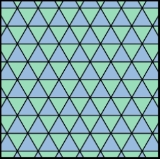
Tiling by regular polygons
Plane
tilings by
regular polygons have been widely used since antiquity. The first systematic mathematical treatment was that of
Kepler in
Harmonices Mundi.
Encyclopedia
Plane
tilings by regular polygons have been widely used since antiquity. The first systematic mathematical treatment was that of
Kepler in
Harmonices Mundi.
Regular tilings
Following Grünbaum and Shephard , a tiling is said to be
regular if the
symmetry group of the tiling acts transitively on the
flags of the tiling, where a flag is a triple consisting of a mutually incident vertex, edge and tile of the tiling. This means that for every pair of flags there is a symmetry operation mapping the first flag to the second. This is equivalent to the tiling being an edge-to-edge tiling by congruent regular polygons. There must be six
equilateral triangles, four squares or three regular
hexagons at a vertex, yielding the three
regular tessellations.
Archimedean, uniform or semiregular tilings
Vertex-transitivity means that for every pair of vertices there is a symmetry operation mapping the first vertex to the second.
If the requirement of flag-transitivity is relaxed to one of vertex-transitivity, while the condition that the tiling is edge-to-edge is kept, there are eight additional tilings possible, known as
Archimedean,
uniform or
semiregular tilings.
Grünbaum and Shephard distinguish the description of these tilings as
Archimedean as referring only to the local property of the arrangement of tiles around each vertex being the same, and that as
uniform as referring to the global property of vertex-transitivity. Though these yield the same set of tilings in the plane, in other spaces there are Archimedean tilings which are not uniform.
Combinations of regular polygons that can meet at a vertex
The
internal angles of the polygons meeting at a vertex must add to 360 degrees. A regular -gon has internal angle degrees. There are seventeen combinations of regular polygons whose internal angles add up to 360 degrees, each being referred to as a
species of vertex; in four cases there are two distinct cyclic orders of the polygons, yielding twenty-one
types of vertex. Only fifteen of these can occur in any tiling of regular polygons. In particular, if three polygons meet at a vertex and one has an odd number of sides, the other two polygons must be the same size. If they are not, they would have to alternate around the first polygon, which is impossible if its number of sides is odd.
With 3 polygons at a vertex:
- 3.7.42
- 3.8.24
- 3.9.18
- 3.10.15
- 3.12.12
- 4.5.20
- 4.6.12
- 4.8.8
- 5.5.10
- 6.6.6
With 4 polygons at a vertex:
- 3.3.4.12 or 3.4.3.12
- 3.3.6.6 or 3.6.3.6
- 4.4.4.4
- 3.4.4.6 or 3.4.6.4
With 5 polygons at a vertex:
- 3.3.3.3.6
- 3.3.3.4.4 or 3.3.4.3.4
With 6 polygons at a vertex:
Other edge-to-edge tilings
Any number of non-uniform edge-to-edge tilings by regular polygons may be drawn. Here are four examples:
3.3.6.6 & 3.3.3.3.3.3 |
3.3.6.6 & 3.6.3.6 |
3.3.4.12 & 3.3.3.3.3.3 |
3.4.4.6 & 3.6.3.6 |
Such periodic tilings may be classified by the number of orbits of vertices, edges and tiles. If there are orbits of vertices, a tiling is known as -uniform or -isogonal; if there are orbits of tiles, as -isohedral; if there are orbits of edges, as -isotoxal. The examples above are four of the twenty 2-uniform tilings. Chavey lists all those edge-to-edge tilings by regular polygons which are at most 3-uniform, 3-isohedral or 3-isotoxal.
Tilings that are not edge-to-edge
Regular polygons can also form plane tilings that are not edge-to-edge. Such tilings may also be known as uniform if they are vertex-transitive; there are eight families of such uniform tilings, each family having a real-valued parameter determining the overlap between sides of adjacent tiles or the ratio between the edge lengths of different tiles.
Beyond the plane
These tessellations are also related to regular and semiregular polyhedra and tessellations of the
hyperbolic plane. Semiregular polyhedra are made from regular polygon faces, but their angles at a point add to less than 360 degrees. Regular polygons in hyperbolic geometry have angles smaller than they do in the plane. In both these cases, that the arrangement of polygons is the same at each vertex does not mean that the polyhedron or tiling is vertex-transitive.
Some regular tilings of the hyperbolic plane
4.4.4.4.4 | 5.5.5.5 | 3.3.3.3.3.3.3 | 7.7.7 | |
| | | | |
See also
References
External links
Euclidean and general tiling links:
Hyperbolic tiling links: