


Tiger Airways

Encyclopedia
Tiger Airways Singapore Pte Ltd, operating as Tiger Airways Singapore, is a low cost airline
which commenced services on 25 March 2005. It is a subsidiary
of Tiger Airways Holdings, a Singapore
-based company, which is owned partially by Singapore Airlines
. Incorporated in September 2003, it is currently the largest low-cost airline operating out of Singapore in terms of passengers carried. In 2006, the airline flew 1.2 million passengers, a growth of 75% from the previous year.
The airline was the first to operate from the Budget Terminal in Changi Airport in order to achieve operating-cost savings and its cost structure is modelled after Ryanair
. Despite regional competition, the airline has reiterated its current intention to remain focused on flying within a five-hour radius from its Singaporean base. To overcome regulatory hurdles in the region, the airline attempts to buy into regional carriers to expand into a pan-Asian carrier.
Flights to India
started in October 2007, and expansion to Malaysia was started in 2008.
Former plans to establish new hubs at Incheon
, Korea have been suspended.
With Singapore Airlines
having a stake in the airline, the airline occasionally fills in the gap when SIA drops its services from certain destinations. Macau
, once served by SIA before being taken up by its subsidiary, SilkAir
, in 2002, terminated all flights completely by the end of 2004. Three months later, the route was taken over by Tiger Airways with flights commencing 25 March 2005. A similar pattern can be observed in Krabi
, where SilkAir suspended services in February 2005 in the wake of the effects of the 2004 Indian Ocean earthquake
. Tiger Airways resumed direct services to the location from 7 October 2005.
In late July 2005, it was announced that the airline would commence flights from Macau to Manila (Clark) on 30 October 2005, a much-heralded move as it may signal the establishment of a secondary base besides Singapore, allowing the airline to expand and diversify risks.
On 21 September 2005 the company produced a report card on its first year of operations, with a total of over 500,000 passengers carried, 5000 scheduled flights flown, and a flight completion rate of 98.7 per cent. 94 per cent of flight departures and 90 per cent of arrivals took place according to schedule. It acquired four aircraft and launched a total of nine routes – of which four are flown exclusively by the airline – during the year.
The airline expected to increase its fleet to nine Airbus A320 aircraft by end 2006, and to carry up to three million passengers a year by then. It also hoped to add six more routes during the year, primarily to destinations in China and India, with flights to Southern China having commenced April. The airline also announced its switch from Singapore Airport Terminal Services
to Swissport
for ground handling when it becomes the first airline to operate at the newly opened Budget Terminal in Changi Airport on 26 March 2006.
Tiger Airways became the first Singaporean low-cost carrier to receive operating permits from the Chinese aviation authorities to fly to the southern Chinese cities of Haikou, Guangzhou and Shenzhen in an announcement on 21 February 2006. Ticket sales to these destinations commenced 24 February 2006, with the first flight to Shenzhen taking place on 15 April, to Haikou from 26 April and to Guangzhou from 27 April 2006. The airline has since indicated that the routes were highly popular, with increased flights to Haikou and Guangzhou less than three months since their launch.
In June 2006, flights to Danang were suspended. On 20 July 2006, the media reported on the airline's intentions to increase its routes from 15 to 20 and to establish a second base city by the end of the year. Possible growth regions include China, Southern India, Cambodia and Brunei
. The airline's plan for a possible initial public offering
was also revealed. At the same time, it announced that it saw an increase of 81 per cent in passengers carried in the months of April to June since its move to the Budget Terminal in March, compared to the same period in the previous year.
In 2007, Tiger plan to enter the Philippines market by forming a leasing and marketing partnership with South East Asian Airlines
(SEAir). The proposed partnership was held up by the Civil Aeronautics Board of the Philippines. The board finally approved the proposed tie-up 18 months later, despite protests from other Philippine airlines, however, due to the unfavorable operating environment, the plan was put into hiatus. Tiger and SEAir revisited the partnership plan in 2010 and it was officially launched on 16 Dec 2010.
Tiger started services from Singapore to Perth
on 23 March 2007.
On 31 March 2009, Tiger launched into the heavily regulated Indonesian market, with rights to Jakarta
once daily. However, Tiger has since won the right for more capacity and will launch a second daily flight on 11 January 2011.
On 25 October 2010, Tiger announced that they will withdraw from Bangalore
effective 14 November 2010, citing no reason. Tiger Airways resumed its flights between Singapore and Bangalore from 31 October 2011.
's third full-scale domestic airline, competing directly with Virgin Australia and Qantas
/Jetstar. Tiger Airways Australia will use their Australian domestic network to support an expanded international presence with the current gateway of Perth
, expanded to include Melbourne
. On 16 March 2007 the airline received approval from Australian authorities to establish the new subsidiary, and established Tiger Airways Australia
Pty Ltd on the same day.
Tiger Airways Australia began operations on 23 November 2007, and its current route network already spans every state in the country. On 31 July 2008 Tiger Airways Australia announced that it would suspend its flights from Darwin on 25 October, citing Darwin International Airport operating and fuel costs, making it the most expensive airport on the Tiger Airways Australia network but did not rule out returning in the future if costs were to decrease. Tiger resumed services to Darwin on Friday 18th, June 2010. On 5 August 2008 the airline announced Adelaide
as its second operational base and began services on 10 January 2010.
Avalon Airport
is to become Tiger Airways Australia's third base, second for Victoria–Melbourne area, and will commence services on 10 November 2010.
On 1 July 2011, Australia's Civil Aviation Safety Authority
(CASA) had instructed Tiger Airways to suspend all domestic flights in Australia over safety concerns for one week, until 9 July 2011 due to a serious safety risk. On 7 July 2011, CASA announced that it will apply for an extension of the suspension until 1 August 2011 at the Federal Court
in Melbourne. Immediately prior to the announcement of action by CASA in respect to Tiger, Group Managing Director, Tony Davis, sold $1,420,000 worth of shares in the Company. At the time the Sydney Morning Herald questioned Tony Davis' belief in the long term, future of the Company.
n-based budget airline. Incheon Tiger Airways was to have been a joint venture between Tiger Aviation and Incheon Metropolitan City, flying to destinations in Japan
, China
, Mongolia
and the Russian Far East
. The airline was to be based in South Korea
's Incheon Airport and planned to begin services by 2009; however, the project was abandoned in December 2008.
will form an airline based in Thailand
, where Thai Airways International
and Tiger Airways will own 51% and 39% respectively of the newly formed airline, while RyanThai will hold the remaining 10%. Operations are expected to begin in the 1st quarter of 2011.
(SEAir), whereby Tiger will lease aircraft to SEAir, and SEAir will operate the aircraft in SEAir's livery, using SEAir's pilot and cabin crew. Seats on the flight operated by SEAir using aircraft leased from Tiger will be sold and marketed by Tiger for SEAir. This Tiger/SEAir partnership began with international flight departing from Clark to Singapore, Hong Kong, and Macau; it was then expanded to domestic flight from Manila
(NAIA) to Cebu
and Davao
. These flights will only show up on Tiger's website route-map. Shortly after SEAir and Tiger launched the partnership, Philippine Airlines, Cebu Pacific, Zest Airways, and Air Philippines sent a letter of protest to the Department of Transportation and Communication. They claimed the partnership between SEAir and Tiger is illegal and requested the authorities to stop flights operating under the partnership.
. The new Mandala Airlines will fly Indonesia domestic destination, as well as international destination within 5 hours radius.
. Tiger Airways' original founding shareholders were Singapore Airlines
(49%), Bill Franke's Indigo Partners (24%); Tony Ryan
's Irelandia Investments (16%) and Temasek Holdings
(11%). Tiger Airways Holdings Limited is listed on SGX since 2010.
Note: Tiger Aviation Holdings Limited was listed on 22 January 2010. Full financial information may not be publicised prior to that date.
, Miri
and Sibu
in a bid to boost tourism in Sarawak
.
From 11 January 2011, Tiger Airways introduced new route to Taiwan
, Taipei
. Taipei is Tiger's sixth destination in Greater China, after Guangzhou
, Haikou
, Hong Kong
, Macau
and Shenzhen
.
From 1 November 2011, Tiger Airways introduced new route to Davao
, Philippines
. Davao
is Tiger Airways' fourth Destination to Philippines, after Manila
, Cebu
and Clark
(Flights to Clark
is operated by SEair). Tiger Airways is the only low-cost carrier that fly directly from Singapore
to Davao
.
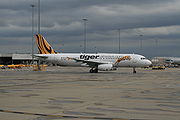 As of October 2011, the Tiger Airways fleet consists of the following aircraft:
Tiger Airway's Fleet
All aircraft offer single-class economy seating for 180 seats each. The seat pitch is approximately 72.5 cm for standard rows and 97.5 cm for extra leg room and exit rows.
On 21 June 2007, Tiger Airways announced it had signed a letter of intent
to purchase 30 aircraft worth US$2.2 billion, with another 20 on option. These would be delivered between 2011 and 2014. On 10 October, Tiger Airways confirmed the letter of intent signed in June. The new aircraft will be deployed in Tiger Airways' Asia-Pacific network and the domestic operation in Australia. On 18 December 2007, Tiger Airways announced that it had taken up the options and this increased the number of Airbus A320s ordered by the airline to 70.
programme - Tiger Bites. The menu offers light meals such as instant noodles, soups and sandwiches. Hot and cold beverages as well as liquor are also available for purchase.
(China, Hong Kong, Macau, Taiwan), Malay
(Malaysia), Indonesian
(Indonesia) or Filipino
(Philippines).
Low-cost carrier
A low-cost carrier or low-cost airline is an airline that generally has lower fares and fewer comforts...
which commenced services on 25 March 2005. It is a subsidiary
Subsidiary
A subsidiary company, subsidiary, or daughter company is a company that is completely or partly owned and wholly controlled by another company that owns more than half of the subsidiary's stock. The subsidiary can be a company, corporation, or limited liability company. In some cases it is a...
of Tiger Airways Holdings, a Singapore
Singapore
Singapore , officially the Republic of Singapore, is a Southeast Asian city-state off the southern tip of the Malay Peninsula, north of the equator. An island country made up of 63 islands, it is separated from Malaysia by the Straits of Johor to its north and from Indonesia's Riau Islands by the...
-based company, which is owned partially by Singapore Airlines
Singapore Airlines
Singapore Airlines Limited is the flag carrier airline of Singapore. Singapore Airlines operates a hub at Changi Airport and has a strong presence in the Southeast Asia, East Asia, South Asia, and "Kangaroo Route" markets...
. Incorporated in September 2003, it is currently the largest low-cost airline operating out of Singapore in terms of passengers carried. In 2006, the airline flew 1.2 million passengers, a growth of 75% from the previous year.
The airline was the first to operate from the Budget Terminal in Changi Airport in order to achieve operating-cost savings and its cost structure is modelled after Ryanair
Ryanair
Ryanair is an Irish low-cost airline. Its head office is at Dublin Airport and its primary operational bases at Dublin Airport and London Stansted Airport....
. Despite regional competition, the airline has reiterated its current intention to remain focused on flying within a five-hour radius from its Singaporean base. To overcome regulatory hurdles in the region, the airline attempts to buy into regional carriers to expand into a pan-Asian carrier.
Flights to India
India
India , officially the Republic of India , is a country in South Asia. It is the seventh-largest country by geographical area, the second-most populous country with over 1.2 billion people, and the most populous democracy in the world...
started in October 2007, and expansion to Malaysia was started in 2008.
Former plans to establish new hubs at Incheon
Incheon International Airport
Incheon International Airport is the largest airport in South Korea, the primary airport serving the Seoul national capital area, and one of the largest and busiest airports in the world...
, Korea have been suspended.
History
The airline was incorporated on 12 December 2003 and began ticket sales on 31 August 2004. The airline flew into a period of relative difficulty for the aviation industry with rising oil prices and intense competition from other airlines. The airline held off imposing fuel surcharges as its competitors had done.With Singapore Airlines
Singapore Airlines
Singapore Airlines Limited is the flag carrier airline of Singapore. Singapore Airlines operates a hub at Changi Airport and has a strong presence in the Southeast Asia, East Asia, South Asia, and "Kangaroo Route" markets...
having a stake in the airline, the airline occasionally fills in the gap when SIA drops its services from certain destinations. Macau
Macau
Macau , also spelled Macao , is, along with Hong Kong, one of the two special administrative regions of the People's Republic of China...
, once served by SIA before being taken up by its subsidiary, SilkAir
SilkAir
SilkAir Private Limited is an airline based in Singapore. It is a wholly owned subsidiary of Singapore Airlines and operates scheduled passenger services from Singapore to 31 cities in Southeast Asia, South Asia and China. It has its head office on the fifth storey of SIA Superhub 1...
, in 2002, terminated all flights completely by the end of 2004. Three months later, the route was taken over by Tiger Airways with flights commencing 25 March 2005. A similar pattern can be observed in Krabi
Krabi
Krabi is a town on the west coast of southern Thailand at the mouth of the Krabi River where it empties in Phangnga Bay. As of 2005 the town has a population of 24,986. The town is the capital of Krabi Province and Krabi district...
, where SilkAir suspended services in February 2005 in the wake of the effects of the 2004 Indian Ocean earthquake
2004 Indian Ocean earthquake
The 2004 Indian Ocean earthquake was an undersea megathrust earthquake that occurred at 00:58:53 UTC on Sunday, December 26, 2004, with an epicentre off the west coast of Sumatra, Indonesia. The quake itself is known by the scientific community as the Sumatra-Andaman earthquake...
. Tiger Airways resumed direct services to the location from 7 October 2005.
In late July 2005, it was announced that the airline would commence flights from Macau to Manila (Clark) on 30 October 2005, a much-heralded move as it may signal the establishment of a secondary base besides Singapore, allowing the airline to expand and diversify risks.
On 21 September 2005 the company produced a report card on its first year of operations, with a total of over 500,000 passengers carried, 5000 scheduled flights flown, and a flight completion rate of 98.7 per cent. 94 per cent of flight departures and 90 per cent of arrivals took place according to schedule. It acquired four aircraft and launched a total of nine routes – of which four are flown exclusively by the airline – during the year.
The airline expected to increase its fleet to nine Airbus A320 aircraft by end 2006, and to carry up to three million passengers a year by then. It also hoped to add six more routes during the year, primarily to destinations in China and India, with flights to Southern China having commenced April. The airline also announced its switch from Singapore Airport Terminal Services
Singapore Airport Terminal Services
SATS Ltd. , commonly abbreviated as SATS is the chief ground-handling and in-flight catering service provider at Singapore Changi Airport. SATS controls about 80% of Changi airport's ground handling and catering business....
to Swissport
Swissport
Swissport International Ltd. is a Swiss company headquartered in Glattbrugg, Opfikon, Switzerland. Owned by PAI, Swissport International Ltd. provides ground services for around 100 million passengers and 3.2 million tonnes of cargo a year on behalf of some 650 client-companies in the aviation...
for ground handling when it becomes the first airline to operate at the newly opened Budget Terminal in Changi Airport on 26 March 2006.
Tiger Airways became the first Singaporean low-cost carrier to receive operating permits from the Chinese aviation authorities to fly to the southern Chinese cities of Haikou, Guangzhou and Shenzhen in an announcement on 21 February 2006. Ticket sales to these destinations commenced 24 February 2006, with the first flight to Shenzhen taking place on 15 April, to Haikou from 26 April and to Guangzhou from 27 April 2006. The airline has since indicated that the routes were highly popular, with increased flights to Haikou and Guangzhou less than three months since their launch.
In June 2006, flights to Danang were suspended. On 20 July 2006, the media reported on the airline's intentions to increase its routes from 15 to 20 and to establish a second base city by the end of the year. Possible growth regions include China, Southern India, Cambodia and Brunei
Brunei
Brunei , officially the State of Brunei Darussalam or the Nation of Brunei, the Abode of Peace , is a sovereign state located on the north coast of the island of Borneo, in Southeast Asia...
. The airline's plan for a possible initial public offering
Initial public offering
An initial public offering or stock market launch, is the first sale of stock by a private company to the public. It can be used by either small or large companies to raise expansion capital and become publicly traded enterprises...
was also revealed. At the same time, it announced that it saw an increase of 81 per cent in passengers carried in the months of April to June since its move to the Budget Terminal in March, compared to the same period in the previous year.
In 2007, Tiger plan to enter the Philippines market by forming a leasing and marketing partnership with South East Asian Airlines
South East Asian Airlines
Southeast Asian Airlines , Inc. operating as SEAir is an airline based in Pampanga, the Philippines. It operates domestic services and its main base is Ninoy Aquino International Airport, Manila, with hubs at Godofredo P. Ramos Airport, Malay, Aklan.- History :The airline was established in 1995...
(SEAir). The proposed partnership was held up by the Civil Aeronautics Board of the Philippines. The board finally approved the proposed tie-up 18 months later, despite protests from other Philippine airlines, however, due to the unfavorable operating environment, the plan was put into hiatus. Tiger and SEAir revisited the partnership plan in 2010 and it was officially launched on 16 Dec 2010.
Tiger started services from Singapore to Perth
Perth, Western Australia
Perth is the capital and largest city of the Australian state of Western Australia and the fourth most populous city in Australia. The Perth metropolitan area has an estimated population of almost 1,700,000....
on 23 March 2007.
On 31 March 2009, Tiger launched into the heavily regulated Indonesian market, with rights to Jakarta
Jakarta
Jakarta is the capital and largest city of Indonesia. Officially known as the Special Capital Territory of Jakarta, it is located on the northwest coast of Java, has an area of , and a population of 9,580,000. Jakarta is the country's economic, cultural and political centre...
once daily. However, Tiger has since won the right for more capacity and will launch a second daily flight on 11 January 2011.
On 25 October 2010, Tiger announced that they will withdraw from Bangalore
Bangalore
Bengaluru , formerly called Bengaluru is the capital of the Indian state of Karnataka. Bangalore is nicknamed the Garden City and was once called a pensioner's paradise. Located on the Deccan Plateau in the south-eastern part of Karnataka, Bangalore is India's third most populous city and...
effective 14 November 2010, citing no reason. Tiger Airways resumed its flights between Singapore and Bangalore from 31 October 2011.
Tiger Airways Australia
On 9 February 2007, Tiger Airways formally announced that it hoped to become AustraliaAustralia
Australia , officially the Commonwealth of Australia, is a country in the Southern Hemisphere comprising the mainland of the Australian continent, the island of Tasmania, and numerous smaller islands in the Indian and Pacific Oceans. It is the world's sixth-largest country by total area...
's third full-scale domestic airline, competing directly with Virgin Australia and Qantas
Qantas
Qantas Airways Limited is the flag carrier of Australia. The name was originally "QANTAS", an initialism for "Queensland and Northern Territory Aerial Services". Nicknamed "The Flying Kangaroo", the airline is based in Sydney, with its main hub at Sydney Airport...
/Jetstar. Tiger Airways Australia will use their Australian domestic network to support an expanded international presence with the current gateway of Perth
Perth, Western Australia
Perth is the capital and largest city of the Australian state of Western Australia and the fourth most populous city in Australia. The Perth metropolitan area has an estimated population of almost 1,700,000....
, expanded to include Melbourne
Melbourne
Melbourne is the capital and most populous city in the state of Victoria, and the second most populous city in Australia. The Melbourne City Centre is the hub of the greater metropolitan area and the Census statistical division—of which "Melbourne" is the common name. As of June 2009, the greater...
. On 16 March 2007 the airline received approval from Australian authorities to establish the new subsidiary, and established Tiger Airways Australia
Tiger Airways Australia
Tiger Airways Australia Pty Ltd, operating as Tiger Airways Australia, is a low cost airline which commenced services in the Australian domestic airline market on 23 November 2007. It is a subsidiary of Tiger Airways Holdings, a Singapore-based company, which is owned partially by Singapore Airlines...
Pty Ltd on the same day.
Tiger Airways Australia began operations on 23 November 2007, and its current route network already spans every state in the country. On 31 July 2008 Tiger Airways Australia announced that it would suspend its flights from Darwin on 25 October, citing Darwin International Airport operating and fuel costs, making it the most expensive airport on the Tiger Airways Australia network but did not rule out returning in the future if costs were to decrease. Tiger resumed services to Darwin on Friday 18th, June 2010. On 5 August 2008 the airline announced Adelaide
Adelaide
Adelaide is the capital city of South Australia and the fifth-largest city in Australia. Adelaide has an estimated population of more than 1.2 million...
as its second operational base and began services on 10 January 2010.
Avalon Airport
Avalon Airport
Avalon Airport is the second busiest of the four airports serving Melbourne and is located in Avalon, Victoria, Australia, which is north-east of the city of Geelong and to the south-west of the state's capital city of Melbourne....
is to become Tiger Airways Australia's third base, second for Victoria–Melbourne area, and will commence services on 10 November 2010.
On 1 July 2011, Australia's Civil Aviation Safety Authority
Civil Aviation Safety Authority
The Civil Aviation Safety Authority is the Australian national aviation authority , the government statutory authority responsible for the regulation of civil aviation.-History:...
(CASA) had instructed Tiger Airways to suspend all domestic flights in Australia over safety concerns for one week, until 9 July 2011 due to a serious safety risk. On 7 July 2011, CASA announced that it will apply for an extension of the suspension until 1 August 2011 at the Federal Court
Federal Court of Australia
The Federal Court of Australia is an Australian superior court of record which has jurisdiction to deal with most civil disputes governed by federal law , along with some summary criminal matters. Cases are heard at first instance by single Judges...
in Melbourne. Immediately prior to the announcement of action by CASA in respect to Tiger, Group Managing Director, Tony Davis, sold $1,420,000 worth of shares in the Company. At the time the Sydney Morning Herald questioned Tony Davis' belief in the long term, future of the Company.
Incheon Tiger Airways
On 5 November 2007, Tiger Airways announced that it would be starting a KoreaKorea
Korea ) is an East Asian geographic region that is currently divided into two separate sovereign states — North Korea and South Korea. Located on the Korean Peninsula, Korea is bordered by the People's Republic of China to the northwest, Russia to the northeast, and is separated from Japan to the...
n-based budget airline. Incheon Tiger Airways was to have been a joint venture between Tiger Aviation and Incheon Metropolitan City, flying to destinations in Japan
Japan
Japan is an island nation in East Asia. Located in the Pacific Ocean, it lies to the east of the Sea of Japan, China, North Korea, South Korea and Russia, stretching from the Sea of Okhotsk in the north to the East China Sea and Taiwan in the south...
, China
China
Chinese civilization may refer to:* China for more general discussion of the country.* Chinese culture* Greater China, the transnational community of ethnic Chinese.* History of China* Sinosphere, the area historically affected by Chinese culture...
, Mongolia
Mongolia
Mongolia is a landlocked country in East and Central Asia. It is bordered by Russia to the north and China to the south, east and west. Although Mongolia does not share a border with Kazakhstan, its western-most point is only from Kazakhstan's eastern tip. Ulan Bator, the capital and largest...
and the Russian Far East
Russian Far East
Russian Far East is a term that refers to the Russian part of the Far East, i.e., extreme east parts of Russia, between Lake Baikal in Eastern Siberia and the Pacific Ocean...
. The airline was to be based in South Korea
South Korea
The Republic of Korea , , is a sovereign state in East Asia, located on the southern portion of the Korean Peninsula. It is neighbored by the People's Republic of China to the west, Japan to the east, North Korea to the north, and the East China Sea and Republic of China to the south...
's Incheon Airport and planned to begin services by 2009; however, the project was abandoned in December 2008.
Thai Tiger Airways
Tiger Airways and Thai Airways InternationalThai Airways International
Thai Airways International Public Company Limited is the national flag carrier and largest airline of Thailand. Formed in 1988, the airline's headquarters are located in Chatuchak District, Bangkok, and operates out of Suvarnabhumi Airport. Thai is a founding member of the Star Alliance. Thai is a...
will form an airline based in Thailand
Thailand
Thailand , officially the Kingdom of Thailand , formerly known as Siam , is a country located at the centre of the Indochina peninsula and Southeast Asia. It is bordered to the north by Burma and Laos, to the east by Laos and Cambodia, to the south by the Gulf of Thailand and Malaysia, and to the...
, where Thai Airways International
Thai Airways International
Thai Airways International Public Company Limited is the national flag carrier and largest airline of Thailand. Formed in 1988, the airline's headquarters are located in Chatuchak District, Bangkok, and operates out of Suvarnabhumi Airport. Thai is a founding member of the Star Alliance. Thai is a...
and Tiger Airways will own 51% and 39% respectively of the newly formed airline, while RyanThai will hold the remaining 10%. Operations are expected to begin in the 1st quarter of 2011.
Tiger Airways' activities in the Philippines
In December 2010, Tiger entered the Philippines market by proxy, without setting up an airline in Philippines. Instead, Tiger went into a partnership with South East Asian AirlinesSouth East Asian Airlines
Southeast Asian Airlines , Inc. operating as SEAir is an airline based in Pampanga, the Philippines. It operates domestic services and its main base is Ninoy Aquino International Airport, Manila, with hubs at Godofredo P. Ramos Airport, Malay, Aklan.- History :The airline was established in 1995...
(SEAir), whereby Tiger will lease aircraft to SEAir, and SEAir will operate the aircraft in SEAir's livery, using SEAir's pilot and cabin crew. Seats on the flight operated by SEAir using aircraft leased from Tiger will be sold and marketed by Tiger for SEAir. This Tiger/SEAir partnership began with international flight departing from Clark to Singapore, Hong Kong, and Macau; it was then expanded to domestic flight from Manila
Manila
Manila is the capital of the Philippines. It is one of the sixteen cities forming Metro Manila.Manila is located on the eastern shores of Manila Bay and is bordered by Navotas and Caloocan to the north, Quezon City to the northeast, San Juan and Mandaluyong to the east, Makati on the southeast,...
(NAIA) to Cebu
Cebu
Cebu is a province in the Philippines, consisting of Cebu Island and 167 surrounding islands. It is located to the east of Negros, to the west of Leyte and Bohol islands...
and Davao
Davao
Davao refers to several closely related places in Mindanao in the Philippines. The term is used most often to refer to the city.*Davao Region, an administrative region*Davao del Norte province*Davao del Sur province*Davao Oriental province...
. These flights will only show up on Tiger's website route-map. Shortly after SEAir and Tiger launched the partnership, Philippine Airlines, Cebu Pacific, Zest Airways, and Air Philippines sent a letter of protest to the Department of Transportation and Communication. They claimed the partnership between SEAir and Tiger is illegal and requested the authorities to stop flights operating under the partnership.
Tiger Airways' activities in Indonesia
Tiger Airways ventured into Indonesia market by buying 33% shares of the troubled Mandala AirlinesMandala Airlines
Mandala Airlines was a low-cost airline headquartered in the Mandala Airlines Building in West Jakarta, Jakarta, Indonesia. Mandala operated scheduled services to 3 international and 17 domestic destinations, used a fleet of narrow body Airbuses. Its main operational base was Soekarno-Hatta...
. The new Mandala Airlines will fly Indonesia domestic destination, as well as international destination within 5 hours radius.
Corporate management
Tiger Airways is wholly owned by Tiger Airways Holdings Limited, a holding company set up in 2007 to manage both Tiger Airways and start-up Australian subsidiary Tiger Airways AustraliaTiger Airways Australia
Tiger Airways Australia Pty Ltd, operating as Tiger Airways Australia, is a low cost airline which commenced services in the Australian domestic airline market on 23 November 2007. It is a subsidiary of Tiger Airways Holdings, a Singapore-based company, which is owned partially by Singapore Airlines...
. Tiger Airways' original founding shareholders were Singapore Airlines
Singapore Airlines
Singapore Airlines Limited is the flag carrier airline of Singapore. Singapore Airlines operates a hub at Changi Airport and has a strong presence in the Southeast Asia, East Asia, South Asia, and "Kangaroo Route" markets...
(49%), Bill Franke's Indigo Partners (24%); Tony Ryan
Tony Ryan
Thomas Anthony "Tony" Ryan was an Irish multi-millionaire, philanthropist and businessman.He was a founder of Guinness Peat Aviation as well as co-founder of Ryanair with Christy Ryan and Liam Lonergan...
's Irelandia Investments (16%) and Temasek Holdings
Temasek Holdings
Temasek Holdings is an investment company owned by the government of Singapore. With an international staff of 380 people, it manages a portfolio of about S$193 billion at end of March 2011, focused primarily in Asia...
(11%). Tiger Airways Holdings Limited is listed on SGX since 2010.
Financial performance
| Year ended | Revenue (S$m) |
Expenditure (S$m) |
Operating profit (S$m) |
Profit before taxation (S$m) |
Profit attributable to equity holders (S$m) |
EPS Earnings per share Earnings per share is the amount of earnings per each outstanding share of a company's stock.In the United States, the Financial Accounting Standards Board requires companies' income statements to report EPS for each of the major categories of the income statement: continuing operations,... after tax – diluted (cents) |
|---|---|---|---|---|---|---|
| 31 March 2006 | 75 | NA | (37.4) | NA | NA | NA |
| 31 March 2007 | 171.2 | NA | (14.3) | NA | NA | NA |
| 31 March 2008 | 231 | NA | 37.8 | NA | NA | NA |
| 31 March 2009 | 378.0 | 425.5 | (47.5) | (47.6) | (50.8) | (0.14) |
| 31 March 2010 | 486.2 | 458.2 | 28.0 | 19.9 | 28.2 | 0.07 |
Note: Tiger Aviation Holdings Limited was listed on 22 January 2010. Full financial information may not be publicised prior to that date.
Operating performance
| Year ended | Passengers (thousand) |
RPK (million) |
ASK Available seat kilometre Available seat kilometre is a measure of an airline flight's passenger carrying capacity. It is equal to the number of seats available multiplied by the number of kilometres flown.See Available Seat Miles for complete article.... (million) |
Load factor (%) |
Seat capacity (thousands) |
|---|---|---|---|---|---|
| 31 March 2009 | 3,167 | 5,245 | 6,459 | 79.4% | 3,989 |
| 31 March 2010 | 4,872 | 6,768 | 7,847 | 85.1% | 5,723 |
Pilot shortage 2010
Tiger suffered a severe crewing shortage that took effect mid 2010. The carrier's attempt to cut wages prompted a mass exodus of captains, leaving the company to cancel half its schedule. As of October 2010, 1 in 3 flights was cancelled every day with the airline turning to Europe for pilots after attempts to lure Indonesian pilots failed due to the Indonesian pilots failing a Singapore CAA exam.Destinations
Tiger Airways currently flies to destinations within an approximate five-hour radius around Singapore to 24 destinations in nine countries around the region. Thailand is its first market, with four cities served, taking advantage of the open-skies agreement between Singapore and Thailand. Aviation agreements have prevented the airline from flying to neighbouring Malaysia except Kuala Lumpur, which started in February 2008, although in September 2006, it was granted rights to fly to KuchingKuching
Kuching , officially the City of Kuching, and formerly the City of Sarawak, is the capital and most populous city of the East Malaysian state of Sarawak. It is the largest city on the island of Borneo, and the fourth largest city in Malaysia....
, Miri
Miri
Miri is a city in northern Sarawak, Malaysia, on the island of Borneo. It is the second largest city in Sarawak, with a population of about 300,000, and the government administrative centre of Miri District in Miri Division....
and Sibu
Sibu
Sibu may refer to:*Sibu, Sarawak in Eastern Malaysia*Sibu Division*Sibu , an impact crater on Mars*Pulau Sibu, an island off the eastern coast of peninsular Malaysia*Sibu , name of a goddess in the Bribri tribe, in Costa Rica...
in a bid to boost tourism in Sarawak
Sarawak
Sarawak is one of two Malaysian states on the island of Borneo. Known as Bumi Kenyalang , Sarawak is situated on the north-west of the island. It is the largest state in Malaysia followed by Sabah, the second largest state located to the North- East.The administrative capital is Kuching, which...
.
From 11 January 2011, Tiger Airways introduced new route to Taiwan
Taiwan
Taiwan , also known, especially in the past, as Formosa , is the largest island of the same-named island group of East Asia in the western Pacific Ocean and located off the southeastern coast of mainland China. The island forms over 99% of the current territory of the Republic of China following...
, Taipei
Taipei
Taipei City is the capital of the Republic of China and the central city of the largest metropolitan area of Taiwan. Situated at the northern tip of the island, Taipei is located on the Tamsui River, and is about 25 km southwest of Keelung, its port on the Pacific Ocean...
. Taipei is Tiger's sixth destination in Greater China, after Guangzhou
Guangzhou
Guangzhou , known historically as Canton or Kwangchow, is the capital and largest city of the Guangdong province in the People's Republic of China. Located in southern China on the Pearl River, about north-northwest of Hong Kong, Guangzhou is a key national transportation hub and trading port...
, Haikou
Haikou
Hǎikǒu , is the capital and most populous city of Hainan Province, in the People's Republic of China. It is situated on the northern coast of Hainan, by the mouth of the Nandu River...
, Hong Kong
Hong Kong
Hong Kong is one of two Special Administrative Regions of the People's Republic of China , the other being Macau. A city-state situated on China's south coast and enclosed by the Pearl River Delta and South China Sea, it is renowned for its expansive skyline and deep natural harbour...
, Macau
Macau
Macau , also spelled Macao , is, along with Hong Kong, one of the two special administrative regions of the People's Republic of China...
and Shenzhen
Shenzhen
Shenzhen is a major city in the south of Southern China's Guangdong Province, situated immediately north of Hong Kong. The area became China's first—and one of the most successful—Special Economic Zones...
.
From 1 November 2011, Tiger Airways introduced new route to Davao
Davao
Davao refers to several closely related places in Mindanao in the Philippines. The term is used most often to refer to the city.*Davao Region, an administrative region*Davao del Norte province*Davao del Sur province*Davao Oriental province...
, Philippines
Philippines
The Philippines , officially known as the Republic of the Philippines , is a country in Southeast Asia in the western Pacific Ocean. To its north across the Luzon Strait lies Taiwan. West across the South China Sea sits Vietnam...
. Davao
Davao
Davao refers to several closely related places in Mindanao in the Philippines. The term is used most often to refer to the city.*Davao Region, an administrative region*Davao del Norte province*Davao del Sur province*Davao Oriental province...
is Tiger Airways' fourth Destination to Philippines, after Manila
Manila
Manila is the capital of the Philippines. It is one of the sixteen cities forming Metro Manila.Manila is located on the eastern shores of Manila Bay and is bordered by Navotas and Caloocan to the north, Quezon City to the northeast, San Juan and Mandaluyong to the east, Makati on the southeast,...
, Cebu
Cebu
Cebu is a province in the Philippines, consisting of Cebu Island and 167 surrounding islands. It is located to the east of Negros, to the west of Leyte and Bohol islands...
and Clark
Clark
Clark is surname in the English language, ultimately derived from the Latin clericus meaning "scribe", "secretary" or a scholar within a religious order, referring to someone who was educated. Clark evolved from "clerk". First records of the name are found in 12th century England...
(Flights to Clark
Clark
Clark is surname in the English language, ultimately derived from the Latin clericus meaning "scribe", "secretary" or a scholar within a religious order, referring to someone who was educated. Clark evolved from "clerk". First records of the name are found in 12th century England...
is operated by SEair). Tiger Airways is the only low-cost carrier that fly directly from Singapore
Singapore
Singapore , officially the Republic of Singapore, is a Southeast Asian city-state off the southern tip of the Malay Peninsula, north of the equator. An island country made up of 63 islands, it is separated from Malaysia by the Straits of Johor to its north and from Indonesia's Riau Islands by the...
to Davao
Davao
Davao refers to several closely related places in Mindanao in the Philippines. The term is used most often to refer to the city.*Davao Region, an administrative region*Davao del Norte province*Davao del Sur province*Davao Oriental province...
.
Fleet
Tiger Airway's Fleet
| Aircraft | Total | Orders | Passengers | Notes | ||||
|---|---|---|---|---|---|---|---|---|
| Y | Total | |||||||
| Airbus A320-200 Airbus A320 The Airbus A320 family is a family of short- to medium-range, narrow-body, commercial passenger jet airliners manufactured by Airbus Industrie.Airbus was originally a consortium of European aerospace companies, and is now fully owned by EADS. Airbus's name has been Airbus SAS since 2001... |
20 | 70 | 180 | 180 | ||||
| Total | 20 | 70 | ||||||
- 20 Airbus A320-200Airbus A320 familyThe Airbus A320 family is a family of short- to medium-range, narrow-body, commercial passenger jet airliners manufactured by Airbus Industrie.Airbus was originally a consortium of European aerospace companies, and is now fully owned by EADS. Airbus's name has been Airbus SAS since 2001...
All aircraft offer single-class economy seating for 180 seats each. The seat pitch is approximately 72.5 cm for standard rows and 97.5 cm for extra leg room and exit rows.
On 21 June 2007, Tiger Airways announced it had signed a letter of intent
Letter of intent
A letter of intent is a document outlining an agreement between two or more parties before the agreement is finalized. The concept is similar to a heads of agreement...
to purchase 30 aircraft worth US$2.2 billion, with another 20 on option. These would be delivered between 2011 and 2014. On 10 October, Tiger Airways confirmed the letter of intent signed in June. The new aircraft will be deployed in Tiger Airways' Asia-Pacific network and the domestic operation in Australia. On 18 December 2007, Tiger Airways announced that it had taken up the options and this increased the number of Airbus A320s ordered by the airline to 70.
Food and beverage options
Tiger Airways offers food and beverages available for purchase as part of a buy on boardBuy on board
In commercial flight, buy on board is a system where food or beverages are paid for on board; often food or beverages are not included in the ticket price for certain fare classes....
programme - Tiger Bites. The menu offers light meals such as instant noodles, soups and sandwiches. Hot and cold beverages as well as liquor are also available for purchase.
Entertainment
An in-flight magazine, Tiger Tales, is provided as free reading material for passengers.Cabin crew
Tiger Airways has a diverse mix of nationalities in its cabin crew team. They include Australians, Chinese, Filipinos, Hong Kongers, Japanese, Koreans, Malaysians, Romanians, Singaporeans, Taiwanese and Thais. Announcements are often translated in MandarinStandard Chinese
Standard Chinese, or Modern Standard Chinese, also known as Mandarin or Putonghua, is the official language of the People's Republic of China and Republic of China , and is one of the four official languages of Singapore....
(China, Hong Kong, Macau, Taiwan), Malay
Malaysian language
Malaysian or Standard Malay is the official language of Malaysia and a standardized form of the Malay language of the Austronesian family. It is over 80% cognate with Indonesian and is spoken natively by over 10 million people...
(Malaysia), Indonesian
Indonesian language
Indonesian is the official language of Indonesia. Indonesian is a normative form of the Riau Islands dialect of Malay, an Austronesian language which has been used as a lingua franca in the Indonesian archipelago for centuries....
(Indonesia) or Filipino
Filipino language
This move has drawn much criticism from other regional groups.In 1987, a new constitution introduced many provisions for the language.Article XIV, Section 6, omits any mention of Tagalog as the basis for Filipino, and states that:...
(Philippines).