
|
|
|
|
Thurso
|
| |
|
| |
Thurso (from Old Norse, meaning 'Bull's water' and called Inbhir Thẹrsa in Scottish Gaelic) is a town and former burgh on the north coast of the Highland council area of Scotland. Historically, the town is one of two burghs within the county of Caithness.
so's history stretches back to at least the era of Norse Orcadian rule in Caithness, which ended conclusively in 1266.

Discussion
Ask a question about 'Thurso'
Start a new discussion about 'Thurso'
Answer questions from other users
|
Encyclopedia
Thurso (from Old Norse, meaning 'Bull's water' and called Inbhir Thẹrsa in Scottish Gaelic) is a town and former burgh on the north coast of the Highland council area of Scotland. Historically, the town is one of two burghs within the county of Caithness.
History
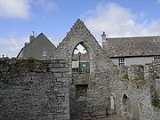
Thurso's history stretches back to at least the era of Norse Orcadian rule in Caithness, which ended conclusively in 1266. The town was an important Norse port, and has a later history of trade with ports throughout northern Europe, especially during the 19th century. Old St Peter's Kirk is said to date from circa. 1220 and the time of Caithness Bishop Gilbert Murray, who died in 1245. Much of the town is, however, a planned 19th-century development, and a major expansion occurred in the mid-20th century when the Dounreay nuclear power plant was established at Dounreay, 9 miles (14.5 km) to the west of the town. Within a period of about five years, Thurso's population expanded rapidly from around 2,500 to about 12,000 between 1955-58, as the nuclear plant attracted skilled migrants from all parts of the United Kingdom, although it dropped back to around 9,000 by 1960 after a lot of the initial Dounreay construction crew left the area.
Thurso is also the name of the viscountcy held by the Sinclair family in the Peerage of the United Kingdom. The present Viscount Thurso is also the local MP.
Governance
Thurso has history as a burgh of barony dating from 1633.
In 1975, under the Local Government (Scotland) Act 1973, the local government burgh was merged into the Caithness district of the two-tier Highland region. In 1996, under the Local Government etc (Scotland) Act 1994, the district was abolished and the region became a unitary council area.
From 1996 until 2007, the town of Thurso was covered by two or three wards, each electing one councillor by the first past the post system of election. In 2007, a single Thurso ward was created to elect three councillors by the single transferable vote system. The new ward is one of three within the Highland Council's Caithness ward management area and one of seven within the council's Caithness, Sutherland and Easter Ross corporate management area.
There is also Thurso Community Council, which was created in 1975 when the burgh was abolished. The community council is not a tier of local government, but it is recognised as a level of statutory representation. The community council represents an area which is somewhat smaller than that represented by ward councillors. The ward area also includes parts of other community council areas.
Geography
Thurso is the northernmost town on the British mainland, situated at the northern end of the A9 road, the main road linking Caithness with the south of Scotland, and is 20 miles (32 km) west of John o' Groats and 21 miles (34 km) northwest of Wick, the closest town. The nearest city is Inverness, some 110 miles (177 km) to the south. Thurso railway station is the most northerly location served by Britain's rail network, which links the town directly with Wick, the county town of Caithness, and with Inverness, which is the administrative centre of the Highland Council area. It has a population of around 9,000 residents (2001 census). Thurso lies as far north (latitude 59 degrees north) as the Alaskan state capital of Juneau, the Hudson Bay and the city of Stavanger in Norway.
The town is within the Parish of Thurso, with the parishes of Olrig and Bower to the east, Halkirk to the south, and Reay to the west. The parish of Thurso also has a north-facing Atlantic coastline stretching from Crosskirk Bay in the west to the Haven in Dunnet Bay in the east.
The River Thurso flows through the town and into Thurso Bay and the Pentland Firth. The river estuary serves as a small harbour. Thurso has a fine harbour and beach and looks out over the Pentland Firth to the Orkney island of Hoy and the famous towering Old Man of Hoy (a stack of rock standing out from the main island).
Facilities
Offices of the Highland Council are located in the town, as is the main campus of North Highland College, formerly Thurso College. This is one of several partner colleges which constitute the UHI Millennium Institute, and offers several certificate, diploma and degree courses from subjects as diverse as Nuclear Decommissioning, Hairdressing, Gamekeeping and Golf Management. Next door to the UHI is Thurso High School, the most northerly secondary school on the British mainland. The town also has three primary schools.
Thurso boasts a small museum, a two-screen cinema, ten-pin bowling, a nightclub, several hotels and bars, a surf shop/cafe stocking famous brands such as Animal, a small skatepark and an internet cafe. There is also a sizeable British Telecom call centre and a plant making special lithium-ion batteries for the MOD on the west side of the town, which along with the Dounreay Nuclear power plant, provide a high level of employment in Caithness. The Co-operative, Tesco and Lidl have supermarkets in Thurso. There are car dealerships for Ford, Nissan, Vauxhall and Citroen, plus a fitted kitchen factory and a timber-framed house factory.
Thurso is a major area for surfing, and has a regular surfing championships leg on the UK Tour.
The main window of the old St Peter's Church, near the harbour, is carved from a single piece of stone and is thought to be the largest of its type in the world.
Economy
The port of Scrabster lies about 1½ miles (2 km) to the west of the estuary of the River Thurso. Scrabster has deep water in the shelter of Holborn Head. The harbour includes a berth for the MV Hamnavoe, a roll-on/roll-off ferry operated by Northlink linking the Scottish mainland with Stromness on Orkney.
From June 2007, a summer-only weekly ferry service connects Scrabster with the Faroe Islands, Iceland and Norway. The service is operated by the Faroese company Smyril Line.
Transport
From Scrabster Harbour (Ordnance Survey ), the A9 runs generally east/southeast through Thurso, and then generally south towards Inverness, Perth and the M9 motorway near Stirling and Falkirk. In Thurso, the A9 has junctions with two other classified roads, the A836 and the B874, and in the Georgemas area, about 5 miles (8 km) south of Thurso, the A9 has a locally important junction with the A882 which leads to Wick. From the A9 near Burnside in Thurso, the A836 leads generally west towards Reay, Melvich, Bettyhill and Tongue. From the A9 in central Thurso , the B874 leads generally south towards Halkirk. From the A9 in the Millbank area of Thurso , the A836 leads generally east towards Castletown and John o' Groats.
Thurso is the northern terminus of the Far North Line. From Thurso, trains go to Georgemas Junction and then to Wick, then head southward to Inverness.
Sport
The football (soccer) team, Thurso FC (nicknamed "the Vikings"), plays in the North Caledonian League. The current champions of the Caithness County League are the Thurso Academicals FC, also known as the "Acks", who won the league in the 2005 season for the first time in 36 years. Thurso Swifts FC are the oldest surviving football club in Thurso. Another football team in Thurso is the Pathetic Sharks, although they are some way below Premier League standard and, as their name indicates, they are named after characters from the satirical comic Viz.
Surfing is a pastime with many of the local youths. The power of the waves rolling in from the Pentland Firth has been compared with those of Hawaii. Certainly, for those with a penchant for barrelling reef-breaks, Thurso East leaves little to be desired on a good day. On a big day, 20-second coverups are possible. In April, the European Surfing Qualifying was held in the notorious Pentland Firth, with world-famous surfers coming to battle it out for a place in the championships. Both the European Surfing Championships and Scottish Surf Kayaking Championships are sometimes held in Caithness, with Thurso East being the main focus of activity; this indicates the esteem in which the Northern Scotland waves are held.
The Caithness Motocross Club is based in Thurso, and stages races fortnightly during the summer on tracks around the county. It also sends a team to race in Orkney Motocross Club's annual beach enduro in November, on the Island of Burray. The Caithness Car Club and the Caithness and Sutherland Vintage Vehicle Club are also based in Thurso.
Thurso Squash Club is in Millbank Road, next door to the fire station. Thurso Bowling Club is next door to the Tesco supermarket, and the Thurso Club is in Janet Street, overlooking the river.
Twin Towns
Notable people
Thurso was the birthplace in 1736 of Arthur Sinclair (Arthur St. Clair), a merchant's son, a soldier in the American Revolutionary War, friend of George Washington, President of Congress and Governor of the Northwestern Territory.
The noted geologist Robert Dick lived in Thurso between 1830 and his death in 1866, and contributed greatly to the study of the fossils of the region. There is a plaque on the wall of the house where he lived.
Thurso was also the birthplace in 1854 of Sir William Alexander Smith, founder of the Boys Brigade.
Chief Inspector Donald Swanson of the Metropolitan Police was born in Thurso in 1848.
Bryan Gunn, the former Scotland, Aberdeen and Norwich City goalkeeper, was born in Thurso in 1963.
External links
- - Another guide to Thurso and also local area
- - Online guide to the area. Many high-res pictures.
- - Thurso Photos Gallery
|
| |
|
|