

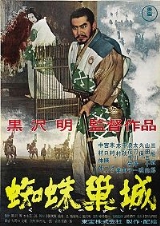
Throne of Blood

Encyclopedia
Throne of Blood is a 1957
Japanese film directed by Akira Kurosawa
. Its original Japanese title is Kumonosu-jō (蜘蛛巣城), which means "Spider Web Castle". The film transposes the plot of William Shakespeare's
play Macbeth
to feudal Japan
.
commanders under a local lord, Lord Tsuzuki, who reigns in the castle of the Spider's Web Forest. After defeating the lord's enemies in battle, they return to Tsuzuki's castle. On their way through the forest surrounding the castle, they meet a spirit, who foretells their future. The spirit tells them that today Washizu will be named master of the North Castle and Miki will now command Fort One. She then foretells that Washizu will eventually become Lord of Forest Castle, and finally she tells Miki that his son will also become lord of the castle.
When the two return to Tsuzuki's estate, he rewards them with exactly what the spirit had predicted. As Washizu discusses this with Asaji, his wife, she manipulates him into making the second part of the prophecy
come true by killing Tsuzuki when he visits. Washizu kills him with the help of his wife, who poisons the lord's guards. When Washizu returns in shock at his deed, Asaji grabs the bloody spear and puts it in the hands of one of the three unconscious guards. She then yells "murder" through the courtyard, and Washizu slays the guard before he has a chance to plead his innocence.
Tsuzuki's vengeful son Kunimaru and a rival of Washizu named Noriyasu both suspect Washizu as the murderous traitor and try to warn Miki, who refuses to believe what they are saying about his friend. Washizu, though, is unsure of Miki's loyalty, but he wants to trust his friend and he still plans to let Miki's son be his heir, since he and Asaji have been unable to bear a child of their own.
Washizu plans to tell Miki and his son about his decision at a grand banquet, but Asaji tells him that she is pregnant, which leaves him with a quandary concerning his heir. During the banquet Washizu drinks sake copiously because he is clearly agitated, and at the sudden appearance of Miki's ghost, begins losing control. In his delusional panic, he reveals his betrayal to all by exclaiming that he is willing to slay Miki for a second time, going so far as unsheathing his sword and striking over Miki's mat. Asaji, attempting to pick up the pieces of Washizu's blunder, tells the guests that he is drunk and that they must retire for the evening. Then one of his men arrive with the severed head of Miki. The guard also tells them that Miki's son escaped.
Later, distraught upon hearing of his wife's miscarriage and in dire need of help with the impending battle with his foes, he returns to the forest to summon the spirit. She tells him that he will not be defeated unless the very trees of Spider's Web forest rise against the castle. Washizu believes this is impossible and is confident of his victory. Washizu knows he must kill all his enemies, so he tells his troops of the last prophecy, and they share his confidence.
He then finds Asaji in a semi-catatonic state, trying to wash clean the imaginary foul stench of blood from her hands, obviously distraught at her grave misdeeds. Distracted by the sound of his troops moving outside the room, he investigates and is told by a panicked soldier that the trees of Spider's Web forest "have risen to attack us." The prophecy has come true and Washizu is doomed.
As Washizu tries to get his troops to attack, they remain still. Finally they turn on their master and begin firing arrows at him as revenge for his traitorous actions. Washizu finally succumbs to his wounds just as his enemies approach the castle gates. It is revealed that the attacking force is using trees cut down during the previous night to disguise and protect themselves in their advance on the castle.
In Kurosawa's own words, "It was a very hard film to make. We decided that the main castle set had to be built on the slope of Mount Fuji, not because I wanted to show this mountain but because it has precisely the stunted landscape that I wanted. And it is usually foggy. I had decided that I wanted lots of fog for this film... Making the set was very difficult because we didn't have enough people and the location was so far from Tokyo. Fortunately, there was a U.S. Marine Corps base nearby and they helped a great deal; also a whole MP battalion helped us out. We all worked very hard indeed, clearing the ground, building the set. Our labor on this steep fog-bound slope, I remember, absolutely exhausted us; we almost got sick."
Washizu's famous death scene, in which his own archers turn upon him and fill his body with arrows, was in fact performed with real arrows, a choice made to help Mifune produce realistic facial expressions of fear. The arrows seen to impact the wooden walls were not superimposed or faked by special effects, but instead shot by choreographed archers. During filming, Mifune waved his arms, ostensibly because his character was trying to brush away the arrows embedded in the planks; this indicated to the archers the direction in which Mifune wanted to move.
's impalement death scene in Carrie
. Throne of Blood is also referenced in the anime
film Millennium Actress
.
"Throne of Blood" was adapted for the stage by director Ping Chong
. This version premiered at the 2010 Oregon Shakespeare Festival
in Ashland
, Oregon
, USA.
judged it "the most successful film version of Macbeth." Throne of Blood is reputed to have been a favorite of poet T. S. Eliot
.
1957 in film
The year 1957 in film involved some significant events.-Events:* October 21 - The movie Jailhouse Rock, starring Elvis Presley, opens.-Top grossing films : After theatrical re-issue-Awards:...
Japanese film directed by Akira Kurosawa
Akira Kurosawa
was a Japanese film director, producer, screenwriter and editor. Regarded as one of the most important and influential filmmakers in the history of cinema, Kurosawa directed 30 filmsIn 1946, Kurosawa co-directed, with Hideo Sekigawa and Kajiro Yamamoto, the feature Those Who Make Tomorrow ;...
. Its original Japanese title is Kumonosu-jō (蜘蛛巣城), which means "Spider Web Castle". The film transposes the plot of William Shakespeare's
William Shakespeare
William Shakespeare was an English poet and playwright, widely regarded as the greatest writer in the English language and the world's pre-eminent dramatist. He is often called England's national poet and the "Bard of Avon"...
play Macbeth
Macbeth
The Tragedy of Macbeth is a play by William Shakespeare about a regicide and its aftermath. It is Shakespeare's shortest tragedy and is believed to have been written sometime between 1603 and 1607...
to feudal Japan
Japan
Japan is an island nation in East Asia. Located in the Pacific Ocean, it lies to the east of the Sea of Japan, China, North Korea, South Korea and Russia, stretching from the Sea of Okhotsk in the north to the East China Sea and Taiwan in the south...
.
Plot
Generals Miki and Washizu are SamuraiSamurai
is the term for the military nobility of pre-industrial Japan. According to translator William Scott Wilson: "In Chinese, the character 侍 was originally a verb meaning to wait upon or accompany a person in the upper ranks of society, and this is also true of the original term in Japanese, saburau...
commanders under a local lord, Lord Tsuzuki, who reigns in the castle of the Spider's Web Forest. After defeating the lord's enemies in battle, they return to Tsuzuki's castle. On their way through the forest surrounding the castle, they meet a spirit, who foretells their future. The spirit tells them that today Washizu will be named master of the North Castle and Miki will now command Fort One. She then foretells that Washizu will eventually become Lord of Forest Castle, and finally she tells Miki that his son will also become lord of the castle.
When the two return to Tsuzuki's estate, he rewards them with exactly what the spirit had predicted. As Washizu discusses this with Asaji, his wife, she manipulates him into making the second part of the prophecy
Prophecy
Prophecy is a process in which one or more messages that have been communicated to a prophet are then communicated to others. Such messages typically involve divine inspiration, interpretation, or revelation of conditioned events to come as well as testimonies or repeated revelations that the...
come true by killing Tsuzuki when he visits. Washizu kills him with the help of his wife, who poisons the lord's guards. When Washizu returns in shock at his deed, Asaji grabs the bloody spear and puts it in the hands of one of the three unconscious guards. She then yells "murder" through the courtyard, and Washizu slays the guard before he has a chance to plead his innocence.
Tsuzuki's vengeful son Kunimaru and a rival of Washizu named Noriyasu both suspect Washizu as the murderous traitor and try to warn Miki, who refuses to believe what they are saying about his friend. Washizu, though, is unsure of Miki's loyalty, but he wants to trust his friend and he still plans to let Miki's son be his heir, since he and Asaji have been unable to bear a child of their own.
Washizu plans to tell Miki and his son about his decision at a grand banquet, but Asaji tells him that she is pregnant, which leaves him with a quandary concerning his heir. During the banquet Washizu drinks sake copiously because he is clearly agitated, and at the sudden appearance of Miki's ghost, begins losing control. In his delusional panic, he reveals his betrayal to all by exclaiming that he is willing to slay Miki for a second time, going so far as unsheathing his sword and striking over Miki's mat. Asaji, attempting to pick up the pieces of Washizu's blunder, tells the guests that he is drunk and that they must retire for the evening. Then one of his men arrive with the severed head of Miki. The guard also tells them that Miki's son escaped.
Later, distraught upon hearing of his wife's miscarriage and in dire need of help with the impending battle with his foes, he returns to the forest to summon the spirit. She tells him that he will not be defeated unless the very trees of Spider's Web forest rise against the castle. Washizu believes this is impossible and is confident of his victory. Washizu knows he must kill all his enemies, so he tells his troops of the last prophecy, and they share his confidence.
He then finds Asaji in a semi-catatonic state, trying to wash clean the imaginary foul stench of blood from her hands, obviously distraught at her grave misdeeds. Distracted by the sound of his troops moving outside the room, he investigates and is told by a panicked soldier that the trees of Spider's Web forest "have risen to attack us." The prophecy has come true and Washizu is doomed.
As Washizu tries to get his troops to attack, they remain still. Finally they turn on their master and begin firing arrows at him as revenge for his traitorous actions. Washizu finally succumbs to his wounds just as his enemies approach the castle gates. It is revealed that the attacking force is using trees cut down during the previous night to disguise and protect themselves in their advance on the castle.
Cast
| Character | Equivalent in Macbeth Macbeth The Tragedy of Macbeth is a play by William Shakespeare about a regicide and its aftermath. It is Shakespeare's shortest tragedy and is believed to have been written sometime between 1603 and 1607... | Actor |
|---|---|---|
| Taketoki Washizu | Macbeth Macbeth (character) Macbeth is the title character in William Shakespeare's Macbeth . The character is based on the historical king Macbeth of Scotland, and is derived largely from the account in Holinshed's Chronicles , a history of Britain. Macbeth is a Scottish noble and a valiant military man. He is portrayed... |
Toshirō Mifune Toshiro Mifune Toshirō Mifune was a Japanese actor who appeared in almost 170 feature films. He is best known for his 16-film collaboration with filmmaker Akira Kurosawa, from 1948 to 1965, in works such as Rashomon, Seven Samurai, Throne of Blood, and Yojimbo... |
| Asaji | Lady Macbeth Lady Macbeth Lady Macbeth may refer to:*Lady Macbeth, from William Shakespeare's play Macbeth**Queen Gruoch of Scotland, the real-life Queen on whom Shakespeare based the character... |
Isuzu Yamada Isuzu Yamada is a Japanese actress on stage and screen whose career has spanned eight decades.-Career:Yamada was born in Osaka with the name Mitsu Yamada. Her father, Kusuo Yamada, was a shinpa stage actor specializing in onnagata roles and her mother, Ritsu, was a geisha... |
| Yoshiaki Miki | Banquo Banquo Banquo is a character in William Shakespeare's 1606 play Macbeth. In the play, he is at first an ally to Macbeth and they are together when they meet the Three Witches. After prophesying that Macbeth will become king, the witches tell Banquo that he will not be king himself, but that his... |
Minoru Chiaki Minoru Chiaki was a Japanese actor who appeared in such films as Akira Kurosawa's Seven Samurai and The Hidden Fortress.In Seven Samurai, he was the good-natured samurai Heihachi, and he was the first of the samurai to be killed. Ironically, in real life, he turned out to be the last of the seven actors to... |
| Forest Spirit (Witch) | The Three Witches Three Witches The Three Witches or Weird Sisters are characters in William Shakespeare's play Macbeth . Their origin lies in Holinshed's Chronicles , a history of England, Scotland and Ireland... |
Chieko Naniwa |
| Lord Kuniharu Tsuzuki | King Duncan King Duncan King Duncan is a fictional character in Shakespeare's Macbeth. He is the father of two youthful sons , and the victim of a well-plotted regicide in a power grab by his trusted captain Macbeth... |
Hiroshi Tachikawa |
| Yoshiteru | Fleance Fleance Fleance is a figure in legendary Scottish history. He was depicted by sixteenth century historians as the son of Banquo and the ancestor of the kings of the House of Stuart. In reality both Banquo and Fleance are likely fictional. Fleance is best known as a character in William Shakespeare's play... |
Akira Kubo Akira Kubo Akira Kubo is a Japanese actor. He has appeared in 75 films since 1952. He starred in the film Arashi, which was entered into the 7th Berlin International Film Festival.-Selected filmography:* Arashi... |
| Kuniharu | Malcolm Malcolm III of Scotland Máel Coluim mac Donnchada , was King of Scots... and/or Donalbain |
Takamaru Sasaki |
| Noriyasu | MacDuff | Takashi Shimura Takashi Shimura was a Japanese actor.He was born in Ikuno, Hyogo, Japan.His debut as actor was the film Akanishi Kakita and cast in the Kenji Mizoguchi's film Osaka Elegy .... |
Production
The castle exteriors were built and shot high up on Mt. Fuji. The castle courtyard was constructed at Toho's Tamagawa studio, with volcanic soil brought from Fuji so that the ground would match. The interiors were shot in a smaller Tokyo studio. The forest scenes were a combination of actual Fuji forest and studio shots in Tokyo. Washizu's mansion was shot in the Izu peninsula.In Kurosawa's own words, "It was a very hard film to make. We decided that the main castle set had to be built on the slope of Mount Fuji, not because I wanted to show this mountain but because it has precisely the stunted landscape that I wanted. And it is usually foggy. I had decided that I wanted lots of fog for this film... Making the set was very difficult because we didn't have enough people and the location was so far from Tokyo. Fortunately, there was a U.S. Marine Corps base nearby and they helped a great deal; also a whole MP battalion helped us out. We all worked very hard indeed, clearing the ground, building the set. Our labor on this steep fog-bound slope, I remember, absolutely exhausted us; we almost got sick."
Washizu's famous death scene, in which his own archers turn upon him and fill his body with arrows, was in fact performed with real arrows, a choice made to help Mifune produce realistic facial expressions of fear. The arrows seen to impact the wooden walls were not superimposed or faked by special effects, but instead shot by choreographed archers. During filming, Mifune waved his arms, ostensibly because his character was trying to brush away the arrows embedded in the planks; this indicated to the archers the direction in which Mifune wanted to move.
Influence
Toshirō Mifune's death scene was the source of inspiration for Piper LauriePiper Laurie
Piper Laurie is an American actress of stage and screen known for her roles in the television series Twin Peaks and the films The Hustler, Carrie, and Children of a Lesser God, all of which brought her Academy Award nominations...
's impalement death scene in Carrie
Carrie (film)
Carrie is a 1976 American supernatural horror film directed by Brian De Palma and written by Lawrence D. Cohen, based on the novel Carrie by Stephen King. The film and the novel tell the story of a socially outcast teenage girl, Carrie White, who discovers she possesses latent psionic power which...
. Throne of Blood is also referenced in the anime
Anime
is the Japanese abbreviated pronunciation of "animation". The definition sometimes changes depending on the context. In English-speaking countries, the term most commonly refers to Japanese animated cartoons....
film Millennium Actress
Millennium Actress
is a 2001 Japanese anime by director Satoshi Kon and animated by the Studio Madhouse. It tells the story of a documentary filmmaker investigating the life of an elderly actress in which reality and cinema become blurred.-Plot:...
.
"Throne of Blood" was adapted for the stage by director Ping Chong
Ping Chong
Ping Chong is an American contemporary theater director, choreographer, video and installation artist. He was born in Toronto and raised in the Chinatown section of New York City...
. This version premiered at the 2010 Oregon Shakespeare Festival
Oregon Shakespeare Festival
The Oregon Shakespeare Festival is a regional repertory theatre in Ashland, Oregon, United States. The festival annually produces eleven plays on three stages during a season that lasts from February to October...
in Ashland
Ashland, Oregon
Ashland is a city in Jackson County, Oregon, United States, near Interstate 5 and the California border, and located in the south end of the Rogue Valley. It was named after Ashland County, Ohio, point of origin of Abel Helman and other founders, and secondarily for Ashland, Kentucky, where other...
, Oregon
Oregon
Oregon is a state in the Pacific Northwest region of the United States. It is located on the Pacific coast, with Washington to the north, California to the south, Nevada on the southeast and Idaho to the east. The Columbia and Snake rivers delineate much of Oregon's northern and eastern...
, USA.
Reception
The film has received praise from literary critics, despite the many liberties it takes with the original play. The American literary critic Harold BloomHarold Bloom
Harold Bloom is an American writer and literary critic, and is Sterling Professor of Humanities at Yale University. He is known for his defense of 19th-century Romantic poets, his unique and controversial theories of poetic influence, and his prodigious literary output, particularly for a literary...
judged it "the most successful film version of Macbeth." Throne of Blood is reputed to have been a favorite of poet T. S. Eliot
T. S. Eliot
Thomas Stearns "T. S." Eliot OM was a playwright, literary critic, and arguably the most important English-language poet of the 20th century. Although he was born an American he moved to the United Kingdom in 1914 and was naturalised as a British subject in 1927 at age 39.The poem that made his...
.
External links
- "Shakespeare Transposed" essay by Stephen Prince
- Program note from the 1957 San Francisco International Film FestivalSan Francisco International Film FestivalSan Francisco International Film Festival is the oldest continuously running film festival in the Americas. Organized by the San Francisco Film Society, the International is held each spring for two weeks, presenting an average of 150 films from over 50 countries...
- Throne of Blood at the Japanese Movie DatabaseJapanese Movie DatabaseThe , commonly referred to as JMDB, is an online database of information about Japanese movies, actors, and production crew personnel. It is similar to the Internet Movie Database, but lists only those films originally released in Japan. The site was started in 1997, and contains movies from Meiji...