

Thoracentesis

Encyclopedia
Pleural effusion
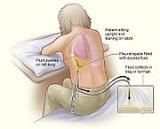
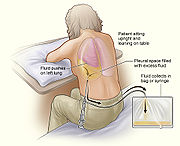
Pleural effusion is excess fluid that accumulates between the two pleural layers, the fluid-filled space that surrounds the lungs. Excessive amounts of such fluid can impair breathing by limiting the expansion of the lungs during ventilation.-Pathophysiology:...
or air
Pneumothorax
Pneumothorax is a collection of air or gas in the pleural cavity of the chest between the lung and the chest wall. It may occur spontaneously in people without chronic lung conditions as well as in those with lung disease , and many pneumothoraces occur after physical trauma to the chest, blast...
from the pleural space
Pleural cavity
In human anatomy, the pleural cavity is the potential space between the two pleura of the lungs. The pleura is a serous membrane which folds back onto itself to form a two-layered, membrane structure. The thin space between the two pleural layers is known as the pleural cavity; it normally...
for diagnostic or therapeutic purposes. A cannula
Cannula
A cannula or canula is a tube that can be inserted into the body, often for the delivery or removal of fluid or for the gathering of data...
, or hollow needle, is carefully introduced into the thorax, generally after administration of local anesthesia
Local anesthesia
Local anesthesia is any technique to induce the absence of sensation in part of the body, generally for the aim of inducing local analgesia, that is, local insensitivity to pain, although other local senses may be affected as well. It allows patients to undergo surgical and dental procedures with...
. The procedure was first described in 1852.
The recommended location varies depending upon the source. It is critical that the patient hold his or her breath to avoid piercing of the lung. Some sources recommend the midaxillary line
Midaxillary line
The midaxillary line is a coronal line on the torso between the anterior axillary line and the posterior axillary line.It is a landmark used in thoracentesis.-External links:* http://www.meddean.luc.edu/Lumen/MedEd/MEDICINE/PULMONAR/apd/lines.htm...
, in the ninth intercostal space
Intercostal space
The intercostal space is the space between two ribs . Since there are 12 ribs on each side, there are 11 intercostal spaces, each numbered for the rib superior to it.-Structures in intercostal space:* several kinds of intercostal muscle...
.
Indications
This procedure is indicated when unexplained fluid accumulates in the chest cavity outside the lung. In more than 90% of cases analysis of pleural fluid yields clinically useful information. If a large amount of fluid is present, then this procedure can also be used therapeutically to remove that fluid and improve patient comfort and lung function.The most common causes of pleural effusions are cancer
Cancer
Cancer , known medically as a malignant neoplasm, is a large group of different diseases, all involving unregulated cell growth. In cancer, cells divide and grow uncontrollably, forming malignant tumors, and invade nearby parts of the body. The cancer may also spread to more distant parts of the...
, congestive heart failure
Congestive heart failure
Heart failure often called congestive heart failure is generally defined as the inability of the heart to supply sufficient blood flow to meet the needs of the body. Heart failure can cause a number of symptoms including shortness of breath, leg swelling, and exercise intolerance. The condition...
, pneumonia
Pneumonia
Pneumonia is an inflammatory condition of the lung—especially affecting the microscopic air sacs —associated with fever, chest symptoms, and a lack of air space on a chest X-ray. Pneumonia is typically caused by an infection but there are a number of other causes...
, and recent surgery
Surgery
Surgery is an ancient medical specialty that uses operative manual and instrumental techniques on a patient to investigate and/or treat a pathological condition such as disease or injury, or to help improve bodily function or appearance.An act of performing surgery may be called a surgical...
. In countries where tuberculosis
Tuberculosis
Tuberculosis, MTB, or TB is a common, and in many cases lethal, infectious disease caused by various strains of mycobacteria, usually Mycobacterium tuberculosis. Tuberculosis usually attacks the lungs but can also affect other parts of the body...
is common, this is also a common cause of pleural effusions.
When cardiopulmonary status is compromised (i.e. when the fluid or air has its repercussions on the function of heart and lungs), due to air (significant pneumothorax
Pneumothorax
Pneumothorax is a collection of air or gas in the pleural cavity of the chest between the lung and the chest wall. It may occur spontaneously in people without chronic lung conditions as well as in those with lung disease , and many pneumothoraces occur after physical trauma to the chest, blast...
), fluid (pleural fluid
Pleural effusion
Pleural effusion is excess fluid that accumulates between the two pleural layers, the fluid-filled space that surrounds the lungs. Excessive amounts of such fluid can impair breathing by limiting the expansion of the lungs during ventilation.-Pathophysiology:...
) or blood
Blood
Blood is a specialized bodily fluid in animals that delivers necessary substances such as nutrients and oxygen to the cells and transports metabolic waste products away from those same cells....
(hemothorax
Hemothorax
A hemothorax is a condition that results from blood accumulating in the pleural cavity.-Cause and presentation:Its cause is usually traumatic, from a blunt or penetrating injury to the thorax, resulting in a rupture of the serous membrane either lining the thorax or covering the lungs...
) outside the lung, then this procedure is usually replaced with tube thoracostomy, the placement of a large tube in the pleural space.
Contraindications
An uncooperative patient or a coagulationCoagulation
Coagulation is a complex process by which blood forms clots. It is an important part of hemostasis, the cessation of blood loss from a damaged vessel, wherein a damaged blood vessel wall is covered by a platelet and fibrin-containing clot to stop bleeding and begin repair of the damaged vessel...
disorder that can not be corrected are absolute contraindications.
Relative contraindications include cases in which the site of insertion has known bullous disease (e.g. emphysema
Emphysema
Emphysema is a long-term, progressive disease of the lungs that primarily causes shortness of breath. In people with emphysema, the tissues necessary to support the physical shape and function of the lungs are destroyed. It is included in a group of diseases called chronic obstructive pulmonary...
), use of positive end-expiratory pressure
Positive end-expiratory pressure
Positive end-expiratory pressure is the pressure in the lungs above atmospheric pressure that exists at the end of expiration...
(PEEP, see mechanical ventilation
Mechanical ventilation
In medicine, mechanical ventilation is a method to mechanically assist or replace spontaneous breathing. This may involve a machine called a ventilator or the breathing may be assisted by a physician, respiratory therapist or other suitable person compressing a bag or set of bellows...
) and only one functioning lung
Lung
The lung is the essential respiration organ in many air-breathing animals, including most tetrapods, a few fish and a few snails. In mammals and the more complex life forms, the two lungs are located near the backbone on either side of the heart...
(due to diminished reserve).
The aspiration should not exceed 1L as there is a risk of development of pulmonary edema.
Complications
Major complications are pneumothoraxPneumothorax
Pneumothorax is a collection of air or gas in the pleural cavity of the chest between the lung and the chest wall. It may occur spontaneously in people without chronic lung conditions as well as in those with lung disease , and many pneumothoraces occur after physical trauma to the chest, blast...
(3-30%), hemopneumothorax
Hemopneumothorax
Hemopneumothorax, or haemopneumothorax, is a medical term describing the combination of two conditions: pneumothorax, or air in the chest cavity, and hemothorax , or blood in the chest cavity....
, hemorrhage
Hemothorax
A hemothorax is a condition that results from blood accumulating in the pleural cavity.-Cause and presentation:Its cause is usually traumatic, from a blunt or penetrating injury to the thorax, resulting in a rupture of the serous membrane either lining the thorax or covering the lungs...
, hypotension (low blood pressure due to a vasovagal response) and reexpansion pulmonary edema
Pulmonary edema
Pulmonary edema , or oedema , is fluid accumulation in the air spaces and parenchyma of the lungs. It leads to impaired gas exchange and may cause respiratory failure...
.
Minor complications include a dry tap (no fluid return), subcutaneous hematoma
Hematoma
A hematoma, or haematoma, is a localized collection of blood outside the blood vessels, usually in liquid form within the tissue. This distinguishes it from an ecchymosis, which is the spread of blood under the skin in a thin layer, commonly called a bruise...
or seroma
Seroma
A seroma is a pocket of clear serous fluid that sometimes develops in the body after surgery. When small blood vessels are ruptured, blood plasma can seep out; inflammation caused by dying injured cells also contributes to the fluid....
, anxiety, dyspnea and cough (after removing large volume of fluid).
The use of ultrasound for needle guidance can minimize the complication rate.
Interpretation of pleural fluid analysis
Several diagnostic tools are available to determine the etiologyEtiology
Etiology is the study of causation, or origination. The word is derived from the Greek , aitiologia, "giving a reason for" ....
of pleural fluid.
Transudate versus exudate
First the fluid is either transudateTransudate
Transudate is extravascular fluid with low protein content and a low specific gravity .This is in contrast to transudate where the extracellular fluid is an ultrafiltrate of blood plasma and thus larger molecules such as proteins and cell debris are absent....
or exudate
Exudate
An exudate is any fluid that filters from the circulatory system into lesions or areas of inflammation. It can apply to plants as well as animals. Its composition varies but generally includes water and the dissolved solutes of the main circulatory fluid such as sap or blood...
.
A transudate is defined as pleural fluid to serum total protein ratio of less than 0.5, pleural fluid to serum LDH ratio < 0.6, and absolute pleural fluid LDH < 200 IU or < 2/3 of the normal serum.
An exudate is any fluid that filters from the circulatory system into lesions or areas of inflammation. Its composition varies but generally includes water and the dissolved solutes of the main circulatory fluid such as blood. In the case of blood: it will contain some or all plasma proteins, white blood cells, platelets and (in the case of local vascular damage) red blood cells.
Exudate
- hemorrhage
- InfectionInfectionAn infection is the colonization of a host organism by parasite species. Infecting parasites seek to use the host's resources to reproduce, often resulting in disease...
- InflammationInflammationInflammation is part of the complex biological response of vascular tissues to harmful stimuli, such as pathogens, damaged cells, or irritants. Inflammation is a protective attempt by the organism to remove the injurious stimuli and to initiate the healing process...
- Malignancy
- Iatrogenic
- Connective tissue diseaseConnective tissue diseaseA connective tissue disease is any disease that has the connective tissues of the body as a target of pathology. Connective tissue is any type of biological tissue with an extensive extracellular matrix that supports, binds together, and protects organs...
- Endocrine disorders
- Lymphatic disorders vs Constrictive pericarditisPericarditisPericarditis is an inflammation of the pericardium . A characteristic chest pain is often present.The causes of pericarditis are varied, including viral infections of the pericardium, idiopathic causes, uremic pericarditis, bacterial infections of the precardium Pericarditis is an inflammation of...
Transudate
- Congestive heart failureCongestive heart failureHeart failure often called congestive heart failure is generally defined as the inability of the heart to supply sufficient blood flow to meet the needs of the body. Heart failure can cause a number of symptoms including shortness of breath, leg swelling, and exercise intolerance. The condition...
- Nephrotic syndromeNephrotic syndromeNephrotic syndrome is a nonspecific disorder in which the kidneys are damaged, causing them to leak large amounts of protein from the blood into the urine....
- HypoalbuminemiaHypoalbuminemiaHypoalbuminemia is a medical condition where levels of albumin in blood serum are abnormally low. It is a specific form of hypoproteinemia.Albumin is a major protein in the human body, making up about 60% of total human plasma protein by mass...
- CirrhosisCirrhosisCirrhosis is a consequence of chronic liver disease characterized by replacement of liver tissue by fibrosis, scar tissue and regenerative nodules , leading to loss of liver function...
- AtelectasisAtelectasisAtelectasis is defined as the collapse or closure of alveoli resulting in reduced or absent gas exchange. It may affect part or all of one lung. It is a condition where the alveoli are deflated, as distinct from pulmonary consolidation.It is a very common finding in chest x-rays and other...
- trapped lung
- Peritoneal dialysisDialysisIn medicine, dialysis is a process for removing waste and excess water from the blood, and is primarily used to provide an artificial replacement for lost kidney function in people with renal failure...
- Superior vena cava obstructionSuperior vena cava syndromeSuperior vena cava syndrome , or superior vena cava obstruction , is usually the result of the direct obstruction of the superior vena cava by malignancies such as compression of the vessel wall by right upper lobe tumors or thymoma and/or mediastinal lymphadenopathy. The most common malignancies...
Amylase
A high amylase level (twice the serum level or the absolute value is greater than 160 Somogy units) in the pleural fluid is indicative of either acute or chronic pancreatitisPancreatitis
Pancreatitis is inflammation of the pancreas. It occurs when pancreatic enzymes that digest food are activated in the pancreas instead of the small intestine. It may be acute – beginning suddenly and lasting a few days, or chronic – occurring over many years...
, pancreatic pseudocyst
Pseudocyst
Pseudocysts are like cysts, but lack epithelial or endothelial cells. Initial management consists of general supportive care. Symptoms and complications caused by pseudocysts require surgery. CT scans are used for initial imaging of cysts, and endoscopic ultrasounds are used in differentiating...
that has dissected or ruptured into the pleural space, cancer
Cancer
Cancer , known medically as a malignant neoplasm, is a large group of different diseases, all involving unregulated cell growth. In cancer, cells divide and grow uncontrollably, forming malignant tumors, and invade nearby parts of the body. The cancer may also spread to more distant parts of the...
or esophageal rupture.
GlucoseGlucoseGlucose is a simple sugar and an important carbohydrate in biology. Cells use it as the primary source of energy and a metabolic intermediate...
This is considered low if pleural fluid value is less than 50% of normal serum value. The differential diagnosisDifferential diagnosis
A differential diagnosis is a systematic diagnostic method used to identify the presence of an entity where multiple alternatives are possible , and may also refer to any of the included candidate alternatives A differential diagnosis (sometimes abbreviated DDx, ddx, DD, D/Dx, or ΔΔ) is a...
for this is:
- rheumatoid effusion.The levels are characteristically low (<15 mg/dL).
- lupus effusion
- bacterial empyemaEmpyemaPleural empyema is an accumulation of pus in the pleural cavity. Most pleural empyemas arise from an infection within the lung , often associated with parapneumonic effusions. There are three stages: exudative, fibrinopurulent and organizing. In the exudative stage, the pus accumulates...
- malignancy
- tuberculosisTuberculosisTuberculosis, MTB, or TB is a common, and in many cases lethal, infectious disease caused by various strains of mycobacteria, usually Mycobacterium tuberculosis. Tuberculosis usually attacks the lungs but can also affect other parts of the body...
- esophageal rupture (Boerhaave syndromeBoerhaave syndromeEsophageal rupture is rupture of the esophageal wall due to vomiting. 56% of esophageal perforations are iatrogenic, usually due to medical instrumentation such as an endoscopy or paraesophageal surgery...
)
pH
Normal pleural fluid pH is approximately 7.60. A pleural fluid pH below 7.30 with normal arterial blood pH has the same differential diagnosis as low pleural fluid glucose.Triglyceride and cholesterol
ChylothoraxChylothorax
A chylothorax is a type of pleural effusion. It results from lymphatic fluid accumulating in the pleural cavity.-Causes:...
(fluid from lymph vessel
Lymph vessel
In anatomy, lymph vessels are thin walled, valved structures that carry lymph. As part of the lymphatic system, lymph vessels are complementary to the cardiovascular system. Lymph vessels are lined by endothelial cells, and deep to that have a thin layer of smooth muscles, and adventitia that bind...
s leaking into the pleural cavity) may be identified by determining triglyceride
Triglyceride
A triglyceride is an ester derived from glycerol and three fatty acids. There are many triglycerides, depending on the oil source, some are highly unsaturated, some less so....
and cholesterol
Cholesterol
Cholesterol is a complex isoprenoid. Specifically, it is a waxy steroid of fat that is produced in the liver or intestines. It is used to produce hormones and cell membranes and is transported in the blood plasma of all mammals. It is an essential structural component of mammalian cell membranes...
levels, which are relatively high in lymph
Lymph
Lymph is considered a part of the interstitial fluid, the fluid which lies in the interstices of all body tissues. Interstitial fluid becomes lymph when it enters a lymph capillary...
. A triglyceride level over 110 mg/dl and the presence of chylomicrons indicate a chylous effusion
Chylothorax
A chylothorax is a type of pleural effusion. It results from lymphatic fluid accumulating in the pleural cavity.-Causes:...
. The appearance is generally milky but can be serous.
The main cause for chylothorax is rupture of the thoracic duct
Thoracic duct
In human anatomy, the thoracic duct of the lymphatic system is the largest lymphatic vessel in the body. It is also known as the left lymphatic duct, alimentary duct, chyliferous duct, and Van Hoorne's canal....
, most frequently as a result of trauma or malignancy (such as lymphoma
Lymphoma
Lymphoma is a cancer in the lymphatic cells of the immune system. Typically, lymphomas present as a solid tumor of lymphoid cells. Treatment might involve chemotherapy and in some cases radiotherapy and/or bone marrow transplantation, and can be curable depending on the histology, type, and stage...
).
Cell count and differential
The number of white blood cells can give an indication of infection. The specific subtypes can also give clues as to the type on infection. The amount of red blood cells are an obvious sign of bleeding.Cultures and stains
If the effusion is caused by infectionInfection
An infection is the colonization of a host organism by parasite species. Infecting parasites seek to use the host's resources to reproduce, often resulting in disease...
, microbiological culture
Microbiological culture
A microbiological culture, or microbial culture, is a method of multiplying microbial organisms by letting them reproduce in predetermined culture media under controlled laboratory conditions. Microbial cultures are used to determine the type of organism, its abundance in the sample being tested,...
may yield the infectious organism responsible for the infection, sometimes before other cultures (e.g. blood cultures and sputum cultures) become positive. A Gram stain
Gram staining
Gram staining is a method of differentiating bacterial species into two large groups ....
may give a rough indication of the causative organism. A Ziehl-Neelsen stain
Ziehl-Neelsen stain
The Ziehl–Neelsen stain, also known as the acid-fast stain, was first described by two German doctors; Franz Ziehl , a bacteriologist and Friedrich Neelsen , a pathologist. It is a special bacteriological stain used to identify acid-fast organisms, mainly Mycobacteria...
may identify tuberculosis
Tuberculosis
Tuberculosis, MTB, or TB is a common, and in many cases lethal, infectious disease caused by various strains of mycobacteria, usually Mycobacterium tuberculosis. Tuberculosis usually attacks the lungs but can also affect other parts of the body...
or other mycobacterial diseases.
Cytology
CytologyCytopathology
Cytopathology is a branch of pathology that studies and diagnoses diseases on the cellular level. The discipline was founded by Rudolf Virchow in 1858. A common application of cytopathology is the Pap smear, used as a screening tool, to detect precancerous cervical lesions and prevent cervical...
is an important tool in identifying effusions due to malignancy
Cancer
Cancer , known medically as a malignant neoplasm, is a large group of different diseases, all involving unregulated cell growth. In cancer, cells divide and grow uncontrollably, forming malignant tumors, and invade nearby parts of the body. The cancer may also spread to more distant parts of the...
. The most common causes for pleural fluid are lung cancer
Lung cancer
Lung cancer is a disease characterized by uncontrolled cell growth in tissues of the lung. If left untreated, this growth can spread beyond the lung in a process called metastasis into nearby tissue and, eventually, into other parts of the body. Most cancers that start in lung, known as primary...
, metastasis
Metastasis
Metastasis, or metastatic disease , is the spread of a disease from one organ or part to another non-adjacent organ or part. It was previously thought that only malignant tumor cells and infections have the capacity to metastasize; however, this is being reconsidered due to new research...
from elsewhere and pleural mesothelioma. The latter often presents with an effusion. Normal cytology results do not reliably rule out malignancy, but make the diagnosis more unlikely.
External links
- Thoracocentesis video by the New England Journal of Medicine
- A photo gallery of thoracentesis showing the procedure step-by-step. V. Dimov, B. Altaqi, Clinical Notes, 2005. A free PDA version.
- Diagnostic Thoracentesis Virtual Cancer Centre
- Therapeutic Thoracentesis Virtual Cancer Centre