
All Topics  
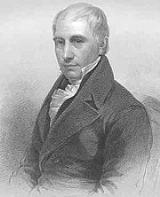
Thomas Thomson


   Email Print
   Bookmark   Link


Thomas Thomson


Thomas Thomson FRS (12 April 1773 – 2 July 1852) was a Scottish chemist
Chemist

A chemist is a scientist trained in the science of chemistry. Chemists study the composition of matter and its properties such as density, acidity, size and shape....
 whose writings contributed to the early spread of Dalton's
John Dalton

John Dalton Fellow of the Royal Society was an England chemist, meteorologist and physicist. He is best known for his pioneering work in the development of modern atomic theory, and his research into Color blindness ....
 atomic theory.

Life and work
Thomas Thomson was born in Crieff
Crieff

Crieff is a market town in Perth and Kinross, Scotland. It lies on the A85 road between Perth, Scotland and Crianlarich and also lies on the A822 road between Greenloaning and Aberfeldy....
, Perthshire
Perthshire

Perthshire , officially the County of Perth, is a registration county in central Scotland. It extends from Strathmore, Angus and Perth & Kinross in the east, to the Pass of Drumochter in the north, Rannoch Moor and Ben Lui in the west, and Aberfoyle, Scotland in the south....
 in 1773. He was educated at the University of St. Andrews in classics
Classics

Classics is the branch of the Humanities comprising the languages, literature, philosophy, history, art, and other culture of the ancient Mediterranean World; especially Ancient Greece and Ancient Rome during Classical Antiquity ....
, mathematics
Mathematics

Mathematics is the study of quantity, structure, space, change, and related topics of pattern and form. Mathematicians seek out patterns whether found in numbers, space, natural science, computers, imaginary abstractions, or elsewhere....
, and natural philosophy
Natural philosophy

Natural philosophy or the philosophy of nature , is a term applied to the Objectivity study of nature and the physical universe that was dominant before the development of modern science....
, and went on to graduate in medicine
Medicine

Medicine is the art and science of healing. It encompasses a range of health care practices evolved to maintain and restore health by the prevention and treatment of illness....
 from the University of Edinburgh
University of Edinburgh

The University of Edinburgh founded in 1582, is an internationally renowned centre for teaching and research in Edinburgh, Scotland, United Kingdom....
 in 1799. However, he was inspired by Joseph Black
Joseph Black

Joseph Black was a Scottish physician, physicist, and chemist, known for his discoveries of latent heat, specific heat, and carbon dioxide. He was a founder of thermochemistry who developed many pre-thermodynamics concepts, such as heat capacity, and was the mentor for James Watt....
 to take up the study of chemistry
Chemistry

Chemistry is the science concerned with the composition, structure, and properties of matter, as well as the changes it undergoes during chemical reactions....
.

In 1796, Thomson succeeded his brother, James, as assistant editor of the Supplement to the Third Edition of the Encyclopędia Britannica
Encyclopędia Britannica

The Encyclop?dia Britannica is a general English language encyclopedia published by Encyclop?dia Britannica, Inc., a privately held company....
, contributing the articles Chemistry, Mineralogy
Mineralogy

Mineralogy is an Earth Science focused around the chemistry, crystal structure, and physical properties of minerals. Specific studies within mineralogy include the processes of mineral origin and formation, classification of minerals, their geographical distribution, as well as their utilization....
, and Vegetable
Vegetable

The term "vegetable" generally means the Eating parts of plants. The definition of the word is traditional rather than scientific, however, and therefore the usage of the word is somewhat arbitrary and subjective, as it is determined by individual cultural customs of food selection and food preparation....
, animal
Animal

Animals are a major group of multicellular, eukaryotic organisms of the Kingdom Animalia or Metazoa. Their body plan eventually becomes fixed as they develop, although some undergo a process of metamorphosis later on in their life....
 and dyeing
Dyeing

Dyeing is the process of imparting colours to a textile material in loose fibre, yarn, cloth or garment form by treatment with a dye....
 substances
.


Discussion
Ask a question about 'Thomas Thomson'
Start a new discussion about 'Thomas Thomson'
Answer questions from other users
Full Discussion Forum


Recent Posts


Encyclopedia


Thomas Thomson FRS (12 April 1773 – 2 July 1852) was a Scottish chemist
Chemist

A chemist is a scientist trained in the science of chemistry. Chemists study the composition of matter and its properties such as density, acidity, size and shape....
 whose writings contributed to the early spread of Dalton's
John Dalton

John Dalton Fellow of the Royal Society was an England chemist, meteorologist and physicist. He is best known for his pioneering work in the development of modern atomic theory, and his research into Color blindness ....
 atomic theory.

Life and work


Thomas Thomson was born in Crieff
Crieff

Crieff is a market town in Perth and Kinross, Scotland. It lies on the A85 road between Perth, Scotland and Crianlarich and also lies on the A822 road between Greenloaning and Aberfeldy....
, Perthshire
Perthshire

Perthshire , officially the County of Perth, is a registration county in central Scotland. It extends from Strathmore, Angus and Perth & Kinross in the east, to the Pass of Drumochter in the north, Rannoch Moor and Ben Lui in the west, and Aberfoyle, Scotland in the south....
 in 1773. He was educated at the University of St. Andrews in classics
Classics

Classics is the branch of the Humanities comprising the languages, literature, philosophy, history, art, and other culture of the ancient Mediterranean World; especially Ancient Greece and Ancient Rome during Classical Antiquity ....
, mathematics
Mathematics

Mathematics is the study of quantity, structure, space, change, and related topics of pattern and form. Mathematicians seek out patterns whether found in numbers, space, natural science, computers, imaginary abstractions, or elsewhere....
, and natural philosophy
Natural philosophy

Natural philosophy or the philosophy of nature , is a term applied to the Objectivity study of nature and the physical universe that was dominant before the development of modern science....
, and went on to graduate in medicine
Medicine

Medicine is the art and science of healing. It encompasses a range of health care practices evolved to maintain and restore health by the prevention and treatment of illness....
 from the University of Edinburgh
University of Edinburgh

The University of Edinburgh founded in 1582, is an internationally renowned centre for teaching and research in Edinburgh, Scotland, United Kingdom....
 in 1799. However, he was inspired by Joseph Black
Joseph Black

Joseph Black was a Scottish physician, physicist, and chemist, known for his discoveries of latent heat, specific heat, and carbon dioxide. He was a founder of thermochemistry who developed many pre-thermodynamics concepts, such as heat capacity, and was the mentor for James Watt....
 to take up the study of chemistry
Chemistry

Chemistry is the science concerned with the composition, structure, and properties of matter, as well as the changes it undergoes during chemical reactions....
.

In 1796, Thomson succeeded his brother, James, as assistant editor of the Supplement to the Third Edition of the Encyclopędia Britannica
Encyclopędia Britannica

The Encyclop?dia Britannica is a general English language encyclopedia published by Encyclop?dia Britannica, Inc., a privately held company....
, contributing the articles Chemistry, Mineralogy
Mineralogy

Mineralogy is an Earth Science focused around the chemistry, crystal structure, and physical properties of minerals. Specific studies within mineralogy include the processes of mineral origin and formation, classification of minerals, their geographical distribution, as well as their utilization....
, and Vegetable
Vegetable

The term "vegetable" generally means the Eating parts of plants. The definition of the word is traditional rather than scientific, however, and therefore the usage of the word is somewhat arbitrary and subjective, as it is determined by individual cultural customs of food selection and food preparation....
, animal
Animal

Animals are a major group of multicellular, eukaryotic organisms of the Kingdom Animalia or Metazoa. Their body plan eventually becomes fixed as they develop, although some undergo a process of metamorphosis later on in their life....
 and dyeing
Dyeing

Dyeing is the process of imparting colours to a textile material in loose fibre, yarn, cloth or garment form by treatment with a dye....
 substances
. In 1802, Thomson used these articles as the basis of his book System of Chemistry.

Thomson dabbled in publishing
Publishing

Publishing is the process of production and dissemination of literature or information – the activity of making information available for public view....
, acted as a consultant to the Scottish excise board, invented the instrument known as Allan's saccharometer, and opposed the geological
Geology

Geology is the science and study of the solid and liquid matter that constitute the Earth. The field of geology encompasses the study of the composition, structural geology, physical properties, dynamics, and History of the Earth of Earth materials, and the processes by which they are formed, moved, and changed....
 theories of James Hutton
James Hutton

James Hutton Doctor of Medicine was a Scotland geologist, physician, Natural history, chemist and experimental Agriculture. He is considered the father of modern geology....
, founding the Wernerian Natural History Society of Edinburgh as a platform in 1808.

In 1817, Thomson became Regius Professor of Chemistry at the University of Glasgow
University of Glasgow

The University of Glasgow was founded in 1451, in Glasgow, Scotland, and, along with its contemporary institution, the University of St Andrews, it formed the Kingdom of Scotland's equivalent to Oxbridge....
, and in 1820 he identified a new zeolite
Zeolite

Zeolites are Microporous material, aluminosilicate minerals commonly used as commercial absorbents. The term zeolite was originally coined in 1756 by Sweden mineralogist Axel Fredrik Cronstedt, who observed that upon rapidly heating the material stilbite, it produced large amounts of steam from water that had been absorbed by the material....
 mineral
Mineral

A mineral is a naturally occurring solid formed through Geology processes that has a characteristic chemical composition, a highly ordered atomic structure, and specific physical properties....
, named thomsonite
Thomsonite

Thomsonite is the name of a series of Silicate minerals minerals of the zeolite group. Prior to 1997, thomsonite was recognized as a mineral species, but a reclassification in 1997 by the International Mineralogical Association changed it to a series name, with the mineral species being named thomsonite-Ca and thomsonite-Sr....
 in his honour.

Thomson died at Kilmun
Kilmun

Kilmun is a linear settlement on the north shore of the Holy Loch in Argyll and Bute in south-west Scotland, up to the village of Strone at Strone Point where the loch joins the Firth of Clyde....
 in 1852 and was buried at the Glasgow Necropolis
Glasgow Necropolis

The Glasgow Necropolis is a Victorian era cemetery in Glasgow, Scotland. It is on a hill above, and to the east of, St. Mungo's Cathedral, Glasgow ....
.

Honours


  • Fellow of the Royal Society of Edinburgh
    Royal Society of Edinburgh

    The Royal Society of Edinburgh is Scotland's national academy of science and letters. The membership consists of over 1400 peer-elected fellows, who are known as Fellows of the Royal Society of Edinburgh, denoted FRSE in official titles....
     (1805)
  • Fellow of the Royal Society
    Royal Society

    The Royal Society of London for the Improvement of Natural Knowledge, known simply as the Royal Society, or even the Royal, is a learned society for science that was founded in 1660 and is considered by most to be the oldest such society still in existence....
    , (1811)


Selected writings


  • Survey of Chemistry (1802)


  • (1810)


  • (1825)


  • (1830)


  • (1831)


  • (1843)


Further reading


External links