

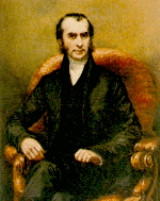
Thomas Hodgkin

Encyclopedia
Thomas Hodgkin was a British
physician
, considered one of the most prominent pathologists
of his time and a pioneer in preventive medicine
. He is now best known for the first account of Hodgkin's disease, a form of lymphoma
and blood disease, in 1832. Hodgkin's work marked the beginning of times when a pathologist was actively involved in the clinical process. He was a contemporary of Thomas Addison
and Richard Bright
at Guy's Hospital
.
 Thomas Hodgkin was born to a Quaker family in Pentonville
, St. James Parish, Middlesex
. He received private education and, in September 1819 he was admitted to St. Thomas's and Guy's Medical School. He also studied at the University of Edinburgh
, Scotland
. In 1821, he went to Italy
and France
, where he learned to work with the stethoscope
, a recent invention of René Laënnec
. In 1823, Hodgkin qualified for his M.D. at Edinburgh
with a thesis on the physiological mechanisms of absorption in animals.
He was also an integral part of The Friends' School, Hobart, where they remember him by naming one of the four school houses after him.
Hodgkin was a close friend of Sir Moses Montefiore
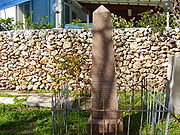
and he accompanied him to Palestine in 1866. There he contracted dysentery
and died on 4 April 1866. He was buried in Jaffa
.
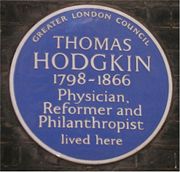
There is a blue plaque
on his house in Bedford Square
, London.
 Hodgkin described the disease that bears his name (Hodgkin's lymphoma
) in 1832, in a paper titled On Some Morbid Appearances of the Absorbent Glands and Spleen. He received 33 years later the eponym
through the recognition of British physician Samuel Wilks
, who rediscovered the disease. It is a malignancy that produces enlargement of lymphoid tissue, spleen
, and liver
, with invasion of other tissues. A more benign form is called Hodgkin’s paragranuloma, while a more invasive form is called Hodgkin's sarcoma.
He published as a book his Lectures on Morbid Anatomy in 1836 and 1840. His greatest contribution to the teaching of pathology, however, was made in 1829, with his two volumed work entitled The Morbid Anatomy of Serous and Mucous Membranes, which became a classic in modern pathology.
Hodgkin was one of the earliest defenders of preventive medicine, having published On the Means of Promoting and Preserving Health in book form in 1841. Among other early observations were the first description of acute appendicitis
, of the biconcave format of red blood cells and the striation of muscle
fibers.
United Kingdom
The United Kingdom of Great Britain and Northern IrelandIn the United Kingdom and Dependencies, other languages have been officially recognised as legitimate autochthonous languages under the European Charter for Regional or Minority Languages...
physician
Physician
A physician is a health care provider who practices the profession of medicine, which is concerned with promoting, maintaining or restoring human health through the study, diagnosis, and treatment of disease, injury and other physical and mental impairments...
, considered one of the most prominent pathologists
Pathology
Pathology is the precise study and diagnosis of disease. The word pathology is from Ancient Greek , pathos, "feeling, suffering"; and , -logia, "the study of". Pathologization, to pathologize, refers to the process of defining a condition or behavior as pathological, e.g. pathological gambling....
of his time and a pioneer in preventive medicine
Preventive medicine
Preventive medicine or preventive care refers to measures taken to prevent diseases, rather than curing them or treating their symptoms...
. He is now best known for the first account of Hodgkin's disease, a form of lymphoma
Lymphoma
Lymphoma is a cancer in the lymphatic cells of the immune system. Typically, lymphomas present as a solid tumor of lymphoid cells. Treatment might involve chemotherapy and in some cases radiotherapy and/or bone marrow transplantation, and can be curable depending on the histology, type, and stage...
and blood disease, in 1832. Hodgkin's work marked the beginning of times when a pathologist was actively involved in the clinical process. He was a contemporary of Thomas Addison
Thomas Addison
Thomas Addison was a renowned 19th-century English physician and scientist. He is traditionally regarded as one of the "great men" of Guy's Hospital in London....
and Richard Bright
Richard Bright (physician)
Richard Bright was an English physician and early pioneer in the research of kidney disease.He was born in Bristol, Gloucestershire, the third son of Sarah and Richard Bright Sr., a wealthy merchant and banker. Bright Sr. shared his interest in science with his son,encouraging him to consider it...
at Guy's Hospital
Guy's Hospital
Guy's Hospital is a large NHS hospital in the borough of Southwark in south east London, England. It is administratively a part of Guy's and St Thomas' NHS Foundation Trust. It is a large teaching hospital and is home to the King's College London School of Medicine...
.
Life
Pentonville
Pentonville is an area of north-central London in the London Borough of Islington, centred on the Pentonville Road. The area is named after Henry Penton, who developed a number of streets in the 1770s in what was open countryside adjacent to the New Road...
, St. James Parish, Middlesex
Middlesex
Middlesex is one of the historic counties of England and the second smallest by area. The low-lying county contained the wealthy and politically independent City of London on its southern boundary and was dominated by it from a very early time...
. He received private education and, in September 1819 he was admitted to St. Thomas's and Guy's Medical School. He also studied at the University of Edinburgh
University of Edinburgh
The University of Edinburgh, founded in 1583, is a public research university located in Edinburgh, the capital of Scotland, and a UNESCO World Heritage Site. The university is deeply embedded in the fabric of the city, with many of the buildings in the historic Old Town belonging to the university...
, Scotland
Scotland
Scotland is a country that is part of the United Kingdom. Occupying the northern third of the island of Great Britain, it shares a border with England to the south and is bounded by the North Sea to the east, the Atlantic Ocean to the north and west, and the North Channel and Irish Sea to the...
. In 1821, he went to Italy
Italy
Italy , officially the Italian Republic languages]] under the European Charter for Regional or Minority Languages. In each of these, Italy's official name is as follows:;;;;;;;;), is a unitary parliamentary republic in South-Central Europe. To the north it borders France, Switzerland, Austria and...
and France
France
The French Republic , The French Republic , The French Republic , (commonly known as France , is a unitary semi-presidential republic in Western Europe with several overseas territories and islands located on other continents and in the Indian, Pacific, and Atlantic oceans. Metropolitan France...
, where he learned to work with the stethoscope
Stethoscope
The stethoscope is an acoustic medical device for auscultation, or listening to the internal sounds of an animal body. It is often used to listen to lung and heart sounds. It is also used to listen to intestines and blood flow in arteries and veins...
, a recent invention of René Laënnec
René Laennec
René-Théophile-Hyacinthe Laennec was a French physician. He invented the stethoscope in 1816, while working at the Hôpital Necker and pioneered its use in diagnosing various chest conditions....
. In 1823, Hodgkin qualified for his M.D. at Edinburgh
Edinburgh
Edinburgh is the capital city of Scotland, the second largest city in Scotland, and the eighth most populous in the United Kingdom. The City of Edinburgh Council governs one of Scotland's 32 local government council areas. The council area includes urban Edinburgh and a rural area...
with a thesis on the physiological mechanisms of absorption in animals.
He was also an integral part of The Friends' School, Hobart, where they remember him by naming one of the four school houses after him.
Hodgkin was a close friend of Sir Moses Montefiore
Moses Montefiore
Sir Moses Haim Montefiore, 1st Baronet, Kt was one of the most famous British Jews of the 19th century. Montefiore was a financier, banker, philanthropist and Sheriff of London...
and he accompanied him to Palestine in 1866. There he contracted dysentery
Dysentery
Dysentery is an inflammatory disorder of the intestine, especially of the colon, that results in severe diarrhea containing mucus and/or blood in the faeces with fever and abdominal pain. If left untreated, dysentery can be fatal.There are differences between dysentery and normal bloody diarrhoea...
and died on 4 April 1866. He was buried in Jaffa
Jaffa
Jaffa is an ancient port city believed to be one of the oldest in the world. Jaffa was incorporated with Tel Aviv creating the city of Tel Aviv-Yafo, Israel. Jaffa is famous for its association with the biblical story of the prophet Jonah.-Etymology:...
.
There is a blue plaque
Blue plaque
A blue plaque is a permanent sign installed in a public place to commemorate a link between that location and a famous person or event, serving as a historical marker....
on his house in Bedford Square
Bedford Square
Bedford Square is a square in the Bloomsbury district of the Borough of Camden in London, England.Built between 1775 and 1783 as an upper middle class residential area, the sqare has had many distinguished residents, including Lord Eldon, one of Britain's longest serving and most celebrated Lord...
, London.
Works
Hodgkin's lymphoma
Hodgkin's lymphoma, previously known as Hodgkin's disease, is a type of lymphoma, which is a cancer originating from white blood cells called lymphocytes...
) in 1832, in a paper titled On Some Morbid Appearances of the Absorbent Glands and Spleen. He received 33 years later the eponym
Eponym
An eponym is the name of a person or thing, whether real or fictitious, after which a particular place, tribe, era, discovery, or other item is named or thought to be named...
through the recognition of British physician Samuel Wilks
Samuel Wilks
Sir Samuel Wilks, 1st Baronet , was a British physician and biographer.-Early life:Samuel Wilks was born on 2 June 1824 in Camberwell, London, the second son of Joseph Barber Wilks, a cashier at the East India House...
, who rediscovered the disease. It is a malignancy that produces enlargement of lymphoid tissue, spleen
Spleen
The spleen is an organ found in virtually all vertebrate animals with important roles in regard to red blood cells and the immune system. In humans, it is located in the left upper quadrant of the abdomen. It removes old red blood cells and holds a reserve of blood in case of hemorrhagic shock...
, and liver
Liver
The liver is a vital organ present in vertebrates and some other animals. It has a wide range of functions, including detoxification, protein synthesis, and production of biochemicals necessary for digestion...
, with invasion of other tissues. A more benign form is called Hodgkin’s paragranuloma, while a more invasive form is called Hodgkin's sarcoma.
He published as a book his Lectures on Morbid Anatomy in 1836 and 1840. His greatest contribution to the teaching of pathology, however, was made in 1829, with his two volumed work entitled The Morbid Anatomy of Serous and Mucous Membranes, which became a classic in modern pathology.
Hodgkin was one of the earliest defenders of preventive medicine, having published On the Means of Promoting and Preserving Health in book form in 1841. Among other early observations were the first description of acute appendicitis
Appendicitis
Appendicitis is a condition characterized by inflammation of the appendix. It is classified as a medical emergency and many cases require removal of the inflamed appendix, either by laparotomy or laparoscopy. Untreated, mortality is high, mainly because of the risk of rupture leading to...
, of the biconcave format of red blood cells and the striation of muscle
Muscle
Muscle is a contractile tissue of animals and is derived from the mesodermal layer of embryonic germ cells. Muscle cells contain contractile filaments that move past each other and change the size of the cell. They are classified as skeletal, cardiac, or smooth muscles. Their function is to...
fibers.
External links
- ODNB article by Amalie M. Kass, ‘Hodgkin, Thomas (1798–1866)’, Oxford Dictionary of National Biography, Oxford University Press, 2004 http://www.oxforddnb.com/view/article/13429, accessed 22 Sept 2007.