
All Topics  
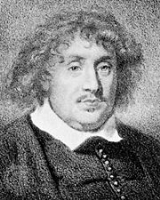
Thomas Fuller

 
Thomas Fuller

   Email Print
   Bookmark   Link


Thomas Fuller


Thomas Fuller (1608 – August 16, 1661) was an English churchman and historian.

eldest son of Thomas Fuller, rector of Aldwinkle St Peter's, Northamptonshire
Northamptonshire

Northamptonshire is a landlocked Counties of England in the England East Midlands, with a population of 629,676 as at the United Kingdom Census 2001....
, he was born at his father's rectory and was baptised on June 19 1608. Dr John Davenant
John Davenant

John Davenant was an English academic and bishop of Salisbury from 1621....
, bishop of Salisbury
Bishop of Salisbury

The Bishop of Salisbury is the Ordinary of the Church of England Diocese of Salisbury in the Province of Canterbury.The diocese covers much of the Counties of Wiltshire and Dorset....
, was his uncle and godfather.


Discussion
Ask a question about 'Thomas Fuller'
Start a new discussion about 'Thomas Fuller'
Answer questions from other users
Full Discussion Forum


Quotations


Anger is one of the sinews of the soul; he that wants it hath a maimed mind.

Of Anger

Do not in an instant what an age cannot recompense.

Of Anger

Fame sometimes hath created something of nothing.

Of Fame

He knows little who will tell his wife all he knows.

The Good Husband

He will make a strange combustion in the state of his soul, who at the landing of every cockboat sets the beacons on fire.

Of Anger

Heat of passion makes our souls to chap, and the devil creeps in at the crannies.

Of Anger


Encyclopedia


Thomas Fuller
Thomas Fuller (1608 – August 16, 1661) was an English churchman and historian.

Life

The eldest son of Thomas Fuller, rector of Aldwinkle St Peter's, Northamptonshire
Northamptonshire

Northamptonshire is a landlocked Counties of England in the England East Midlands, with a population of 629,676 as at the United Kingdom Census 2001....
, he was born at his father's rectory and was baptised on June 19 1608. Dr John Davenant
John Davenant

John Davenant was an English academic and bishop of Salisbury from 1621....
, bishop of Salisbury
Bishop of Salisbury

The Bishop of Salisbury is the Ordinary of the Church of England Diocese of Salisbury in the Province of Canterbury.The diocese covers much of the Counties of Wiltshire and Dorset....
, was his uncle and godfather. According to John Aubrey
John Aubrey

John Aubrey was an England antiquary and writer, best known as the author of the collection of short biographical pieces usually referred to as Brief Lives and as the discoverer of the Aubrey holes in Stonehenge....
, Fuller was "a boy of pregnant wit." At thirteen he was admitted to Queens' College, Cambridge
Queens' College, Cambridge

Queens' College is a Colleges of the University of Cambridge of the University of Cambridge. It was first founded in 1448 by Margaret of Anjou , and refounded in 1465 by Elizabeth Woodville ....
, then presided over by John Davenant. His cousin, Edward Davenant, was a tutor there. He did well academically; and in Lent 1624-1625 he became B.A. and in July 1628, M.A. After being overlooked in an election of fellows of his college, he moved to Sidney Sussex College, Cambridge
Sidney Sussex College, Cambridge

Sidney Sussex College was founded in 1596 and named after its foundress, Frances Sidney, Countess of Sussex. It is one of the 31 Colleges that make up the University of Cambridge....
 in November 1628. In 1630 he received from Corpus Christi College
Corpus Christi College, Cambridge

Corpus Christi College is a College of the University of Cambridge. It is notable for being the only college to have been founded by Cambridge townspeople, having been founded in 1352 by the Guilds of Corpus Christi and the Blessed Virgin Mary....
 the curacy of St Benet's, Cambridge.

Fuller's oratory soon attracted attention. In 1631, he published a poem on the subject of David and Bathsheba
Bathsheba

According to the Hebrew Bible, Bathsheba was the wife of Uriah the Hittite and later of David , king of the United Kingdom of Israel and Judah....
, entitled David's Heinous Sinne, Heartie Repentance, Heavie Punishment. In June of the same year his uncle gave him a prebend in Salisbury, where his father, who died in the following year, already held a canonry
Canon (priest)

A canon is a priest who is a member of certain bodies of the Christianity clergy subject to an ecclesiastical rule .Originally, a canon was a cleric living with others in a clergyhouse or, later, in one of the houses within the precinct or close of a cathedral and ordering his life according to the orders or rules of the church....
. The rectory of Broadwindsor
Broadwindsor

Broadwindsor is a village in west Dorset, England, two miles west of Beaminster. The village has a population of 1,218 .Broadwindsor was also formerly a liberty , containing only the parish itself....
, Dorset, then in the diocese of Bristol
Diocese of Bristol

The Diocese of Bristol is a Church of England diocese based in Bristol, also covering South Gloucestershire and parts of north Wiltshire to Swindon....
, was his next preferment (1634); and on June 11, 1635 he proceeded B.D. At Broadwindsor he compiled The Historie of the Holy Warre (1639), a history of the crusades
Crusades

The Crusades were a series of religious war waged by much of Christian Europe against external and internal opponents. Crusades were fought mainly against Muslims, though campaigns were also directed against Paganism Slavic peoples, Jews, Eastern Orthodox Church, Mongols, Catharism, Hussites, Waldensians, Old Prussians, and political enemi...
, and The Holy State and the Prophane State (1642). This work describes the holy state as existing in the family and in public life, gives rules of conduct, model "characters" for the various professions and profane biographies. It was perhaps the most popular of all his writings. In 1640, he was elected proctor for Bristol in the memorable convocation of Canterbury, which assembled with the Short Parliament
Short Parliament

The Short Parliament of King Charles I of England is so called because it lasted only three weeks.After eleven years of attempting personal rule, Charles recalled Parliament in 1640, under the advice of Lord Wentworth, recently created Thomas Wentworth, 1st Earl of Strafford....
. On the sudden dissolution of the latter he joined those who urged that convocation should likewise dissolve. That opinion was overruled; and the assembly continued to sit by royal writ. Fuller left, in his Church History, a valuable account of the proceedings of this synod
Synod

A synod is a council of a Ecclesia , usually a Christianity church, convened to decide an issue of doctrine, administration or application. An ecumenical council is so named because it is a synod of the whole church ...
, for sitting in which he was fined £200. His first published volume of sermons appeared in 1640 under the title of Joseph's partly-coloured Coat.

In about 1640 he had married Eleanor, daughter of Hugh Grove of Chisenbury, Wiltshire
Wiltshire

Wiltshire is a Ceremonial counties of England in the South West England of England. It is landlocked and borders the counties of Dorset, Somerset, Hampshire, Gloucestershire, Oxfordshire and Berkshire....
. She died in 1641. Their son, John, baptized at Broadwindsor by his father on 6 June 1641, was afterwards of Sidney Sussex College, edited the Worthies of England, 1662, and became rector of Great Wakering, Essex, where he died in 1687. At Broadwindsor, early in 1641, Thomas Fuller, his curate Henry Sanders, the churchwardens, and five others certified that their parish, represented by 242 adult males, had taken the Protestation ordered by the speaker of the Long Parliament
Long Parliament

The Long Parliament is the name of the List of Parliaments of England called by Charles I of England, on 3 November 1640, following the Bishops' Wars....
. Fuller was not formally dispossessed of his living and prebend on the triumph of the Presbyterian party, but he relinquished both preferments about this time. For a short time he preached with success at the Inns of Court
Inns of Court

The Inns of Court in London are the professional associations to one of which every Barristers in England and Wales must belong. They have supervisory and disciplinary functions over their members....
, and then at the invitation of the master of the Savoy, Walter Balcanqual, and the brotherhood of that foundation, became lecturer at their chapel of St Mary Savoy. Some of the best discourses of the witty preacher were delivered at the Savoy to audiences which extended into the chapel-yard. In one he set forth with searching and truthful minuteness the hindrances to peace, and urged the signing of petitions to the king at Oxford, and to the parliament, to continue their care in advancing an accommodation. In his Appeal of Injured Innocence Fuller says that he was once deputed to carry a petition to the king at Oxford. This has been identified with a petition entrusted to Sir Edward Wardour, clerk of the pells, Dr Dukeson, "Dr Fuller," and four or five others from the city of Westminster and the parishes contiguous to the Savoy. A pass was granted by the House of Lords, on January 2 1643, for an equipage of two coaches, four or six horses and eight or ten attendants. On the arrival of the deputation at Uxbridge, on January 4, officers of the Parliamentary army stopped the coaches and searched the gentlemen; and they found upon the latter "two scandalous books arraigning the proceedings of the House," and letters with ciphers to Lord Viscount Falkland
Viscount Falkland

Viscount of Falkland is a title in the Peerage of Scotland. It was created in 1620 for Sir Henry Cary. He was made Lord Cary at the same time, also in the Peerage of Scotland....
 and the Lord Spencer
Lord Spencer

Lord Spencer may refer to:* Earl Spencer, English title of nobility*Lord Charles Spencer *Lord Henry Spencer ...
. A joint order of both Houses remanded the party; and Fuller and his friends were briefly imprisoned. The Westminster Petition reached the king's hands; and it was published with the royal reply (see JE Bailey, Life of Thomas Fuller, pp. 245 el seq.). When it was expected, three months later, that a favourable result would attend the negotiations at Oxford, Fuller preached a sermon at Westminster Abbey
Westminster Abbey

The Collegiate Church of St Peter at Westminster, which is almost always referred to popularly and informally as Westminster Abbey, is a large, mainly Gothic architecture Church , in Westminster, London, just to the west of the Palace of Westminster....
, on March 27 1643, on the anniversary of Charles I's accession, on the text, "Yea, let him take all, so my Lord the King return in peace." On Wednesday, July 26, he preached on church reformation, satirizing the religious reformers, and maintaining that only the Supreme Power could initiate reforms.

He was now obliged to leave London, and in August 1643 he joined the king at Oxford, where he lodged in a chamber at Lincoln College
Lincoln College, Oxford

Lincoln College is one of the Colleges of the University of Oxford of the University of Oxford in the United Kingdom. It is situated in the centre of Oxford, backing onto Brasenose College, Oxford and, lying on Turl Street as it is, is the second oldest of the three Turl Street Colleges ....
. Thence he put forth a witty and effective reply to John Saltmarsh
John Saltmarsh (clergyman)

John Saltmarsh was a radical English religious and controversial writer and preacher. He is considered one of the Seekers. William Haller called him that strange genius, part poet and part whirling dervish....
, who had attacked his views on, ecclesiastical reform. Fuller subsequently published by royal request a sermon preached on May 10 1644, at St Mary's, Oxford, before the king and Prince Charles
Charles II of England

Charles II was the Monarchy of Kingdom of England, Kingdom of Scotland, and Kingdom of Ireland.His father Charles I of England Regicide#The regicide of Charles I of England at Palace of Whitehall on 30 January 1649, at the climax of the English Civil War....
, called Jacob's Vow. The spirit of Fuller's preaching, characterized by calmness and moderation, offended the high royalists. To silence unjust censures he became chaplain to the regiment of Sir Ralph Hopton. For the first five years of the war, he "had little list or leisure to write, fearing to be made a history, and shifting daily for my safety. All that time I could not live to study, who did only study to live." After the defeat of Hopton at Cheriton Down
Battle of Cheriton

The Battle of Cheriton was an important Parliament of England victory in the English Civil War. It took place on March 29, 1644 and resulted in the defeat of a Cavalier army, which threw Charles I of England onto the defensive for the remainder of the year....
, Fuller retreated to Basing House
Basing House

Basing House, Hampshire, was a major England Tudor period palace and castle that once rivalled Hampton Court Palace in its size and opulence. Today only its foundations and earthworks remain....
. He took an active part in its defence, and his life with the troops caused him to be afterwards regarded as one of "the great cavalier parsons." He compiled in 1645 a small volume of prayers and meditations--the Good Thoughts in Bad Times--which, set up and printed in the besieged city of Exeter, where he had retired, was called by himself "the first fruits of Exeter press." It was inscribed to Lady Dalkeith, governess to the infant princess, Henrietta Anne
Henrietta Anne Stuart

Henrietta Anne of England, Duchess of Orl?ans , in French Henriette d'Angleterre, known familiarly as Minette, was the youngest daughter of King Charles I of England of England and Henrietta Maria of France....
 (b. 1644), to whose household he was attached as chaplain. The corporation gave him the Bodleian lectureship on March 21 1645/6, and he held it until June 17 following, soon after the surrender of the city to the parliament. The Fear of losing life Old Light (1646) was his farewell discourse to his Exeter friends. Under the Articles of Surrender Fuller made his composition with the government at London, his "delinquency" being that he had been present in the king's garrisons. In Andronicus, or the Unfortunate Politician (1646), partly authentic and partly fictitious, he satirized the leaders of the Revolution; and for the comfort of sufferers by the war he issued (1647) a second devotional manual, entitled Good Thoughts in Worse Times, abounding in fervent aspirations, and drawing moral lessons in beautiful language out of the events of his life or the circumstances of the time. In grief over his losses, which included his library and manuscripts (his "upper and nether millstone"), and over the calamities of the country, he wrote his work on the Cause and Cure of a Wounded Conscience (1647). It was prepared at Boughton House in his native county, where he and his son were entertained by Edward Lord Montagu
Edward Montagu, 2nd Earl of Manchester

Edward Montagu, 2nd Earl of Manchester Knight of the Garter, Knight of the Bath, Fellow of the Royal Society was an important commander of Parliamentary forces in the First English Civil War, and for a time Oliver Cromwell's superior....
, who had been one of his contemporaries at the university and had taken the side of the parliament. For the next few years of his life Fuller was mainly dependent upon his dealings with booksellers, of whom he asserted that none had ever lost by him. He made considerable progress in an English translation from the manuscript of the Annales of his friend Archbishop Ussher.

Amongst his benefactors was Sir John Danvers
John Danvers

Sir John Danvers was an England politician.Danvers was the third son of Sir John Danvers of Dauntsey in Wiltshire and younger brother of Henry Danvers, 1st Earl of Danby....
 of Chelsea, the regicide. Fuller in 1647 began to preach at St Clement's, Eastcheap, and elsewhere in the capacity of lecturer. While at St Clement's he was suspended; but soon recovered his freedom and preached wherever he was invited. At Chelsea, where also he occasionally officiated, he covertly preached a sermon on the death of Charles I
Charles I of England

Charles I was List of English monarchs, List of monarchs of Scotland and King of Ireland from 27 March 1625 until his capital punishment on 30 January 1649....
, but he did not break with his Roundhead
Roundhead

"Roundheads" was the nickname given to the Puritan supporters of Parliament of England during the English Civil War. Also known as Parliamentarians, they were the supporters of Oliver Cromwell against Charles I of England ....
 patrons. James Hay, 2nd Earl of Carlisle, made him his chaplain, and presented him in 1648 or 1649 to the curacy of Waltham Abbey
Waltham Abbey (abbey)

Waltham Abbey is an abbey Church , first consecrated in 1060, in the town of Waltham Abbey, Essex, England...
. His possession of the living was in jeopardy on the appointment of Oliver Cromwell
Oliver Cromwell

Oliver Cromwell was an English people Military history of the United Kingdom and Politics of England leader best known for his involvement in making England into a republican Commonwealth and for his later role as Lord Protector of England, Scotland, and Ireland....
's "Tryers"; but he evaded their inquisitorial questions by his ready wit. He was not disturbed at Waltham in 1655, when the Protector's edict prohibited the adherents of the late king from preaching. Lionel, 3rd Earl of Middlesex, who lived at Copt Hall, near Waltham, gave him what remained of the books of the lord treasurer his father; and through the good offices of the marchioness of Hertford, part of his own pillaged library was restored to him. Fuller was thus able to prosecute his literary labours, producing successively his descriptive geography of the Holy Land, called A Pisgah-Sight of Palestine (1650), and his Church-History of Britain (1655), from the birth of Jesus Christ until the year 1648.

With the Church-History was printed The History of the University of Cambridge since the Conquest and The History of Waltham Abbey. These works were furthered in no slight degree by his connection with Sion College
Sion College

Sion College, in London, an institution founded by Royal Charter in 1630 as a college, gild of parochial clergy and almshouse, under the 1623 will of Dr Thomas White, vicar of St Dunstan's in the West....
, London, where he had a chamber, as well for the convenience of the press as of his city lectureships. The Church-History was angrily attacked by Dr P Heylyn
Peter Heylin

Peter Heylin or Heylyn was an England ecclesiastic and author of many polemical, historical, political and theological tracts. He incorporated his political concepts into his geographical books Microcosmus in 1621 and Cosmography ....
, who, in the spirit of High-Churchmanship, wished, as he said, to vindicate the truth, the church and the injured clergy. About 1652 Fuller married his second wife, Mary Roper, youngest sister of Thomas, Viscount Baltinglass, by whom he had several children. At the Oxford Act of 1657, Robert South, who was Terrae filius, lampooned Fuller, whom he described in this Oratio as living in London, ever scribbling and each year bringing forth new folia like a tree. At length, continues South, the Church-History came forth with its 166 dedications to wealthy and noble friends; and with this huge volume under one arm, and his wife (said to be little of stature) on the other, he ran up and down the streets of London, seeking at the houses of his patrons invitations to dinner, to be repaid by his dull jests at table. His last and best patron was George Berkeley, 1st Earl Berkeley (1628-1698), of Cranford House, Middlesex, whose chaplain he was, and who gave him Cranford rectory (1658). To this noble-man Fuller's reply to Heylyn's Examen Historicum, called The Appeal of Injured Innocence (1659), was inscribed. At the end of the Appeal is an epistle "to my loving friend Dr Peter Heylyn," conceived in the admirable Christian spirit which characterized all Fuller's dealings with controversialists. "Why should Peter," he asked, "fall out with Thomas, both being disciples to the same Lord and Master? I assure you, sir, whatever you conceive to the contrary, I am cordial to the cause of the English Church, and my hoary hairs will go down to the grave in sorrow for her sufferings." In An Alarum to the Counties of England and Wales (1660) Fuller argued for a free and full parliament--free from force, as he expressed it, as well as from abjurations or previous engagements. Mixt Contemplations in Better Times (1660), dedicated to Lady Monk, tendered advice in the spirit of its motto, "Let your moderation be known to all men: the Lord is at hand."

There is good reason to suppose that Fuller was at the Hague
The Hague

The Hague is the third largest city in the Netherlands after Amsterdam and Rotterdam, with a population of 475,904 and an area of approximately 100 km?....
 immediately before the Restoration, in the retinue of Lord Berkeley, one of the commissioners of the House of Lords, whose last service to his friend was to interest himself in obtaining him a bishopric. A Panegyrick to His Majesty on his Happy Return, one of the many contemporary poems celebrating the restoration of Charles II, was the last of Fuller's verse efforts.

On August 2, by royal letters, he was admitted Doctor of Divinity at Cambridge. He resumed his lectures at the Savoy, where Samuel Pepys
Samuel Pepys

Samuel Pepys, Fellow of the Royal Society was an English people Navy Board and Member of Parliament, who is now most famous for his diary. Although Pepys had no maritime experience, he rose by patronage, hard work and his talent for administration, to be the Chief Secretary to the Admiralty under James II of England....
 heard him preach; but he preferred his conversation or his books to his sermons.

Fuller's last promotion was that of Chaplain Extraordinary
Chaplain Extraordinary

Past holders of the office of Chaplain Extraordinary to the Crown have included Henry Ferne, Thomas Fuller, Thomas Vane and Eric James....
 to Charles II
Charles II of England

Charles II was the Monarchy of Kingdom of England, Kingdom of Scotland, and Kingdom of Ireland.His father Charles I of England Regicide#The regicide of Charles I of England at Palace of Whitehall on 30 January 1649, at the climax of the English Civil War....
. In the summer of 1661 he visited the West in connexion with the business of his prebend, which had been restored to him. On Sunday, August 12, while preaching at the Savoy, be was seized with typhus fever, and died at his new lodgings in Covent Garden
Covent Garden

Covent Garden is a district in London, England, located on the easternmost parts of the City of Westminster and the southwest corner of the London Borough of Camden....
 on the 16th of August. He was buried in Cranford church, where a mural tablet was afterwards set up on the north side of the chancel, with an epitaph which contains a conceit worthy of his own pen, to the effect that while he was endeavouring (viz, in. The Worthies) to give immortality to others, he himself attained it. Fuller's wit and vivacious good-humour made him, a favourite with men of both sides, and his sense of humour kept him from extremes. Probably Heylyn and South had some excuse for their attitude towards his very moderate politics. "By his particular temper and management," said Echard (Hist. of England), "he weathered the late great storm with more success than many other great men." He was known as "a perfect walking library." The strength of his memory was proverbial, and some amusing anecdotes are connected with it. His writings were the product of a highly original mind. He had a fertile imagination and a happy faculty of illustration. Antithetic and axiomatic sentences abound in his pages, embodying literally the wisdom of the many in the wit of one. He was quaint, and something more. "Wit," said Coleridge
Samuel Taylor Coleridge

Samuel Taylor Coleridge was an England poet, critic and Philosophy who was, along with his friend William Wordsworth, one of the founders of the Romanticism in England and one of the Lake Poets....
, in a well-known eulogy, "was the stuff and substance of Fuller's intellect. It was the element, the earthen base, the material which he worked in; and this very circumstance has defrauded him of his due praise for the practical wisdom of the thoughts, for the beauty and variety of the truths, into which he shaped the stuff. Fuller was incomparably the most sensible, the least prejudiced, great man of an age that boasted a galaxy of great men" (Literary Remains, vol. ii. (1836), pp. 389-390). This opinion was formed after the perusal of the Church-History.

That work and the History of the Worthies of England are unquestionably Fuller's greatest efforts. The Holy State ranks among the best books of "characters". Charles Lamb made some selections from Fuller, and had a profound admiration for the "golden works" of the "dear, fine, silly old angel." After Lamb's time, mainly through the appreciative criticisms of Coleridge, Robert Southey
Robert Southey

Robert Southey was an English poet of the Romantic poetry school, one of the so-called "Lake Poets", and Poet Laureate for 30 years from 1813 to his death in 1843....
 and others, Fuller's works received much attention.