

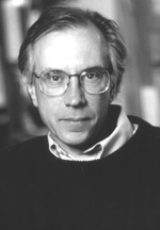
Thomas Cech

Encyclopedia
Thomas Robert Cech is a chemist who shared the 1989 Nobel prize
in chemistry
with Sidney Altman
, for their discovery of the catalytic properties of RNA. Cech discovered that RNA could itself cut strands of RNA, which showed that life could have started as RNA. He also studied telomeres, and his lab discovered an enzyme, TERT (telomerase reverse transcriptase), which is part of the process of restoring telomeres after they are shortened during cell division.Telomeres, Telomerase, and Other Noncoding RNAs, Howard Hughes Medical Institute, July 13, 2010 As president of Howard Hughes Medical Institute
, he promoted science education, and he teaches an undergraduate chemistry course at the University of Colorado
.
. In junior high school, he knocked on the doors of geology professors at the University of Iowa, and asked them to discuss crystal structures, meteorites and fossils.
In 1966, he entered Grinnell College
where he studied Homer's Odyssey
, Dante's Inferno
, constitutional history and chemistry. He married his organic chemistry lab partner, Carol Lynn Martinson, and graduated with a B.A. in 1970.
In 1975, Cech completed his Ph.D. in Chemistry at the University of California, Berkeley
and in the same year, he entered the Massachusetts Institute of Technology
where he engaged in postdoctoral research. In 1978, he obtained his first faculty position at the University of Colorado
where he lectured undergraduate students in chemistry and biochemistry
, and where he remains on the faculty, currently as Distinguished Professor in the Department of Chemistry and Biochemistry. In 2000, Cech succeeded Purnell Choppin as president of the Howard Hughes Medical Institute
in Maryland
. He also continues to head his biochemistry laboratory, the Colorado Initiative in Molecular Biotechnology, at the University of Colorado, Boulder. Cech continues to teach undergraduate chemistry at CU-Boulder. On April 1, 2008, Cech announced that he will step down as the president of HHMI, to return to teaching and research, in spring 2009.
in the nucleus of cells. He studies how the genetic code
of DNA
is transcribed into RNA
. In the 1970s, Cech had been studying the splicing
of RNA in the unicellular organism Tetrahymena thermophila when he discovered that an unprocessed RNA molecule could splice itself. In 1982, Cech became the first to show that RNA molecules are not restricted to being passive carriers of genetic information - they can have catalytic functions and can participate in cellular reactions. RNA-processing reactions and protein synthesis on ribosome
s in particular are catalysed by RNA. RNA enzyme
s are known as ribozymes and have provided a new tool for gene technology. They also have the potential to provide new therapeutic agents - for example, they have the ability to destroy and cleave invading, viral RNAs.
Cech's second area of research is on telomeres, the structure that protects the ends of chromosomes. Telomeres are shortened with every duplication of DNA, and must be lengthened again. He studies telomerase
, the enzyme that copies the telomeric sequences and lengthens them. The active site protein subunits of telomerase comprise a new class of reverse transcriptase
s, enzymes previously thought to be restricted to viruses and transposable elements. Telomerase
is activated in 90% of human cancers. Therefore, a drug that would inhibit its activity could be useful in treating cancer
.
(1987),the Louisa Gross Horwitz Prize
from Columbia University
(1988), the Heineken Prize
of the Royal Netherlands Academy of Sciences (1988), the Albert Lasker Basic Medical Research Award
(1988), the Nobel Prize in Chemistry
(1989, shared with Sidney Altman
) and the National Medal of Science
(1995). In 1987, Cech was elected to the United States National Academy of Sciences
and in 1988 he was elected to the American Academy of Arts and Sciences
Nobel Prize
The Nobel Prizes are annual international awards bestowed by Scandinavian committees in recognition of cultural and scientific advances. The will of the Swedish chemist Alfred Nobel, the inventor of dynamite, established the prizes in 1895...
in chemistry
Chemistry
Chemistry is the science of matter, especially its chemical reactions, but also its composition, structure and properties. Chemistry is concerned with atoms and their interactions with other atoms, and particularly with the properties of chemical bonds....
with Sidney Altman
Sidney Altman
Sidney Altman is a Canadian American molecular biologist, who is currently the Sterling Professor of Molecular, Cellular, and Developmental Biology and Chemistry at Yale University. In 1989 he shared the Nobel Prize in Chemistry with Thomas R...
, for their discovery of the catalytic properties of RNA. Cech discovered that RNA could itself cut strands of RNA, which showed that life could have started as RNA. He also studied telomeres, and his lab discovered an enzyme, TERT (telomerase reverse transcriptase), which is part of the process of restoring telomeres after they are shortened during cell division.Telomeres, Telomerase, and Other Noncoding RNAs, Howard Hughes Medical Institute, July 13, 2010 As president of Howard Hughes Medical Institute
Howard Hughes Medical Institute
Howard Hughes Medical Institute is a United States non-profit medical research organization based in Chevy Chase, Maryland. It was founded by the American businessman Howard Hughes in 1953. It is one of the largest private funding organizations for biological and medical research in the United...
, he promoted science education, and he teaches an undergraduate chemistry course at the University of Colorado
University of Colorado
The University of Colorado system is a system of public universities in Colorado consisting of three universities in four campuses: University of Colorado Boulder, University of Colorado Colorado Springs, and University of Colorado Denver in downtown Denver and at the Anschutz Medical Campus in...
.
Early life and career
Cech was born to parents of Czech origin (his grandfather was Czech, his other grandparents were first-generation Americans) in Chicago, he grew up in Iowa City, IowaIowa City, Iowa
Iowa City is a city in Johnson County, State of Iowa. As of the 2010 Census, the city had a total population of about 67,862, making it the sixth-largest city in the state. Iowa City is the county seat of Johnson County and home to the University of Iowa...
. In junior high school, he knocked on the doors of geology professors at the University of Iowa, and asked them to discuss crystal structures, meteorites and fossils.
In 1966, he entered Grinnell College
Grinnell College
Grinnell College is a private liberal arts college in Grinnell, Iowa, U.S. known for its strong tradition of social activism. It was founded in 1846, when a group of pioneer New England Congregationalists established the Trustees of Iowa College....
where he studied Homer's Odyssey
Odyssey
The Odyssey is one of two major ancient Greek epic poems attributed to Homer. It is, in part, a sequel to the Iliad, the other work ascribed to Homer. The poem is fundamental to the modern Western canon, and is the second—the Iliad being the first—extant work of Western literature...
, Dante's Inferno
Inferno
Inferno means "Hell" in both Italian and Portuguese, so this word may refer to:*Hell*Conflagration, a large uncontrolled fire.-Literature:* Inferno , the first part of Dante's Divine Comedy...
, constitutional history and chemistry. He married his organic chemistry lab partner, Carol Lynn Martinson, and graduated with a B.A. in 1970.
In 1975, Cech completed his Ph.D. in Chemistry at the University of California, Berkeley
University of California, Berkeley
The University of California, Berkeley , is a teaching and research university established in 1868 and located in Berkeley, California, USA...
and in the same year, he entered the Massachusetts Institute of Technology
Massachusetts Institute of Technology
The Massachusetts Institute of Technology is a private research university located in Cambridge, Massachusetts. MIT has five schools and one college, containing a total of 32 academic departments, with a strong emphasis on scientific and technological education and research.Founded in 1861 in...
where he engaged in postdoctoral research. In 1978, he obtained his first faculty position at the University of Colorado
University of Colorado at Boulder
The University of Colorado Boulder is a public research university located in Boulder, Colorado...
where he lectured undergraduate students in chemistry and biochemistry
Biochemistry
Biochemistry, sometimes called biological chemistry, is the study of chemical processes in living organisms, including, but not limited to, living matter. Biochemistry governs all living organisms and living processes...
, and where he remains on the faculty, currently as Distinguished Professor in the Department of Chemistry and Biochemistry. In 2000, Cech succeeded Purnell Choppin as president of the Howard Hughes Medical Institute
Howard Hughes Medical Institute
Howard Hughes Medical Institute is a United States non-profit medical research organization based in Chevy Chase, Maryland. It was founded by the American businessman Howard Hughes in 1953. It is one of the largest private funding organizations for biological and medical research in the United...
in Maryland
Maryland
Maryland is a U.S. state located in the Mid Atlantic region of the United States, bordering Virginia, West Virginia, and the District of Columbia to its south and west; Pennsylvania to its north; and Delaware to its east...
. He also continues to head his biochemistry laboratory, the Colorado Initiative in Molecular Biotechnology, at the University of Colorado, Boulder. Cech continues to teach undergraduate chemistry at CU-Boulder. On April 1, 2008, Cech announced that he will step down as the president of HHMI, to return to teaching and research, in spring 2009.
Research
Cech's main research area is that of the process of transcriptionTranscription (genetics)
Transcription is the process of creating a complementary RNA copy of a sequence of DNA. Both RNA and DNA are nucleic acids, which use base pairs of nucleotides as a complementary language that can be converted back and forth from DNA to RNA by the action of the correct enzymes...
in the nucleus of cells. He studies how the genetic code
Genetic code
The genetic code is the set of rules by which information encoded in genetic material is translated into proteins by living cells....
of DNA
DNA
Deoxyribonucleic acid is a nucleic acid that contains the genetic instructions used in the development and functioning of all known living organisms . The DNA segments that carry this genetic information are called genes, but other DNA sequences have structural purposes, or are involved in...
is transcribed into RNA
RNA
Ribonucleic acid , or RNA, is one of the three major macromolecules that are essential for all known forms of life....
. In the 1970s, Cech had been studying the splicing
RNA splicing
In molecular biology and genetics, splicing is a modification of an RNA after transcription, in which introns are removed and exons are joined. This is needed for the typical eukaryotic messenger RNA before it can be used to produce a correct protein through translation...
of RNA in the unicellular organism Tetrahymena thermophila when he discovered that an unprocessed RNA molecule could splice itself. In 1982, Cech became the first to show that RNA molecules are not restricted to being passive carriers of genetic information - they can have catalytic functions and can participate in cellular reactions. RNA-processing reactions and protein synthesis on ribosome
Ribosome
A ribosome is a component of cells that assembles the twenty specific amino acid molecules to form the particular protein molecule determined by the nucleotide sequence of an RNA molecule....
s in particular are catalysed by RNA. RNA enzyme
Enzyme
Enzymes are proteins that catalyze chemical reactions. In enzymatic reactions, the molecules at the beginning of the process, called substrates, are converted into different molecules, called products. Almost all chemical reactions in a biological cell need enzymes in order to occur at rates...
s are known as ribozymes and have provided a new tool for gene technology. They also have the potential to provide new therapeutic agents - for example, they have the ability to destroy and cleave invading, viral RNAs.
Cech's second area of research is on telomeres, the structure that protects the ends of chromosomes. Telomeres are shortened with every duplication of DNA, and must be lengthened again. He studies telomerase
Telomerase
Telomerase is an enzyme that adds DNA sequence repeats to the 3' end of DNA strands in the telomere regions, which are found at the ends of eukaryotic chromosomes. This region of repeated nucleotide called telomeres contains non-coding DNA material and prevents constant loss of important DNA from...
, the enzyme that copies the telomeric sequences and lengthens them. The active site protein subunits of telomerase comprise a new class of reverse transcriptase
Reverse transcriptase
In the fields of molecular biology and biochemistry, a reverse transcriptase, also known as RNA-dependent DNA polymerase, is a DNA polymerase enzyme that transcribes single-stranded RNA into single-stranded DNA. It also helps in the formation of a double helix DNA once the RNA has been reverse...
s, enzymes previously thought to be restricted to viruses and transposable elements. Telomerase
Telomerase
Telomerase is an enzyme that adds DNA sequence repeats to the 3' end of DNA strands in the telomere regions, which are found at the ends of eukaryotic chromosomes. This region of repeated nucleotide called telomeres contains non-coding DNA material and prevents constant loss of important DNA from...
is activated in 90% of human cancers. Therefore, a drug that would inhibit its activity could be useful in treating cancer
Cancer
Cancer , known medically as a malignant neoplasm, is a large group of different diseases, all involving unregulated cell growth. In cancer, cells divide and grow uncontrollably, forming malignant tumors, and invade nearby parts of the body. The cancer may also spread to more distant parts of the...
.
Awards
Cech's work has been recognised by many awards and prizes including: lifetime Professorship by the American Cancer SocietyAmerican Cancer Society
The American Cancer Society is the "nationwide community-based voluntary health organization" dedicated, in their own words, "to eliminating cancer as a major health problem by preventing cancer, saving lives, and diminishing suffering from cancer, through research, education, advocacy, and...
(1987),the Louisa Gross Horwitz Prize
Louisa Gross Horwitz Prize
Louisa Gross Horwitz Prize for Biology or Biochemistry is an annual prize awarded by Columbia University to a researcher or group of researchers that have made an outstanding contribution in basic research in the fields of biology or biochemistry....
from Columbia University
Columbia University
Columbia University in the City of New York is a private, Ivy League university in Manhattan, New York City. Columbia is the oldest institution of higher learning in the state of New York, the fifth oldest in the United States, and one of the country's nine Colonial Colleges founded before the...
(1988), the Heineken Prize
Dr A.H. Heineken Prize
The Dr. A.H. Heineken and Dr. H.P. Heineken Prizes, named in honor of Alfred Heineken, former Chairman of Heineken Holdings, and Henry Pierre Heineken, son of founder Gerard Adriaan Heineken, are a series of awards bestowed by the Royal Netherlands Academy of Arts and Sciences .-History:Alfred...
of the Royal Netherlands Academy of Sciences (1988), the Albert Lasker Basic Medical Research Award
Lasker Award
The Lasker Awards have been awarded annually since 1946 to living persons who have made major contributions to medical science or who have performed public service on behalf of medicine. They are administered by the Lasker Foundation, founded by advertising pioneer Albert Lasker and his wife Mary...
(1988), the Nobel Prize in Chemistry
Nobel Prize in Chemistry
The Nobel Prize in Chemistry is awarded annually by the Royal Swedish Academy of Sciences to scientists in the various fields of chemistry. It is one of the five Nobel Prizes established by the will of Alfred Nobel in 1895, awarded for outstanding contributions in chemistry, physics, literature,...
(1989, shared with Sidney Altman
Sidney Altman
Sidney Altman is a Canadian American molecular biologist, who is currently the Sterling Professor of Molecular, Cellular, and Developmental Biology and Chemistry at Yale University. In 1989 he shared the Nobel Prize in Chemistry with Thomas R...
) and the National Medal of Science
National Medal of Science
The National Medal of Science is an honor bestowed by the President of the United States to individuals in science and engineering who have made important contributions to the advancement of knowledge in the fields of behavioral and social sciences, biology, chemistry, engineering, mathematics and...
(1995). In 1987, Cech was elected to the United States National Academy of Sciences
United States National Academy of Sciences
The National Academy of Sciences is a corporation in the United States whose members serve pro bono as "advisers to the nation on science, engineering, and medicine." As a national academy, new members of the organization are elected annually by current members, based on their distinguished and...
and in 1988 he was elected to the American Academy of Arts and Sciences
American Academy of Arts and Sciences
The American Academy of Arts and Sciences is an independent policy research center that conducts multidisciplinary studies of complex and emerging problems. The Academy’s elected members are leaders in the academic disciplines, the arts, business, and public affairs.James Bowdoin, John Adams, and...
External links
- Tom Cech iBioMagazine talk: "Discovering Ribozymes"
- Chemical and Engineering News
- The Nobel Prize in Chemistry 1989: Sidney Altman, Thomas R. Cech
- The Nobel Prize in Chemistry 1989: Illustrated Presentation
- Nobel autobiography
- HHMI profile
- HHMI bio
- HHMI Investigators bio
- The Official Site of Louisa Gross Horwitz Prize