

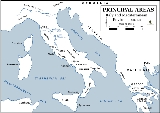
Third Servile War

Encyclopedia
The Third Servile War (73-71 BCE), also called the Gladiator War and the War of Spartacus by Plutarch
, was the last of a series of unrelated and unsuccessful slave rebellion
s against the Roman Republic
, known collectively as the Roman Servile Wars
. The Third Servile War was the only one to directly threaten the Roman heartland of Italy and was doubly alarming to the Roman people due to the repeated successes of the rapidly growing band of rebel slaves against the Roman army between 73 and 71 BCE. The rebellion was finally crushed through the concentrated military effort of a single commander, Marcus Licinius Crassus
, although the rebellion continued to have indirect effects on Roman politics for years to come.
Between 73 and 71 BCE, a band of escaped slaves—originally a small cadre
of about 78 escaped gladiator
s which grew into a band of over 120,000 men, women and children—wandered throughout and raided Italy with relative impunity under the guidance of several leaders, including the famous gladiator-general Spartacus
. The able-bodied adults of this band were a surprisingly effective armed force that repeatedly showed they could withstand the Roman military, from the local Campania
n patrols, to the Roman militia
, and to trained Roman legion
s under consul
ar command. Plutarch described the actions of the slaves as an attempt by Roman slaves to escape their masters and flee through Cisalpine Gaul
, while Appian
and Florus
depicted the revolt as a civil war in which the slaves waged a campaign to capture the city of Rome itself.
The Roman Senate
's growing alarm about the continued military successes of this band, and about their depredations against Roman towns and the countryside, eventually led to Rome's fielding of an army of eight legions under the harsh but effective leadership of Marcus Licinius Crassus
. The war ended in 71 BCE when the armies of Spartacus, after long and bitter fighting, retreating before the legions of Crassus, and realizing that the legions of Gnaeus Pompeius Magnus and Marcus Terentius Varro Lucullus
were moving in to entrap them, launched their full strength against Crassus' legions and were utterly destroyed.
The Third Servile War was significant to the broader history of ancient Rome mostly in its effect on the careers of Pompey and Crassus. The two generals used their success in putting down the rebellion to further their political careers, using their public acclaim and the implied threat of their legions to sway the consular elections of 70 BCE in their favor. Their actions as Consuls greatly furthered the subversion of Roman political institutions and contributed to the eventual transition of the Roman Republic into the Roman Empire
.
, the existence of a pool of inexpensive labor in the form of slaves was an important factor in the economy
. Slaves were acquired for the Roman workforce through a variety of means, including purchase from foreign merchants and the enslavement of foreign populations through military conquest. With Rome's heavy involvement in wars of conquest in the second and first centuries BCE, tens if not hundreds of thousands of slaves at a time were imported into the Roman economy from various European and Mediterranean acquisitions. While there was limited use for slaves as servants, craftsmen, and personal attendants, vast numbers of slaves worked in mines and on the agricultural lands of Sicily
and southern Italy.
For the most part, slaves were treated harshly and oppressively during the Roman republic
an period. Under Republican law, a slave was not considered a person, but property. Owners could abuse, injure or even kill their own slaves without legal consequence. While there were many grades and types of slaves, the lowest—and most numerous—grades who worked in the fields and mines were subject to a life of hard physical labor.
This high concentration and oppressive treatment of the slave population led to rebellions. In 135 BCE and 104 BCE, the First
and Second
Servile Wars, respectively, erupted in Sicily, where small bands of rebels found tens of thousands of willing followers wishing to escape the oppressive life of a Roman slave. While these were considered serious civil disturbances
by the Roman Senate
, taking years and direct military intervention to quell, they were never considered a serious threat to the Republic. The Roman heartland of Italy had never seen a slave uprising, nor had slaves ever been seen as a potential threat to the city of Rome
. This would all change with the Third Servile War.
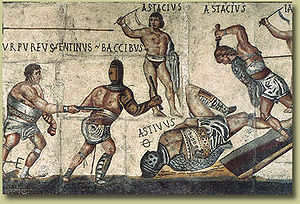 In the Roman Republic of the first century, gladiator
ial games were one of the more popular forms of entertainment. In order to supply gladiators for the contests, several training schools, or ludi, were established throughout Italy. In these schools, prisoners of war and condemned criminals—who were considered slaves
—were taught the skills required to fight to the death in gladiatorial games. In 73 BCE, a group of some 200 gladiator
s in the Capua
n school owned by Lentulus Batiatus
plotted an escape. When their plot was betrayed, a force of about 70 men seized kitchen implements, ("choppers and spits"), fought their way free from the school, and seized several wagons of gladiatorial weapons and armor.
Once free, the escaped gladiators chose leaders from their number, selecting two Gallic slaves—Crixus
and Oenomaus
—and Spartacus
, who was said either to be a Thracian
auxiliary
from the Roman legion
s later condemned to slavery, or a captive taken by the legions. There is some question as to Spartacus's nationality, however, as a Thraex
(plural Thraces or Threses) was a type of gladiator in Rome, so the title "Thracian" may simply refer to the style of gladiatorial combat in which he was trained.
These escaped slaves were able to defeat a small force of troops sent after them from Capua
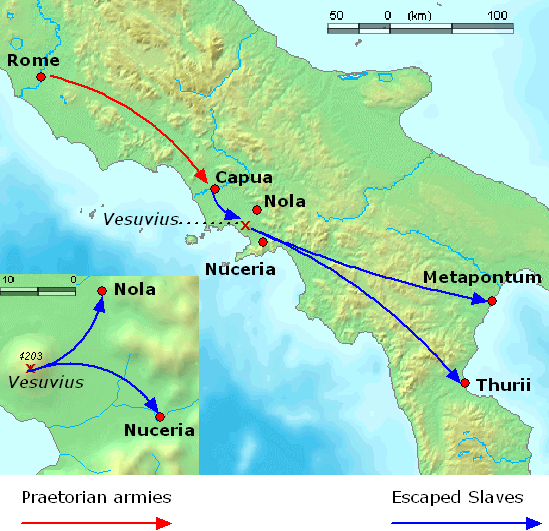
, and equip themselves with captured military equipment as well as their gladiatorial weapons. Sources are somewhat contradictory on the order of events immediately following the escape, but they generally agree that this band of escaped gladiators plundered the region surrounding Capua, recruited many other slaves into their ranks, and eventually retired to a more defensible position on Mount Vesuvius
.
 As the revolt and raids were occurring in Campania
—which was a vacation region of the rich and influential in Rome, and the location of many estates—the revolt quickly came to the attention of Roman authorities. They initially viewed the revolt as more a major crime wave
than an armed rebellion.
However, later that year, Rome dispatched military force under praetor
ian authority to put down the rebellion. A Roman praetor
, Gaius Claudius Glaber
, gathered a force of 3,000 men, not as legion
s, but as a militia
"picked up in haste and at random, for the Romans did not consider this a war yet, but a raid, something like an attack of robbery." Glaber's forces besieged the slaves on Mount Vesuvius
, blocking the only known way down the mountain. With the slaves thus contained, Glaber was content to wait until starvation forced the slaves to surrender.
While the slaves lacked military training, Spartacus' forces displayed ingenuity in their use of available local materials, and in their use of clever, unorthodox tactics when facing the disciplined Roman armies. In response to Glaber's siege, Spartacus' men made ropes and ladders from vines and trees growing on the slopes of Vesuvius and used them to rappel down the cliffs on the side of the mountain opposite Glaber's forces. They moved around the base of Vesuvius, outflanked the army, and annihilated Glaber's men.
A second expedition, under the praetor
Publius Varinius
, was then dispatched against Spartacus. For some reason, Varinius seems to have split his forces under the command of his subordinates Furius and Cossinius. Plutarch mentions that Furius commanded some 2,000 men, but neither the strength of the remaining forces, nor whether the expedition was composed of militia or legions, appears to be known. These forces were also defeated by the army of escaped slaves: Cossinius was killed, Varinius was nearly captured, and the equipment of the armies was seized by the slaves. With these successes, more and more slaves flocked to the Spartacan forces, as did "many of the herdsmen
and shepherd
s of the region", swelling their ranks to some 70,000. The rebel slaves spent the winter of 73–72 BCE training, arming and equipping their new recruits, and expanding their raiding territory to include the towns of Nola
, Nuceria
, Thurii
and Metapontum
.
The victories of the rebel slaves did not come without a cost. At some time during these events, one of their leaders, Oenomaus
, was lost—presumably in battle—and is not mentioned further in the histories.
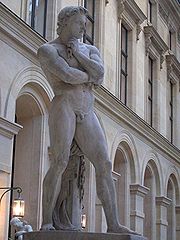 By the end of 73 BCE, Spartacus and Crixus were in command of a large group of armed men with a proven ability to withstand Roman armies. What they intended to do with this force is somewhat difficult for modern readers to determine. Since the Third Servile War was ultimately an unsuccessful rebellion, no firsthand account of the slaves' motives and goals exists, and historians writing about the war propose contradictory theories.
Many popular modern accounts of the war claim that there was a factional split in the escaped slaves between those under Spartacus, who wished to escape over the Alps to freedom, and those under Crixus, who wished to stay in southern Italy to continue raiding and plundering. This appears to be an interpretation of events based on the following: the regions that Florus
lists as being raided by the slaves include Thurii
and Metapontum
, which are geographically distant from Nola
and Nuceria
. This indicates the existence of two groups: Lucius Gellius Publicola
eventually attacked Crixus and a group of some 30,000 followers who are described as being separate from the main group under Spartacus; Plutarch
describes the desire of some of the escaped slaves to plunder Italy, rather than escape over the Alps. While this factional split is not contradicted by classical sources, there does not seem to be any direct evidence to support it.
Fictional accounts—such as Stanley Kubrick
's 1960 film Spartacus
—sometimes portray Spartacus as an ancient Roman freedom fighter, struggling to change a corrupt Roman society and to end the Roman institution of slavery. Although this is not contradicted by classical historians, no historical account mentions that the goal of the rebel slaves was to end slavery in the Republic, nor do any of Spartacus' actions seem specifically aimed at ending slavery.
Even classical historians, who were writing only years after the events themselves, seem to be divided as to what the motives of Spartacus were. Appian
and Florus
write that he intended to march on Rome itself—although this may have been no more than a reflection of Roman fears. If Spartacus did intend to march on Rome, it was a goal he must have later abandoned. Plutarch
writes that Spartacus merely wished to escape northwards into Cisalpine Gaul
and disperse his men back to their homes.
It is not certain that the slaves were a homogeneous group under the leadership of Spartacus. While this is the unspoken assumption of the Roman historians, this may be the Romans projecting their own hierarchical view of military power and responsibility on the ad hoc
organization of the slaves. Certainly other slave leaders are mentioned—Crixus, Oenomaus, Gannicus, and Castus—and we cannot tell from the historical evidence whether they were aides, subordinates, or even equals leading groups of their own and traveling in convoy with Spartacus' people.
.
The Senate, alarmed by the size of the revolt and the defeat of the praetor
ian armies of Glaber
and Varinius
, dispatched a pair of consul
ar legions
under the command of Lucius Gellius Publicola
and Gnaeus Cornelius Lentulus Clodianus
. Initially, the consular armies were successful. Gellius
engaged a group of about 30,000 slaves, under the command of Crixus
, near Mount Garganus and killed two-thirds of the rebels, including Crixus himself.
At this point in the history, there is a divergence in the classical sources as to the course of events which cannot be reconciled until the entry of Marcus Licinius Crassus
into the war. The two most comprehensive (extant) histories of the war by Appian
and Plutarch
detail very different events. However, neither account directly contradicts the other, but simply reports different events, ignoring some events in the other account, and reporting events that are unique to that account.
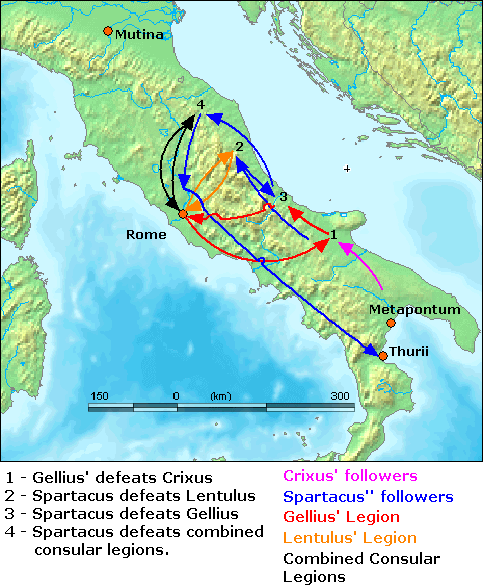 According to Appian, the battle between Gellius' legions and Crixus' men near Mount Garganus was the beginning of a long and complex series of military maneuvers that almost resulted in the Spartacan forces directly assaulting the city of Rome
itself.
After his victory over Crixus, Gellius moved northwards, following the main group of slaves under Spartacus
who were heading for Cisalpine Gaul
. The army of Lentulus
was deployed to bar Spartacus
' path, and the consuls hoped to trap the rebel slaves between them. Spartacus' army met Lentulus' legion, defeated it, turned, and destroyed Gellius' army, forcing the Roman legions to retreat in disarray. Appian claims that Spartacus executed some 300 captured Roman soldiers to avenge the death of Crixus
, forcing them to fight each other to the death as gladiators. Following this victory, Spartacus pushed northwards with his followers (some 120,000) as fast as he could travel, "having burned all his useless material, killed all his prisoners, and butchered his pack-animals in order to expedite his movement".
The defeated consular armies fell back to Rome to regroup while Spartacus' followers moved northward. The consuls again engaged Spartacus somewhere in the Picenum
region, and once again were defeated.
Appian claims that at this point Spartacus changed his intention of marching on Rome—implying this was Spartacus' goal following the confrontation in Picenum—as "he did not consider himself ready as yet for that kind of a fight, as his whole force was not suitably armed, for no city had joined him, but only slaves, deserters, and riff-raff", and decided to withdraw into southern Italy once again. They seized the town of Thurii
and the surrounding countryside, arming themselves, raiding the surrounding territories, trading plunder with merchants for bronze and iron (with which to manufacture more arms), and clashing occasionally with Roman forces which were invariably defeated.
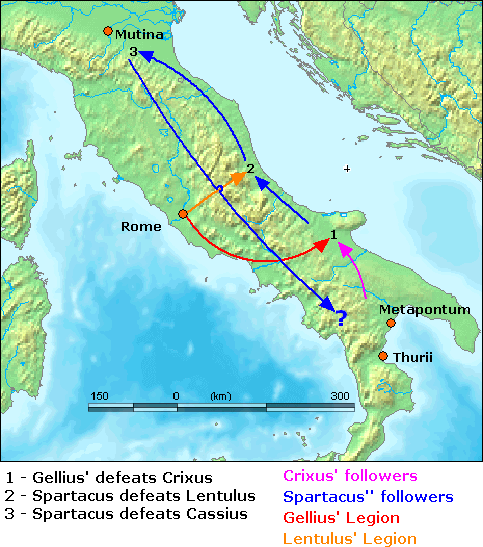 Plutarch's description of events differs significantly from that of Appian's.
According to Plutarch, after the battle between Gellius' legion and Crixus's men (whom Plutarch describes as "Germans") near Mount Garganus, Spartacus' men engaged the legion commanded by Lentulus, defeated them, seized their supplies and equipment, and pushed directly into northern Italy. After this defeat, both consuls were relieved of command of their armies by the Roman Senate
and recalled to Rome. Plutarch does not mention Spartacus engaging Gellius' legion at all, nor of Spartacus facing the combined consular legions in Picenum.
Plutarch then goes on to detail a conflict not mentioned in Appian's history. According to Plutarch, Spartacus' army continued northwards to the region around Mutina (modern Modena
). There, a Roman army of some 10,000 soldiers, led by the governor of Cisalpine Gaul
, Gaius Cassius Longinus attempted to bar Spartacus' progress and were also defeated.
Plutarch makes no further mention of events until the initial confrontation between Marcus Licinius Crassus
and Spartacus in the spring of 71 BCE, omitting the march on Rome and the retreat to Thurii described by Appian. However, as Plutarch describes Crassus forcing Spartacus' followers to retreat southwards from Picenum, one might infer that the rebel slaves approached Picenum from the south in early 71 BCE, implying that they withdrew from Mutina into southern or central Italy for the winter of 72–71 BCE.
Why they might do so, when there was apparently no reason for them not to escape over the Alps—Spartacus' goal according to Plutarch—is not explained.
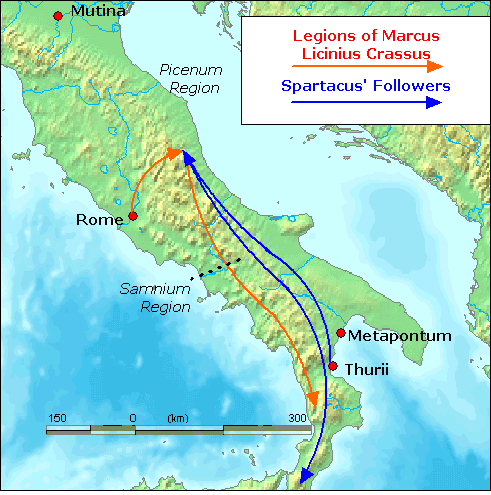 Despite the contradictions in the classical sources regarding the events of 72 BCE, there seems to be general agreement that Spartacus and his followers were in the south of Italy in early 71 BCE.
. Crassus was no stranger to Roman politics, or to military command as he had been a field commander under Lucius Cornelius Sulla
during the second civil war
between Sulla and the Marian faction
in 82 BCE, and had served under Sulla during the following dictatorship.
Crassus was given a praetor
ship, and assigned six new legions in addition to the two formerly consular legions of Gellius
and Lentulus
, giving him an army of some 40,000–50,000 trained Roman soldiers. Crassus treated his legions with harsh, even brutal, discipline, reviving the punishment of unit decimation
within his army. Appian is uncertain whether he decimated the two consular legions for cowardice when he was appointed their commander
, or whether he had his entire army decimated for a later defeat (an event in which up to 4,000 legionaries would have been executed). Plutarch only mentions the decimation of 50 legionaries of one cohort as punishment after Mummius' defeat in the first confrontation between Crassus and Spartacus. Regardless of what actually occurred, Crassus' treatment of his legions proved that "he was more dangerous to them than the enemy", and spurred them on to victory rather than running the risk of displeasing their commander.
region, Appian claims it occurred near the Samnium
region), and detached two legions under his legate
, Mummius, to maneuver behind Spartacus, but gave them orders not to engage the rebels. When an opportunity presented itself, Mummius disobeyed, attacked the Spartacan forces, and was subsequently routed. Despite this initial loss, Crassus engaged Spartacus and defeated him, killing some 6,000 of the rebels.
The tide seemed to have turned in the war. Crassus' legions were victorious in several engagements, killing thousands of the rebel slaves, and forcing Spartacus to retreat south through Lucania
to the straits near Messina. According to Plutarch
, Spartacus made a bargain with Cilicia
n pirates to transport him and some 2,000 of his men to Sicily
, where he intended to incite a slave revolt and gather reinforcements. However, he was betrayed by the pirates, who took payment and then abandoned the rebel slaves. Minor sources mention that there were some attempts at raft and shipbuilding by the rebels as a means to escape, but that Crassus took unspecified measures to ensure the rebels could not cross to Sicily, and their efforts were abandoned.
Spartacus' forces then retreated towards Rhegium. Crassus' legions followed and upon arrival built fortifications across the isthmus at Rhegium, despite harassing raids from the rebel slaves. The rebels were under siege and cut off from their supplies.
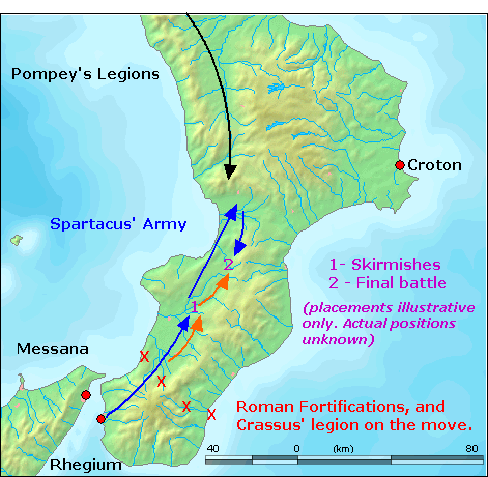 At this time, the legions of Pompey
were returning to Italy, having put down the rebellion of Quintus Sertorius
in Hispania
.
Sources disagree on whether Crassus had requested reinforcements, or whether the Senate simply took advantage of Pompey's return to Italy, but Pompey was ordered to bypass Rome and head south to aid Crassus. The Senate also sent reinforcements under the command of "Lucullus", mistakenly thought by Appian
to be Lucius Licinius Lucullus
, commander of the forces engaged in the Third Mithridatic War
at the time, but who appears to have been the proconsul
of Macedonia
, Marcus Terentius Varro Lucullus
, the former's younger brother. With Pompey's legions marching out of the north, and Lucullus' troops landing in Brundisium, Crassus realized that if he did not put down the slave revolt quickly, credit for the war would go to the general who arrived with reinforcements, and thus he spurred his legions on to end the conflict quickly.
Hearing of the approach of Pompey, Spartacus attempted to negotiate with Crassus to bring the conflict to a close before Roman reinforcements arrived. When Crassus refused, a portion of Spartacus' forces broke out of confinement and fled toward the mountains west of Petelia (modern Strongoli
) in Bruttium, with Crassus' legions in pursuit. The legions managed to catch a portion of the rebels – under the command of Gannicus and Castus – separated from the main army, killing 12,300. However, Crassus' legions also suffered losses, as some of the army of escaping slaves turned to meet the Roman forces under the command of a cavalry officer named Lucius Quinctius and the quaestor
Gnaeus Tremellius Scrofa, routing them. The rebel slaves were not, however, a professional army, and had reached their limit. They were unwilling to flee any farther, and groups of men were breaking away from the main force to independently attack the oncoming legions of Crassus. With discipline breaking down, Spartacus turned his forces around and brought his entire strength to bear on the oncoming legions. In this last stand, Spartacus' forces were finally routed completely, with the vast majority of them being killed on the battlefield. The eventual fate of Spartacus himself is unknown, as his body was never found, but he is accounted by historians to have perished in battle along with his men.
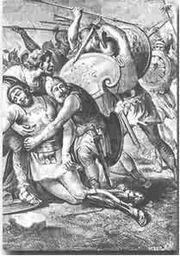 The rebellion of the Third Servile War had been annihilated by Crassus. Although Pompey's forces did not directly engage Spartacus' forces at any time, his legions moving in from the north were able to capture some 5,000 rebels fleeing the battle, "all of whom he slew". After this action, Pompey sent a dispatch to the Senate, saying that while Crassus certainly had conquered the slaves in open battle, he himself had ended the war, thus claiming a large portion of the credit and earning the enmity of Crassus.
While most of the rebel slaves were killed on the battlefield, some 6,000 survivors were captured by the legions of Crassus. All 6,000 were crucified
along the Appian Way
from Rome
to Capua
.
Pompey and Crassus reaped political benefit for having put down the rebellion. Both Crassus and Pompey returned to Rome with their legions and refused to disband them, instead encamping outside Rome. Both men stood for the consul
ship of 70 BCE, even though Pompey was ineligible because of his youth and lack of service as praetor
or quaestor
. Nonetheless, both men were elected consul
for 70 BCE, partly due to the implied threat of their armed legions encamped outside the city.
The effects of the Third Servile War on Roman attitudes towards slavery, and on the institution of slavery in Rome, are harder to determine. Certainly the revolt had shaken the Roman people, who "out of sheer fear seem to have begun to treat their slaves less harshly than before." The wealthy owners of the latifundia
began to reduce the number of agricultural slaves, opting to employ the large pool of formerly dispossessed freemen in sharecropping
arrangements. With the end of Julius Caesar
's Gallic Wars
in 52 BCE, the major Roman wars of conquest ceased until the reign of Emperor Trajan
(reigned 98–117 AD), and with them ended the supply of plentiful and inexpensive slaves through military conquest. This era of peace further promoted the use of freedmen as laborers in agricultural estates.
The legal status and rights of Roman slaves also began to change. During the time of Emperor Claudius
(reigned 41–54 AD), a constitution was enacted that made the killing of an old or infirm slave an act of murder, and decreed that if such slaves were abandoned by their owners, they became freedmen. Under Antoninus Pius
(reigned 138–161 AD), laws further extended the rights of slaves, holding owners responsible for the killing of slaves, forcing the sale of slaves when it could be shown that they were being mistreated, and providing a (theoretically) neutral third party to which a slave could appeal. While these legal changes occurred much too late to be direct results of the Third Servile War, they represent the legal codification of changes in the Roman attitude toward slaves that would have been evolving for decades.
It is difficult to determine the extent to which the events of this war contributed to changes in the use and legal rights of Roman slaves. The end of the Servile Wars seems to have coincided with the end of the period of the most prominent use of slaves in Rome and the beginning of a new perception of slaves within Roman society and law. The Third Servile War was the last of the Servile Wars, and Rome did not see another slave uprising of this magnitude again.
Works at LacusCurtius.
Works at Livius.org.
Works at The Internet Classics Archive.
Modern works
Plutarch
Plutarch then named, on his becoming a Roman citizen, Lucius Mestrius Plutarchus , c. 46 – 120 AD, was a Greek historian, biographer, essayist, and Middle Platonist known primarily for his Parallel Lives and Moralia...
, was the last of a series of unrelated and unsuccessful slave rebellion
Slave rebellion
A slave rebellion is an armed uprising by slaves. Slave rebellions have occurred in nearly all societies that practice slavery, and are amongst the most feared events for slaveholders...
s against the Roman Republic
Roman Republic
The Roman Republic was the period of the ancient Roman civilization where the government operated as a republic. It began with the overthrow of the Roman monarchy, traditionally dated around 508 BC, and its replacement by a government headed by two consuls, elected annually by the citizens and...
, known collectively as the Roman Servile Wars
Roman Servile Wars
The Servile Wars were a series of three slave revolts in the late Roman Republic. See:...
. The Third Servile War was the only one to directly threaten the Roman heartland of Italy and was doubly alarming to the Roman people due to the repeated successes of the rapidly growing band of rebel slaves against the Roman army between 73 and 71 BCE. The rebellion was finally crushed through the concentrated military effort of a single commander, Marcus Licinius Crassus
Marcus Licinius Crassus
Marcus Licinius Crassus was a Roman general and politician who commanded the right wing of Sulla's army at the Battle of the Colline Gate, suppressed the slave revolt led by Spartacus, provided political and financial support to Julius Caesar and entered into the political alliance known as the...
, although the rebellion continued to have indirect effects on Roman politics for years to come.
Between 73 and 71 BCE, a band of escaped slaves—originally a small cadre
En cadre
En cadre or cadre is a French expression originally denoting either the complement of commissioned officers of a regiment or the permanent skeleton establishment of a unit, around which the unit could be built if needed...
of about 78 escaped gladiator
Gladiator
A gladiator was an armed combatant who entertained audiences in the Roman Republic and Roman Empire in violent confrontations with other gladiators, wild animals, and condemned criminals. Some gladiators were volunteers who risked their legal and social standing and their lives by appearing in the...
s which grew into a band of over 120,000 men, women and children—wandered throughout and raided Italy with relative impunity under the guidance of several leaders, including the famous gladiator-general Spartacus
Spartacus
Spartacus was a famous leader of the slaves in the Third Servile War, a major slave uprising against the Roman Republic. Little is known about Spartacus beyond the events of the war, and surviving historical accounts are sometimes contradictory and may not always be reliable...
. The able-bodied adults of this band were a surprisingly effective armed force that repeatedly showed they could withstand the Roman military, from the local Campania
Campania
Campania is a region in southern Italy. The region has a population of around 5.8 million people, making it the second-most-populous region of Italy; its total area of 13,590 km² makes it the most densely populated region in the country...
n patrols, to the Roman militia
Militia
The term militia is commonly used today to refer to a military force composed of ordinary citizens to provide defense, emergency law enforcement, or paramilitary service, in times of emergency without being paid a regular salary or committed to a fixed term of service. It is a polyseme with...
, and to trained Roman legion
Roman legion
A Roman legion normally indicates the basic ancient Roman army unit recruited specifically from Roman citizens. The organization of legions varied greatly over time but they were typically composed of perhaps 5,000 soldiers, divided into maniples and later into "cohorts"...
s under consul
Consul
Consul was the highest elected office of the Roman Republic and an appointive office under the Empire. The title was also used in other city states and also revived in modern states, notably in the First French Republic...
ar command. Plutarch described the actions of the slaves as an attempt by Roman slaves to escape their masters and flee through Cisalpine Gaul
Cisalpine Gaul
Cisalpine Gaul, in Latin: Gallia Cisalpina or Citerior, also called Gallia Togata, was a Roman province until 41 BC when it was merged into Roman Italy.It bore the name Gallia, because the great body of its inhabitants, after the expulsion of the Etruscans, consisted of Gauls or Celts...
, while Appian
Appian
Appian of Alexandria was a Roman historian of Greek ethnicity who flourished during the reigns of Trajan, Hadrian, and Antoninus Pius.He was born ca. 95 in Alexandria. He tells us that, after having filled the chief offices in the province of Egypt, he went to Rome ca. 120, where he practised as...
and Florus
Florus
Florus, Roman historian, lived in the time of Trajan and Hadrian.He compiled, chiefly from Livy, a brief sketch of the history of Rome from the foundation of the city to the closing of the temple of Janus by Augustus . The work, which is called Epitome de T...
depicted the revolt as a civil war in which the slaves waged a campaign to capture the city of Rome itself.
The Roman Senate
Roman Senate
The Senate of the Roman Republic was a political institution in the ancient Roman Republic, however, it was not an elected body, but one whose members were appointed by the consuls, and later by the censors. After a magistrate served his term in office, it usually was followed with automatic...
's growing alarm about the continued military successes of this band, and about their depredations against Roman towns and the countryside, eventually led to Rome's fielding of an army of eight legions under the harsh but effective leadership of Marcus Licinius Crassus
Marcus Licinius Crassus
Marcus Licinius Crassus was a Roman general and politician who commanded the right wing of Sulla's army at the Battle of the Colline Gate, suppressed the slave revolt led by Spartacus, provided political and financial support to Julius Caesar and entered into the political alliance known as the...
. The war ended in 71 BCE when the armies of Spartacus, after long and bitter fighting, retreating before the legions of Crassus, and realizing that the legions of Gnaeus Pompeius Magnus and Marcus Terentius Varro Lucullus
Marcus Terentius Varro Lucullus
Marcus Terentius Varro Lucullus , younger brother of the more famous Lucius Licinius Lucullus, was a supporter of Lucius Cornelius Sulla and consul of ancient Rome in 73 BC. As proconsul of Macedonia in 72 BC, he defeated the Bessi in Thrace and advanced to the Danube and the west coast of the...
were moving in to entrap them, launched their full strength against Crassus' legions and were utterly destroyed.
The Third Servile War was significant to the broader history of ancient Rome mostly in its effect on the careers of Pompey and Crassus. The two generals used their success in putting down the rebellion to further their political careers, using their public acclaim and the implied threat of their legions to sway the consular elections of 70 BCE in their favor. Their actions as Consuls greatly furthered the subversion of Roman political institutions and contributed to the eventual transition of the Roman Republic into the Roman Empire
Roman Empire
The Roman Empire was the post-Republican period of the ancient Roman civilization, characterised by an autocratic form of government and large territorial holdings in Europe and around the Mediterranean....
.
Slavery in the Roman republic
Through varying degrees throughout Roman historyAncient Rome
Ancient Rome was a thriving civilization that grew on the Italian Peninsula as early as the 8th century BC. Located along the Mediterranean Sea and centered on the city of Rome, it expanded to one of the largest empires in the ancient world....
, the existence of a pool of inexpensive labor in the form of slaves was an important factor in the economy
Economy
An economy consists of the economic system of a country or other area; the labor, capital and land resources; and the manufacturing, trade, distribution, and consumption of goods and services of that area...
. Slaves were acquired for the Roman workforce through a variety of means, including purchase from foreign merchants and the enslavement of foreign populations through military conquest. With Rome's heavy involvement in wars of conquest in the second and first centuries BCE, tens if not hundreds of thousands of slaves at a time were imported into the Roman economy from various European and Mediterranean acquisitions. While there was limited use for slaves as servants, craftsmen, and personal attendants, vast numbers of slaves worked in mines and on the agricultural lands of Sicily
Sicily
Sicily is a region of Italy, and is the largest island in the Mediterranean Sea. Along with the surrounding minor islands, it constitutes an autonomous region of Italy, the Regione Autonoma Siciliana Sicily has a rich and unique culture, especially with regard to the arts, music, literature,...
and southern Italy.
For the most part, slaves were treated harshly and oppressively during the Roman republic
Roman Republic
The Roman Republic was the period of the ancient Roman civilization where the government operated as a republic. It began with the overthrow of the Roman monarchy, traditionally dated around 508 BC, and its replacement by a government headed by two consuls, elected annually by the citizens and...
an period. Under Republican law, a slave was not considered a person, but property. Owners could abuse, injure or even kill their own slaves without legal consequence. While there were many grades and types of slaves, the lowest—and most numerous—grades who worked in the fields and mines were subject to a life of hard physical labor.
This high concentration and oppressive treatment of the slave population led to rebellions. In 135 BCE and 104 BCE, the First
First Servile War
The First Servile War of 135–132 BC was an unsuccessful rebellion of slaves against the Roman Republic. The war was prompted by slave revolts in Enna on the island of Sicily. It was led by Eunus, a former slave claiming to be a prophet, and Cleon, a Cilician who became Eunus's military commander...
and Second
Second Servile War
The Second Servile War was an unsuccessful slave uprising against the Roman Republic on the island of Sicily. The war lasted from 104 BC until 100 BC....
Servile Wars, respectively, erupted in Sicily, where small bands of rebels found tens of thousands of willing followers wishing to escape the oppressive life of a Roman slave. While these were considered serious civil disturbances
Civil disorder
Civil disorder, also known as civil unrest or civil strife, is a broad term that is typically used by law enforcement to describe one or more forms of disturbance caused by a group of people. Civil disturbance is typically a symptom of, and a form of protest against, major socio-political problems;...
by the Roman Senate
Roman Senate
The Senate of the Roman Republic was a political institution in the ancient Roman Republic, however, it was not an elected body, but one whose members were appointed by the consuls, and later by the censors. After a magistrate served his term in office, it usually was followed with automatic...
, taking years and direct military intervention to quell, they were never considered a serious threat to the Republic. The Roman heartland of Italy had never seen a slave uprising, nor had slaves ever been seen as a potential threat to the city of Rome
Rome
Rome is the capital of Italy and the country's largest and most populated city and comune, with over 2.7 million residents in . The city is located in the central-western portion of the Italian Peninsula, on the Tiber River within the Lazio region of Italy.Rome's history spans two and a half...
. This would all change with the Third Servile War.
Capuan revolt
Gladiator
A gladiator was an armed combatant who entertained audiences in the Roman Republic and Roman Empire in violent confrontations with other gladiators, wild animals, and condemned criminals. Some gladiators were volunteers who risked their legal and social standing and their lives by appearing in the...
ial games were one of the more popular forms of entertainment. In order to supply gladiators for the contests, several training schools, or ludi, were established throughout Italy. In these schools, prisoners of war and condemned criminals—who were considered slaves
Slavery in antiquity
Slavery in the ancient world, specifically, in Mediterranean cultures, comprised a mixture of debt-slavery, slavery as a punishment for crime, and the enslavement of prisoners of war....
—were taught the skills required to fight to the death in gladiatorial games. In 73 BCE, a group of some 200 gladiator
Gladiator
A gladiator was an armed combatant who entertained audiences in the Roman Republic and Roman Empire in violent confrontations with other gladiators, wild animals, and condemned criminals. Some gladiators were volunteers who risked their legal and social standing and their lives by appearing in the...
s in the Capua
Capua
Capua is a city and comune in the province of Caserta, Campania, southern Italy, situated 25 km north of Naples, on the northeastern edge of the Campanian plain. Ancient Capua was situated where Santa Maria Capua Vetere is now...
n school owned by Lentulus Batiatus
Lentulus Batiatus
Gnaeus Cornelius Lentulus Batiatus was the Roman owner of a gladiatorial school in Capua , in southern Italy. It was from this school that in 73 BC, the Thracian slave, Spartacus, and about 70 to 78 followers, escaped...
plotted an escape. When their plot was betrayed, a force of about 70 men seized kitchen implements, ("choppers and spits"), fought their way free from the school, and seized several wagons of gladiatorial weapons and armor.
Once free, the escaped gladiators chose leaders from their number, selecting two Gallic slaves—Crixus
Crixus
Crixus was a leader of the slave rebellion in the Third Servile War, along with Spartacus and Oenomaus.He was a Gaul , and had been a slave for several years before the revolt. Crixus had fought for the Allobroges against the Romans and had been captured. Like his companions, Crixus had trained as...
and Oenomaus
Oenomaus (rebel slave)
Oenomaus was a gladiator from Gaul, who escaped from the gladiatorial school of Lentulus Batiatus in Capua. Together with the Thracian Spartacus and a fellow Gaul, Crixus, he became one of the leaders of rebellious slaves during the Third Servile War , but died early in the war.Oenomaus was...
—and Spartacus
Spartacus
Spartacus was a famous leader of the slaves in the Third Servile War, a major slave uprising against the Roman Republic. Little is known about Spartacus beyond the events of the war, and surviving historical accounts are sometimes contradictory and may not always be reliable...
, who was said either to be a Thracian
Thracians
The ancient Thracians were a group of Indo-European tribes inhabiting areas including Thrace in Southeastern Europe. They spoke the Thracian language – a scarcely attested branch of the Indo-European language family...
auxiliary
Auxiliaries (Roman military)
Auxiliaries formed the standing non-citizen corps of the Roman army of the Principate , alongside the citizen legions...
from the Roman legion
Roman legion
A Roman legion normally indicates the basic ancient Roman army unit recruited specifically from Roman citizens. The organization of legions varied greatly over time but they were typically composed of perhaps 5,000 soldiers, divided into maniples and later into "cohorts"...
s later condemned to slavery, or a captive taken by the legions. There is some question as to Spartacus's nationality, however, as a Thraex
Thraex
The Thraex , or Thracian, was a type of Roman gladiator, armed in the Thracian style with small rectangular shield called a parmula and a very short sword with a slightly curved blade called a sica , intended to maim an opponent's unarmoured back...
(plural Thraces or Threses) was a type of gladiator in Rome, so the title "Thracian" may simply refer to the style of gladiatorial combat in which he was trained.
These escaped slaves were able to defeat a small force of troops sent after them from Capua
Capua
Capua is a city and comune in the province of Caserta, Campania, southern Italy, situated 25 km north of Naples, on the northeastern edge of the Campanian plain. Ancient Capua was situated where Santa Maria Capua Vetere is now...
, and equip themselves with captured military equipment as well as their gladiatorial weapons. Sources are somewhat contradictory on the order of events immediately following the escape, but they generally agree that this band of escaped gladiators plundered the region surrounding Capua, recruited many other slaves into their ranks, and eventually retired to a more defensible position on Mount Vesuvius
Mount Vesuvius
Mount Vesuvius is a stratovolcano in the Gulf of Naples, Italy, about east of Naples and a short distance from the shore. It is the only volcano on the European mainland to have erupted within the last hundred years, although it is not currently erupting...
.
Defeat of the praetorian armies
Campania
Campania is a region in southern Italy. The region has a population of around 5.8 million people, making it the second-most-populous region of Italy; its total area of 13,590 km² makes it the most densely populated region in the country...
—which was a vacation region of the rich and influential in Rome, and the location of many estates—the revolt quickly came to the attention of Roman authorities. They initially viewed the revolt as more a major crime wave
Crime Wave
Crime Wave can refer to:* An increase in crime - or perception of an increase in crime - in a particular period and place* Crime Wave , film starring Sterling Hayden* "Crime Wave" , season 3 episode 8 of CSI Miami...
than an armed rebellion.
However, later that year, Rome dispatched military force under praetor
Praetor
Praetor was a title granted by the government of Ancient Rome to men acting in one of two official capacities: the commander of an army, usually in the field, or the named commander before mustering the army; and an elected magistratus assigned varied duties...
ian authority to put down the rebellion. A Roman praetor
Praetor
Praetor was a title granted by the government of Ancient Rome to men acting in one of two official capacities: the commander of an army, usually in the field, or the named commander before mustering the army; and an elected magistratus assigned varied duties...
, Gaius Claudius Glaber
Gaius Claudius Glaber
Gaius Claudius Glaber was a Roman praetor and legatus in 73 BC. He tried but failed to hem in Spartacus and his fellow slaves on Mt. Vesuvius during the Third Servile War. The rebels were trapped by a narrow passage, the only way leading up. Without the Roman cohorts knowing, Spartacus and his men...
, gathered a force of 3,000 men, not as legion
Roman legion
A Roman legion normally indicates the basic ancient Roman army unit recruited specifically from Roman citizens. The organization of legions varied greatly over time but they were typically composed of perhaps 5,000 soldiers, divided into maniples and later into "cohorts"...
s, but as a militia
Militia
The term militia is commonly used today to refer to a military force composed of ordinary citizens to provide defense, emergency law enforcement, or paramilitary service, in times of emergency without being paid a regular salary or committed to a fixed term of service. It is a polyseme with...
"picked up in haste and at random, for the Romans did not consider this a war yet, but a raid, something like an attack of robbery." Glaber's forces besieged the slaves on Mount Vesuvius
Mount Vesuvius
Mount Vesuvius is a stratovolcano in the Gulf of Naples, Italy, about east of Naples and a short distance from the shore. It is the only volcano on the European mainland to have erupted within the last hundred years, although it is not currently erupting...
, blocking the only known way down the mountain. With the slaves thus contained, Glaber was content to wait until starvation forced the slaves to surrender.
While the slaves lacked military training, Spartacus' forces displayed ingenuity in their use of available local materials, and in their use of clever, unorthodox tactics when facing the disciplined Roman armies. In response to Glaber's siege, Spartacus' men made ropes and ladders from vines and trees growing on the slopes of Vesuvius and used them to rappel down the cliffs on the side of the mountain opposite Glaber's forces. They moved around the base of Vesuvius, outflanked the army, and annihilated Glaber's men.
A second expedition, under the praetor
Praetor
Praetor was a title granted by the government of Ancient Rome to men acting in one of two official capacities: the commander of an army, usually in the field, or the named commander before mustering the army; and an elected magistratus assigned varied duties...
Publius Varinius
Publius Varinius
Publius Varinius was a Roman praetor in 73 BC and proconsul in 72 BC and suffered several defeats against Spartacus' rebellious slaves during the Third Servile War. The history has gaps in it and all we know is that an advance force of 2,000 led by Varinius legate Lucius Furius was defeated and...
, was then dispatched against Spartacus. For some reason, Varinius seems to have split his forces under the command of his subordinates Furius and Cossinius. Plutarch mentions that Furius commanded some 2,000 men, but neither the strength of the remaining forces, nor whether the expedition was composed of militia or legions, appears to be known. These forces were also defeated by the army of escaped slaves: Cossinius was killed, Varinius was nearly captured, and the equipment of the armies was seized by the slaves. With these successes, more and more slaves flocked to the Spartacan forces, as did "many of the herdsmen
Herder
A herder is a worker who lives a possibly semi-nomadic life, caring for various domestic animals, in places where these animals wander pasture lands....
and shepherd
Shepherd
A shepherd is a person who tends, feeds or guards flocks of sheep.- Origins :Shepherding is one of the oldest occupations, beginning some 6,000 years ago in Asia Minor. Sheep were kept for their milk, meat and especially their wool...
s of the region", swelling their ranks to some 70,000. The rebel slaves spent the winter of 73–72 BCE training, arming and equipping their new recruits, and expanding their raiding territory to include the towns of Nola
Nola
Nola is a city and comune of Campania, southern Italy, in the province of Naples, situated in the plain between Mount Vesuvius and the Apennines...
, Nuceria
Nocera Inferiore
Nocera Inferiore, formerly Nocera dei Pagani, is a town and comune in Campania, Italy, in the province of Salerno, at the foot of Monte Albino, 20 km east-south-east of Naples by rail.-History:...
, Thurii
Thurii
Thurii , called also by some Latin writers Thurium , for a time also Copia and Copiae, was a city of Magna Graecia, situated on the Tarentine gulf, within a short distance of the site of Sybaris, whose place it may be considered as having taken...
and Metapontum
Metapontum
Metapontum, Metapontium or Metapontion , was an important city of Magna Graecia, situated on the gulf of Tarentum, between the river Bradanus and the Casuentus . It was distant about 20 km from Heraclea and 40 from Tarentum...
.
The victories of the rebel slaves did not come without a cost. At some time during these events, one of their leaders, Oenomaus
Oenomaus (rebel slave)
Oenomaus was a gladiator from Gaul, who escaped from the gladiatorial school of Lentulus Batiatus in Capua. Together with the Thracian Spartacus and a fellow Gaul, Crixus, he became one of the leaders of rebellious slaves during the Third Servile War , but died early in the war.Oenomaus was...
, was lost—presumably in battle—and is not mentioned further in the histories.
Motivation and leadership of the escaped slaves
Many popular modern accounts of the war claim that there was a factional split in the escaped slaves between those under Spartacus, who wished to escape over the Alps to freedom, and those under Crixus, who wished to stay in southern Italy to continue raiding and plundering. This appears to be an interpretation of events based on the following: the regions that Florus
Florus
Florus, Roman historian, lived in the time of Trajan and Hadrian.He compiled, chiefly from Livy, a brief sketch of the history of Rome from the foundation of the city to the closing of the temple of Janus by Augustus . The work, which is called Epitome de T...
lists as being raided by the slaves include Thurii
Thurii
Thurii , called also by some Latin writers Thurium , for a time also Copia and Copiae, was a city of Magna Graecia, situated on the Tarentine gulf, within a short distance of the site of Sybaris, whose place it may be considered as having taken...
and Metapontum
Metapontum
Metapontum, Metapontium or Metapontion , was an important city of Magna Graecia, situated on the gulf of Tarentum, between the river Bradanus and the Casuentus . It was distant about 20 km from Heraclea and 40 from Tarentum...
, which are geographically distant from Nola
Nola
Nola is a city and comune of Campania, southern Italy, in the province of Naples, situated in the plain between Mount Vesuvius and the Apennines...
and Nuceria
Nocera Inferiore
Nocera Inferiore, formerly Nocera dei Pagani, is a town and comune in Campania, Italy, in the province of Salerno, at the foot of Monte Albino, 20 km east-south-east of Naples by rail.-History:...
. This indicates the existence of two groups: Lucius Gellius Publicola
Lucius Gellius Publicola
Lucius Gellius Publicola was a Roman politician and general who was one of two Consuls of the Republic in 72 BC along with Gnaeus Cornelius Lentulus Clodianus...
eventually attacked Crixus and a group of some 30,000 followers who are described as being separate from the main group under Spartacus; Plutarch
Plutarch
Plutarch then named, on his becoming a Roman citizen, Lucius Mestrius Plutarchus , c. 46 – 120 AD, was a Greek historian, biographer, essayist, and Middle Platonist known primarily for his Parallel Lives and Moralia...
describes the desire of some of the escaped slaves to plunder Italy, rather than escape over the Alps. While this factional split is not contradicted by classical sources, there does not seem to be any direct evidence to support it.
Fictional accounts—such as Stanley Kubrick
Stanley Kubrick
Stanley Kubrick was an American film director, writer, producer, and photographer who lived in England during most of the last four decades of his career...
's 1960 film Spartacus
Spartacus (film)
Spartacus is a 1960 American epic historical drama film directed by Stanley Kubrick and based on the novel of the same name by Howard Fast...
—sometimes portray Spartacus as an ancient Roman freedom fighter, struggling to change a corrupt Roman society and to end the Roman institution of slavery. Although this is not contradicted by classical historians, no historical account mentions that the goal of the rebel slaves was to end slavery in the Republic, nor do any of Spartacus' actions seem specifically aimed at ending slavery.
Even classical historians, who were writing only years after the events themselves, seem to be divided as to what the motives of Spartacus were. Appian
Appian
Appian of Alexandria was a Roman historian of Greek ethnicity who flourished during the reigns of Trajan, Hadrian, and Antoninus Pius.He was born ca. 95 in Alexandria. He tells us that, after having filled the chief offices in the province of Egypt, he went to Rome ca. 120, where he practised as...
and Florus
Florus
Florus, Roman historian, lived in the time of Trajan and Hadrian.He compiled, chiefly from Livy, a brief sketch of the history of Rome from the foundation of the city to the closing of the temple of Janus by Augustus . The work, which is called Epitome de T...
write that he intended to march on Rome itself—although this may have been no more than a reflection of Roman fears. If Spartacus did intend to march on Rome, it was a goal he must have later abandoned. Plutarch
Plutarch
Plutarch then named, on his becoming a Roman citizen, Lucius Mestrius Plutarchus , c. 46 – 120 AD, was a Greek historian, biographer, essayist, and Middle Platonist known primarily for his Parallel Lives and Moralia...
writes that Spartacus merely wished to escape northwards into Cisalpine Gaul
Cisalpine Gaul
Cisalpine Gaul, in Latin: Gallia Cisalpina or Citerior, also called Gallia Togata, was a Roman province until 41 BC when it was merged into Roman Italy.It bore the name Gallia, because the great body of its inhabitants, after the expulsion of the Etruscans, consisted of Gauls or Celts...
and disperse his men back to their homes.
It is not certain that the slaves were a homogeneous group under the leadership of Spartacus. While this is the unspoken assumption of the Roman historians, this may be the Romans projecting their own hierarchical view of military power and responsibility on the ad hoc
Ad hoc
Ad hoc is a Latin phrase meaning "for this". It generally signifies a solution designed for a specific problem or task, non-generalizable, and not intended to be able to be adapted to other purposes. Compare A priori....
organization of the slaves. Certainly other slave leaders are mentioned—Crixus, Oenomaus, Gannicus, and Castus—and we cannot tell from the historical evidence whether they were aides, subordinates, or even equals leading groups of their own and traveling in convoy with Spartacus' people.
Defeat of the consular armies (72 BCE)
In the spring of 72 BCE, the escaped slaves left their winter encampments and began to move northwards towards Cisalpine GaulCisalpine Gaul
Cisalpine Gaul, in Latin: Gallia Cisalpina or Citerior, also called Gallia Togata, was a Roman province until 41 BC when it was merged into Roman Italy.It bore the name Gallia, because the great body of its inhabitants, after the expulsion of the Etruscans, consisted of Gauls or Celts...
.
The Senate, alarmed by the size of the revolt and the defeat of the praetor
Praetor
Praetor was a title granted by the government of Ancient Rome to men acting in one of two official capacities: the commander of an army, usually in the field, or the named commander before mustering the army; and an elected magistratus assigned varied duties...
ian armies of Glaber
Gaius Claudius Glaber
Gaius Claudius Glaber was a Roman praetor and legatus in 73 BC. He tried but failed to hem in Spartacus and his fellow slaves on Mt. Vesuvius during the Third Servile War. The rebels were trapped by a narrow passage, the only way leading up. Without the Roman cohorts knowing, Spartacus and his men...
and Varinius
Publius Varinius
Publius Varinius was a Roman praetor in 73 BC and proconsul in 72 BC and suffered several defeats against Spartacus' rebellious slaves during the Third Servile War. The history has gaps in it and all we know is that an advance force of 2,000 led by Varinius legate Lucius Furius was defeated and...
, dispatched a pair of consul
Consul
Consul was the highest elected office of the Roman Republic and an appointive office under the Empire. The title was also used in other city states and also revived in modern states, notably in the First French Republic...
ar legions
Roman legion
A Roman legion normally indicates the basic ancient Roman army unit recruited specifically from Roman citizens. The organization of legions varied greatly over time but they were typically composed of perhaps 5,000 soldiers, divided into maniples and later into "cohorts"...
under the command of Lucius Gellius Publicola
Lucius Gellius Publicola
Lucius Gellius Publicola was a Roman politician and general who was one of two Consuls of the Republic in 72 BC along with Gnaeus Cornelius Lentulus Clodianus...
and Gnaeus Cornelius Lentulus Clodianus
Gnaeus Cornelius Lentulus Clodianus
Gnaeus Cornelius Lentulus Clodianus was a Roman politician and general who was one of two Consuls of the Republic in 72 BC along with Lucius Gellius Publicola...
. Initially, the consular armies were successful. Gellius
Lucius Gellius Publicola
Lucius Gellius Publicola was a Roman politician and general who was one of two Consuls of the Republic in 72 BC along with Gnaeus Cornelius Lentulus Clodianus...
engaged a group of about 30,000 slaves, under the command of Crixus
Crixus
Crixus was a leader of the slave rebellion in the Third Servile War, along with Spartacus and Oenomaus.He was a Gaul , and had been a slave for several years before the revolt. Crixus had fought for the Allobroges against the Romans and had been captured. Like his companions, Crixus had trained as...
, near Mount Garganus and killed two-thirds of the rebels, including Crixus himself.
At this point in the history, there is a divergence in the classical sources as to the course of events which cannot be reconciled until the entry of Marcus Licinius Crassus
Marcus Licinius Crassus
Marcus Licinius Crassus was a Roman general and politician who commanded the right wing of Sulla's army at the Battle of the Colline Gate, suppressed the slave revolt led by Spartacus, provided political and financial support to Julius Caesar and entered into the political alliance known as the...
into the war. The two most comprehensive (extant) histories of the war by Appian
Appian
Appian of Alexandria was a Roman historian of Greek ethnicity who flourished during the reigns of Trajan, Hadrian, and Antoninus Pius.He was born ca. 95 in Alexandria. He tells us that, after having filled the chief offices in the province of Egypt, he went to Rome ca. 120, where he practised as...
and Plutarch
Plutarch
Plutarch then named, on his becoming a Roman citizen, Lucius Mestrius Plutarchus , c. 46 – 120 AD, was a Greek historian, biographer, essayist, and Middle Platonist known primarily for his Parallel Lives and Moralia...
detail very different events. However, neither account directly contradicts the other, but simply reports different events, ignoring some events in the other account, and reporting events that are unique to that account.
Appian's history
Rome
Rome is the capital of Italy and the country's largest and most populated city and comune, with over 2.7 million residents in . The city is located in the central-western portion of the Italian Peninsula, on the Tiber River within the Lazio region of Italy.Rome's history spans two and a half...
itself.
After his victory over Crixus, Gellius moved northwards, following the main group of slaves under Spartacus
Spartacus
Spartacus was a famous leader of the slaves in the Third Servile War, a major slave uprising against the Roman Republic. Little is known about Spartacus beyond the events of the war, and surviving historical accounts are sometimes contradictory and may not always be reliable...
who were heading for Cisalpine Gaul
Cisalpine Gaul
Cisalpine Gaul, in Latin: Gallia Cisalpina or Citerior, also called Gallia Togata, was a Roman province until 41 BC when it was merged into Roman Italy.It bore the name Gallia, because the great body of its inhabitants, after the expulsion of the Etruscans, consisted of Gauls or Celts...
. The army of Lentulus
Gnaeus Cornelius Lentulus Clodianus
Gnaeus Cornelius Lentulus Clodianus was a Roman politician and general who was one of two Consuls of the Republic in 72 BC along with Lucius Gellius Publicola...
was deployed to bar Spartacus
Spartacus
Spartacus was a famous leader of the slaves in the Third Servile War, a major slave uprising against the Roman Republic. Little is known about Spartacus beyond the events of the war, and surviving historical accounts are sometimes contradictory and may not always be reliable...
' path, and the consuls hoped to trap the rebel slaves between them. Spartacus' army met Lentulus' legion, defeated it, turned, and destroyed Gellius' army, forcing the Roman legions to retreat in disarray. Appian claims that Spartacus executed some 300 captured Roman soldiers to avenge the death of Crixus
Crixus
Crixus was a leader of the slave rebellion in the Third Servile War, along with Spartacus and Oenomaus.He was a Gaul , and had been a slave for several years before the revolt. Crixus had fought for the Allobroges against the Romans and had been captured. Like his companions, Crixus had trained as...
, forcing them to fight each other to the death as gladiators. Following this victory, Spartacus pushed northwards with his followers (some 120,000) as fast as he could travel, "having burned all his useless material, killed all his prisoners, and butchered his pack-animals in order to expedite his movement".
The defeated consular armies fell back to Rome to regroup while Spartacus' followers moved northward. The consuls again engaged Spartacus somewhere in the Picenum
Picenum
Picenum was a region of ancient Italy. The name is an exonym assigned by the Romans, who conquered and incorporated it into the Roman Republic. Picenum was the birthplace of such notables as Pompey the Great and his father Pompeius Strabo. It was situated in what is now Marche...
region, and once again were defeated.
Appian claims that at this point Spartacus changed his intention of marching on Rome—implying this was Spartacus' goal following the confrontation in Picenum—as "he did not consider himself ready as yet for that kind of a fight, as his whole force was not suitably armed, for no city had joined him, but only slaves, deserters, and riff-raff", and decided to withdraw into southern Italy once again. They seized the town of Thurii
Thurii
Thurii , called also by some Latin writers Thurium , for a time also Copia and Copiae, was a city of Magna Graecia, situated on the Tarentine gulf, within a short distance of the site of Sybaris, whose place it may be considered as having taken...
and the surrounding countryside, arming themselves, raiding the surrounding territories, trading plunder with merchants for bronze and iron (with which to manufacture more arms), and clashing occasionally with Roman forces which were invariably defeated.
Plutarch's history
According to Plutarch, after the battle between Gellius' legion and Crixus's men (whom Plutarch describes as "Germans") near Mount Garganus, Spartacus' men engaged the legion commanded by Lentulus, defeated them, seized their supplies and equipment, and pushed directly into northern Italy. After this defeat, both consuls were relieved of command of their armies by the Roman Senate
Roman Senate
The Senate of the Roman Republic was a political institution in the ancient Roman Republic, however, it was not an elected body, but one whose members were appointed by the consuls, and later by the censors. After a magistrate served his term in office, it usually was followed with automatic...
and recalled to Rome. Plutarch does not mention Spartacus engaging Gellius' legion at all, nor of Spartacus facing the combined consular legions in Picenum.
Plutarch then goes on to detail a conflict not mentioned in Appian's history. According to Plutarch, Spartacus' army continued northwards to the region around Mutina (modern Modena
Modena
Modena is a city and comune on the south side of the Po Valley, in the Province of Modena in the Emilia-Romagna region of Italy....
). There, a Roman army of some 10,000 soldiers, led by the governor of Cisalpine Gaul
Cisalpine Gaul
Cisalpine Gaul, in Latin: Gallia Cisalpina or Citerior, also called Gallia Togata, was a Roman province until 41 BC when it was merged into Roman Italy.It bore the name Gallia, because the great body of its inhabitants, after the expulsion of the Etruscans, consisted of Gauls or Celts...
, Gaius Cassius Longinus attempted to bar Spartacus' progress and were also defeated.
Plutarch makes no further mention of events until the initial confrontation between Marcus Licinius Crassus
Marcus Licinius Crassus
Marcus Licinius Crassus was a Roman general and politician who commanded the right wing of Sulla's army at the Battle of the Colline Gate, suppressed the slave revolt led by Spartacus, provided political and financial support to Julius Caesar and entered into the political alliance known as the...
and Spartacus in the spring of 71 BCE, omitting the march on Rome and the retreat to Thurii described by Appian. However, as Plutarch describes Crassus forcing Spartacus' followers to retreat southwards from Picenum, one might infer that the rebel slaves approached Picenum from the south in early 71 BCE, implying that they withdrew from Mutina into southern or central Italy for the winter of 72–71 BCE.
Why they might do so, when there was apparently no reason for them not to escape over the Alps—Spartacus' goal according to Plutarch—is not explained.
The war under Crassus (71 BCE)
Crassus takes command of the legions
The Senate, now alarmed at the apparently unstoppable rebellion occurring within Italy, gave the task of putting down the rebellion to Marcus Licinius CrassusMarcus Licinius Crassus
Marcus Licinius Crassus was a Roman general and politician who commanded the right wing of Sulla's army at the Battle of the Colline Gate, suppressed the slave revolt led by Spartacus, provided political and financial support to Julius Caesar and entered into the political alliance known as the...
. Crassus was no stranger to Roman politics, or to military command as he had been a field commander under Lucius Cornelius Sulla
Lucius Cornelius Sulla
Lucius Cornelius Sulla Felix , known commonly as Sulla, was a Roman general and statesman. He had the rare distinction of holding the office of consul twice, as well as that of dictator...
during the second civil war
Sulla's second civil war
Sulla's second civil war was one of a series of civil wars of ancient Rome. It was fought between Lucius Cornelius Sulla and Gaius Marius the younger in 82 BC.-Prelude:...
between Sulla and the Marian faction
Gaius Marius
Gaius Marius was a Roman general and statesman. He was elected consul an unprecedented seven times during his career. He was also noted for his dramatic reforms of Roman armies, authorizing recruitment of landless citizens, eliminating the manipular military formations, and reorganizing the...
in 82 BCE, and had served under Sulla during the following dictatorship.
Crassus was given a praetor
Praetor
Praetor was a title granted by the government of Ancient Rome to men acting in one of two official capacities: the commander of an army, usually in the field, or the named commander before mustering the army; and an elected magistratus assigned varied duties...
ship, and assigned six new legions in addition to the two formerly consular legions of Gellius
Lucius Gellius Publicola
Lucius Gellius Publicola was a Roman politician and general who was one of two Consuls of the Republic in 72 BC along with Gnaeus Cornelius Lentulus Clodianus...
and Lentulus
Gnaeus Cornelius Lentulus Clodianus
Gnaeus Cornelius Lentulus Clodianus was a Roman politician and general who was one of two Consuls of the Republic in 72 BC along with Lucius Gellius Publicola...
, giving him an army of some 40,000–50,000 trained Roman soldiers. Crassus treated his legions with harsh, even brutal, discipline, reviving the punishment of unit decimation
Decimation (Roman Army)
Decimation |ten]]") was a form of military discipline used by officers in the Roman Army to punish mutinous or cowardly soldiers. The word decimation is derived from Latin meaning "removal of a tenth".-Procedure:...
within his army. Appian is uncertain whether he decimated the two consular legions for cowardice when he was appointed their commander
Dux
Dux is Latin for leader and later for Duke and its variant forms ....
, or whether he had his entire army decimated for a later defeat (an event in which up to 4,000 legionaries would have been executed). Plutarch only mentions the decimation of 50 legionaries of one cohort as punishment after Mummius' defeat in the first confrontation between Crassus and Spartacus. Regardless of what actually occurred, Crassus' treatment of his legions proved that "he was more dangerous to them than the enemy", and spurred them on to victory rather than running the risk of displeasing their commander.
Crassus and Spartacus
When the forces of Spartacus moved northwards once again, Crassus deployed six of his legions on the borders of the region (Plutarch claims the initial battle between Crassus' legions and Spartacus' followers occurred near the PicenumPicenum
Picenum was a region of ancient Italy. The name is an exonym assigned by the Romans, who conquered and incorporated it into the Roman Republic. Picenum was the birthplace of such notables as Pompey the Great and his father Pompeius Strabo. It was situated in what is now Marche...
region, Appian claims it occurred near the Samnium
Samnium
Samnium is a Latin exonym for a region of south or south and central Italy in Roman times. The name survives in Italian today, but today's territory comprising it is only a small portion of what it once was. The populations of Samnium were called Samnites by the Romans...
region), and detached two legions under his legate
Legatus
A legatus was a general in the Roman army, equivalent to a modern general officer. Being of senatorial rank, his immediate superior was the dux, and he outranked all military tribunes...
, Mummius, to maneuver behind Spartacus, but gave them orders not to engage the rebels. When an opportunity presented itself, Mummius disobeyed, attacked the Spartacan forces, and was subsequently routed. Despite this initial loss, Crassus engaged Spartacus and defeated him, killing some 6,000 of the rebels.
The tide seemed to have turned in the war. Crassus' legions were victorious in several engagements, killing thousands of the rebel slaves, and forcing Spartacus to retreat south through Lucania
Lucania
Lucania was an ancient district of southern Italy, extending from the Tyrrhenian Sea to the Gulf of Taranto. To the north it adjoined Campania, Samnium and Apulia, and to the south it was separated by a narrow isthmus from the district of Bruttium...
to the straits near Messina. According to Plutarch
Plutarch
Plutarch then named, on his becoming a Roman citizen, Lucius Mestrius Plutarchus , c. 46 – 120 AD, was a Greek historian, biographer, essayist, and Middle Platonist known primarily for his Parallel Lives and Moralia...
, Spartacus made a bargain with Cilicia
Cilicia
In antiquity, Cilicia was the south coastal region of Asia Minor, south of the central Anatolian plateau. It existed as a political entity from Hittite times into the Byzantine empire...
n pirates to transport him and some 2,000 of his men to Sicily
Sicily
Sicily is a region of Italy, and is the largest island in the Mediterranean Sea. Along with the surrounding minor islands, it constitutes an autonomous region of Italy, the Regione Autonoma Siciliana Sicily has a rich and unique culture, especially with regard to the arts, music, literature,...
, where he intended to incite a slave revolt and gather reinforcements. However, he was betrayed by the pirates, who took payment and then abandoned the rebel slaves. Minor sources mention that there were some attempts at raft and shipbuilding by the rebels as a means to escape, but that Crassus took unspecified measures to ensure the rebels could not cross to Sicily, and their efforts were abandoned.
Spartacus' forces then retreated towards Rhegium. Crassus' legions followed and upon arrival built fortifications across the isthmus at Rhegium, despite harassing raids from the rebel slaves. The rebels were under siege and cut off from their supplies.
Reinforcement legions arrive; the end of the war
Pompey
Gnaeus Pompeius Magnus, also known as Pompey or Pompey the Great , was a military and political leader of the late Roman Republic...
were returning to Italy, having put down the rebellion of Quintus Sertorius
Quintus Sertorius
Quintus Sertorius was a Roman statesman and general, born in Nursia, in Sabine territory. His brilliance as a military commander was shown most clearly in his battles against Rome for control of Hispania...
in Hispania
Hispania
Another theory holds that the name derives from Ezpanna, the Basque word for "border" or "edge", thus meaning the farthest area or place. Isidore of Sevilla considered Hispania derived from Hispalis....
.
Sources disagree on whether Crassus had requested reinforcements, or whether the Senate simply took advantage of Pompey's return to Italy, but Pompey was ordered to bypass Rome and head south to aid Crassus. The Senate also sent reinforcements under the command of "Lucullus", mistakenly thought by Appian
Appian
Appian of Alexandria was a Roman historian of Greek ethnicity who flourished during the reigns of Trajan, Hadrian, and Antoninus Pius.He was born ca. 95 in Alexandria. He tells us that, after having filled the chief offices in the province of Egypt, he went to Rome ca. 120, where he practised as...
to be Lucius Licinius Lucullus
Lucullus
Lucius Licinius Lucullus , was an optimate politician of the late Roman Republic, closely connected with Sulla Felix...
, commander of the forces engaged in the Third Mithridatic War
Third Mithridatic War
The Third Mithridatic War was the last and longest of three Mithridatic Wars fought between Mithridates VI of Pontus and his allies and the Roman Republic...
at the time, but who appears to have been the proconsul
Proconsul
A proconsul was a governor of a province in the Roman Republic appointed for one year by the senate. In modern usage, the title has been used for a person from one country ruling another country or bluntly interfering in another country's internal affairs.-Ancient Rome:In the Roman Republic, a...
of Macedonia
Macedonia (Roman province)
The Roman province of Macedonia was officially established in 146 BC, after the Roman general Quintus Caecilius Metellus defeated Andriscus of Macedon, the last Ancient King of Macedon in 148 BC, and after the four client republics established by Rome in the region were dissolved...
, Marcus Terentius Varro Lucullus
Marcus Terentius Varro Lucullus
Marcus Terentius Varro Lucullus , younger brother of the more famous Lucius Licinius Lucullus, was a supporter of Lucius Cornelius Sulla and consul of ancient Rome in 73 BC. As proconsul of Macedonia in 72 BC, he defeated the Bessi in Thrace and advanced to the Danube and the west coast of the...
, the former's younger brother. With Pompey's legions marching out of the north, and Lucullus' troops landing in Brundisium, Crassus realized that if he did not put down the slave revolt quickly, credit for the war would go to the general who arrived with reinforcements, and thus he spurred his legions on to end the conflict quickly.
Hearing of the approach of Pompey, Spartacus attempted to negotiate with Crassus to bring the conflict to a close before Roman reinforcements arrived. When Crassus refused, a portion of Spartacus' forces broke out of confinement and fled toward the mountains west of Petelia (modern Strongoli
Strongoli
Strongoli is a comune and town with a population of over 6000 people in the province of Crotone, in Calabria, Italy.-History:In antiquity, Strongoli was the site of Petelia, said to have been founded by Philoctetes....
) in Bruttium, with Crassus' legions in pursuit. The legions managed to catch a portion of the rebels – under the command of Gannicus and Castus – separated from the main army, killing 12,300. However, Crassus' legions also suffered losses, as some of the army of escaping slaves turned to meet the Roman forces under the command of a cavalry officer named Lucius Quinctius and the quaestor
Quaestor
A Quaestor was a type of public official in the "Cursus honorum" system who supervised financial affairs. In the Roman Republic a quaestor was an elected official whereas, with the autocratic government of the Roman Empire, quaestors were simply appointed....
Gnaeus Tremellius Scrofa, routing them. The rebel slaves were not, however, a professional army, and had reached their limit. They were unwilling to flee any farther, and groups of men were breaking away from the main force to independently attack the oncoming legions of Crassus. With discipline breaking down, Spartacus turned his forces around and brought his entire strength to bear on the oncoming legions. In this last stand, Spartacus' forces were finally routed completely, with the vast majority of them being killed on the battlefield. The eventual fate of Spartacus himself is unknown, as his body was never found, but he is accounted by historians to have perished in battle along with his men.
Aftermath
While most of the rebel slaves were killed on the battlefield, some 6,000 survivors were captured by the legions of Crassus. All 6,000 were crucified
Crucifixion
Crucifixion is an ancient method of painful execution in which the condemned person is tied or nailed to a large wooden cross and left to hang until dead...
along the Appian Way
Appian Way
The Appian Way was one of the earliest and strategically most important Roman roads of the ancient republic. It connected Rome to Brindisi, Apulia, in southeast Italy...
from Rome
Rome
Rome is the capital of Italy and the country's largest and most populated city and comune, with over 2.7 million residents in . The city is located in the central-western portion of the Italian Peninsula, on the Tiber River within the Lazio region of Italy.Rome's history spans two and a half...
to Capua
Capua
Capua is a city and comune in the province of Caserta, Campania, southern Italy, situated 25 km north of Naples, on the northeastern edge of the Campanian plain. Ancient Capua was situated where Santa Maria Capua Vetere is now...
.
Pompey and Crassus reaped political benefit for having put down the rebellion. Both Crassus and Pompey returned to Rome with their legions and refused to disband them, instead encamping outside Rome. Both men stood for the consul
Consul
Consul was the highest elected office of the Roman Republic and an appointive office under the Empire. The title was also used in other city states and also revived in modern states, notably in the First French Republic...
ship of 70 BCE, even though Pompey was ineligible because of his youth and lack of service as praetor
Praetor
Praetor was a title granted by the government of Ancient Rome to men acting in one of two official capacities: the commander of an army, usually in the field, or the named commander before mustering the army; and an elected magistratus assigned varied duties...
or quaestor
Quaestor
A Quaestor was a type of public official in the "Cursus honorum" system who supervised financial affairs. In the Roman Republic a quaestor was an elected official whereas, with the autocratic government of the Roman Empire, quaestors were simply appointed....
. Nonetheless, both men were elected consul
Consul
Consul was the highest elected office of the Roman Republic and an appointive office under the Empire. The title was also used in other city states and also revived in modern states, notably in the First French Republic...
for 70 BCE, partly due to the implied threat of their armed legions encamped outside the city.
The effects of the Third Servile War on Roman attitudes towards slavery, and on the institution of slavery in Rome, are harder to determine. Certainly the revolt had shaken the Roman people, who "out of sheer fear seem to have begun to treat their slaves less harshly than before." The wealthy owners of the latifundia
Latifundia
Latifundia are pieces of property covering very large land areas. The latifundia of Roman history were great landed estates, specializing in agriculture destined for export: grain, olive oil, or wine...
began to reduce the number of agricultural slaves, opting to employ the large pool of formerly dispossessed freemen in sharecropping
Sharecropping
Sharecropping is a system of agriculture in which a landowner allows a tenant to use the land in return for a share of the crop produced on the land . This should not be confused with a crop fixed rent contract, in which a landowner allows a tenant to use the land in return for a fixed amount of...
arrangements. With the end of Julius Caesar
Julius Caesar
Gaius Julius Caesar was a Roman general and statesman and a distinguished writer of Latin prose. He played a critical role in the gradual transformation of the Roman Republic into the Roman Empire....
's Gallic Wars
Gallic Wars
The Gallic Wars were a series of military campaigns waged by the Roman proconsul Julius Caesar against several Gallic tribes. They lasted from 58 BC to 51 BC. The Gallic Wars culminated in the decisive Battle of Alesia in 52 BC, in which a complete Roman victory resulted in the expansion of the...
in 52 BCE, the major Roman wars of conquest ceased until the reign of Emperor Trajan
Trajan
Trajan , was Roman Emperor from 98 to 117 AD. Born into a non-patrician family in the province of Hispania Baetica, in Spain Trajan rose to prominence during the reign of emperor Domitian. Serving as a legatus legionis in Hispania Tarraconensis, in Spain, in 89 Trajan supported the emperor against...
(reigned 98–117 AD), and with them ended the supply of plentiful and inexpensive slaves through military conquest. This era of peace further promoted the use of freedmen as laborers in agricultural estates.
The legal status and rights of Roman slaves also began to change. During the time of Emperor Claudius
Claudius
Claudius , was Roman Emperor from 41 to 54. A member of the Julio-Claudian dynasty, he was the son of Drusus and Antonia Minor. He was born at Lugdunum in Gaul and was the first Roman Emperor to be born outside Italy...
(reigned 41–54 AD), a constitution was enacted that made the killing of an old or infirm slave an act of murder, and decreed that if such slaves were abandoned by their owners, they became freedmen. Under Antoninus Pius
Antoninus Pius
Antoninus Pius , also known as Antoninus, was Roman Emperor from 138 to 161. He was a member of the Nerva-Antonine dynasty and the Aurelii. He did not possess the sobriquet "Pius" until after his accession to the throne...
(reigned 138–161 AD), laws further extended the rights of slaves, holding owners responsible for the killing of slaves, forcing the sale of slaves when it could be shown that they were being mistreated, and providing a (theoretically) neutral third party to which a slave could appeal. While these legal changes occurred much too late to be direct results of the Third Servile War, they represent the legal codification of changes in the Roman attitude toward slaves that would have been evolving for decades.
It is difficult to determine the extent to which the events of this war contributed to changes in the use and legal rights of Roman slaves. The end of the Servile Wars seems to have coincided with the end of the period of the most prominent use of slaves in Rome and the beginning of a new perception of slaves within Roman society and law. The Third Servile War was the last of the Servile Wars, and Rome did not see another slave uprising of this magnitude again.
External links
Classical historical worksWorks at LacusCurtius.
- AppianAppianAppian of Alexandria was a Roman historian of Greek ethnicity who flourished during the reigns of Trajan, Hadrian, and Antoninus Pius.He was born ca. 95 in Alexandria. He tells us that, after having filled the chief offices in the province of Egypt, he went to Rome ca. 120, where he practised as...
's The Civil Wars. - Frontinus's The Strategemata.
- PlutarchPlutarchPlutarch then named, on his becoming a Roman citizen, Lucius Mestrius Plutarchus , c. 46 – 120 AD, was a Greek historian, biographer, essayist, and Middle Platonist known primarily for his Parallel Lives and Moralia...
's, Life of Crassus - Plutarch's, Life of Pompey
Works at Livius.org.
- Appian on Spartacus (excerpts from The Civil Wars).
- Florus on Spartacus (excerpts from the Epitome of Roman History).
- LivyLivyTitus Livius — known as Livy in English — was a Roman historian who wrote a monumental history of Rome and the Roman people. Ab Urbe Condita Libri, "Chapters from the Foundation of the City," covering the period from the earliest legends of Rome well before the traditional foundation in 753 BC...
's Periochae. 95:2. - Livy's Periochae. 96:1 and 97:1.
- Plutarch on Spartacus (excerpts from the Life of Crassus).
Works at The Internet Classics Archive.
- Livy's Histories
Modern works
- William Smith's, A Dictionary of Greek and Roman Antiquities at LacusCurtius. A scanned page version is also available at The Ancient Library.