
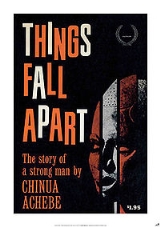
Things Fall Apart
is a
1958The year 1958 in literature involved some significant events and new books.-Events:*August 18 - Vladimir Nabokov's controversial novel Lolita is published in United States.*First volume of The Civil War by Shelby Foote is published....
English language novel by
NigeriaNigeria , officially the Federal Republic of Nigeria, is a federal constitutional republic comprising 36 states and its Federal Capital Territory, Abuja. The country is located in West Africa and shares land borders with the Republic of Benin in the west, Chad and Cameroon in the east, and Niger in...
n author
Chinua AchebeAlbert Chinụalụmọgụ Achebe popularly known as Chinua Achebe is a Nigerian novelist, poet, professor, and critic...
. It is a staple book in schools throughout Africa and widely read and studied in English-speaking countries around the world. It is seen as the archetypal modern
African novelAfrican literature refers to literature of and from Africa. As George Joseph notes on the first page of his chapter on African literature in Understanding Contemporary Africa, while the European perception of literature generally refers to written letters, the African concept includes oral...
in English, and one of the first African novels written in English to receive global critical acclaim. The title of the novel comes from
William Butler YeatsWilliam Butler Yeats was an Irish poet and playwright, and one of the foremost figures of 20th century literature. A pillar of both the Irish and British literary establishments, in his later years he served as an Irish Senator for two terms...
's poem
"The Second Coming""The Second Coming" is a poem composed by Irish poet William Butler Yeats in 1919 and first printed in The Dial and afterwards included in his 1921 collection of verses titled Michael Robartes and the Dancer. The poem uses Christian imagery regarding the Apocalypse and second coming as allegory to...
. In 2009,
Newsweek ranked
Things Fall Apart #14 on its list of Top 100 Books: The Meta-List.
The novel depicts the life of
OkonkwoOkonkwo is the protagonist of Chinua Achebe's 1958 novel Things Fall Apart. A rash warrior who acts upon impulse, he is the first in a series of tragic heroes appearing in the novels of Chinua Achebe.-Character information:...
, a leader and local wrestling champion in Umuofia—one of a fictional group of nine villages in Nigeria, inhabited by the
IgboIgbo people, also referred to as the Ibo, Ebo, Eboans or Heebo are an ethnic group living chiefly in southeastern Nigeria. They speak Igbo, which includes various Igboid languages and dialects; today, a majority of them speak English alongside Igbo as a result of British colonialism...
ethnic group. In addition it focuses on his three wives, his children, and the influences of
BritishThe United Kingdom of Great Britain and Northern IrelandIn the United Kingdom and Dependencies, other languages have been officially recognised as legitimate autochthonous languages under the European Charter for Regional or Minority Languages...
colonialism and Christian
missionariesA missionary is a member of a religious group sent into an area to do evangelism or ministries of service, such as education, literacy, social justice, health care and economic development. The word "mission" originates from 1598 when the Jesuits sent members abroad, derived from the Latin...
on his traditional
IgboIgbo people, also referred to as the Ibo, Ebo, Eboans or Heebo are an ethnic group living chiefly in southeastern Nigeria. They speak Igbo, which includes various Igboid languages and dialects; today, a majority of them speak English alongside Igbo as a result of British colonialism...
(archaically "Ibo") community during the late nineteenth century.
Things Fall Apart was followed by a sequel,
No Longer at EaseNo Longer at Ease is a 1960 novel by Nigerian author Chinua Achebe. It is the story of an Igbo man, Obi Okonkwo, who leaves his village for a British education and a job in the Nigerian colonial civil service, but who struggles to adapt to a Western lifestyle and ends up taking a bribe...
(
1960The year 1960 in literature involved some significant events and new books.-Events:*November 2 – Penguin Books is found not guilty of obscenity in the Lady Chatterley's Lover case in the United Kingdom....
), originally written as the second part of a larger work together with
Things Fall Apart, and
Arrow of GodArrow of God is a 1964 novel by Chinua Achebe. It is Achebe's third novel following Things Fall Apart and No Longer at Ease. These three books are sometimes called The African Trilogy...
(
1964The year 1964 in literature involved some significant events and new books.-Events:*Jean-Paul Sartre becomes head of the Organization to Defend Iranian Political Prisoners....
), on a similar subject. Achebe states that his two later novels,
A Man of the PeopleA Man of the People is a 1966 satirical novel by Chinua Achebe. It is Achebe's fourth novel. The novel tells the story of the young and educated Odili, the narrator, and his conflict with Chief Nanga, his former teacher who enters a career in politics in an unnamed modern African country...
(
1966The year 1966 in literature involved some significant events and new books.-Events:*February 14 - Dissident writers Yuli Daniel and Andrei Sinyavsky are sentenced to hard labour for "anti-Soviet activity"....
) and
Anthills of the SavannahAnthills of the Savannah is a 1987 novel by Nigerian writer Chinua Achebe. A finalist for the 1987 Booker Prize for Fiction, it has been described as the "most important novel to come out of Africa in the [1980s]."-Plot:...
(
1987The year 1987 in literature involved some significant events and new books.-Events:*Tom Wolfe was paid $5 million for the film rights to his novel, The Bonfire of the Vanities, the most ever earned by an author, at the time.-Fiction:...
), while not featuring Okonkwo's descendants and set in fictional African countries, are spiritual successors to the previous novels in chronicling African history.
Plot summary
Okonkwo is a leader and wrestling champion in his village. He is known to be hard working and shows no weakness — emotional or otherwise — to anyone. Although brusque with his family and neighbors, he is wealthy, courageous, and powerful among the people of his village. He is a leader of his village, and his place in that society is what he has striven for his entire life.
Because of his great esteem in the village, Okonkwo is selected by the elders to be the guardian of Ikemefuna, a boy taken prisoner by the village as a peace settlement between two villages after his father killed an Umuofian woman. Ikemefuna is to stay with Okonkwo until the Oracle instructs the elders on what to do with the boy. For three years the boy lives with Okonkwo's family and Okonkwo grows fond of him. The boy looks up to Okonkwo and considers him a second father. Then the elders decide that the boy must be killed. The oldest man in the village warns Okonkwo, telling him to have nothing to do with the murder because it would be like killing his own child. Rather than seem weak and feminine to the other men of the village, Okonkwo participates in the murder of the boy despite the warning from the old man. In fact, Okonkwo himself strikes the killing blow as Ikemefuna begs him for protection.
Shortly after Ikemefuna's death, things begin to go wrong for Okonkwo. When he accidentally kills someone at a ritual funeral ceremony when his gun explodes, he and his family are sent into exile for seven years to appease the gods he has offended. While Okonkwo is away in exile, white men begin coming to Umuofia and they peacefully introduce their religion. As the number of converts increases, the foothold of the white people grows beyond their religion and a new government is introduced.
Okonkwo returns to his village after his exile to find it a changed place because of the presence of the white man. He and other tribal leaders try to reclaim their hold on their native land by destroying a local Christian church. In return, the leader of the white government takes them prisoner and holds them for ransom for a short while, further humiliating and insulting the native leaders. As a result, the people of Umuofia finally gather for what could be a great uprising. Okonkwo, adamant over following Umuofian custom and tradition, despises any form of cowardice and advocates for war against the white men. When messengers of the white government try to stop the meeting, Okonkwo kills one of them. He realizes with despair that the people of Umuofia are not going to fight to protect themselves because they let the other messengers escape and so all is lost for the village.
When the local leader of the white government comes to Okonkwo's house to take him to court, he finds that Okonkwo has
hanged himselfSuicide is the act of intentionally causing one's own death. Suicide is often committed out of despair or attributed to some underlying mental disorder, such as depression, bipolar disorder, schizophrenia, alcoholism, or drug abuse...
, ruining his great reputation as it is strictly against the custom of the Igbo to commit suicide.
Culture
Achebe depicts the Igbo as people with great social institutions in accordance with their particular society, ie, wrestling, human sacrifice and suicide. Their culture is heavy in traditions and laws that focus on justice and fairness. The people are ruled not by a king or chief but by a kind of democracy, where the males meet and make decisions by consensus and in accordance to an "Oracle" that should be written down. It is the Europeans, who often talk of bringing democratic institutions to the rest of the world, who upset this system. Achebe emphasizes that high rank is attainable for all freeborn Igbo men – Okonkwo attains his through fighting as opposed to reading or ploughing the land and growing herbal remedies, vegetation, rearing cattle, fowl etc.
He also depicts the injustices of Igbo society. No more or less than Victorian England of the same era, the Ibo are a patriarchal society. They also fear twins, who are to be abandoned immediately after birth and left to die of exposure. The novel attempts to repair some of the damage done by earlier European depictions of Africans.
Characters
Okonkwo: An influential clan leader in Umuofia. Since early childhood, Okonkwo’s embarrassment about his lazy, squandering, and effeminate father, Unoka, has driven him to succeed. Okonkwo’s hard work and prowess in war have earned him a position of high status in his clan, and he attains wealth sufficient to support three wives and their eight children. Okonkwo’s tragic flaw is that he is terrified of being weak or "womanly" like his father. As a result, he behaves rashly, bringing a great deal of trouble and sorrow upon himself and his family. He is a tragic character who not only brings suffering to himself but also to those around him. Towards the end of the novel one can view Okonkwo as a tragic hero because like other tragic heroes he has one major flaw. His main flaw stems from the fear of being like his father, who is a soft-spoken, cheerful layabout who plays his flute and does not repay his debts. Okonkwo represses his emotions because he doesn't want to seem weak or effeminate, and when he does show any emotion, it is an uncontrollable rage. As a result of his flaws he makes many terrible mistakes, which ultimately leads to his tragic death.
Nwoye (later known as Isaac): Okonkwo’s oldest son, whom Okonkwo believes is weak, effeminate, and lazy, like his grandfather, Unoka. Okonkwo continually beats Nwoye, hoping to correct what he sees as flaws in his personality. When under the influence of Ikemefuna, Nwoye begins to exhibit more masculine behavior, which pleases Okonkwo. However, Nwoye harbours doubts about some of the laws and rules of his village and eventually converts to Christianity, an act that Okonkwo criticizes as “effeminate,” and punishes with beatings, after which the son leaves. Okonkwo believes that Nwoye is afflicted with the same weaknesses that his father, Unoka, possessed in abundance.
Ezinma: The only child of Okonkwo’s second wife, Ekwefi. As the only one of Ekwefi’s ten children to survive past infancy, Ezinma is the center of her mother’s world. Their relationship is atypical—Ezinma calls Ekwefi by her name and is treated by her as an equal. Ezinma is also Okonkwo’s favorite child, for she understands him better than any of his other children. She reminds him of Ekwefi, who was the village beauty. Okonkwo rarely demonstrates his affection, however, because he fears that doing so would make him look weak. Furthermore, he wishes that Ezinma were a boy because she would have been the perfect son.
Ikemefuna: A boy given to Okonkwo by a neighboring village. Ikemefuna lives in the hut of Okonkwo’s first wife and quickly becomes popular with Okonkwo’s children. He develops an especially close relationship with Nwoye, Okonkwo’s oldest son, who looks up to him. Okonkwo too becomes very fond of Ikemefuna, who calls him “father” and is a perfect clansman, but Okonkwo does not demonstrate his affection because he fears that doing so would make him look weak.
Mr. Brown: The first white missionary to travel to Umuofia. Mr. Brown institutes a policy of compromise, understanding, and non-aggression between his flock and the clan. He even becomes friends with prominent clansmen and builds a school and a hospital in Umuofia. Unlike Reverend Smith, he attempts to appeal respectfully to the Igbo value system rather than harshly impose his religion on it.
Reverend James Smith: The missionary who replaces Mr. Brown. Unlike Mr. Brown, Reverend Smith is uncompromising and strict. He demands that his converts reject all of their indigenous beliefs, and he shows no respect for indigenous customs or culture. He is the stereotypical white colonialist, and his behavior epitomizes the problems of colonialism. He intentionally provokes his congregation, inciting it to anger and even indirectly, through Enoch, encouraging some fairly serious transgressions.
Uchendu: The younger brother of Okonkwo’s mother. Uchendu receives Okonkwo and his family warmly when they travel to Mbanta, and he advises Okonkwo to be grateful for the comfort that his motherland offers him lest he anger the dead—especially his mother, who is buried there. Uchendu himself has suffered—all but one of his six wives are dead and he has buried twenty-two children. He is a peaceful, compromising man and functions as a foil (a character whose emotions or actions highlight, by means of contrast, the emotions or actions of another character) to Okonkwo, who acts impetuously and without thinking.
The District Commissioner An authority figure in the white colonial government in Nigeria. The prototypical racist colonialist, the District Commissioner thinks that he understands everything about native African customs and cultures and he has no respect for them. He plans to work his experiences into an ethnographic study on local African tribes, the idea of which embodies his dehumanizing and reductive attitude toward race relations.
Unoka: Okonkwo’s father, of whom Okonkwo has been ashamed since childhood. By the standards of the clan, Unoka was a coward and a spendthrift. He never took a title in his life, he borrowed money from his clansmen, and he rarely repaid his debts. He never became a warrior because he feared the sight of blood. Moreover, he died of an abominable illness. On the positive side, Unoka appears to have been a talented musician and gentle, if idle. He may well have been a dreamer, ill-suited to the entrenchant culture into which he was born. The novel opens ten years after his death.
Obierika: Okonkwo’s close friend, whose daughter’s wedding provides cause for festivity early in the novel. Obierika looks out for his friend, selling Okonkwo’s yams to ensure that Okonkwo won’t suffer financial ruin while in exile and comforting Okonkwo when he is depressed. Like Nwoye, Obierika questions some of the Igbo traditional structures.
Ekwefi: Okonkwo’s second wife, once the village beauty. Ekwefi ran away from her first husband to live with Okonkwo. Ezinma is her only surviving child, her other nine having died in infancy, and Ekwefi constantly fears that she will lose Ezinma as well. Ekwefi is good friends with Chielo, the priestess of the goddess Agbala.
Enoch: A fanatical convert to the Christian church in Umuofia. Enoch’s disrespectful act of ripping the mask off an egwugwu during an annual ceremony to honor the earth deity leads to the climactic clash between the indigenous and colonial justice systems. While Mr. Brown, early on, keeps Enoch in check in the interest of community harmony, Reverend Smith approves of his zealotry.
Ogbuefi Ezeudu: The oldest man in the village and one of the most important clan elders and leaders. Ogbuefi Ezeudu was a great warrior in his youth and now delivers messages from the Oracle.
Chielo: A priestess in Umuofia who is dedicated to the Oracle of the goddess Agbala. Chielo is a widow with two children. She is good friends with Ekwefi and is fond of Ezinma, whom she calls “my daughter.” At one point, she carries Ezinma on her back for miles in order to help purify her and appease the gods.
Akunna: A clan leader of Umuofia. Akunna and Mr. Brown discuss their religious beliefs peacefully, and Akunna’s influence on the missionary advances Mr. Brown’s strategy for converting the largest number of clansmen by working with, rather than against, their belief system. In so doing, however, Akunna formulates an articulate and rational defense of his religious system and draws some striking parallels between his style of worship and that of the Christian missionaries.
Nwakibie: A wealthy clansmen who takes a chance on Okonkwo by lending him 800 seed yams—twice the number for which Okonkwo asks. Nwakibie thereby helps Okonkwo build up the beginnings of his personal wealth, status, and independence.
Mr. Kiaga: The native-turned-Christian missionary who arrives in Mbanta and converts Nwoye and many others.
Okagbue Uyanwa: A famous medicine man whom Okonkwo summons for help in dealing with Ezinma’s health problems.
Maduka: Obierika’s son. Maduka wins a wrestling contest in his mid-teens. Okonkwo wishes he had promising, manly sons like Maduka.
Obiageli: The daughter of Okonkwo’s first wife. Although Obiageli is close to Ezinma in age, Ezinma has a great deal of influence over her.
Ojiugo: Okonkwo’s third and youngest wife, and the mother of Nkechi. Okonkwo beats Ojiugo during the week of peace after she is late bringing in his dinner, and is fined.
Themes and motifs
Themes throughout the novel include change, loneliness, abandonment, and fear:
- Individuals derive strength from their society, and societies derive strength from the individuals who belong to them. In Things Fall Apart, Okonkwo builds his fortune and strength with the help of his society's customs. Likewise, Okonkwo's society benefits from his hard work and determination.
- In contacts between other cultures, beliefs about superiority or inferiority, due to limited and partial world view, are invariably wrong-headed and destructive . When new cultures and religions meet the original, there is likely to be a struggle for dominance. For example, the Christians and Okonkwo's people have a limited view of each other, and have a very difficult time understanding and accepting one another's customs and beliefs, which resulted in violence as with the destruction of a local church and Okonkwo's killing of the messenger.
- In spite of innumerable opportunities for understanding, people must strive to communicate. For example, Okonkwo and his son, Nwoye have a difficult time understanding one another because they hold different values. On the other hand, Okonkwo spends more time with Ikemefuna and develops a deeper relationship that seems to go beyond cultural restraints.
- A social value—such as individual ambition—which is constructive when balanced by other values, can become destructive when overemphasized at the expense of other values. For example, Okonkwo values tradition so highly that he cannot accept change. (It may be more accurate to say he values tradition because of the high cost he has paid to uphold it, i.e. killing Ikemefuna and moving to Mbanta). The Christian teachings render these large sacrifices on his part meaningless. The distress over the loss of tradition, whether driven by his love of the tradition or the meaning of his sacrifices to it, can be seen as the main reasons for his suicide.
- There is no such thing as a static culture; change is continual, and flexibility is necessary for successful adaptation. Because Okonkwo cannot accept the change the Christians bring, he cannot adapt.
- The struggle between change and tradition is constant; however, this statement only appears to apply to Okonkwo. Change can very well be accepted, as evidenced by how the people of Umuofia refused to join Okonkwo as he struck down the white man at the end. Perhaps Okonkwo is not so much bothered by change, but the idea of losing everything he had built up - his fortune, fame, title, etc. that will be replaced by new customs. It is evidenced throughout the book that he cares for these things, especially his mentions of a lack of a "respectable" father figure from whom he could have inherited them from. A second interpretation is apparent with Okonkwo's static behavior to cultural change. His suicide can be seen as a final attempt to show to the people of Umuofia the results of a clash between cultures and as a means for the Igbo culture to be upheld. In the same way that his father's failure motivated Okonkwo to reach a high standing within Igbo culture and society, Okonkwo's suicide leads Obierika and fellow Umuofia men to recognize the long held custom of not burying a man who commits suicide and perform the associated rituals with his death. This interpretation is further emphasized with Obierika's comment on Okonkwo as a great man driven to kill himself, likely as a result of the loss of tradition. His killing of the messenger and subsequent suicide continues the internal struggle between change and tradition.
- The role of culture in society. With the death of Ikemefuna, Okonkwo's expulsion due to causes beyond his control, and the journey of Ezinma with Chielo, Achebe questions, particularly through Obierika, whether adherence to culture is for the better of society, when it has caused many hardships and sacrifices on the part of Okonkwo and his family.
- Definitions of masculinity vary throughout different societies. In this case, Okonkwo views aggression and action as masculinity.
- Notion of success and failure. Okonkwo's personal ambition to avoid a life of complacency like his father, Unoka, leads to his high ranking and affluence in the community. He ardently tries to avoid failure. The notion of failure correlates with the idea of change in Umuofia and a shift in cultural values. Failure, for Okonkwo, is societal reform. Hence Okonkwo's drastic and at times erratic action against anything foreign or not masculine.
- Through the Achebe’s use of language, he is successful in demonstrating (and attesting to) the Igbo’s rich and unique culture. By integrating traditional Igbo words (e.g. egwugwu, or the spirits of the ancestor’s of Nigerian tribes), folktales, and songs into English sentences, the author is successful in proving that African languages aren’t incomprehensible, although they are often too complex for direct translation into English. Additionally, the author is successful in verifying that each of the continent’s languages are unique, as Mr. Brown’s translator is ridiculed after his misinterpretation of an Igbo word.
Literary significance and reception
Things Fall Apart is a milestone in
African literatureAfrican literature refers to literature of and from Africa. As George Joseph notes on the first page of his chapter on African literature in Understanding Contemporary Africa, while the European perception of literature generally refers to written letters, the African concept includes oral...
. It has achieved the status of the archetypal modern African novel in English, and is read in Nigeria and throughout Africa. It is studied widely in Europe and North America, where it has spawned numerous secondary and tertiary analytical works. It has achieved similar status and repute in India and Australia. Considered Achebe's
magnum opusMasterpiece in modern usage refers to a creation that has been given much critical praise, especially one that is considered the greatest work of a person's career or to a work of outstanding creativity, skill or workmanship....
, it has sold more than 8 million copies worldwide. Time Magazine included the novel in its
TIME 100 Best English-language Novels from 1923 to 2005.
Achebe’s writing about African society, by telling from an African point of view the story of the colonization of the Igbo, tends to extinguish the misconception that African culture had been savage and primitive. In
Things Fall Apart, western culture is portrayed as being “arrogant and ethnocentric," insisting that the African culture needed a leader. As it had no kings or chiefs, Umofian culture was vulnerable to invasion by western civilization. It is felt that the repression of the Igbo language at the end of the novel contributes greatly to the destruction of the culture. Although Achebe favors the African culture of the pre-western society, the author attributes its destruction to the “weaknesses within the native structure.” Achebe portrays the culture as having a religion, a government, a system of money, and an artistic tradition, as well as a judicial system.
Achebe named
Things Fall Apart from a line in
William Butler YeatsWilliam Butler Yeats was an Irish poet and playwright, and one of the foremost figures of 20th century literature. A pillar of both the Irish and British literary establishments, in his later years he served as an Irish Senator for two terms...
's "
The Second Coming"The Second Coming" is a poem composed by Irish poet William Butler Yeats in 1919 and first printed in The Dial and afterwards included in his 1921 collection of verses titled Michael Robartes and the Dancer. The poem uses Christian imagery regarding the Apocalypse and second coming as allegory to...
," thus tying in the meaning of the poem itself. The missionaries' arrival begins the downfall of traditional Igbo society. This downfall destroys the Igbo way of life, leading to the death of Okonkwo, who was once a hero of the village.
Things Fall Apart has been called a modern Greek tragedy. It has the same plot elements as a Greek tragedy, including the use of a
tragic heroA tragic hero is the main character in a tragedy. Tragic heroes appear in the dramatic works of Aeschylus, Sophocles, Euripides, Seneca, Marlowe, Shakespeare, Webster, Marston, Corneille, Racine, Goethe, Schiller, Kleist, Strindberg, and many other writers.-Aristotle's tragic hero:Aristotle...
, the following of the string model, etc. Okonkwo is a classic
tragic heroA tragic hero is the main character in a tragedy. Tragic heroes appear in the dramatic works of Aeschylus, Sophocles, Euripides, Seneca, Marlowe, Shakespeare, Webster, Marston, Corneille, Racine, Goethe, Schiller, Kleist, Strindberg, and many other writers.-Aristotle's tragic hero:Aristotle...
, even though the story is set in more modern times. He shows multiple
hamartiaHamartia is a term developed by Aristotle in his work Poetics. The word hamartia is rooted in the notion of missing the mark and covers a broad spectrum that includes ignorant, mistaken, or accidental wrongdoing, as well as deliberate iniquity, error, or sin...
, including
hubrisHubris , also hybris, means extreme haughtiness, pride or arrogance. Hubris often indicates a loss of contact with reality and an overestimation of one's own competence or capabilities, especially when the person exhibiting it is in a position of power....
(pride) and
ateAtë or Aite a Greek word for "ruin, folly, delusion", is the action performed by the hero, usually because of hubris, that leads to his or her death or downfall. There is also a goddess by that name in Greek mythology, a personification of the same.In Homer's Iliad she is called eldest daughter...
(rashness), and these character traits do lead to his
peripeteiaPeripeteia is a reversal of circumstances, or turning point. The term is primarily used with reference to works of literature. The English form of peripeteia is peripety. Peripety is a sudden reversal dependent on intellect and logic...
, or reversal of fortune, and his downfall at the end of the novel. He is distressed by social changes brought by white men, because he has worked so hard to move up in the traditional society. This position is at risk due to the arrival of a new values system. Those who commit suicide lose their place in the ancestor-worshipping traditional society, to the extent that they may not even be touched to give a proper burial. The irony is that Okonkwo completely loses his standing in both value systems. Okonkwo truly has good intentions, but his need to feel in control and his fear that other men will sense weakness in him drive him to make decisions, whether consciously or subconsciously, that he regrets as he progresses through his life.
Language
Achebe writes his novels in English because written Standard Ibo was created by mixing the various languages, creating a stilted written form. In an interview for
The Paris Review by James Brooks in 1994, Achebe says, "the novel form seems to go with the English language. There is a problem with the Igbo language. It suffers from a very serious inheritance, which it received at the beginning of this century from the Anglican mission. They sent out a missionary by the name of Dennis. Archdeacon Dennis. He was a scholar. He had this notion that the Igbo language—which had very many different dialects—should somehow manufacture a uniform dialect that would be used in writing to avoid all these different dialects. Because the missionaries were powerful, what they wanted to do they did. This became the law. But the standard version cannot sing. There’s nothing you can do with it to make it sing. It’s heavy. It’s wooden. It doesn’t go anywhere."
Aspects of gender
Gender differentiation is seen in Igbo classification of crimes. The narrator of
Things Fall Apart states that "The crime [of killing Ezeudu's son] was of two kinds, male and female. Okonkwo had committed the female because it was an accident. He would be allowed to return to the clan after seven years." Okonkwo fled to the land of his mother, Mbanta, because a man finds refuge with his mother. Uchendu explains this to Okonkwo:
"It is true that a child belongs to his father. But when the father beats his child, it seeks sympathy in its mother's hut. A man belongs to his fatherland when things are good and life is sweet. But when there is sorrow and bitterness, he finds refuge in his motherland. Your mother is there to protect you. She is buried there. And that is why we say that mother is supreme."
Women are understated throughout Things Fall Apart. A crucial element of the story is represented through the cultural aspects of the Igbo society, and traditions. As such, it can be argued that the infrequent mentions of wives in the story of "Things Fall Apart," can be taken as a statement of the limited value of women. The mentioning of wives purely as the bearers of children can then be taken as a statement that women are actually nothing more than tools of reproduction. The fact that the number of wives you have affects social status further depicts women as possessions of the men. The fact that the men are free to beat their wives also adds to this idea. Okonkwo wishing that his favorite child, Enzima, was a boy further reveals in the inequality between the genders in Nigeria at the time.
Political structures in the novel
Prior to British colonization, the Igbo people as featured in
Things Fall Apart, lived in a patriarchal collective political system. Decisions were not made by a chief or by any individual but were rather decided by a council of male elders. Religious leaders were also called upon to settle debates reflecting the cultural focus of the Igbo people.
The Portuguese were the first Europeans to explore Nigeria. Though the Portuguese are not mentioned by Achebe, the remaining influence of the Portuguese can be seen in many Nigerian surnames. The British entered Nigeria first through trade and then established The Royal Niger Colony in 1886. The success of the colony led to Nigeria becoming a British protectorate in 1901.
The arrival of the British slowly began to deteriorate the traditional society. The British government would intervene in tribal disputes rather than allowing the Igbo to settle issues in a traditional manner. The frustration caused by these shifts in power is illustrated by the struggle of the protagonist Okonkwo in the second half of the novel.
Film, television, and theatrical adaptations
A dramatic radio program called
Okonkwo was made of the novel in April 1961 by the Nigerian Broadcasting Corporation. It featured
Wole SoyinkaAkinwande Oluwole "Wole" Soyinka is a Nigerian writer, poet and playwright. He was awarded the 1986 Nobel Prize in Literature, where he was recognised as a man "who in a wide cultural perspective and with poetic overtones fashions the drama of existence", and became the first African in Africa and...
in a supporting role.
In 1987, the book was made into a very successful mini series directed by David Orere and broadcast on Nigerian television by the NTA (Nigerian Television Authority). It starred movie veterans like
Pete EdochiePete Edochie is a Nigerian actor. A devout Catholic, he is considered one of Africa’s most talented actors, by both Movie Awards and Movie Magic’s Africa Magic Cable network...
,
Nkem OwohNkem Owoh is a Nigerian actor and comedian. In 2008 he won the African Movie Academy Award for Best Actor in a Leading Role.-Early life:Owoh was born in Enugu, Nigeria. After his primary and secondary school he headed to the University of Ilorin and studied engineering...
and Sam Loco.
Recently, the author turned down $1 million from rapper
50 centCurtis James Jackson III , better known by his stage name 50 Cent, is an American rapper, entrepreneur, investor, record producer, and actor. He rose to fame with the release of his albums Get Rich or Die Tryin and The Massacre . Get Rich or Die Tryin has been certified eight times platinum by...
who sought permission to use the name of the book as the title of the upcoming movie that he is producing.
See also
- No Longer at Ease
No Longer at Ease is a 1960 novel by Nigerian author Chinua Achebe. It is the story of an Igbo man, Obi Okonkwo, who leaves his village for a British education and a job in the Nigerian colonial civil service, but who struggles to adapt to a Western lifestyle and ends up taking a bribe...
- Arrow of God
Arrow of God is a 1964 novel by Chinua Achebe. It is Achebe's third novel following Things Fall Apart and No Longer at Ease. These three books are sometimes called The African Trilogy...
- Heart of Darkness
Heart of Darkness is a novella written by Joseph Conrad. Before its 1903 publication, it appeared as a three-part series in Blackwood's Magazine. It was classified by the Modern Library website editors as one of the "100 best novels" and part of the Western canon.The story centres on Charles...
- Weep Not, Child
Weep Not, Child is Kenyan author Ngũgĩ wa Thiong'o's first novel, published in 1964 under the name James Ngugi. It was the first English novel to be published by an East African. Thiong'o's works deal with the relationship between Africans and the British colonists in Africa, and are heavily...
- Death and the King's Horseman
Death and The King's Horseman is a play by Wole Soyinka based on a real incident that took place in Nigeria during British colonial rule: the ritual suicide of the horseman of an important chief was prevented by the intervention of the colonial authorities...
External links