


Thermal Micrometeoroid Garment

Encyclopedia
Space suit
A space suit is a garment worn to keep an astronaut alive in the harsh environment of outer space. Space suits are often worn inside spacecraft as a safety precaution in case of loss of cabin pressure, and are necessary for extra-vehicular activity , work done outside spacecraft...
. The TMG has three functions: to insulate the suit occupant and prevent heat loss, to shield the occupant from harmful solar radiation, and to protect the astronaut from micrometeoroid
Micrometeoroid
A micrometeoroid is a tiny meteoroid; a small particle of rock in space, usually weighing less than a gram. A micrometeor or micrometeorite is such a particle that enters the Earth's atmosphere or falls to Earth.-Scientific interest:...
s and other orbital debris, which could puncture the suit and depressurize it.
The specific design of TMGs varies between different space agencies and different suits, though they all serve the same purpose.
Apollo/Skylab A7L suit

Liquid Cooling and Ventilation Garment
A Liquid Cooling Garment is a form-fitting garment that is used to remove body heat from the wearer in environments where evaporative cooling from sweating and open air convection cooling does not work, or the wearer has a biological problem that hinders self-regulation of body temperature.A...
, pressure bladder, and restraint layer, the TMG for the A7L
Apollo/Skylab A7L
The A7L Apollo & Skylab spacesuit is the primary pressure suit worn by NASA astronauts for Project Apollo, the three manned Skylab flights, and the Apollo-Soyuz Test Project between 1968 and the termination of the Apollo program in 1975. The "A7L" designation is used by NASA as the seventh Apollo...
suit worn on the Moon and during the Skylab
Skylab
Skylab was a space station launched and operated by NASA, the space agency of the United States. Skylab orbited the Earth from 1973 to 1979, and included a workshop, a solar observatory, and other systems. It was launched unmanned by a modified Saturn V rocket, with a mass of...
Program began with a layer of neoprene
Neoprene
Neoprene or polychloroprene is a family of synthetic rubbers that are produced by polymerization of chloroprene. Neoprene in general has good chemical stability, and maintains flexibility over a wide temperature range...
-coated nylon
Nylon
Nylon is a generic designation for a family of synthetic polymers known generically as polyamides, first produced on February 28, 1935, by Wallace Carothers at DuPont's research facility at the DuPont Experimental Station...
ripstop
Ripstop
Ripstop fabrics are woven fabrics often made out of nylon, using a special reinforcing technique that makes them resistant to tearing and ripping. During weaving reinforcement threads are interwoven at regular intervals in a crosshatch pattern. The intervals are typically 5 to 8 millimeters...
. This was the innermost layer of protection from micrometeoroids. Next, thermal radiation
Thermal radiation
Thermal radiation is electromagnetic radiation generated by the thermal motion of charged particles in matter. All matter with a temperature greater than absolute zero emits thermal radiation....
protection was provided by five layers of aluminized PET film
PET film (biaxially oriented)
BoPET is a polyester film made from stretched polyethylene terephthalate and is used for its high tensile strength, chemical and dimensional stability, transparency, reflectivity, gas and aroma barrier properties and electrical insulation.A variety of companies manufacture boPET and other...
(Mylar), alternating with four layers of nonwoven
Nonwovens
Nonwoven fabric is a fabric-like material made from long fibres, bonded together by chemical, mechanical, heat or solvent treatment. The term is used in the textile manufacturing industry to denote fabrics, such as felt, which are neither woven nor knitted. Nonwoven materials typically lack...
Dacron, which provided thermal spacing, followed by two layers of aluminized polyimide
Polyimide
Polyimide is a polymer of imide monomers. The structure of imide is as shown. Polyimides have been in mass production since 1955...
Kapton
Kapton
Kapton is a polyimide film developed by DuPont which can remain stable in a wide range of temperatures, from -273 to +400 °C...
film and Beta cloth
Beta cloth
Beta cloth is a type of fireproof silica fiber cloth used in the manufacture of Apollo/Skylab A7L space suits and in other specialized applications....
marquisette laminate. The outermost layer of PTFE
Polytetrafluoroethylene
Polytetrafluoroethylene is a synthetic fluoropolymer of tetrafluoroethylene that finds numerous applications. PTFE is most well known by the DuPont brand name Teflon....
(Teflon)-coated filament Beta cloth was non-flammable and provided abrasion protection from the notoriously abrasive lunar dust. This layer was supplemented with Teflon abrasion patches at the knees and other areas.
Space Shuttle/EMU suit
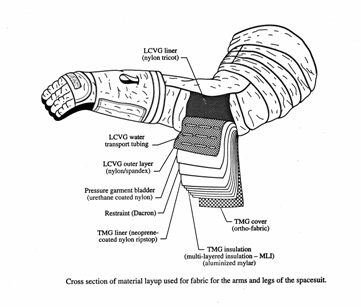
The construction of the TMG on the EMUExtravehicular Mobility Unit
The Space Shuttle/International Space Station Extravehicular Mobility Unit is an independent anthropomorphic system that provides environmental protection, mobility, life support, and communications for a Space Shuttle or International Space Station crew member to perform extra-vehicular activity...
suits in use on the Space Shuttle
Space Shuttle
The Space Shuttle was a manned orbital rocket and spacecraft system operated by NASA on 135 missions from 1981 to 2011. The system combined rocket launch, orbital spacecraft, and re-entry spaceplane with modular add-ons...
and International Space Station
International Space Station
The International Space Station is a habitable, artificial satellite in low Earth orbit. The ISS follows the Salyut, Almaz, Cosmos, Skylab, and Mir space stations, as the 11th space station launched, not including the Genesis I and II prototypes...
differs somewhat from the construction of the Apollo/Skylab TMG.
The EMU TMG includes seven layers of aluminized Mylar laminated with Dacron, rather than five, and eliminates the use of Kapton. The outermost layer is white Ortho-Fabric, made with a blend of Gore-Tex
Gore-Tex
Gore-Tex is a waterproof/breathable fabric, and a registered trademark of W. L. Gore and Associates. It was co-invented by Wilbert L. Gore, Rowena Taylor, and Gore's son, Robert W. Gore. Robert Gore was granted on April 27, 1976, for a porous form of polytetrafluoroethylene with a...
, Kevlar
Kevlar
Kevlar is the registered trademark for a para-aramid synthetic fiber, related to other aramids such as Nomex and Technora. Developed at DuPont in 1965, this high strength material was first commercially used in the early 1970s as a replacement for steel in racing tires...
, and Nomex
Nomex
Nomex is a registered trademark for flame resistant meta-aramid material developed in the early 1960s by DuPont and first marketed in 1967.- Properties:...
. This layer can withstand temperatures from −300° to +300° Fahrenheit
Fahrenheit
Fahrenheit is the temperature scale proposed in 1724 by, and named after, the German physicist Daniel Gabriel Fahrenheit . Within this scale, the freezing of water into ice is defined at 32 degrees, while the boiling point of water is defined to be 212 degrees...
(-184.4 to 149 Celsius
Celsius
Celsius is a scale and unit of measurement for temperature. It is named after the Swedish astronomer Anders Celsius , who developed a similar temperature scale two years before his death...
). The outer layer provides both micrometeoroid and thermal protection, by reflecting most of the sun's thermal radiation.