
Therianthropy (from n.
therianthrope and adj.
therianthropic, part man and part beast, from the Greek
theríon, θηρίον, meaning "wild animal" or "beast" (impliedly mammalian), and
anthrōpos, άνθρωπος, meaning "human being") refers to the
metamorphosisMetamorphosis is a biological process by which an animal physically develops after birth or hatching, involving a conspicuous and relatively abrupt change in the animal's body structure through cell growth and differentiation...
of
humanHumans are bipedal primates belonging to the species Homo sapiens in Hominidae, the great ape family. They are the only surviving member of the genus Homo. Humans have a highly developed brain, capable of abstract reasoning, language, introspection, and problem solving...
s into other animals. Therianthropes have long existed in
mythologyMythology is the study of myths and or of a body of myths. For example, comparative mythology is the study of connections between myths from different cultures, whereas Greek mythology is the body of myths from ancient Greece. The term "myth" is often used colloquially to refer to a false story;...
, appearing in ancient cave drawings such as
the SorcererThe Sorcerer is one name for an enigmatic cave painting found in the cavern known as 'The Sanctuary' at Trois-Frères, Ariège, France. The figure's significance is unknown, but it is usually interpreted as some kind of great spirit or master of the animals. The unusual nature of The Sanctuary’s...
at Les Trois Frères.
The term
therianthropy was used to refer to animal transformation folklore of Asia and Europe as early as 1901. Sometimes, "zoanthropy" is used instead of "therianthropy".
Therianthropy was also used to describe spiritual belief in animal transformation in 1915
and one source raises the possibility the term may have been used in the 16th century in criminal trials of suspected werewolves.
Shamanism
Ethnologist Ivar Lissner theorised that cave paintings of beings with human and non-human animal features were not physical representations of mythical shapeshifters, but were instead attempts to depict shamans in the process of acquiring the mental and spiritual attributes of various beasts. Religious historian
Mircea EliadeMircea Eliade was a Romanian historian of religion, fiction writer, philosopher, and professor at the University of Chicago. He was a leading interpreter of religious experience, who established paradigms in religious studies that persist to this day...
has observed that beliefs regarding animal identity and transformation into animals are widespread.
Transmigration of souls
Therianthropy is often confused with
transmigrationTransmigration of the soul is similar and foreign in some ways to the philosophy of reincarnation. The idea of transmigration of the soul comes from the ancient Greeks...
; but the essential feature of the were-animal is that it is the alternative form or the double of a living human being, while the soul-animal is the vehicle, temporary or permanent, of the spirit of a dead human being. Nevertheless, instances in legend of humans
reincarnatedReincarnation, literally "to be made flesh again", is a doctrine or metaphysical belief that some essential part of a living being survives death to be reborn in a new body. This essential part is often referred to as the spirit or soul, the "higher" or "true" self, "divine spark", or "I"...
as wolves are often classed with lycanthropy, as well as these instances being labeled werewolves in local folklore.
There is no line of demarcation, and this makes it probable that lycanthropy is connected with nagualism and the belief in familiar spirits, rather than with
metempsychosisMetempsychosis is a philosophical term in the Greek language referring to transmigration of the soul, especially its reincarnation after death. It is a doctrine popular among a number of Eastern religions such as Hinduism, Buddhism, Jainism and Druzism wherein an individual incarnates from one body...
, as E. B. Tylor argued, or with totemism, as suggested by J. F. M'Lennan. Thus, these origins for lycanthropy mingle a belief in
reincarnationReincarnation, literally "to be made flesh again", is a doctrine or metaphysical belief that some essential part of a living being survives death to be reborn in a new body. This essential part is often referred to as the spirit or soul, the "higher" or "true" self, "divine spark", or "I"...
, a belief in the sharing of souls between living humans and beasts and a belief in human
ghostA ghost has been defined as the disembodied spirit or soul of a deceased person, although in popular usage the term refers only to the apparition of such a person...
s appearing as non-human animals after death. A characteristic of metempsychosis is a blurring of the boundaries between the intangible and the corporeal, so that souls are often conceived of as solid, visible forms that need to eat and can do physical harm.
Animal ancestors
Stories of humans descending from animals are common explanations for tribal and clan origins. Sometimes the animals assumed human forms in order to ensure their descendants retained their human shapes; other times the origin story is of a human marrying a normal animal.
North American
indigenous traditionsAlthough a section on Mythology is no substitute for a section on Native American Religion, Native American belief systems include many sacred narratives. Such spiritual stories are deeply based in Nature and are rich with the symbolism of seasons, weather, plants, animals, earth, water, sky and fire...
particularly mingle the idea of
bearBears are mammals of the family Ursidae. Bears are classified as caniforms, or doglike carnivorans, with the pinnipeds being their closest living relatives. Although there are only eight living species of bear, they are widespread, appearing in a wide variety of habitats throughout the Northern...
ancestors and
ursine shapeshiftersWereBears were plush stuffed toy bears, created by George Nicholas Creations in 1983. Their heads and paws were reversible, allowing them to change from "happy" to "angry", much the same as a werewolf...
, with bears often being able to shed their skins to assume human form, marrying human women in this guise. The offspring may be creatures with combined anatomy, they might be very beautiful children with uncanny strength, or they could be shapeshifters themselves.
P'an Hu is represented in various
Chinese legendsChinese Mythology is a collection of cultural history, folktales, and religions that have been passed down in oral or written are several aspects to Chinese mythology, including creation myths and legends and myths concerning the founding of Chinese culture and the Chinese state...
as a
supernaturalThe term supernatural or supranatural pertains to an order of existence beyond the scientifically visible universe. Religious miracles are typically supernatural claims, as are spells and curses, divination, the belief that there is an afterlife for the dead, and innumerable others...
dog, a dog-headed man, or a canine shapeshifter that married an emperor's daughter and founded at least one race. When he is depicted as a shapeshifter, all of him can become human except for his head. The race(s) descended from P'an Hu were often characterized by Chinese writers as monsters who combined human and dog anatomy.
In
Altaic mythologyThe mythologies of the Turkic and Mongolian peoples are related and have exerted strong influence on one another...
of the
TurkicThe Turkic peoples are Eurasian peoples residing in northern, central and western Eurasia. They speak languages belonging to the Turkic language family. They share, to varying degrees, certain cultural traits and historical backgrounds...
and Mongolian peoples, the wolf is a revered animal. The shamanic Turkic peoples even believed they were descendants of wolves in Turkic legends. The legend of
AsenaAsena is the name of a female wolf in Turkic mythology. It is associated with a Göktürk ethnogenic myth "full of shamanic symbolism".The legend runs as follows. After a battle, only an injured young boy survives. A she-wolf with a sky-blue mane named Asena finds the injured child and nursed him...
is an old Turkic myth that tells of how the Turkic people were created. In Northern China a small Turkic village was raided by Chinese soldiers, but one small baby was left behind. An old she-wolf with a sky-blue mane named Asena found the baby and nursed him, later giving birth to the half wolf, half human cubs who were the ancestors of the Turkic people.
Animal spirits
In North and Central America, and to some extent in West Africa,
AustraliaAustralia , officially the Commonwealth of Australia, is a country in the Southern Hemisphere comprising the continental mainland , the island of Tasmania, and numerous smaller islands in the Indian and Pacific Oceans...
and other parts of the world, every male acquires at puberty a tutelary spirit. In some Native American tribes the youth kills the animal of which he dreams in his initiation fast; its claw, skin or feathers are put into a little bag and become his "medicine" and must be carefully retained, for a "medicine" once lost can never be replaced. In West Africa this relation is said to be entered into by means of the blood bond, and it is so close that the death of the animal causes the man to die and vice versa. Elsewhere the possession of a tutelary spirit in animal form is the privilege of the magician. In
AlaskaAlaska is the largest state of the United States of America by area; it is situated in the northwest extremity of the North American continent, with Canada to the east, the Arctic Ocean to the north, and the Pacific Ocean to the west and south, with Russia further west across the Bering Strait...
the candidate for magical powers has to leave the abodes of men; the chief of the gods sends an
otterOtters are semi-aquatic fish-eating mammals. The otter subfamily Lutrinae forms part of the family Mustelidae, which also includes weasels, polecats, badgers, as well as others. With thirteen species in seven genera, otters have an almost worldwide distribution...
to meet him, which he kills by saying "O" four times; he then cuts out its tongue and thereby secures the powers which he seeks.
The
MalaysMalaysia is a country in Southeast Asia that consists of thirteen states and three Federal Territories, with a total landmass of . The capital city is Kuala Lumpur, while Putrajaya is the seat of the federal government. The population stands at over 28 million inhabitants...
believe that the office of
pawang (priest) is only hereditary if the soul of the dead priest, in the form of a tiger, passes into the body of his son. While the familiar is often regarded as the alternative form of the magician, the
nagual or bush-soul is commonly regarded as wholly distinct from the human being. Transitional beliefs, however, are found, especially in Africa, in which the power of transformation is attributed to the whole of the population of certain areas. The people of Banana are said to change themselves by magical means, composed of human
embryoAn embryo is a multicellular diploid eukaryote in its earliest stage of development, from the time of first cell division until birth, hatching, or germination...
s and other ingredients, but in their
leopardThe leopard , Panthera pardus, is a member of the Felidae family and the smallest of the four "big cats" in the genus Panthera; the other three being the tiger, lion and jaguar...
form they may do no harm to mankind under pain of retaining forever the beast shape. In other cases the change is supposed to be made for the purposes of evil magic and human victims are not prohibited.
A further link is supplied by the
ZuluThe Zulu are the largest South African ethnic group of an estimated 10–11 million people who live mainly in the province of KwaZulu-Natal, South Africa. Small numbers also live in Zimbabwe, Zambia, and Mozambique. Their language, Zulu, is a Bantu language; more specifically, part of the Nguni...
belief that the magician's familiar is really a transformed human being; when he finds a dead body on which he can work his spells without fear of discovery, the wizard breathes a sort of life into it, which enables it to move and speak, it being thought that some dead wizard has taken possession of it. He then burns a hole in the head and through the aperture extracts the tongue. Further spells have the effect of changing the revivified body into the form of some animal,
hyenaThe Hyaenidae is a mammalian family of order Carnivora. The Hyaenidae family, native to both African and Asian continents, consists of four living species, the Striped Hyena and Brown Hyena , the Spotted Hyena , and the Aardwolf .-Evolution:Hyenas seem to have originated 26 million years ago from...
,
owlThe Owls are the order Strigiformes, comprising 200 birds of prey, species. Most are solitary, and nocturnal, with some exceptions . Owls hunt mostly small mammals, insects, and other birds, though a few species specialize in hunting fish. They are found in all regions of the Earth except...
or
wild catThe Wildcat , sometimes Wild Cat or Wild-cat, is a small felid native to Europe, the western part of Asia, and Africa. It is a hunter of small mammals, birds, and other creatures of a similar size. There are several subspecies distributed in different regions...
, the latter being most in favour. This creature then becomes the wizard's servant and obeys him in all things; its chief use is, however, to inflict sickness and death upon persons who are disliked by its master.
In
MelanesiaMelanesia is a subregion of Oceania extending from the western end of the Pacific Ocean to the Arafura Sea, and eastward to Fiji. The region comprises most of the islands immediately north and northeast of Australia...
there is a belief in the
tamaniu or
atai which is an animal counterpart to a person. It can be an eel, a shark, a lizard, or some other creature. This creature is corporeal, can understand human speech, and shares the same soul as its master, leading to legends which have many characteristics typical of
shapeshifterShapeshifting is a common theme in mythology and folklore, as well as in science fiction and fantasy. In its broadest sense, it is when a being undergoes a transformation. Commonly the transformation is purposeful, and not a curse or spell...
tales, such as any death or injury affecting both forms at once.
Hybrids
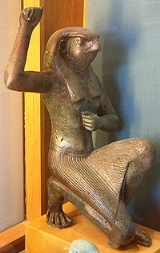
Therianthropy can also refer to artistic descriptions of characters that simultaneously share human and nonhuman animal traits, for example the animal-headed humanoid forms of gods depicted in
Egyptian mythologyAncient Egyptian religion encompasses the various religious beliefs and rituals practiced in ancient Egypt over more than 3,000 years, from the predynastic period until the adoption of Christianity in the early centuries AD...
(such as
RaRA is an abbreviation or code which may refer to :Science* Right ascension, an astronomical term for one of the two coordinates of a point on the celestial sphere when using the equatorial coordinate system...
,
SobekSobek was the deification of crocodiles, as crocodiles were deeply feared in the nation so dependent on the Nile River...
,
AnubisAnubis is the Greek name for a jackal-headed god associated with mummification and the afterlife in Egyptian mythology. In the ancient Egyptian language, Anubis is known as Inpu, . The oldest known mention of Anubis is in the Old Kingdom pyramid texts, where he is associated with the burial of the...
, and others) as well as creatures like
centaurIn Greek mythology, the centaurs are a race of creatures composed of part human and part horse. In early Attic vase-paintings, they are depicted with the torso of a human joined at the waist to the horse's withers, where the horse's neck would be.This half-human and half-animal composition has led...
s and
mermaidA mermaid is a mythological aquatic creature with a human head and torso and the tail of an aquatic animal such as a fish.-Overview and etymology:...
s.
Shape-shifting
Some common forms of therianthropy have their own terminologies. Of these,
lycanthropy, cynanthropyCynanthropy is a mental delusion in which one imagines oneself as a dog, frequently barking and growling. In folklore and mythology, it has been applied to shapeshifters....
, and
ailuranthropy are the best known. The term "cynanthropy" was applied in 1901 to
ChineseChina is a cultural region, an ancient civilization, and, depending on perspective, a national or multinational entity extending over a large area in East Asia....
myths about humans turning into dogs, dogs becoming people, and sexual relations between humans and canines.
Lycanthropy
In
folkloreFolklore is the body of expressive culture, including stories, music, dance, legends, oral history, proverbs, jokes, popular beliefs, customs, and so forth within a particular population comprising the traditions of that culture, subculture, or group. It is also the set of practices through which...
, mythology and
anthropologyAnthropology is the study of human beings, everywhere and throughout time....
, the most commonly known form of therianthropy is
lycanthropy (from the Greek words
lycos ("wolf") and
anthropos ("human being")). Although the definition specifically describes a metamorphic change from human to canine form (as with a
werewolfA werewolf or werwolf, also known as a lycanthrope , is a mythological or folkloric human with the ability to shapeshift into a wolf or an anthropomorphic wolf-like creature, either purposely, by being bitten or scratched by another werewolf, or after being placed under a curse...
), the term is often used to refer to any human to nonhuman animal transformation.
Psychiatry
Among a sampled set of psychiatric patients, the belief of being part animal, or
clinical lycanthropyClinical lycanthropy is defined as a rare psychiatric syndrome which involves a delusion that the affected person can or has transformed into an animal, or that he or she is an animal. Its name is connected to the mythical condition of lycanthropy, a supernatural affliction in which people are said...
, was generally associated with severe psychosis, but not always with any specific psychiatric diagnosis or neurological findings. Others regard clinical lycanthropy as a delusion in the sense of the self-identity disorder found in affective and schizophrenic disorders, or as a symptom of other psychiatric disorders..
In fiction
A Practical Guide to Monsters, a Dungeons and Dragons themed book published under
Wizards of the CoastWizards of the Coast is an American publisher of games, primarily based on fantasy and science fiction themes...
's juvenile publishing imprint Mirrorstone Books, makes reference on page 33 to D&D's use of the term lycanthrope to refer to many different types of humanoid/animal shapeshifters. The text goes on to state that "A better term for this group would be 'therianthrope,' from the root therios (animal)."
Although the were-wolf is the best known animal transformation figure in popular culture, the plots of several novels in the
fantasyFantasy is a genre that uses magic and other supernatural forms as a primary element of plot, theme, and/or setting. Many works within the genre take place on fictional planes or planets where magic is common...
and
mythic fictionMythic fiction is literature that is rooted in, inspired by, or that in some way draws from the tropes, themes and symbolism of myth, folklore, and fairy tales. The term is widely credited to Charles de Lint and Terri Windling...
fields revolve around other kinds of therianthropic characters.
Swim the Moon by Paul Brandon, set in contemporary Australia, explores Scottish
selkieSelkies are creatures found in Faroese, Icelandic, Irish, and Scottish mythology.They can transform themselves from seals to humans...
legends.
The Antelope Wife by
Louise ErdrichKaren Louise Erdrich, known as Louise Erdrich, is a Native American author of novels, poetry, and children's books. She is an enrolled member of the Anishinaabe nation and also has German, French and American ancestry...
, set in modern-day Minnesota, draws on Ojibway myths of women who can shift between human and antelope shape.
The Fox Woman by
Kij JohnsonKij Johnson is an American writer of fantasy. She has worked extensively in publishing: managing editor for Tor Books and Wizards of the Coast/TSR, collections editor for Dark Horse Comics, and project manager working on the Microsoft Reader...
, set in historic Japan, re-tells a
kitsuneis the Japanese word for fox. Foxes are a common subject of Japanese folklore; kitsune usually refers to them in this context. Stories depict them as intelligent beings and as possessing magical abilities that increase with their age and wisdom. Foremost among these is the ability to assume human...
legend in novel form.
Coyote BlueCoyote Blue is the second novel by Christopher Moore, published in 1994.The plot concerns a salesman in Santa Barbara, California named Sam Hunter who, as a teenager, fled his home when he was involved in the death of a law officer...
by
Christopher MooreChristopher Moore is an American writer of absurdist fiction and comic fantasy. He grew up in Mansfield, Ohio, and attended Ohio State University and Brooks Institute of Photography in Santa Barbara, California....
is a contemporary comic novel about a Native American
tricksterIn mythology, and in the study of folklore and religion, a trickster is a god, goddess, spirit, man, woman, or anthropomorphic animal who plays tricks or otherwise disobeys normal rules and conventional behavior. It is suggested by Hansen that the term "Trickster" was probably first used in this...
who can shift between human and coyote forms.
Hannah's Garden by
Midori SnyderMidori Snyder is an American writer of fantasy, mythic fiction, and nonfiction on myth and folklore. She has published eight novels for children and adults, winning the Mythopoeic Award for The Innamorati...
, set in the rural American midwest, draws on Anglo-Irish legends of shape-changing hares to tell a story about death, family dynamics, and the power of creativity.
The Wood WifeThe Wood Wife by Terri Windling was published by Tor Books in 1996, and won the Mythopoeic Award for Novel of the Year. Set in the mountain outskirts of contemporary Tucson, Arizona, the novel could equally be described as magical realism, contemporary fantasy, or mythic fiction...
by
Terri WindlingTerri Windling is an American editor, artist, essayist, and the author of books for both children and adults. Windling has won nine World Fantasy Awards, the Mythopoeic Award, the Bram Stoker Award, and her collection The Armless Maiden appeared on the short-list for the James Tiptree, Jr. Award...
, set in Tucson, Arizona, and most of the novels of
Charles de LintCharles de Lint is a Canadian fantasy author and Celtic folk musician.Along with writers like Terri Windling and John Crowley, De Lint popularized the genres of urban fantasy and mythic fiction which fall somewhere between classical fantasy literature, and mainstream fiction with a magical realist...
, set in Canada, blend the shape-shifting legends of European folklore, the therianthropic lore of
tricksterIn mythology, and in the study of folklore and religion, a trickster is a god, goddess, spirit, man, woman, or anthropomorphic animal who plays tricks or otherwise disobeys normal rules and conventional behavior. It is suggested by Hansen that the term "Trickster" was probably first used in this...
s and shamans, and animal-human hybrid characters drawn from various Native American mythologies. Alice Hoffman draws on the folklore of therianthropy and lycanthropy in her contemporary novel
Second Nature, although in this case the protagonist shiftshapes metaphorically rather than literally, having been raised by wolves in the wild.
Subculture
The first widely-known internet use of the term developed among the
UsenetUsenet, a portmanteau of "user" and "network" , is a worldwide distributed Internet discussion system. It evolved from the general purpose UUCP architecture of the same name....
group
alt.horror.werewolves (ca. 1992). Some Usenet users began publicly asserting that they were part
animal, generally in a spiritual sense. Such people initially called themselves
lycanthropes, but because that word specifically means wolf-people the term
therianthropes became more popular. From these foundations, a subculture of individuals identifying as
therianthropes has developed.. Some self-described
therianthropes also consider themselves members of the
OtherkinOtherkin are a primarily Internet-based subculture of people who identify in some way as non-human. Otherkin often believe themselves to be mythological or legendary creatures, explaining their beliefs through reincarnation, having a nonhuman soul, ancestry, or symbolic metaphor.Common creatures...
subculture.
See also
- Clinical lycanthropy
Clinical lycanthropy is defined as a rare psychiatric syndrome which involves a delusion that the affected person can or has transformed into an animal, or that he or she is an animal. Its name is connected to the mythical condition of lycanthropy, a supernatural affliction in which people are said...
- List of shapeshifters in myth and fiction
- Morphological freedom
Morphological freedom refers to a proposed civil right of a person to either maintain or modify his or her own body, on his or her own terms, through informed, consensual recourse to, or refusal of, available therapeutic or enabling medical technology....
- Nagual
In Mesoamerican folk religion, a Nagual or Nahual is a human being who has the power to magically turn him- or herself into an animal form, most commonly donkey, turkey and dogs, but also other and more powerful animals. The Nagual can then use his powers for good or for evil causes according to...
- Potnia Theron
Potnia Theron is an ancient title of the Minoan Goddess, an aspect of her power that was assumed by Artemis among others in the Olympian hierarchy that was later introduced in mainland Greece...
- Shapeshifting
Shapeshifting is a common theme in mythology and folklore, as well as in science fiction and fantasy. In its broadest sense, it is when a being undergoes a transformation. Commonly the transformation is purposeful, and not a curse or spell...
- Theriocephaly
Theriocephaly is the condition or quality of having the head of an animal - commonly used to refer the depiction in art of humans with animal heads.-Examples:...
- Totem
A totem is any supposed entity that watches over or assists a group of people, such as a family, clan, or tribe.Totems support larger groups than the individual person. In kinship and descent, if the apical ancestor of a clan is nonhuman, it is called a totem...
- Angel
Angels are spiritual beings found in many religious traditions. They are broadly viewed as messengers of God, sent to do God's tasks. Traditions vary as to the precise nature and role of these messages and tasks...
- Animal worship
Animal worship refers to religious rituals involving animals, especially in pre-modern societies, such as the glorification of animal deities, or animal sacrifice.The origins of animal worship have been the subject of many theories...