
All Topics  
Therapeutae


   Email Print
   Bookmark   Link


Therapeutae


The Therapeutae (male, pl.) and Therapeutrides (female, pl.), according to the account in De vita contemplativa by the Jewish philosopher Philo of Alexandria (c. 20 BCE - 50 CE) who appears to have been personally acquainted with them, were "philosophers" (cf. I.2) that lived on a low hill by the Lake Mareotis close to Alexandria
Alexandria

Alexandria , with a population of 4.1 million, is the second-largest city in Egypt, and is the country's largest seaport, serving about 80% of Egypt's imports and exports....
 in circumstances resembling lavrite
Lavra

In Eastern Orthodox Church and certain other Eastern Christian communities Lavra or Laura originally meant a cluster of cells or caves for hermits, with a Church and sometimes a refectory at the center....
 life (cf. III.22), and were "the best" of a kind given to "perfect goodness" that "exists in many places in the inhabited world" (cf.


Discussion
Ask a question about 'Therapeutae'
Start a new discussion about 'Therapeutae'
Answer questions from other users
Full Discussion Forum


Encyclopedia


The Therapeutae (male, pl.) and Therapeutrides (female, pl.), according to the account in De vita contemplativa by the Jewish philosopher Philo of Alexandria (c. 20 BCE - 50 CE) who appears to have been personally acquainted with them, were "philosophers" (cf. I.2) that lived on a low hill by the Lake Mareotis close to Alexandria
Alexandria

Alexandria , with a population of 4.1 million, is the second-largest city in Egypt, and is the country's largest seaport, serving about 80% of Egypt's imports and exports....
 in circumstances resembling lavrite
Lavra

In Eastern Orthodox Church and certain other Eastern Christian communities Lavra or Laura originally meant a cluster of cells or caves for hermits, with a Church and sometimes a refectory at the center....
 life (cf. III.22), and were "the best" of a kind given to "perfect goodness" that "exists in many places in the inhabited world" (cf. III.21). Philo derives the name Therapeutae/Therapeutides from Greek
Greek language

Greek is an Indo-European languages native to the southern Balkan peninsula, the language of the Greek people. It forms an independent branch within Indo-European....
 ?e?ape?? in the sense of "cure" or "worship" (cf. I.2), whilst Pseudo-Dionysius favours the meaning "servants".

Philo's account

Philo described the Therapeutae in the beginning of the 1st century CE in De vita contemplativa ("On the contemplative life"), written ca. 10 CE. By that time, the origins of the Therapeutae were already lost in the past, and Philo was even unsure about the etymology of their name, which he explained as meaning either physicians of souls or servants of God. The opening phrases of his essay establish that it followed one that has been lost, on the active life. Philo was employing the familiar polarity in Hellenic philosophy between the active and the contemplative life, exemplifying the active life by the Essenes
Essenes

The Essenes were, strictly speaking, a Jewish religious group that flourished from the 2nd century BCE to the 1st century CE. Being much fewer in number than the Pharisees and the Sadducees the Essenes lived in various cities but congregated in communal life dedicated to asceticism, voluntary poverty, and abstinence from worldly pleasures, i...
, another severely ascetic sect, and the contemplative life by the desert-dwelling Therapeutae.

Forerunners of early Christian monastic orders

According to Philo, the Therapeutae were widely distributed in the Ancient world, among the Greeks and beyond in the non-Greek world of the "Barbarians", with one of ther major gathering point being in Alexandria
Alexandria

Alexandria , with a population of 4.1 million, is the second-largest city in Egypt, and is the country's largest seaport, serving about 80% of Egypt's imports and exports....
, in the area of the Lake Mareotis:

They lived chastely with utter simplicity; they "first of all laid down temperance as a sort of foundation for the soul to rest upon, proceed to build up other virtues on this foundation" (Philo). They were dedicated to the contemplative life, and their activities for six days of the week consisted of ascetic practices, fasting, solitary prayers and the study of the scriptures in their isolated cells, each with its separate holy sanctuary, and enclosed courtyard:

In addition to the Pentateuch, the Prophets
Prophets

Prophets may refer to:*Nevi'im , which is the second of the three major sections in the Tanakh *Prophets of Islam - 124,000 in total, beginning with Adam and Eve and ending with Muhammad....
 and Psalms
Psalms

Psalms is a book of the Hebrew Bible , included in the collected works known as the "Writings" or Ketuvim....
 they possessed arcane writings of their own tradition, including formulae for numerological and allegorical interpretations.

They renounced property and followed severe discipline:

They "professed an art of healing superior to that practiced in the cities" Philo notes, and the reader must be reminded of the reputation as a healer Saint Anthony
Anthony the Great

Anthony the Great , also known as Saint Anthony, Anthony the Abbot, Anthony of Egypt, Anthony of the Desert, Anthony the Anchorite, Abba Antonius , and Father of All Monks, was an Christianity saint from Egypt, a prominent leader among the Desert Fathers....
 possessed among his 4th-century contemporaries, who flocked out from Alexandria
Alexandria

Alexandria , with a population of 4.1 million, is the second-largest city in Egypt, and is the country's largest seaport, serving about 80% of Egypt's imports and exports....
 to reach him.

On the seventh day the Therapeutae met in a meeting house, the men on one side of an open partition, the women modestly on the other, to hear discourses. Once in seven weeks they meet for a night-long vigil after a banquet where they served one another, for "
they are not waited on by slaves, because they deem any possession of servants whatever to be contrary to nature. For she has begotten all men alike free" (Philo, para.70) and sing antiphonal
Antiphonary

An Antiphonary, Antiphonal, or Antiphoner is one of the present Catholic liturgical books. It is intended for use in choro , and originally characterized, as its name implies, by the assignment to it principally of the antiphons used in various parts of the Roman liturgy....
 hymns until dawn.

Eusebius of Caesarea

The 4th century Christian writer Eusebius of Caesarea
Eusebius of Caesarea

Eusebius of Caesarea became the bishop of Caesarea Maritima c 314. He is often referred to as the Father of Church History because of his work in recording the history of the early Christianity church, especially Chronicon and Church_History_....
, in his
Ecclesiastical History
Church History (Eusebius)

The Church History of Eusebius of Caesarea was a fourth-century pioneer work giving a chronological account of the development of Christianity from the first century....
, describes Philo's Therapeutae as the first Christian monks, identifying their renunciation of property, chastity, fasting, solitary lives with the cenobitic ideal of the Christian monks.

Eusebius was so sure of his identification of
Therapeutae with Christians that he deduced that Philo, who admired them so, must have been Christian himself, not knowing the date of Philo's essay, and Christian readers still believed that this must have been so until the end of the 18th century. Like the first Christian hermits of the Egyptian desert, they were hermits, or anchorite
Anchorite

Anchorite /anchoress , , denotes someone who, for religious reasons, withdraws from secular society so as to be able to lead an intensely prayer-oriented, ascetic and, circumstances permitting, Eucharist-focused life....
s, rather than living communally, as later Christian monastic communities would do.

Pseudo-Dionysius

Secondary reference to the Therapeutae is known through the 5th century Pseudo-Dionysius, which mentions that "Some people gave to the ascetics the name 'Therapeutae' or servants while some others gave them the name monks". The Pseudo-Dionysius however already describes a highly organized Christian ascetic order.

Formative influences


Hebrew tradition

Various formative influences on the Therapeutae have been conjectured. The
Book of Enoch
Book of Enoch

The Book of Enoch is a pseudepigraphic work ascribed to Enoch, ancestor of Noah, the great-grandfather of Noah and son of Jared .While this book today is Biblical apocrypha in most Christian Churches, it was explicitly quoted in the New Testament and by many of the early Church Fathers....
and Jubilees
Jubilees

The Book of Jubilees , sometimes called the Lesser Genesis , is an ancient Jewish religious work, considered one of the Pseudepigrapha by most Protestant, Roman Catholic, and Eastern Orthodox Christians....
exemplify the Hebrew tradition for the mystic values of numbers and for allegorical interpretations, without having to reach to Zoroaster
Zoroaster

Zoroaster or Zarathushtra , also referred to as Zartosht , was an ancient Iranian peoples prophet and religious poet. The hymns attributed to him, the Gathas, are at the liturgical core of Zoroastrianism....
 or Pythagoreans.

Buddhism

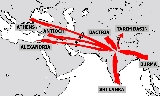
The similarities between the Therapeutae and Buddhist monasticism
Monasticism

Monasticism is the religion practice in which one renounces world pursuits in order to fully devote one's life to spiritual work. The origin of the word is from Ancient Greek, and the idea was originally related to Christian monks....
, a tradition earlier by several centuries, combined with Indian evidence of Buddhist missionary activity to the Mediterranean around 250 BCE (the Edicts of Ashoka
Edicts of Ashoka

The Edicts of Ashoka are a collection of 33 inscriptions on the Pillars of Ashoka, as well as boulders and cave walls, made by the Emperor Ashoka the Great of the Mauryan dynasty during his reign from 272 to 231 BC....
), have been pointed out. The Therapeutae would have been the descendants of Ashoka's emissaries to the West, and would have influenced the early formation of Christianity. The linguist Zacharias P. Thundy also suggests that the word "Therapeutae" is only a Hellenisation of the Indian Pali word for traditional Buddhists, Theravada
Theravada

Theravada...
. In general, Egypt had intense trade and cultural contacts with India during the period, as described in the 1st century CE Periplus of the Erythraean Sea
Periplus of the Erythraean Sea

The Periplus of the Erythraean Sea is a Greek language periplus, describing navigation and Roman commerce from History of Roman Egypt ports like Berenice along the coast of the Red Sea, and others along Horn of Africa and India....
.

From the standpoint of comparative religions, ascetism can be seen as a common point between Buddhism and Christianity, and is in contrast to the absence of asceticism in Judaism
Asceticism in Judaism

Asceticism is a term derived from the Greek language verb ?s???, meaning "to practise strenuously," "to exercise." Athletes were therefore said to go through ascetic training, and to be ascetics....
:

See also

  • Abbey
    Abbey

    An abbey , is a Christianity monastery or convent, under the government of an Abbot or an Abbess, who serves as the spiritual father or mother of the community....
  • Buddhist influences on Christianity
  • Christian monasticism
    Christian monasticism

    Monasticism began to develop early in the history of the Church, modeled upon scriptural examples and ideals, including those in the Old Testament, but not mandated as an institution in the scriptures....
  • Monasticism
    Monasticism

    Monasticism is the religion practice in which one renounces world pursuits in order to fully devote one's life to spiritual work. The origin of the word is from Ancient Greek, and the idea was originally related to Christian monks....
  • Testament of Job
    Testament of Job

    The Testament of Job is a book written in the 1st century BC or the 1st century AD . The earliest surviving manuscript is in Coptic language, of the 5th century; other early surviving manuscripts are in Greek and Old Slavonic....


Further reading

  • Taylor, Joan E. Jewish Women Philosophers of First-Century Alexandria: Philo's "Therapeutae" Reconsidered
  • Simon, Marcel and James H. Farley (tr.) (1967) 1980. Jewish Sects at the Time of Jesus (Philadelphia: Fortress Press)


External links

  • excerpts (in English)