


Theodoros Kolokotronis

Encyclopedia
Theodoros Kolokotronis (3 April 1770 – 4 February 1843) was a Greek
Field Marshal
and one of the leaders of the Greek War of Independence
against the Ottoman Empire
.
Kolokotronis' greatest success was the defeat of the Ottoman army under Mahmud Dramali Pasha
at Dervenakia
in 1822. In 1825, he was appointed commander-in-chief of the Greek forces in the Peloponnese
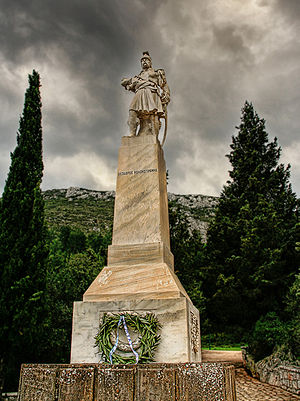
. Today Kolokotronis is among the most revered of the protagonists of the War of Independence.
, and grew up in Libovitsi in Arcadia
. The Kolokotroneoi were a powerful and respected clan in Arcadia in the 18th century. Their legendary pride and insubordination is commemorated in a well-known folk song from that time:
Ahorse they go to church,
Ahorse they kiss the icons,
Ahorse they receive communion
From the priest's hand.
His father, Constantine Kolokotronis, took part in an armed rebellion which was supported by Catherine the Great of Russia, but was killed in an engagement along with two of his brothers George and Harry. Theodoros joined the ranks of a Peloponnesian guerrilla band, and by age fifteen was the leader (kapetanios, which means "captain") of his own group. He had a brief stint at sea as a corsair
, then in 1805 he took service on a series of ships in the Russian fleet in the Russo-Turkish War
. After 1810 he served in a corps of Greek infantry in British service on Zakynthos
, then a British possession, and was awarded the brevet
rank of brigadier
for his service against the French
. From his service in the regular Russian and British forces, Kolokotronis gained valuable insights that he would later use in his career.
.jpg)
bands. These he tried to train and organize into something resembling a modern army. In May, he was named archistrategos
or Marshal Commander-in-Chief. He was already 50 years old by this time, a fact which contributed to his sobriquet O Geros tou Morea or "The Elder of Morea," whereby Morea
was another name describing the Peloponnese
. Kolokotronis' first action was the defense of Valtetsi
, the village near Tripoli
where his army was mustering.
. He took the port, and the Turkish garrison in the town's twin citadels was running low on supplies, but the disorganized Greek provisional government at Argos
, just to the north, could not complete negotiations for its surrender before a large Ottoman force began marching southward to crush the rebels. Panicked, government officials abandoned Argos and began evacuations by sea at Nafplion. Only an under-strength battalion under Demetrios Ypsilantis remained to hold Larissa castle, the fortress of Argos.
lent a hand. The Ottoman army from the north commanded by Mahmud Dramali Pasha
, after taking Corinth
, had marched to the plain of Argos. The castle of Larissa was an excellent position, commanding the whole plain. To leave such a stronghold straddling Turkish supply lines was far too dangerous. Dramali would have to reduce the fortress before moving on. Scaling the cliffs, breaching the castle's stout walls, and overcoming its resolute defenders would be no easy task.
Yet, there was one weakness Dramali was unaware of: Larissa, unlike the famous Acropolis
in Athens, had no spring and consequently fresh water had to be supplied from cistern
s. Unfortunately for the Greeks, it was July and no rains were falling to fill the cisterns. Ypsilantis bluffed the Turks as long as he could, but towards the end of the month had to sneak his men out in the middle of the night. Dramali's men plundered the castle the next day, and he was now free to march them toward the coast to resupply. (The Greeks had pursued a scorched earth
policy, and the large Ottoman force was eating through its food supplies rather quickly). Ypsilantis' defense had bought Kolokotronis and the klephts valuable time.
To his dismay, Dramali found himself cut off from his supply fleet, which had intended to land at Nafplio but was successfully blockade
d by the Greek fleet under Admiral Andreas Miaoulis. Dramali reluctantly decided upon a retreat toward Corinth through the Dervenaki Pass, through which he had just come unmolested. This was exactly what Kolokotronis had been hoping for. In August 1822 his quicker-moving guerrilla forces trapped the Turks in the pass and annihilated them. A devastated Sultan Mahmud II
in Constantinople
was forced to turn to Muhammad Ali
, ruler of the nominally Ottoman pashaluk
of Egypt
for help.
..jpg) The Greeks resumed the siege against the fortresses at Nafplio, which fell in December. Kolokotronis is said to have ridden his horse up the steep slopes of Kastro Palamidi
The Greeks resumed the siege against the fortresses at Nafplio, which fell in December. Kolokotronis is said to have ridden his horse up the steep slopes of Kastro Palamidi
to celebrate his victory there; a statue in the town square commemorates the event. He is attired in something resembling the costume of a hussar
topped with a plumed Corinthian helmet
, which he was fond of wearing, and which foreign Philhellenes were even fonder of seeing him in. (While he seems to have enjoyed dressing like a Western European cavalryman cum Ancient Greek hoplite
, he is also frequently depicted wearing the more traditional fustanella
and other traditional accoutrements).
between the various Greek factions; when his party was finally defeated, he was jailed in Hydra with some of his followers in March 1825, and was released only when an Egyptian army under the command of Ibrahim Pasha
invaded the Morea.
as an appanage
for young Ibrahim if he could crush the rebels. With his eye on the prize, he burned his way through the Peloponnese, gaining much territory but arousing much hostility in Western European public opinion
, which in the long run proved disastrous for the Turks.
 The island of Sphacteria
and Navarino
had already fallen into Ibrahim's hands, and to make matters worse for Kolokotronis, he still had to be on guard against the machinations of Petrobey Mavromichalis even as he was bracing himself against the new threat. Kolokotronis used guerrilla tactics to wear Ibrahim's forces down; but given his limited resources, was unable to prevent the widespread destruction that Ibrahim left in his wake. Still, in 1825, in recognition of his military acumen and many services to the Greek cause, he was appointed commander-in-chief of Greek forces in the Peloponnese.
and a proponent of alliance with Russia
. When the count was assassinated on 8 October 1831, Kolokotronis created his own administration in support of Prince Otto of Bavaria
as a king of Greece. However, later he opposed the Bavaria
n-dominated regency
during his rule. He was charged with treason
and on 7 June 1834 sentenced to death; but he was pardoned in 1835. Theodoros Kolokotronis died in 1843 in Athens
one day after his son's Konstantinos(Kollinos) wedding.
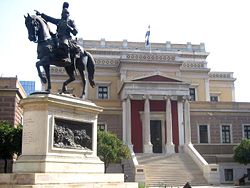
s, which have been a perennial favorite in Greece and have been several times translated into English and other languages. Kolokotronis' famed helmet, along with the rest of his arms and armor, may today be seen in the National History Museum of Greece in Athens. In addition to the Nafplio statue mentioned earlier, there is another to be seen in Athens, in the forecourt of the Old Parliament building
on Stadiou Street
, near Syntagma Square
.
Κοlokotronis was so famous in popular culture that one can find references about him in strange places like a gravure sculpted by knife on a stony sterna inside a cave in one of the holes in mount Ntaouli opposite the village Lyrkeia in the valley of river Inarhos.
Kolokotronis' portrait was depicted on the obverse
of the Greek 5000 drachmas
banknote of 1984-2001.
Greece
Greece , officially the Hellenic Republic , and historically Hellas or the Republic of Greece in English, is a country in southeastern Europe....
Field Marshal
Field Marshal
Field Marshal is a military rank. Traditionally, it is the highest military rank in an army.-Etymology:The origin of the rank of field marshal dates to the early Middle Ages, originally meaning the keeper of the king's horses , from the time of the early Frankish kings.-Usage and hierarchical...
and one of the leaders of the Greek War of Independence
Greek War of Independence
The Greek War of Independence, also known as the Greek Revolution was a successful war of independence waged by the Greek revolutionaries between...
against the Ottoman Empire
Ottoman Empire
The Ottoman EmpireIt was usually referred to as the "Ottoman Empire", the "Turkish Empire", the "Ottoman Caliphate" or more commonly "Turkey" by its contemporaries...
.
Kolokotronis' greatest success was the defeat of the Ottoman army under Mahmud Dramali Pasha
Mahmud Dramali Pasha
Mahmud Pasha, called Dramalı was a Beyzade, an Ottoman Vizier, Serdar-ı Ekrem, Pasha and governor of Larissa, Drama and the Morea. In 1822, he was tasked with suppressing the Greek Revolution, but was defeated and died shortly after....
at Dervenakia
Dervenakia
Dervenakia are small hamlets in the prefecture of Corinthia, in northeastern Peloponnesus . The name is derived from the Turkish word derven, meaning mountain pass....
in 1822. In 1825, he was appointed commander-in-chief of the Greek forces in the Peloponnese
Peloponnese
The Peloponnese, Peloponnesos or Peloponnesus , is a large peninsula , located in a region of southern Greece, forming the part of the country south of the Gulf of Corinth...
. Today Kolokotronis is among the most revered of the protagonists of the War of Independence.
Early life
Kolokotronis was born at Ramavouni in MesseniaMessenia
Messenia is a regional unit in the southwestern part of the Peloponnese region, one of 13 regions into which Greece has been divided by the Kallikratis plan, implemented 1 January 2011...
, and grew up in Libovitsi in Arcadia
Arcadia
Arcadia is one of the regional units of Greece. It is part of the administrative region of Peloponnese. It is situated in the central and eastern part of the Peloponnese peninsula. It takes its name from the mythological character Arcas. In Greek mythology, it was the home of the god Pan...
. The Kolokotroneoi were a powerful and respected clan in Arcadia in the 18th century. Their legendary pride and insubordination is commemorated in a well-known folk song from that time:
Ahorse they go to church,
Ahorse they kiss the icons,
Ahorse they receive communion
From the priest's hand.
His father, Constantine Kolokotronis, took part in an armed rebellion which was supported by Catherine the Great of Russia, but was killed in an engagement along with two of his brothers George and Harry. Theodoros joined the ranks of a Peloponnesian guerrilla band, and by age fifteen was the leader (kapetanios, which means "captain") of his own group. He had a brief stint at sea as a corsair
Corsair
Corsairs were privateers, authorized to conduct raids on shipping of a nation at war with France, on behalf of the French Crown. Seized vessels and cargo were sold at auction, with the corsair captain entitled to a portion of the proceeds...
, then in 1805 he took service on a series of ships in the Russian fleet in the Russo-Turkish War
Russo-Turkish War, 1806-1812
The Russo-Turkish War was one of many wars fought between Imperial Russia and the Ottoman Empire.- Background :The war broke out in 1805–1806 against the background of the Napoleonic Wars...
. After 1810 he served in a corps of Greek infantry in British service on Zakynthos
Zakynthos
Zakynthos , also Zante, the other form often used in English and in Italian , is a Greek island in the Ionian Sea. It is the third largest of the Ionian Islands. It is also a separate regional unit of the Ionian Islands region, and the only municipality of the regional unit. It covers an area of ...
, then a British possession, and was awarded the brevet
Brevet (military)
In many of the world's military establishments, brevet referred to a warrant authorizing a commissioned officer to hold a higher rank temporarily, but usually without receiving the pay of that higher rank except when actually serving in that role. An officer so promoted may be referred to as being...
rank of brigadier
Brigadier
Brigadier is a senior military rank, the meaning of which is somewhat different in different military services. The brigadier rank is generally superior to the rank of colonel, and subordinate to major general....
for his service against the French
France
The French Republic , The French Republic , The French Republic , (commonly known as France , is a unitary semi-presidential republic in Western Europe with several overseas territories and islands located on other continents and in the Indian, Pacific, and Atlantic oceans. Metropolitan France...
. From his service in the regular Russian and British forces, Kolokotronis gained valuable insights that he would later use in his career.
War of Independence
Outbreak
Kolokotronis returned to the mainland just prior to the outbreak of the war (officially, 25 March 1821) and formed a confederation of irregular Moreot klephtKlepht
Klephts were self-appointed armatoloi, anti-Ottoman insurgents, and warlike mountain-folk who lived in the countryside when Greece was a part of the Ottoman Empire...
bands. These he tried to train and organize into something resembling a modern army. In May, he was named archistrategos
Strategos
Strategos, plural strategoi, is used in Greek to mean "general". In the Hellenistic and Byzantine Empires the term was also used to describe a military governor...
or Marshal Commander-in-Chief. He was already 50 years old by this time, a fact which contributed to his sobriquet O Geros tou Morea or "The Elder of Morea," whereby Morea
Morea
The Morea was the name of the Peloponnese peninsula in southern Greece during the Middle Ages and the early modern period. It also referred to a Byzantine province in the region, known as the Despotate of Morea.-Origins of the name:...
was another name describing the Peloponnese
Peloponnese
The Peloponnese, Peloponnesos or Peloponnesus , is a large peninsula , located in a region of southern Greece, forming the part of the country south of the Gulf of Corinth...
. Kolokotronis' first action was the defense of Valtetsi
Valtetsi
Valtetsi is a village and a former municipality in Arcadia, Peloponnese, Greece. Since the 2011 local government reform it is part of the municipality Tripoli, of which it is a municipal unit. Population 1,842 . The seat of the municipality was in Asea. The municipality was recreated in the...
, the village near Tripoli
Tripoli, Greece
Tripoli is a city of about 25,000 inhabitants in the central part of the Peloponnese, in Greece. It is the capital of the prefecture of Arcadia and the centre of the municipality of Tripolis, pop...
where his army was mustering.
Nafplion
He next commanded Greek troops in the siege of the coastal town of NafplionNafplion
Nafplio is a seaport town in the Peloponnese in Greece that has expanded up the hillsides near the north end of the Argolic Gulf. The town was the first capital of modern Greece, from the start of the Greek Revolution in 1821 until 1834. Nafplio is now the capital of the peripheral unit of...
. He took the port, and the Turkish garrison in the town's twin citadels was running low on supplies, but the disorganized Greek provisional government at Argos
Argos
Argos is a city and a former municipality in Argolis, Peloponnese, Greece. Since the 2011 local government reform it is part of the municipality Argos-Mykines, of which it is a municipal unit. It is 11 kilometres from Nafplion, which was its historic harbour...
, just to the north, could not complete negotiations for its surrender before a large Ottoman force began marching southward to crush the rebels. Panicked, government officials abandoned Argos and began evacuations by sea at Nafplion. Only an under-strength battalion under Demetrios Ypsilantis remained to hold Larissa castle, the fortress of Argos.
As liberator
Kolokotronis gathered the klephts together to march to the relief of Ypsilantis. This was quite a feat in itself, considering the near-collapse of the government and the notoriously quarrelsome nature of the klephtic bands. Even the troublesome SouliotesSouliotes
Souliotes were a warlike community from the area of Souli, in Greece, who became famous across Greece for their resistance against the local Ottoman Pashalik of Yanina ruled by the Muslim Albanian Ali Pasha...
lent a hand. The Ottoman army from the north commanded by Mahmud Dramali Pasha
Mahmud Dramali Pasha
Mahmud Pasha, called Dramalı was a Beyzade, an Ottoman Vizier, Serdar-ı Ekrem, Pasha and governor of Larissa, Drama and the Morea. In 1822, he was tasked with suppressing the Greek Revolution, but was defeated and died shortly after....
, after taking Corinth
Corinth
Corinth is a city and former municipality in Corinthia, Peloponnese, Greece. Since the 2011 local government reform it is part of the municipality Corinth, of which it is the seat and a municipal unit...
, had marched to the plain of Argos. The castle of Larissa was an excellent position, commanding the whole plain. To leave such a stronghold straddling Turkish supply lines was far too dangerous. Dramali would have to reduce the fortress before moving on. Scaling the cliffs, breaching the castle's stout walls, and overcoming its resolute defenders would be no easy task.
Yet, there was one weakness Dramali was unaware of: Larissa, unlike the famous Acropolis
Acropolis
Acropolis means "high city" in Greek, literally city on the extremity and is usually translated into English as Citadel . For purposes of defense, early people naturally chose elevated ground to build a new settlement, frequently a hill with precipitous sides...
in Athens, had no spring and consequently fresh water had to be supplied from cistern
Cistern
A cistern is a waterproof receptacle for holding liquids, usually water. Cisterns are often built to catch and store rainwater. Cisterns are distinguished from wells by their waterproof linings...
s. Unfortunately for the Greeks, it was July and no rains were falling to fill the cisterns. Ypsilantis bluffed the Turks as long as he could, but towards the end of the month had to sneak his men out in the middle of the night. Dramali's men plundered the castle the next day, and he was now free to march them toward the coast to resupply. (The Greeks had pursued a scorched earth
Scorched earth
A scorched earth policy is a military strategy or operational method which involves destroying anything that might be useful to the enemy while advancing through or withdrawing from an area...
policy, and the large Ottoman force was eating through its food supplies rather quickly). Ypsilantis' defense had bought Kolokotronis and the klephts valuable time.
To his dismay, Dramali found himself cut off from his supply fleet, which had intended to land at Nafplio but was successfully blockade
Blockade
A blockade is an effort to cut off food, supplies, war material or communications from a particular area by force, either in part or totally. A blockade should not be confused with an embargo or sanctions, which are legal barriers to trade, and is distinct from a siege in that a blockade is usually...
d by the Greek fleet under Admiral Andreas Miaoulis. Dramali reluctantly decided upon a retreat toward Corinth through the Dervenaki Pass, through which he had just come unmolested. This was exactly what Kolokotronis had been hoping for. In August 1822 his quicker-moving guerrilla forces trapped the Turks in the pass and annihilated them. A devastated Sultan Mahmud II
Mahmud II
Mahmud II was the 30th Sultan of the Ottoman Empire from 1808 until his death in 1839. He was born in the Topkapi Palace, Istanbul, the son of Sultan Abdulhamid I...
in Constantinople
Constantinople
Constantinople was the capital of the Roman, Eastern Roman, Byzantine, Latin, and Ottoman Empires. Throughout most of the Middle Ages, Constantinople was Europe's largest and wealthiest city.-Names:...
was forced to turn to Muhammad Ali
Muhammad Ali of Egypt
Muhammad Ali Pasha al-Mas'ud ibn Agha was a commander in the Ottoman army, who became Wāli, and self-declared Khedive of Egypt and Sudan...
, ruler of the nominally Ottoman pashaluk
Pashaluk
Pashaluk or Pashalik is a term for one type of the Subdivisions of the Ottoman Empire.It is the abstract word derived from pasha, denoting the quality, office or jurisdiction of a pasha or the territory administered by him....
of Egypt
Egypt
Egypt , officially the Arab Republic of Egypt, Arabic: , is a country mainly in North Africa, with the Sinai Peninsula forming a land bridge in Southwest Asia. Egypt is thus a transcontinental country, and a major power in Africa, the Mediterranean Basin, the Middle East and the Muslim world...
for help.
Palamidi
Palamidi is a military fortress to the east of the Acronauplia in the town of Nafplion in the Peloponnese region of southern Greece. Nestled on the crest of a 216-metre high hill, the fortress was built by the Venetians during their second occupation of the area .The fortress was a very large and...
to celebrate his victory there; a statue in the town square commemorates the event. He is attired in something resembling the costume of a hussar
Hussar
Hussar refers to a number of types of light cavalry which originated in Hungary in the 14th century, tracing its roots from Serbian medieval cavalry tradition, brought to Hungary in the course of the Serb migrations, which began in the late 14th century....
topped with a plumed Corinthian helmet
Corinthian helmet
The Corinthian helmet originated in ancient Greece and took its name from the city-state of Corinth. It was a helmet made of bronze which in its later styles covered the entire head and neck, with slits for the eyes and mouth. A large curved projection protected the nape of the neck...
, which he was fond of wearing, and which foreign Philhellenes were even fonder of seeing him in. (While he seems to have enjoyed dressing like a Western European cavalryman cum Ancient Greek hoplite
Hoplite
A hoplite was a citizen-soldier of the Ancient Greek city-states. Hoplites were primarily armed as spearmen and fought in a phalanx formation. The word "hoplite" derives from "hoplon" , the type of the shield used by the soldiers, although, as a word, "hopla" could also denote weapons held or even...
, he is also frequently depicted wearing the more traditional fustanella
Fustanella
Fustanella is a traditional skirt-like garment worn by men of many nations in the Balkans, similar to the kilt. In modern times, the fustanella is part of Balkan folk dresses...
and other traditional accoutrements).
Parliamentary crisis
From December 1823 to February 1825, he took part in the civil warsGreek civil wars of 1824–1825
The Greek War of Independence was marked by two civil wars, which took place in 1824–1825. The conflict had both political and regional dimensions, as it pitted the Roumeliots against the Peloponnesians or Moreots...
between the various Greek factions; when his party was finally defeated, he was jailed in Hydra with some of his followers in March 1825, and was released only when an Egyptian army under the command of Ibrahim Pasha
Ibrahim Pasha of Egypt
Ibrahim Pasha was the eldest son of Muhammad Ali, the Wāli and unrecognised Khedive of Egypt and Sudan. He served as a general in the Egyptian army that his father established during his reign, taking his first command of Egyptian forces was when he was merely a teenager...
invaded the Morea.
Ibrahim's campaign
Ibrahim was fresh from fighting the Wahhabi rebels in Arabia, and so was used to fighting guerrillas. His troops were armed with the most modern equipment and trained by European experts. The sultan had promised his father the island of CreteCrete
Crete is the largest and most populous of the Greek islands, the fifth largest island in the Mediterranean Sea, and one of the thirteen administrative regions of Greece. It forms a significant part of the economy and cultural heritage of Greece while retaining its own local cultural traits...
as an appanage
Appanage
An apanage or appanage or is the grant of an estate, titles, offices, or other things of value to the younger male children of a sovereign, who would otherwise have no inheritance under the system of primogeniture...
for young Ibrahim if he could crush the rebels. With his eye on the prize, he burned his way through the Peloponnese, gaining much territory but arousing much hostility in Western European public opinion
Public opinion
Public opinion is the aggregate of individual attitudes or beliefs held by the adult population. Public opinion can also be defined as the complex collection of opinions of many different people and the sum of all their views....
, which in the long run proved disastrous for the Turks.
Sphacteria
Sphacteria Sphacteria Sphacteria (Sphacteria (Sphacteria is a small island at the entrance to the bay of Pylos in the Peloponnese, Greece. It was the site of three battles:*the 425 BC Battle of Sphacteria in the Peloponnesian war....
and Navarino
Pylos
Pylos , historically known under its Italian name Navarino, is a town and a former municipality in Messenia, Peloponnese, Greece. Since the 2011 local government reform it is part of the municipality Pylos-Nestoras, of which it is the seat and a municipal unit. It was the capital of the former...
had already fallen into Ibrahim's hands, and to make matters worse for Kolokotronis, he still had to be on guard against the machinations of Petrobey Mavromichalis even as he was bracing himself against the new threat. Kolokotronis used guerrilla tactics to wear Ibrahim's forces down; but given his limited resources, was unable to prevent the widespread destruction that Ibrahim left in his wake. Still, in 1825, in recognition of his military acumen and many services to the Greek cause, he was appointed commander-in-chief of Greek forces in the Peloponnese.
Postbellum activities
After the war Kolokotronis became a supporter of Count Ioannis KapodistriasIoannis Kapodistrias
Count Ioannis Antonios Kapodistrias |Academy of Athens]] Critical Observations about the 6th-Grade History Textbook"): "3.2.7. Σελ. 40: Δεν αναφέρεται ότι ο Καποδίστριας ήταν Κερκυραίος ευγενής." "...δύο ιστορικούς της Aκαδημίας κ.κ...
and a proponent of alliance with Russia
Russia
Russia or , officially known as both Russia and the Russian Federation , is a country in northern Eurasia. It is a federal semi-presidential republic, comprising 83 federal subjects...
. When the count was assassinated on 8 October 1831, Kolokotronis created his own administration in support of Prince Otto of Bavaria
Otto of Greece
Otto, Prince of Bavaria, then Othon, King of Greece was made the first modern King of Greece in 1832 under the Convention of London, whereby Greece became a new independent kingdom under the protection of the Great Powers .The second son of the philhellene King Ludwig I of Bavaria, Otto ascended...
as a king of Greece. However, later he opposed the Bavaria
Bavaria
Bavaria, formally the Free State of Bavaria is a state of Germany, located in the southeast of Germany. With an area of , it is the largest state by area, forming almost 20% of the total land area of Germany...
n-dominated regency
Regent
A regent, from the Latin regens "one who reigns", is a person selected to act as head of state because the ruler is a minor, not present, or debilitated. Currently there are only two ruling Regencies in the world, sovereign Liechtenstein and the Malaysian constitutive state of Terengganu...
during his rule. He was charged with treason
Treason
In law, treason is the crime that covers some of the more extreme acts against one's sovereign or nation. Historically, treason also covered the murder of specific social superiors, such as the murder of a husband by his wife. Treason against the king was known as high treason and treason against a...
and on 7 June 1834 sentenced to death; but he was pardoned in 1835. Theodoros Kolokotronis died in 1843 in Athens
Athens
Athens , is the capital and largest city of Greece. Athens dominates the Attica region and is one of the world's oldest cities, as its recorded history spans around 3,400 years. Classical Athens was a powerful city-state...
one day after his son's Konstantinos(Kollinos) wedding.
Epilogue
In the twilight of his life, Kolokotronis had learned to write in order to complete his memoirMemoir
A memoir , is a literary genre, forming a subclass of autobiography – although the terms 'memoir' and 'autobiography' are almost interchangeable. Memoir is autobiographical writing, but not all autobiographical writing follows the criteria for memoir set out below...
s, which have been a perennial favorite in Greece and have been several times translated into English and other languages. Kolokotronis' famed helmet, along with the rest of his arms and armor, may today be seen in the National History Museum of Greece in Athens. In addition to the Nafplio statue mentioned earlier, there is another to be seen in Athens, in the forecourt of the Old Parliament building
Old Parliament House, Athens
The Old Parliament building at Stadiou Street in Athens, housed the Greek Parliament between 1875 and 1932. It now houses the country's National Historical Museum .-History:...
on Stadiou Street
Stadiou Street
Stadiou Street is Athens' major street linking the Omonoia and Syntagma Squares. It runs diagonally and is one-way from northwest to southeast...
, near Syntagma Square
Syntagma Square
Syntagma Square , is located in central Athens, Greece. The Square is named after the Constitution that King Otto was forced to grant the people after a popular and military uprising, on September 3, 1843....
.
Legacy
Kolokotronis is also the name of military barracks near Tripolis.Κοlokotronis was so famous in popular culture that one can find references about him in strange places like a gravure sculpted by knife on a stony sterna inside a cave in one of the holes in mount Ntaouli opposite the village Lyrkeia in the valley of river Inarhos.
Kolokotronis' portrait was depicted on the obverse
Obverse and reverse
Obverse and its opposite, reverse, refer to the two flat faces of coins and some other two-sided objects, including paper money, flags , seals, medals, drawings, old master prints and other works of art, and printed fabrics. In this usage, obverse means the front face of the object and reverse...
of the Greek 5000 drachmas
Greek drachma
Drachma, pl. drachmas or drachmae was the currency used in Greece during several periods in its history:...
banknote of 1984-2001.
Further reading
- Brewer, David L. The Greek War of Independence: The Struggle for Freedom from Ottoman Oppression and the Birth of the Modern Greek Nation. Woodstock & New York, Overlook Press: 2001.
- Kolokotronis, Theodoros. Memoirs from the Greek War of Independence, 1821–1833 Argonaut Publishers: 1969.
- Kolokotronis, Theodoros (translated by Elizabeth M. Edmonds). The Old Man of the Morea: An Autobiography. Reprint. Boston, Holy Cross Orthodox Press: 1984.http://ia600401.us.archive.org/22/items/kolokotronesklep00kolorich/kolokotronesklep00kolorich.pdf