
All Topics  
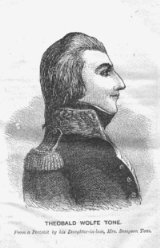
Theobald Wolfe Tone


   Email Print
   Bookmark   Link


Theobald Wolfe Tone


Theobald Wolfe Tone, commonly known as Wolfe Tone (20 June 1763 – 19 November 1798) was a leading figure in the United Irishmen Irish independence
Irish independence

Irish independence may refer to:* Irish War of Independence - a guerrilla war fought between the Irish Republican Army, under the Irish Republic, and the United Kingdom of Great Britain and Ireland...
 movement and is regarded as the father of Irish republicanism
Irish Republicanism

Irish republicanism is an ideology based on the Irish nationalist belief that all of Ireland should be a single independent republic.In 1801, under the Act of Union 1800, the Kingdoms of Great Britain and Ireland merged to form the United Kingdom of Great Britain and Ireland....
. He died from a wound after being sentenced to death for his part in the Irish Rebellion of 1798
Irish Rebellion of 1798

The Irish Rebellion of 1798 , or 1798 rebellion as it is known locally, was an uprising in 1798, lasting several months, against United Kingdom and its subject Kingdom of Ireland....
; the exact circumstances of which have always been debated, as to whether the wound was self-inflicted - or carried out by another, thus depriving Tone of the opportunity of appealing his death sentence.

in Dublin
Dublin

Dublin is both the largest city and capital of Republic of Ireland. It is located near the midpoint of Ireland's east coast, at the mouth of the River Liffey and at the centre of the Dublin Region....
, the son of a Church of Ireland
Church of Ireland

The Church of Ireland is an autonomous province of the Anglican Communion, operating across the island of Ireland. Like other Anglican churches, it considers itself to be both Catholicism and Protestant Reformation....
 Protestant coach-maker, Tone studied law at Trinity College, Dublin
Trinity College, Dublin

Trinity College, Dublin , corporately designated as the Provost, Fellows and Scholars of the College of the Holy and Undivided Trinity of Queen Elizabeth near Dublin, was founded in 1592 by Queen Elizabeth I of England as the "mother of a university", and is the only constituent residential college of the University of Dublin....
 and qualified as a barrister from King's Inns at the age of 26 and attended the Inns of Court
Inns of Court

The Inns of Court in London are the professional associations to one of which every Barristers in England and Wales must belong. They have supervisory and disciplinary functions over their members....
 in London
London

London is the capital of both England and the United Kingdom, and the most populous municipality in the European Union. An important settlement for two millennia, History of London goes back to its founding by the Roman Empire....
.


Discussion
Ask a question about 'Theobald Wolfe Tone'
Start a new discussion about 'Theobald Wolfe Tone'
Answer questions from other users
Full Discussion Forum


Encyclopedia


Theobald Wolfe Tone, commonly known as Wolfe Tone (20 June 1763 – 19 November 1798) was a leading figure in the United Irishmen Irish independence
Irish independence

Irish independence may refer to:* Irish War of Independence - a guerrilla war fought between the Irish Republican Army, under the Irish Republic, and the United Kingdom of Great Britain and Ireland...
 movement and is regarded as the father of Irish republicanism
Irish Republicanism

Irish republicanism is an ideology based on the Irish nationalist belief that all of Ireland should be a single independent republic.In 1801, under the Act of Union 1800, the Kingdoms of Great Britain and Ireland merged to form the United Kingdom of Great Britain and Ireland....
. He died from a wound after being sentenced to death for his part in the Irish Rebellion of 1798
Irish Rebellion of 1798

The Irish Rebellion of 1798 , or 1798 rebellion as it is known locally, was an uprising in 1798, lasting several months, against United Kingdom and its subject Kingdom of Ireland....
; the exact circumstances of which have always been debated, as to whether the wound was self-inflicted - or carried out by another, thus depriving Tone of the opportunity of appealing his death sentence.

Early years

Born in Dublin
Dublin

Dublin is both the largest city and capital of Republic of Ireland. It is located near the midpoint of Ireland's east coast, at the mouth of the River Liffey and at the centre of the Dublin Region....
, the son of a Church of Ireland
Church of Ireland

The Church of Ireland is an autonomous province of the Anglican Communion, operating across the island of Ireland. Like other Anglican churches, it considers itself to be both Catholicism and Protestant Reformation....
 Protestant coach-maker, Tone studied law at Trinity College, Dublin
Trinity College, Dublin

Trinity College, Dublin , corporately designated as the Provost, Fellows and Scholars of the College of the Holy and Undivided Trinity of Queen Elizabeth near Dublin, was founded in 1592 by Queen Elizabeth I of England as the "mother of a university", and is the only constituent residential college of the University of Dublin....
 and qualified as a barrister from King's Inns at the age of 26 and attended the Inns of Court
Inns of Court

The Inns of Court in London are the professional associations to one of which every Barristers in England and Wales must belong. They have supervisory and disciplinary functions over their members....
 in London
London

London is the capital of both England and the United Kingdom, and the most populous municipality in the European Union. An important settlement for two millennia, History of London goes back to its founding by the Roman Empire....
. As a student, he eloped with Martha Witherington, daughter of William Witherington of Dublin, and his wife, Catherine Fanning.

Politician

Disappointed at finding no support for a plan to found a military colony in Hawaii
Hawaii

File:Pahoehoe and Aa flows at Hawaii.jpgThe State of Hawaii is a U.S. state in the United States, located on an archipelago in the central Pacific Ocean southwest of the continental United States, southeast of Japan, and northeast of Australia....
 he submitted to William Pitt the Younger
William Pitt the Younger

William Pitt, the Younger was a Kingdom of Great Britain politician of the late eighteenth century and early nineteenth century. He became the youngest Prime Minister of the United Kingdom in 1783 at the age of 24....
, Tone turned to Irish politics. In 1790 pamphlet attacking the administration of the Marquess of Buckingham
George Nugent-Temple-Grenville, 1st Marquess of Buckingham

George Nugent-Temple-Grenville, 1st Marquess of Buckingham, knight of the Garter, Her Majesty's Most Honourable Privy Council was a United Kingdom statesman; he was the second son of George Grenville and a brother of the William Grenville, 1st Baron Grenville....
 brought him to the notice of the Whig
British Whig Party

The Whigs are often described as one of two political party in Kingdom of England and later the United Kingdom from the late 17th to the mid-19th centuries....
 club; in September 1791 he wrote an essay by "A Northern Whig," 10,000 copies of which were said to have been sold.

The principles of the French Revolution
French Revolution

The French Revolution was a period of political and social upheaval and radical change in the history of France, during which the French governmental structure, previously an absolute monarchy with feudalism for the aristocracy and Roman Catholic Church clergy, underwent radical change to forms based on Age of Enlightenment principles of cit...
 were now being eagerly embraced in Ireland, especially among the Presbyterians of Ulster
Ulster

Ulster is one of the four Provinces of Ireland of Ireland, in addition to Connacht, Munster and Leinster. The name is sometimes informally used as a synonym for Northern Ireland, one of the countries of the United Kingdom, although Northern Ireland covers only two thirds of Ulster....
. Two months before Tone's essay, a meeting had been held in Belfast
Belfast

Belfast is the capital city of Northern Ireland and the seat of Devolution#United Kingdom Northern Ireland Executive and legislative Northern Ireland Assembly in Northern Ireland....
, where republican toasts had been drunk and a resolution in favour of the abolition of religious disqualifications gave the first sign of political sympathy between the Roman Catholics and the Protestant dissenter
Dissenter

The term dissenter , labels one who dissents or disagrees in matters of opinion, belief, etc. In the social and religious history of England and Wales, however, it refers particularly to a member of a religious body in England or Wales who has, for one reason or another, separated from the Established Church....
s ("Whigs") of the north. "A Northern Whig" emphasized the growing breach between Whig
British Whig Party

The Whigs are often described as one of two political party in Kingdom of England and later the United Kingdom from the late 17th to the mid-19th centuries....
 patriots like Henry Flood
Henry Flood

Henry Flood , Irish statesman, son of Warden Flood, chief justice of the kings bench in Ireland, was educated at Trinity College, Dublin, and afterwards at Christ Church, Oxford, where he became proficient in the classics....
 and Henry Grattan
Henry Grattan

Henry Grattan was a member of the Irish House of Commons and a campaigner for legislative freedom for the Parliament of Ireland in the late 18th century....
, who aimed at Catholic emancipation
Catholic Emancipation

Catholic Emancipation or Catholic Relief, was a process in Great Britain and Ireland in the late 18th century and early 19th century which involved reducing and removing many of the restrictions on Roman Catholics which had been introduced by the Act of Uniformity, the Test Acts and the Penal Laws....
 and parliamentary reform without severing the tie to England, and those who desired a separate Irish republic
Republic

A republic is a state or country that is not led by a hereditary monarch but in which the people have an impact on its government. The word originates from the Latin term res publica....
. Tone expressed contempt for the constitution Grattan so triumphantly extorted from the British government in 1782; himself an Anglican, Tone urged co-operation between the different religions in Ireland as the only means of obtaining redress of Irish grievances. In October 1791 Tone converted these ideas into practical policy by founding, in conjunction with Thomas Russell
Thomas Russell (rebel)

Thomas Paliser Russell was a co-founder and leader of the United Irishmen who was executed for his part in Robert Emmet rebellion in 1803....
 (1767-1803), Napper Tandy
James Napper Tandy

James Napper Tandy , was an Ireland rebel leader....
 and others, the Society of the United Irishmen
Society of the United Irishmen

The Society of United Irishmen was founded as a Liberalism political organisation in eighteenth century Ireland that sought Parliament of Great Britain reform....
. The original purpose of this society was no more than the formation of a political union between Roman Catholics and Protestants, with a view to obtaining a liberal measure of parliamentary reform. It was only when it was obvious that this was unattainable by constitutional methods that the majority of the members adopted the more uncompromising opinions which Wolfe Tone held from the first, and conspired to establish an Irish republic by armed rebellion.

Tone himself admitted that with him hatred of England had always been "rather an instinct than a principle", though until his views should become more generally accepted in Ireland he was prepared to work for reform as distinguished from revolution
Revolution

A revolution is a fundamental social change in power or organizational structures that takes place in a relatively short period of time....
. But he wanted to root out the popular respect for the names of Charlemont
James Caulfeild, 1st Earl of Charlemont

James Caulfeild, 1st Earl of Charlemont Order of St Patrick Privy Council of Ireland was an Ireland statesman.The son of the James Caulfeild, 3rd Viscount Charlemont, he was born in Dublin, and succeeded his father as 4th Viscount in 1734....
 and Henry Grattan, transferring the leadership to more militant campaigners. Grattan was a reformer and a patriot without democratic ideas; Wolfe Tone was a revolutionary whose principles were drawn from the French Convention
National Convention

During the French Revolution, the National Convention or Convention, in France, comprised the constitutional and legislative Deliberative assembly which sat from 20 September 1792 to 26 October 1795 ....
. Grattan's political philosophy was allied to that of Edmund Burke
Edmund Burke

Edmund Burke was an Irish statesman, author, orator, political theorist, and philosophy who, after relocating to Great Britain, served for many years in the British House of Commons as a member of the British Whig Party party....
; Tone was a disciple of Georges Danton
Georges Danton

Georges Jacques Danton was a leading figure in the early stages of the French Revolution and the first President of the Committee of Public Safety....
 and Thomas Paine
Thomas Paine

Thomas Paine was a UK pamphleteer, revolutionary, Radicalism , inventor, and intellectual. He lived and worked in Britain until age 37, when he emigrated to the British American colonies, in time to participate in the American Revolution....
. Paine was a roommate of Tone's compatriot, "Citizen Lord" Edward FitzGerald
Lord Edward FitzGerald

Lord Edward FitzGerald was an Irish aristocrat and revolutionary. He was the fifth son of the James FitzGerald, 1st Duke of Leinster and the Lady Emily Lennox and, was born at Carton House, near Dublin....
, in Paris; and Paine's famous themes of the "rights of man" and "common sense" can be seen in the opening paragraph of the Declaration of the United Irishmen.

It is important to note the use of the word 'united'. This was what particularly alarmed the British aristocracy in Westminster as they saw the Catholic population as the greatest threat to their power in Ireland. Catholics had additional concerns of their own, these usually being having to pay the tithe
Tithe

A tithe is a one-tenth part of something, paid as a voluntary contribution or as a tax or levy, usually to support a Christian religious organization....
 bill to the Anglican Church of Ireland
Church of Ireland

The Church of Ireland is an autonomous province of the Anglican Communion, operating across the island of Ireland. Like other Anglican churches, it considers itself to be both Catholicism and Protestant Reformation....
 and the rent necessary to lease land from the Protestant Ascendancy
Protestant Ascendancy

The Protestant Ascendancy is a convenient phrase used when referring to the political, economic, and social domination of the former Kingdom of Ireland by a minority of great landowners, establishment clergy, and professionals, all members of the Established Church during the 17th, 18th, and 19th centuries....
. Eighteenth century Ireland was a sectarian state, ruled by a small Anglican minority, over both a majority Catholic population (most of whose ancestors had been dispossessed of land and political power in the 17th century Plantations of Ireland
Plantations of Ireland

Plantations in 16th and 17th century Ireland were established throughout the country by the confiscation of lands occupied by Gaelic clans and Hiberno-Norman dynasties, but principally in the provinces of Munster and Ulster....
), as well to the exclusion of Presbyterian and dissenting Christians from high political office. This was in part also an ethnic division, the Catholics and Presbyterians being descended from native Irish, Normans, 'Old English', and Scottish settlers, and the "Protestants" (Church of Ireland) more often from English settlers. It is important to note, however, that in this era and place, "Protestant" referred specifically to the state sanctioned church, rather than to what today would be broadly referred to as "Protestantism"; many of what would be today called "Protestants" (but not Episcopalian/Anglican/Church of Ireland) would have then referred to themselves as "dissenters".

Existing sectarian animosity did threaten to undermine the United Irishmen movement: two secret societies in Ulster
Ulster

Ulster is one of the four Provinces of Ireland of Ireland, in addition to Connacht, Munster and Leinster. The name is sometimes informally used as a synonym for Northern Ireland, one of the countries of the United Kingdom, although Northern Ireland covers only two thirds of Ulster....
 fought against each other, the Peep O'Day Boys
Peep O'Day Boys

The Peep O'Day Boys was a Protestant faction fighting group in Ireland 1691-1801, active in the 1780s and '90s and precursor of the Orange Order....
, who were made up mostly of Protestants, and the Defenders
Defenders (Ireland)

The Defenders were a militant, vigilante agrarian secret society in Ireland 1691-1801, who were involved in the Society of United Irishmen Irish Rebellion of 1798....
, who were made up of Catholics. These two groups clashed frequently from 1785 and sectarian violence worsened in the county Armagh
County Armagh

County Armagh is a counties of Ireland in Ulster in the north east of Ireland. It is the smallest, in area, of the six counties that form Northern Ireland and second smallest in Ulster....
 area from the mid 1790s. Sectarianism was deliberately fostered to undermine Wolfe Tone's movement, as it suggested that Ireland couldn't be united and that religious prejudices were too strong. In addition, the militant Protestant groups, including the newly founded Orange Order
Orange Institution

The Orange Institution, more commonly known as the Orange Order or the Orange Lodge, is a Protestant fraternal organisation based predominantly in Northern Ireland and Scotland with lodges throughout the Commonwealth of Nations and the United States....
, could be mobilised against the United Irishmen by the British authorities. However these groups were largely based in Ulster, and the underlying reason for their conflicts was the growing demand for rented land, not religion per se.

However, democratic principles were gaining ground among the Catholics as well as among the Presbyterians. A quarrel between the moderate and the more advanced sections of the Catholic Committee led, in December 1791, to the secession of sixty-eight of the former, led by Lord Kenmare
Thomas Browne, 4th Viscount Kenmare

Thomas Browne, 6th Baronet & 4th Viscount Kenmare was an Irish landowner and politician. He was probably born at Killarney, County Kerry, the second of four children of Valentine Browne, fifth Baronet, third Viscount Kenmare , one of the few remaining great Roman Catholic landowners in Ireland, and his first wife, Honoria Butler ....
; and the direction of the committee then passed to more violent leaders, of whom the most prominent was John Keogh
John Keogh

John Keogh was a leading Irish people campaigner who struggled to get Irish Roman Catholicism the right to vote and the repeal of the Penal laws ....
, a Dublin tradesman, known as 'Gog'. The active participation of the Catholics in the movement of the United Irishmen was strengthened by the appointment of Tone as paid secretary of the Roman Catholic Committee in the spring of 1792. Despite his desire to emancipate his fellow countrymen, Tone had very little respect for the Catholic faith (a view shared by many subsequent Irish republicans
Irish Republicanism

Irish republicanism is an ideology based on the Irish nationalist belief that all of Ireland should be a single independent republic.In 1801, under the Act of Union 1800, the Kingdoms of Great Britain and Ireland merged to form the United Kingdom of Great Britain and Ireland....
). When the legality of the Catholic Convention in 1792 was questioned by the government, Tone drew up for the committee a statement of the case on which a favourable opinion of counsel was obtained; and a sum of £1500 with a gold medal was voted to Tone by the Convention when it dissolved itself in April 1793. A petition was made to the king early in 1793 and that year the re-enfranchisement of Catholics was enacted, if they had property as 'forty shilling freeholders
Forty Shilling Freeholders

Forty shilling freeholders were a group of landowners who had the Parliamentary franchise to vote in county constituencies in various parts of the British Isles....
'. They could not, however, enter parliament or be made state officials above grand jurors. Burke and Grattan were anxious that provision should be made for the education of Irish Roman Catholic priests in Ireland, to preserve them from the contagion of Jacobinism in France; Wolfe Tone, "with an incomparably juster forecast", as Lecky observes, "advocated the same measure for exactly opposite reasons." He rejoiced that the breaking up of the French schools by the revolution had rendered necessary the foundation of St Patrick's College, Maynooth, which he foresaw would draw the sympathies of the clergy into more democratic channels.

Revolutionary in exile

In 1794 the United Irishmen, persuaded that their scheme of universal suffrage
Universal suffrage

Universal suffrage consists of the extension of the Suffrage to adult citizens as a whole, though it may also mean extending said right to minors and noncitizens....
 and equal electoral districts was not likely to be accepted by any party in the Irish parliament, began to found their hopes on a French invasion. An English clergyman named William Jackson, who had imbibed revolutionary opinions during his long stay in France, came to Ireland to negotiate between the French committee of public safety
Committee of Public Safety

File:Comite de Salut Public.jpgThe Committee of Public Safety , set up by the National Convention in July of 1793, formed the de facto executive government of France during the Reign of Terror of the French Revolution....
 and the United Irishmen. Tone drew up a memorandum for Jackson on the state of Ireland, which he described as ripe for revolution; the memorandum was betrayed to the government by an attorney named Cockayne, to whom Jackson had imprudently disclosed his mission; and in April 1794 Jackson was arrested on a charge of treason.

Also in 1794 the society became a sworn association, using oaths that were clearly designed to overthrow the state. Given that France and Britain had been at war since early 1793
French Revolutionary Wars

The French Revolutionary Wars were a series of major conflicts, from 1792 until 1802, fought between the French Revolutionary government and several European states....
, administering or making such oaths turned the society into something more than a liberal pressure group.

Several of the leading United Irishmen, including Reynolds and Archibald Hamilton Rowan
Archibald Hamilton Rowan

Archibald Hamilton Rowan , christened Archibald Hamilton, was an Irish celebrity and founding member of The Dublin Society of United Irishmen. He was the son of Gawen Hamilton of Killyleagh Castle, Co....
, immediately fled the country; the papers of the United Irishmen were seized, and for a time the organisation was broken up. Tone, who had not attended meetings of the society since May 1793, remained in Ireland until after the trial and suicide of Jackson in April 1795. Having friends among the government party, including members of the Beresford family, he was able to make terms with the government, and in return for information as to what had passed between Jackson, Rowan and himself, he was permitted to emigrate to the United States, where he arrived in May 1795. Before leaving, he and his family travelled to Belfast
Belfast

Belfast is the capital city of Northern Ireland and the seat of Devolution#United Kingdom Northern Ireland Executive and legislative Northern Ireland Assembly in Northern Ireland....
, and it was at the summit of Cavehill
Cavehill

Cavehill is a basaltic hill overlooking the city of Belfast in Northern Ireland. It forms part of the south eastern border of the Antrim Plateau....
 that Tone made the famous Cavehill compact with fellow United Irishmen, Russel and McCracken, promising "Never to desist in our efforts until we subvert the authority of England over our country and asserted our independence". Living at Philadelphia, he wrote a few months later to Thomas Russell expressing unqualified dislike of the American people, whom he was disappointed to find no more truly democratic in sentiment and no less attached to authority than the English; he described George Washington
George Washington

George Washington was the leader of the Continental Army in the American Revolutionary War and served as the List of Presidents of the United States President of the United States of the United States of Americas ....
 as a "high-flying aristocrat," and he found the aristocracy of money in America still less to his liking than the European aristocracy of birth. Tone also lived briefly in West Chester, Pennsylvania
West Chester, Pennsylvania

The Borough of West Chester is the county seat of Chester County, Pennsylvania, United States.Philadelphia is 25 miles to the east and Wilmington, Delaware 17 miles to the south....
 and Downingtown, Pennsylvania
Downingtown, Pennsylvania

Downingtown is a borough in Chester County, Pennsylvania, Pennsylvania, 33 miles west of Philadelphia, Pennsylvania. Downingtown has been in existence since the early 1700s and boasts a number of historic buildings and structures....
.

Tone did not feel himself bound by his agreement with the British government to abstain from further conspiracy; and finding himself at Philadelphia in the company of Reynolds, Rowan, and Tandy, he went to Paris
Paris

Paris is the Capital of France and the country's largest city. It is situated on the river Seine, in northern France, at the heart of the ?le-de-France Regions of France ....
 to persuade the French government to send an expedition to invade Ireland. In February 1796 he arrived in Paris
Paris

Paris is the Capital of France and the country's largest city. It is situated on the river Seine, in northern France, at the heart of the ?le-de-France Regions of France ....
 and had interviews with De La Croix and Carnot, who were impressed by his energy, sincerity, and ability. A commission was given him as adjutant-general in the French army, which he hoped might protect him from the penalty of treason in the event of capture by the English; though he himself claimed the authorship of a proclamation said to have been issued by the United Irishmen, enjoining that all Irishmen taken with arms in their hands in the British service should be instantly shot; and he supported a project for landing La Legion Noire
La Legion Noire

La L?gion Noire was a military unit of the French Revolutionary Army. The only action of any note that it took part in was the unsuccessful last invasion of Britain in February 1797....
 in England, who were to burn Bristol, England and commit other atrocities. He drew up two memorials representing that the landing of a considerable French force in Ireland would be followed by a general rising of the people, and giving a detailed account of the condition of the country.

Hoche's expedition and the 1798 rebellion

See also Irish Rebellion of 1798
Irish Rebellion of 1798

The Irish Rebellion of 1798 , or 1798 rebellion as it is known locally, was an uprising in 1798, lasting several months, against United Kingdom and its subject Kingdom of Ireland....


The French Directory
French Directory

The Executive Directory was a body of five Directors that held executive branch in France following the French Convention and preceding the French Consulate....
, which possessed information from Lord Edward FitzGerald
Lord Edward FitzGerald

Lord Edward FitzGerald was an Irish aristocrat and revolutionary. He was the fifth son of the James FitzGerald, 1st Duke of Leinster and the Lady Emily Lennox and, was born at Carton House, near Dublin....
 and Arthur O'Connor confirming Tone, prepared to despatch an expedition under Louis Lazare Hoche. On 15 December, 1796, the expedition, consisting of forty-three sail and carrying about 14,000 men with a large supply of war material for distribution in Ireland, sailed from Brest
Brest, France

Brest is a city in the Finist?re Departments of France in Bretagne in northwestern France.Located in a sheltered position not far from the western tip of the Brittany peninsula, Brest is an important port and naval base....
. Tone accompanied it as "Adjutant-general Smith" and had the greatest contempt for the seamanship of the French sailors, who were unable to land due to severe gales. They waited for days off Bantry Bay
Bantry Bay

Bantry Bay is a bay located in County Cork, southwest Ireland. The bay runs approximately 35 km from northeast to southwest into the Atlantic Ocean....
, waiting for the winds to ease, but eventually returned to France. Tone served for some months in the French army under Hoche; in June 1797 he took part in preparations for a Dutch
Netherlands

The Netherlands is a country that is part of the Kingdom of the Netherlands. It is a parliamentary democratic constitutional monarchy. The Netherlands is located in North-West Europe, and bordered by the North Sea to the north and west, Belgium to the south, and Germany to the east....
 expedition to Ireland, which was to be supported by the French. But the Dutch fleet was detained in the Texel
Texel

Texel is a municipality and an island in the Netherlands, in the province of North Holland. It is the biggest and most populated of the West Frisian Islands in the Wadden Sea, and also the westernmost of this archipelago, which extends to Denmark....
 for many weeks by unfavourable weather, and before it eventually put to sea in October (only to be crushed by Duncan in the battle of Camperdown
Battle of Camperdown

The Battle of Camperdown was a United Kingdom naval victory in the North Sea over the Batavian Republic during the French Revolutionary Wars. The British fleet under Admiral Adam Duncan, 1st Viscount Duncan of Camperdown defeated the Dutch fleet under Admiral de Winter off the coastal village of Camperduin, north-west of Alkmaar....
), Tone had returned to Paris and Hoche, the chief hope of the United Irishmen, was dead.

Returns of membership in 1797 suggested that the United Irish had 280,000 members by then. This amounted to about 5% of the population, but considerably less than this number mobilised during the rebellion in the following year.

Napoleon Bonaparte, with whom Tone had several interviews about this time, was much less disposed than Hoche had been to undertake in earnest an Irish expedition; and when the rebellion
Irish Rebellion of 1798

The Irish Rebellion of 1798 , or 1798 rebellion as it is known locally, was an uprising in 1798, lasting several months, against United Kingdom and its subject Kingdom of Ireland....
 broke out in Ireland in 1798 he had started for Egypt. When, therefore, Tone urged the Directory to send effective assistance to the Irish rebels, all that could be promised was a number of small raids to descend simultaneously on different points of the Irish coast. One of these under General Humbert succeeded in landing a force near Killala
Killala

Killala is a village in County Mayo in Republic of Ireland, north of Ballina. The rail transport in Ireland from Dublin to Ballina once extended to Killala....
, County Mayo, and gained some success in Connacht
Connacht

Connacht is the western Provinces of Ireland of Ireland, comprising counties County Galway, County Leitrim, County Mayo, County Roscommon, County Sligo....
 (particularly at Castlebar
Castlebar

Castlebar is the county town of, and at the centre of, County Mayo in Ireland. It is Mayo's largest town. A campus of Galway-Mayo Institute of Technology and the Country Life section of the National Museum of Ireland are two important local amenities....
) before it was subdued by Lake and Charles Cornwallis. Wolfe Tone's brother Matthew was captured, tried by court-martial
Court-martial

A court-martial is a military court. These military courts can determine punishments for members of the military subject to military law who are found guilty or may dismiss the charges based on the evidence and the case presented....
, and hanged; a second raid, accompanied by Napper Tandy, came to disaster on the coast of Donegal
Donegal

Donegal is a town in County Donegal, in the Province of Ulster, in Republic of Ireland. Donegal is not the county town of County Donegal, despite being its namesake....
; while Wolfe Tone took part in a third, under Admiral Bompard, with General Hardy in command of a force of about 3000 men. This encountered an English squadron at Buncrana
Buncrana

Buncrana is a town in County Donegal, the northwest of Republic of Ireland, located on the Inishowen peninsula, along Lough Swilly, 10 kilometres from Derry and 43 kilometres from Letterkenny....
 on Lough Swilly
Lough Swilly

Lough Swilly in Ireland is a fjord-like body of water lying between the western side of the Inishowen in County Donegal and the Fanad Peninsula with the rest of northern Donegal....
 on 12 October, 1798. Tone, on board the Hoche, refused Bompard's offer of escape in a frigate
Frigate

A frigate is a warship. The term has been used for warships of many sizes and roles over the past few centuries.In the 18th century, the term referred to ships which were as long as a ship-of-the-line and were square rig on all three masts , but were faster and with lighter armament, used for patrolling and escort....
 before the action, and was taken prisoner when Hoche surrendered.

Death

When the prisoners were landed a fortnight later, Sir George Hill recognized Tone in the French adjutant-general's uniform. At his trial by court-martial in Dublin on 8 November, 1798 Tone made a speech avowing his determined hostility to England and his intention "by frank and open war to procure the separation of the countries". Recognizing that the court was certain to convict him, he asked "... that the court should adjudge me to die the death of a soldier, and that I may be shot...". Reading from a prepared speech, he defended his view of a military separation from Britain (as had occurred in the fledgling United States), and lamented the outbreak of mass violence:

"Such are my principles such has been my conduct; if in consequence of the measures in which I have been engaged misfortunes have been brought upon this country, I heartily lament it, but let it be remembered that it is now nearly four years since I have quit Ireland and consequently I have been personally concerned in none of them; if I am rightly informed very great atrocities have been committed on both sides, but that does not at all diminish my regret; for a fair and open war I was prepared; if that has degenerated into a system of assassination, massacre, and plunder I do again most sincerely lament it, band those few who know me personally will give me I am sure credit for the assertion." (cited by Marianne Eliot, p. 393) To the people, he had the following to say: "I have laboured to abolish the infernal spirit of religious persecution by uniting the Catholics and Dissenters," he declared from the dock. "To the former, I owe more than ever can be repaid. The service I was so fortunate as to render them they rewarded munificently but they did more: when the public cry was raised against me, when the friends of my youth swarmed off and left me alone, the Catholics did not desert me.

They had the virtue even to sacrifice their own interests to a rigid principle of honour. They refused, though strongly urged, to disgrace a man who, whatever his conduct towards the Government might have been, had faithfully and conscientiously discharged his duty towards them and in so doing, though it was in my own case, I will say they showed an instance of public virtue of which I know not whether there exists another example."

His eloquence, however, was in vain, and his request to be shot denied. On 10 November, 1798, he was found guilty and was sentenced to be hanged on 12 November. Before this sentence was carried out, he attempted suicide by slitting his throat. The story goes that he was initially saved when the wound was sealed with a bandage, and he was told if he tried to talk the wound would open and he'd bleed to death. He responded with the statement 'so be it'. He died on 19 November, 1798 at the age of 35 in Provost's Prison, Dublin, not far from where he was born. A cast of Tone's death mask is open to public viewing in the vaults of St. Michan's Church
St. Michan's Church

St. Michan's Church Church Street, Dublin 7. .Built on the site of an early Denmark chapel , the current structure dates largely from a reconstruction in 1686, but is still the only parish church on the north side of the Liffey surviving from a Viking foundation....
, Dublin.

Support from Lord Kilwarden

Wolfetonestatue
A long-standing belief in Kildare
Kildare

Kildare is a town in County Kildare, Republic of Ireland. Its population of 7,538 makes it the seventh largest town in Kildare and the 55th largest in the Republic of Ireland, with a growth rate of 32.4pc since the 2002 census....
 is that Tone was the natural son of a neighbouring landlord at Blackhall, near Clane, called Theobald Wolfe. This man was certainly his godfather, and a cousin of Arthur Wolfe, Lord Kilwarden, who warned Tone to leave Ireland in 1795. Then when Tone was arrested and brought to Dublin in 1798, and facing certain execution, it was Kilwarden (a senior judge) who granted two orders for Habeas Corpus
Habeas corpus

For the Living Things CD, see Habeas Corpus Habeas corpus is a legal action, or writ, through which a person can seek justice from the unlawful detention of him or herself, or of another person....
 for his release. This was a remarkable act, given that the rebellion had just occurred with great loss of life, and one that could never be enlarged upon as Kilwarden was unlucky enough to be killed in the riot starting Emmet's
Robert Emmet

Robert Emmet was an Irish nationalism rebel leader. He led an abortive rebellion against British rule in 1803 and was captured, tried and executed....
 revolt in 1803. The suggestion is that the Wolfes knew that Tone was a cousin; Tone himself may not have known. As a pillar of the Protestant Ascendancy
Protestant Ascendancy

The Protestant Ascendancy is a convenient phrase used when referring to the political, economic, and social domination of the former Kingdom of Ireland by a minority of great landowners, establishment clergy, and professionals, all members of the Established Church during the 17th, 18th, and 19th centuries....
 and notorious at the time for his prosecution of William Orr
William Orr

William Orr was a member of the United Irishmen who was executed in 1797 in what was widely believed at the time to be "judicial murder" and whose memory led to the rallying cry ?Remember Orr? during the Irish Rebellion of 1798....
, Kilwarden had no motive whatsoever for trying to assist Tone in 1795 and 1798. Portraits of Wolfes around 1800 arguably show a resemblance to the rebel leader.

Emily Wolfe (1892-1980), the last of the Wolfes to live in Kildare, continued her family tradition of annually laying flowers at Tone's grave until her death.

Legacy

"He rises," says William Lecky the 19th century historian, "far above the dreary level of commonplace which Irish conspiracy in general presents. The tawdry and exaggerated rhetoric; the petty vanity and jealousies; the weak sentimentalism; the utter incapacity for proportioning means to ends, and for grasping the stern realities of things, which so commonly disfigure the lives and conduct even of the more honest members of his class, were wholly alien to his nature. His judgement of men and things was keen, lucid and masculine, and he was alike prompt in decision and brave in action."

His journals, which were written for his family and intimate friends were published after his death by his son, William Theobald Wolfe Tone (1791 - 1828), who was educated by the French government and served with some distinction in the armies of Napoleon, emigrating after Waterloo to America, where he died, in New York City, on October 10, 1828 at the age of 37. His mother, Matilda (or Mathilda) Tone also emigrated to the United States, and she is buried in Greenwood Cemetery
Green-Wood Cemetery

Green-Wood Cemetery was founded in 1838 as a rural cemetery in Kings County, New York, now in Brooklyn. It was granted National Historic Landmark status in 2006 by the U.S....
 in Brooklyn, New York.

Tone has been adopted by the Young Ireland
Young Ireland

Young Ireland was a political, cultural and social movement, which was to revolutionise the way that Irish nationalism was perceived as a political force in Irish society....
 movement of the 1840s as an iconic figure, -the "father of Irish republicanism". Modern republicans often quote him:

"To subvert the tyranny of our execrable government, to break the connection with England, the never failing source of all our political evils, and to assert the independence of my country--these were my objects. To unite the whole people of Ireland, to abolish the memory of all past dissentions, and to substitute the common name of Irishman, in the place of the denominations of Protestant, Catholic, and Dissenter--these were my means."

"To unite Protestant, Catholic and Dissenter under the common name of Irishmen in order break the connection with England, the never failing source of all our political evils, that was my aim".

"If the men of property will not support us, they must fall. Our strength shall come from that great and respectable class, the men of no property".

Every summer, Irish Republicans of various political and paramilitary groupings hold commemorations at Tone's grave in Bodenstown
Bodenstown

Bodenstown is a townland located on the outskirts of Sallins in County Kildare, Ireland.The most notable local features are a well-known golf club and the parish cemetery for Sallins....
, County Kildare
County Kildare

County Kildare is an Republic of Ireland county located to the southwest of Dublin in the province of Leinster. The name comes from the Irish, meaning church of the oaks ....
.

An attempt on 17 June 1934 by Protestant Republican Congress
Republican Congress

The Republican Congress was an Irish republicanism political organisation founded in 1934, when Left-wing politics republicans left the Irish Republican Army ....
 members from Belfast to join in the commemoration march was prevented by IRA stewards. The marchers were stoned and 'scuffles broke out'. This was later portrayed by some commentators as sectarianism, that republicans had abandoned Tone's aim to unite Irishmen by ignoring their religious differences, paying tribute only to his anti-British republicanism. However, Brian Hanley's history of the IRA from 1926-1936 concludes that the trouble arose because they were seen as "communist", and not for sectarian reasons.

Many Gaelic Athletic Association
Gaelic Athletic Association

The Gaelic Athletic Association is an amateur Irish and international cultural and sporting organisation mainly focused on promoting Gaelic games: the traditional Ireland sports of hurling, camogie, Gaelic football, Gaelic handball and rounders....
 clubs in Ireland are named in honour of Wolfe Tone; for example Bellaghy Wolfe Tones GAC, County Derry
Derry GAA

The Derry County Board of the Gaelic Athletic Association or Derry GAA is one of the 32 GAA county of the GAA in Ireland, and holds de facto responsibility for the Gaelic games of Gaelic football, hurling, ladies' Gaelic football, camogie, Gaelic handball and rounders in County Londonderry, Northern Ireland....
.

A minor character named Wolfe Tone O'Rooney appears in Thomas Pynchon
Thomas Pynchon

Thomas Ruggles Pynchon, Jr. is an American literature based in New York City, noted for his dense and complex works of fiction. Hailing from Long Island, Pynchon spent two years in the United States Navy and earned an English studies degree from Cornell University....
's 2006 novel Against the Day
Against the Day

Against the Day is a novel by Thomas Pynchon. The narrative takes place between the World's Columbian Exposition and the time immediately following World War I and features more than a hundred characters spread across the United States, Europe, Mexico, Central Asia, and "one or two places not strictly speaking on the map at all," accordin...
.

In 1963 Brian Warfield, Noel Nagle, Tommy Byrne, and Derek Warfield formed The Wolfe Tones, an Irish rebel music band deeply rooted in Irish traditional music.

Descendants

There are likely numerous descendants of Wolfe Tone, including a Missouri family who claim descent through Wolfe Tone's only surving daughter, Mrs. Grace Georgiana Tone Maxwell (widow of Lascelles E Maxwell of 498 Washington Ave, Brooklyn NY; he died in 1878 and she, in 1900). She was a guest of honour at the Centenary of the 1798 Rising. Amongst her descendents are those of her daughter, Matilda Tone Maxwell Banks.

Bibliography

  • The Writings of Theobald Wolfe Tone 1763-98: Volume One Tone's Career in Ireland to June 1795 Volume Two America, France and Bantry Bay - August 1795 to December 1796 and Volume Three France, the Rhine, Lough Swilly and Death of Tone - January 1797 to November 1798.
  • Life of Theobald Wolfe Tone by himself, continued by his son, with his political writings, edited by W. T. Wolfe Tone (2 volumes., Washington, 1826), another edition of which is entitled
  • Autobiography of Theobald Wolfe Tone, edited with introduction by R. Barry O'Brien (2 vols., London, 1893);
  • Lives of the United Irishmen by R. R. Madden, (7 vols., London, 1842);
  • Compendium of Irish Biography by Alfred Webb (Dublin, 1878);
  • History of Ireland in the Eighteenth Century, by W. E. H. Lecky, vols. iii., iv., v. (cabinet ed., 5 vols., London, 1892).
  • "Wolfe Tone's Provost Prison", by Patrick Denis O'Donnell
    Patrick Denis O'Donnell

    Patrick Denis O'Donnell, , was an Irish Military history, writer, former United Nations peace-keeper, and retired Commandant of the Irish Defence Forces....
    , in
    The Irish Sword, no. 42, Volume XI, Military History Society of Ireland, Dublin, 1973.
  • "Wolfe Tone: Suicide or Assassination", by Patrick Denis O'Donnell, in Irish Journal of Medical Science, no. 57, Dublin, 1997 (with Dr. T. Gorey)
  • "By fair and open war to procure the separation of the Two countries," Footsteps in Time by Kevin McCarthy. published by CJ Fallon.
  • Chapter 13 "Theobald Wolfe Tone and County Kildare" by C.J. Woods; in Kildare History and Society (Geography Press, Dublin 2006) pp.387-398. ed. by Nolan, W. & McGrath, T.
  • Elliott, Marianne (1989). Wolfe Tone: Prophet of Irish Independence. New Haven, CT: Yale University Press.
  • The Year of the French by Thomas Flanagan


See also


  • St. Mary's Church, Dublin
    St. Mary's Church, Dublin

    St. Mary's Church, Dublin is a former Church of Ireland building that dates from 1627. The architect was William Robinson , and it is notable as the first Dublin church to be built with galleries....


External links

  • "" and "", from the Memoirs of William Sampson
    William Sampson (attorney)

    William Sampson was an Irish Protestant lawyer known for his defense of religious liberty in Ireland and United States....