

Theaceae

Encyclopedia
The Theaceae is a family
of flowering plant
s, composed of shrubs and trees. Some botanists include the family Ternstroemiaceae within the Theaceae while others do not. Theaceae can be described as having anywhere from 7-40 genera, depending on the source and the method of circumscription used.
foliage, but Stewartia and Franklinia are deciduous
. The toothed margins are generally associated with a characteristic Theoid leaf tooth, which is crowned by a glandular, deciduous tip. The flowers in this family are usually pink or white and large and showy, often with a strong scent. The calyx consists of five or more sepals, which are often persistent in the fruiting stage, and the corolla is five-merous, rarely numerous. Plants in Theaceae are multistaminate, usually with 20-100+ stamen either free or adnate to the base of the corolla, and are also distinctive because of the presence of pseudopollen. The pseudopollen is produced from connective cells, and has either rib-like or circular thickenings. The ovary is often hairy and narrows gradually into the style, which may be branched or cleft. The carpels are typically opposite from the petals, or the sepals in the case of Camellia. The fruits are loculicidal capsules, indehiscent baccate fruits or sometimes pome
s. The seeds are few and sometimes winged, or in some generas covered by fleshy tissue or unwinged and nude. 3,4
and common polyphenols including flavonols, flavones and proanthocyanins are widely distributed throughout the family. Gallic acid and catechins only occur in Camellia sect. Thea (C. sinensis, C. taliensis and C. irrawadiensis. Caffeine and its precursors theobromine and theophylline are only found in sect. Thea and are not found in other species of Camellia or other Theaceae. Caffeine content in the tea bush makes up 2.5-4% of the leave's dry weight, and this high content of catechins and caffeine in the tea bush is the result of selection by man for these characters. Triterpenes and their glycosides (saponins) are found widely throughout the family in the seeds, leaves, wood and bark. Plants in this family are also known to accumulate aluminum and fluoride.3
(Malesia
north to Japan
), with several genera in Central
and South America
. Three genera are found only in Africa
, and two genera are only found in the Neotropics.4 Three genera (Franklinia
, Gordonia
and Stewartia) also have species native to the southeastern United States
, with Franklinia being endemic there, and under recent interpretations, also Gordonia with the Asian species formerly included in that genus being transferred to Polyspora. There are five genera with very restricted distributions. These include Apterosperma and Euryodendron found in Southern China
, Archboldiodendron found in New Guinea
, Dankia found in Vietnam
, and Visnea in the Canary Islands
and Madeira
. 4
is Camellia
, which includes the plant whose leaves are used to produce tea
(Camellia sinensis). In parts of Asia, other species are used as a beverage, including C. taliensis, C. gradnibractiata, C. kwangsiensis, C. gymnogyna, C. crassicolumna, C. tachangensis, C. ptilophyllaand, and C. irrawadiensis. Several species
grown widely as ornamentals for their flowers and handsome foliage.
Family
In human context, a family is a group of people affiliated by consanguinity, affinity, or co-residence. In most societies it is the principal institution for the socialization of children...
of flowering plant
Flowering plant
The flowering plants , also known as Angiospermae or Magnoliophyta, are the most diverse group of land plants. Angiosperms are seed-producing plants like the gymnosperms and can be distinguished from the gymnosperms by a series of synapomorphies...
s, composed of shrubs and trees. Some botanists include the family Ternstroemiaceae within the Theaceae while others do not. Theaceae can be described as having anywhere from 7-40 genera, depending on the source and the method of circumscription used.
Family Characteristics
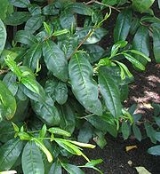
Plants in this family are characterized by simple leaves that are alternate spiral to distichial, serrated, and usually glossy. Most of the genera have evergreenEvergreen
In botany, an evergreen plant is a plant that has leaves in all seasons. This contrasts with deciduous plants, which completely lose their foliage during the winter or dry season.There are many different kinds of evergreen plants, both trees and shrubs...
foliage, but Stewartia and Franklinia are deciduous
Deciduous
Deciduous means "falling off at maturity" or "tending to fall off", and is typically used in reference to trees or shrubs that lose their leaves seasonally, and to the shedding of other plant structures such as petals after flowering or fruit when ripe...
. The toothed margins are generally associated with a characteristic Theoid leaf tooth, which is crowned by a glandular, deciduous tip. The flowers in this family are usually pink or white and large and showy, often with a strong scent. The calyx consists of five or more sepals, which are often persistent in the fruiting stage, and the corolla is five-merous, rarely numerous. Plants in Theaceae are multistaminate, usually with 20-100+ stamen either free or adnate to the base of the corolla, and are also distinctive because of the presence of pseudopollen. The pseudopollen is produced from connective cells, and has either rib-like or circular thickenings. The ovary is often hairy and narrows gradually into the style, which may be branched or cleft. The carpels are typically opposite from the petals, or the sepals in the case of Camellia. The fruits are loculicidal capsules, indehiscent baccate fruits or sometimes pome
Pome
In botany, a pome is a type of fruit produced by flowering plants in the subfamily Maloideae of the family Rosaceae.A pome is an accessory fruit composed of one or more carpels surrounded by accessory tissue...
s. The seeds are few and sometimes winged, or in some generas covered by fleshy tissue or unwinged and nude. 3,4
Chemistry
There is distinctive chemistry within the Theaceae family. Sometimes, single crystals of calcium oxalate are present in Theaceous plants. Ellagic acidEllagic acid
Ellagic acid is a natural phenol antioxidant found in numerous fruits and vegetables including blackberries, raspberries, strawberries, cranberries, walnuts, pecans, pomegranates, wolfberry and other plant foods...
and common polyphenols including flavonols, flavones and proanthocyanins are widely distributed throughout the family. Gallic acid and catechins only occur in Camellia sect. Thea (C. sinensis, C. taliensis and C. irrawadiensis. Caffeine and its precursors theobromine and theophylline are only found in sect. Thea and are not found in other species of Camellia or other Theaceae. Caffeine content in the tea bush makes up 2.5-4% of the leave's dry weight, and this high content of catechins and caffeine in the tea bush is the result of selection by man for these characters. Triterpenes and their glycosides (saponins) are found widely throughout the family in the seeds, leaves, wood and bark. Plants in this family are also known to accumulate aluminum and fluoride.3
Distribution
Eleven genera are found only in east AsiaEast Asia
East Asia or Eastern Asia is a subregion of Asia that can be defined in either geographical or cultural terms...
(Malesia
Malesia
Malesia is a biogeographical region straddling the boundaries of the Indomalaya ecozone and Australasia ecozone, and also a phytogeographical floristic region in the Paleotropical Kingdom.-Floristic province:...
north to Japan
Japan
Japan is an island nation in East Asia. Located in the Pacific Ocean, it lies to the east of the Sea of Japan, China, North Korea, South Korea and Russia, stretching from the Sea of Okhotsk in the north to the East China Sea and Taiwan in the south...
), with several genera in Central
Central America
Central America is the central geographic region of the Americas. It is the southernmost, isthmian portion of the North American continent, which connects with South America on the southeast. When considered part of the unified continental model, it is considered a subcontinent...
and South America
South America
South America is a continent situated in the Western Hemisphere, mostly in the Southern Hemisphere, with a relatively small portion in the Northern Hemisphere. The continent is also considered a subcontinent of the Americas. It is bordered on the west by the Pacific Ocean and on the north and east...
. Three genera are found only in Africa
Africa
Africa is the world's second largest and second most populous continent, after Asia. At about 30.2 million km² including adjacent islands, it covers 6% of the Earth's total surface area and 20.4% of the total land area...
, and two genera are only found in the Neotropics.4 Three genera (Franklinia
Franklinia
Franklinia is a monotypic genus in the tea plant family, Theaceae. The sole species in this genus is a flowering tree, Franklinia alatamaha, commonly called the Franklin tree, and native to the Altamaha River valley in Georgia in the southeastern United States...
, Gordonia
Gordonia
Gordonia is a genus of flowering plants in the family Theaceae, related to Franklinia, Camellia and Stewartia. Of the roughly 40 species, all but two are native to southeast Asia in southern China, Taiwan and Indochina. The remaining species, G...
and Stewartia) also have species native to the southeastern United States
Southeastern United States
The Southeastern United States, colloquially referred to as the Southeast, is the eastern portion of the Southern United States. It is one of the most populous regions in the United States of America....
, with Franklinia being endemic there, and under recent interpretations, also Gordonia with the Asian species formerly included in that genus being transferred to Polyspora. There are five genera with very restricted distributions. These include Apterosperma and Euryodendron found in Southern China
China
Chinese civilization may refer to:* China for more general discussion of the country.* Chinese culture* Greater China, the transnational community of ethnic Chinese.* History of China* Sinosphere, the area historically affected by Chinese culture...
, Archboldiodendron found in New Guinea
New Guinea
New Guinea is the world's second largest island, after Greenland, covering a land area of 786,000 km2. Located in the southwest Pacific Ocean, it lies geographically to the east of the Malay Archipelago, with which it is sometimes included as part of a greater Indo-Australian Archipelago...
, Dankia found in Vietnam
Vietnam
Vietnam – sometimes spelled Viet Nam , officially the Socialist Republic of Vietnam – is the easternmost country on the Indochina Peninsula in Southeast Asia. It is bordered by China to the north, Laos to the northwest, Cambodia to the southwest, and the South China Sea –...
, and Visnea in the Canary Islands
Canary Islands
The Canary Islands , also known as the Canaries , is a Spanish archipelago located just off the northwest coast of mainland Africa, 100 km west of the border between Morocco and the Western Sahara. The Canaries are a Spanish autonomous community and an outermost region of the European Union...
and Madeira
Madeira
Madeira is a Portuguese archipelago that lies between and , just under 400 km north of Tenerife, Canary Islands, in the north Atlantic Ocean and an outermost region of the European Union...
. 4
Economic Importance
The best known genusGenus
In biology, a genus is a low-level taxonomic rank used in the biological classification of living and fossil organisms, which is an example of definition by genus and differentia...
is Camellia
Camellia
Camellia, the camellias, is a genus of flowering plants in the family Theaceae. They are found in eastern and southern Asia, from the Himalaya east to Korea and Indonesia. There are 100–250 described species, with some controversy over the exact number...
, which includes the plant whose leaves are used to produce tea
Tea
Tea is an aromatic beverage prepared by adding cured leaves of the Camellia sinensis plant to hot water. The term also refers to the plant itself. After water, tea is the most widely consumed beverage in the world...
(Camellia sinensis). In parts of Asia, other species are used as a beverage, including C. taliensis, C. gradnibractiata, C. kwangsiensis, C. gymnogyna, C. crassicolumna, C. tachangensis, C. ptilophyllaand, and C. irrawadiensis. Several species
Species
In biology, a species is one of the basic units of biological classification and a taxonomic rank. A species is often defined as a group of organisms capable of interbreeding and producing fertile offspring. While in many cases this definition is adequate, more precise or differing measures are...
grown widely as ornamentals for their flowers and handsome foliage.