

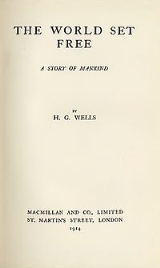
The World Set Free

Encyclopedia
The World Set Free is a novel published in 1914 by H. G. Wells
. The book is considered to foretell nuclear weapons. It had appeared first in serialized form with a different ending as A Prophetic Trilogy, consisting of three books: A Trap to Catch the Sun, The Last War in the World and The World Set Free.
A constant theme of Wells's work, such as his 1901 nonfiction book Anticipations
, was the effect of energy and technological advance as a determinant of human progress. The novel begins: "The history of mankind is the history of the attainment of external power. Man is the tool-using, fire-making animal."
Scientists of the time were well aware that the slow natural radioactive decay of elements like radium
continues for thousands of years, and that while the rate of energy release is negligible, the total amount released is huge. Wells used this as the basis for his story.
In his fiction,
As demonstrated above, Wells did have some knowledge of atomic physics, and William Ramsay
, Ernest Rutherford
, and Frederick Soddy
's discovery of the disintegration of uranium; Soddy's book Wealth, Virtual Wealth and Debt
praises The World Set Free.
The physicist Leó Szilárd
read the book in 1932, the same year the neutron
was discovered. In 1933 he conceived the idea of neutron chain reaction
, and filed for patents on it in 1934.
In Wells's story, the "atomic bombs" have no more force than ordinary high explosive—but they "continue to explode" for long periods of time:
Wells offers the following explanation of how the bombs are supposed to work:
Wells further wrote:
Wells viewed war as the inevitable result of the Modern State; the introduction of atomic energy
in a world divided resulted in the collapse of society. The only possibilities remaining were "either the relapse of mankind to agricultural barbarism from which it had emerged so painfully or the acceptance of achieved science as the basis of a new social order." Wells's theme of world government is presented as a solution to the threat of nuclear weapons.
H. G. Wells
Herbert George Wells was an English author, now best known for his work in the science fiction genre. He was also a prolific writer in many other genres, including contemporary novels, history, politics and social commentary, even writing text books and rules for war games...
. The book is considered to foretell nuclear weapons. It had appeared first in serialized form with a different ending as A Prophetic Trilogy, consisting of three books: A Trap to Catch the Sun, The Last War in the World and The World Set Free.
A constant theme of Wells's work, such as his 1901 nonfiction book Anticipations
Anticipations
Anticipations is the magazine of the Young Fabians, the under-31 section of the Fabian Society.The magazine was founded in 1996, however the group only produced one edition. It was re-formatted and re-launched the following year and since then had published three or four editions per year.The title...
, was the effect of energy and technological advance as a determinant of human progress. The novel begins: "The history of mankind is the history of the attainment of external power. Man is the tool-using, fire-making animal."
Scientists of the time were well aware that the slow natural radioactive decay of elements like radium
Radium
Radium is a chemical element with atomic number 88, represented by the symbol Ra. Radium is an almost pure-white alkaline earth metal, but it readily oxidizes on exposure to air, becoming black in color. All isotopes of radium are highly radioactive, with the most stable isotope being radium-226,...
continues for thousands of years, and that while the rate of energy release is negligible, the total amount released is huge. Wells used this as the basis for his story.
In his fiction,
As demonstrated above, Wells did have some knowledge of atomic physics, and William Ramsay
William Ramsay
Sir William Ramsay was a Scottish chemist who discovered the noble gases and received the Nobel Prize in Chemistry in 1904 "in recognition of his services in the discovery of the inert gaseous elements in air" .-Early years:Ramsay was born in Glasgow on 2...
, Ernest Rutherford
Ernest Rutherford
Ernest Rutherford, 1st Baron Rutherford of Nelson OM, FRS was a New Zealand-born British chemist and physicist who became known as the father of nuclear physics...
, and Frederick Soddy
Frederick Soddy
Frederick Soddy was an English radiochemist who explained, with Ernest Rutherford, that radioactivity is due to the transmutation of elements, now known to involve nuclear reactions. He also proved the existence of isotopes of certain radioactive elements...
's discovery of the disintegration of uranium; Soddy's book Wealth, Virtual Wealth and Debt
Wealth, Virtual Wealth and Debt
Wealth, Virtual Wealth and Debt is a 1926 book by the Nobel prize-winning chemist Frederick Soddy on monetary policy and society and the role of energy in economic systems....
praises The World Set Free.
The physicist Leó Szilárd
Leó Szilárd
Leó Szilárd was an Austro-Hungarian physicist and inventor who conceived the nuclear chain reaction in 1933, patented the idea of a nuclear reactor with Enrico Fermi, and in late 1939 wrote the letter for Albert Einstein's signature that resulted in the Manhattan Project that built the atomic bomb...
read the book in 1932, the same year the neutron
Neutron
The neutron is a subatomic hadron particle which has the symbol or , no net electric charge and a mass slightly larger than that of a proton. With the exception of hydrogen, nuclei of atoms consist of protons and neutrons, which are therefore collectively referred to as nucleons. The number of...
was discovered. In 1933 he conceived the idea of neutron chain reaction
Chain reaction
A chain reaction is a sequence of reactions where a reactive product or by-product causes additional reactions to take place. In a chain reaction, positive feedback leads to a self-amplifying chain of events....
, and filed for patents on it in 1934.
In Wells's story, the "atomic bombs" have no more force than ordinary high explosive—but they "continue to explode" for long periods of time:
Wells offers the following explanation of how the bombs are supposed to work:
Wells further wrote:
Wells viewed war as the inevitable result of the Modern State; the introduction of atomic energy
Atomic energy
Atomic energy is energy produced by atoms.*Nuclear energy, the energy resulting from potential differences in the nuclear force*Nuclear reaction, a process in which nuclei or nuclear particles interact, resulting in products different from the initial ones; see also nuclear fission and nuclear...
in a world divided resulted in the collapse of society. The only possibilities remaining were "either the relapse of mankind to agricultural barbarism from which it had emerged so painfully or the acceptance of achieved science as the basis of a new social order." Wells's theme of world government is presented as a solution to the threat of nuclear weapons.
External links
, (edited and with an introduction by Greg Bear) Note: in his Introduction, Bear says without further explanation that "For this Bison Books edition, The World Set Free has been retitled. For this historical introduction, I will continue to use Wells's original title."- The World Set Free, a story of mankind, by H. G. Wells, 1914. (a searchable facsimile at the University of Georgia Libraries; DjVuDjVuDjVu is a computer file format designed primarily to store scanned documents, especially those containing a combination of text, line drawings, and photographs. It uses technologies such as image layer separation of text and background/images, progressive loading, arithmetic coding, and lossy...
& layered PDF format)