

.gif)
The Wizard of Oz (1939 film)

Encyclopedia
The Wizard of Oz is a 1939 American musical fantasy film
produced by Metro-Goldwyn-Mayer
. It was directed primarily by Victor Fleming
. Noel Langley
, Florence Ryerson and Edgar Allan Woolf received credit for the screenplay, but there were uncredited contributions by others. The lyrics for the songs were written by E.Y. Harburg
, the music by Harold Arlen
. Incidental music, based largely on the songs, was by Herbert Stothart
, with borrowings from classical composers.
Based on the 1900 children's novel, The Wonderful Wizard of Oz
by L. Frank Baum
, the film stars Judy Garland
, Ray Bolger
, Jack Haley
, Bert Lahr
, and Frank Morgan
, with Billie Burke
, Margaret Hamilton
, Charles Grapewin
, Clara Blandick
and the Singer Midgets
as the Munchkins. Notable for its use of special effects, Technicolor
, fantasy storytelling and unusual characters, The Wizard of Oz has become, over the years, one of the best-known of all films. It is far and away the best-known version of L. Frank Baum's book, perhaps even eclipsing the fame of the novel itself.
Although it received largely positive reviews, won two Academy Awards, and was nominated for Best Picture of the Year (losing to Gone with the Wind
), The Wizard of Oz was initially a box office failure
. The film was MGM's most expensive production up to that time, but its initial release failed to recoup the studio's investment. Subsequent re-releases made up for that, however. "Over the Rainbow
" won the Academy Award for Best Original Song
and the film itself received several Academy Award nominations.
Telecasts of The Wizard of Oz began in 1956, re-introducing the film to the public and eventually becoming an annual tradition, making it one of the most famous films ever made. The film was named the most-watched motion picture in history by the Library of Congress
, is often ranked among the Top 10 Best Movies of All-Time in various critics' and popular polls, and is the source of many memorable quotes referenced in modern popular culture
.
) lives with her Aunt Em (Clara Blandick
), Uncle Henry (Charles Grapewin
), and three farm hands, Hickory (Jack Haley
), Hunk (Ray Bolger
), and Zeke (Bert Lahr
). When Miss Almira Gulch (Margaret Hamilton
) is bitten by Dorothy's dog Toto, she gets a sheriff's order and takes Toto away to be destroyed
. He escapes and returns to Dorothy, who, fearing for his life, runs away with him.
Dorothy soon encounters a traveling fortune teller named Professor Marvel (Frank Morgan
in the first of his five roles), who guesses she has run away and tells her fortune
. Marvel convinces her to return home by falsely telling her that her aunt has fallen ill from grief. With a twister
fast approaching, she rushes back to the farmhouse, but is unable to join her family in the locked storm cellar
. Taking shelter inside the house, she is knocked unconscious by a window frame blown in by the twister.
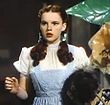 Dorothy awakens to find the house being carried away by the tornado. After the house falls back to earth, she opens the door and finds herself alone in a strange village. Arriving in a floating bubble, Glinda, the Good Witch of the North
(Billie Burke
), informs Dorothy that her house landed on and killed the Wicked Witch of the East
.
The timid Munchkin
s come out of hiding to celebrate the demise of the Witch by singing "Ding-Dong! The Witch Is Dead". Their celebration is interrupted when the Wicked Witch of the West
(Hamilton) suddenly appears in a cloud of smoke and tries to claim her dead sister's powerful ruby slippers
. But Glinda magically transfers the slippers from the dead witch onto Dorothy's feet and reminds the Witch of the West that her power is ineffectual in Munchkinland
. The Witch promises Dorothy "I'll get you, my pretty...and your little dog, too!" before leaving the same way she arrived. When Dorothy asks how to get back home, Glinda advises her to seek the help of the mysterious Wizard of Oz in the Emerald City
, which she can reach by following the Yellow Brick Road
, and warns Dorothy never to remove the slippers or she will be at the mercy of the Wicked Witch.
On her way to the city, Dorothy meets a Scarecrow
(Bolger), a Tin Man
(Haley), and a Cowardly Lion
(Lahr), who lament to her that they respectively lack a brain, a heart, and courage. The three decide to accompany Dorothy in hopes that the Wizard will also fulfill their desires, although they demonstrate that they already have the qualities they believe they lack: the Scarecrow has several good ideas, the Tin Man is kind and sympathetic, and the Lion, though terrified, is ready to face danger.
After Dorothy and the Cowardly Lion nearly succumb to one of the Witch's traps, the foursome enter the Emerald City and are allowed to see the Wizard of Oz, who appears amidst smoke and flames as a disembodied, intimidating head. In a booming voice, he states that he will consider granting their wishes if they bring him the Wicked Witch's broomstick.
They set out for the Witch's castle, but she detects them and dispatches her army of flying monkeys
, who carry Dorothy and Toto back to her. When the Witch threatens to drown Toto, Dorothy agrees to give up the slippers, but a shower of sparks prevents their removal. Realizing the shoes cannot be removed unless Dorothy dies, the Witch leaves to ponder how to accomplish this.
Toto escapes and leads Dorothy's companions to the castle. After overpowering some of the Witch's guards and disguising themselves in their uniforms, they find and free Dorothy. The Witch and her soldiers corner the group on a parapet
, where the Witch sets the Scarecrow's arm ablaze with her broomstick. Dorothy throws water on her friend and accidentally splashes the Witch, causing her to melt. The soldiers are delighted, and their captain gives Dorothy the broomstick.
Upon their triumphant return to the Wizard's chamber, Toto opens a curtain, revealing the Wizard to be an ordinary man (Frank Morgan) operating a console of wheels and levers while speaking into a microphone. Apologetic, he explains that Dorothy's companions already possess what they have been seeking all along, but bestows upon them tokens of esteem in recognition of their respective virtues. Explaining that he too was born in Kansas, and was brought to Oz by a runaway hot air balloon
, the man offers to take Dorothy home in the same balloon, leaving the Scarecrow, Tin Man and Lion in charge of the Emerald City.
As they are about to leave, Toto jumps out of the balloon's basket and Dorothy runs after him. The Wizard, unable to control the balloon, leaves without her. As Dorothy despairs of ever getting back home, Glinda appears and tells her that she always had the power to return home, but that she needed to learn for herself that she did not have to run away to find her heart's desire. Dorothy bids her friends goodbye, then follows Glinda's instructions to close her eyes, tap her heels together three times, and keep repeating "There's no place like home".
Dorothy awakens in her bedroom in Kansas, surrounded by family and friends, and tells them of her journey. Although Aunt Em assures her it was all a dream, Dorothy insists it was real and promises never to run away from home again.
(who has no name in the book), Glinda the Good Witch of the South, and the Queen of the Field Mice are merged into one omniscient character, Glinda the Good Witch of the North. To take advantage of the new vivid Technicolor process, Dorothy's silver shoes
were changed to ruby slippers
for the movie. Due to time constraints, a number of incidents from the book, including the China Country and the Hammerheads, were cut. The role of the Wicked Witch of the West was also enlarged for the movie (in the book, although she is mentioned several times before, she is only present for one chapter towards the end). This was done to provide more dramatic tension throughout the film, and to unify what is otherwise a very episodic plot. The role and character of Dorothy were also transformed: in the film, Dorothy is depicted as a damsel in distress
who needs to be rescued, while in the novel, Dorothy, a little girl, rescues her friends, in keeping with Baum's feminist sympathies.
A famous song from the film is "Follow the Yellow Brick Road". However, in the original novel, there is no reference to a "yellow brick road"; the original reference in the novel is to "the road of yellow brick".
There are at least 44 identifiable major differences between the original Wizard of Oz book and this movie interpretation. Nevertheless, the film was far more faithful to Baum's original book than many earlier scripts (see below) or film versions. Two silent versions were produced in 1910 and 1925 and the seven-minute animated cartoon
in 1933 (the 1925 version
, with which Baum, who had died six years earlier, had no association, made Dorothy a princess of Oz, rather like the later sci-fi TV miniseries Tin Man
). The 1939 movie interprets the Oz experience as a dream, in which many of the characters that Dorothy meets represent the people from her home life (such as Miss Gulch, Professor Marvel and the farmhands, none of whom appear in the book). In L. Frank Baum
's original novel, Oz is meant to be a real place, one to which Dorothy would return in the author's later Oz books and which would later provide a refuge for Aunt Em and Uncle Henry when unable to pay the mortgage on the new house that was built after the old one really was carried away by the tornado.
In the film's end credits, all actors with more than one role are listed only as their Kansas characters, not their Oz characters. The dog Toto is listed as having been played by himself, not by the dog's real name "Terry". Uncle Henry is the only character to appear in Kansas without appearing in Oz (Aunt Em appears in Oz in the hourglass scene).
Pat Walshe was the last surviving significant member of the cast when he died in December 1991, aged 91. Meinhardt Raabe
was one of the last surviving Munchkin actors, and the last surviving cast member with any dialogue when he died in April 2010, aged 94.
. The opening
and closing credits
, as well as the Kansas
sequences, were filmed in black and white and colored in a sepia tone process. Sepia-toned film was also used in the scene where Aunt Em appears in the Wicked Witch's crystal ball.
In his book The Wonderful Wizard of Oz, Baum describes Kansas as being 'in shades of gray'. Further, Dorothy lived inside a farmhouse which had its paint blistered and washed away by the weather, giving it an 'air of grayness'. The farm house and property were situated in the middle of a sweeping prairie where the grass was burnt gray by harsh sun. Dorothy's aunt and uncle were 'gray with age'. Effectively, the use of monochrome sepia tones for the Kansas sequences was a stylistic choice that evoked the dull and gray Kansas countryside. Much attention was given to the use of color in the production, with the MGM production crew favoring some hues over others. Consequently, it took the studio's art department almost a week to settle on the final shade of yellow used for the Yellow Brick Road
.
bought the rights to the hugely popular novel
from Samuel Goldwyn
, who had toyed with the idea of making the film as a vehicle for Eddie Cantor
, who was under contract to the Goldwyn studios and whom Goldwyn wanted to cast as the Scarecrow.
The script went through a number of writers and revisions before the final shooting. Originally, Mervyn LeRoy
's assistant William H. Cannon submitted a brief four-page outline. Because recent fantasy films had not fared well at the box office, he recommended that the magical elements of the story be toned down or eliminated. In his outline, the Scarecrow
was a man so stupid that the only way he could get employment was to dress up as a scarecrow and scare away crows in a cornfield, and the Tin Woodman
was a hardened criminal so heartless he was sentenced to be placed in a tin suit for eternity. The torture of being encased in the suit had softened him and made him gentle and kind. His vision was similar to Larry Semon
's 1925 film adaptation
of the story, in which the magical element is absent.
After that, LeRoy hired screenwriter Herman J. Mankiewicz
to work on a script. Despite Mankiewicz's notorious reputation at that time for being an alcoholic
, he soon delivered a 17-page script of the Kansas scenes, and a few weeks later, he handed in a further 56 pages. Noel Langley
and poet Ogden Nash
were also hired to write separate versions of the story. None of the three writers involved knew anyone else was working on a script, but it was not an uncommon procedure. Nash soon delivered a four page outline, Langley turned in a 43-page treatment and a full film script. He turned in three more, this time incorporating the songs that had been written by Harold Arlen
and Yip Harburg
. No sooner had he completed it than Florence Ryerson and Edgar Allan Woolf submitted a script and were brought on board to touch up the writing. They would be responsible for making sure the story stayed true to the Baum book. During filming, Victor Fleming
and John Lee Mahin
revised the script further, adding and cutting some scenes. In addition, Jack Haley and Bert Lahr are known to have written some of their own dialogue for the Kansas sequence.
The final draft of the script was completed on October 8, 1938, following numerous rewrites. All in all, it was a mish-mash of many creative minds, but Langley, Ryerson and Woolf got the film credits. Along with the contributors already mentioned, others who assisted with the adaptation without receiving official credit include: Irving Brecher
, Herbert Fields
, Arthur Freed
, E. Y. Harburg
, Samuel Hoffenstein
, Jack Mintz, Sid Silvers, Richard Thorpe
, George Cukor
and King Vidor
.
In addition, songwriter Harburg's son (and biographer) Ernie Harburg reports,
The original producers thought that a 1939 audience was too sophisticated to accept Oz as a straight-ahead fantasy; therefore, it was re-conceived as a lengthy, elaborate dream
. Because of a perceived need to attract a youthful audience through appealing to modern fads and styles, the script originally featured a scene with a series of musical contests. A spoiled, selfish princess in Oz had outlawed all forms of music except classical and operetta
and went up against Dorothy in a singing contest in which Dorothy's swing style enchanted listeners and won the grand prize. This part was initially written for Betty Jaynes
. The plan was later dropped.
Another scene, which was removed before final script approval and never filmed, was a concluding scene back in Kansas after Dorothy's return. Hunk (the Kansan counterpart to the Scarecrow) is leaving for agricultural college and extracts a promise from Dorothy to write to him. The implication of the scene is that romance will eventually develop between the two, which also may have been intended as an explanation for Dorothy's partiality for the Scarecrow over her other two companions. This plot idea was never totally dropped, however; it is especially noticeable in the final script when Dorothy, just before she is to leave Oz, tells the Scarecrow, "I think I'll miss you most of all." (Such partiality could result, at least in part, from the Scarecrow being with Dorothy the longest.)
to play the part of Dorothy, on loan out from 20th Century Fox
. A persistent rumor also existed that Fox was in turn promised Clark Gable
and Jean Harlow
as a loan from MGM. The tale is almost certainly untrue, as Harlow died in 1937, before MGM had even purchased the rights to the story. Despite this, the story appears in many film biographies (including Temple's own autobiography). The documentary The Wonderful Wizard of Oz: The Making of a Movie Classic states that Mervyn LeRoy was under pressure to cast Temple, then the most popular child star; but at an unofficial audition, MGM musical mainstay Roger Edens
listened to her sing and felt that an actress with a different style was needed. Newsreel footage is included in which Temple wisecracks, "There's no place like home," suggesting that she was being considered for the part at that time. A possibility is that this consideration did indeed take place, but that Gable and Harlow were not part of the proposed deal.
Actress Deanna Durbin
, who was under contract to Universal
, was also considered for the part of Dorothy. Durbin, at the time, far exceeded Garland in film experience and fan base and the two had co-starred in a 1936 two-reeler
called Every Sunday
. The film was most notable for exhibiting Durbin's operatic style of singing against Garland's jazzier style. Durbin was possibly passed over once it was decided to bring on Betty Jaynes, also an operatic singer, to rival Garland's jazz in the aforementioned discarded subplot of the film.
 Casting The Wizard of Oz was problematic, with two actors swapping roles prior to the start of filming. Ray Bolger was originally cast as the Tin Man and Buddy Ebsen
(later famous for his role as Jed Clampett on the popular 1960s TV show The Beverly Hillbillies
) was to play the Scarecrow. Bolger, however, longed to play the Scarecrow, as his childhood idol Fred Stone
had done on stage in 1902
; with that very performance, Stone had inspired him to become a vaudevillian in the first place. Now unhappy with his role as the Tin Man (reportedly claiming, "I'm not a tin performer; I'm fluid"), Bolger convinced producer Mervyn LeRoy to recast him in the part he so desired. Ebsen did not object; after going over the basics of the Scarecrow's distinctive gait with Bolger (as a professional dancer, Ebsen had been cast because the studio was confident he would be up to the task of replicating the famous "wobbly-walk" of Stone's Scarecrow), he recorded all of his songs, went through all the rehearsals as the Tin Man, and began filming with the rest of the cast.
Gale Sondergaard
was originally cast as the Wicked Witch
. She became unhappy when the witch's persona shifted from sly and glamorous (thought to emulate the wicked queen in Disney's Snow White and the Seven Dwarfs
) into the familiar "ugly hag." She turned down the role and was replaced on October 10, 1938, just three days before filming started, by MGM contract player Margaret Hamilton. Sondergaard said in an interview for a bonus feature on the DVD that she had no regrets about turning down the part, and would go on to play a glamorous villain in Fox's version of Maurice Maeterlinck
's The Blue Bird
in 1940; that same year, Margaret Hamilton would play a role remarkably similar to the Wicked Witch in the Judy Garland film Babes in Arms
.
On July 25, 1938, Bert Lahr was signed for the Cowardly Lion; Charles Grapewin was cast as Uncle Henry on August 12.
W. C. Fields
was originally chosen for the role of the Wizard, but the studio ran out of patience after protracted haggling over his fee; instead, another contract player, Frank Morgan, was cast on September 22. According to Aljean Harmetz
, when the wardrobe department was looking for a coat for Morgan, they decided that they wanted a once elegant coat that had "gone to seed". They went to a second-hand shop and purchased a whole rack of coats, from which Morgan, the head of the wardrobe department and director Fleming chose one they thought had the perfect appearance of shabby gentility. One day, while he was on set wearing the coat, Morgan turned out one of the pockets and discovered a label indicating that the coat had once belonged to Oz author L. Frank Baum. Mary Mayer, a unit publicist for the film, contacted the tailor and Baum's widow, who both verified that the coat had indeed once belonged to the writer. After filming was completed, the coat was presented to Mrs. Baum. Baum biographer Michael Patrick Hearn
disbelieves the story, it having been refuted by members of the Baum family, who never saw the coat or knew of the story, as well as by Margaret Hamilton, who considered it a concocted studio rumor.
lot in Culver City, California
, under the direction of Richard Thorpe
(replacing original director Norman Taurog
, who only filmed a few early Technicolor tests and was then reassigned). Thorpe initially shot about two weeks of footage (nine days, total) involving Dorothy's first encounter with the Scarecrow, as well as a number of sequences in the Wicked Witch's castle, such as Dorothy's rescue (which, though unreleased, comprises the only footage of Buddy Ebsen's Tin Man).
Ten days into the shoot, however, Ebsen suffered a reaction to the aluminum powder makeup he wore; the powder he breathed in daily as it was applied had coated his lungs. Ebsen was hospitalized in critical condition, and subsequently was forced to leave the project; in a later interview (included on the 2005 DVD release of Wizard of Oz), Ebsen recalled the studio heads initially disbelieving that he was seriously ill, only realizing the extent of the actor's condition when they showed up in the hospital as he was convalescing in an iron lung
. Ebsen's sudden medical departure caused the film to shut down while a new actor was found to fill the part. No full footage of Ebsen as the Tin Man has ever been released — only photographs taken during filming and test photos of different makeup styles remain. MGM did not publicize the reasons for Ebsen's departure until decades later, in a promotional documentary about the film. His replacement, Jack Haley
, simply assumed he had been fired.
Producer Mervyn LeRoy had taken this time to review the already shot footage and felt that Thorpe seemed to be rushing the picture along, creating a negative impact on the actors' performances; thus, LeRoy decided to have Thorpe replaced. Despite being let go from the production, however, some of Thorpe's footage would be retained in the final edit, such as close-ups of the Scarecrow sans Dorothy during his first scene (due to a major subsequent change in the Dorothy character makeup, wide shots and close-ups of Judy Garland from the days of that shoot could not be used), as well as certain sequences too expensive to reorganize and reshoot, including the entirety of the Winkies' march outside the Witch's castle during the climax of the film — right up to when the Scarecrow, Lion, and Buddy Ebsen's Tin Man (though his face is not seen) sneak into the castle behind the marchers.
During reorganization on the production, George Cukor
temporarily took over, under LeRoy's guidance. Initially, the studio had made Garland wear a blond wig and heavy, "baby-doll" makeup, and she played Dorothy in an exaggerated fashion; now, Cukor changed Judy Garland's and Margaret Hamilton's makeup and costumes, and told Garland to "be herself." This meant that all the scenes Garland and Hamilton had already completed had to be discarded and re-filmed. Cukor also suggested that the studio cast Jack Haley, on loan from 20th Century Fox
, as the Tin Man. To keep down on production costs, Haley only rerecorded "If I Only Had a Heart" and solo lines during "The Jitterbug" and "If I Only Had the Nerve"; as such, Buddy Ebsen's voice can still be heard in the remaining songs featuring the Tin Man in group vocals. The makeup used for Haley was quietly changed to an aluminum paste, with a layer of clown white greasepaint underneath to protect his skin; although it did not have the same dire effect on Haley, he did at one point suffer from an unpleasant eye infection from it.
In addition, Ray Bolger
's original recording of "If I Only Had a Brain" had been far more sedate compared to the version heard in the film; during this time, Cukor and LeRoy decided that a more energetic rendition would better suit Dorothy's initial meeting with the Scarecrow (initially, it was to contrast with his lively manner in Thorpe's footage), and was re-recorded as such. At first thought to be lost for over seven decades, a recording of this original version was rediscovered in 2009.
Cukor did not actually shoot any scenes for the film, merely acting as something of a "creative advisor" to the troubled production, and, because of his prior commitment to direct Gone with the Wind
, he left on November 3, 1938, at which time Victor Fleming
assumed the directorial responsibility. As director, Fleming chose not to shift the film from Cukor's creative realignment, as producer LeRoy had already pronounced his satisfaction with the new course the film was taking.
Production on the bulk of the Technicolor sequences was a long and cumbersome process that ran for over six months, from October 1938 to March 1939. Most of the actors worked six days a week and had to arrive at the studio as early as four or five in the morning, to be fitted with makeup and costumes and would not leave until seven or eight at night. Cumbersome makeup and costumes were compounded by the fact that the early Technicolor process required a significant amount of lighting to be used, which would usually heat the set to over a hundred degrees. According to Ray Bolger, most of the Oz principals were banned from eating in the studio's commissary due to their costumes. Margaret Hamilton's makeup meant that food could not be ingested and so she practically lived on a liquid diet during filming of the Oz sequences. Additionally, it took upwards of 12 takes to have Dorothy's dog Toto run alongside the actors as they skipped down the Yellow Brick Road.
The massive shoot also proved to be somewhat chaotic. This was most evident when trying to put together the Munchkinland sequences. MGM talent scouts searched the country far and wide to come up with over a hundred little people who would make up the citizens of Munchkinland; this meant that most of the film's Oz sequences would have to already be shot before work on the Munchkinland sequence could begin. According to Munchkin actor Jerry Maren
, each little person was paid over $125 a week for their performances. Munchkin Meinhardt Raabe
, who played the coroner, revealed in the 1990 documentary The Making of the Wizard of Oz that the MGM costume and wardrobe department, under the direction of designer Adrian
, had to design over one hundred costumes for the Munchkin sequences. They then had to photograph and catalog each Munchkin in his or her costume so that they could correctly apply the same costume and makeup each day of production.
For years, many exaggerated rumors circulated about the wild behavior of many of the Munchkin actors. One of the most famous claimed that the completed film shows an actor who played one of the Munchkins committing suicide by hanging in the background of one scene. This has been shown to be false; the object in question is actually a wild crane used in the forest scene.
Filming even proved to be dangerous, at times. Margaret Hamilton was severely burned in the Munchkinland scene. There was a little elevator
that was supposed to take her down, with a fire
erupting to dramatize and conceal her exit. As told by Hamilton in archival audio included on the DVD commentary, the first take went smoothly, and that was the one eventually used in the film. For the second take, the timing was off, and she was exposed to the flames. Her copper-based makeup had to be completely and quickly removed before her face could be treated, and her hands were also burned.
On February 12, 1939, Victor Fleming hastily replaced George Cukor in directing Gone with the Wind
; the next day, King Vidor
was assigned as director by the studio to finish the filming of The Wizard of Oz (mainly the sepia Kansas sequences, including Judy Garland's singing of "Over the Rainbow
"). In later years, when the film became firmly established as a classic, Vidor chose not to take public credit for his contribution until after the death of his friend Fleming in 1949.
At this point, the film began a long arduous post-production. Herbert Stothart
had to compose the film's background score, while A. Arnold Gillespie
had to perfect the various special effects that the film required, including many of the rear projection shots. The MGM art department also had to create the various matte paintings for the background of many of the scenes.
One significant innovation for the film was the use of "stencil printing" which was used for the transition to Technicolor: Each frame was to be hand-tinted to maintain the sepia tone; however, because this was too expensive and labor intensive, it was abandoned and MGM used a simpler and less expensive variation of the process. During the re-shoots in May, the inside of the farm house was painted sepia, and when Dorothy
opens the door, it is not Garland but her stand-in, Bobbie Koshay, wearing a sepia gingham dress, who then backs out of frame; once the camera moves through the door, Garland steps back into frame in her bright blue gingham dress (as noted in DVD extras), and the sepia-painted door briefly tints her with the same color before she emerges from the house's shadow, into the bright glare of the Technicolor lighting. This also meant that the re-shoots provided the first proper shot of Munchkinland; if one looks carefully, the brief cut to Dorothy looking around outside the house bisects a single long shot, from the inside of the doorway to the pan-around that finally ends in a reverse-angle as we see the ruins of the house behind Dorothy as she comes to a stop at the foot of the small bridge.
Test screenings of the film began on June 5, 1939. Oz initially was running nearly two hours long. LeRoy and Fleming knew that at least a quarter of an hour needed to be deleted to get the film down to a manageable running time, the average film in 1939 running just about 90 minutes. Three sneak previews in Santa Barbara
, Pomona
and San Luis Obispo
, California helped guide LeRoy and Fleming in the cutting. Among the many cuts was "The Jitterbug
" number, the Scarecrow's elaborate dance sequence following "If I Only Had A Brain", a reprise of "Over the Rainbow", and "Ding Dong the Witch Is Dead", and a number of smaller dialogue sequences. This left the final, mostly serious portion of the film with no songs, only the dramatic underscoring.
One song that was almost deleted was "Over the Rainbow." MGM had felt that it made the Kansas sequence too long, as well as being far over the heads of the target audience of children. The studio also thought that it was degrading for Judy Garland to sing in a barnyard. Producer Mervyn LeRoy
, uncredited associate producer Arthur Freed
, and director Victor Fleming
fought to keep it and eventually won. The song went on to win the Academy Award for Best Song of the Year. In 2004, the song was ranked #1 by the American Film Institute on AFI's 100 Years…100 Songs list.
After the preview in San Luis Obispo in early July, The Wizard of Oz was officially released in August 1939 at its current 101-minute running time.
s: on August 11, 1939, at Kenosha, Wisconsin
and Cape Cod, Massachusetts, and at the Strand Theatre in Oconomowoc, Wisconsin
on August 12.
The Hollywood premiere was on August 15, 1939, at Grauman's Chinese Theatre
. The New York City
premiere at Loew's Capitol Theatre
on August 17, 1939 was followed by a live performance with Judy Garland and her frequent film co-star Mickey Rooney
. They would continue to perform there after each screening for a week, extended in Rooney's case for a second week and in Garland's to three (with Oz co-stars Ray Bolger and Bert Lahr replacing Rooney for the third and final week). The movie opened nationally on August 25, 1939.
The film grossed approximately $3 million (equal to $ today) against production/distribution costs of $2.8 million (equal to $ today) in its initial release. It did not show what MGM considered a large profit until a 1949 re-release earned an additional $1.5 million (equal to $ today).
has anything quite so fantastic succeeded half so well. Nugent had issues with some of the film's special effects, saying "[w]ith the best of will and ingenuity, they cannot make a Munchkin or a Flying Monkey that will not still suggest, however vaguely, a Singer's midget in a Jack Dawn
masquerade. Nor can they, without a few betraying jolts and split-screen overlappings, bring down from the sky the great soap bubble in which the Good Witch rides and roll it smoothly into place." According to Nugent, "Judy Garland's Dorothy is a pert and fresh-faced miss with the wonder-lit eyes of a believer in fairy tales, but the Baum fantasy is at its best when the Scarecrow, the Woodman and the Lion are on the move."
In current reviews, The Wizard of Oz is still highly praised by critics. On the film's Rotten Tomatoes
listing, 100% of critics give the film positive reviews, based on 70 reviews.
release in 1989, the opening Kansas sequences, were shown in black-and-white, instead of the sepia tone as originally filmed.
This was done despite the fact that the sepia had been specifically chosen for the picture to help mask the switch to Technicolor. The actual switch occurs before the door is opened from the transported house onto the Land of Oz. In the sepia prints, one doesn't notice any color until that door is opened, because the door itself is a shade of brown which matches the sepia. In black-and-white, one cannot help but notice the switch to color before the door is opened, which was precisely what the film's producers wanted to avoid. For the film's 50th anniversary restoration, the sepia was brought back to the opening and closing Kansas scenes and beginning in 1990, the film was shown on CBS television nationally as originally released in 1939. It was also very common (and even an FCC requirement for early color broadcasters) for TV stations to turn off the color portion of their transmission when broadcasting a black & white show or movie. This was because unusual colors or "color noise" could be seen during the showing of black-and-white programming under some conditions. Though the opening Kansas scenes in The Wizard of Oz were meant to be shown in sepia and though the sepia was restored to the film in 1989 for the film's 50th anniversary VHS and laserdisc reissue, a few local CBS affiliates still showed the sepia portion of the film with the color signal disabled for many years. Most of these were small market affiliates that ran some syndicated black & white shows as these stations were used to turning the color modes off during black & white programming. One CBS affiliate, WGNX
, transmitted the opening Kansas scenes in black-and-white as recently as its 1996 showing because this station was an independent station that ran a moderate amount of black-and-white films before becoming a CBS affiliate.
1955 saw the release of a widescreen
1.85:1 aspect ratio
version to theatres, with portions of the top and the bottom of the film removed via soft matte
s to produce a widescreen effect. The re-release trailer falsely claimed that "every scene" from Baum's novel was in the film, including "the rescue of Dorothy", though there is no such incident in the novel.
The MGM "Children's Matinees" series re-released the film twice, in 1970 and 1971.
In 1986, the film was acquired by Turner Entertainment
as part of a deal involving a majority of MGM's pre-1986 library. In 1996, Turner merged with Time Warner
, and since then Warner Bros. Pictures has been handling distribution for all media on Turner's behalf.
The film was re-released again in U.S. theaters by WB on November 6, 1998. The version was a newly restored and remastered print with a remixed stereo soundtrack. It also featured restoration and sound remixing credits at the end (none of these extra credits have appeared on any video release).
In 1999, the film had a theatrical re-release in Australia
, in honor of the film's 60th Anniversary.
On September 23, 2009, The Wizard of Oz was re-released in select theaters for a one-night-only event in honor of the film's 70th Anniversary and as a promotion for various new disc releases later in the month. An encore of this event was re-released in theaters on November 17, 2009.
, as the last installment of the Ford Star Jubilee
, making it, historically, the first uncut Hollywood film shown in one evening on a commercial television network. The Oz scenes were shown in color (posters still exist advertising the broadcast and they specifically say in color and black-and-white), but because most television sets then were not color sets, few members of the TV audience saw the film that way. An estimated 45 million people watched the broadcast. However, it was not rerun until three years later. On December 13, 1959 the film was shown (again on CBS) as a two-hour Christmas season special
and at an earlier time, to an even larger audience (commercial breaks were much shorter then, enabling the film to run in a two-hour time slot without being cut). Encouraged by the response, CBS decided to make it an annual Christmas tradition, showing it from 1959 through 1962 always on the second Sunday of December. The film was not shown in December 1963 as might have been expected, perhaps due to the proximity of the John F. Kennedy assassination
, which occurred on November 22 of that year and plunged the U.S. into a period of mourning. Others say that there was no room on the schedule, because by then there were other Christmas specials on television, though not nearly as many as there would be in later years (A Charlie Brown Christmas
, How the Grinch Stole Christmas!
and Frosty the Snowman
, all first shown on CBS in the 1960s, were still more than two years away, and NBC did not premiere Rudolph the Red-Nosed Reindeer
until 1964).
Whatever the reason, the telecast was moved from December 1963 to the evening of January 26, 1964. The 1964 broadcast marked the end of the Christmas season showings, but The Wizard of Oz was nevertheless still televised only once a year for nearly three decades. Beginning in 1967, showing of the film was moved to February, and after that the date of the showings would constantly shift, rather than always occurring in the same month. That same year, the film was bought for annual TV showings by NBC
, whose telecasts of it began in April 1968, but by 1976, it had reverted to CBS. CBS dropped its broadcasts of the film in 1998; the rights are now in the hands of Turner Entertainment
(through Warner Bros. Television
), and the film is now shown several times a year (rather than annually) on or just before several notable holidays (including Easter
, the Fourth of July
, Thanksgiving
and/or Christmas
). Turner Classic Movies
cable channel, TNT and the TBS Superstation
now often show the film during the same week "in rotation."
For the film's first nine telecasts, all on CBS, the film featured on-camera celebrity hosts, who provided commentary (often comic) and information about the making of the film. The hosts for these telecasts were a young Liza Minnelli
, Bert Lahr
, Justin Schiller ("Oz" historian and the founder and first president of "The International Wizard Of Oz Club"), all hosting the first telecast, Red Skelton
and his daughter Valentina, (the second telecast), Richard Boone
and his son Peter (the third telecast), Dick Van Dyke
and his children (the fourth and fifth telecasts), and Danny Kaye
(the sixth, seventh, eighth, and ninth telecasts).
(via current rights holder Turner Entertainment
). The first laserdisc
release of The Wizard of Oz was in 1982, with two versions of a second, (one from Turner and one from The Criterion Collection
with a commentary track) for the 50th Anniversary release in 1989, a third in 1991, a fourth in 1993, a fifth in 1995 and a sixth and final laserdisc release on September 11, 1996.
The first DVD
release of the film was on March 26, 1997 by MGM and contained no special features or supplements. It was re-released by Warner Bros. for its 60th Anniversary on October 19, 1999, in snapper case packaging with its soundtrack presented in a new 5.1 surround sound
mix. The monochrome-to-color transition was more smoothly accomplished by digitally keeping the inside of the house in monochrome while Dorothy and the reveal of Munchkinland are in color. The DVD also contained an extensive behind-the-scenes documentary: The Wonderful Wizard of Oz: The Making of a Movie Classic, produced in 1990 and hosted by Angela Lansbury
, which was originally featured in the 1993 "Ultimate Oz" laserdisc box set release. Despite being a one-disc release, outtakes, the deleted "Jitterbug" musical number, clips of pre-1939 Oz adaptations, trailers, newsreels and a portrait gallery were also included, as well as two radio programs of the era publicizing the film.
In 2005, two new DVD editions were released, both featuring a newly restored version of the film with audio commentary and an isolated music and effects track. One of the two DVD releases was a "Two-Disc Special Edition", featuring production documentaries, trailers, various outtakes, newsreels, radio shows and still galleries. The other set, a "Three-Disc Collector's Edition", included these features as well as the digitally restored 80th anniversary edition of the 1925 feature-length silent film version of The Wizard of Oz, other silent Oz movies, and a 1933 animated short version.
The Wizard of Oz was released on Blu-ray Disc
on September 29, 2009 for the film's 70th anniversary in a four-disc "Ultimate Collector's Edition", including all the bonus features from the 2005 Collector's Edition DVD, new bonus features about Victor Fleming
and the surviving Munchkins, the telefilm The Dreamer of Oz: The L. Frank Baum Story
and the miniseries MGM: When the Lion Roars. The Blu-ray Disc version of Oz features a significant picture quality increase over all previous home video releases due to Warner commissioning a new transfer at 8K
resolution from the original film negatives, a feat which required 22 terabytes of storage space. This master was then used to create the 22 gigabyte
1080p
encode for the Blu-ray Disc
which runs at an average 23 Mbit/s bitrate
using the VC-1
codec
. This restored version also features a lossless 5.1 Dolby TrueHD
audio track. A DVD version was also released as a Two-Disc Special Edition and a Five-Disc Ultimate Collector's Edition. As previously mentioned, the September 23, 2009 one-day-only theatrical 70th anniversary showings were also a promotion for the various disc releases six days later.
On December 1, 2009, three discs of the Ultimate Collector's Edition Blu-ray Disc were repackaged as a less expensive "Emerald Edition," with an Emerald Edition four-disc DVD arriving the following week. A single-disc Blu-ray, containing the restored movie and all the extra features of the two-disc Special Edition DVD, also became available on March 16, 2010.
and E.Y. "Yip" Harburg
, who won the Academy Awards for Best Music Song
for "Over the Rainbow." In addition, Herbert Stothart
, who composed the instrumental underscore, won the Academy Award for Best Original Score. Georgie Stoll
was associate conductor and screen credit was given to George Bassman
, Murray Cutter
, Ken Darby
and Paul Marquardt for orchestral and vocal arrangements. (As usual Roger Edens
was also heavily involved as an unbilled musical associate to Freed).
The song "The Jitterbug
", written in a swing style, was intended for the sequence in which the four are journeying to the castle of the Wicked Witch of the West
. Due to time constraints, the song was cut from the final theatrical version. The film footage for the song has been lost, although silent home film footage of rehearsals for the number has survived. The sound recording for the song, however, is intact and was included in the 2-CD Rhino Records
deluxe edition of the film soundtrack, as well as on the VHS and DVD editions of the film. A reference to "The Jitterbug" remains in the film: the Witch remarks to her flying monkeys that they should have no trouble apprehending Dorothy and her friends because "I've sent a little insect on ahead to take the fight out of them."
Another musical number that was cut before release occurred right after the Wicked Witch of the West was melted and before Dorothy and her friends returned to the Wizard. This was a reprise of "Ding! Dong! The Witch is Dead" with the lyrics altered to "Hail! Hail! The Witch is Dead!." This started with the Witch's guard saying "Hail to Dorothy! The Wicked Witch is dead!" and dissolved to a huge celebration of the citizens of Emerald City singing the song as they accompany Dorothy and her friends to see the Wizard. Today, the film of this scene is also presumed lost and only a few stills survive along with a few seconds of footage used on several reissue trailers. The entire audio still exists and is included on the 2-CD Rhino Record deluxe edition of the film soundtrack.
In addition, a brief reprise of Over the Rainbow was intended to be sung by Garland while Dorothy is trapped in the Witch's castle, but it was cut because it was too emotionally intense. The original soundtrack recording still exists, however, and was included as an extra in the 2005 DVD release.
The songs were recorded in a studio before filming. Several of the recordings were completed while Buddy Ebsen was still with the cast. Therefore, while Ebsen had to be dropped from the cast due to illness from the aluminum powder makeup, his singing voice remained in the soundtrack
. [as noted in the notes for the CD Deluxe Edition] In the group vocals of "We're Off to See the Wizard
," his voice is easy to detect. Jack Haley spoke with a distinct Boston accent and thus did not pronounce the r in wizard. By contrast, Ebsen was a Midwest
erner, like Judy Garland, and thus pronounced it. Of course, Haley rerecorded Ebsen's solo parts later.
An arranged version of "Night on Bald Mountain
" is played during the scene where the Scarecrow, the Tin Man, and the Cowardly Lion rescue Dorothy from the Wicked Witch of the West's castle.
and Best Visual Effects. in the Best Picture category, it lost to another MGM film, Gone with the Wind
, another film directed by Victor Fleming
. E.Y. Harburg and Harold Arlen won the award for Best Song
(Over The Rainbow) and Best Original Music Score; composer Herbert Stothart received the Best Original Score Award. Garland received a special Academy Juvenile Award
that year, for "Best Performances by a Juvenile" (the award was also for her role in the film version of Babes in Arms
). The Wizard of Oz did not receive an Oscar for its special effects — that award went to the 1939 film version of The Rains Came
. Additional nominations went to Cedric Gibbons and William A. Horning
for Art Direction, and Hal Rosson for Cinematography (color), but both of those awards were won by Gone With the Wind. There was no award for makeup then, so Jack Dawn could not receive an award for his detailed makeup for the Oz fantasy characters.
In June 2008, AFI revealed its "Ten top Ten"—the best ten American films in ten genres—after polling over 1,500 film artists, critics and historians. The Wizard of Oz was acknowledged as the best film in the fantasy genre.
American Film Institute
recognition
The film is among the top ten of the BFI list of the 50 films you should see by the age of 14.
, with Judy Garland reprising her earlier role. An official sequel, the animated Journey Back to Oz
, starring Liza Minnelli
, daughter of Judy Garland
, as Dorothy, was produced beginning in 1964 to commemorate the original film's 25th anniversary. It also featured Margaret Hamilton
, who previously played the Wicked Witch, as Aunt Em. The unfinished film lost financing early on and was not finished until 1972 when the producing studio, Filmation
, had made enough profit from its television series to finish the film. It was released in the USA in 1974, and again in 1976 with additional live-action footage. In the movie, Dorothy is the victim of another minor head injury incurred during another Kansas tornado. She wakes to find herself back in Oz. There, she is reunited with her old friends, the Scarecrow, the Tin Man and the Lion, but none of them have time to spend with her or the desire to fight yet another wicked witch (played by Ethel Merman
). She befriends the kindly Pumpkinhead, voiced by Paul Lynde
, and a horse named Woodenhead Pinto Stallion III. Drama ensues, resulting in both the witch's death and that of Pumpkinhead, her creation. However, a single tear that proves her love for her friend, saves Pumpkinhead. Soon, Dorothy wakes to find herself back in Kansas with her aunt and uncle.
In 1975, the stage show The Wiz
premiered on Broadway: it was an African American
version of The Wizard of Oz
reworked for the Broadway stage. It starred Stephanie Mills
and other Broadway stars and earned Tony awards. The play's financing was handled by actor Geoffrey Holder
. The play inspired revivals after it left the stage and a motion picture
made in 1978, starring Diana Ross
as Dorothy and Michael Jackson
as the Scarecrow.
Disney made an unofficial sequel, Return to Oz
, in 1985. Based mostly on the books Ozma of Oz
and The Marvelous Land of Oz
, it fared poorly with critics and in the box office, although it has since gone on to become a cult classic.
In 1964, a one-hour animated cartoon
, also called Return to Oz, was shown as an afternoon weekend special on NBC. In this production, the Wicked Witch of the West somehow comes back to life, and not only steals the Scarecrow's brain, the Tin Man's heart, and the lion's medal, but returns them to the exact situations they were in before they met Dorothy.
For the film's 56th anniversary, a stage show also entitled The Wizard of Oz was based upon the 1939 film and the book by L. Frank Baum. It toured from 1995–2008, except for 2004 - see The Wizard of Oz (1987 stage play)
.
In 1995, Gregory Maguire published the book Wicked: The Life and Times of the Wicked Witch of the West
(which was later adapted into the Tony Award
winning Broadway musical Wicked
), a back story to the film and novel that describes what happened before Dorothy dropped into Oz and how the Wicked Witch (named Elphaba
) was really misunderstood, and eventually became known as wicked.
Andrew Lloyd Webber
and Tim Rice
wrote a musical based on the film, which is also titled The Wizard of Oz
. The musical opened in 2011 at the West End
s London Palladium
. It features all of the songs from the film plus new songs written by Lloyd Webber and Rice. Lloyd Webber also found Danielle Hope
to play Dorothy on the reality show, Over the Rainbow
.
An unofficial telling of events after the Wizard of Oz was filmed in 2010 and released in Kingman, Kansas in 2011. The movie was titled After the Wizard and was written and directed by Hugh Gross.
An animated version of The Wizard of Oz was recently made by Warner Brothers Animation, incorporating Tom and Jerry
into the story as Dorothy's "protectors" and casting Tuffy as a munchkin mouse who accompanies them to see the wizard in hopes he will make him taller. Thaios animated movie was called Tom and Jerry and the Wizard of Oz
.
A prequel to The Wizard of Oz is scheduled to be released in 2013. The working title is Oz: The Great and Powerful
. It will be directed by Spider-Man's Sam Raimi
and released by Disney. It was originally going to star Robert Downey, Jr. but Downey dropped out due to unknown reasons and for a time Johnny Depp
was in talks to replace him. After Depp passed on the part, the most recent contender is James Franco
, who has previously worked with Raimi on the Spider-Man films.
Despite his near-death experience with the aluminum-powder makeup, Buddy Ebsen outlived all his principal cast members by at least sixteen years, although his film career was damaged by the incident. Because of his illness, followed by his subsequent service in the Coast Guard
, his career did not fully recover until the 1950s, when he began a string of popular film and TV series appearances, notably the Disney Davy Crockett
films and the popular TV series The Beverly Hillbillies
, that would continue into the 1980s. Although his lungs had presumably recovered from the effects of the powder makeup, he eventually died of complications from pneumonia on July 6, 2003 at the age of ninety-five.
Director Victor Fleming, music arranger Herbert Stothart, screenwriter Edgar Allan Woolf, film editor Blanche Sewell
, and actor Charles Grapewin
(who played Dorothy's Uncle Henry) did not live to see the film's first telecast. By coincidence, Fleming, Stothart, Sewell and Morgan all died in 1949, which was also the year of the film's successful first re-release in movie theatres. Woolf had died the year before and Grapewin died in February 1956, nine months before the film's television premiere, and a few months after the film's second re-release. Costume designer Adrian
died in September 1959, only three months before the highly successful second telecast of the film, the one that would persuade CBS to make it an annual tradition. The film's principal art director Cedric Gibbons
died in July 1960, after the 1959 telecast, but only five months before the next TV showing on December 11, 1960. And principal makeup artist Jack Dawn
died in June 1961, six months after the film's third telecast. Bert Lahr, the film's Cowardly Lion, died in December 1967. As the 1960s ended, Judy Garland
joined them: she died in London, England on June 22, 1969 at the age of 47 from a drug overdose before a scheduled concert appearance.
Co-screenwriter Florence Ryerson died in 1965, after the film's seventh telecast, and principal screenwriter Noel Langley, who reportedly hated the changes that Ryerson and Edgar Allan Woolf had made to his version of the script, but was later reconciled to them, lived to see the film become a television institution. He died in 1980, months after the twenty-second telecast of the film. Oz songwriters E.Y. Harburg
and Harold Arlen
also lived to see the film become a television immortal, both of them also passing away in the 1980s, as did Oz director of photography Harold Rosson
. The principal creator of the special effects which were so much a part of the film, A. Arnold Gillespie
, died in 1978.
The film also has been deemed "culturally significant" by the United States Library of Congress
, which selected it for preservation in the National Film Registry
in 1989. In June 2007, the film was listed on UNESCO's Memory of the World Register
.
The film placed at number 86 on Bravo's 100 Scariest Movie Moments. In 1977, Aljean Harmetz
wrote The Making of The Wizard of Oz
, a detailed description of the creation of the film based on interviews and research; it was updated in 1989.
In a 2009 retrospective article about The Wizard of Oz, San Francisco Chronicle
film critic and author Mick LaSalle
declared that the film's "entire [Munchkinland] sequence, from Dorothy's arrival in Oz to her departure on the Yellow Brick Road
, has to be one of the greatest in cinema history — a masterpiece of set design, costuming, choreography, music, lyrics, storytelling and sheer imagination.".
After filming, the shoes were stored among the studio's extensive collection of costumes and faded from attention. They were found in the basement of MGM's wardrobe department during preparations for a mammoth auction in 1970. One pair was the highlight of the auction, going for a then unheard of $15,000 to an anonymous buyer, who apparently donated them to the Smithsonian
in 1979. Four other pairs are known to exist; one sold for $666,000 at auction in 2000. A pair stolen from the Judy Garland Museum in Minnesota is still missing. Another, differently styled pair not used in the film has been put up for auction with the rest of her collections by owner actress Debbie Reynolds
.
claimed that, in the film, a Munchkin could be seen committing suicide
(hanging
by the neck from behind a prop tree and swinging back and forth) far away (left) in the background, while the Tin Man, Dorothy and the Scarecrow are singing We're Off to See the Wizard and skipping down the Yellow Brick Road
into the distance. The object in question is actually a bird borrowed from the Los Angeles Zoo, most likely a crane
or an emu
, one of several birds placed on the indoor set to give it a more realistic feel.
The pairing of the 1973 Pink Floyd
music album The Dark Side of the Moon
with the visual portion of the film produces moments where the film and the album appear to correspond with each other in a music video-like experience. This juxtaposition has been called Dark Side of the Rainbow
.
community, in part due to Judy Garland
's starring role. (According to the website activemusician.com, during a press conference in San Francisco in the 1960s, a reporter asked Garland if she was aware of her loyal gay following. "I couldn't care less," she said. "I sing to people.")
Attempts have been made to determine the film's impact on LGBT-identified persons: editors Corey K. Creekmur and Alexander Doty, in their introduction to Out in Culture: Gay, Lesbian and Queer Essays on Popular Culture (1995, Duke University Press), write that the film's gay resonance and interpretations depends entirely upon camp
. Some have attempted a more serious interpretation of the film: for example, Cassell's Encyclopedia of Queer Myth, Symbol and Spirit: Gay, Lesbian, Bisexual and Transgender Lore quotes therapist Robert Hopcke as saying that the dreary reality of Kansas implies the presence of homophobia and is contrasted with the colorful and accepting land of Oz."; they state that when shown in gay venues, the film is is "transformed into a rite celebrating acceptance and community. Queer theorists
have attempted to draw parallels between LGBT people and characters in the film, specifically pointing to the characters' double lives and Dorothy's longing "for a world in which her inner desires can be expressed freely and fully."
Fantasy film
Fantasy films are films with fantastic themes, usually involving magic, supernatural events, make-believe creatures, or exotic fantasy worlds. The genre is considered to be distinct from science fiction film and horror film, although the genres do overlap...
produced by Metro-Goldwyn-Mayer
Metro-Goldwyn-Mayer
Metro-Goldwyn-Mayer Inc. is an American media company, involved primarily in the production and distribution of films and television programs. MGM was founded in 1924 when the entertainment entrepreneur Marcus Loew gained control of Metro Pictures, Goldwyn Pictures Corporation and Louis B. Mayer...
. It was directed primarily by Victor Fleming
Victor Fleming
Victor Lonzo Fleming was an American film director, cinematographer, and producer. His most popular films were The Wizard of Oz , and Gone with the Wind , for which he won an Academy Award for Best Director.-Life and career:Fleming was born in La Canada, California, the son of Elizabeth Evaleen ...
. Noel Langley
Noel Langley
Noel Langley was a successful novelist, playwright, screenwriter and director. While under contract to MGM he was one of the screenwriters for The Wizard of Oz...
, Florence Ryerson and Edgar Allan Woolf received credit for the screenplay, but there were uncredited contributions by others. The lyrics for the songs were written by E.Y. Harburg
Yip Harburg
Edgar Yipsel Harburg , known as E.Y. Harburg or Yip Harburg, was an American popular song lyricist who worked with many well-known composers...
, the music by Harold Arlen
Harold Arlen
Harold Arlen was an American composer of popular music, having written over 500 songs, a number of which have become known the world over. In addition to composing the songs for The Wizard of Oz, including the classic 1938 song, "Over the Rainbow,” Arlen is a highly regarded contributor to the...
. Incidental music, based largely on the songs, was by Herbert Stothart
Herbert Stothart
Herbert Stothart was a song writer, arranger, conductor, and composer. He was also nominated for nine Oscars, winning Best Original Score for The Wizard of Oz.-Biography:...
, with borrowings from classical composers.
Based on the 1900 children's novel, The Wonderful Wizard of Oz
The Wonderful Wizard of Oz
The Wonderful Wizard of Oz is a children's novel written by L. Frank Baum and illustrated by W. W. Denslow. Originally published by the George M. Hill Company in Chicago on May 17, 1900, it has since been reprinted numerous times, most often under the name The Wizard of Oz, which is the name of...
by L. Frank Baum
L. Frank Baum
Lyman Frank Baum was an American author of children's books, best known for writing The Wonderful Wizard of Oz...
, the film stars Judy Garland
Judy Garland
Judy Garland was an American actress and singer. Through a career that spanned 45 of her 47 years and for her renowned contralto voice, she attained international stardom as an actress in musical and dramatic roles, as a recording artist and on the concert stage...
, Ray Bolger
Ray Bolger
Raymond Wallace "Ray" Bolger was an American entertainer of stage and screen, best known for his portrayal of the Scarecrow and Kansas farmworker Hank in The Wizard of Oz.-Early life:...
, Jack Haley
Jack Haley
John Joseph "Jack" Haley was an American stage, radio, and film actor best known for his portrayal of the Tin Man and Kansas farmworker Hickory in The Wizard of Oz.-Career:...
, Bert Lahr
Bert Lahr
Bert Lahr was an American actor and comedian. Lahr is remembered today for his roles as the Cowardly Lion and Kansas farmworker Zeke in The Wizard of Oz, but was also well-known for work in burlesque, vaudeville, and on Broadway.-Early life:Lahr was born in New York City, of German-Jewish heritage...
, and Frank Morgan
Frank Morgan
Frank Morgan was an American actor. He was best known for his portrayal of the title character in the film The Wizard of Oz.-Early life:...
, with Billie Burke
Billie Burke
Mary William Ethelbert Appleton "Billie" Burke was an American actress. She is primarily known to modern audiences as Glinda the Good Witch of the North in the musical film The Wizard of Oz. She was nominated for an Academy Award for her performance as Emily Kilbourne in Merrily We Live...
, Margaret Hamilton
Margaret Hamilton
Margaret Hamilton was an American film actress known for her portrayal of the Wicked Witch of the West in the 1939 film The Wizard of Oz...
, Charles Grapewin
Charles Grapewin
Charley Ellsworth Grapewin was an American vaudeville performer and a stage and film actor, who portrayed Uncle Henry in MGM's The Wizard of Oz and Grandpa Joad in the film The Grapes of Wrath ....
, Clara Blandick
Clara Blandick
Clara Blandick was an American actress. Her many film appearances include the role of Auntie Em in the 1939 film The Wizard of Oz.-Early life:She was born Clara Dickey, the daughter of Isaac B...
and the Singer Midgets
Leo Singer
Leopold von Singer was the manager of the Singer Midgets, a popular vaudeville group in the first half of the twentieth century.Singer was born to a prominent family in Vienna, Austria...
as the Munchkins. Notable for its use of special effects, Technicolor
Technicolor
Technicolor is a color motion picture process invented in 1916 and improved over several decades.It was the second major process, after Britain's Kinemacolor, and the most widely used color process in Hollywood from 1922 to 1952...
, fantasy storytelling and unusual characters, The Wizard of Oz has become, over the years, one of the best-known of all films. It is far and away the best-known version of L. Frank Baum's book, perhaps even eclipsing the fame of the novel itself.
Although it received largely positive reviews, won two Academy Awards, and was nominated for Best Picture of the Year (losing to Gone with the Wind
Gone with the Wind (film)
Gone with the Wind is a 1939 American historical epic film adapted from Margaret Mitchell's Pulitzer-winning 1936 novel of the same name. It was produced by David O. Selznick and directed by Victor Fleming from a screenplay by Sidney Howard...
), The Wizard of Oz was initially a box office failure
Box office bomb
The phrase box office bomb refers to a film for which the production and marketing costs greatly exceeded the revenue regained by the movie studio. This should not be confused with Hollywood accounting when official figures show large losses, yet the movie is a financial success.A film's financial...
. The film was MGM's most expensive production up to that time, but its initial release failed to recoup the studio's investment. Subsequent re-releases made up for that, however. "Over the Rainbow
Over the Rainbow
"Over the Rainbow" is a classic Academy Award-winning ballad song with music by Harold Arlen and lyrics by E.Y. Harburg. It was written for the movie The Wizard of Oz, and was sung by Judy Garland in the movie...
" won the Academy Award for Best Original Song
Academy Award for Best Original Song
The Academy Award for Best Original Song is one of the awards given annually to people working in the motion picture industry by the Academy of Motion Picture Arts and Sciences . It is presented to the songwriters who have composed the best original song written specifically for a film...
and the film itself received several Academy Award nominations.
Telecasts of The Wizard of Oz began in 1956, re-introducing the film to the public and eventually becoming an annual tradition, making it one of the most famous films ever made. The film was named the most-watched motion picture in history by the Library of Congress
Library of Congress
The Library of Congress is the research library of the United States Congress, de facto national library of the United States, and the oldest federal cultural institution in the United States. Located in three buildings in Washington, D.C., it is the largest library in the world by shelf space and...
, is often ranked among the Top 10 Best Movies of All-Time in various critics' and popular polls, and is the source of many memorable quotes referenced in modern popular culture
Popular culture
Popular culture is the totality of ideas, perspectives, attitudes, memes, images and other phenomena that are deemed preferred per an informal consensus within the mainstream of a given culture, especially Western culture of the early to mid 20th century and the emerging global mainstream of the...
.
Plot
Kansas farm girl Dorothy Gale (Judy GarlandJudy Garland
Judy Garland was an American actress and singer. Through a career that spanned 45 of her 47 years and for her renowned contralto voice, she attained international stardom as an actress in musical and dramatic roles, as a recording artist and on the concert stage...
) lives with her Aunt Em (Clara Blandick
Clara Blandick
Clara Blandick was an American actress. Her many film appearances include the role of Auntie Em in the 1939 film The Wizard of Oz.-Early life:She was born Clara Dickey, the daughter of Isaac B...
), Uncle Henry (Charles Grapewin
Charles Grapewin
Charley Ellsworth Grapewin was an American vaudeville performer and a stage and film actor, who portrayed Uncle Henry in MGM's The Wizard of Oz and Grandpa Joad in the film The Grapes of Wrath ....
), and three farm hands, Hickory (Jack Haley
Jack Haley
John Joseph "Jack" Haley was an American stage, radio, and film actor best known for his portrayal of the Tin Man and Kansas farmworker Hickory in The Wizard of Oz.-Career:...
), Hunk (Ray Bolger
Ray Bolger
Raymond Wallace "Ray" Bolger was an American entertainer of stage and screen, best known for his portrayal of the Scarecrow and Kansas farmworker Hank in The Wizard of Oz.-Early life:...
), and Zeke (Bert Lahr
Bert Lahr
Bert Lahr was an American actor and comedian. Lahr is remembered today for his roles as the Cowardly Lion and Kansas farmworker Zeke in The Wizard of Oz, but was also well-known for work in burlesque, vaudeville, and on Broadway.-Early life:Lahr was born in New York City, of German-Jewish heritage...
). When Miss Almira Gulch (Margaret Hamilton
Margaret Hamilton
Margaret Hamilton was an American film actress known for her portrayal of the Wicked Witch of the West in the 1939 film The Wizard of Oz...
) is bitten by Dorothy's dog Toto, she gets a sheriff's order and takes Toto away to be destroyed
Animal euthanasia
Animal euthanasia is the act of putting to death painlessly or allowing to die, as by withholding extreme medical measures, an animal suffering from an incurable, especially a painful, disease or condition. Euthanasia methods are designed to cause minimal pain and distress...
. He escapes and returns to Dorothy, who, fearing for his life, runs away with him.
Dorothy soon encounters a traveling fortune teller named Professor Marvel (Frank Morgan
Frank Morgan
Frank Morgan was an American actor. He was best known for his portrayal of the title character in the film The Wizard of Oz.-Early life:...
in the first of his five roles), who guesses she has run away and tells her fortune
Fortune-telling
Fortune-telling is the practice of predicting information about a person's life. The scope of fortune-telling is in principle identical with the practice of divination...
. Marvel convinces her to return home by falsely telling her that her aunt has fallen ill from grief. With a twister
Tornado
A tornado is a violent, dangerous, rotating column of air that is in contact with both the surface of the earth and a cumulonimbus cloud or, in rare cases, the base of a cumulus cloud. They are often referred to as a twister or a cyclone, although the word cyclone is used in meteorology in a wider...
fast approaching, she rushes back to the farmhouse, but is unable to join her family in the locked storm cellar
Storm cellar
A storm shelter or storm cellar is a type of underground bunker designed to protect the occupants from violent severe weather, particularly tornadoes...
. Taking shelter inside the house, she is knocked unconscious by a window frame blown in by the twister.
Good Witch of the North
The Good Witch of the North is a fictional character in the Land of Oz, created by American author L. Frank Baum. She is the elderly and mild-mannered Ruler of the Gillikin Country...
(Billie Burke
Billie Burke
Mary William Ethelbert Appleton "Billie" Burke was an American actress. She is primarily known to modern audiences as Glinda the Good Witch of the North in the musical film The Wizard of Oz. She was nominated for an Academy Award for her performance as Emily Kilbourne in Merrily We Live...
), informs Dorothy that her house landed on and killed the Wicked Witch of the East
Wicked Witch of the East
The Wicked Witch of the East is a character in the fictional Land of Oz created by American author L. Frank Baum in his Oz series of books....
.
The timid Munchkin
Munchkin
The Munchkins are the natives of the fictional Munchkin Country in the Oz books by L. Frank Baum. They first appeared in the 1900 novel The Wonderful Wizard of Oz, in which they are described as being somewhat short of stature, and wear only blue...
s come out of hiding to celebrate the demise of the Witch by singing "Ding-Dong! The Witch Is Dead". Their celebration is interrupted when the Wicked Witch of the West
Wicked Witch of the West
The Wicked Witch of the West is a fictional character and the most significant antagonist in L. Frank Baum's children's book The Wonderful Wizard of Oz...
(Hamilton) suddenly appears in a cloud of smoke and tries to claim her dead sister's powerful ruby slippers
Ruby slippers
The ruby slippers are the shoes worn by Dorothy in the 1939 MGM movie The Wizard of Oz. Because of their iconic stature, they are now among the most treasured and valuable of film memorabilia. As was customary for important props, a number of pairs were made for the film, though no one knows...
. But Glinda magically transfers the slippers from the dead witch onto Dorothy's feet and reminds the Witch of the West that her power is ineffectual in Munchkinland
Munchkin Country
Munchkin Country is the Eastern region in the fictional Land of Oz in L. Frank Baum's Oz books, first described in The Wonderful Wizard of Oz. In Wizard it was originally called "the land of Munchkins", and "Munchkin Country" in all subsequent Oz books...
. The Witch promises Dorothy "I'll get you, my pretty...and your little dog, too!" before leaving the same way she arrived. When Dorothy asks how to get back home, Glinda advises her to seek the help of the mysterious Wizard of Oz in the Emerald City
Emerald City
The Emerald City is the fictional capital city of the Land of Oz in L. Frank Baum's Oz books, first described in The Wonderful Wizard of Oz...
, which she can reach by following the Yellow Brick Road
Yellow brick road
The road of yellow brick is an element in the novel The Wonderful Wizard of Oz by L. Frank Baum, with additional such roads appearing in The Marvelous Land of Oz and The Patchwork Girl of Oz...
, and warns Dorothy never to remove the slippers or she will be at the mercy of the Wicked Witch.
On her way to the city, Dorothy meets a Scarecrow
Scarecrow (Oz)
The Scarecrow is a character in the fictional Land of Oz created by American author L. Frank Baum and illustrator William Wallace Denslow. In his first appearance, the Scarecrow reveals that he lacks a brain and desires above all else to have one. In reality, he is only two days old and merely...
(Bolger), a Tin Man
Tin Woodman
The Tin Woodman, sometimes referred to as the Tin Man or the Tin Woodsman , is a character in the fictional Land of Oz created by American author L. Frank Baum...
(Haley), and a Cowardly Lion
Cowardly Lion
The Cowardly Lion is the main character in the fictional Land of Oz created by American author L. Frank Baum. He is a Lion, but he talks and interacts with humans....
(Lahr), who lament to her that they respectively lack a brain, a heart, and courage. The three decide to accompany Dorothy in hopes that the Wizard will also fulfill their desires, although they demonstrate that they already have the qualities they believe they lack: the Scarecrow has several good ideas, the Tin Man is kind and sympathetic, and the Lion, though terrified, is ready to face danger.
After Dorothy and the Cowardly Lion nearly succumb to one of the Witch's traps, the foursome enter the Emerald City and are allowed to see the Wizard of Oz, who appears amidst smoke and flames as a disembodied, intimidating head. In a booming voice, he states that he will consider granting their wishes if they bring him the Wicked Witch's broomstick.
They set out for the Witch's castle, but she detects them and dispatches her army of flying monkeys
Winged monkeys
Winged monkeys are characters from The Wonderful Wizard of Oz, of enough impact between the books and the 1939 movie to have taken their own place in popular culture, regularly referenced in comedic or ironic situations as a source of evil or fear.-Details:In the original Oz novels, these were...
, who carry Dorothy and Toto back to her. When the Witch threatens to drown Toto, Dorothy agrees to give up the slippers, but a shower of sparks prevents their removal. Realizing the shoes cannot be removed unless Dorothy dies, the Witch leaves to ponder how to accomplish this.
Toto escapes and leads Dorothy's companions to the castle. After overpowering some of the Witch's guards and disguising themselves in their uniforms, they find and free Dorothy. The Witch and her soldiers corner the group on a parapet
Parapet
A parapet is a wall-like barrier at the edge of a roof, terrace, balcony or other structure. Where extending above a roof, it may simply be the portion of an exterior wall that continues above the line of the roof surface, or may be a continuation of a vertical feature beneath the roof such as a...
, where the Witch sets the Scarecrow's arm ablaze with her broomstick. Dorothy throws water on her friend and accidentally splashes the Witch, causing her to melt. The soldiers are delighted, and their captain gives Dorothy the broomstick.
Upon their triumphant return to the Wizard's chamber, Toto opens a curtain, revealing the Wizard to be an ordinary man (Frank Morgan) operating a console of wheels and levers while speaking into a microphone. Apologetic, he explains that Dorothy's companions already possess what they have been seeking all along, but bestows upon them tokens of esteem in recognition of their respective virtues. Explaining that he too was born in Kansas, and was brought to Oz by a runaway hot air balloon
Hot air balloon
The hot air balloon is the oldest successful human-carrying flight technology. It is in a class of aircraft known as balloon aircraft. On November 21, 1783, in Paris, France, the first untethered manned flight was made by Jean-François Pilâtre de Rozier and François Laurent d'Arlandes in a hot air...
, the man offers to take Dorothy home in the same balloon, leaving the Scarecrow, Tin Man and Lion in charge of the Emerald City.
As they are about to leave, Toto jumps out of the balloon's basket and Dorothy runs after him. The Wizard, unable to control the balloon, leaves without her. As Dorothy despairs of ever getting back home, Glinda appears and tells her that she always had the power to return home, but that she needed to learn for herself that she did not have to run away to find her heart's desire. Dorothy bids her friends goodbye, then follows Glinda's instructions to close her eyes, tap her heels together three times, and keep repeating "There's no place like home".
Dorothy awakens in her bedroom in Kansas, surrounded by family and friends, and tells them of her journey. Although Aunt Em assures her it was all a dream, Dorothy insists it was real and promises never to run away from home again.
Differences from the novel
Many details are omitted or altered, while many of the perils that Dorothy encountered in the novel are not at all mentioned in the feature film. Oz, and Dorothy's time there, is real in the book, not just a dream. The Good Witch of the NorthGood Witch of the North
The Good Witch of the North is a fictional character in the Land of Oz, created by American author L. Frank Baum. She is the elderly and mild-mannered Ruler of the Gillikin Country...
(who has no name in the book), Glinda the Good Witch of the South, and the Queen of the Field Mice are merged into one omniscient character, Glinda the Good Witch of the North. To take advantage of the new vivid Technicolor process, Dorothy's silver shoes
Silver Shoes
The Silver Shoes are the magical shoes that appear in the book The Wonderful Wizard of Oz as Dorothy Gale's transport home. They were originally owned by the Wicked Witch of the East but passed to Dorothy when her house landed on the Witch...
were changed to ruby slippers
Ruby slippers
The ruby slippers are the shoes worn by Dorothy in the 1939 MGM movie The Wizard of Oz. Because of their iconic stature, they are now among the most treasured and valuable of film memorabilia. As was customary for important props, a number of pairs were made for the film, though no one knows...
for the movie. Due to time constraints, a number of incidents from the book, including the China Country and the Hammerheads, were cut. The role of the Wicked Witch of the West was also enlarged for the movie (in the book, although she is mentioned several times before, she is only present for one chapter towards the end). This was done to provide more dramatic tension throughout the film, and to unify what is otherwise a very episodic plot. The role and character of Dorothy were also transformed: in the film, Dorothy is depicted as a damsel in distress
Damsel in distress
The subject of the damsel in distress, or persecuted maiden, is a classic theme in world literature, art, and film. She is usually a beautiful young woman placed in a dire predicament by a villain or monster and who requires a hero to achieve her rescue. She has become a stock character of fiction,...
who needs to be rescued, while in the novel, Dorothy, a little girl, rescues her friends, in keeping with Baum's feminist sympathies.
A famous song from the film is "Follow the Yellow Brick Road". However, in the original novel, there is no reference to a "yellow brick road"; the original reference in the novel is to "the road of yellow brick".
There are at least 44 identifiable major differences between the original Wizard of Oz book and this movie interpretation. Nevertheless, the film was far more faithful to Baum's original book than many earlier scripts (see below) or film versions. Two silent versions were produced in 1910 and 1925 and the seven-minute animated cartoon
Animated cartoon
An animated cartoon is a short, hand-drawn film for the cinema, television or computer screen, featuring some kind of story or plot...
in 1933 (the 1925 version
Wizard of Oz (1925 film)
Wizard of Oz is a 1925 silent film directed by Larry Semon, who also appears in a lead role. The first major film adaptation of L. Frank Baum's novel The Wonderful Wizard of Oz, this film features a young Oliver Hardy as the "Tin Woodsman."-Plot:...
, with which Baum, who had died six years earlier, had no association, made Dorothy a princess of Oz, rather like the later sci-fi TV miniseries Tin Man
Tin Man (TV miniseries)
Tin Man is a 2007 four and a half hour miniseries co-produced by RHI Entertainment and Sci Fi Channel original pictures that was broadcast in the United States on the Sci Fi Channel in three parts. The first part aired on December 2, and the remaining two parts airing on the following nights...
). The 1939 movie interprets the Oz experience as a dream, in which many of the characters that Dorothy meets represent the people from her home life (such as Miss Gulch, Professor Marvel and the farmhands, none of whom appear in the book). In L. Frank Baum
L. Frank Baum
Lyman Frank Baum was an American author of children's books, best known for writing The Wonderful Wizard of Oz...
's original novel, Oz is meant to be a real place, one to which Dorothy would return in the author's later Oz books and which would later provide a refuge for Aunt Em and Uncle Henry when unable to pay the mortgage on the new house that was built after the old one really was carried away by the tornado.
Cast
- Judy GarlandJudy GarlandJudy Garland was an American actress and singer. Through a career that spanned 45 of her 47 years and for her renowned contralto voice, she attained international stardom as an actress in musical and dramatic roles, as a recording artist and on the concert stage...
as Dorothy GaleDorothy GaleDorothy Gale is the protagonist of many of the Oz novels by American author L. Frank Baum, and the best friend of Oz's ruler Princess Ozma. Dorothy first appears in Baum's classic children's novel The Wonderful Wizard of Oz and reappears in most of its sequels... - Frank MorganFrank MorganFrank Morgan was an American actor. He was best known for his portrayal of the title character in the film The Wizard of Oz.-Early life:...
as Professor Marvel / Doorman / Cabbie / Guard / The Wizard - Ray BolgerRay BolgerRaymond Wallace "Ray" Bolger was an American entertainer of stage and screen, best known for his portrayal of the Scarecrow and Kansas farmworker Hank in The Wizard of Oz.-Early life:...
as Hunk / ScarecrowScarecrow (Oz)The Scarecrow is a character in the fictional Land of Oz created by American author L. Frank Baum and illustrator William Wallace Denslow. In his first appearance, the Scarecrow reveals that he lacks a brain and desires above all else to have one. In reality, he is only two days old and merely... - Bert LahrBert LahrBert Lahr was an American actor and comedian. Lahr is remembered today for his roles as the Cowardly Lion and Kansas farmworker Zeke in The Wizard of Oz, but was also well-known for work in burlesque, vaudeville, and on Broadway.-Early life:Lahr was born in New York City, of German-Jewish heritage...
as Zeke / Cowardly LionCowardly LionThe Cowardly Lion is the main character in the fictional Land of Oz created by American author L. Frank Baum. He is a Lion, but he talks and interacts with humans.... - Jack HaleyJack HaleyJohn Joseph "Jack" Haley was an American stage, radio, and film actor best known for his portrayal of the Tin Man and Kansas farmworker Hickory in The Wizard of Oz.-Career:...
as Hickory / Tin ManTin WoodmanThe Tin Woodman, sometimes referred to as the Tin Man or the Tin Woodsman , is a character in the fictional Land of Oz created by American author L. Frank Baum... - Billie BurkeBillie BurkeMary William Ethelbert Appleton "Billie" Burke was an American actress. She is primarily known to modern audiences as Glinda the Good Witch of the North in the musical film The Wizard of Oz. She was nominated for an Academy Award for her performance as Emily Kilbourne in Merrily We Live...
as Glinda the Good Witch of the NorthGood Witch of the NorthThe Good Witch of the North is a fictional character in the Land of Oz, created by American author L. Frank Baum. She is the elderly and mild-mannered Ruler of the Gillikin Country... - Margaret HamiltonMargaret HamiltonMargaret Hamilton was an American film actress known for her portrayal of the Wicked Witch of the West in the 1939 film The Wizard of Oz...
as Miss Almira Gulch / The Wicked Witch of the WestWicked Witch of the WestThe Wicked Witch of the West is a fictional character and the most significant antagonist in L. Frank Baum's children's book The Wonderful Wizard of Oz... - Charley GrapewinCharles GrapewinCharley Ellsworth Grapewin was an American vaudeville performer and a stage and film actor, who portrayed Uncle Henry in MGM's The Wizard of Oz and Grandpa Joad in the film The Grapes of Wrath ....
as Uncle Henry - Pat WalshePat WalshePat Walshe was an American dwarf actor and animal impersonator. He was most famous for playing Nikko, the head of the Winged Monkeys in The Wizard of Oz. He appeared in only three films, and most of his work was in theatre...
as Nikko (the Head Flying Monkey) - Clara BlandickClara BlandickClara Blandick was an American actress. Her many film appearances include the role of Auntie Em in the 1939 film The Wizard of Oz.-Early life:She was born Clara Dickey, the daughter of Isaac B...
as Auntie EmAunt EmAunt Em is a fictional character from the Oz books. She is the aunt of Dorothy Gale and wife of Uncle Henry, and lived together with them on a farm in Kansas... - TerryTerry (dog)Terry was a Cairn Terrier whose most famous role was Toto in the movie The Wizard of Oz . She appeared in 15 different movies but was only credited in that one, though not as Terry but as Toto....
as Toto - The Singer MidgetsLeo SingerLeopold von Singer was the manager of the Singer Midgets, a popular vaudeville group in the first half of the twentieth century.Singer was born to a prominent family in Vienna, Austria...
as the MunchkinsMunchkinThe Munchkins are the natives of the fictional Munchkin Country in the Oz books by L. Frank Baum. They first appeared in the 1900 novel The Wonderful Wizard of Oz, in which they are described as being somewhat short of stature, and wear only blue...
In the film's end credits, all actors with more than one role are listed only as their Kansas characters, not their Oz characters. The dog Toto is listed as having been played by himself, not by the dog's real name "Terry". Uncle Henry is the only character to appear in Kansas without appearing in Oz (Aunt Em appears in Oz in the hourglass scene).
Pat Walshe was the last surviving significant member of the cast when he died in December 1991, aged 91. Meinhardt Raabe
Meinhardt Raabe
Meinhardt Frank Raabe was an American actor. He was one of the last surviving Munchkin-actors in The Wizard of Oz, and was also the last surviving cast member with any dialogue in the film...
was one of the last surviving Munchkin actors, and the last surviving cast member with any dialogue when he died in April 2010, aged 94.
Color and sepia tone
All of the Oz sequences were filmed in three-strip TechnicolorTechnicolor
Technicolor is a color motion picture process invented in 1916 and improved over several decades.It was the second major process, after Britain's Kinemacolor, and the most widely used color process in Hollywood from 1922 to 1952...
. The opening
Opening credits
In a motion picture, television program, or video game, the opening credits are shown at the very beginning and list the most important members of the production. They are now usually shown as text superimposed on a blank screen or static pictures, or sometimes on top of action in the show. There...
and closing credits
Closing credits
Closing credits or end credits are added at the end of a motion picture, television program, or video game to list the cast and crew involved in the production. They usually appear as a list of names in small type, which either flip very quickly from page to page, or move smoothly across the...
, as well as the Kansas
Kansas
Kansas is a US state located in the Midwestern United States. It is named after the Kansas River which flows through it, which in turn was named after the Kansa Native American tribe, which inhabited the area. The tribe's name is often said to mean "people of the wind" or "people of the south...
sequences, were filmed in black and white and colored in a sepia tone process. Sepia-toned film was also used in the scene where Aunt Em appears in the Wicked Witch's crystal ball.
In his book The Wonderful Wizard of Oz, Baum describes Kansas as being 'in shades of gray'. Further, Dorothy lived inside a farmhouse which had its paint blistered and washed away by the weather, giving it an 'air of grayness'. The farm house and property were situated in the middle of a sweeping prairie where the grass was burnt gray by harsh sun. Dorothy's aunt and uncle were 'gray with age'. Effectively, the use of monochrome sepia tones for the Kansas sequences was a stylistic choice that evoked the dull and gray Kansas countryside. Much attention was given to the use of color in the production, with the MGM production crew favoring some hues over others. Consequently, it took the studio's art department almost a week to settle on the final shade of yellow used for the Yellow Brick Road
Yellow brick road
The road of yellow brick is an element in the novel The Wonderful Wizard of Oz by L. Frank Baum, with additional such roads appearing in The Marvelous Land of Oz and The Patchwork Girl of Oz...
.
Development and pre-production
Development of the film started when the success of Snow White and the Seven Dwarfs showed that films adapted from popular children's stories and fairytale folklore could be successful. In January 1938, Metro-Goldwyn-MayerMetro-Goldwyn-Mayer
Metro-Goldwyn-Mayer Inc. is an American media company, involved primarily in the production and distribution of films and television programs. MGM was founded in 1924 when the entertainment entrepreneur Marcus Loew gained control of Metro Pictures, Goldwyn Pictures Corporation and Louis B. Mayer...
bought the rights to the hugely popular novel
The Wonderful Wizard of Oz
The Wonderful Wizard of Oz is a children's novel written by L. Frank Baum and illustrated by W. W. Denslow. Originally published by the George M. Hill Company in Chicago on May 17, 1900, it has since been reprinted numerous times, most often under the name The Wizard of Oz, which is the name of...
from Samuel Goldwyn
Samuel Goldwyn
Samuel Goldwyn was an American film producer, and founding contributor executive of several motion picture studios.-Biography:...
, who had toyed with the idea of making the film as a vehicle for Eddie Cantor
Eddie Cantor
Eddie Cantor was an American "illustrated song" performer, comedian, dancer, singer, actor and songwriter...
, who was under contract to the Goldwyn studios and whom Goldwyn wanted to cast as the Scarecrow.
The script went through a number of writers and revisions before the final shooting. Originally, Mervyn LeRoy
Mervyn LeRoy
Mervyn LeRoy was an American film director, producer and sometime actor.-Early life:Born to Jewish parents in San Francisco, California, his family was financially ruined by the 1906 earthquake...
's assistant William H. Cannon submitted a brief four-page outline. Because recent fantasy films had not fared well at the box office, he recommended that the magical elements of the story be toned down or eliminated. In his outline, the Scarecrow
Scarecrow (Oz)
The Scarecrow is a character in the fictional Land of Oz created by American author L. Frank Baum and illustrator William Wallace Denslow. In his first appearance, the Scarecrow reveals that he lacks a brain and desires above all else to have one. In reality, he is only two days old and merely...
was a man so stupid that the only way he could get employment was to dress up as a scarecrow and scare away crows in a cornfield, and the Tin Woodman
Tin Woodman
The Tin Woodman, sometimes referred to as the Tin Man or the Tin Woodsman , is a character in the fictional Land of Oz created by American author L. Frank Baum...
was a hardened criminal so heartless he was sentenced to be placed in a tin suit for eternity. The torture of being encased in the suit had softened him and made him gentle and kind. His vision was similar to Larry Semon
Larry Semon
Lawrence "Larry" Semon was an American actor, director, producer, and screenwriter during the silent film era. In his day, Semon was considered a major movie comedian, but he is now remembered mainly for working with both Stan Laurel and Oliver Hardy before they started working together.He is also...
's 1925 film adaptation
Wizard of Oz (1925 film)
Wizard of Oz is a 1925 silent film directed by Larry Semon, who also appears in a lead role. The first major film adaptation of L. Frank Baum's novel The Wonderful Wizard of Oz, this film features a young Oliver Hardy as the "Tin Woodsman."-Plot:...
of the story, in which the magical element is absent.
After that, LeRoy hired screenwriter Herman J. Mankiewicz
Herman J. Mankiewicz
Herman Jacob Mankiewicz was an American screenwriter, who, with Orson Welles, wrote the screenplay for Citizen Kane . Earlier, he was the Berlin correspondent for the Chicago Tribune and the drama critic for The New York Times and The New Yorker. Alexander Woollcott, said that Herman Mankiewicz was...
to work on a script. Despite Mankiewicz's notorious reputation at that time for being an alcoholic
Alcoholism
Alcoholism is a broad term for problems with alcohol, and is generally used to mean compulsive and uncontrolled consumption of alcoholic beverages, usually to the detriment of the drinker's health, personal relationships, and social standing...
, he soon delivered a 17-page script of the Kansas scenes, and a few weeks later, he handed in a further 56 pages. Noel Langley
Noel Langley
Noel Langley was a successful novelist, playwright, screenwriter and director. While under contract to MGM he was one of the screenwriters for The Wizard of Oz...
and poet Ogden Nash
Ogden Nash
Frederic Ogden Nash was an American poet well known for his light verse. At the time of his death in 1971, the New York Times said his "droll verse with its unconventional rhymes made him the country's best-known producer of humorous poetry".-Early life:Nash was born in Rye, New York...
were also hired to write separate versions of the story. None of the three writers involved knew anyone else was working on a script, but it was not an uncommon procedure. Nash soon delivered a four page outline, Langley turned in a 43-page treatment and a full film script. He turned in three more, this time incorporating the songs that had been written by Harold Arlen
Harold Arlen
Harold Arlen was an American composer of popular music, having written over 500 songs, a number of which have become known the world over. In addition to composing the songs for The Wizard of Oz, including the classic 1938 song, "Over the Rainbow,” Arlen is a highly regarded contributor to the...
and Yip Harburg
Yip Harburg
Edgar Yipsel Harburg , known as E.Y. Harburg or Yip Harburg, was an American popular song lyricist who worked with many well-known composers...
. No sooner had he completed it than Florence Ryerson and Edgar Allan Woolf submitted a script and were brought on board to touch up the writing. They would be responsible for making sure the story stayed true to the Baum book. During filming, Victor Fleming
Victor Fleming
Victor Lonzo Fleming was an American film director, cinematographer, and producer. His most popular films were The Wizard of Oz , and Gone with the Wind , for which he won an Academy Award for Best Director.-Life and career:Fleming was born in La Canada, California, the son of Elizabeth Evaleen ...
and John Lee Mahin
John Lee Mahin
John Lee Mahin was a prolific screenwriter and producer. He was the son of John Lee Mahin, Sr. , a Chicago newspaper and advertising man, and Julia Graham Snitzler....
revised the script further, adding and cutting some scenes. In addition, Jack Haley and Bert Lahr are known to have written some of their own dialogue for the Kansas sequence.
The final draft of the script was completed on October 8, 1938, following numerous rewrites. All in all, it was a mish-mash of many creative minds, but Langley, Ryerson and Woolf got the film credits. Along with the contributors already mentioned, others who assisted with the adaptation without receiving official credit include: Irving Brecher
Irving Brecher
Irving Brecher enjoyed early success as a screenwriter for the Marx Brothers; he was the only writer to get sole credit on a Marx Brothers film including At the Circus in 1939 and Go West in 1940...
, Herbert Fields
Herbert Fields
Herbert Fields was an American librettist and screenwriter.Born in New York City, Fields began his career as an actor, then graduated to choreography and stage direction before turning to writing. From 1925 until his death, he contributed to the libretti of many Broadway musicals...
, Arthur Freed
Arthur Freed
Arthur Freed was born Arthur Grossman in Charleston, South Carolina. He was a Jewish American lyricist and a Hollywood film producer.- Biography :Freed began his career as a song-plugger and pianist in Chicago...
, E. Y. Harburg
Yip Harburg
Edgar Yipsel Harburg , known as E.Y. Harburg or Yip Harburg, was an American popular song lyricist who worked with many well-known composers...
, Samuel Hoffenstein
Samuel Hoffenstein
Samuel "Sam" Hoffenstein was a screenwriter and a musical composer. Born in Russia, he immigrated to the United States and began a career in New York City as a newspaper writer and in the entertainment business. In 1931 he moved to Los Angeles where he lived for the rest of his life where he wrote...
, Jack Mintz, Sid Silvers, Richard Thorpe
Richard Thorpe
Richard Thorpe was an American film director.Born Rollo Smolt Thorpe in Hutchinson, Kansas, he began his entertainment career performing in vaudeville and onstage. In 1921 he began in motion pictures as an actor and directed his first silent film in 1923. He went on to direct more than one hundred...
, George Cukor
George Cukor
George Dewey Cukor was an American film director. He mainly concentrated on comedies and literary adaptations. His career flourished at RKO and later MGM, where he directed What Price Hollywood? , A Bill of Divorcement , Dinner at Eight , Little Women , David Copperfield , Romeo and Juliet and...
and King Vidor
King Vidor
King Wallis Vidor was an American film director, film producer, and screenwriter whose career spanned nearly seven decades...
.
In addition, songwriter Harburg's son (and biographer) Ernie Harburg reports,
The original producers thought that a 1939 audience was too sophisticated to accept Oz as a straight-ahead fantasy; therefore, it was re-conceived as a lengthy, elaborate dream
Dream sequence
A dream sequence is a technique used in storytelling, particularly in television and film, to set apart a brief interlude from the main story. The interlude may consist of a flashback, a flashforward, a fantasy, a vision, a dream, or some other element. Commonly, dream sequences appear in many...
. Because of a perceived need to attract a youthful audience through appealing to modern fads and styles, the script originally featured a scene with a series of musical contests. A spoiled, selfish princess in Oz had outlawed all forms of music except classical and operetta
Operetta
Operetta is a genre of light opera, light in terms both of music and subject matter. It is also closely related, in English-language works, to forms of musical theatre.-Origins:...
and went up against Dorothy in a singing contest in which Dorothy's swing style enchanted listeners and won the grand prize. This part was initially written for Betty Jaynes
Betty Jaynes
Betty Jaynes was a B-movie actress in the late 1930s to mid-1940s.She was born in Greeneville, Tennessee but attended high school in Chicago. At the age of 15 she made a "sensational debut" with the Chicago City Opera Company in La boheme...
. The plan was later dropped.
Another scene, which was removed before final script approval and never filmed, was a concluding scene back in Kansas after Dorothy's return. Hunk (the Kansan counterpart to the Scarecrow) is leaving for agricultural college and extracts a promise from Dorothy to write to him. The implication of the scene is that romance will eventually develop between the two, which also may have been intended as an explanation for Dorothy's partiality for the Scarecrow over her other two companions. This plot idea was never totally dropped, however; it is especially noticeable in the final script when Dorothy, just before she is to leave Oz, tells the Scarecrow, "I think I'll miss you most of all." (Such partiality could result, at least in part, from the Scarecrow being with Dorothy the longest.)
Casting
Mervyn LeRoy had always insisted that he wanted to cast Judy Garland to play Dorothy from the start; however, evidence suggests that negotiations took place early in pre-production for Shirley TempleShirley Temple
Shirley Temple Black , born Shirley Jane Temple, is an American film and television actress, singer, dancer, autobiographer, and former U.S. Ambassador to Ghana and Czechoslovakia...
to play the part of Dorothy, on loan out from 20th Century Fox
20th Century Fox
Twentieth Century Fox Film Corporation — also known as 20th Century Fox, or simply 20th or Fox — is one of the six major American film studios...
. A persistent rumor also existed that Fox was in turn promised Clark Gable
Clark Gable
William Clark Gable , known as Clark Gable, was an American film actor most famous for his role as Rhett Butler in the 1939 Civil War epic film Gone with the Wind, in which he starred with Vivien Leigh...
and Jean Harlow
Jean Harlow
Jean Harlow was an American film actress and sex symbol of the 1930s. Known as the "Blonde Bombshell" and the "Platinum Blonde" , Harlow was ranked as one of the greatest movie stars of all time by the American Film Institute...
as a loan from MGM. The tale is almost certainly untrue, as Harlow died in 1937, before MGM had even purchased the rights to the story. Despite this, the story appears in many film biographies (including Temple's own autobiography). The documentary The Wonderful Wizard of Oz: The Making of a Movie Classic states that Mervyn LeRoy was under pressure to cast Temple, then the most popular child star; but at an unofficial audition, MGM musical mainstay Roger Edens
Roger Edens
Roger Edens was a Hollywood composer, arranger and associate producer, and is considered one of the major creative figures in Arthur Freed's musical film production unit at Metro-Goldwyn-Mayer during the "golden era of Hollywood".-Early career and work with Judy Garland:Edens was born in...
listened to her sing and felt that an actress with a different style was needed. Newsreel footage is included in which Temple wisecracks, "There's no place like home," suggesting that she was being considered for the part at that time. A possibility is that this consideration did indeed take place, but that Gable and Harlow were not part of the proposed deal.
Actress Deanna Durbin
Deanna Durbin
Deanna Durbin is a Canadian-born, Southern California-raised retired singer and actress, who appeared in a number of musical films in the 1930s and 1940s singing standards as well as operatic arias....
, who was under contract to Universal
Universal Studios
Universal Pictures , a subsidiary of NBCUniversal, is one of the six major movie studios....
, was also considered for the part of Dorothy. Durbin, at the time, far exceeded Garland in film experience and fan base and the two had co-starred in a 1936 two-reeler
Short subject
A short film is any film not long enough to be considered a feature film. No consensus exists as to where that boundary is drawn: the Academy of Motion Picture Arts and Sciences defines a short film as "an original motion picture that has a running time of 40 minutes or less, including all...
called Every Sunday
Every Sunday
Every Sunday is a 1936 American short musical film. It tells the story of two young girls and their efforts to save a public concert series, which was being threatened by poor attendance.Directed by Felix E...
. The film was most notable for exhibiting Durbin's operatic style of singing against Garland's jazzier style. Durbin was possibly passed over once it was decided to bring on Betty Jaynes, also an operatic singer, to rival Garland's jazz in the aforementioned discarded subplot of the film.
Buddy Ebsen
Buddy Ebsen was an American character actor and dancer. A performer for seven decades, he had starring roles as Jed Clampett in the long-running television series The Beverly Hillbillies and as the title character in the 1970s detective series Barnaby Jones, and played Barnaby Jones in the movie...
(later famous for his role as Jed Clampett on the popular 1960s TV show The Beverly Hillbillies
The Beverly Hillbillies
The Beverly Hillbillies is an American situation comedy originally broadcast for nine seasons on CBS from 1962 to 1971, starring Buddy Ebsen, Irene Ryan, Donna Douglas, and Max Baer, Jr....
) was to play the Scarecrow. Bolger, however, longed to play the Scarecrow, as his childhood idol Fred Stone
Fred Stone
Fred Andrew Stone was an American actor. Stone began his career as a performer in circuses and minstrel shows, went on to act on vaudeville, and became a star on Broadway and in feature films, which earned him a star on the Hollywood Walk of Fame.-Biography:He was particularly famous for appearing...
had done on stage in 1902
The Wizard of Oz (1902 stage play)
The Wizard of Oz was a 1902 musical extravaganza based on The Wonderful Wizard of Oz by L. Frank Baum, which was originally published in 1900...
; with that very performance, Stone had inspired him to become a vaudevillian in the first place. Now unhappy with his role as the Tin Man (reportedly claiming, "I'm not a tin performer; I'm fluid"), Bolger convinced producer Mervyn LeRoy to recast him in the part he so desired. Ebsen did not object; after going over the basics of the Scarecrow's distinctive gait with Bolger (as a professional dancer, Ebsen had been cast because the studio was confident he would be up to the task of replicating the famous "wobbly-walk" of Stone's Scarecrow), he recorded all of his songs, went through all the rehearsals as the Tin Man, and began filming with the rest of the cast.
Gale Sondergaard
Gale Sondergaard
Gale Sondergaard was an American actress.Sondergaard began her acting career in theatre, and progressed to films in 1936. She was the first recipient of the Academy Award for Best Supporting Actress for her film debut in Anthony Adverse...
was originally cast as the Wicked Witch
Wicked Witch of the West
The Wicked Witch of the West is a fictional character and the most significant antagonist in L. Frank Baum's children's book The Wonderful Wizard of Oz...
. She became unhappy when the witch's persona shifted from sly and glamorous (thought to emulate the wicked queen in Disney's Snow White and the Seven Dwarfs
Snow White and the Seven Dwarfs (1937 film)
Snow White and the Seven Dwarfs is a 1937 American animated film based on Snow White, a German fairy tale by the Brothers Grimm. It was the first full-length cel-animated feature in motion picture history, as well as the first animated feature film produced in America, the first produced in full...
) into the familiar "ugly hag." She turned down the role and was replaced on October 10, 1938, just three days before filming started, by MGM contract player Margaret Hamilton. Sondergaard said in an interview for a bonus feature on the DVD that she had no regrets about turning down the part, and would go on to play a glamorous villain in Fox's version of Maurice Maeterlinck
Maurice Maeterlinck
Maurice Polydore Marie Bernard Maeterlinck, also called Comte Maeterlinck from 1932, was a Belgian playwright, poet, and essayist who wrote in French. He was awarded the Nobel Prize in Literature in 1911. The main themes in his work are death and the meaning of life...
's The Blue Bird
The Blue Bird (1940 film)
The Blue Bird is a 1940 American fantasy film directed by Walter Lang. The screenplay by Walter Bullock was adapted from the 1908 play of the same name by Maurice Maeterlinck...
in 1940; that same year, Margaret Hamilton would play a role remarkably similar to the Wicked Witch in the Judy Garland film Babes in Arms
Babes in Arms (film)
Babes in Arms is the 1939 film version of the 1937 Broadway musical of the same name. The film version stars Mickey Rooney, Judy Garland, Charles Winninger, Guy Kibbee, June Preisser, Grace Hayes and Betty Jaynes.-Production:...
.
On July 25, 1938, Bert Lahr was signed for the Cowardly Lion; Charles Grapewin was cast as Uncle Henry on August 12.
W. C. Fields
W. C. Fields
William Claude Dukenfield , better known as W. C. Fields, was an American comedian, actor, juggler and writer...
was originally chosen for the role of the Wizard, but the studio ran out of patience after protracted haggling over his fee; instead, another contract player, Frank Morgan, was cast on September 22. According to Aljean Harmetz
Aljean Harmetz
Aljean Harmetz is a Hollywood journalist and film historian. She has written as a Hollywood film correspondent for The New York Times since 1981....
, when the wardrobe department was looking for a coat for Morgan, they decided that they wanted a once elegant coat that had "gone to seed". They went to a second-hand shop and purchased a whole rack of coats, from which Morgan, the head of the wardrobe department and director Fleming chose one they thought had the perfect appearance of shabby gentility. One day, while he was on set wearing the coat, Morgan turned out one of the pockets and discovered a label indicating that the coat had once belonged to Oz author L. Frank Baum. Mary Mayer, a unit publicist for the film, contacted the tailor and Baum's widow, who both verified that the coat had indeed once belonged to the writer. After filming was completed, the coat was presented to Mrs. Baum. Baum biographer Michael Patrick Hearn
Michael Patrick Hearn
Michael Patrick Hearn is an American literary scholar and one of America's leading men of letters specializing in children's literature and its illustration. His works include The Annotated Wizard of Oz , The Annotated Christmas Carol , and The Annotated Huckleberry Finn...
disbelieves the story, it having been refuted by members of the Baum family, who never saw the coat or knew of the story, as well as by Margaret Hamilton, who considered it a concocted studio rumor.
Filming
Filming commenced October 13, 1938 on the MGM StudiosMetro-Goldwyn-Mayer
Metro-Goldwyn-Mayer Inc. is an American media company, involved primarily in the production and distribution of films and television programs. MGM was founded in 1924 when the entertainment entrepreneur Marcus Loew gained control of Metro Pictures, Goldwyn Pictures Corporation and Louis B. Mayer...
lot in Culver City, California
Culver City, California
Culver City is a city in western Los Angeles County, California. As of the 2010 census, the city had a population of 38,883, up from 38,816 at the 2000 census. It is mostly surrounded by the city of Los Angeles, but also shares a border with unincorporated areas of Los Angeles County. Culver...
, under the direction of Richard Thorpe
Richard Thorpe
Richard Thorpe was an American film director.Born Rollo Smolt Thorpe in Hutchinson, Kansas, he began his entertainment career performing in vaudeville and onstage. In 1921 he began in motion pictures as an actor and directed his first silent film in 1923. He went on to direct more than one hundred...
(replacing original director Norman Taurog
Norman Taurog
Norman Rae Taurog was an American film director, and screenwriter.Between 1920 and 1968, Taurog directed over 140 films, and directed Elvis Presley in more movies than any other director...
, who only filmed a few early Technicolor tests and was then reassigned). Thorpe initially shot about two weeks of footage (nine days, total) involving Dorothy's first encounter with the Scarecrow, as well as a number of sequences in the Wicked Witch's castle, such as Dorothy's rescue (which, though unreleased, comprises the only footage of Buddy Ebsen's Tin Man).
Ten days into the shoot, however, Ebsen suffered a reaction to the aluminum powder makeup he wore; the powder he breathed in daily as it was applied had coated his lungs. Ebsen was hospitalized in critical condition, and subsequently was forced to leave the project; in a later interview (included on the 2005 DVD release of Wizard of Oz), Ebsen recalled the studio heads initially disbelieving that he was seriously ill, only realizing the extent of the actor's condition when they showed up in the hospital as he was convalescing in an iron lung
Iron lung
A negative pressure ventilator is a form of medical ventilator that enables a person to breathe when normal muscle control has been lost or the work of breathing exceeds the person's ability....
. Ebsen's sudden medical departure caused the film to shut down while a new actor was found to fill the part. No full footage of Ebsen as the Tin Man has ever been released — only photographs taken during filming and test photos of different makeup styles remain. MGM did not publicize the reasons for Ebsen's departure until decades later, in a promotional documentary about the film. His replacement, Jack Haley
Jack Haley
John Joseph "Jack" Haley was an American stage, radio, and film actor best known for his portrayal of the Tin Man and Kansas farmworker Hickory in The Wizard of Oz.-Career:...
, simply assumed he had been fired.
Producer Mervyn LeRoy had taken this time to review the already shot footage and felt that Thorpe seemed to be rushing the picture along, creating a negative impact on the actors' performances; thus, LeRoy decided to have Thorpe replaced. Despite being let go from the production, however, some of Thorpe's footage would be retained in the final edit, such as close-ups of the Scarecrow sans Dorothy during his first scene (due to a major subsequent change in the Dorothy character makeup, wide shots and close-ups of Judy Garland from the days of that shoot could not be used), as well as certain sequences too expensive to reorganize and reshoot, including the entirety of the Winkies' march outside the Witch's castle during the climax of the film — right up to when the Scarecrow, Lion, and Buddy Ebsen's Tin Man (though his face is not seen) sneak into the castle behind the marchers.
During reorganization on the production, George Cukor
George Cukor
George Dewey Cukor was an American film director. He mainly concentrated on comedies and literary adaptations. His career flourished at RKO and later MGM, where he directed What Price Hollywood? , A Bill of Divorcement , Dinner at Eight , Little Women , David Copperfield , Romeo and Juliet and...
temporarily took over, under LeRoy's guidance. Initially, the studio had made Garland wear a blond wig and heavy, "baby-doll" makeup, and she played Dorothy in an exaggerated fashion; now, Cukor changed Judy Garland's and Margaret Hamilton's makeup and costumes, and told Garland to "be herself." This meant that all the scenes Garland and Hamilton had already completed had to be discarded and re-filmed. Cukor also suggested that the studio cast Jack Haley, on loan from 20th Century Fox
20th Century Fox
Twentieth Century Fox Film Corporation — also known as 20th Century Fox, or simply 20th or Fox — is one of the six major American film studios...
, as the Tin Man. To keep down on production costs, Haley only rerecorded "If I Only Had a Heart" and solo lines during "The Jitterbug" and "If I Only Had the Nerve"; as such, Buddy Ebsen's voice can still be heard in the remaining songs featuring the Tin Man in group vocals. The makeup used for Haley was quietly changed to an aluminum paste, with a layer of clown white greasepaint underneath to protect his skin; although it did not have the same dire effect on Haley, he did at one point suffer from an unpleasant eye infection from it.
In addition, Ray Bolger
Ray Bolger
Raymond Wallace "Ray" Bolger was an American entertainer of stage and screen, best known for his portrayal of the Scarecrow and Kansas farmworker Hank in The Wizard of Oz.-Early life:...
's original recording of "If I Only Had a Brain" had been far more sedate compared to the version heard in the film; during this time, Cukor and LeRoy decided that a more energetic rendition would better suit Dorothy's initial meeting with the Scarecrow (initially, it was to contrast with his lively manner in Thorpe's footage), and was re-recorded as such. At first thought to be lost for over seven decades, a recording of this original version was rediscovered in 2009.
Cukor did not actually shoot any scenes for the film, merely acting as something of a "creative advisor" to the troubled production, and, because of his prior commitment to direct Gone with the Wind
Gone with the Wind (film)
Gone with the Wind is a 1939 American historical epic film adapted from Margaret Mitchell's Pulitzer-winning 1936 novel of the same name. It was produced by David O. Selznick and directed by Victor Fleming from a screenplay by Sidney Howard...
, he left on November 3, 1938, at which time Victor Fleming
Victor Fleming
Victor Lonzo Fleming was an American film director, cinematographer, and producer. His most popular films were The Wizard of Oz , and Gone with the Wind , for which he won an Academy Award for Best Director.-Life and career:Fleming was born in La Canada, California, the son of Elizabeth Evaleen ...
assumed the directorial responsibility. As director, Fleming chose not to shift the film from Cukor's creative realignment, as producer LeRoy had already pronounced his satisfaction with the new course the film was taking.
Production on the bulk of the Technicolor sequences was a long and cumbersome process that ran for over six months, from October 1938 to March 1939. Most of the actors worked six days a week and had to arrive at the studio as early as four or five in the morning, to be fitted with makeup and costumes and would not leave until seven or eight at night. Cumbersome makeup and costumes were compounded by the fact that the early Technicolor process required a significant amount of lighting to be used, which would usually heat the set to over a hundred degrees. According to Ray Bolger, most of the Oz principals were banned from eating in the studio's commissary due to their costumes. Margaret Hamilton's makeup meant that food could not be ingested and so she practically lived on a liquid diet during filming of the Oz sequences. Additionally, it took upwards of 12 takes to have Dorothy's dog Toto run alongside the actors as they skipped down the Yellow Brick Road.
The massive shoot also proved to be somewhat chaotic. This was most evident when trying to put together the Munchkinland sequences. MGM talent scouts searched the country far and wide to come up with over a hundred little people who would make up the citizens of Munchkinland; this meant that most of the film's Oz sequences would have to already be shot before work on the Munchkinland sequence could begin. According to Munchkin actor Jerry Maren
Jerry Maren
Jerry Maren is an American actor and one of only three confirmed surviving dwarf munchkins from the 1939 film The Wizard of Oz. The other two surviving munchkin cast members are Margaret Williams Pellegrini and Ruth Robinson Duccini, making Maren the last surviving male Munchkin from the...
, each little person was paid over $125 a week for their performances. Munchkin Meinhardt Raabe
Meinhardt Raabe
Meinhardt Frank Raabe was an American actor. He was one of the last surviving Munchkin-actors in The Wizard of Oz, and was also the last surviving cast member with any dialogue in the film...
, who played the coroner, revealed in the 1990 documentary The Making of the Wizard of Oz that the MGM costume and wardrobe department, under the direction of designer Adrian
Adrian (costume designer)
Adrian Adolph Greenberg , most widely known as Adrian, was an American costume designer whose most famous costumes were for The Wizard of Oz and other Metro-Goldwyn-Mayer films of the 1930s and 1940s. During his career, he designed costumes for over 250 films and his screen credits usually read as...
, had to design over one hundred costumes for the Munchkin sequences. They then had to photograph and catalog each Munchkin in his or her costume so that they could correctly apply the same costume and makeup each day of production.
For years, many exaggerated rumors circulated about the wild behavior of many of the Munchkin actors. One of the most famous claimed that the completed film shows an actor who played one of the Munchkins committing suicide by hanging in the background of one scene. This has been shown to be false; the object in question is actually a wild crane used in the forest scene.
Filming even proved to be dangerous, at times. Margaret Hamilton was severely burned in the Munchkinland scene. There was a little elevator
Elevator
An elevator is a type of vertical transport equipment that efficiently moves people or goods between floors of a building, vessel or other structures...
that was supposed to take her down, with a fire
Fire
Fire is the rapid oxidation of a material in the chemical process of combustion, releasing heat, light, and various reaction products. Slower oxidative processes like rusting or digestion are not included by this definition....
erupting to dramatize and conceal her exit. As told by Hamilton in archival audio included on the DVD commentary, the first take went smoothly, and that was the one eventually used in the film. For the second take, the timing was off, and she was exposed to the flames. Her copper-based makeup had to be completely and quickly removed before her face could be treated, and her hands were also burned.
On February 12, 1939, Victor Fleming hastily replaced George Cukor in directing Gone with the Wind
Gone with the Wind (film)
Gone with the Wind is a 1939 American historical epic film adapted from Margaret Mitchell's Pulitzer-winning 1936 novel of the same name. It was produced by David O. Selznick and directed by Victor Fleming from a screenplay by Sidney Howard...
; the next day, King Vidor
King Vidor
King Wallis Vidor was an American film director, film producer, and screenwriter whose career spanned nearly seven decades...
was assigned as director by the studio to finish the filming of The Wizard of Oz (mainly the sepia Kansas sequences, including Judy Garland's singing of "Over the Rainbow
Over the Rainbow
"Over the Rainbow" is a classic Academy Award-winning ballad song with music by Harold Arlen and lyrics by E.Y. Harburg. It was written for the movie The Wizard of Oz, and was sung by Judy Garland in the movie...
"). In later years, when the film became firmly established as a classic, Vidor chose not to take public credit for his contribution until after the death of his friend Fleming in 1949.
Post-production
Principal photography concluded with the Kansas sequences on March 16, 1939; nonetheless re-shoots and pick-up shots were filmed throughout April, May and into June, under the direction of producer LeRoy. After the deletion of the "Over the Rainbow" reprise during subsequent test screenings in early June, Judy Garland had to be brought back one more time in order to reshoot the "Auntie Em, I'm frightened!" scene without the song; the footage of Clara Blandick's Auntie Em, as shot by Vidor, had already been set aside for rear projection work, and was simply reused. After Margaret Hamilton's torturous experience with the Munchkinland elevator, she refused to do the pick-ups for the scene in which she flies on a broomstick which billows smoke, so LeRoy chose to have stand-in Betty Danko perform the scene instead; as a result, Danko was severely injured doing the scene due to a malfunction in the smoke mechanism.At this point, the film began a long arduous post-production. Herbert Stothart
Herbert Stothart
Herbert Stothart was a song writer, arranger, conductor, and composer. He was also nominated for nine Oscars, winning Best Original Score for The Wizard of Oz.-Biography:...
had to compose the film's background score, while A. Arnold Gillespie
A. Arnold Gillespie
Albert Arnold Gillespie was an American cinema special effects artist.-Early years:Gillespie joined MGM as a set designer in 1925, a year after it was founded. He was educated at Columbia University and the Arts Students League. His first project was the silent film Ben-Hur, released that same year...
had to perfect the various special effects that the film required, including many of the rear projection shots. The MGM art department also had to create the various matte paintings for the background of many of the scenes.
One significant innovation for the film was the use of "stencil printing" which was used for the transition to Technicolor: Each frame was to be hand-tinted to maintain the sepia tone; however, because this was too expensive and labor intensive, it was abandoned and MGM used a simpler and less expensive variation of the process. During the re-shoots in May, the inside of the farm house was painted sepia, and when Dorothy
Dorothy Gale
Dorothy Gale is the protagonist of many of the Oz novels by American author L. Frank Baum, and the best friend of Oz's ruler Princess Ozma. Dorothy first appears in Baum's classic children's novel The Wonderful Wizard of Oz and reappears in most of its sequels...
opens the door, it is not Garland but her stand-in, Bobbie Koshay, wearing a sepia gingham dress, who then backs out of frame; once the camera moves through the door, Garland steps back into frame in her bright blue gingham dress (as noted in DVD extras), and the sepia-painted door briefly tints her with the same color before she emerges from the house's shadow, into the bright glare of the Technicolor lighting. This also meant that the re-shoots provided the first proper shot of Munchkinland; if one looks carefully, the brief cut to Dorothy looking around outside the house bisects a single long shot, from the inside of the doorway to the pan-around that finally ends in a reverse-angle as we see the ruins of the house behind Dorothy as she comes to a stop at the foot of the small bridge.
Test screenings of the film began on June 5, 1939. Oz initially was running nearly two hours long. LeRoy and Fleming knew that at least a quarter of an hour needed to be deleted to get the film down to a manageable running time, the average film in 1939 running just about 90 minutes. Three sneak previews in Santa Barbara
Santa Barbara, California
Santa Barbara is the county seat of Santa Barbara County, California, United States. Situated on an east-west trending section of coastline, the longest such section on the West Coast of the United States, the city lies between the steeply-rising Santa Ynez Mountains and the Pacific Ocean...
, Pomona
Pomona, California
-2010:The 2010 United States Census reported that Pomona had a population of 149,058, a slight decline from the 2000 census population. The population density was 6,491.2 people per square mile...
and San Luis Obispo
San Luis Obispo, California
San Luis Obispo is a city in California, located roughly midway between San Francisco and Los Angeles on the Central Coast. Founded in 1772 by Spanish Fr. Junipero Serra, San Luis Obispo is one of California’s oldest communities...
, California helped guide LeRoy and Fleming in the cutting. Among the many cuts was "The Jitterbug
The Jitterbug
"The Jitterbug" was a song sung by Judy Garland as Dorothy, together with the Scarecrow, Tinman and Lion, that was cut from the soundtrack of the 1939 film The Wizard of Oz. It was both a jazzy development of the plot and a nod to the then popular bobby-soxer dance craze...
" number, the Scarecrow's elaborate dance sequence following "If I Only Had A Brain", a reprise of "Over the Rainbow", and "Ding Dong the Witch Is Dead", and a number of smaller dialogue sequences. This left the final, mostly serious portion of the film with no songs, only the dramatic underscoring.
One song that was almost deleted was "Over the Rainbow." MGM had felt that it made the Kansas sequence too long, as well as being far over the heads of the target audience of children. The studio also thought that it was degrading for Judy Garland to sing in a barnyard. Producer Mervyn LeRoy
Mervyn LeRoy
Mervyn LeRoy was an American film director, producer and sometime actor.-Early life:Born to Jewish parents in San Francisco, California, his family was financially ruined by the 1906 earthquake...
, uncredited associate producer Arthur Freed
Arthur Freed
Arthur Freed was born Arthur Grossman in Charleston, South Carolina. He was a Jewish American lyricist and a Hollywood film producer.- Biography :Freed began his career as a song-plugger and pianist in Chicago...
, and director Victor Fleming
Victor Fleming
Victor Lonzo Fleming was an American film director, cinematographer, and producer. His most popular films were The Wizard of Oz , and Gone with the Wind , for which he won an Academy Award for Best Director.-Life and career:Fleming was born in La Canada, California, the son of Elizabeth Evaleen ...
fought to keep it and eventually won. The song went on to win the Academy Award for Best Song of the Year. In 2004, the song was ranked #1 by the American Film Institute on AFI's 100 Years…100 Songs list.
After the preview in San Luis Obispo in early July, The Wizard of Oz was officially released in August 1939 at its current 101-minute running time.
Release
The film was previewed in three test marketTest market
A test market, in the field of business and marketing, is a geographic region or demographic group used to gauge the viability of a product or service in the mass market prior to a wide scale roll-out...
s: on August 11, 1939, at Kenosha, Wisconsin
Kenosha, Wisconsin
Kenosha is a city and the county seat of Kenosha County in the State of Wisconsin in United States. With a population of 99,218 as of May 2011, Kenosha is the fourth-largest city in Wisconsin. Kenosha is also the fourth-largest city on the western shore of Lake Michigan, following Chicago,...
and Cape Cod, Massachusetts, and at the Strand Theatre in Oconomowoc, Wisconsin
Oconomowoc, Wisconsin
Oconomowoc is a city in Waukesha County, Wisconsin, United States. The name was derived from Coo-no-mo-wauk, the Potawatomi term for "waterfall." The population was 12,382 at the 2000 census. The city is partially adjacent to the Town of Oconomowoc and near the Village of Oconomowoc...
on August 12.
The Hollywood premiere was on August 15, 1939, at Grauman's Chinese Theatre
Grauman's Chinese Theatre
Grauman's Chinese Theatre is a movie theater at 6925 Hollywood Boulevard in Hollywood. It is on the historic Hollywood Walk of Fame.The Chinese Theatre was commissioned following the success of the nearby Grauman's Egyptian Theatre which opened in 1922...
. The New York City
New York City
New York is the most populous city in the United States and the center of the New York Metropolitan Area, one of the most populous metropolitan areas in the world. New York exerts a significant impact upon global commerce, finance, media, art, fashion, research, technology, education, and...
premiere at Loew's Capitol Theatre
Capitol Theatre (New York City)
The Capitol Theatre was a movie palace located at 1645 Broadway, just north of Times Square in New York City, across from the Winter Garden Theatre. Designed by Thomas W. Lamb, the Capitol seated 4000 and opened October 24, 1919. It was one of the first of the large lavish movie theaters that...
on August 17, 1939 was followed by a live performance with Judy Garland and her frequent film co-star Mickey Rooney
Mickey Rooney
Mickey Rooney is an American film actor and entertainer whose film, television, and stage appearances span nearly his entire lifetime. He has won multiple awards, including an Honorary Academy Award, a Golden Globe and an Emmy Award...
. They would continue to perform there after each screening for a week, extended in Rooney's case for a second week and in Garland's to three (with Oz co-stars Ray Bolger and Bert Lahr replacing Rooney for the third and final week). The movie opened nationally on August 25, 1939.
The film grossed approximately $3 million (equal to $ today) against production/distribution costs of $2.8 million (equal to $ today) in its initial release. It did not show what MGM considered a large profit until a 1949 re-release earned an additional $1.5 million (equal to $ today).
Reception
Frank S. Nugent said the film was a "delightful piece of wonder-working which had the youngsters' eyes shining and brought a quietly amused gleam to the wiser ones of the oldsters"; he said "not since Disney's Snow WhiteSnow White and the Seven Dwarfs (1937 film)
Snow White and the Seven Dwarfs is a 1937 American animated film based on Snow White, a German fairy tale by the Brothers Grimm. It was the first full-length cel-animated feature in motion picture history, as well as the first animated feature film produced in America, the first produced in full...
has anything quite so fantastic succeeded half so well. Nugent had issues with some of the film's special effects, saying "[w]ith the best of will and ingenuity, they cannot make a Munchkin or a Flying Monkey that will not still suggest, however vaguely, a Singer's midget in a Jack Dawn
Jack Dawn
Jack Dawn was an acclaimed American make-up artist whose career spanned thirty-seven years, during which he worked on more than two hundred films, many of them regarded as classics by historians and moviegoers alike....
masquerade. Nor can they, without a few betraying jolts and split-screen overlappings, bring down from the sky the great soap bubble in which the Good Witch rides and roll it smoothly into place." According to Nugent, "Judy Garland's Dorothy is a pert and fresh-faced miss with the wonder-lit eyes of a believer in fairy tales, but the Baum fantasy is at its best when the Scarecrow, the Woodman and the Lion are on the move."
In current reviews, The Wizard of Oz is still highly praised by critics. On the film's Rotten Tomatoes
Rotten Tomatoes
Rotten Tomatoes is a website devoted to reviews, information, and news of films—widely known as a film review aggregator. Its name derives from the cliché of audiences throwing tomatoes and other vegetables at a poor stage performance...
listing, 100% of critics give the film positive reviews, based on 70 reviews.
Re-releases
Beginning with the 1955 reissue, and continuing until the film's 50th Anniversary VHSVHS
The Video Home System is a consumer-level analog recording videocassette standard developed by Victor Company of Japan ....
release in 1989, the opening Kansas sequences, were shown in black-and-white, instead of the sepia tone as originally filmed.
This was done despite the fact that the sepia had been specifically chosen for the picture to help mask the switch to Technicolor. The actual switch occurs before the door is opened from the transported house onto the Land of Oz. In the sepia prints, one doesn't notice any color until that door is opened, because the door itself is a shade of brown which matches the sepia. In black-and-white, one cannot help but notice the switch to color before the door is opened, which was precisely what the film's producers wanted to avoid. For the film's 50th anniversary restoration, the sepia was brought back to the opening and closing Kansas scenes and beginning in 1990, the film was shown on CBS television nationally as originally released in 1939. It was also very common (and even an FCC requirement for early color broadcasters) for TV stations to turn off the color portion of their transmission when broadcasting a black & white show or movie. This was because unusual colors or "color noise" could be seen during the showing of black-and-white programming under some conditions. Though the opening Kansas scenes in The Wizard of Oz were meant to be shown in sepia and though the sepia was restored to the film in 1989 for the film's 50th anniversary VHS and laserdisc reissue, a few local CBS affiliates still showed the sepia portion of the film with the color signal disabled for many years. Most of these were small market affiliates that ran some syndicated black & white shows as these stations were used to turning the color modes off during black & white programming. One CBS affiliate, WGNX
WGCL-TV
WGCL-TV, virtual channel 46.1 is the CBS-affiliated television station serving the Atlanta, Georgia area. Its city of license is Atlanta, and the station is owned by Meredith Corporation, making it the largest-market CBS station not owned by the network...
, transmitted the opening Kansas scenes in black-and-white as recently as its 1996 showing because this station was an independent station that ran a moderate amount of black-and-white films before becoming a CBS affiliate.
1955 saw the release of a widescreen
Widescreen
Widescreen images are a variety of aspect ratios used in film, television and computer screens. In film, a widescreen film is any film image with a width-to-height aspect ratio greater than the standard 1.37:1 Academy aspect ratio provided by 35mm film....
1.85:1 aspect ratio
Aspect ratio
The aspect ratio of a shape is the ratio of its longer dimension to its shorter dimension. It may be applied to two characteristic dimensions of a three-dimensional shape, such as the ratio of the longest and shortest axis, or for symmetrical objects that are described by just two measurements,...
version to theatres, with portions of the top and the bottom of the film removed via soft matte
Matte (filmmaking)
Mattes are used in photography and special effects filmmaking to combine two or more image elements into a single, final image. Usually, mattes are used to combine a foreground image with a background image . In this case, the matte is the background painting...
s to produce a widescreen effect. The re-release trailer falsely claimed that "every scene" from Baum's novel was in the film, including "the rescue of Dorothy", though there is no such incident in the novel.
The MGM "Children's Matinees" series re-released the film twice, in 1970 and 1971.
In 1986, the film was acquired by Turner Entertainment
Turner Entertainment
Turner Entertainment Company, Inc. is an American media company founded by Ted Turner. Now owned by Time Warner, the company is largely responsible for overseeing its library for worldwide distribution Turner Entertainment Company, Inc. (commonly known as Turner Entertainment Co.) is an American...
as part of a deal involving a majority of MGM's pre-1986 library. In 1996, Turner merged with Time Warner
Time Warner
Time Warner is one of the world's largest media companies, headquartered in the Time Warner Center in New York City. Formerly two separate companies, Warner Communications, Inc...
, and since then Warner Bros. Pictures has been handling distribution for all media on Turner's behalf.
The film was re-released again in U.S. theaters by WB on November 6, 1998. The version was a newly restored and remastered print with a remixed stereo soundtrack. It also featured restoration and sound remixing credits at the end (none of these extra credits have appeared on any video release).
In 1999, the film had a theatrical re-release in Australia
Australia
Australia , officially the Commonwealth of Australia, is a country in the Southern Hemisphere comprising the mainland of the Australian continent, the island of Tasmania, and numerous smaller islands in the Indian and Pacific Oceans. It is the world's sixth-largest country by total area...
, in honor of the film's 60th Anniversary.
On September 23, 2009, The Wizard of Oz was re-released in select theaters for a one-night-only event in honor of the film's 70th Anniversary and as a promotion for various new disc releases later in the month. An encore of this event was re-released in theaters on November 17, 2009.
Television
The film was first shown on television November 3, 1956 on CBSCBS
CBS Broadcasting Inc. is a major US commercial broadcasting television network, which started as a radio network. The name is derived from the initials of the network's former name, Columbia Broadcasting System. The network is sometimes referred to as the "Eye Network" in reference to the shape of...
, as the last installment of the Ford Star Jubilee
Ford Star Jubilee
Ford Star Jubilee was a usually live, ninety minute, color anthology series that aired once a month on Saturday nights on CBS at 9:00 P.M., E.S.T. from the fall of 1955 to the fall of 1956...
, making it, historically, the first uncut Hollywood film shown in one evening on a commercial television network. The Oz scenes were shown in color (posters still exist advertising the broadcast and they specifically say in color and black-and-white), but because most television sets then were not color sets, few members of the TV audience saw the film that way. An estimated 45 million people watched the broadcast. However, it was not rerun until three years later. On December 13, 1959 the film was shown (again on CBS) as a two-hour Christmas season special
Christmas in the media
Christmas themes have long been an inspiration to artists, writers, and weavers of folklore. Moviemakers have picked up on this wealth of material, with both adaptations of literary classics and new stories.-Films:...
and at an earlier time, to an even larger audience (commercial breaks were much shorter then, enabling the film to run in a two-hour time slot without being cut). Encouraged by the response, CBS decided to make it an annual Christmas tradition, showing it from 1959 through 1962 always on the second Sunday of December. The film was not shown in December 1963 as might have been expected, perhaps due to the proximity of the John F. Kennedy assassination
John F. Kennedy assassination
John Fitzgerald Kennedy, the thirty-fifth President of the United States, was assassinated at 12:30 p.m. Central Standard Time on Friday, November 22, 1963, in Dealey Plaza, Dallas, Texas...
, which occurred on November 22 of that year and plunged the U.S. into a period of mourning. Others say that there was no room on the schedule, because by then there were other Christmas specials on television, though not nearly as many as there would be in later years (A Charlie Brown Christmas
A Charlie Brown Christmas
A Charlie Brown Christmas is the first prime-time animated TV special based upon the comic strip Peanuts, by Charles M. Schulz. It was produced and directed by former Warner Bros. and UPA animator Bill Melendez, who also supplied the voice for the character of Snoopy...
, How the Grinch Stole Christmas!
How the Grinch Stole Christmas! (TV special)
How the Grinch Stole Christmas! is a 1966 American animated television special directed by Chuck Jones. It is based on the homonymous children's book by Dr. Seuss, the story of The Grinch trying to take away Christmas from the townsfolk of Whoville below his mountain hideaway...
and Frosty the Snowman
Frosty the Snowman (TV program)
Frosty the Snowman is an American animated television special based on the popular song of the same title. The program, which first aired on December 7, 1969 on CBS , was produced for television by Rankin/Bass and featured the voices of comedians Jimmy Durante as narrator and Jackie Vernon as the...
, all first shown on CBS in the 1960s, were still more than two years away, and NBC did not premiere Rudolph the Red-Nosed Reindeer
Rudolph the Red-Nosed Reindeer (TV special)
Rudolph the Red-Nosed Reindeer is a Christmas television special produced in stop motion animation by Rankin/Bass. It first aired Sunday, December 6, 1964, on the NBC television network in the USA, and was sponsored by General Electric under the umbrella title of The General Electric Fantasy Hour...
until 1964).
Whatever the reason, the telecast was moved from December 1963 to the evening of January 26, 1964. The 1964 broadcast marked the end of the Christmas season showings, but The Wizard of Oz was nevertheless still televised only once a year for nearly three decades. Beginning in 1967, showing of the film was moved to February, and after that the date of the showings would constantly shift, rather than always occurring in the same month. That same year, the film was bought for annual TV showings by NBC
NBC
The National Broadcasting Company is an American commercial broadcasting television network and former radio network headquartered in the GE Building in New York City's Rockefeller Center with additional major offices near Los Angeles and in Chicago...
, whose telecasts of it began in April 1968, but by 1976, it had reverted to CBS. CBS dropped its broadcasts of the film in 1998; the rights are now in the hands of Turner Entertainment
Turner Entertainment
Turner Entertainment Company, Inc. is an American media company founded by Ted Turner. Now owned by Time Warner, the company is largely responsible for overseeing its library for worldwide distribution Turner Entertainment Company, Inc. (commonly known as Turner Entertainment Co.) is an American...
(through Warner Bros. Television
Warner Bros. Television
Warner Bros. Television is the television production arm of Warner Bros. Entertainment, itself part of Time Warner. Alongside CBS Television Studios, it serves as a television production arm of The CW Television Network , though it also produces shows for other networks, such as Shameless on...
), and the film is now shown several times a year (rather than annually) on or just before several notable holidays (including Easter
Easter
Easter is the central feast in the Christian liturgical year. According to the Canonical gospels, Jesus rose from the dead on the third day after his crucifixion. His resurrection is celebrated on Easter Day or Easter Sunday...
, the Fourth of July
Independence Day (United States)
Independence Day, commonly known as the Fourth of July, is a federal holiday in the United States commemorating the adoption of the Declaration of Independence on July 4, 1776, declaring independence from the Kingdom of Great Britain...
, Thanksgiving
Thanksgiving
Thanksgiving Day is a holiday celebrated primarily in the United States and Canada. Thanksgiving is celebrated each year on the second Monday of October in Canada and on the fourth Thursday of November in the United States. In Canada, Thanksgiving falls on the same day as Columbus Day in the...
and/or Christmas
Christmas
Christmas or Christmas Day is an annual holiday generally celebrated on December 25 by billions of people around the world. It is a Christian feast that commemorates the birth of Jesus Christ, liturgically closing the Advent season and initiating the season of Christmastide, which lasts twelve days...
). Turner Classic Movies
Turner Classic Movies
Turner Classic Movies is a movie-oriented cable television channel, owned by the Turner Broadcasting System subsidiary of Time Warner, featuring commercial-free classic movies, mostly from the Turner Entertainment and MGM, United Artists, RKO and Warner Bros. film libraries...
cable channel, TNT and the TBS Superstation
TBS (TV channel)
TBS , stylized in the logo as tbs, is an American cable television channel owned by Time Warner that shows a variety of programming, with a focus on comedy. TBS was originally known as WTCG, a UHF terrestrial television station that broadcast from Atlanta, Georgia, during the late 1970s...
now often show the film during the same week "in rotation."
For the film's first nine telecasts, all on CBS, the film featured on-camera celebrity hosts, who provided commentary (often comic) and information about the making of the film. The hosts for these telecasts were a young Liza Minnelli
Liza Minnelli
Liza May Minnelli is an American actress and singer. She is the daughter of singer and actress Judy Garland and film director Vincente Minnelli....
, Bert Lahr
Bert Lahr
Bert Lahr was an American actor and comedian. Lahr is remembered today for his roles as the Cowardly Lion and Kansas farmworker Zeke in The Wizard of Oz, but was also well-known for work in burlesque, vaudeville, and on Broadway.-Early life:Lahr was born in New York City, of German-Jewish heritage...
, Justin Schiller ("Oz" historian and the founder and first president of "The International Wizard Of Oz Club"), all hosting the first telecast, Red Skelton
Red Skelton
Richard Bernard "Red" Skelton was an American comedian who is best known as a top radio and television star from 1937 to 1971. Skelton's show business career began in his teens as a circus clown and went on to vaudeville, Broadway, films, radio, TV, night clubs and casinos, all while pursuing...
and his daughter Valentina, (the second telecast), Richard Boone
Richard Boone
Richard Allen Boone was an American actor who starred in over 50 films and was notable for his roles in Westerns and for starring in the TV series Have Gun – Will Travel.-Early life:...
and his son Peter (the third telecast), Dick Van Dyke
Dick Van Dyke
Richard Wayne "Dick" Van Dyke is an American actor, comedian, writer, and producer with a career spanning six decades. He is the older brother of Jerry Van Dyke, and father of Barry Van Dyke...
and his children (the fourth and fifth telecasts), and Danny Kaye
Danny Kaye
Danny Kaye was a celebrated American actor, singer, dancer, and comedian...
(the sixth, seventh, eighth, and ninth telecasts).
Home video
The Wizard of Oz was among the first videocassettes released by MGM/CBS Home Video in 1980; all current home video releases are by Warner Home VideoWarner Home Video
Warner Home Video is the home video unit of Warner Bros. Entertainment, Inc., itself part of Time Warner. It was founded in 1978 as WCI Home Video . The company launched in the United States with twenty films on VHS and Betamax videocassettes in late 1979...
(via current rights holder Turner Entertainment
Turner Entertainment
Turner Entertainment Company, Inc. is an American media company founded by Ted Turner. Now owned by Time Warner, the company is largely responsible for overseeing its library for worldwide distribution Turner Entertainment Company, Inc. (commonly known as Turner Entertainment Co.) is an American...
). The first laserdisc
Laserdisc
LaserDisc was a home video format and the first commercial optical disc storage medium. Initially licensed, sold, and marketed as MCA DiscoVision in North America in 1978, the technology was previously referred to interally as Optical Videodisc System, Reflective Optical Videodisc, Laser Optical...
release of The Wizard of Oz was in 1982, with two versions of a second, (one from Turner and one from The Criterion Collection
The Criterion Collection
The Criterion Collection is a video-distribution company selling "important classic and contemporary films" to film aficionados. The Criterion series is noted for helping to standardize the letterbox format for home video, bonus features, and special editions...
with a commentary track) for the 50th Anniversary release in 1989, a third in 1991, a fourth in 1993, a fifth in 1995 and a sixth and final laserdisc release on September 11, 1996.
The first DVD
DVD
A DVD is an optical disc storage media format, invented and developed by Philips, Sony, Toshiba, and Panasonic in 1995. DVDs offer higher storage capacity than Compact Discs while having the same dimensions....
release of the film was on March 26, 1997 by MGM and contained no special features or supplements. It was re-released by Warner Bros. for its 60th Anniversary on October 19, 1999, in snapper case packaging with its soundtrack presented in a new 5.1 surround sound
Surround sound
Surround sound encompasses a range of techniques such as for enriching the sound reproduction quality of an audio source with audio channels reproduced via additional, discrete speakers. Surround sound is characterized by a listener location or sweet spot where the audio effects work best, and...
mix. The monochrome-to-color transition was more smoothly accomplished by digitally keeping the inside of the house in monochrome while Dorothy and the reveal of Munchkinland are in color. The DVD also contained an extensive behind-the-scenes documentary: The Wonderful Wizard of Oz: The Making of a Movie Classic, produced in 1990 and hosted by Angela Lansbury
Angela Lansbury
Angela Brigid Lansbury CBE is an English actress and singer in theatre, television and motion pictures, whose career has spanned eight decades and earned her more performance Tony Awards than any other individual , with five wins...
, which was originally featured in the 1993 "Ultimate Oz" laserdisc box set release. Despite being a one-disc release, outtakes, the deleted "Jitterbug" musical number, clips of pre-1939 Oz adaptations, trailers, newsreels and a portrait gallery were also included, as well as two radio programs of the era publicizing the film.
In 2005, two new DVD editions were released, both featuring a newly restored version of the film with audio commentary and an isolated music and effects track. One of the two DVD releases was a "Two-Disc Special Edition", featuring production documentaries, trailers, various outtakes, newsreels, radio shows and still galleries. The other set, a "Three-Disc Collector's Edition", included these features as well as the digitally restored 80th anniversary edition of the 1925 feature-length silent film version of The Wizard of Oz, other silent Oz movies, and a 1933 animated short version.
The Wizard of Oz was released on Blu-ray Disc
Blu-ray Disc
Blu-ray Disc is an optical disc storage medium designed to supersede the DVD format. The plastic disc is 120 mm in diameter and 1.2 mm thick, the same size as DVDs and CDs. Blu-ray Discs contain 25 GB per layer, with dual layer discs being the norm for feature-length video discs...
on September 29, 2009 for the film's 70th anniversary in a four-disc "Ultimate Collector's Edition", including all the bonus features from the 2005 Collector's Edition DVD, new bonus features about Victor Fleming
Victor Fleming
Victor Lonzo Fleming was an American film director, cinematographer, and producer. His most popular films were The Wizard of Oz , and Gone with the Wind , for which he won an Academy Award for Best Director.-Life and career:Fleming was born in La Canada, California, the son of Elizabeth Evaleen ...
and the surviving Munchkins, the telefilm The Dreamer of Oz: The L. Frank Baum Story
The Dreamer of Oz: The L. Frank Baum Story
The Dreamer of Oz: The L. Frank Baum Story is a 1990 film that stars John Ritter as Lyman Frank Baum, the man who wrote The Wonderful Wizard of Oz and thirteen of the other Oz books. Also starring in this TV movie was Annette O'Toole as Baum's supportive wife Maud, and Rue McClanahan who played...
and the miniseries MGM: When the Lion Roars. The Blu-ray Disc version of Oz features a significant picture quality increase over all previous home video releases due to Warner commissioning a new transfer at 8K
8K Video Format
8K is a digital video format standard. It is used as a master format for movies shot with digital cameras, or sometimes used for high quality master transfers from analog to digital....
resolution from the original film negatives, a feat which required 22 terabytes of storage space. This master was then used to create the 22 gigabyte
Gigabyte
The gigabyte is a multiple of the unit byte for digital information storage. The prefix giga means 109 in the International System of Units , therefore 1 gigabyte is...
1080p
1080p
1080p is the shorthand identification for a set of HDTV high-definition video modes that are characterized by 1080 horizontal lines of resolution and progressive scan, meaning the image is not interlaced as is the case with the 1080i display standard....
encode for the Blu-ray Disc
Blu-ray Disc
Blu-ray Disc is an optical disc storage medium designed to supersede the DVD format. The plastic disc is 120 mm in diameter and 1.2 mm thick, the same size as DVDs and CDs. Blu-ray Discs contain 25 GB per layer, with dual layer discs being the norm for feature-length video discs...
which runs at an average 23 Mbit/s bitrate
Bitrate
In telecommunications and computing, bit rate is the number of bits that are conveyed or processed per unit of time....
using the VC-1
VC-1
VC-1 is the informal name of the SMPTE 421M video codec standard, which was initially developed as a proprietary video format by Microsoft before it was released as a formal SMPTE standard video format on April 3, 2006...
codec
Codec
A codec is a device or computer program capable of encoding or decoding a digital data stream or signal. The word codec is a portmanteau of "compressor-decompressor" or, more commonly, "coder-decoder"...
. This restored version also features a lossless 5.1 Dolby TrueHD
Dolby TrueHD
Dolby TrueHD is an advanced lossless multi-channel audio codec developed by Dolby Laboratories which is intended primarily for high-definition home-entertainment equipment such as Blu-ray Disc and HD DVD. It is the successor to the AC-3 Dolby Digital surround sound codec which was used as the...
audio track. A DVD version was also released as a Two-Disc Special Edition and a Five-Disc Ultimate Collector's Edition. As previously mentioned, the September 23, 2009 one-day-only theatrical 70th anniversary showings were also a promotion for the various disc releases six days later.
On December 1, 2009, three discs of the Ultimate Collector's Edition Blu-ray Disc were repackaged as a less expensive "Emerald Edition," with an Emerald Edition four-disc DVD arriving the following week. A single-disc Blu-ray, containing the restored movie and all the extra features of the two-disc Special Edition DVD, also became available on March 16, 2010.
Music
The Wizard of Oz is widely noted for its musical selections and soundtrack. Music & lyrics were by Harold ArlenHarold Arlen
Harold Arlen was an American composer of popular music, having written over 500 songs, a number of which have become known the world over. In addition to composing the songs for The Wizard of Oz, including the classic 1938 song, "Over the Rainbow,” Arlen is a highly regarded contributor to the...
and E.Y. "Yip" Harburg
Yip Harburg
Edgar Yipsel Harburg , known as E.Y. Harburg or Yip Harburg, was an American popular song lyricist who worked with many well-known composers...
, who won the Academy Awards for Best Music Song
Academy Award for Best Original Song
The Academy Award for Best Original Song is one of the awards given annually to people working in the motion picture industry by the Academy of Motion Picture Arts and Sciences . It is presented to the songwriters who have composed the best original song written specifically for a film...
for "Over the Rainbow." In addition, Herbert Stothart
Herbert Stothart
Herbert Stothart was a song writer, arranger, conductor, and composer. He was also nominated for nine Oscars, winning Best Original Score for The Wizard of Oz.-Biography:...
, who composed the instrumental underscore, won the Academy Award for Best Original Score. Georgie Stoll
Georgie Stoll
Georgie Stoll was a musical director, conductor, composer and jazz violinist, associated with the Golden Age of MGM musicals and performers from the 1940s to 1960s. Born George Martin Stoll, he was also later credited as George E...
was associate conductor and screen credit was given to George Bassman
George Bassman
George Bassman was an American composer and arranger.-Biography:Born in New York to a Russian Jewish émigré couple, Bassman was later raised in Boston and began studying music at the Boston Conservatory while still a boy....
, Murray Cutter
Murray Cutter
Murray Cutter was a versatile Hollywood orchestrator, working mainly for filmcomposer Max Steiner, with over 150 credits spanning the mid-thirties to early 1960s...
, Ken Darby
Ken Darby
Kenneth Lorin Darby was an American composer, vocal arranger, lyricist, and conductor. His film scores were recognized with three Academy Awards and one Grammy Award.- Personal life :...
and Paul Marquardt for orchestral and vocal arrangements. (As usual Roger Edens
Roger Edens
Roger Edens was a Hollywood composer, arranger and associate producer, and is considered one of the major creative figures in Arthur Freed's musical film production unit at Metro-Goldwyn-Mayer during the "golden era of Hollywood".-Early career and work with Judy Garland:Edens was born in...
was also heavily involved as an unbilled musical associate to Freed).
The song "The Jitterbug
The Jitterbug
"The Jitterbug" was a song sung by Judy Garland as Dorothy, together with the Scarecrow, Tinman and Lion, that was cut from the soundtrack of the 1939 film The Wizard of Oz. It was both a jazzy development of the plot and a nod to the then popular bobby-soxer dance craze...
", written in a swing style, was intended for the sequence in which the four are journeying to the castle of the Wicked Witch of the West
Wicked Witch of the West
The Wicked Witch of the West is a fictional character and the most significant antagonist in L. Frank Baum's children's book The Wonderful Wizard of Oz...
. Due to time constraints, the song was cut from the final theatrical version. The film footage for the song has been lost, although silent home film footage of rehearsals for the number has survived. The sound recording for the song, however, is intact and was included in the 2-CD Rhino Records
Rhino Entertainment
Rhino Entertainment Company is an American specialty record label and production company. It is owned by Warner Music Group.-History:Rhino was originally a novelty song and reissue company during the 1970s and 1980s, releasing compilation albums of pop, rock & roll, and rhythm & blues successes...
deluxe edition of the film soundtrack, as well as on the VHS and DVD editions of the film. A reference to "The Jitterbug" remains in the film: the Witch remarks to her flying monkeys that they should have no trouble apprehending Dorothy and her friends because "I've sent a little insect on ahead to take the fight out of them."
Another musical number that was cut before release occurred right after the Wicked Witch of the West was melted and before Dorothy and her friends returned to the Wizard. This was a reprise of "Ding! Dong! The Witch is Dead" with the lyrics altered to "Hail! Hail! The Witch is Dead!." This started with the Witch's guard saying "Hail to Dorothy! The Wicked Witch is dead!" and dissolved to a huge celebration of the citizens of Emerald City singing the song as they accompany Dorothy and her friends to see the Wizard. Today, the film of this scene is also presumed lost and only a few stills survive along with a few seconds of footage used on several reissue trailers. The entire audio still exists and is included on the 2-CD Rhino Record deluxe edition of the film soundtrack.
In addition, a brief reprise of Over the Rainbow was intended to be sung by Garland while Dorothy is trapped in the Witch's castle, but it was cut because it was too emotionally intense. The original soundtrack recording still exists, however, and was included as an extra in the 2005 DVD release.
The songs were recorded in a studio before filming. Several of the recordings were completed while Buddy Ebsen was still with the cast. Therefore, while Ebsen had to be dropped from the cast due to illness from the aluminum powder makeup, his singing voice remained in the soundtrack
Soundtrack
A soundtrack can be recorded music accompanying and synchronized to the images of a motion picture, book, television program or video game; a commercially released soundtrack album of music as featured in the soundtrack of a film or TV show; or the physical area of a film that contains the...
. [as noted in the notes for the CD Deluxe Edition] In the group vocals of "We're Off to See the Wizard
We're Off to See the Wizard
"We're Off to See the Wizard" is one of the classic and most memorable songs from the Academy Award-winning film The Wizard of Oz. Composer Harold Arlen described it, along with "The Merry Old Land of Oz" and "Ding-Dong! The Witch is Dead", as one of the "lemon drop" songs of the film.The melody's...
," his voice is easy to detect. Jack Haley spoke with a distinct Boston accent and thus did not pronounce the r in wizard. By contrast, Ebsen was a Midwest
Midwestern United States
The Midwestern United States is one of the four U.S. geographic regions defined by the United States Census Bureau, providing an official definition of the American Midwest....
erner, like Judy Garland, and thus pronounced it. Of course, Haley rerecorded Ebsen's solo parts later.
Song list
- "Over the RainbowOver the Rainbow"Over the Rainbow" is a classic Academy Award-winning ballad song with music by Harold Arlen and lyrics by E.Y. Harburg. It was written for the movie The Wizard of Oz, and was sung by Judy Garland in the movie...
" - Judy Garland as Dorothy Gale - Munchkinland Sequence:
- "Come Out,..." - Billie Burke as Glinda and the Munchkins
- "It Really Was No Miracle" - Judy Garland as Dorothy, Billy Bletcher, and the Munchkins
- "We Thank You Very Sweetly" - Frank Cucksey and Joseph Koziel
- "Ding Dong the Witch Is DeadDing Dong The Witch Is Dead"Ding-Dong! The Witch Is Dead" is the centrepiece of several individual songs in an extended set-piece performed by the Munchkins, Glinda and Dorothy Gale in the 1939 film The Wizard of Oz. It was composed by Harold Arlen, with the lyrics written by E.Y...
" - Billie Burke as Glinda and the Munchkins - "As Mayor of the Munchkin City" - Charles Becker as the Mayor, Charles Grapewin as the Judge, Pinto Colvig as Man #1, and JD Jewkes as Man #2
- "As Coroner, I Must Aver" - Meinhardt RaabeMeinhardt RaabeMeinhardt Frank Raabe was an American actor. He was one of the last surviving Munchkin-actors in The Wizard of Oz, and was also the last surviving cast member with any dialogue in the film...
as the Coroner and Charles Becker as the Mayor - "Ding Dong the Witch Is DeadDing Dong The Witch Is Dead"Ding-Dong! The Witch Is Dead" is the centrepiece of several individual songs in an extended set-piece performed by the Munchkins, Glinda and Dorothy Gale in the 1939 film The Wizard of Oz. It was composed by Harold Arlen, with the lyrics written by E.Y...
" (Reprise) - The Munchkins - "The Lullaby League" - Lorraine Bridges, Betty Rome and Carol Tevis as Lullaby Girls
- "The Lollipop Guild" - Jerry Maren, Billy Bletcher and Pinto Colvig as Lollipop Kids
- "We Welcome You to Munchkinland" - The Munchkins
- "Follow the Yellow Brick Road/You're Off to See the Wizard" - Judy Garland as Dorothy and the Munchkins
- "If I Only Had a BrainIf I Only Had A Brain"If I Only Had a Brain" is a song by Harold Arlen and E.Y. Harburg . The song is sung in the 1939 film The Wizard of Oz by the characters that meet Dorothy...
" - Ray Bolger as the Scarecrow and Judy Garland as Dorothy - "We're Off to See the WizardWe're Off to See the Wizard"We're Off to See the Wizard" is one of the classic and most memorable songs from the Academy Award-winning film The Wizard of Oz. Composer Harold Arlen described it, along with "The Merry Old Land of Oz" and "Ding-Dong! The Witch is Dead", as one of the "lemon drop" songs of the film.The melody's...
" - Judy Garland as Dorothy and Ray Bolger as the Scarecrow - "If I Only Had a HeartIf I Only Had A Brain"If I Only Had a Brain" is a song by Harold Arlen and E.Y. Harburg . The song is sung in the 1939 film The Wizard of Oz by the characters that meet Dorothy...
" - Jack Haley as the Tin Man and Adriana CaselottiAdriana CaselottiAdriana Mitchell Caselotti was an American actress and singer. She was the voice of the title character in Walt Disney's Snow White and the Seven Dwarfs. Caselotti was named as a Disney Legend in 1994.-Early life:...
as JulietJulietJuliet is one of the title characters in William Shakespeare's tragedy Romeo and Juliet, the other being Romeo. She is the daughter of old Capulet, head of the house of Capulet. The story has a long history that precedes Shakespeare himself.... - "We're Off to See the WizardWe're Off to See the Wizard"We're Off to See the Wizard" is one of the classic and most memorable songs from the Academy Award-winning film The Wizard of Oz. Composer Harold Arlen described it, along with "The Merry Old Land of Oz" and "Ding-Dong! The Witch is Dead", as one of the "lemon drop" songs of the film.The melody's...
" (Reprise 1) - Judy Garland as Dorothy, Ray Bolger as the Scarecrow, and Buddy EbsenBuddy EbsenBuddy Ebsen was an American character actor and dancer. A performer for seven decades, he had starring roles as Jed Clampett in the long-running television series The Beverly Hillbillies and as the title character in the 1970s detective series Barnaby Jones, and played Barnaby Jones in the movie...
as the Tin Man - "If I Only Had the NerveIf I Only Had A Brain"If I Only Had a Brain" is a song by Harold Arlen and E.Y. Harburg . The song is sung in the 1939 film The Wizard of Oz by the characters that meet Dorothy...
" - Bert Lahr as the Cowardly Lion, Jack Haley as the Tin Man, Ray Bolger as the Scarecrow, and Judy Garland as Dorothy - "We're Off to See the WizardWe're Off to See the Wizard"We're Off to See the Wizard" is one of the classic and most memorable songs from the Academy Award-winning film The Wizard of Oz. Composer Harold Arlen described it, along with "The Merry Old Land of Oz" and "Ding-Dong! The Witch is Dead", as one of the "lemon drop" songs of the film.The melody's...
" (Reprise 2) - Judy Garland as Dorothy, Ray Bolger as the Scarecrow, Buddy Ebsen as the Tin Man, and Bert Lahr as the Cowardly Lion - "Optimistic VoicesOptimistic Voices"Optimistic Voices" is the name of both a song and the choir singing it, from the 1939 film classic The Wizard of Oz. The music is by Herbert Stothart & Harold Arlen and the lyrics are by E.Y. Harburg....
" - MGM Studio Chorus - "The Merry Old Land of OzThe Merry Old Land Of Oz"The Merry Old Land of Oz" is a song from the 1939 film The Wizard of Oz and the musical. It is sung by the townspeople of the Emerald City, who are joined at appropriate times by the group of four travelers: Dorothy, Scarecrow, Tin Man and Cowardly Lion....
" - Frank Morgan as Cabby, Judy Garland as Dorothy, Ray Bolger as Scarecrow, Jack Haley as the Tin Man and Bert Lahr as the Cowardly Lion - "If I Were King of the ForestIf I Were King Of The Forest"If I Were King of the Forest" is a song from the 1939 film The Wizard of Oz, with music by Harold Arlen and lyrics by Yip Harburg.The comic number is sung by the Cowardly Lion during the scene at the Emerald City, when the Cowardly Lion, Dorothy , the Tin Man and the Scarecrow are waiting to...
" - Bert Lahr as the Cowardly Lion, Judy Garland as Dorothy, Ray Bolger as the Scarecrow, and Jack Haley as the Tin Man
An arranged version of "Night on Bald Mountain
Night on Bald Mountain
Night on Bald Mountain is a composition by Modest Mussorgsky that exists in, at least, two versions—a seldom performed 1867 version or a later and very popular "fantasy for orchestra" arranged by Nikolai Rimsky-Korsakov, A Night on the Bare Mountain , based on the vocal score of the "Dream Vision...
" is played during the scene where the Scarecrow, the Tin Man, and the Cowardly Lion rescue Dorothy from the Wicked Witch of the West's castle.
Awards and honors
The film was nominated for several Academy Awards, including Best PictureAcademy Award for Best Picture
The Academy Award for Best Picture is one of the Academy Awards of Merit presented annually by the Academy of Motion Picture Arts and Sciences to artists working in the motion picture industry. The Best Picture category is the only category in which every member of the Academy is eligible not only...
and Best Visual Effects. in the Best Picture category, it lost to another MGM film, Gone with the Wind
Gone with the Wind (film)
Gone with the Wind is a 1939 American historical epic film adapted from Margaret Mitchell's Pulitzer-winning 1936 novel of the same name. It was produced by David O. Selznick and directed by Victor Fleming from a screenplay by Sidney Howard...
, another film directed by Victor Fleming
Victor Fleming
Victor Lonzo Fleming was an American film director, cinematographer, and producer. His most popular films were The Wizard of Oz , and Gone with the Wind , for which he won an Academy Award for Best Director.-Life and career:Fleming was born in La Canada, California, the son of Elizabeth Evaleen ...
. E.Y. Harburg and Harold Arlen won the award for Best Song
Academy Award for Best Original Song
The Academy Award for Best Original Song is one of the awards given annually to people working in the motion picture industry by the Academy of Motion Picture Arts and Sciences . It is presented to the songwriters who have composed the best original song written specifically for a film...
(Over The Rainbow) and Best Original Music Score; composer Herbert Stothart received the Best Original Score Award. Garland received a special Academy Juvenile Award
Academy Juvenile Award
The Academy Juvenile Award, also known as the Juvenile Oscar, was a Special Honorary Academy Award bestowed at the discretion of the Board of Governors of the Academy of Motion Picture Arts and Sciences to specifically recognize juvenile performers under the age of eighteen for their "outstanding...
that year, for "Best Performances by a Juvenile" (the award was also for her role in the film version of Babes in Arms
Babes in Arms (film)
Babes in Arms is the 1939 film version of the 1937 Broadway musical of the same name. The film version stars Mickey Rooney, Judy Garland, Charles Winninger, Guy Kibbee, June Preisser, Grace Hayes and Betty Jaynes.-Production:...
). The Wizard of Oz did not receive an Oscar for its special effects — that award went to the 1939 film version of The Rains Came
The Rains Came
The Rains Came is the title of a novel by Louis Bromfield, published in 1937, as well as the 1939 20th Century Fox film version which followed it...
. Additional nominations went to Cedric Gibbons and William A. Horning
William A. Horning
William A. Horning was a multiple Academy Award winner. He was married to Esther Montgomery until his death....
for Art Direction, and Hal Rosson for Cinematography (color), but both of those awards were won by Gone With the Wind. There was no award for makeup then, so Jack Dawn could not receive an award for his detailed makeup for the Oz fantasy characters.
In June 2008, AFI revealed its "Ten top Ten"—the best ten American films in ten genres—after polling over 1,500 film artists, critics and historians. The Wizard of Oz was acknowledged as the best film in the fantasy genre.
American Film Institute
American Film Institute
The American Film Institute is an independent non-profit organization created by the National Endowment for the Arts, which was established in 1967 when President Lyndon B. Johnson signed the National Foundation on the Arts and the Humanities Act...
recognition
- AFI's 100 Years…100 Movies - #6
- AFI's 100 Years…100 Thrills - #43
- AFI's 100 Years…100 Heroes and Villains:
- The Wicked Witch of the West - #4 Villain
- AFI's 100 Years…100 Songs:
- "Over the RainbowOver the Rainbow"Over the Rainbow" is a classic Academy Award-winning ballad song with music by Harold Arlen and lyrics by E.Y. Harburg. It was written for the movie The Wizard of Oz, and was sung by Judy Garland in the movie...
" #1 - "Ding-Dong! The Witch Is Dead," #82
- "If I Only Had A Brain/Heart/The NerveIf I Only Had A Brain"If I Only Had a Brain" is a song by Harold Arlen and E.Y. Harburg . The song is sung in the 1939 film The Wizard of Oz by the characters that meet Dorothy...
" - Nominated
- "Over the Rainbow
- AFI's 100 Years…100 Movie Quotes:
- "Toto, I've got a feeling we're not in Kansas anymore." - #4
- "There's no place like home." - #23
- "I'll get you, my pretty and your little dog, too!" - #99
- "Lions and tigers and bears, oh my!" - Nominated
- "I'm melting! Melting! Oh, what a world! What a world!" - Nominated
- "Pay no attention to that man behind the curtain!" - Nominated
- AFI's 100 Years of Film ScoresAFI's 100 Years of Film ScoresPart of the AFI 100 Years… series, AFI's 100 Years of Film Scores is a list of the top 25 film scores in American cinema. The list was unveiled by the American Film Institute in 2005.-The List:-External links:**...
- Nominated - AFI's 100 Years of MusicalsAFI's 100 Years of MusicalsPart of the AFI 100 Years… series, AFI's Greatest Movie Musicals is a list of the top musicals in American cinema. The list was unveiled by the American Film Institute at the Hollywood Bowl on September 3, 2006...
- #3 - AFI's 100 Years…100 Cheers - #26
- AFI's 100 Years…100 Movies (10th Anniversary Edition) - #10
- AFI's 10 Top 10AFI's 10 Top 10AFI's 10 Top 10 honors the ten greatest American films in ten classic film genres. Presented by the American Film Institute , the lists were unveiled on a television special broadcast by CBS on June 17, 2008....
- #1 Fantasy filmFantasy filmFantasy films are films with fantastic themes, usually involving magic, supernatural events, make-believe creatures, or exotic fantasy worlds. The genre is considered to be distinct from science fiction film and horror film, although the genres do overlap...
The film is among the top ten of the BFI list of the 50 films you should see by the age of 14.
Other noted honors
- 1999 Rolling StoneRolling StoneRolling Stone is a US-based magazine devoted to music, liberal politics, and popular culture that is published every two weeks. Rolling Stone was founded in San Francisco in 1967 by Jann Wenner and music critic Ralph J...
's 100 Maverick Movies ranked #20. - 1999 Entertainment WeeklyEntertainment WeeklyEntertainment Weekly is an American magazine, published by the Time division of Time Warner, that covers film, television, music, broadway theatre, books and popular culture...
's 100 Greatest Films ranked #32. - 2000 The Village VoiceThe Village VoiceThe Village Voice is a free weekly newspaper and news and features website in New York City that features investigative articles, analysis of current affairs and culture, arts and music coverage, and events listings for New York City...
's 100 Best Films of the 20th Century ranked #14. - 2002 Sight & SoundSight & SoundSight & Sound is a British monthly film magazine published by the British Film Institute .Sight & Sound was first published in 1932 and in 1934 management of the magazine was handed to the nascent BFI, which still publishes the magazine today...
's Greatest Film Poll of Directors ranked #41. - 2005 Total FilmTotal FilmTotal Film is a British film magazine published 13 times a year by Future Publishing. The magazine was launched in 1997 and offers film, DVD and Blu-ray news, reviews and features...
's 100 Greatest Films #83. - 2007 Total Film's 23 Weirdest Films ranked #1.
- 2007 The ObserverThe ObserverThe Observer is a British newspaper, published on Sundays. In the same place on the political spectrum as its daily sister paper The Guardian, which acquired it in 1993, it takes a liberal or social democratic line on most issues. It is the world's oldest Sunday newspaper.-Origins:The first issue,...
ranked the film's songs and music at the top of its list of 50 greatest film soundtracks.
Sequels and reinterpretations
The Wizard of Oz was dramatized as a one-hour radio play on the December 25, 1950 broadcast of Lux Radio TheaterLux Radio Theater
Lux Radio Theater, a long-run classic radio anthology series, was broadcast on the NBC Blue Network ; CBS and NBC . Initially, the series adapted Broadway plays during its first two seasons before it began adapting films. These hour-long radio programs were performed live before studio audiences...
, with Judy Garland reprising her earlier role. An official sequel, the animated Journey Back to Oz
Journey Back to Oz
Journey Back To Oz is a 1974 animated film and the official sequel to the 1939 MGM film The Wizard of Oz. It is loosely based on L. Frank Baum's second Oz novel, The Marvelous Land of Oz, although Baum received no screen credit. However, the Wizard was nowhere to be found, at least in the...
, starring Liza Minnelli
Liza Minnelli
Liza May Minnelli is an American actress and singer. She is the daughter of singer and actress Judy Garland and film director Vincente Minnelli....
, daughter of Judy Garland
Judy Garland
Judy Garland was an American actress and singer. Through a career that spanned 45 of her 47 years and for her renowned contralto voice, she attained international stardom as an actress in musical and dramatic roles, as a recording artist and on the concert stage...
, as Dorothy, was produced beginning in 1964 to commemorate the original film's 25th anniversary. It also featured Margaret Hamilton
Margaret Hamilton
Margaret Hamilton was an American film actress known for her portrayal of the Wicked Witch of the West in the 1939 film The Wizard of Oz...
, who previously played the Wicked Witch, as Aunt Em. The unfinished film lost financing early on and was not finished until 1972 when the producing studio, Filmation
Filmation
Filmation Associates was an American production company that produced animation and live action programming for television during the latter half of the 20th century. Located in Reseda, California, the animation studio was founded in 1963...
, had made enough profit from its television series to finish the film. It was released in the USA in 1974, and again in 1976 with additional live-action footage. In the movie, Dorothy is the victim of another minor head injury incurred during another Kansas tornado. She wakes to find herself back in Oz. There, she is reunited with her old friends, the Scarecrow, the Tin Man and the Lion, but none of them have time to spend with her or the desire to fight yet another wicked witch (played by Ethel Merman
Ethel Merman
Ethel Merman was an American actress and singer. Known primarily for her powerful voice and roles in musical theatre, she has been called "the undisputed First Lady of the musical comedy stage." Among the many standards introduced by Merman in Broadway musicals are "I Got Rhythm", "Everything's...
). She befriends the kindly Pumpkinhead, voiced by Paul Lynde
Paul Lynde
Paul Edward Lynde was an American comedian and actor. A noted character actor, Lynde was well known for his roles as Uncle Arthur on Bewitched and Harry MacAfee, the befuddled father in Bye Bye Birdie...
, and a horse named Woodenhead Pinto Stallion III. Drama ensues, resulting in both the witch's death and that of Pumpkinhead, her creation. However, a single tear that proves her love for her friend, saves Pumpkinhead. Soon, Dorothy wakes to find herself back in Kansas with her aunt and uncle.
In 1975, the stage show The Wiz
The Wiz
The Wiz: The Super Soul Musical "Wonderful Wizard of Oz" is a musical with music and lyrics by Charlie Smalls and book by William F. Brown. It is a retelling of L. Frank Baum's The Wonderful Wizard of Oz in the context of African American culture. It opened on October 21, 1974 at the Morris A...
premiered on Broadway: it was an African American
African American
African Americans are citizens or residents of the United States who have at least partial ancestry from any of the native populations of Sub-Saharan Africa and are the direct descendants of enslaved Africans within the boundaries of the present United States...
version of The Wizard of Oz
The Wizard of Oz (adaptations)
The Wonderful Wizard of Oz is a 1900 novel by L. Frank Baum, which has been adapted into several different works, the most famous being the 1939 film The Wizard of Oz, starring Judy Garland...
reworked for the Broadway stage. It starred Stephanie Mills
Stephanie Mills
Stephanie Dorthea Mills is an American R&B and soul singer, and a former Broadway star.-Career:Mills began her career appearing in her first play at the age of nine. Two years later, Mills won Amateur Night at the Apollo Theater a record six times...
and other Broadway stars and earned Tony awards. The play's financing was handled by actor Geoffrey Holder
Geoffrey Holder
Geoffrey Richard Holder is a Trinidadian actor, choreographer, director, dancer, painter, costume designer, singer and voice-over artist.-Early life:...
. The play inspired revivals after it left the stage and a motion picture
The Wiz (film)
The Wiz is a 1978 musical film produced by Motown Productions and Universal Pictures, and released by Universal on October 24, 1978. An urbanized retelling of L. Frank Baum's The Wonderful Wizard of Oz featuring an entirely African-American cast, The Wiz was adapted from the 1975 Broadway musical...
made in 1978, starring Diana Ross
Diana Ross
Diana Ernestine Earle Ross is an American singer, record producer, and actress. Ross was lead singer of the Motown group The Supremes during the 1960s. After leaving the group in 1970, Ross began a solo career that included successful ventures into film and Broadway...
as Dorothy and Michael Jackson
Michael Jackson
Michael Joseph Jackson was an American recording artist, entertainer, and businessman. Referred to as the King of Pop, or by his initials MJ, Jackson is recognized as the most successful entertainer of all time by Guinness World Records...
as the Scarecrow.
Disney made an unofficial sequel, Return to Oz
Return to Oz
Return to Oz is a 1985 film which is an unofficial sequel to Victor Fleming's The Wizard of Oz. The film is based on the second and third Oz books, The Marvelous Land of Oz and Ozma of Oz...
, in 1985. Based mostly on the books Ozma of Oz
Ozma of Oz
Ozma of Oz: A Record of Her Adventures with Dorothy Gale of Kansas, the Yellow Hen, the Scarecrow, the Tin Woodman, Tiktok, the Cowardly Lion and the Hungry Tiger; Besides Other Good People too Numerous to Mention Faithfully Recorded Herein published on July 30, 1907, was the third book of L....
and The Marvelous Land of Oz
The Marvelous Land of Oz
The Marvelous Land of Oz: Being an Account of the Further Adventures of the Scarecrow and the Tin Woodman, commonly shortened to The Land of Oz, published on July 5, 1904, is the second of L. Frank Baum's books set in the Land of Oz, and the sequel to The Wonderful Wizard of Oz. This and the next...
, it fared poorly with critics and in the box office, although it has since gone on to become a cult classic.
In 1964, a one-hour animated cartoon
Return to Oz (TV program)
Return to Oz is an animated television special produced by Crawley Films for Rankin/Bass . It first aired 9 February 1964 in the United States on NBC's General Electric Color Fantasy Hour. It was directed by F.R...
, also called Return to Oz, was shown as an afternoon weekend special on NBC. In this production, the Wicked Witch of the West somehow comes back to life, and not only steals the Scarecrow's brain, the Tin Man's heart, and the lion's medal, but returns them to the exact situations they were in before they met Dorothy.
For the film's 56th anniversary, a stage show also entitled The Wizard of Oz was based upon the 1939 film and the book by L. Frank Baum. It toured from 1995–2008, except for 2004 - see The Wizard of Oz (1987 stage play)
The Wizard of Oz (1987 stage play)
The Wizard of Oz is a musical with a book by John Kane, music by Harold Arlen and lyrics by E.Y. Harburg. It has additional background music by Herbert Stothart. It is based on the novel The Wonderful Wizard of Oz by L...
.
In 1995, Gregory Maguire published the book Wicked: The Life and Times of the Wicked Witch of the West
Wicked: The Life and Times of the Wicked Witch of the West
Wicked: The Life and Times of the Wicked Witch of the West, is a parallel novel published in 1995 written by Gregory Maguire and illustrated by Douglas Smith. It is a revisionist look at the land and characters of Oz from L. Frank Baum's 1900 novel The Wonderful Wizard of Oz, its sequels, and the...
(which was later adapted into the Tony Award
Tony Award
The Antoinette Perry Award for Excellence in Theatre, more commonly known as a Tony Award, recognizes achievement in live Broadway theatre. The awards are presented by the American Theatre Wing and The Broadway League at an annual ceremony in New York City. The awards are given for Broadway...
winning Broadway musical Wicked
Wicked (musical)
Wicked is a musical with music and lyrics by Stephen Schwartz and a book by Winnie Holzman. It is based on the Gregory Maguire novel Wicked: The Life and Times of the Wicked Witch of the West , a parallel novel of the 1939 film The Wizard of Oz and L. Frank Baum's classic story The Wonderful Wizard...
), a back story to the film and novel that describes what happened before Dorothy dropped into Oz and how the Wicked Witch (named Elphaba
Elphaba
Elphaba Thropp is a fictional character in Wicked: The Life and Times of the Wicked Witch of the West by Gregory Maguire, as well as in the Broadway and West End adaptations, Wicked. In the original L. Frank Baum book The Wonderful Wizard of Oz, the Wicked Witch of the West is unnamed and little...
) was really misunderstood, and eventually became known as wicked.
Andrew Lloyd Webber
Andrew Lloyd Webber
Andrew Lloyd Webber, Baron Lloyd-Webber is an English composer of musical theatre.Lloyd Webber has achieved great popular success in musical theatre. Several of his musicals have run for more than a decade both in the West End and on Broadway. He has composed 13 musicals, a song cycle, a set of...
and Tim Rice
Tim Rice
Sir Timothy Miles Bindon "Tim" Rice is an British lyricist and author.An Academy Award, Golden Globe Award, Tony Award and Grammy Award-winning lyricist, Rice is best known for his collaborations with Andrew Lloyd Webber, with whom he wrote Joseph and the Amazing Technicolor Dreamcoat, Jesus...
wrote a musical based on the film, which is also titled The Wizard of Oz
The Wizard of Oz (2011 musical)
The Wizard of Oz is a musical based on the 1939 film The Wizard of Oz and L. Frank Baum's 1900 novel The Wonderful Wizard of Oz. The adaptation is by Andrew Lloyd Webber and Jeremy Sams. The musical uses all of the Harold Arlen and E. Y...
. The musical opened in 2011 at the West End
West End theatre
West End theatre is a popular term for mainstream professional theatre staged in the large theatres of London's 'Theatreland', the West End. Along with New York's Broadway theatre, West End theatre is usually considered to represent the highest level of commercial theatre in the English speaking...
s London Palladium
London Palladium
The London Palladium is a 2,286 seat West End theatre located off Oxford Street in the City of Westminster. From the roster of stars who have played there and many televised performances, it is arguably the most famous theatre in London and the United Kingdom, especially for musical variety...
. It features all of the songs from the film plus new songs written by Lloyd Webber and Rice. Lloyd Webber also found Danielle Hope
Danielle Hope
Danielle Hope is an English actress and singer. She is the winner of the BBC talent contest Over The Rainbow and as a result is currently playing the part of Dorothy in the Andrew Lloyd Webber production of The Wizard of Oz, which began performances in the West End at the London Palladium in...
to play Dorothy on the reality show, Over the Rainbow
Over the Rainbow (2010 TV series)
Over the Rainbow is a British television talent series which aired on BBC One from March to May 2010. It documents the search for a new, undiscovered musical theatre performer to play the role of Dorothy in the forthcoming Andrew Lloyd Webber stage production of the 1939 film The Wizard of Oz and a...
.
An unofficial telling of events after the Wizard of Oz was filmed in 2010 and released in Kingman, Kansas in 2011. The movie was titled After the Wizard and was written and directed by Hugh Gross.
An animated version of The Wizard of Oz was recently made by Warner Brothers Animation, incorporating Tom and Jerry
Tom and Jerry
Tom and Jerry are the cat and mouse cartoon characters that were evolved starting in 1939.Tom and Jerry also may refer to:Cartoon works featuring the cat and mouse so named:* The Tom and Jerry Show...
into the story as Dorothy's "protectors" and casting Tuffy as a munchkin mouse who accompanies them to see the wizard in hopes he will make him taller. Thaios animated movie was called Tom and Jerry and the Wizard of Oz
Tom and Jerry and the Wizard of Oz
Tom and Jerry & The Wizard of Oz is a 2011 animated direct-to-video film starring Tom and Jerry, produced by Warner Bros. Animation. It is a crossover film version of MGM's famed 1939 film The Wizard of Oz, with characters from the Tom and Jerry/Droopy universe sharing screen with Dorothy and her...
.
A prequel to The Wizard of Oz is scheduled to be released in 2013. The working title is Oz: The Great and Powerful
Oz: The Great and Powerful
Oz: the Great and Powerful is an upcoming 2013 fantasy film directed by Sam Raimi for release in 2013. The film, adapted from L. Frank Baum's 1900 novel The Wonderful Wizard of Oz, is intended as a prequel to the 1939 film The Wizard of Oz...
. It will be directed by Spider-Man's Sam Raimi
Sam Raimi
Samuel Marshall "Sam" Raimi is an American film director, producer, actor and writer. He is best known for directing cult horror films like the Evil Dead series, Darkman and Drag Me to Hell, as well as the blockbuster Spider-Man films and the producer of the successful TV series Hercules: The...
and released by Disney. It was originally going to star Robert Downey, Jr. but Downey dropped out due to unknown reasons and for a time Johnny Depp
Johnny Depp
John Christopher "Johnny" Depp II is an American actor, producer and musician. He has won the Golden Globe Award and Screen Actors Guild award for Best Actor. Depp rose to prominence on the 1980s television series 21 Jump Street, becoming a teen idol...
was in talks to replace him. After Depp passed on the part, the most recent contender is James Franco
James Franco
James Edward Franco is an American actor, film director, producer, screenwriter, author, painter, performance artist and instructor at New York University. He left college in order to pursue acting and started off his career by making guest appearances on television series in the 1990s...
, who has previously worked with Raimi on the Spider-Man films.
Legacy
All of the film's stars except Frank Morgan, who died in 1949, lived long enough to see and enjoy at least some of the film's legendary reputation after it came to television. The last of the major players to die was Ray Bolger, in 1987. The day after his death, an editorial cartoon referenced the cultural impact of this film, portraying the Scarecrow running along the Yellow Brick Road to catch up with the other characters, as they all danced off into the sunset. Billie Burke died in 1970, Jack Haley in 1979, and Margaret Hamilton in 1985.
Despite his near-death experience with the aluminum-powder makeup, Buddy Ebsen outlived all his principal cast members by at least sixteen years, although his film career was damaged by the incident. Because of his illness, followed by his subsequent service in the Coast Guard
United States Coast Guard
The United States Coast Guard is a branch of the United States Armed Forces and one of the seven U.S. uniformed services. The Coast Guard is a maritime, military, multi-mission service unique among the military branches for having a maritime law enforcement mission and a federal regulatory agency...
, his career did not fully recover until the 1950s, when he began a string of popular film and TV series appearances, notably the Disney Davy Crockett
Davy Crockett (TV miniseries)
Davy Crockett is a five part serial which aired on ABC in one-hour episodes on the Disneyland series. The series stars Fess Parker as real-life frontiersman Davy Crockett and Buddy Ebsen as his fictional best friend, George Russel....
films and the popular TV series The Beverly Hillbillies
The Beverly Hillbillies
The Beverly Hillbillies is an American situation comedy originally broadcast for nine seasons on CBS from 1962 to 1971, starring Buddy Ebsen, Irene Ryan, Donna Douglas, and Max Baer, Jr....
, that would continue into the 1980s. Although his lungs had presumably recovered from the effects of the powder makeup, he eventually died of complications from pneumonia on July 6, 2003 at the age of ninety-five.
Director Victor Fleming, music arranger Herbert Stothart, screenwriter Edgar Allan Woolf, film editor Blanche Sewell
Blanche Sewell
Blanche Sewell was an American film editor.She had hoped to work as an actress in Hollywood, but became a negative cutter and then an editor. She was film editor on several notable MGM films, including The Wizard of Oz, though she did not live to see the film's spectacular success as a television...
, and actor Charles Grapewin
Charles Grapewin
Charley Ellsworth Grapewin was an American vaudeville performer and a stage and film actor, who portrayed Uncle Henry in MGM's The Wizard of Oz and Grandpa Joad in the film The Grapes of Wrath ....
(who played Dorothy's Uncle Henry) did not live to see the film's first telecast. By coincidence, Fleming, Stothart, Sewell and Morgan all died in 1949, which was also the year of the film's successful first re-release in movie theatres. Woolf had died the year before and Grapewin died in February 1956, nine months before the film's television premiere, and a few months after the film's second re-release. Costume designer Adrian
Adrian (costume designer)
Adrian Adolph Greenberg , most widely known as Adrian, was an American costume designer whose most famous costumes were for The Wizard of Oz and other Metro-Goldwyn-Mayer films of the 1930s and 1940s. During his career, he designed costumes for over 250 films and his screen credits usually read as...
died in September 1959, only three months before the highly successful second telecast of the film, the one that would persuade CBS to make it an annual tradition. The film's principal art director Cedric Gibbons
Cedric Gibbons
Austin Cedric Gibbons was an Irish American art director who was one of the most important and influential in the field in the history of American film. He also made a great impact on motion picture theater architecture through the 1930s to 1950s, the period considered the golden-era of theater...
died in July 1960, after the 1959 telecast, but only five months before the next TV showing on December 11, 1960. And principal makeup artist Jack Dawn
Jack Dawn
Jack Dawn was an acclaimed American make-up artist whose career spanned thirty-seven years, during which he worked on more than two hundred films, many of them regarded as classics by historians and moviegoers alike....
died in June 1961, six months after the film's third telecast. Bert Lahr, the film's Cowardly Lion, died in December 1967. As the 1960s ended, Judy Garland
Judy Garland
Judy Garland was an American actress and singer. Through a career that spanned 45 of her 47 years and for her renowned contralto voice, she attained international stardom as an actress in musical and dramatic roles, as a recording artist and on the concert stage...
joined them: she died in London, England on June 22, 1969 at the age of 47 from a drug overdose before a scheduled concert appearance.
Co-screenwriter Florence Ryerson died in 1965, after the film's seventh telecast, and principal screenwriter Noel Langley, who reportedly hated the changes that Ryerson and Edgar Allan Woolf had made to his version of the script, but was later reconciled to them, lived to see the film become a television institution. He died in 1980, months after the twenty-second telecast of the film. Oz songwriters E.Y. Harburg
Yip Harburg
Edgar Yipsel Harburg , known as E.Y. Harburg or Yip Harburg, was an American popular song lyricist who worked with many well-known composers...
and Harold Arlen
Harold Arlen
Harold Arlen was an American composer of popular music, having written over 500 songs, a number of which have become known the world over. In addition to composing the songs for The Wizard of Oz, including the classic 1938 song, "Over the Rainbow,” Arlen is a highly regarded contributor to the...
also lived to see the film become a television immortal, both of them also passing away in the 1980s, as did Oz director of photography Harold Rosson
Harold Rosson
Harold G. "Hal" Rosson, A.S.C. was an American cinematographer during the early and classical Hollywood cinema. He is best known for his work on the 1939 masterpiece The Wizard of Oz.-Biography:Rosson came from a film-making family...
. The principal creator of the special effects which were so much a part of the film, A. Arnold Gillespie
A. Arnold Gillespie
Albert Arnold Gillespie was an American cinema special effects artist.-Early years:Gillespie joined MGM as a set designer in 1925, a year after it was founded. He was educated at Columbia University and the Arts Students League. His first project was the silent film Ben-Hur, released that same year...
, died in 1978.
Cultural impact
Regarding the original Baum storybook, it has been said: "The Wonderful Wizard of Oz is America's greatest and best-loved home grown fairytale. The first totally American fantasy for children, it is one of the most-read children's books . . . and despite its many particularly American attributes, including a wizard from Omaha, The Wonderful Wizard of Oz has universal appeal."The film also has been deemed "culturally significant" by the United States Library of Congress
Library of Congress
The Library of Congress is the research library of the United States Congress, de facto national library of the United States, and the oldest federal cultural institution in the United States. Located in three buildings in Washington, D.C., it is the largest library in the world by shelf space and...
, which selected it for preservation in the National Film Registry
National Film Registry
The National Film Registry is the United States National Film Preservation Board's selection of films for preservation in the Library of Congress. The Board, established by the National Film Preservation Act of 1988, was reauthorized by acts of Congress in 1992, 1996, 2005, and again in October 2008...
in 1989. In June 2007, the film was listed on UNESCO's Memory of the World Register
Memory of the World Programme
UNESCO's Memory of the World Programme is an international initiative launched to safeguard the documentary heritage of humanity against collective amnesia, neglect, the ravages of time and climatic conditions, and willful and deliberate destruction...
.
The film placed at number 86 on Bravo's 100 Scariest Movie Moments. In 1977, Aljean Harmetz
Aljean Harmetz
Aljean Harmetz is a Hollywood journalist and film historian. She has written as a Hollywood film correspondent for The New York Times since 1981....
wrote The Making of The Wizard of Oz
The Making of The Wizard of Oz
The Making of the Wizard Of Oz, written by film historian Aljean Harmetz, is a book about the production of the 1939 film The Wizard of Oz....
, a detailed description of the creation of the film based on interviews and research; it was updated in 1989.
In a 2009 retrospective article about The Wizard of Oz, San Francisco Chronicle
San Francisco Chronicle
thumb|right|upright|The Chronicle Building following the [[1906 San Francisco earthquake|1906 earthquake]] and fireThe San Francisco Chronicle is a newspaper serving primarily the San Francisco Bay Area of the U.S. state of California, but distributed throughout Northern and Central California,...
film critic and author Mick LaSalle
Mick LaSalle
Mick LaSalle is an American Mick LaSalle is an [[United States|American]] Mick LaSalle is an [[United States|American]] [[film reviewer] and the author of two books on pre-[[Motion Picture Production Code|Hays Code]] Hollywood...
declared that the film's "entire [Munchkinland] sequence, from Dorothy's arrival in Oz to her departure on the Yellow Brick Road
Yellow brick road
The road of yellow brick is an element in the novel The Wonderful Wizard of Oz by L. Frank Baum, with additional such roads appearing in The Marvelous Land of Oz and The Patchwork Girl of Oz...
, has to be one of the greatest in cinema history — a masterpiece of set design, costuming, choreography, music, lyrics, storytelling and sheer imagination.".
Ruby slippers
Because of their iconic stature, the ruby slippers worn by Judy Garland in The Wizard of Oz are now among the most treasured and valuable film memorabilia in movie history. The silver slippers that Dorothy wore in the book series were changed to ruby to take advantage of the new Technicolor process. Gilbert Adrian, MGM's chief costume designer, was responsible for the final design. A number of pairs were made, though no one knows exactly how many.After filming, the shoes were stored among the studio's extensive collection of costumes and faded from attention. They were found in the basement of MGM's wardrobe department during preparations for a mammoth auction in 1970. One pair was the highlight of the auction, going for a then unheard of $15,000 to an anonymous buyer, who apparently donated them to the Smithsonian
Smithsonian Institution
The Smithsonian Institution is an educational and research institute and associated museum complex, administered and funded by the government of the United States and by funds from its endowment, contributions, and profits from its retail operations, concessions, licensing activities, and magazines...
in 1979. Four other pairs are known to exist; one sold for $666,000 at auction in 2000. A pair stolen from the Judy Garland Museum in Minnesota is still missing. Another, differently styled pair not used in the film has been put up for auction with the rest of her collections by owner actress Debbie Reynolds
Debbie Reynolds
Debbie Reynolds is an American actress, singer, and dancer.She was initially signed at age 16 by Warner Bros., but her career got off to a slow start. When her contract was not renewed, Metro-Goldwyn-Mayer gave her a small, but significant part in the film Three Little Words , then signed her to...
.
Urban legends
An old urban legendUrban legend
An urban legend, urban myth, urban tale, or contemporary legend, is a form of modern folklore consisting of stories that may or may not have been believed by their tellers to be true...
claimed that, in the film, a Munchkin could be seen committing suicide
Suicide
Suicide is the act of intentionally causing one's own death. Suicide is often committed out of despair or attributed to some underlying mental disorder, such as depression, bipolar disorder, schizophrenia, alcoholism, or drug abuse...
(hanging
Hanging
Hanging is the lethal suspension of a person by a ligature. The Oxford English Dictionary states that hanging in this sense is "specifically to put to death by suspension by the neck", though it formerly also referred to crucifixion and death by impalement in which the body would remain...
by the neck from behind a prop tree and swinging back and forth) far away (left) in the background, while the Tin Man, Dorothy and the Scarecrow are singing We're Off to See the Wizard and skipping down the Yellow Brick Road
Yellow brick road
The road of yellow brick is an element in the novel The Wonderful Wizard of Oz by L. Frank Baum, with additional such roads appearing in The Marvelous Land of Oz and The Patchwork Girl of Oz...
into the distance. The object in question is actually a bird borrowed from the Los Angeles Zoo, most likely a crane
Crane (bird)
Cranes are a family, Gruidae, of large, long-legged and long-necked birds in the order Gruiformes. There are fifteen species of crane in four genera. Unlike the similar-looking but unrelated herons, cranes fly with necks outstretched, not pulled back...
or an emu
Emu
The Emu Dromaius novaehollandiae) is the largest bird native to Australia and the only extant member of the genus Dromaius. It is the second-largest extant bird in the world by height, after its ratite relative, the ostrich. There are three subspecies of Emus in Australia...
, one of several birds placed on the indoor set to give it a more realistic feel.
The pairing of the 1973 Pink Floyd
Pink Floyd
Pink Floyd were an English rock band that achieved worldwide success with their progressive and psychedelic rock music. Their work is marked by the use of philosophical lyrics, sonic experimentation, innovative album art, and elaborate live shows. Pink Floyd are one of the most commercially...
music album The Dark Side of the Moon
The Dark Side of the Moon
The Dark Side of the Moon is the eighth studio album by English progressive rock band Pink Floyd, released in March 1973. It built on ideas explored in the band's earlier recordings and live shows, but lacks the extended instrumental excursions that characterised their work following the departure...
with the visual portion of the film produces moments where the film and the album appear to correspond with each other in a music video-like experience. This juxtaposition has been called Dark Side of the Rainbow
Dark Side of the Rainbow
Dark Side of the Rainbow – also known as Dark Side of Oz or The Wizard of Floyd – refers to the pairing of the 1973 Pink Floyd album The Dark Side of the Moon with the visual portion of the 1939 film The Wizard of Oz. This produces moments where the film and the album appear to...
.
Alleged impact upon the LGBT culture
The Wizard of Oz is alleged to have been identified as being of importance to the LGBTLGBT
LGBT is an initialism that collectively refers to "lesbian, gay, bisexual, and transgender" people. In use since the 1990s, the term "LGBT" is an adaptation of the initialism "LGB", which itself started replacing the phrase "gay community" beginning in the mid-to-late 1980s, which many within the...
community, in part due to Judy Garland
Judy Garland
Judy Garland was an American actress and singer. Through a career that spanned 45 of her 47 years and for her renowned contralto voice, she attained international stardom as an actress in musical and dramatic roles, as a recording artist and on the concert stage...
's starring role. (According to the website activemusician.com, during a press conference in San Francisco in the 1960s, a reporter asked Garland if she was aware of her loyal gay following. "I couldn't care less," she said. "I sing to people.")
Attempts have been made to determine the film's impact on LGBT-identified persons: editors Corey K. Creekmur and Alexander Doty, in their introduction to Out in Culture: Gay, Lesbian and Queer Essays on Popular Culture (1995, Duke University Press), write that the film's gay resonance and interpretations depends entirely upon camp
Camp (style)
Camp is an aesthetic sensibility that regards something as appealing because of its taste and ironic value. The concept is closely related to kitsch, and things with camp appeal may also be described as being "cheesy"...
. Some have attempted a more serious interpretation of the film: for example, Cassell's Encyclopedia of Queer Myth, Symbol and Spirit: Gay, Lesbian, Bisexual and Transgender Lore quotes therapist Robert Hopcke as saying that the dreary reality of Kansas implies the presence of homophobia and is contrasted with the colorful and accepting land of Oz."; they state that when shown in gay venues, the film is is "transformed into a rite celebrating acceptance and community. Queer theorists
Queer theory
Queer theory is a field of critical theory that emerged in the early 1990s out of the fields of LGBT studies and feminist studies. Queer theory includes both queer readings of texts and the theorisation of 'queerness' itself...
have attempted to draw parallels between LGBT people and characters in the film, specifically pointing to the characters' double lives and Dorothy's longing "for a world in which her inner desires can be expressed freely and fully."