


The Tramp

Encyclopedia
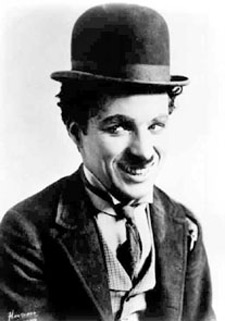
Charlie Chaplin
Sir Charles Spencer "Charlie" Chaplin, KBE was an English comic actor, film director and composer best known for his work during the silent film era. He became the most famous film star in the world before the end of World War I...
's most memorable on-screen character, a recognized icon of world cinema most dominant during the silent film
Silent film
A silent film is a film with no synchronized recorded sound, especially with no spoken dialogue. In silent films for entertainment the dialogue is transmitted through muted gestures, pantomime and title cards...
era.
The Tramp, as portrayed by Chaplin, is a bumbling but usually good-hearted character who is most famously presented as a vagrant
Vagrancy (people)
A vagrant is a person in poverty, who wanders from place to place without a home or regular employment or income.-Definition:A vagrant is "a person without a settled home or regular work who wanders from place to place and lives by begging;" vagrancy is the condition of such persons.-History:In...
who endeavors to behave with the manners and dignity of a gentleman despite his actual social status. However, while he is ready to take what paying work that is available, he also uses his cunning to get what he needs to survive and escape the authority figures who will not tolerate his antics. Chaplin's films did not always portray "The Tramp" (or "The Little Fellow," as Chaplin called him) as a vagrant, however. The character was rarely referred to by any names onscreen, although he was sometimes identified as "Charlie" and rarely, as in the original silent version of The Gold Rush
The Gold Rush
The Gold Rush is a 1925 silent film comedy written, produced, directed by, and starring Charlie Chaplin in his Little Tramp role. The film also stars Georgia Hale, Mack Swain, Tom Murray, Henry Bergman, Malcolm Waite....
, "The Little funny Tramp".
History
The character of the Tramp was originally created by accident while Chaplin was socializing with some other famed actors of the day. Chaplin decided to make his companions laugh by putting on Buster Keaton's shoes on the wrong feet, a jacket that was too large for him, a hat and the hairs off a shoe brush for a mustache.The Tramp debuted during the silent film era in the Keystone
Keystone Studios
Keystone Studios was an early movie studio founded in Edendale, California in 1912 as the Keystone Pictures Studio by Mack Sennett with backing from Adam Kessel and Charles O. Bauman, owners of the New York Motion Picture Company...
comedy
Comedy film
Comedy film is a genre of film in which the main emphasis is on humour. They are designed to elicit laughter from the audience. Comedies are mostly light-hearted dramas and are made to amuse and entertain the audiences...
Kid Auto Races at Venice
Kid Auto Races at Venice
Kid Auto Races At Venice is a 1914 American-made motion picture starring Charlie Chaplin in which his "Little Tramp" character makes his first appearance.-Synopsis:...
(released on February 7, 1914
1914 in film
The year 1914 in film involved some significant events, including the debut of Cecil B. DeMille as a director.-Events:*The 3,300-seat Mark Strand Theatre opens in New York City....
). Chaplin, with his Little Tramp character, quickly became the most popular star in Keystone director Mack Sennett
Mack Sennett
Mack Sennett was a Canadian-born American director and was known as the innovator of slapstick comedy in film. During his lifetime he was known at times as the "King of Comedy"...
's company of players. Chaplin continued to play the Tramp through dozens of short films and, later, feature-length productions (in only a handful of other productions did he play characters other than the Tramp).
The Tramp was closely identified with the silent era, and was considered an international character; when the sound
Sound film
A sound film is a motion picture with synchronized sound, or sound technologically coupled to image, as opposed to a silent film. The first known public exhibition of projected sound films took place in Paris in 1900, but decades would pass before sound motion pictures were made commercially...
era began in the late 1920s, Chaplin refused to make a talkie featuring the character. The 1931 production City Lights
City Lights
City Lights is a 1931 American silent film and romantic comedy-drama written by, directed by, and starring Charlie Chaplin. It also has the leads Virginia Cherrill and Harry Myers. Although "talking" pictures were on the rise since 1928, City Lights was immediately popular. Today, it is thought of...
featured no dialogue. Chaplin officially retired the character in the film Modern Times
Modern Times (film)
Modern Times is a 1936 comedy film by Charlie Chaplin that has his iconic Little Tramp character struggling to survive in the modern, industrialized world. The film is a comment on the desperate employment and fiscal conditions many people faced during the Great Depression, conditions created, in...
(released February 5, 1936
1936 in film
The year 1936 in film involved some significant events.-Events:*May 29 - Fritz Lang's first Hollywood film Fury, starring Spencer Tracy and Bruce Cabot, is released.*November 6 - first Porky Pig animated cartoon...
), which appropriately ended with the Tramp walking down an endless highway toward the horizon. The film was only a partial talkie and is often called the last silent film. The Tramp remains silent until near the end of the film when, for the first time, his voice is finally heard, albeit only as part of a French/Italian-derived gibberish song. This allowed the Tramp to finally be given a voice but not tarnish his association with the silent era.
In The Great Dictator
The Great Dictator
The Great Dictator is a comedy film by Charlie Chaplin released in October 1940. Like most Chaplin films, he wrote, produced, and directed, in addition to starring as the lead. Having been the only Hollywood film maker to continue to make silent films well into the period of sound films, this was...
, Chaplin's first film after Modern Times, Chaplin plays the dual role of a Hitler-esque dictator, and a Jewish Barber. Although Chaplin emphatically stated that the barber was not The Tramp, he retains the Tramp's moustache, hat, and general appearance. Despite a few silent scenes, the barber speaks throughout the film (using Chaplin's own British accent), including the passionate plea for peace that has been widely interpreted as Chaplin speaking as himself.
Two films Chaplin made in 1915, The Tramp
The Tramp (film)
The Tramp is Charlie Chaplin's sixth film for Essanay Studios in 1915. Directed by Chaplin, it was the fifth and last film made at Essanay's Niles, California studio. The Tramp marked the beginning of The Tramp character most known today, even though Chaplin played the character in earlier films...
and The Bank, created the characteristics of his screen persona. While in the end the Tramp manages to shake off his disappointment and resume his carefree ways, “the pathos lies in The Tramp's hope for a more permanent transformation through love, and his failure to achieve this.”
Characteristics
The physical attributes of the Tramp include a pair of baggy pants, a tight coat, a small bowler hatBowler hat
The bowler hat, also known as a coke hat, derby , billycock or bombin, is a hard felt hat with a rounded crown originally created in 1849 for the English soldier and politician Edward Coke, the younger brother of the 2nd Earl of Leicester...
, a large pair of shoes, a cane and the famous small mustache
Toothbrush moustache
The Toothbrush moustache is a moustache, shaved at the edges, except for three to five centimeters above the centre of the lip...
. The Tramp walks strangely and uncomfortably because of the ill-fitting clothing; either he is wearing secondhand clothes, or they are originally his but he cannot afford new ones. The Tramp may have seen better days, but he maintains the attitude and demeanor of a high-class individual; as long as he acts like one he can believe that he is one, and is able to keep his hope that some day he actually will be again.
The Tramp was usually the victim of circumstance and coincidence, but sometimes the results worked in his favor. In Modern Times he picks up a red flag
Red flag
In politics, a red flag is a symbol of Socialism, or Communism, or sometimes left-wing politics in general. It has been associated with left-wing politics since the French Revolution. Socialists adopted the symbol during the Revolutions of 1848 and it became a symbol of communism as a result of its...
that falls off a truck and starts to wave it at the truck in an attempt to return it, and by doing so, unknowingly and inadvertently becomes the leader of group of protesting workers, and ends up in jail because of it. While in jail he accidentally eats “nose powder” (A.K.A. cocaine
Cocaine
Cocaine is a crystalline tropane alkaloid that is obtained from the leaves of the coca plant. The name comes from "coca" in addition to the alkaloid suffix -ine, forming cocaine. It is a stimulant of the central nervous system, an appetite suppressant, and a topical anesthetic...
), which causes him to not return to his jail cell; but when he eventually does, he fights off some jail breakers attempting to escape, thus saving the life of the warden. Because of this, the warden offers to let him go, but the Tramp would rather stay in jail because it is better than the outside world.
Significance
Chaplin's social commentary, while critical of the faults and excesses created by the capitalistCapitalism
Capitalism is an economic system that became dominant in the Western world following the demise of feudalism. There is no consensus on the precise definition nor on how the term should be used as a historical category...
system, also shows support and belief in the “American Dream”. In Modern Times, Chaplin creates a “portrayal consistent with popular leftist
Left-wing politics
In politics, Left, left-wing and leftist generally refer to support for social change to create a more egalitarian society...
stereotypes of wealthy capitalists and oppressed workers in the 1930s.” While the Tramp and his fellow workers sweat on the assembly line, the president of the Electro Steel Company works on a puzzle and reads the funnies in the newspaper. The obsession of working with efficiency and assembly line productivity ultimately drives the Tramp mad. This could be seen as “an attack on the capitalist rationalization of production.” However, “the film also guardedly affirms American middle-class, particularly its optimism.” An example of this is sequence depicting a dream that the Tramp has, in which he and the gamine
Gamine
Gamine is a French word, the feminine form of gamin, originally meaning urchin, waif or playful, naughty child.The word was used in English from about the mid-19th century , but, in the 20th century, came to be applied in its more modern sense of a slim, often boyish, wide-eyed young woman who...
live a traditional middle-class lifestyle.
The Tramp and the gamine find a rundown shack to live in. The gamine cooks a cheap breakfast, and then the Tramp is off to work, while the gamine stays to maintain the home. This scene in the rundown shack is an allusion to a middle-class setting. By the ending of Modern Times, “the film seems tailored to please the middle-class optimist.” Due to all of their failings the final scene had the gamine stating, “What's the use of trying?”, with the Tramp replying with, “Buck up–never say die.” Chaplin was unique among the silent film comedians because of his physical shtick, but also because of the universality of his class struggle humor and his social commentary. “What makes Modern Times decidedly different from Chaplin's previous three films are the political references and social realism that keep intruding into Charlie's world.” “No comedian before or after him has spent more energy depicting people in their working lives.” “Though there had been films depicting the lives of immigrants and urban workers, no filmmaker before Chaplin had created their experience so humanly and lovingly.”
Chaplin used not one, but two similar-looking characters to the Tramp in The Great Dictator
The Great Dictator
The Great Dictator is a comedy film by Charlie Chaplin released in October 1940. Like most Chaplin films, he wrote, produced, and directed, in addition to starring as the lead. Having been the only Hollywood film maker to continue to make silent films well into the period of sound films, this was...
(released October 15, 1940); however, this was an all-talking film (Chaplin's first). The film was inspired by the noted similarity between Chaplin's appearance (most notably his small mustache) and that of German
Nazi Germany
Nazi Germany , also known as the Third Reich , but officially called German Reich from 1933 to 1943 and Greater German Reich from 26 June 1943 onward, is the name commonly used to refer to the state of Germany from 1933 to 1945, when it was a totalitarian dictatorship ruled by...
dictator Adolf Hitler
Adolf Hitler
Adolf Hitler was an Austrian-born German politician and the leader of the National Socialist German Workers Party , commonly referred to as the Nazi Party). He was Chancellor of Germany from 1933 to 1945, and head of state from 1934 to 1945...
. Chaplin used this similarity to create a dark version of the Tramp character in parody of the dictator. (In his book My Autobiography
My Autobiography (Chaplin)
My Autobiography is the title of a book by screen legend Charlie Chaplin, first published by Simon & Schuster in 1964. Along with Chaplin: His Life and Art, it provided the source material for the 1992 feature film Chaplin. It is a revealing work into the life of a 20th century celebrity....
, Chaplin stated that he was unaware of the Holocaust
The Holocaust
The Holocaust , also known as the Shoah , was the genocide of approximately six million European Jews and millions of others during World War II, a programme of systematic state-sponsored murder by Nazi...
when he made the film; if he had been, he writes, he wouldn't have been able to make a comedy satirizing Hitler). The barber, while having many similarities to the Tramp, is not considered a version of that character, although he does engage in several Tramp-like comedy sequences. A noticeable difference is that the barber has a streak of grey in his hair; the Tramp had always been depicted as having dark hair. Also, the barber lacks the ill-fitting clothes of The Tramp, and is clearly portrayed as having a profession. His character does share much of The Tramp's character, notably his idealism and anger at seeing unfairness.
Chaplin's views
In an interview in 1933, Chaplin explained how he came up with the look of the Tramp:In 1959, having been editing The Chaplin Revue, Chaplin commented to a reporter (regarding the Tramp character) "I was wrong to kill him. There was room for the Little Man in the atomic age."
In the 1980s, the character connected with a new generation as the mascot and feature character of a well-received advertising campaign promoting the IBM PC
IBM PC
The IBM Personal Computer, commonly known as the IBM PC, is the original version and progenitor of the IBM PC compatible hardware platform. It is IBM model number 5150, and was introduced on August 12, 1981...
personal computer
Personal computer
A personal computer is any general-purpose computer whose size, capabilities, and original sales price make it useful for individuals, and which is intended to be operated directly by an end-user with no intervening computer operator...
.
The short film
The TrampThe Tramp (film)
The Tramp is Charlie Chaplin's sixth film for Essanay Studios in 1915. Directed by Chaplin, it was the fifth and last film made at Essanay's Niles, California studio. The Tramp marked the beginning of The Tramp character most known today, even though Chaplin played the character in earlier films...
is also a short film starring Chaplin as the titular main character. In the film, a hobo exchanges the Tramp's sandwich for a brick, so the Tramp must eat grass. The same hobo later bothers a farmer's daughter, and the Tramp comes to her aid with the help of the brick. When two more hobos show up, the Tramp throws all three into a lake. The grateful girl takes the Tramp home, where he fails as a farmhand. He again helps drive off the hobos (who are now trying to break into the house). The girl's fiancé arrives. Though a hero, Charlie – knowing he must go – writes a farewell note and leaves again for the open road.
The film also stars Edna Purviance
Edna Purviance
Edna Purviance was an American actress during the silent movie era. She was the leading lady in many Charlie Chaplin movies. In a span of eight years, she appeared in over thirty films with Chaplin.-Early life:...
, Lloyd Bacon
Lloyd Bacon
Lloyd Francis Bacon was a screen, stage, and vaudeville actor and film director.-Life:Bacon was born in San Jose California, the son of actor Frank Bacon, later the co-author and star of the long running Broadway show 'Lightnin' , and Jennie Bacon. He was not related to actor Irving Bacon whom he...
, and Leo White.
The Tramp was released on April 11, 1915 through Essanay Studios
Essanay Studios
The Essanay Film Manufacturing Company was an American motion picture studio. It is best known today for its series of Charlie Chaplin comedies of 1915.-Founding:...
.